REVIEW 5 major objections 5 minor 1 cited by
Diverse Image Generation with Diffusion Models and Cross Class Label Learning for Polyp Classification
T0 review · 5 major / 5 minor · reviewed 2026-08-08 · deepseek-v4-flash
Pith's one-line read Text-prompted diffusion generates colonoscopy images that boost polyp classification accuracy by up to 7.91%.
desk verdict A substantial engineering paper whose headline cross-class-label gain for NBI is likely inflated by WLI leakage; the authors admit this and show that fixing it lowers the numbers, so the central claim needs a sharper, controlled comparison before it can be taken at face value. read the letter →
The pith
A machine-rendered reading of the paper's core claim, the machinery that carries it, and where it could break.
The reading
What carries the argument
The object that carries the argument is PathoPolyp-Diff, a two-stage fine-tuning of the Stable Diffusion v1-4 latent diffusion model. Stage-I fine-tunes the pretrained model on polyp/non-polyp colonoscopy frames with quality-conditioned text prompts ('good-quality, clear' vs. 'low-quality, artifacts'); Stage-II locks the first U-Net block, continues fine-tuning on adenomatous/hyperplastic frames with prompts that also specify WLI or NBI, and mixes in undersampled Stage-I data so the model retains the quality concepts. The text prompts act as the conditioning mechanism through CLIP embeddings and cross-attention, and cross-class label learning is the reuse of the Stage-I quality tokens in Stage-II prompts whose training data lacks quality labels.
What would settle it
A concrete falsifier: generate NBI polyp images with prompt B ('narrow band imaging, good-quality, clear') and have blinded expert endoscopists rate modality fidelity; if a large share of these images are judged to contain white-light characteristics or if a modality classifier trained on real WLI/NBI images systematically mislabels them, then the reported cross-class benefit comes from unintended modality leakage rather than from transferred quality control.
Extended reading notes
Core claim
On the paper's own terms, the central discovery is that a latent diffusion model fine-tuned in two stages can be steered by text prompts to generate colonoscopy images with a specified combination of pathology (adenomatous or hyperplastic), imaging modality (white light or narrow band), and quality (good or low). The key additional claim is cross-class label learning: tokens such as 'good-quality, clear' learned during Stage-I on the SUN Database, where quality annotations exist, can be appended to Stage-II prompts on the ISIT-UMR dataset, which has pathology and modality labels but no quality labels, and this transfer produces synthetic images that improve downstream classification. The paper reports that adding these images to real training data yields up to 7.91% higher balanced accuracy at the frame level, and that the cross-class prompt (prompt B) outperforms the plain prompt (prompt A) by up to 18.33% in video-level balanced accuracy, with statistical significance in the key comparisons.
Load-bearing premise
The whole method depends on the assumption that quality cues learned from white-light images can be transferred to narrow-band images through text tokens without contaminating the target modality, which the paper admits sometimes fails.
Editorial extensions
If this is right
- If the central claim holds, hospitals and research groups with small labeled polyp datasets can create larger, more diverse training sets by regenerating synthetic examples of both pathology classes and both imaging modalities, without hiring experts to annotate quality labels.
- Text-prompt conditioning provides a practical interface for controlling synthetic medical image generation: changing a few words ('narrow band imaging,' 'good-quality, clear') changes the generated distribution, so augmentation can be targeted at underrepresented classes or modalities.
- The two-stage transfer suggests that quality-related concepts learned on one dataset can be reused on another through prompt tokens, reducing annotation cost for new generative tasks.
- Because the paper shows performance saturates or degrades when synthetic data is over-added, the practical recipe is a limited augmentation ratio rather than unbounded synthetic expansion.
Reading between the lines
- The cross-class gains may be partly explained by the quality tokens acting as a regularizer that filters out low-quality frames, rather than by the model learning genuine pathology cues from another class; a controlled experiment isolating token contribution would separate these.
- The same two-stage prompt-reuse recipe could transfer to other medical imaging pairs where a well-annotated modality is used to condition generation in a less-annotated modality, provided the visual correlation between modalities is higher than the WLI-to-NBI correlation in this study.
- A stronger test of cross-class label learning would be to train the classifier on synthetic-only data from prompts A and B; if B's advantage persists when no real images are present during training, the benefit is in the generated content itself rather than in augmentation synergy.
Editorial analysis
A structured set of objections, weighed in public.
Referee Report
Summary. This manuscript introduces PathoPolyp-Diff, a two-stage fine-tuned Stable Diffusion pipeline for generating synthetic colonoscopy polyp images conditioned on text prompts describing pathology (adenomatous/hyperplastic), imaging modality (WLI/NBI), and quality (good-quality, clear / low-quality, artifacts). Stage-I learns polyp/non-polyp and quality controls on the SUN Database; Stage-II fine-tunes on the ISIT-UMR dataset with pathology/modality prompts while appending the Stage-I quality tokens "good-quality, clear" as a cross-class label learning mechanism. The authors evaluate the generated images with KID, F1-score, t-SNE, and then use them to augment an EfficientNet-B0 adenoma/hyperplastic classifier; they report balanced accuracy gains up to 7.91% at the frame level and an 18.33% video-level gain attributed to cross-class label learning. The manuscript is an exploratory study with public datasets and released code.
Significance. If the central claims were fully supported, this would be a useful contribution: it is, to my knowledge, the first exploration of text-prompt conditional polyp generation, and the two-stage transfer of quality control is an interesting idea for reducing annotation burden in a target dataset. The paper includes several strengths: thorough iteration-wise monitoring of diffusion fine-tuning, use of KID and F1 balanced against qualitative inspection, negative-prompt ablation, and a code release. The downstream classification improvement on a public dataset is a concrete falsifiable outcome. However, the current experimental design does not isolate cross-class label learning from modality leakage, and the headline numbers are selected cells from a large grid without multiplicity control or key baselines; these issues must be resolved before the significance claim is established.
major comments (5)
- [Results, 'Model Performance: Stage-II'] The abstract's 7.91% improvement (0.6983±0.039 vs. 0.6192±0.073) is one cell in Table 5 (NBI, x=16, x+3x, prompt B) selected from a grid of 18 augmentation conditions across two modalities and three real-image counts. Several cells show no gain or a decrease (e.g., WLI x=64, x+2x, prompt B: 0.6194 vs. baseline 0.6357), and no multiple-comparison correction or pre-specified primary analysis is reported. The 'up to' claim is technically accurate, but as presented the reader cannot distinguish a robust effect from selection of the largest observed difference; the paper should report a multiplicity-aware summary or clearly identify the confirmatory analysis.
- [Results, 'Video-wise Analysis with Statistical Significance Test'] The headline video-level 18.33% is a comparison between text prompt B and text prompt A (0.6 vs. 0.7833 in Table 6a, x=16, x+x), not a comparison with the real-data baseline, which is 0.6333 for that cell. The abstract and conclusion phrase this as an 'improvement ... during video-level analysis,' which can be read as an improvement over real data; the paper should state explicitly that the 18.33% is the B-vs-A difference, and should report the corresponding real-vs-augmented difference (+15%, p=0.037) as the relevant augmentation effect. The associated 95% CI (3.43%, 33.23%) is also wide given the small number of test videos.
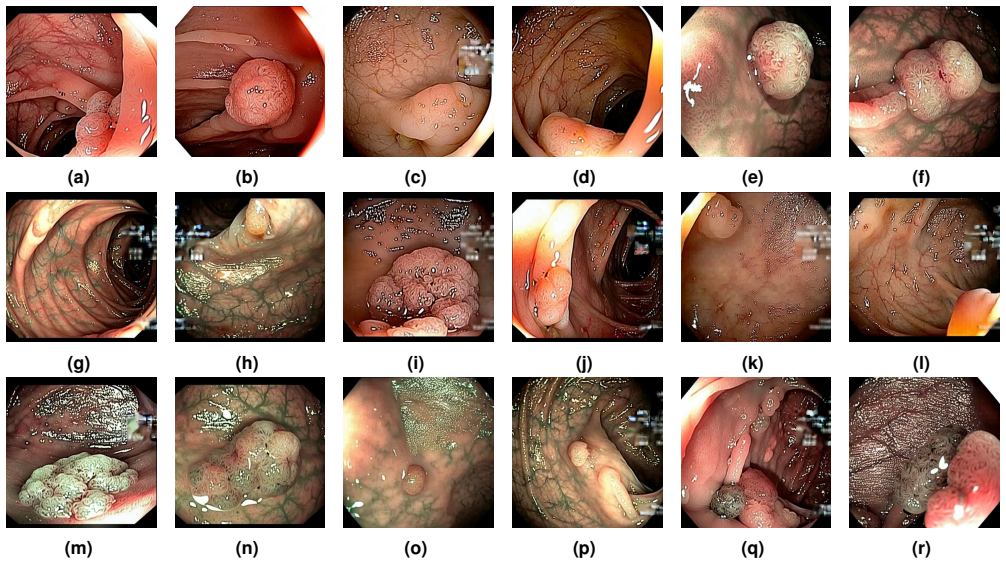
- [Results, 'Qualitative Results and Interpretability through Visualization'; Fig. 11q-r and Fig. 12] The manuscript's own analysis undermines the clean interpretation of cross-class label learning for NBI: Stage-I associates 'good-quality, clear' with WLI, and the paper states that this association sometimes blends WLI characteristics into NBI images (Fig. 11q-r). The weighted-prompt experiment in Fig. 12, which suppresses the leak, 'resulted in better qualitative outcomes' but 'the related quantitative outcomes are reduced in most of the cases.' This is evidence that the B-vs-A accuracy gains for NBI may be partly an artifact of WLI leakage rather than a generic quality improvement. The authors need to measure modality fidelity of generated images (e.g., with a modality classifier or human evaluation) and show that the cross-class label benefit survives when leaked images are excluded or when modality is enforced; the current text's limitations paragraph acknowledges the risk but does not resolve it.
- [Table 5 and 'Model Performance: Stage-II'] The augmentation experiments compare only against a real-data baseline with no synthetic images. To attribute the observed gains to the proposed text-controlled diversity and cross-class label learning, the paper should add control conditions such as oversampling real minority-class frames, standard image augmentation (e.g., geometric/color transforms), and at least one alternative generative augmentation method (e.g., a GAN or mask-conditioned diffusion). Without these, the improvement could be explained by generic data expansion rather than the specific mechanism claimed.
- [Results, 'Video-wise Analysis with Statistical Significance Test'] The statistical significance procedure is underspecified: the test set appears to contain only 6 videos per class per modality, the t-test is computed over 'all possible combinations' of the data proportions, and no multiple-testing correction is described. The NBI modality results show no significant difference between prompts A and B in most cases, while the WLI 18.33% cell has a wide confidence interval. The paper should report the number of videos used, confirm test-video independence, and apply or justify a correction for the many pairwise comparisons; as currently reported, the phrase 'statistically significant improvement' overstates what is established for NBI and for the full grid.
minor comments (5)
- [Abstract and Conclusion] The phrase 'cross-class label learning achieves a statistically significant improvement of up to 18.33%' should specify that this is a prompt-B-versus-prompt-A comparison, not a real-data improvement.
- [Methodology, Eq. (4)] The attention formula appears to be missing the division by sqrt(h); it should read softmax(QK^T / sqrt(h))V for the standard scaled dot-product attention.
- [Table 2] The Stage-II classifier row is difficult to parse because several columns are incomplete; consider aligning the split with the text '29:11 and 15:6' and explicitly marking train/validation/test cells.
- [Results, 'Impact of Negative Prompt'] The FFT-based negative-prompt evaluation in Fig. 8 is described only qualitatively; report the FFT values used to select 'blur, low-quality' as the best combination.
- [Model Performance, Stage-II] The sentence 'the training data for the diffusion model and the classifier overlap' is correct only because synthetic images are added to the classifier's training set while the test set is disjoint; the sentence should be clarified to avoid appearing contradictory.
Circularity Check
No circularity: the method is an empirical transfer-learning pipeline and the reported classification gains are evaluated on a held-out external test split.
full rationale
The paper's derivation chain is empirical rather than self-referential. Stage-I fine-tunes Stable Diffusion on the SUN Database using polyp/non-polyp and quality labels (from Ref. 29); Stage-II fine-tunes on ISIT-UMR with pathology and modality labels while retaining Stage-I features through undersampled informative frames. Text prompt B appends the Stage-I tokens 'good-quality, clear' to implement cross-class label learning. The central claims—text-controlled generation fidelity and classification improvement—are tested on a video-level held-out ISIT-UMR test split that is mutually exclusive from the training sets of both the diffusion model and the classifier, using balanced accuracy on EfficientNet-B0. No equation, parameter, or fitted value is defined in terms of the reported outcome, and no prediction is statistically forced by its own input. The self-citations (Refs. 6, 19, 29, 34) provide related work, quality annotations used as training data, and a comparison to prior augmentation trends; they do not supply a load-bearing uniqueness theorem or an unverified premise that reduces to the paper's own claim. The paper's own admission of WLI leakage into some NBI images, and the decreased quantitative results when the NBI token is upweighted, is a genuine validity concern about the modality-transfer premise, but it is an empirical confound rather than a circular reduction. Accordingly, the derivation is self-contained with respect to the reported predictions, and no circularity is present.
Assumptions & free parameters
free parameters (6)
- Stage-I iteration count =
8,000
- Stage-II iteration count =
6,000
- Negative prompt =
'blur, low-quality'
- Cross-class text prompt suffix =
'good-quality, clear'
- Token weighting for NBI =
higher weight on 'narrow band imaging' tokens
- Adenoma undersampling ratio =
not reported
assumptions (6)
- domain assumption Stable Diffusion v1-4 pretrained representations can be fine-tuned to colonoscopy images with small datasets.
- domain assumption CLIP text embeddings of phrases such as 'adenomatous polyp', 'narrow band imaging', and 'good-quality, clear' align with the intended visual distinctions.
- domain assumption SUN Database quality labels (informative/uninformative) are accurate and transfer to ISIT-UMR images.
- domain assumption ISIT-UMR pathology and modality labels are correct.
- domain assumption KID computed with DenseNet features and FFT-based blur assessment are valid proxies for clinical realism.
- domain assumption Video-level majority voting and two-tailed t-tests on 12 test videos support the statistical claims.
Cite this review
Pith. "Pith review of Diverse Image Generation with Diffusion Models and Cross Class Label Learning for Polyp Classification." pith.science (2026). https://pith.science/paper/PKPQIT5J
@misc{pith2026250205444,
  author       = {Pith},
  title        = {Pith review of: Diverse Image Generation with Diffusion Models and Cross Class Label Learning for Polyp Classification},
  year         = {2026},
  howpublished = {\url{https://pith.science/paper/PKPQIT5J}},
  note         = {Machine review of arXiv:2502.05444}
}
read the original abstract
Pathologic diagnosis is a critical phase in deciding the optimal treatment procedure for dealing with colorectal cancer (CRC). Colonic polyps, precursors to CRC, can pathologically be classified into two major types: adenomatous and hyperplastic. For precise classification and early diagnosis of such polyps, the medical procedure of colonoscopy has been widely adopted paired with various imaging techniques, including narrow band imaging and white light imaging. However, the existing classification techniques mainly rely on a single imaging modality and show limited performance due to data scarcity. Recently, generative artificial intelligence has been gaining prominence in overcoming such issues. Additionally, various generation-controlling mechanisms using text prompts and images have been introduced to obtain visually appealing and desired outcomes. However, such mechanisms require class labels to make the model respond efficiently to the provided control input. In the colonoscopy domain, such controlling mechanisms are rarely explored; specifically, the text prompt is a completely uninvestigated area. Moreover, the unavailability of expensive class-wise labels for diverse sets of images limits such explorations. Therefore, we develop a novel model, PathoPolyp-Diff, that generates text-controlled synthetic images with diverse characteristics in terms of pathology, imaging modalities, and quality. We introduce cross-class label learning to make the model learn features from other classes, reducing the burdensome task of data annotation. The experimental results report an improvement of up to 7.91% in balanced accuracy using a publicly available dataset. Moreover, cross-class label learning achieves a statistically significant improvement of up to 18.33% in balanced accuracy during video-level analysis. The code is available at https://github.com/Vanshali/PathoPolyp-Diff.
Figures


Figures from the paper (9 more)



Forward citations
Cited by 1 Pith paper
-
C3VDv2 -- Colonoscopy 3D video dataset with enhanced realism
C3VDv2 releases 169 registered colonoscopy videos with depth, normals, optical flow, occlusion, pose, and 3D model ground truth, plus eight full-colon screening videos and fifteen deformation videos with enhanced realism.
Reference graph
Works this paper leans on
-
[1]
Organization, W. H. Colorectal cancer fact sheets. https://www.who.int/news-room/fact-sheets/detail/colorectal-cancer (2023)
work page 2023
-
[2]
Cheng, W. et al. Narrow-band imaging endoscopy is advantageous over conventional white light endoscopy for the diagnosis and treatment of children with peutz-jeghers syndrome. Medicine 96 (2017)
work page 2017
- [3]
-
[4]
Bhadra, S., Zhou, W. & Anastasio, M. A. Medical image reconstruction with image-adaptive priors learned by use of generative adversarial networks. In Medical Imaging 2020: Physics of Medical Imaging, vol. 11312, 206–213 (2020)
work page 2020
-
[5]
Xun, S. et al. Generative adversarial networks in medical image segmentation: A review. Comput. biology medicine 140, 105063 (2022)
work page 2022
- [6]
-
[7]
Wolleb, J., Bieder, F., Sandkühler, R. & Cattin, P. C. Diffusion models for medical anomaly detection. InInternational Conference on Medical image computing and computer-assisted intervention, 35–45 (2022). 18/20
work page 2022
-
[8]
Rahman, A., Valanarasu, J. M. J., Hacihaliloglu, I. & Patel, V . M. Ambiguous medical image segmentation using diffusion models. In Proceedings of the IEEE/CVF Conference on Computer Vision and Pattern Recognition, 11536–11546 (2023)
work page 2023
Show all 35 references
-
[9]
Macháˇcek, R. et al. Mask-conditioned latent diffusion for generating gastrointestinal polyp images. arXiv preprint arXiv:2304.05233 (2023)
2023 arXiv
-
[10]
K., Thambawita, V ., Torresen, J
Pishva, A. K., Thambawita, V ., Torresen, J. & Hicks, S. A. Repolyp: A framework for generating realistic colon polyps with corresponding segmentation masks using diffusion models. In 2023 IEEE 36th International Symposium on Computer-Based Medical Systems (CBMS), 47–52 (2023)
2023
-
[11]
Shin, Y ., Qadir, H. A. & Balasingham, I. Abnormal colon polyp image synthesis using conditional adversarial networks for improved detection performance. IEEE Access 6, 56007–56017 (2018)
2018
-
[12]
A., Balasingham, I
Qadir, H. A., Balasingham, I. & Shin, Y . Simple u-net based synthetic polyp image generation: Polyp to negative and negative to polyp. Biomed. Signal Process. Control. 74, 103491 (2022)
2022
-
[13]
Fagereng, J. A. et al. Polypconnect: Image inpainting for generating realistic gastrointestinal tract images with polyps. In 2022 IEEE 35th International Symposium on Computer-Based Medical Systems (CBMS), 66–71 (2022)
2022
-
[14]
& Kasugai, K
Sasmal, P., Bhuyan, M., Sonowal, S., Iwahori, Y . & Kasugai, K. Improved endoscopic polyp classification using gan generated synthetic data augmentation. In 2020 IEEE Applied Signal Processing Conference (ASPCON), 247–251 (2020)
2020
-
[15]
E., Lonseko, Z
Adjei, P. E., Lonseko, Z. M., Du, W., Zhang, H. & Rao, N. Examining the effect of synthetic data augmentation in polyp detection and segmentation. Int. J. Comput. Assist. Radiol. Surg. 17, 1289–1302 (2022)
2022
-
[16]
He, F. et al. Colonoscopic image synthesis for polyp detector enhancement via gan and adversarial training. In 2021 IEEE 18th International Symposium on Biomedical Imaging (ISBI), 1887–1891 (2021)
2021
-
[17]
& Shomee, H
Sams, A. & Shomee, H. H. Gan-based realistic gastrointestinal polyp image synthesis. In 2022 IEEE 19th International Symposium on Biomedical Imaging (ISBI), 1–4 (2022)
2022
-
[18]
L., Ngamruengphong, S
Golhar, M., Bobrow, T. L., Ngamruengphong, S. & Durr, N. J. Gan inversion for data augmentation to improve colonoscopy lesion classification. arXiv preprint arXiv:2205.02840 (2022)
2022 arXiv
-
[19]
V ., Sharma, V ., Iwahori, Y ., Bhuyan, M
Bhamre, N. V ., Sharma, V ., Iwahori, Y ., Bhuyan, M. & Kasugai, K. Colonoscopy polyp classification adding generated narrow band imaging. In International Conference on Computer Vision and Image Processing, 322–334 (2022)
2022
-
[20]
Arsdm: Colonoscopy images synthesis with adaptive refinement semantic diffusion models
Du, Y .et al. Arsdm: Colonoscopy images synthesis with adaptive refinement semantic diffusion models. In International Conference on Medical Image Computing and Computer-Assisted Intervention, 339–349 (2023)
2023
-
[21]
& Ommer, B
Rombach, R., Blattmann, A., Lorenz, D., Esser, P. & Ommer, B. High-resolution image synthesis with latent diffusion models. In Proceedings of the IEEE/CVF conference on computer vision and pattern recognition, 10684–10695 (2022)
2022
-
[22]
& Abbeel, P
Ho, J., Jain, A. & Abbeel, P. Denoising diffusion probabilistic models. Adv. neural information processing systems 33, 6840–6851 (2020)
2020
-
[23]
P., Welling, M
Kingma, D. P., Welling, M. et al. An introduction to variational autoencoders. Foundations Trends Mach. Learn. 12, 307–392 (2019)
2019
-
[24]
& Brox, T
Ronneberger, O., Fischer, P. & Brox, T. U-net: Convolutional networks for biomedical image segmentation. InMedical Image Computing and Computer-Assisted Intervention–MICCAI 2015: 18th International Conference, Munich, Germany, October 5-9, 2015, Proceedings, Part III 18, 234–2...
2015
-
[25]
Radford, A. et al. Learning transferable visual models from natural language supervision. In Proceedings of the International conference on machine learning, 8748–8763 (2021)
2021
-
[26]
Misawa, M. et al. Development of a computer-aided detection system for colonoscopy and a publicly accessible large colonoscopy video database (with video). Gastrointest. endoscopy 93, 960–967 (2021)
2021
-
[27]
Itoh, H. et al. Sun colonoscopy video database. http://amed8k.sundatabase.org/ (2020)
2020
-
[28]
Mesejo, P. et al. Computer-aided classification of gastrointestinal lesions in regular colonoscopy. IEEE transactions on medical imaging 35, 2051–2063 (2016)
2016
-
[29]
A multi-scale attention framework for automated polyp localization and keyframe extraction from colonoscopy videos
Sharma, V .et al. A multi-scale attention framework for automated polyp localization and keyframe extraction from colonoscopy videos. IEEE Transactions on Autom. Sci. Eng. (2023)
2023
-
[30]
J., Arbel, M
Bi´nkowski, M., Sutherland, D. J., Arbel, M. & Gretton, A. Demystifying mmd gans. arXiv preprint arXiv:1801.01401 (2018). 19/20
2018 arXiv
-
[31]
Jha, D. et al. Gastrovision: A multi-class endoscopy image dataset for computer aided gastrointestinal disease detection. In Workshop on Machine Learning for Multimodal Healthcare Data, 125–140 (Springer, 2023)
2023
-
[32]
& Weinberger, K
Huang, G., Liu, Z., Van Der Maaten, L. & Weinberger, K. Q. Densely connected convolutional networks. In Proceedings of the IEEE conference on computer vision and pattern recognition, 4700–4708 (2017)
2017
-
[33]
Tan, M. & Le, Q. Efficientnet: Rethinking model scaling for convolutional neural networks. In Proceedings of the International conference on machine learning, 6105–6114 (2019)
2019
-
[34]
Controlpolypnet: Towards controlled colon polyp synthesis for improved polyp segmentation
Sharma, V .et al. Controlpolypnet: Towards controlled colon polyp synthesis for improved polyp segmentation. In Proceedings of the IEEE/CVF Conference on Computer Vision and Pattern Recognition, 2325–2334 (2024)
2024
-
[35]
Sagers, L. W. et al. Augmenting medical image classifiers with synthetic data from latent diffusion models. arXiv preprint arXiv:2308.12453 (2023). Acknowledgements V .S. is supported by the INSPIRE fellowship (IF190362), DST, Govt. of India. D.J. is supported by the NIH fundi...
2023 arXiv
Reviewed August 8, 2026 · model on record in the stance chip above.
Discussion (0). Continue with ORCID to comment.