REVIEW 5 major objections 4 minor 69 references
From "I have nothing to hide" to "It looks like stalking": Measuring Americans' Level of Comfort with Individual Mobility Features Extracted from Location Data
T0 review · 5 major / 4 minor · reviewed 2026-08-08 · deepseek-v4-flash
Pith's one-line read This paper claims that Americans' comfort with sharing location data is determined more by what is extracted—detailed trip routes versus obfuscated census-tract summaries—than by whether tracking happens at all, and that obfuscation…
desk verdict Real new measurement of trajectory-feature privacy perceptions, but the headline effects depend on an unreported post hoc exclusion step; deserves review with a revision request. read the letter →
The pith
A machine-rendered reading of the paper's core claim, the machinery that carries it, and where it could break.
The reading
What carries the argument
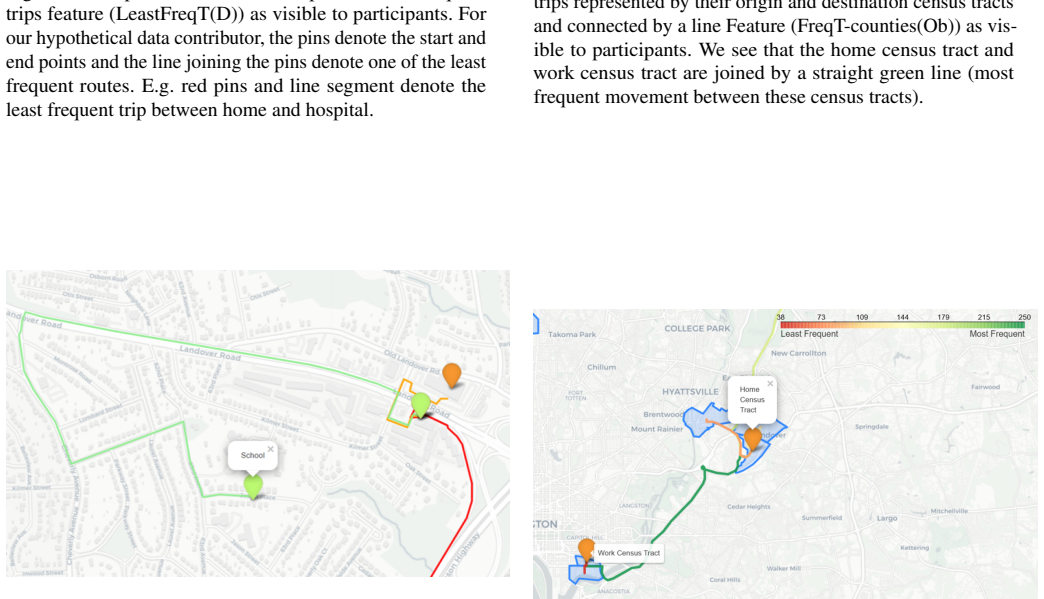
The paper's machinery is the factorial vignette: each survey item presents a fixed template—'Actor X wants to do Purpose Y, and for that they need Feature Z'—with one of nine actors, ten purposes, and eighteen location features drawn from the plausible combinations (445 total). Each feature comes in a 'detailed' version (GPS points, exact routes, pin-point home) and an 'obfuscated' version (census tract or county, charts without routes, straight lines between tract centroids), and every vignette is accompanied by an interactive map or chart so respondents see exactly what the feature would look like. Comfort is measured on a 5-point Likert scale and modeled with a mixed-effects ordinal logistic regression in which participant ID and vignette identity are random effects; interaction effects between features and actors or purposes are then probed with Kruskal-Wallis and Dunn post-hoc tests, and the same data feed supervised classifiers for predicting comfort from context, demographics, and privacy attitudes.
What would settle it
Have a fresh sample of participants view the same vignette either with its interactive visualization or with a text-only description of the feature, and compare comfort ratings; if the visualization changes ratings substantially, the measured 'feature' effects are partly artifacts of the graphic. A second check: ask participants after the vignette what the map actually showed (e.g., that the polygon is their home county, that the straight line is not the real route); if a large share misidentifies these elements, the comfort levels do not correspond to the intended features.
Extended reading notes
Core claim
On the paper's own terms, the central discovery is a quantitative map of U.S. privacy comfort across the specific location features that data brokers actually sell. Using a vignette survey in which each question paired one actor, one purpose, and one location feature, the authors show that trajectory-based features are consistently associated with lower comfort than visits to points of interest: the odds of being comfortable with detailed most-frequent-trips are 0.74 times the odds for detailed places visited (p<0.05). Obfuscation reverses this: obfuscated frequent walking activity (odds ratio 1.58), obfuscated home location (1.55), and obfuscated work location (1.46) are each significantly more comfortable than the detailed-place-visits baseline. Race also matters: Hispanic respondents have 1.65 times the odds of White respondents of rating a scenario comfortable, while no significant overall education effect appears in the main regression. Finally, a supervised model that adds privacy attitude answers to the actor-purpose-feature-demographic tuple reaches an F1 score of 0.60 for binary comfortable-versus-uncomfortable prediction.
Load-bearing premise
The load-bearing premise is that the synthetic map and chart visualizations shown in the vignettes convey to each of the 1,405 participants the same concrete feature they would be asked to share—an assumption validated only by a qualitative pilot with five respondents before the main fielding.
Editorial extensions
If this is right
- Data brokers and app SDKs could offer per-feature consent screens organized by the six feature clusters, letting users opt into detailed versus obfuscated versions rather than a single all-or-nothing location permission.
- Regulators writing bright-line rules for location data could reasonably treat detailed trajectory features (frequent trips, walking routes) as higher-risk than place-visit categories, and treat obfuscation to census-tract level as a meaningful mitigation.
- Because obfuscated walking activity and home or work locations reach comfort levels at or above detailed place visits, a default-obfuscated data pipeline with an opt-in for detail would align data broker practice with measured user preferences.
- Comfort prediction that reaches F1 0.60 using actor-purpose-feature plus demographics and privacy attitudes is accurate enough to let companies pre-test a new location feature's acceptability before deployment, though not precise enough to replace consent.
Reading between the lines
- The paper's feature set does not include health-care, religious, or protest destinations as explicit trip types, so the measured comfort for detailed trajectories probably overstates comfort for the most sensitive destination categories; a vignette set that adds these destinations would test whether the 'stalking' reaction intensifies.
- Obfuscation comfort may signal perceived rather than actual anonymity: a census-tract polygon still reveals the home neighborhood, and a straight line between tract centroids still reveals commute direction; a follow-up that asks respondents what an adversary could infer from the obfuscated map could separate perceived from actual privacy.
- The predictive jump from F1 around 0.28 to 0.60 when privacy attitudes are added suggests a short attitudes questionnaire, not demographics, is the scalable predictor of location-sharing comfort; the paper does not propose such an instrument, but the data support building one.
Signed reviews
Editorial analysis
A structured set of objections, weighed in public.
Referee Report
Summary. The paper reports a factorial vignette survey of 1,405 U.S. participants, each answering five randomized vignettes that combine actors, purposes, and location features, with features presented in detailed or obfuscated forms. The authors fit a weighted mixed-effects ordinal regression (Table 5) to estimate effects on a 5-point comfort scale, use Kruskal-Wallis and Dunn post-hoc tests for interaction analyses, and train classifiers to predict comfort from vignette and demographic or privacy-attitude features. The headline findings are that detailed trajectory features reduce comfort relative to detailed points of interest, some obfuscation practices increase comfort, and race/ethnicity and education are associated with differences in comfort; the abstract also reports a predictive F1 score of 0.6.
Significance. If the central empirical findings hold, the paper makes a useful contribution to the contextual-integrity literature on location privacy by extending it from points of interest to trajectory-derived features and to current data-broker obfuscation practices. The factorial design is appropriate for the research questions, and the use of a mixed-effects ordinal model with random intercepts for participant and vignette is a sound analytic choice, supported by assumption checks and model comparison in the appendix. The paper also provides a large set of interaction and subgroup analyses that are transparently reported in the appendix. The main risk is not the analytic framework but the quality and comparability of the analytic sample after the exclusions described in Section 5, plus a few claims that outrun the reported numbers.
major comments (5)
- [Section 7 and Table 14] The response-exclusion procedure is not quantified and is outcome-dependent. The text reports that 7,025 vignette responses were reduced by removing answers whose free-text explanations "did not clearly match" the selected Likert comfort level, judged by two researchers who "agreed upon its quality," plus responses faster than 10 seconds. No exclusion counts, explicit coding criteria, or inter-rater reliability are given, and the analytic sample size for Table 5 is never stated. Because whether a response is kept depends on the written justification given for the same comfort rating that is the dependent variable, differential exclusion across features, actors, purposes, or demographic groups could produce or amplify the headline effects in Table 5, such as Most Frequent Trips (Detailed) OR 0.74 and Frequent Walking Activity (Obfuscated) OR 1.58. Please report how many responses were removed by each criterion, by feature/actor/purpose and by demographic stratum, and re-estimate the main regressions and RQ2 mean comparisons with and without these exclusions as a robustness check.
- [Section 8 and Table 5] Section 7 states that "all means were higher for obfuscation features than for their detailed counterpart," but Table 14 contradicts this: International visits (Detailed) has mean 0.286 versus 0.247 for International visits (Obfuscated), and Work location (Detailed) has mean 0.268 versus 0.263 for Work location (Obfuscated). This "all" claim is load-bearing for RQ2, which the abstract summarizes as "some data broker based obfuscation practices increase levels of comfort." Please revise the claim to the subset of features for which the data actually show higher means, and correct the related sentence in Section 10 ("the mean values were lower") if it was intended to say "higher."
- [Section 9 and Tables 7-8] The abstract and conclusion claim that education has an effect on data-sharing privacy perceptions, but Table 5 shows no statistically significant education coefficient (Bachelors and above OR 0.814, p=0.103; Under Highschool OR 0.983, p=0.94). The only supporting evidence is the exploratory interaction analysis in Section 8.2 and Table 22. The claim should be limited to the interaction results and the conclusion reformulated accordingly, or the main-effects regression should be complemented by a preregistered or otherwise explicitly confirmatory interaction test. As written, the abstract overstates what the primary model supports.
- [Section 3] The predictive modeling section does not describe how the 80/20 train/test split handles the repeated-measures structure of the data. Each participant contributes five vignette responses, and Model 2 includes individual privacy attitudes as features; a random split can place the same participant's other responses in the training set, leaking individual-level information and inflating the reported F1 of 0.6. Please use participant-grouped cross-validation (for example, GroupKFold or leave-participants-out) and report class frequencies and per-participant performance, or explicitly justify why a response-level split is appropriate.
- [Section 5] The validity of every comfort rating depends on participants' comprehension of the synthetic visualizations, but the only reported validation is a qualitative study with 5 Craigslist respondents who each answered 10 vignette questions. That is weak evidence for comprehension across 1,405 participants from a broader U.S. panel, especially because the detailed and obfuscated visualizations differ substantially in visual complexity. Please add a quantitative comprehension check or report coding of the free-text explanations by feature type to show that non-comprehension does not vary systematically across features and obfuscation conditions; otherwise the feature comparisons in Table 5 may partly reflect reactions to visual complexity rather than to the intended location feature.
minor comments (4)
- [Section 8.1] The justification for the 10-second cutoff cites an average adult reading speed of "100-1200 words/min," which appears to be a typo; 1200 words per minute is far above typical reading speeds. Please correct the range and show the response-time distribution used to motivate the cutoff.
- [Table 1 and Table 5] There is an unresolved cross-reference in Section 8.1 to "Tables ?? in the Appendix"; please replace it with the actual table numbers for the race/ethnicity interaction analyses.
- [Section 3.2 and Table 4] The feature names are not fully consistent between Table 1 and the regression rows in Table 5 (for example, "Places you visit" versus "Places you Visit"); harmonize the naming so readers can map each regression coefficient back to the corresponding vignette visualization.
- [Section 10] The text calls the sample "U.S. representative," while Table 4 shows notable deviations for Hispanic participants (7.6% versus 14.9% of the census) and for the education-by-race cells; "approximately representative" with the weighting description would be a more precise characterization.
Circularity Check
No circularity: the paper reports observational survey measurements, and its predictive model is an honest held-out evaluation on the same data, not a derivation from first principles.
full rationale
The paper's chain is measurement, not derivation. The headline findings are estimated associations from a mixed-effects ordinal regression of self-reported comfort on vignette features, actors, purposes, demographics, and attitudes; the dependent variable is the survey response itself, and no independent variable is constructed from that same outcome. The 'predictive task' in Section 9 fits classifiers on an 80/20 split of the collected survey responses and reports held-out F1 = 0.6. Because the split and the features are disclosed, this is standard out-of-sample evaluation within the dataset, not a fitted parameter renamed as an external prediction. The abstract's phrasing 'predictive task' is loose, but the method section makes the within-sample nature clear, so it does not constitute fitted-input-called-prediction. The cited prior work, including Martin and Nissenbaum, supplies the contextual integrity framing and the actor/purpose vocabularies, but the paper's central comparisons (detailed vs. obfuscated features, trajectory vs. POI features, demographic differences) are measured from the authors' own survey responses and do not derive their content from those citations. Self-citations in the literature review are used as examples of mobility-data analytics and are not load-bearing for the paper's conclusions. The post hoc exclusion of free-text responses that 'did not clearly match' the selected Likert rating is a potential validity threat to the regression estimates, but it is not a circularity: the filter is applied to the justification of the outcome, not used to define an input feature from the outcome. Similarly, the vignette-comprehension assumption is an operationalization assumption, not a circular reduction. No equation, coefficient, or stated result reduces to its own input by construction.
Assumptions & free parameters
free parameters (3)
- Response time exclusion threshold =
10 seconds
- Manual quality-exclusion judgment =
Not specified
- Post-stratification weights =
e.g., 1.72 for White under-high-school stratum
assumptions (4)
- standard math Ordinal Likert responses can be modeled by mixed-effects ordinal logistic regression with proportional odds assumptions.
- domain assumption Factorial vignette responses reflect general privacy preferences beyond the specific vignette (contextual integrity).
- domain assumption The obfuscation descriptions accurately represent current data broker and aggregator practices.
- domain assumption Post-stratification weighting corrects for demographic imbalance without residual bias.
Cite this review
Pith. "Pith review of From "I have nothing to hide" to "It looks like stalking": Measuring Americans' Level of Comfort with Individual Mobility Features Extracted from Location Data." pith.science (2026). https://pith.science/paper/BZWZPEY6
@misc{pith2026250205686,
  author       = {Pith},
  title        = {Pith review of: From "I have nothing to hide" to "It looks like stalking": Measuring Americans' Level of Comfort with Individual Mobility Features Extracted from Location Data},
  year         = {2026},
  howpublished = {\url{https://pith.science/paper/BZWZPEY6}},
  note         = {Machine review of arXiv:2502.05686}
}
read the original abstract
Location data collection has become widespread with smart phones becoming ubiquitous. Smart phone apps often collect precise location data from users by offering \textit{free} services and then monetize it for advertising and marketing purposes. While major tech companies only sell aggregate behaviors for marketing purposes; data aggregators and data brokers offer access to individual location data. Some data brokers and aggregators have certain rules in place to preserve privacy; and the FTC has also started to vigorously regulate consumer privacy for location data. In this paper, we present an in-depth exploration of U.S. privacy perceptions with respect to specific location features derivable from data made available by location data brokers and aggregators. These results can provide policy implications that could assist organizations like the FTC in defining clear access rules. Using a factorial vignette survey, we collected responses from 1,405 participants to evaluate their level of comfort with sharing different types of location features, including individual trajectory data and visits to points of interest, available for purchase from data brokers worldwide. Our results show that trajectory-related features are associated with higher privacy concerns, that some data broker based obfuscation practices increase levels of comfort, and that race, ethnicity and education have an effect on data sharing privacy perceptions. We also model the privacy perceptions of people as a predictive task with F1 score \textbf{0.6}.
Figures


Figures from the paper (15 more)




Reference graph
Works this paper leans on
-
[1]
Effect of COVID-19 response policies on walking be- havior in US cities
Ruth F Hunter, Leandro Garcia, Thiago Herick de Sa, Belen Zapata-Diomedi, Christopher Millett, James Woodcock, Alex ’sandy’ Pentland, and Esteban Moro. Effect of COVID-19 response policies on walking be- havior in US cities. Nat. Commun., 12(1):3652, June 2021
work page 2021
-
[2]
Unraveling hurricane ian’s impact: A multiscale analysis of mobility networks in florida
Jinpeng Wang and Yujie Hu. Unraveling hurricane ian’s impact: A multiscale analysis of mobility networks in florida. Transportation Research Part D: Transport and Environment, 136:104482, 2024
work page 2024
-
[3]
Qingqing Chen and Ate Poorthuis. Identifying home locations in human mobility data: an open-source r package for comparison and reproducibility. Interna- tional Journal of Geographical Information Science , 35(7):1425–1448, 2021
work page 2021
-
[4]
Katarzyna Siła-Nowicka, Jan Vandrol, Taylor Oshan, Jed A. Long, Urška Demšar, and A. Stewart Fother- ingham. Analysis of human mobility patterns from gps trajectories and contextual information. Interna- tional Journal of Geographical Information Science , 30(5):881–906, 2016
work page 2016
-
[5]
https://therecord.me dia/ftc-settles-case-geolocation-data-bro ker-xmode-outlogic
FTC settles unprecedented case against geolocation data broker — therecord.media. https://therecord.me dia/ftc-settles-case-geolocation-data-bro ker-xmode-outlogic. [Accessed 27-08-2024]
work page 2024
-
[6]
Closing the data broker loophole | brennan center for justice, Jan 2024
Brennan Center. Closing the data broker loophole | brennan center for justice, Jan 2024
work page 2024
-
[7]
This outed priest’s story is a warning for everyone about the need for data privacy laws, Jul 2021
Sara Morrison. This outed priest’s story is a warning for everyone about the need for data privacy laws, Jul 2021
work page 2021
-
[8]
Data broker is selling location data of people who visit abortion clinics, May 2022
Joseph Cox. Data broker is selling location data of people who visit abortion clinics, May 2022
work page 2022
Show all 69 references
-
[9]
Privacy perception in location-based ser- vices for mobile devices in the university community of the north coast of colombia
Margarita Gamarra, Inés Meriño Fuentes, Juan Cal- abria Sarmiento, Omar Gutierrez Acosta, Mauricio Bar- rios Barrios, Nallig Leal, and Pedro Mario Wight- man Rojas. Privacy perception in location-based ser- vices for mobile devices in the university community of the north coas...
2019
-
[10]
When research is the context: Cross-platform user expecta- tions for social media data reuse
Sarah Gilbert, Katie Shilton, and Jessica Vitak. When research is the context: Cross-platform user expecta- tions for social media data reuse. Big Data & Society, 10(1):20539517231164108, 2023
2023
-
[11]
What is it about location? Berkeley technology law journal / Boalt Hall School of Law, University of California, Berkeley , 12 2019
Kirsten Martin and Helen Nissenbaum. What is it about location? Berkeley technology law journal / Boalt Hall School of Law, University of California, Berkeley , 12 2019
2019
-
[12]
Places data curated for accurate geospatial analytics, 2025
SafeGraph. Places data curated for accurate geospatial analytics, 2025
2025
-
[13]
https: //docs.spectus.ai/Getting%20Started/User_G uides/Data_Assets/Device_Recurring_Areas _and_Sensitive_Locations/#how-we-expose-t he-devices-recurring-areas
Device Recurring Areas and Sensitive Locations - Spec- tus Documentation Portal — docs.spectus.ai. https: //docs.spectus.ai/Getting%20Started/User_G uides/Data_Assets/Device_Recurring_Areas _and_Sensitive_Locations/#how-we-expose-t he-devices-recurring-areas . [Accessed 05-02- 2025]
2025
-
[14]
The long road to computational loca- tion privacy: A survey
Vincent Primault, Antoine Boutet, Sonia Ben Mokhtar, and Lionel Brunie. The long road to computational loca- tion privacy: A survey. IEEE Communications Surveys & Tutorials, 21(3):2772–2793, 2019
2019
-
[15]
Kumar, and Jason Pridmore
Jessica Vitak, Yuting Liao, Anouk Mols, Daniel Trottier, Michael Zimmer, Priya C. Kumar, and Jason Pridmore. When do data collection and use become a matter of concern? a cross-cultural comparison of u. 2022
2022
-
[16]
Privacy as contextual integrity
Helen Nissenbaum. Privacy as contextual integrity. Wash. L. Rev., 79:119, 2004
2004
-
[17]
https: //therecord.media/ftc-warns-tech-industr y-ai-data-privacy
FTC’s Khan warns tech industry that agency will strictly enforce AI data privacy — therecord.media. https: //therecord.media/ftc-warns-tech-industr y-ai-data-privacy . [Accessed 27-08-2024]
2024
-
[18]
https://developers.goo gle.com/location-context/fused-location-p rovider
Fused Location Provider API | Google for Developers — developers.google.com. https://developers.goo gle.com/location-context/fused-location-p rovider. [Accessed 02-09-2024]. 14
2024
-
[19]
https://developer.apple.com/documentatio n/corelocation/cllocationmanager
Cclocationmanager | apple developer documentation. https://developer.apple.com/documentatio n/corelocation/cllocationmanager . [Accessed 02-09-2024]
2024
-
[20]
The hidden trackers in your phone, explained, Jul 2020
Sara Morrison. The hidden trackers in your phone, explained, Jul 2020
2020
-
[21]
Contact tracing apps for the covid-19 pandemic: a sys- tematic literature review of challenges and future di- rections for neo-liberal societies
Alex Akinbi, Mark Forshaw, and Victoria Blinkhorn. Contact tracing apps for the covid-19 pandemic: a sys- tematic literature review of challenges and future di- rections for neo-liberal societies. Health Information Science and Systems, 9(1), Apr 2021
2021
-
[22]
Topic models to infer socio-economic maps
Lingzi Hong, Enrique Frias-Martinez, and Vanessa Frias- Martinez. Topic models to infer socio-economic maps. In Proceedings of the AAAI Conference on Artificial Intelligence, volume 30, 2016
2016
-
[24]
Horn, Brooke M
Bernardo Garcia-Bulle, Abigail L. Horn, Brooke M. Bell, Mohsen Bahrami, Burcin Bozkaya, Alex Pentland, Kayla de la Haye, and Esteban Moro. You are where you eat: Effect of mobile food environments on fast food visits. medRxiv, 2022
2022
-
[25]
Aldrich, and Esteban Moro
Timothy Fraser, Takahiro Yabe, Daniel P. Aldrich, and Esteban Moro. The great equalizer? mixed effects of so- cial infrastructure on diverse encounters in cities. Com- puters, Environment and Urban Systems, 113:102173, 2024
2024
-
[26]
Location-based advertising on mobile devices
Christine Bauer and Christine Strauss. Location-based advertising on mobile devices. Management Review Quarterly, 66(3):159–194, Jan 2016
2016
-
[27]
Charac- terization of internal migrant behavior in the immedi- ate post-migration period using cell phone traces
Lingzi Hong, Jiahui Wu, Enrique Frias-Martinez, An- drés Villarreal, and Vanessa Frias-Martinez. Charac- terization of internal migrant behavior in the immedi- ate post-migration period using cell phone traces. In Proceedings of the tenth international conference on informatio...
2019
-
[28]
Development of a data- driven platform for transit performance measures using smart card and gps data
Xiaolei Ma and Yinhai Wang. Development of a data- driven platform for transit performance measures using smart card and gps data. Journal of Transportation Engineering, 140(12):04014063, 2014
2014
-
[29]
Enhancing short-term crime prediction with human mo- bility flows and deep learning architectures
Jiahui Wu, Saad Mohammad Abrar, Naman Awasthi, Enrique Frias-Martinez, and Vanessa Frias-Martinez. Enhancing short-term crime prediction with human mo- bility flows and deep learning architectures. EPJ data science, 11(1):53, 2022
2022
-
[30]
Dynamic and mobile GIS
Roland Billen, Elsa Joao, and David Forrest, editors. Dynamic and mobile GIS . Innovations in GIS. CRC Press, Boca Raton, FL, November 2006
2006
-
[31]
Surveillance and the future of work: exploring employees’ attitudes to- ward monitoring in a post-covid workplace
Jessica Vitak and Michael Zimmer. Surveillance and the future of work: exploring employees’ attitudes to- ward monitoring in a post-covid workplace. J. Comput. Mediat. Commun., 28, 2023
2023
-
[32]
An analysis of the relationship between indi- viduals? perceptions of privacy and mobile phone loca- tion data - a grounded theory study
A Gorra. An analysis of the relationship between indi- viduals? perceptions of privacy and mobile phone loca- tion data - a grounded theory study. April 2007
2007
-
[33]
Mathews and G
Emily Fekete Matthew Haffner, Adam J. Mathews and G. Allen Finchum. Location-based social media behav- ior and perception: Views of university students. Geo- graphical Review, 108(2):203–224, 2018
2018
-
[34]
Raghav Rao
Rajarshi Chakraborty, Claire Vishik, and H. Raghav Rao. Privacy preserving actions of older adults on social me- dia: Exploring the behavior of opting out of information sharing. Decision Support Systems, 55(4):948–956, Nov 2013
2013
-
[35]
Personality traits and privacy perceptions: An empirical study in the context of location-based services
Iris Junglas and Christiane Spitzmuller. Personality traits and privacy perceptions: An empirical study in the context of location-based services. In2006 International Conference on Mobile Business, pages 36–36, 2006
2006
-
[36]
Do context and personality matter? trust and pri- vacy concerns in disclosing private information online
Gaurav Bansal, Fatemeh Mariam Zahedi, and David Gefen. Do context and personality matter? trust and pri- vacy concerns in disclosing private information online. Information & Management, 53(1):1–21, 2016
2016
-
[37]
Perceived quality factors of location-based apps on trust, perceived privacy risk, and continuous usage intention
Edward Shih-Tse Wang and Ruenn-Lien Lin. Perceived quality factors of location-based apps on trust, perceived privacy risk, and continuous usage intention. Behaviour & Information Technology, 36(1):2–10, 2017
2017
-
[38]
Americans’ perceptions of privacy and surveillance in the covid-19 pandemic
Baobao Zhang, Sarah Kreps, Nina McMurry, and R Miles McCain. Americans’ perceptions of privacy and surveillance in the covid-19 pandemic. Plos one, 15(12):e0242652, 2020
2020
-
[39]
Privacy and surveil- lance attitudes during health crises: Acceptance of surveillance and privacy protection behaviours
Athina Ioannou and Iis Tussyadiah. Privacy and surveil- lance attitudes during health crises: Acceptance of surveillance and privacy protection behaviours. Tech- nology in Society, 67:101774, 2021
2021
-
[40]
Context is king: Privacy perceptions of camera-based surveillance
Andrew Tzer-Yeu Chen, Morteza Biglari-Abhari, and Kevin I-Kai Wang. Context is king: Privacy perceptions of camera-based surveillance. In 2018 15th IEEE In- ternational Conference on Advanced Video and Signal Based Surveillance (AVSS), pages 1–6, 2018
2018
-
[41]
Kurtz, Bernd W
Oliver T. Kurtz, Bernd W. Wirtz, and Paul F. Langer. An empirical analysis of location-based mobile adver- tising—determinants, success factors, and moderating 15 effects. Journal of Interactive Marketing, 54(1):69–85, 2021
2021
-
[42]
Junghwan Kim and Mei-Po Kwan. An examination of people’s privacy concerns, perceptions of social benefits, and acceptance of covid-19 mitigation measures that harness location information: A comparative study of the us and south korea. ISPRS International Journal of Geo-Inform...
2021
-
[43]
Willingness to partici- pate in geolocation-based research
Carlos Ochoa Gómez. Willingness to partici- pate in geolocation-based research. PLOS ONE , 17(12):e0278416, Dec 2022
2022
-
[44]
Willingness to Participate in Passive Mobile Data Collection
Florian Keusch, Bella Struminskaya, Christopher An- toun, Mick P Couper, and Frauke Kreuter. Willingness to Participate in Passive Mobile Data Collection. Public Opinion Quarterly, 83(S1):210–235, 06 2019
2019
-
[45]
Capturing location-privacy preferences: quantifying accuracy and user-burden trade- offs
Michael Benisch, Patrick Gage Kelley, Norman Sadeh, and Lorrie Faith Cranor. Capturing location-privacy preferences: quantifying accuracy and user-burden trade- offs. Personal Ubiquitous Comput., 15(7):679–694, Oc- tober 2011
2011
-
[46]
all apps do this
Vanessa Bracamonte, Sebastian Pape, and Sascha Loeb- ner. “all apps do this”: Comparing privacy concerns towards privacy tools and non-privacy tools for social media content. Proceedings on Privacy Enhancing Tech- nologies, 2022(3):57–78, Jul 2022
2022
-
[47]
Investigating people’s privacy risk percep- tion
Nina Gerber, Benjamin Reinheimer, and Melanie V olka- mer. Investigating people’s privacy risk percep- tion. Proceedings on Privacy Enhancing Technologies, 2019(3):267–288, Jul 2019
2019
-
[48]
Privacy- aware location privacy preference recommendations
Yuchen Zhao, Juan Ye, and Tristan Henderson. Privacy- aware location privacy preference recommendations. In Proceedings of the 11th International Conference on Mobile and Ubiquitous Systems: Computing, Network- ing and Services, MOBIQUITOUS ’14, page 120–129, Brussels, BEL, 20...
2014
-
[49]
Alshehri and Fayez Alotaibi
A. Alshehri and Fayez Alotaibi. Predicting users mo- bile app privacy preferences. Journal of Computer and Communications, 2019
2019
-
[50]
Daniel Smullen, Yuanyuan Feng, Shikun Zhang, and N. Sadeh. The best of both worlds: Mitigating trade-offs between accuracy and user burden in capturing mobile app privacy preferences. Proceedings on Privacy En- hancing Technologies, 2020:195 – 215, 2020
2020
-
[51]
Privacy expectations and preferences in an IoT world
Pardis Emami Naeini, Sruti Bhagavatula, Hana Habib, Martin Degeling, Lujo Bauer, Lorrie Faith Cranor, and Norman Sadeh. Privacy expectations and preferences in an IoT world. In Thirteenth Symposium on Usable Privacy and Security (SOUPS 2017) , pages 399–412, Santa Clara, CA, J...
2017
-
[52]
On the feasi- bility of predicting users’ privacy concerns using con- textual labels and personal preferences
Yaqing Yang, Tony W Li, and Haojian Jin. On the feasi- bility of predicting users’ privacy concerns using con- textual labels and personal preferences. In Proceedings of the CHI Conference on Human Factors in Computing Systems, CHI ’24, New York, NY , USA, 2024. Associa- tion ...
2024
-
[53]
Identi- fying latent activity behaviors and lifestyles using mo- bility data to describe urban dynamics
Yanni Yang, Alex Pentland, and Esteban Moro. Identi- fying latent activity behaviors and lifestyles using mo- bility data to describe urban dynamics. EPJ Data Sci., 12(1):15, May 2023
2023
-
[54]
Lifestyle pattern analysis unveils recovery trajectories of communities impacted by disasters
Natalie Coleman, Chenyue Liu, Yiqing Zhao, and Ali Mostafavi. Lifestyle pattern analysis unveils recovery trajectories of communities impacted by disasters. Hu- manit. Soc. Sci. Commun., 10(1), November 2023
2023
-
[55]
Dumont, Leah Flake, and Hadi Sadrsadat
Thomas Adler, Vince Bernardin, J. Dumont, Leah Flake, and Hadi Sadrsadat. The promise and limitations of lo- cational app data for origin-destination analysis: A case study. Technical Report FHWA-HEP-20-022, United States. Federal Highway Administration, 10 2017
2017
-
[56]
Analysing the relationship between proximity to transit stations and local living patterns: A study of human mobility within a 15 min walking distance through mobile location data
I-Ting Chuang, Lee Beattie, and Lei Feng. Analysing the relationship between proximity to transit stations and local living patterns: A study of human mobility within a 15 min walking distance through mobile location data. Urban Science, 7(4), 2023
2023
-
[57]
Understanding intra-urban human mobility through an exploratory spatiotemporal analysis of bike-sharing trajectories
Wenwen Li, Shaohua Wang, Xiaoyi Zhang, Qingren Jia, and Yuanyuan Tian. Understanding intra-urban human mobility through an exploratory spatiotemporal analysis of bike-sharing trajectories. International Journal of Geographical Information Science, 34(12):2451–2474, 2020
2020
-
[58]
Gps data- based mobility mode inference model using long-term recurrent convolutional networks
Jinsoo Kim, Jae Hun Kim, and Gunwoo Lee. Gps data- based mobility mode inference model using long-term recurrent convolutional networks. Transportation Re- search Part C: Emerging Technologies , 135:103523, 2022
2022
-
[59]
Urban street dynamics: Assessing the relationship of sidewalk width and pedestrian activity in auckland, new zealand, based on mobile phone data
I-Ting Chuang and Qingqing Chen. Urban street dynamics: Assessing the relationship of sidewalk width and pedestrian activity in auckland, new zealand, based on mobile phone data. Urban Studies , 0(0):00420980241293659, 0
-
[60]
Come Back Soon! Measuring the Effectiveness of Tourism Campaigns with — cue- biq.com
Cuebiq Marketing Team. Come Back Soon! Measuring the Effectiveness of Tourism Campaigns with — cue- biq.com. https://cuebiq.com/come-back-soon-t ourism/. [Accessed 06-02-2025]. 16
2025
-
[61]
Farke, David G
Florian M. Farke, David G. Balash, Maximilian Golla, Markus Dürmuth, and Adam J. Aviv. Are privacy dash- boards good for end users? evaluating user perceptions and reactions to google’s my activity. In 30th USENIX Security Symposium (USENIX Security 21), pages 483–
-
[62]
Sta- tistical modelling of vignette data in psychology.British Journal of Psychology, 113(4):1143–1163, 2022
Thom Baguley, Grace Dunham, and Oonagh Steer. Sta- tistical modelling of vignette data in psychology.British Journal of Psychology, 113(4):1143–1163, 2022
2022
-
[63]
speed limits
Silvia Primativo, Donatella Spinelli, Pierluigi Zoccolotti, Maria De Luca, and Marialuisa Martelli. Perceptual and cognitive factors imposing “speed limits” on reading rate: A study with the rapid serial visual presentation. PLoS One, 11(4):e0153786, April 2016
2016
-
[64]
Census Bureau
U.S. Census Bureau. Age and sex. American Com- munity Survey 5-Year Estimates Subject Tables, Table S0101, 2022. Available at: https://data.census.go v/table/ACSST1Y2023.S1501?q=education%20at tainment
2022
-
[65]
Discovering smart home internet of things privacy norms using contextual integrity
Noah Apthorpe, Yan Shvartzshnaider, Arunesh Mathur, Dillon Reisman, and Nick Feamster. Discovering smart home internet of things privacy norms using contextual integrity. Proc. ACM Interact. Mob. Wearable Ubiqui- tous Technol., 2(2), jul 2018
2018
-
[66]
How the government’s purchase of commercial location data violates carpenter and evades the fourth amendment
Dori H Rahbar. How the government’s purchase of commercial location data violates carpenter and evades the fourth amendment. Columbia Law Rev., 122(3):713– 754, 2022
2022
-
[67]
Internet users’ information privacy concerns (IUIPC): The construct, the scale, and a causal model
Naresh K Malhotra, Sung S Kim, and James Agarwal. Internet users’ information privacy concerns (IUIPC): The construct, the scale, and a causal model. Inf. Syst. Res., 15(4):336–355, December 2004. Table 9: Age distribution in the U.S. and in our survey popu- lation. Age Census...
2004
-
[69]
I do not consent
By grouping the results by actors and analyzing the differ- ent features per actor, we can understand how perceptions of the same actor may vary when accessing different types of location data. This analytical approach is applied throughout the paper for various combinations, ...
-
[70]
Riverfront
Studies like [15, 51, 11, 9] have asked privacy and atti- tude questions which try to understand the person’s general attitudes towards data sharing and privacy. We include the questions in Martin et. al. [11] as additional control variables in our regression to understand how...
-
[500]
USENIX Association, August 2021
2021
Reviewed August 8, 2026 · model on record in the stance chip above.
Discussion (0). Continue with ORCID to comment.