REVIEW 4 major objections 7 minor 51 references
Linear Attention Modeling for Learned Image Compression
T0 review · 4 major / 7 minor · reviewed 2026-08-08 · deepseek-v4-flash
Pith's one-line read A linear-attention image codec beats VTM-9.1 by 15% to 18% in BD-rate on three datasets.
desk verdict First RWKV-based image compression codec with plausible RD gains; the efficiency claim rests on shaky FLOPs measurement. read the letter →
The pith
A machine-rendered reading of the paper's core claim, the machinery that carries it, and where it could break.
The reading
What carries the argument
The central object is the BiWKV attention mechanism, a bidirectional form of RWKV's WKV attention: it computes a weighted average of value vectors, with the current token amplified by a learnable vector and other tokens decayed exponentially according to their distance, all in time linear in sequence length. The Bi-RWKV block wraps this mechanism in a Spatial-Mix branch (with an Omni-Shift reparameterized depthwise convolution to inject local 2D context) and a Channel-Mix branch (a gated MLP with squared ReLU), and this block is reused both inside the analysis and synthesis transforms and inside the RWKV-SCCTX entropy model. The BiWKV attention is what carries the argument: it gives a global effective receptive field while keeping the operation count proportional to $L \cdot D$ rather than $L^2$, which is the efficiency claim that separates this codec from window-based transformers.
What would settle it
Run an independent profiler that counts every tensor operation in the released model across increasing resolutions, or time a 4K decode: if FLOPs or latency grow super-linearly with pixel count, the linear-complexity claim is falsified.
Extended reading notes
Core claim
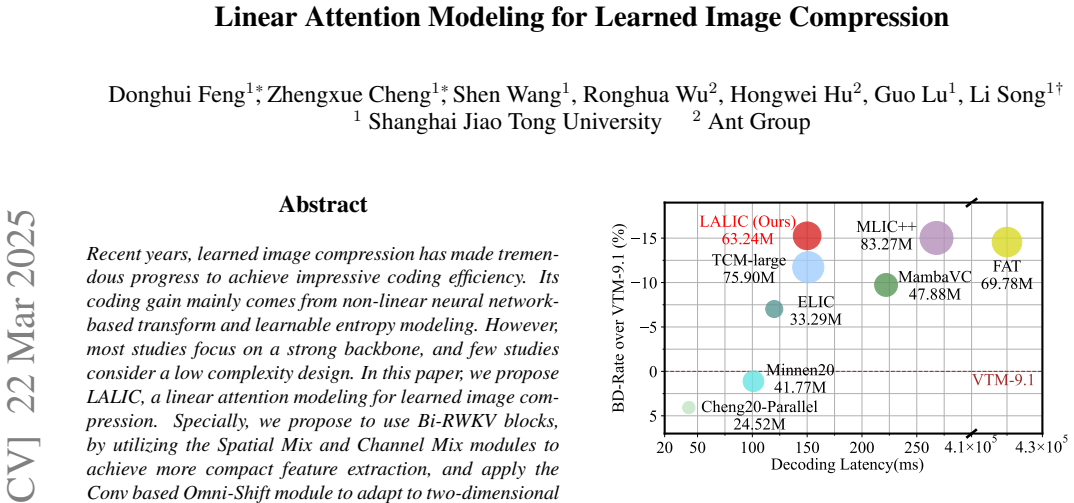
The central claim is that replacing quadratic attention with linear bidirectional WKV attention in both the transform network and the entropy model yields state-of-the-art rate-distortion performance at moderate complexity. The paper introduces Bi-RWKV blocks that combine a Spatial-Mix branch, which uses a reparameterized 5x5 depthwise convolution (Omni-Shift) for local 2D context and BiWKV attention for global dependency, with a Channel-Mix branch for cross-channel fusion. It also proposes RWKV-SCCTX, an entropy model that predicts Gaussian parameters using checkerboard spatial context and chunked channel-wise context processed by the same Bi-RWKV blocks. The reported experiments show LALIC surpassing VTM-9.1 by about 15 to 18 percent in BD-rate on Kodak, CLIC, and Tecnick, and matching or beating recent learned codecs including ELIC, TCM-large, FAT, MLIC++, and MambaVC while keeping decoding time at 150 ms and forward FLOPs at 286 G.
Load-bearing premise
The complexity advantage is measured with a FLOPs counter that cannot see attention operations, matrix multiplications, or CUDA kernels; if the true FLOPs of BiWKV are much higher than the theoretical linear count, the paper's efficiency claim weakens.
Editorial extensions
If this is right
- Learned image codecs can obtain a near-global receptive field with linear complexity in pixel count, removing the need for window partitioning or selective-scan overhead.
- The RWKV-based entropy model improves rate-distortion performance over convolutional spatial-channel context models of similar parameter count, per the ablation study.
- The reported BD-rate gains over VTM-9.1 suggest learned linear-attention codecs are now a practical alternative to traditional codecs on high-resolution content.
- The architecture's moderate decoding latency (150 ms) makes near-real-time decoding of high-resolution images plausible on a consumer GPU.
- The chunked channel-wise context design, allocating fewer channels to the most-referenced early slices, offers a general recipe for efficient autoregressive entropy models.
Reading between the lines
- If the paper's FLOPs measurements undercount attention operations, as it itself notes, an independent profiler that counts every matrix multiplication could rank BiWKV's true cost higher than reported relative to its baselines.
- The Bi-RWKV block is a drop-in component that could be transferred to other pixel-wise tasks such as video compression, super-resolution, or image restoration, where long-range dependencies and low decoding latency both matter.
- RWKV-SCCTX only changes how context is mixed, not how the prior is parameterized, so it can likely be combined with latent residual prediction or conditional priors for further gains.
- The paper's scaling plots imply a testable prediction: decode latency and FLOPs should grow roughly linearly with pixel count; measuring them at 4K resolution against the reported 1024x1024 numbers would confirm or refute that scaling.
Editorial analysis
A structured set of objections, weighed in public.
Referee Report
Summary. The paper proposes LALIC, a learned image compression model that uses Bi-RWKV linear-attention blocks in both the nonlinear transforms and the entropy model, together with a RWKV-based spatial-channel context model. The authors report BD-rate gains over VTM-9.1 of -15.26%, -15.41%, and -17.63% on Kodak, CLIC, and Tecnick, respectively, and claim state-of-the-art performance while maintaining moderate decoding latency (150 ms) on an RTX 4090. The paper includes extensive rate-distortion experiments, ablations, ERF visualizations, and a public code repository.
Significance. If the reported rate-distortion and complexity results hold, this is a meaningful contribution: it is, to my knowledge, the first application of RWKV-style linear attention to learned image compression, and it shows that a global-receptive-field linear-attention backbone can match or beat strong transformer- and Mamba-based codecs on standard benchmarks. The public code, multi-dataset evaluation, and ablation studies are valuable. However, the complexity advantage is currently supported by FLOPs counts that exclude the attention mechanism itself, and there are inconsistencies in the headline BD-rate numbers. The efficiency contribution is therefore not yet firmly established, even though the RD evidence is substantial.
major comments (4)
- [Section 4.3 and Supplementary A, Table 1] The FLOPs comparison is not a valid quantitative measure of the paper's central complexity claim. Supp. A states that the thop package cannot count FLOPs from matrix multiplications, mathematical functions, or CUDA-specific implementations, yet the BiWKV attention in Eq. (6) consists almost entirely of such operations (exponentials, elementwise products, a weighted sum over all tokens, and a division). The reported 286.16 GFLOPs for LALIC therefore excludes the very attention mechanism that is the paper's core contribution, and the comparison against MLIC++ and TCM-large is not conclusive. The authors should provide FLOPs measured with a profiler that includes all operations, or derive a rigorous upper/lower bound for the omitted attention cost.
- [Section 4.3, Table 1 (FAT row)] The reported FAT decoding time of >10 s is inconsistent with the 242 ms reported in the FAT paper, and Supp. A attributes the discrepancy to an unresolved issue in the official GitHub repository. Reporting a >10 s runtime as a scientific comparison point is misleading unless the same inference setup, including code optimizations and environment, is used for all methods. Either the authors should obtain a representative FAT runtime (for example, from the original authors or a properly optimized implementation) or they should exclude the FAT runtime from the comparison table and instead discuss the issue in the text.
- [Abstract and Section 5 (Conclusion)] The headline BD-rate results are internally inconsistent. The abstract reports -15.26%, -15.41%, and -17.63% BD-rate against VTM-9.1 on Kodak, CLIC, and Tecnick, while Section 5 states 'outperforming VTM-9.1 by -14.84% in BD-rate on Kodak, Tecnick and CLIC Professional validation datasets.' The paper must clarify which number is correct, whether -14.84% is an average, and correct the erroneous statement. Since these numbers are the paper's main quantitative claim, this inconsistency affects reproducibility and must be fixed.
- [Section 4.2, Table 1] The claim that LALIC achieves state-of-the-art performance rests on BD-rate differences from MLIC++ of 0.24 percentage points on Kodak, 0.96 on CLIC, and 0.42 on Tecnick. No error bars, standard deviations, or statistical tests are provided. In learned image compression, differences below 0.5% are typically within run-to-run and test-set variance. The authors should report confidence intervals (for example via bootstrap over images) or a paired significance test to support the SOTA claim over MLIC++.
minor comments (7)
- [Section 1, Contribution bullets] The first contribution bullet says 'Spatial-Mix and Time-Mix' but Section 3.2 only defines Spatial Mix and Channel Mix; please correct the terminology.
- [Table 2] The table header says 'BD-rate' but the text states 'we use inference loss as a proxy'; please align the metric name with the reported values.
- [Table 3] The note that DeltaFLOPs 'only counts the operations of attention layer or shift layer' is useful, but it should be stated in the main text that these are analytical counts, not measured FLOPs, given that the thop package cannot count these operations.
- [References] References [9] and [10] appear to refer to the same Vision-RWKV paper; please merge or disambiguate them.
- [Figures 3 and 9] The ERF visualizations lack a color bar and a description of normalization; adding these would make the comparison more interpretable.
- [Table 1] The table does not specify the measurement protocol for encoding/decoding times (e.g., GPU/CPU, batch size, image resolution, number of runs). Please provide this information for reproducibility.
- [Section 4.1] The training dataset description 'the first 400,000 images of the OpenImages dataset' is ambiguous; please specify the exact split or provide a link if this subset is public.
Circularity Check
No significant circularity: the RD and complexity claims are direct empirical measurements anchored to external codecs and external architecture sources, not derived by construction from fitted parameters or self-citations.
full rationale
The paper's central claims are empirical and self-contained. The BD-rate figures (-15.26%, -15.41%, -17.63% relative to VTM-9.1) are direct measurements or adopted R-D curves from external baselines, not quantities reconstructed from the model's own fitted parameters. The architecture is an application of Bi-RWKV blocks and an RWKV-based context model to learned image compression; the BiWKV attention formula in Eq. (6) is credited to Vision-RWKV [9], and the Omni-Shift module to Restore-RWKV [39], both external works with no author overlap with the present paper, so no load-bearing argument reduces to a self-citation. The entropy-model comparison (Conv vs. Conv-Plus vs. RWKV SCCTX, Table 2) is an ablation, and the claim that increasing context parameters helps is supported by an external reference [34], not by the paper's own prior result. The only caveat is in Supp. A, where the authors admit that the thop FLOPs counter excludes matrix multiplications, attention operations, and CUDA-specific kernels; this is a measurement limitation that weakens the precision of the complexity comparison, but it is not circularity because the reported FLOPs and latency are still independently measured quantities rather than quantities forced by definition or by the paper's own assumptions. No fitted input is relabeled as a prediction, no uniqueness theorem is imported from the authors' prior work, and no known result is merely renamed. The derivation chain is therefore not circular.
Assumptions & free parameters
free parameters (4)
- Channel allocation in RWKV-SCCTX =
{16, 16, 32, 64, M-128}
- Bi-RWKV layer configuration =
{2, 4, 6, 6}
- Latent channel dimensions M and N =
M=320, N=192
- Rate-distortion Lagrange multipliers =
MSE: {0.0025, 0.0035, 0.0067, 0.0130, 0.0250, 0.0483}; MS-SSIM: {2.40, 4.58, 8.73, 16.64, 31.73, 60.50}
assumptions (4)
- domain assumption Conditional Gaussian entropy model for latent y
- domain assumption OpenImages first 400k images provide a representative training distribution
- ad hoc to paper The thop FLOPs counter provides a fair approximation of true computational cost
- ad hoc to paper The BiWKV implementation achieves the theoretical linear complexity of Eq. 6
Cite this review
Pith. "Pith review of Linear Attention Modeling for Learned Image Compression." pith.science (2026). https://pith.science/paper/ZXPAXYND
@misc{pith2026250205741,
  author       = {Pith},
  title        = {Pith review of: Linear Attention Modeling for Learned Image Compression},
  year         = {2026},
  howpublished = {\url{https://pith.science/paper/ZXPAXYND}},
  note         = {Machine review of arXiv:2502.05741}
}
read the original abstract
Recent years, learned image compression has made tremendous progress to achieve impressive coding efficiency. Its coding gain mainly comes from non-linear neural network-based transform and learnable entropy modeling. However, most studies focus on a strong backbone, and few studies consider a low complexity design. In this paper, we propose LALIC, a linear attention modeling for learned image compression. Specially, we propose to use Bi-RWKV blocks, by utilizing the Spatial Mix and Channel Mix modules to achieve more compact feature extraction, and apply the Conv based Omni-Shift module to adapt to two-dimensional latent representation. Furthermore, we propose a RWKV-based Spatial-Channel ConTeXt model (RWKV-SCCTX), that leverages the Bi-RWKV to modeling the correlation between neighboring features effectively. To our knowledge, our work is the first work to utilize efficient Bi-RWKV models with linear attention for learned image compression. Experimental results demonstrate that our method achieves competitive RD performances by outperforming VTM-9.1 by -15.26%, -15.41%, -17.63% in BD-rate on Kodak, CLIC and Tecnick datasets. The code is available at https://github.com/sjtu-medialab/RwkvCompress .
Figures


Figures from the paper (9 more)


Reference graph
Works this paper leans on
-
[1]
Johannes Balle, Philip A. Chou, David Minnen, Saurabh Singh, Nick Johnston, Eirikur Agustsson, Sung Jin Hwang, and George Toderici. Nonlinear Transform Coding. IEEE Journal of Selected Topics in Signal Processing, 15(2):339– 353, 2021. 1
work page 2021
-
[2]
Johannes Ball ´e, Valero Laparra, and Eero P. Simoncelli. End-to-end optimized image compression. In 5th Interna- tional Conference on Learning Representations, ICLR 2017, Toulon, France, April 24-26, 2017, Conference Track Pro- ceedings. OpenReview.net, 2017. 2
work page 2017
-
[3]
Variational image compression with a scale hyperprior, 2018
Johannes Ball ´e, David Minnen, Saurabh Singh, Sung Jin Hwang, and Nick Johnston. Variational image compression with a scale hyperprior, 2018. 2, 5
work page 2018
-
[4]
Benjamin Bross, Ye-Kui Wang, Yan Ye, Shan Liu, Jianle Chen, Gary J. Sullivan, and Jens-Rainer Ohm. Overview of the versatile video coding (VVC) standard and its applica- tions. IEEE Transactions on Circuits and Systems for Video Technology, 31(10):3736–3764, 2021. 1
work page 2021
-
[5]
CompressAI: A PyTorch library and evaluation platform for end-to-end compression research, 2020
Jean B ´egaint, Fabien Racap ´e, Simon Feltman, and Akshay Pushparaja. CompressAI: A PyTorch library and evaluation platform for end-to-end compression research, 2020. 1
work page 2020
-
[6]
Video mamba suite: State space model as a versatile alternative for video understanding
Guo Chen, Yifei Huang, Jilan Xu, Baoqi Pei, Zhe Chen, Zhiqi Li, Jiahao Wang, Kunchang Li, Tong Lu, and Limin Wang. Video mamba suite: State space model as a versatile alternative for video understanding. ArXiv, abs/2403.09626,
-
[7]
Learned Image Compression With Discretized Gaus- sian Mixture Likelihoods and Attention Modules
Zhengxue Cheng, Heming Sun, Masaru Takeuchi, and Jiro Katto. Learned Image Compression With Discretized Gaus- sian Mixture Likelihoods and Attention Modules. In Pro- ceedings of the IEEE/CVF Conference on Computer Vision and Pattern Recognition, pages 7939–7948, 2020. 1, 2, 5
work page 2020
-
[8]
The evolution of rwkv: Advancements in effi- cient language modeling, 2024
Akul Datta. The evolution of rwkv: Advancements in effi- cient language modeling, 2024. 2
work page 2024
Show all 51 references
-
[9]
Vision-RWKV: Efficient and Scalable Visual Per- ception with RWKV-Like Architectures, 2024
Yuchen Duan, Weiyun Wang, Zhe Chen, Xizhou Zhu, Lewei Lu, Tong Lu, Yu Qiao, Hongsheng Li, Jifeng Dai, and Wen- hai Wang. Vision-RWKV: Efficient and Scalable Visual Per- ception with RWKV-Like Architectures, 2024. 1, 3, 4, 2
2024
-
[10]
Vision-rwkv: Efficient and scalable visual percep- tion with rwkv-like architectures
Yuchen Duan, Weiyun Wang, Zhe Chen, Xizhou Zhu, Lewei Lu, Tong Lu, Yu Qiao, Hongsheng Li, Jifeng Dai, and Wen- hai Wang. Vision-rwkv: Efficient and scalable visual percep- tion with rwkv-like architectures. ArXiv, abs/2403.02308,
-
[11]
Diffusion-rwkv: Scaling rwkv-like archi- tectures for diffusion models
Zhengcong Fei, Mingyuan Fan, Changqian Yu, Debang Li, and Junshi Huang. Diffusion-rwkv: Scaling rwkv-like archi- tectures for diffusion models. ArXiv, abs/2404.04478, 2024. 3
2024 arXiv
-
[12]
Mamba: Linear-time sequence mod- eling with selective state spaces
Albert Gu and Tri Dao. Mamba: Linear-time sequence mod- eling with selective state spaces. ArXiv, abs/2312.00752,
-
[13]
Mambair: A simple baseline for im- age restoration with state-space model
Hang Guo, Jinmin Li, Tao Dai, Zhihao Ouyang, Xudong Ren, and Shu-Tao Xia. Mambair: A simple baseline for im- age restoration with state-space model. In European Confer- ence on Computer Vision, 2024. 2
2024
-
[14]
ELIC: Efficient Learned Image Com- pression with Unevenly Grouped Space-Channel Contextual Adaptive Coding
Dailan He, Ziming Yang, Weikun Peng, Rui Ma, Hongwei Qin, and Yan Wang. ELIC: Efficient Learned Image Com- pression with Unevenly Grouped Space-Channel Contextual Adaptive Coding. In 2022 IEEE/CVF Conference on Com- puter Vision and Pattern Recognition (CVPR), pages 5708– 5717...
2022
-
[15]
Deform-mamba network for mri super-resolution
Zexin Ji, Beiji Zou, Xiaoyan Kui, Pierre Vera, and Su Ruan. Deform-mamba network for mri super-resolution. ArXiv, abs/2407.05969, 2024. 2
2024 arXiv
-
[16]
MLIC++: Linear Complexity Multi-Reference Entropy Modeling for Learned Image Compression
Wei Jiang, Jiayu Yang, Yongqi Zhai, Feng Gao, and Rong- gang Wang. MLIC++: Linear Complexity Multi-Reference Entropy Modeling for Learned Image Compression. In Pro- ceedings of the 31st ACM International Conference on Mul- timedia, pages 7618–7627, 2023. 5, 7, 2
2023
-
[17]
Burakhan Koyuncu, Han Gao, Atanas Boev, Georgii Gaikov, Elena Alshina, and Eckehard Steinbach
A. Burakhan Koyuncu, Han Gao, Atanas Boev, Georgii Gaikov, Elena Alshina, and Eckehard Steinbach. Con- textformer: A Transformer with Spatio-Channel Attention for Context Modeling in Learned Image Compression. In Computer Vision – ECCV 2022 , pages 447–463. Springer Nature Swi...
2022
-
[18]
Frequency-Aware Transformer for Learned Image Compression
Han Li, Shaohui Li, Wenrui Dai, Chenglin Li, Junni Zou, and Hongkai Xiong. Frequency-Aware Transformer for Learned Image Compression. In The Twelfth International Confer- ence on Learning Representations . arXiv, 2023. 1, 2, 4, 5, 7
2023
-
[19]
Learned Image Compression with Mixed Transformer-CNN Architectures
Jinming Liu, Heming Sun, and Jiro Katto. Learned Image Compression with Mixed Transformer-CNN Architectures. In 2023 IEEE/CVF Conference on Computer Vision and Pat- tern Recognition (CVPR), pages 14388–14397. IEEE, 2023. 1, 2, 4, 5, 7
2023
-
[20]
Vmamba: Visual state space model
Yue Liu, Yunjie Tian, Yuzhong Zhao, Hongtian Yu, Lingxi Xie, Yaowei Wang, Qixiang Ye, and Yunfan Liu. Vmamba: Visual state space model. ArXiv, abs/2401.10166, 2024. 1, 2
2024 arXiv
-
[21]
Swin Transformer: Hierarchical Vision Transformer using Shifted Windows
Ze Liu, Yutong Lin, Yue Cao, Han Hu, Yixuan Wei, Zheng Zhang, Stephen Lin, and Baining Guo. Swin Transformer: Hierarchical Vision Transformer using Shifted Windows. In 2021 IEEE/CVF International Conference on Computer Vi- sion (ICCV), pages 9992–10002. IEEE, 2021. 1, 2
2021
-
[22]
Transformer-based Image Compression
Ming Lu, Peiyao Guo, Huiqing Shi, Chuntong Cao, and Zhan Ma. Transformer-based Image Compression. In 2022 Data Compression Conference (DCC), pages 469–469, Snowbird, UT, USA, 2022. IEEE. 2
2022
-
[23]
Understanding the effective receptive field in deep convolu- tional neural networks
Wenjie Luo, Yujia Li, Raquel Urtasun, and Richard Zemel. Understanding the effective receptive field in deep convolu- tional neural networks. Advances in neural information pro- cessing systems, 29, 2016. 4, 8
2016
-
[24]
U-mamba: Enhancing long-range dependency for biomedical image segmentation
Jun Ma, Feifei Li, and Bo Wang. U-mamba: Enhancing long-range dependency for biomedical image segmentation. ArXiv, abs/2401.04722, 2024. 2
2024 arXiv
-
[25]
Channel-Wise Autore- gressive Entropy Models for Learned Image Compression
David Minnen and Saurabh Singh. Channel-Wise Autore- gressive Entropy Models for Learned Image Compression. In 2020 IEEE International Conference on Image Process- ing (ICIP), pages 3339–3343. IEEE, 2020. 1, 2, 7
2020
-
[26]
Joint Autoregressive and Hierarchical Priors for Learned Image Compression
David Minnen, Johannes Ball ´e, and George Toderici. Joint Autoregressive and Hierarchical Priors for Learned Image Compression. In Advances in Neural Information Processing Systems 31: Annual Conference on Neural Information Pro- cessing Systems 2018, NeurIPS 2018, 3-8 Decemb...
2018
-
[27]
Wind, Stanislaw Wozniak, Ruichong Zhang, Zhenyuan Zhang, Qihang Zhao, Peng Zhou, Qinghua Zhou, Jian Zhu, and Rui-Jie Zhu
Bo Peng, Eric Alcaide, Quentin Anthony, Alon Albalak, Samuel Arcadinho, Stella Biderman, Huanqi Cao, Xin Cheng, Michael Chung, Matteo Grella, Kranthi Kiran GV , Xuzheng He, Haowen Hou, Jiaju Lin, Przemyslaw Kazienko, Jan Kocon, Jiaming Kong, Bartlomiej Kop- tyra, Hayden Lau, K...
2023
-
[28]
Rwkv: Rein- venting rnns for the transformer era, 2023
Bo Peng, Eric Alcaide, Quentin Anthony, et al. Rwkv: Rein- venting rnns for the transformer era, 2023. 2
2023
-
[29]
Eagle and finch: Rwkv with matrix-valued states and dynamic recur- rence
Bo Peng, Daniel Goldstein, Quentin Anthony, Alon Albalak, Eric Alcaide, Stella Biderman, Eugene Cheah, Teddy Fer- dinan, Haowen Hou, Przemys l aw Kazienko, G Kranthiki- ran, Jan Koco’n, Bartlomiej Koptyra, Satyapriya Krishna, Ronald McClelland, Niklas Muennighoff, Fares Obeid,...
2024 arXiv
-
[30]
Entroformer: A Transformer-based Entropy Model for Learned Image Compression, 2022
Yichen Qian, Ming Lin, Xiuyu Sun, Zhiyu Tan, and Rong Jin. Entroformer: A Transformer-based Entropy Model for Learned Image Compression, 2022. 2
2022
-
[31]
Vl-mamba: Ex- ploring state space models for multimodal learning
Yanyuan Qiao, Zheng Yu, Longteng Guo, Sihan Chen, Zijia Zhao, Mingzhen Sun, Qi Wu, and Jing Liu. Vl-mamba: Ex- ploring state space models for multimodal learning. ArXiv, abs/2403.13600, 2024. 2
2024 arXiv
-
[32]
Mambavc: Learned visual compression with selective state spaces
Shiyu Qin, Jinpeng Wang, Yimin Zhou, Bin Chen, Tianci Luo, Baoyi An, Tao Dai, Shu-Tao Xia, and Yaowei Wang. Mambavc: Learned visual compression with selective state spaces. ArXiv, abs/2405.15413, 2024. 1, 2, 7
2024 arXiv
-
[33]
Temporal Context Mining for Learned Video Compression
Xihua Sheng, Jiahao Li, Bin Li, Li Li, Dong Liu, and Yan Lu. Temporal Context Mining for Learned Video Compression. IEEE Transactions on Multimedia, 25:7311–7322, 2023. 2
2023
-
[34]
NVC-1B: A Large Neural Video Coding Model, 2024
Xihua Sheng, Chuanbo Tang, Li Li, Dong Liu, and Feng Wu. NVC-1B: A Large Neural Video Coding Model, 2024. 7
2024
-
[35]
The JPEG 2000 still image compression standard
Athanassios Skodras, Charilaos Christopoulos, and Touradj Ebrahimi. The JPEG 2000 still image compression standard. IEEE Signal processing magazine, 18(5):36–58, 2001. 1
2000
-
[36]
Sullivan, Jens-Rainer Ohm, Woo-Jin Han, and Thomas Wiegand
Gary J. Sullivan, Jens-Rainer Ohm, Woo-Jin Han, and Thomas Wiegand. Overview of the high efficiency video coding (HEVC) standard. IEEE Transactions on circuits and systems for video technology, 22(12):1649–1668, 2012. 1
2012
-
[37]
Gregory K. Wallace. The JPEG still picture compression standard. IEEE transactions on consumer electronics, 38(1): xviii–xxxiv, 1992. 1
1992
-
[38]
Enhanced Invertible Encoding for Learned Image Compression
Yueqi Xie, Ka Leong Cheng, and Qifeng Chen. Enhanced Invertible Encoding for Learned Image Compression. Pro- ceedings of the 29th ACM International Conference on Mul- timedia, pages 162–170, 2021. 7
2021
-
[39]
Restore-RWKV: Efficient and Effective Medical Image Restoration with RWKV, 2024
Zhiwen Yang, Hui Zhang, Dan Zhao, Bingzheng Wei, and Yan Xu. Restore-RWKV: Efficient and Effective Medical Image Restoration with RWKV, 2024. 2, 3
2024
-
[40]
Restore-rwkv: Efficient and effective medical image restoration with rwkv
Zhiwen Yang, Hui Zhang, Dan Zhao, Bingzheng Wei, and Yan Xu. Restore-rwkv: Efficient and effective medical image restoration with rwkv. ArXiv, abs/2407.11087, 2024. 3
2024 arXiv
-
[41]
Mamba or rwkv: Exploring high-quality and high-efficiency segment anything model
Haobo Yuan, Xiangtai Li, Lu Qi, Tao Zhang, Ming-Hsuan Yang, Shuicheng Yan, and Chen Change Loy. Mamba or rwkv: Exploring high-quality and high-efficiency segment anything model. ArXiv, abs/2406.19369, 2024. 3
2024 arXiv
-
[42]
An Attention Free Transformer, 2021
Shuangfei Zhai, Walter Talbott, Nitish Srivastava, Chen Huang, Hanlin Goh, Ruixiang Zhang, and Josh Susskind. An Attention Free Transformer, 2021. 4, 1
2021
-
[43]
End-to-end Optimized Image Compression with Attention Mechanism
Lei Zhou, Zhenhong Sun, Xiangjian Wu, and Junmin Wu. End-to-end Optimized Image Compression with Attention Mechanism. In CVPR workshops, 2019. 2
2019
-
[44]
Bsbp-rwkv: Background suppression with boundary preservation for efficient medical image segmentation
Xudong Zhou and Tianxiang Chen. Bsbp-rwkv: Background suppression with boundary preservation for efficient medical image segmentation. In ACM Multimedia, 2024. 3
2024
-
[45]
Vision mamba: Efficient visual representation learning with bidirectional state space model
Lianghui Zhu, Bencheng Liao, Qian Zhang, Xinlong Wang, Wenyu Liu, and Xinggang Wang. Vision mamba: Efficient visual representation learning with bidirectional state space model. ArXiv, abs/2401.09417, 2024. 2
2024 arXiv
-
[46]
Transformer- based Transform Coding
Yinhao Zhu, Yang Yang, and Taco Cohen. Transformer- based Transform Coding. In International Conference on Learning Representations, 2021. 2
2021
-
[47]
The Devil Is in the Details: Window-based Attention for Image Compression
Renjie Zou, Chunfeng Song, and Zhaoxiang Zhang. The Devil Is in the Details: Window-based Attention for Image Compression. 2022 IEEE/CVF Conference on Computer Vi- sion and Pattern Recognition (CVPR), pages 17471–17480,
2022
-
[48]
The Open Images Dataset V4: Unified image classifica- tion, object detection, and visual relationship detection at scale
Alina Kuznetsova, Hassan Rom, Neil Alldrin, Jasper Ui- jlings, Ivan Krasin, Jordi Pont-Tuset, Shahab Kamali, et al. The Open Images Dataset V4: Unified image classifica- tion, object detection, and visual relationship detection at scale. International Journal of Computer Visio...
1956
-
[49]
Kodak lossless true color image suite (pho- tocd pcd0992)
Eastman Kodak. Kodak lossless true color image suite (pho- tocd pcd0992). 1993. 5
1993
-
[50]
Testimages: A large- scale archive for testing visual devices and basic image pro- cessing algorithms
Nicola Asuni and Andrea Giachetti. Testimages: A large- scale archive for testing visual devices and basic image pro- cessing algorithms. In STAG: Smart Tools and Applications in Computer Graphics, pages 63–70, 2014. 5
2014
-
[51]
Workshop and challenge on learned image compres- sion
CLIC. Workshop and challenge on learned image compres- sion. In Proceedings of the IEEE/CVF Conference on Com- puter Vision and Pattern Recognition, 2021. 5 Linear Attention Modeling for Learned Image Compression Supplementary Material A. Performance Details This section provi...
2021
Reviewed August 8, 2026 · model on record in the stance chip above.
Discussion (0). Continue with ORCID to comment.