REVIEW 4 major objections 4 minor 1 cited by
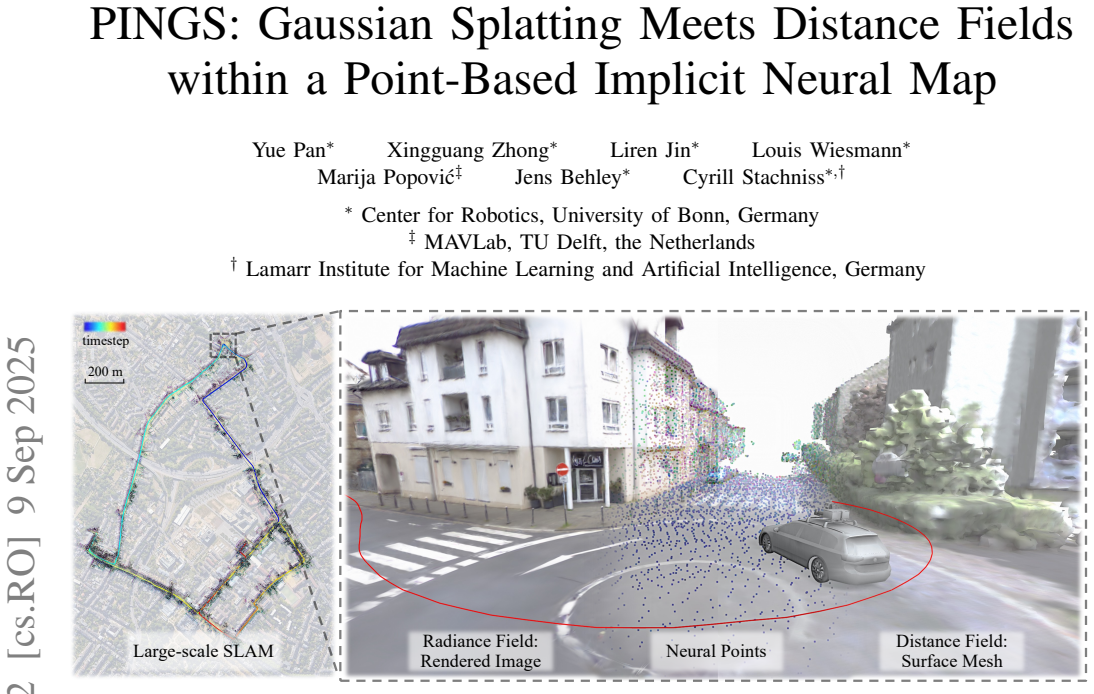
PINGS: Gaussian Splatting Meets Distance Fields within a Point-Based Implicit Neural Map
T0 review · 4 major / 4 minor · reviewed 2026-08-08 · deepseek-v4-flash
Pith's one-line read PINGS shows that a signed distance field and a Gaussian splatting radiance field can be unified in one neural map, each improving the other.
desk verdict A well-built systems paper that does not yet nail its headline mutual-improvement claim; worth reviewing, needs a sharper ablation. read the letter →
The pith
A machine-rendered reading of the paper's core claim, the machinery that carries it, and where it could break.
The reading
What carries the argument
The load-bearing mechanism is the neural point map: each point stores a geometric feature vector and an appearance feature vector, and globally shared shallow MLP decoders turn these features into SDF predictions and into spawned Gaussian primitives positioned in the point's local frame. A geometric consistency loss samples points along each surfel's normal and requires the SDF values to match the offset and the SDF gradient to align with the normal, which is what couples the two fields. Elasticity under pose-graph updates lets the same points move both fields during loop closure correction.
What would settle it
Take two disjoint driving areas with clearly different appearance and structure, run the first 30 timesteps of training in area A, then drive through area B without updating the decoders; if rendering quality or SDF accuracy in area B is markedly worse than a variant that keeps training the decoders, the mutual-improvement claim is shown to depend on the early-generalization assumption.
Extended reading notes
Core claim
The central claim is that geometric consistency between a continuous signed distance field and a Gaussian splatting radiance field can be enforced pointwise, and that this enforcement yields mutual improvement. Gaussian primitives are flattened into 2D surfels and aligned with the SDF's zero-level set and gradients, so the SDF disciplines the radiance field's geometry; conversely, the radiance field's photometric and multi-view losses refine the SDF in regions where LiDAR is sparse or uninformative. The paper argues this is what makes PINGS outperform both pure distance-field SLAM and pure Gaussian-splatting mapping: the two representations share one neural point map and one training objective, so every update to a point improves both fields. It also argues that the elastic point structure allows loop closure corrections to propagate consistently into both fields, keeping a 5 km map globally consistent.
Load-bearing premise
The system freezes all decoder network weights after the first 30 timesteps and only updates per-point features, assuming that decoders trained on the start of a journey can interpret features from every later place, lighting condition, and object category the robot encounters.
Editorial extensions
If this is right
- A single compact map can serve localization, mesh extraction, and photorealistic novel-view rendering simultaneously, replacing separate representations.
- Mutual supervision should reduce the geometric ambiguity that pure photometric radiance field training suffers in textureless or specular regions.
- Loop closure corrections propagate to both fields automatically because Gaussians are spawned in the local frames of neural points that move with the pose graph.
- The representation is compact because shared decoders encode common patterns and per-point features encode local variation, requiring less memory than storing Gaussians or voxels explicitly.
Reading between the lines
- The claim of mutual improvement is tested on urban driving scenes; it remains open whether the same coupling helps in more texture-poor or geometrically featureless environments where the radiance field has little reliable signal to offer the SDF.
- Freezing the decoders after 30 timesteps is a strong invariance assumption; a natural stress test is a trajectory that moves from indoor to outdoor or across radically different object types, where one decoder population may have to cover more variation than early frames suggest.
- The 5 s per frame processing time means the radiance field branch is not real-time; the mutual-supervision idea could be tested with faster optimization schemes to see whether the quality gains survive tighter compute budgets.
- If the representation holds up, it offers a direct path to robot simulators: the same map used for localization could be loaded and rendered as a closed-loop training environment, with geometry and appearance already aligned.
Editorial analysis
A structured set of objections, weighed in public.
Referee Report
Summary. The paper proposes PINGS, a LiDAR-visual SLAM system that unifies a neural signed distance field (SDF) and a Gaussian splatting radiance field in a point-based implicit neural map. The representation builds on PIN-SLAM for the SDF and on Scaffold-GS-style Gaussian spawning for the radiance field, and it introduces a geometric consistency loss that aligns Gaussian surfels with the SDF zero-level set and normals. The system performs incremental mapping, LiDAR odometry against the SDF, camera-pose refinement through differentiable rasterization, loop closure with elastic point-map updates, and dynamic-object filtering. Experiments cover novel-view rendering on five in-house car scenes (in- and out-of-sequence views), surface reconstruction against the Oxford Spires TLS reference, localization on two long sequences, and map-memory trade-offs. The central claim is that the two field types mutually improve each other: the SDF constrains the radiance field, while photometric cues and multi-view consistency improve the SDF.
Significance. If the central claim holds, PINGS is a substantial systems contribution: a single compact point-based representation that supports both photorealistic rendering and accurate geometric mapping in large-scale, incremental SLAM, with an open-source implementation. The evaluation is broad and mostly well anchored: the Oxford Spires benchmark provides an external millimeter-accurate reference, out-of-sequence views test generalization to genuinely novel viewpoints, and the ablations in Table I isolate the consistency loss. The memory-efficiency comparison and the loop-closure demonstration are also valuable. The main weakness is that the mutual-improvement claim rests on small, single-run numerical differences, and one load-bearing design choice (decoder freezing after 30 timesteps) is asserted without an isolating experiment. These issues are fixable with additional experiments and uncertainty quantification rather than being fundamental flaws.
major comments (4)
- [Table I, Sec. IV-B] The ablation isolating the consistency loss L_cons (Eq. 21) is PINGS versus 'Neural Point+GSS' in Table I. The reported gains are small and not uniform: PSNR differences range from -0.09 dB (Roundabout in-sequence, where PINGS is worse) to 0.58 dB, LPIPS gains are between 0.00 and 0.05, and Depth-L1 is often identical. All values are single-run point estimates from a training process with stochastic sampling of images and SDF points, and no error bars, multiple seeds, or significance tests are reported. Since claim (i) of the abstract rests on this comparison, the manuscript should provide uncertainty quantification or otherwise demonstrate that L_cons improves rendering beyond run-to-run variation, and it should explicitly discuss the Roundabout result.
- [Sec. III-E] The design freezes all decoder MLPs after 30 timesteps and thereafter optimizes only neural point features. The text asserts that the decoders converge to the needed interpretation capability within these 30 frames, but no experiment isolates this assumption: all evaluations run the full pipeline with the freeze in place, so the reader cannot tell whether the reported large-scale results depend on a favorable first-30-frame curriculum. Because the decoders are shared across the entire 5 km trajectory and across later lighting and object conditions, this is load-bearing for the incremental-mapping claim. Please add an experiment that retrains or unfreezes decoders, evaluates on disjoint time or region splits, or otherwise measures the generalization of the frozen decoders.
- [Table III, Sec. IV-D] The localization claim is internally inconsistent in one reported number. On Seq. 1 (5.0 km), PINGS odometry achieves ARTE 0.73% but ATE 5.17 m, whereas PIN odometry achieves ARTE 0.95% but ATE 4.51 m; the text states that PINGS achieves both lower odometry drift and superior global localization accuracy. Relative error supports this claim, but absolute trajectory error does not for the odometry (non-loop-closed) row. Please explain this discrepancy or qualify the claim, and clarify how the improved SDF relates to each error measure.
- [Table II, Sec. IV-C] For surface reconstruction, PINGS is compared with PIN-SLAM under ground-truth poses, but the two systems differ in several components (radiance field training, joint optimization, and the L_cons loss), so Table II does not isolate the mechanism claimed in claim (ii). The numerical gains are also small: Chamfer distance improves by at most 0.005 m and F-score by at most 0.019, with no uncertainty estimates. To support the claim that dense photometric cues and multi-view consistency improve the SDF, the authors should add an ablation that turns the radiance-field supervision and L_cons on and off while keeping the rest fixed, and should report variability across runs or sequences.
minor comments (4)
- [Sec. III-D and Sec. I] There are several typos and grammar issues: 'futhermore' in the Sec. III-D heading should be 'furthermore', 'infered' in the introduction should be 'inferred', and Sec. II-C contains 'an VDB' which should be 'a VDB'.
- [Table I] The Roundabout out-of-sequence columns contain missing delimiters, e.g., '0.780.31' and '20.230.77 0.30'. These should be formatted consistently with the rest of the table.
- [Sec. IV-B] The baseline description says that ground-truth poses are used for all methods, but it is not stated whether the per-frame exposure correction and camera-pose refinement described in Sec. III-C are also applied to the baselines. Please clarify this for reproducibility and fairness.
- [Fig. 8, Sec. IV-F] The memory-efficiency plot would benefit from a precise definition of 'map memory' (e.g., file size on disk versus resident memory including decoder MLPs) and from error bars or multiple runs at each resolution setting; currently it is a qualitative comparison without uncertainty information.
Circularity Check
No significant circularity: the mutual-improvement claims are tested against external benchmarks and ablations, not by construction.
full rationale
PINGS's central claim that enforcing geometric consistency between the SDF and the Gaussian splatting radiance field yields mutual improvements is an empirical claim supported by ablations and external references, not a definitional equivalence. The consistency loss L_cons in Eqs. (21)-(23) explicitly couples the two fields, but the paper does not measure success in terms of that coupling: novel-view RGB, depth, and normal quality are evaluated against held-out views, including out-of-sequence trajectories traversed in the opposite direction, and SDF quality is evaluated against the millimeter-accurate Leica RTC360 terrestrial laser scanner reference mesh of the Oxford Spires dataset (Sec. IV-A and IV-C). Table I isolates the mechanism by comparing PINGS to 'Neural Point+GSS', a variant that replaces 3D Gaussians with 2D Gaussian surfels and omits L_cons; whether adding L_cons improves rendering is therefore an empirical question, and the Roundabout row (PSNR 23.45 vs. 23.54, tied SSIM/LPIPS/Depth-L1) shows the benefit is not forced by the loss definition. Table II compares PINGS with PIN-SLAM 'using ground truth poses across all methods', so the claimed SDF improvement from dense photometric cues and multi-view consistency is measured against external geometry, not against the training objective. Self-citations to PIN-SLAM, LocNDF, and the authors' calibration and LiDAR bundle adjustment tools are genuine prior work used as building blocks or for reference pose generation; no uniqueness theorem is imported from the authors, and no central premise reduces to a self-citation. The small and sometimes unreplicated margins, and the weaker Roundabout result, are statistical-strength concerns rather than circularity. Therefore no circular step meets the evidence bar, and the appropriate finding is no significant circularity.
Assumptions & free parameters
free parameters (6)
- consistency loss weights lambda_d_cons, lambda_v_cons =
0.02
- depth loss weight lambda_depth =
0.01
- voxel resolution v_p =
0.3 m
- Gaussians per neural point K =
8
- neural point feature dims F_g, F_a =
32, 16
- decoder freeze timestep =
30
assumptions (5)
- domain assumption Projective signed distance along LiDAR rays is a valid pseudo-SDF label for sampled points.
- standard math Inverse-distance-weighted interpolation of per-neural-point SDF predictions yields a continuous and accurate SDF.
- domain assumption Flattening Gaussian ellipsoids to 2D disks (scale z = 0) and rendering depth via ray-disk intersection gives a geometrically meaningful radiance field.
- domain assumption The consistency loss assumes the SDF zero-level set and the Gaussian surfel surface converge to the same physical surface, so enforcing agreement is beneficial rather than harmful.
- ad hoc to paper Decoder MLPs trained on the first 30 timesteps generalize to the entire 5 km trajectory.
Cite this review
Pith. "Pith review of PINGS: Gaussian Splatting Meets Distance Fields within a Point-Based Implicit Neural Map." pith.science (2026). https://pith.science/paper/JBBSGI2O
@misc{pith2026250205752,
  author       = {Pith},
  title        = {Pith review of: PINGS: Gaussian Splatting Meets Distance Fields within a Point-Based Implicit Neural Map},
  year         = {2026},
  howpublished = {\url{https://pith.science/paper/JBBSGI2O}},
  note         = {Machine review of arXiv:2502.05752}
}
read the original abstract
Robots benefit from high-fidelity reconstructions of their environment, which should be geometrically accurate and photorealistic to support downstream tasks. While this can be achieved by building distance fields from range sensors and radiance fields from cameras, realising scalable incremental mapping of both fields consistently and at the same time with high quality is challenging. In this paper, we propose a novel map representation that unifies a continuous signed distance field and a Gaussian splatting radiance field within an elastic and compact point-based implicit neural map. By enforcing geometric consistency between these fields, we achieve mutual improvements by exploiting both modalities. We present a novel LiDAR-visual SLAM system called PINGS using the proposed map representation and evaluate it on several challenging large-scale datasets. Experimental results demonstrate that PINGS can incrementally build globally consistent distance and radiance fields encoded with a compact set of neural points. Compared to state-of-the-art methods, PINGS achieves superior photometric and geometric rendering at novel views by constraining the radiance field with the distance field. Furthermore, by utilizing dense photometric cues and multi-view consistency from the radiance field, PINGS produces more accurate distance fields, leading to improved odometry estimation and mesh reconstruction. We also provide an open-source implementation of PING at: https://github.com/PRBonn/PINGS.
Figures


Figures from the paper (5 more)


Forward citations
Cited by 1 Pith paper
-
Real-Time LiDAR Gaussian Splatting SLAM
Covariance-coupled G-ICP and spherical 2D Gaussian mapping yields real-time LiDAR-only dense SLAM with 86.78% F-score on Newer College at >20 FPS.
Reference graph
Works this paper leans on
-
[1]
Abou-Chakra, F
J. Abou-Chakra, F. Dayoub, and N. S ¨underhauf. Parti- cleNeRF: A Particle-Based Encoding for Online Neural Radiance Fields. InProc. of the IEEE Winter Conf. on Applications of Computer Vision (WACV), 2024
2024
-
[2]
Abou-Chakra, K
J. Abou-Chakra, K. Rana, F. Dayoub, and N. Suen- derhauf. Physically Embodied Gaussian Splatting: A Realtime Correctable World Model for Robotics. In Proc. of the Conf. on Robot Learning (CoRL), 2024
2024
-
[3]
Behley and C
J. Behley and C. Stachniss. Efficient Surfel-Based SLAM using 3D Laser Range Data in Urban Environments. In Proc. of Robotics: Science and Systems (RSS), 2018
2018
-
[4]
Bortolon, T
M. Bortolon, T. Tsesmelis, S. James, F. Poiesi, and A. Del Bue. 6DGS: 6D Pose Estimation from a Single Image and a 3D Gaussian Splatting Model. InProc. of the Europ. Conf. on Computer Vision (ECCV), 2024
2024
-
[5]
D. Cernea. OpenMVS: Multi-View Stereo Reconstruc- tion Library, 2020
2020
- [6]
-
[7]
Y . Chen, J. Wang, Z. Yang, S. Manivasagam, and R. Ur- tasun. G3R: Gradient Guided Generalizable Reconstruc- tion. InProc. of the Europ. Conf. on Computer Vision (ECCV), 2024
2024
-
[8]
Z. Chen, Z. Li, L. Song, L. Chen, J. Yu, J. Yuan, and Y . Xu. NeuRBF: A Neural Fields Representation with Adaptive Radial Basis Functions. InProc. of the IEEE/CVF Intl. Conf. on Computer Vision (ICCV), 2023
2023
Show all 98 references
-
[9]
Z. Chen, J. Yang, J. Huang, R.d. Lutio, J.M. Esturo, B. Ivanovic, O. Litany, Z. Gojcic, S. Fidler, M. Pavone, L. Song, and Y . Wang. OmniRe: Omni Urban Scene Reconstruction.arXiv preprint, arXiv:2408.16760, 2024
2024 arXiv
-
[10]
J. Cui, J. Cao, F. Zhao, Z. He, Y . Chen, Y . Zhong, L. Xu, Y . Shi, and J. Yu. LetsGo: Large-Scale Garage Modeling and Rendering via LiDAR Assisted Gaussian Primitives. ACM Trans. on Graphics (TOG), 43(6):1–18, 2024
2024
-
[11]
P. Dai, J. Xu, W. Xie, X. Liu, H. Wang, and W. Xu. High- quality Surface Reconstruction using Gaussian Surfels. InProc. of the Intl. Conf. on Computer Graphics and Interactive Techniques (SIGGRAPH), 2024
2024
-
[12]
Driess, I
D. Driess, I. Schubert, P. Florence, Y . Li, and M. Tou- ssaint. Reinforcement Learning with Neural Radiance Fields. InProc. of the Conf. on Neural Information Processing Systems (NeurIPS), 2022
2022
-
[13]
Fischer, J
T. Fischer, J. Kulhanek, S.R. Bul`o, L. Porzi, M. Pollefeys, and P. Kontschieder. Dynamic 3D Gaussian Fields for Urban Areas. InProc. of the Conf. on Neural Information Processing Systems (NeurIPS), 2024
2024
-
[14]
D. Fox, W. Burgard, and S. Thrun. The dynamic window approach to collision avoidance.IEEE Journal of Robotics and Automation, 4(1):23–33, 1997
1997
-
[15]
Geiger, P
A. Geiger, P. Lenz, and R. Urtasun. Are we ready for Autonomous Driving? The KITTI Vision Benchmark Suite. InProc. of the IEEE Conf. on Computer Vision and Pattern Recognition (CVPR), 2012
2012
-
[16]
Grisetti, C
G. Grisetti, C. Stachniss, and W. Burgard. Improved Techniques for Grid Mapping with Rao-Blackwellized Particle Filters.IEEE Trans. on Robotics (TRO), 23(1):34–46, 2007
2007
-
[17]
Gropp, L
A. Gropp, L. Yariv, N. Haim, M. Atzmon, and Y . Lipman. Implicit Geometric Regularization for Learning Shapes. InProc. of the Intl. Conf. on Machine Learning (ICML), 2020
2020
-
[18]
Gu ´edon and V
A. Gu ´edon and V . Lepetit. Sugar: Surface-aligned gaus- sian splatting for efficient 3d mesh reconstruction and high-quality mesh rendering. InProc. of the IEEE/CVF Conf. on Computer Vision and Pattern Recognition (CVPR), 2024
2024
-
[19]
G. Hess, C. Lindstr ¨om, M. Fatemi, C. Petersson, and L. Svensson. SplatAD: Real-Time Lidar and Camera Rendering with 3D Gaussian Splatting for Autonomous Driving.arXiv preprint, arXiv:2411.16816, 2024
2024 arXiv
-
[20]
H ¨ollein, A
L. H ¨ollein, A. Bo ˇziˇc, M. Zollh ¨ofer, and M. Nießner. 3DGS-LM: Faster Gaussian-Splatting Optimization with Levenberg-Marquardt.arXiv preprint, arXiv:2409.12892, 2024
2024 arXiv
-
[21]
S. Hong, J. He, X. Zheng, C. Zheng, and S. Shen. LIV-Gaussmap: Lidar-inertial-visual fusion for real-time 3d radiance field map rendering.IEEE Robotics and Automation Letters (RA-L), 9(11):9765–9772, 2024
2024
-
[22]
Hornung, K
A. Hornung, K. Wurm, M. Bennewitz, C. Stachniss, and W. Burgard. OctoMap: An Efficient Probabilistic 3D Mapping Framework Based on Octrees.Autonomous Robots, 34(3):189–206, 2013
2013
-
[23]
Huang, Z
B. Huang, Z. Yu, A. Chen, A. Geiger, and S. Gao. 2D Gaussian Splatting for Geometrically Accurate Radiance Fields. InProc. of the Intl. Conf. on Computer Graphics and Interactive Techniques (SIGGRAPH), 2024
2024
-
[24]
Hughes, Y
N. Hughes, Y . Chang, S. Hu, R. Talak, R. Abdulhai, J. Strader, and L. Carlone. Foundations of spatial perception for robotics: Hierarchical representations and real-time systems.Intl. Journal of Robotics Research (IJRR), 43(10):1457–1505, 2024
2024
-
[25]
Jiang, R
C. Jiang, R. Gao, K. Shao, Y . Wang, R. Xiong, and Y . Zhang. LI-GS: Gaussian Splatting with LiDAR Incorporated for Accurate Large-Scale Reconstruction. arXiv preprint, arXiv:2409.12899, 2024
2024 arXiv
-
[26]
L. Jin, X. Zhong, Y . Pan, J. Behley, C. Stachniss, and M. Popovic. ActiveGS: Active Scene Reconstruction using Gaussian Splatting.IEEE Robotics and Automation Letters (RA-L), 10(5):4866–4873, 2025
2025
-
[27]
R. Jin, Y . Gao, H. Lu, and F. Gao. GS-Planner: A Gaussian-Splatting-based Planning Framework for Ac- tive High-Fidelity Reconstruction. InProc. of the IEEE/RSJ Intl. Conf. on Intelligent Robots and Systems (IROS), 2024
2024
-
[28]
Kazhdan and H
M. Kazhdan and H. Hoppe. Screened poisson surface reconstruction.ACM Trans. on Graphics, 32(3):1–13, 2013
2013
-
[29]
Keetha, J
N. Keetha, J. Karhade, K.M. Jatavallabhula, G. Yang, S. Scherer, D. Ramanan, and J. Luiten. SplaTAM: Splat Track & Map 3D Gaussians for Dense RGB-D SLAM. InProc. of the IEEE/CVF Conf. on Computer Vision and Pattern Recognition (CVPR), 2024
2024
-
[30]
Kerbl, G
B. Kerbl, G. Kopanas, T. Leimk ¨uhler, and G. Drettakis. 3D Gaussian Splatting for Real-Time Radiance Field Rendering.ACM Trans. on Graphics (TOG), 42(4):1– 14, 2023
2023
-
[31]
Kerbl, A
B. Kerbl, A. Meuleman, G. Kopanas, M. Wimmer, A. Lanvin, and G. Drettakis. A Hierarchical 3D Gaussian Representation for Real-Time Rendering of Very Large Datasets.ACM Trans. on Graphics (TOG), 43(4):1–15, 2024
2024
-
[32]
Kingma and J
D. Kingma and J. Ba. Adam: A Method for Stochastic Optimization. InProc. of the Intl. Conf. on Learning Representations (ICLR), 2015
2015
-
[33]
Klingensmith, I
M. Klingensmith, I. Dryanovski, S. Srinivasa, and J. Xiao. Chisel: Real time large scale 3d reconstruction onboard a mobile device using spatially hashed signed distance fields. InProc. of Robotics: Science and Systems (RSS), 2015
2015
-
[34]
T. Li, X. Wen, Y .S. Liu, H. Su, and Z. Han. Learning Deep Implicit Functions for 3D Shapes with Dynamic Code Clouds. InProc. of the IEEE/CVF Conf. on Computer Vision and Pattern Recognition (CVPR), 2022
2022
-
[35]
Y . Li, Z. Kuang, T. Li, G. Zhou, S. Zhang, and Z. Yan. ActiveSplat: High-Fidelity Scene Reconstruc- tion through Active Gaussian Splatting.arXiv preprint, arXiv:2410.21955, 2024
2024 arXiv
-
[36]
Y . Liu, C. Luo, L. Fan, N. Wang, J. Peng, and Z. Zhang. Citygaussian: Real-time high-quality large-scale scene rendering with gaussians. InProc. of the Europ. Conf. on Computer Vision (ECCV), 2024
2024
-
[37]
Lorensen and H
W. Lorensen and H. Cline. Marching Cubes: a High Res- olution 3D Surface Construction Algorithm. InProc. of the Intl. Conf. on Computer Graphics and Interactive Techniques (SIGGRAPH), 1987
1987
-
[38]
T. Lu, M. Yu, L. Xu, Y . Xiangli, L. Wang, D. Lin, and B. Dai. Scaffold-GS: Structured 3d gaussians for view- adaptive rendering. InProc. of the IEEE/CVF Conf. on Computer Vision and Pattern Recognition (CVPR), 2024
2024
-
[39]
Lyu, Y .T
X. Lyu, Y .T. Sun, Y .H. Huang, X. Wu, Z. Yang, Y . Chen, J. Pang, and X. Qi. 3DGSR: Implicit Surface Recon- struction with 3D Gaussian Splatting.ACM Trans. on Graphics (TOG), 43(6):1–12, 2024
2024
-
[40]
Mallick, R
S.S. Mallick, R. Goel, B. Kerbl, M. Steinberger, F.V . Carrasco, and F. De La Torre. Taming 3DGS: High- Quality Radiance Fields with Limited Resources. In Proc. of the Intl. Conf. on Computer Graphics and Interactive Techniques (SIGGRAPH), 2024
2024
-
[41]
Mascaro and M
R. Mascaro and M. Chli. Scene Representations for Robotic Spatial Perception.Annual Review of Control, Robotics, and Autonomous Systems, 8(5):1–27, 2024
2024
-
[42]
Matsuki, R
H. Matsuki, R. Murai, P.H. Kelly, and A.J. Davison. Gaussian splatting SLAM. InProc. of the IEEE/CVF Conf. on Computer Vision and Pattern Recognition (CVPR), 2024
2024
-
[43]
Maximum Wilder-Smith, Vaishakh Patil
M.H. Maximum Wilder-Smith, Vaishakh Patil. Radi- ance Fields for Robotic Teleoperation. InProc. of the IEEE/RSJ Intl. Conf. on Intelligent Robots and Systems (IROS), 2024
2024
-
[44]
Mescheder, M
L. Mescheder, M. Oechsle, M. Niemeyer, S. Nowozin, and A. Geiger. Occupancy networks: Learning 3d recon- struction in function space. InProc. of the IEEE/CVF Conf. on Computer Vision and Pattern Recognition (CVPR), 2019
2019
-
[45]
Mildenhall, P
B. Mildenhall, P. Srinivasan, M. Tancik, J. Barron, R. Ra- mamoorthi, and R. Ng. NeRF: Representing Scenes as Neural Radiance Fields for View Synthesis. InProc. of the Europ. Conf. on Computer Vision (ECCV), 2020
2020
-
[46]
Newcombe, S
R.A. Newcombe, S. Izadi, O. Hilliges, D. Molyneaux, D. Kim, A.J. Davison, P. Kohli, J. Shotton, S. Hodges, and A. Fitzgibbon. KinectFusion: Real-Time Dense Sur- face Mapping and Tracking. InProc. of the Intl. Symp. on Mixed and Augmented Reality (ISMAR), 2011
2011
-
[47]
Nießner, M
M. Nießner, M. Zollh ¨ofer, S. Izadi, and M. Stamminger. Real-Time 3D Reconstruction at Scale Using V oxel Hashing.ACM Trans. on Graphics (TOG), 32(6):1–11, 2013
2013
-
[48]
Oleynikova, Z
H. Oleynikova, Z. Taylor, M. Fehr, R. Siegwar, and J. Nieto. V oxblox: Incremental 3d euclidean signed distance fields for on-board mav planning. InProc. of the IEEE/RSJ Intl. Conf. on Intelligent Robots and Systems (IROS), 2017
2017
-
[49]
Ortiz, A
J. Ortiz, A. Clegg, J. Dong, E. Sucar, D. Novotny, M. Zollhoefer, and M. Mukadam. isdf: Real-time neural signed distance fields for robot perception. InProc. of Robotics: Science and Systems (RSS), 2022
2022
-
[50]
Y . Pan, P. Xiao, Y . He, Z. Shao, and Z. Li. MULLS: Versatile LiDAR SLAM Via Multi-Metric Linear Least Square. InProc. of the IEEE Intl. Conf. on Robotics & Automation (ICRA), 2021
2021
-
[51]
Y . Pan, X. Zhong, L. Wiesmann, T. Posewsky, J. Behley, and C. Stachniss. PIN-SLAM: LiDAR SLAM Using a Point-Based Implicit Neural Representation for Achiev- ing Global Map Consistency.IEEE Trans. on Robotics (TRO), 40:4045–4064, 2024
2024
-
[52]
J.J. Park, P. Florence, J. Straub, R. Newcombe, and S. Lovegrove. DeepSDF: Learning Continuous Signed Distance Functions for Shape Representation. InProc. of the IEEE/CVF Conf. on Computer Vision and Pattern Recognition (CVPR), 2019
2019
-
[53]
Reijgwart, C
V . Reijgwart, C. Cadena, R. Siegwart, and L. Ott. Ef- ficient volumetric mapping of multi-scale environments using wavelet-based compression. InProc. of Robotics: Science and Systems (RSS), 2023
2023
-
[54]
Rematas, A
K. Rematas, A. Liu, P.P. Srinivasan, J.T. Barron, A. Tagliasacchi, T. Funkhouser, and V . Ferrari. Urban radiance fields. InProc. of the IEEE/CVF Conf. on Computer Vision and Pattern Recognition (CVPR), 2022
2022
-
[55]
K. Ren, L. Jiang, T. Lu, M. Yu, L. Xu, Z. Ni, and B. Dai. Octree-GS: Towards Consistent Real-time Rendering with LOD-structured 3D Gaussians.arXiv preprint, arXiv:2403.17898, 2024
2024 arXiv
-
[56]
Sandstr ¨om, Y
E. Sandstr ¨om, Y . Li, L. Van Gool, and M. R. Oswald. Point-SLAM: Dense Neural Point Cloud-based SLAM. InProc. of the IEEE/CVF Intl. Conf. on Computer Vision (ICCV), 2023
2023
-
[57]
Schmid, O
L. Schmid, O. Andersson, A. Sulser, P. Pfreundschuh, and R. Siegwart. Dynablox: Real-time Detection of Di- verse Dynamic Objects in Complex Environments.IEEE Robotics and Automation Letters (RA-L), 8(10):6259– 6266, 2023
2023
-
[58]
G. Song, C. Cheng, and H. Wang. GVKF: Gaussian V oxel Kernel Functions for Highly Efficient Surface Reconstruction in Open Scenes. InProc. of the Conf. on Neural Information Processing Systems (NeurIPS), 2024
2024
-
[59]
Stachniss, G
C. Stachniss, G. Grisetti, and W. Burgard. Information Gain-based Exploration Using Rao-Blackwellized Parti- cle Filters. InProc. of Robotics: Science and Systems (RSS), 2005
2005
-
[60]
Sucar, S
E. Sucar, S. Liu, J. Ortiz, and A.J. Davison. imap: Implicit mapping and positioning in real-time. InProc. of the IEEE/CVF Intl. Conf. on Computer Vision (ICCV), 2021
2021
-
[61]
Tancik, V
M. Tancik, V . Casser, X. Yan, S. Pradhan, B. Mildenhall, P.P. Srinivasan, J.T. Barron, and H. Kretzschmar. Block- NeRF: Scalable Large Scene Neural View Synthesis. In Proc. of the IEEE/CVF Conf. on Computer Vision and Pattern Recognition (CVPR), 2022
2022
-
[62]
Tancik, E
M. Tancik, E. Weber, E. Ng, R. Li, B. Yi, J. Kerr, T. Wang, A. Kristoffersen, J. Austin, K. Salahi, A. Ahuja, D. McAllister, and A. Kanazawa. Nerfstudio: A Modular Framework for Neural Radiance Field Development. In Proc. of the Intl. Conf. on Computer Graphics and Interactive...
2023
-
[63]
Y . Tao, Y . Bhalgat, L.F.T. Fu, M. Mattamala, N. Che- brolu, and M. Fallon. SiLVR: Scalable Lidar-Visual Reconstruction with Neural Radiance Fields for Robotic Inspection. InProc. of the IEEE Intl. Conf. on Robotics & Automation (ICRA), 2024
2024
-
[64]
Tao, M.A
Y . Tao, M.A. Munoz-Banon, L. Zhang, J. Wang, L.F.T. Fu, and M. Fallon. The Oxford Spires Dataset: Bench- marking Large-Scale LiDAR-Visual Localisation, Recon- struction and Radiance Field Methods.arXiv preprint, arXiv:2411.10546, 2024
2024 arXiv
-
[65]
Thrun, D
S. Thrun, D. Fox, W. Burgard, and F. Dellaert. Robust Monte Carlo Localization for Mobile Robots.Artificial Intelligence, 128(1-2), 2001
2001
-
[66]
Vizzo, X
I. Vizzo, X. Chen, N. Chebrolu, J. Behley, and C. Stach- niss. Poisson Surface Reconstruction for LiDAR Odom- etry and Mapping. InProc. of the IEEE Intl. Conf. on Robotics & Automation (ICRA), 2021
2021
-
[67]
Vizzo, T
I. Vizzo, T. Guadagnino, J. Behley, and C. Stachniss. VDBFusion: Flexible and Efficient TSDF Integration of Range Sensor Data.Sensors, 22(3):1296, 2022
2022
-
[68]
Vizzo, T
I. Vizzo, T. Guadagnino, B. Mersch, L. Wiesmann, J. Behley, and C. Stachniss. KISS-ICP: In Defense of Point-to-Point ICP – Simple, Accurate, and Robust Registration If Done the Right Way.IEEE Robotics and Automation Letters (RA-L), 8(2):1029–1036, 2023
2023
-
[69]
H. Wang, C. Wang, C. Chen, and L. Xie. F-LOAM: Fast LiDAR Odometry and Mapping. InProc. of the IEEE/RSJ Intl. Conf. on Intelligent Robots and Systems (IROS), 2021
2021
-
[70]
P. Wang, L. Liu, Y . Liu, C. Theobalt, T. Komura, and W. Wang. Neus: Learning neural implicit surfaces by volume rendering for multi-view reconstruction. In Proc. of the Conf. on Neural Information Processing Systems (NeurIPS), 2021
2021
-
[71]
Wang, A.C
Z. Wang, A.C. Bovik, H.R. Sheikh, and E.P. Simoncelli. Image quality assessment: from error visibility to struc- tural similarity.IEEE Transactions on Image Processing, 13(4):600–612, 2004
2004
-
[72]
Wei and S
J. Wei and S. Leutenegger. GSfusion: Online RGB-D Mapping Where Gaussian Splatting Meets TSDF Fu- sion.IEEE Robotics and Automation Letters (RA-L), 9(12):11865–11872, 2024
2024
-
[73]
Whelan, S
T. Whelan, S. Leutenegger, R.S. Moreno, B. Glocker, and A. Davison. ElasticFusion: Dense SLAM Without A Pose Graph. InProc. of Robotics: Science and Systems (RSS), 2015
2015
-
[74]
Wiesmann, T
L. Wiesmann, T. Guadagnino, I. Vizzo, N. Zimmerman, Y . Pan, H. Kuang, J. Behley, and C. Stachniss. LocNDF: Neural Distance Field Mapping for Robot Localiza- tion.IEEE Robotics and Automation Letters (RA-L), 8(8):4999–5006, 2023
2023
-
[75]
Wiesmann, T
L. Wiesmann, T. L ¨abe, L. Nunes, J. Behley, and C. Stach- niss. Joint Intrinsic and Extrinsic Calibration of Percep- tion Systems Utilizing a Calibration Environment.IEEE Robotics and Automation Letters (RA-L), 9(10):9103– 9110, 2024
2024
-
[76]
Wiesmann, E
L. Wiesmann, E. Marks, S. Gupta, T. Guadagnino, J. Behley, and C. Stachniss. Efficient LiDAR Bundle Adjustment for Multi-Scan Alignment Utiliz- ing Continuous-Time Trajectories.arXiv preprint, arXiv:2412.11760, 2024
2024 arXiv
-
[77]
L. Wu, C.L. Gentil, and T. Vidal-Calleja. VDB-GPDF: Online Gaussian Process Distance Field with VDB Struc- ture.IEEE Robotics and Automation Letters (RA-L), 10(1):374–381, 2024
2024
-
[78]
Y . Xie, Z. Huang, J. Wu, and J. Ma. GS- LIVM: Real-Time Photo-Realistic LiDAR-Inertial-Visual Mapping with Gaussian Splatting.arXiv preprint, arXiv:2410.17084, 2024
2024 arXiv
-
[79]
Q. Xu, Z. Xu, J. Philip, S. Bi, Z. Shu, K. Sunkavalli, and U. Neumann. Point-NeRF: Point-Based Neural Radiance Fields. InProc. of the IEEE/CVF Conf. on Computer Vision and Pattern Recognition (CVPR), 2022
2022
-
[80]
Y . Yan, H. Lin, C. Zhou, W. Wang, H. Sun, K. Zhan, X. Lang, X. Zhou, and S. Peng. Street Gaussians for Modeling Dynamic Urban Scenes. InProc. of the Europ. Conf. on Computer Vision (ECCV), 2024
2024
-
[81]
Z. Yang, Y . Chen, J. Wang, S. Manivasagam, W.C. Ma, A.J. Yang, and R. Urtasun. UniSim: A Neural Closed- Loop Sensor Simulator. InProc. of the IEEE/CVF Conf. on Computer Vision and Pattern Recognition (CVPR), 2023
2023
-
[82]
Yifan, F
W. Yifan, F. Serena, S. Wu, C. ¨Oztireli, and O. Sorkine- Hornung. Differentiable Surface Splatting for Point- based Geometry Processing.ACM Trans. on Graphics (TOG), 38(6):1–14, 2019
2019
-
[83]
M. Yu, T. Lu, L. Xu, L. Jiang, Y . Xiangli, and B. Dai. GSDF: 3DGS meets SDF for Improved Rendering and Reconstruction. InProc. of the Conf. on Neural Infor- mation Processing Systems (NeurIPS), 2024
2024
-
[84]
Z. Yu, T. Sattler, and A. Geiger. Gaussian Opacity Fields: Efficient Adaptive Surface Reconstruction in Unbounded Scenes.ACM Trans. on Graphics (TOG), 43(6):1–13, 2024
2024
-
[85]
Zhang, C
B. Zhang, C. Fang, R. Shrestha, Y . Liang, X. Long, and P. Tan. RaDe-GS: Rasterizing Depth in Gaussian Splatting.arXiv preprint, arXiv:2406.01467, 2024
2024 arXiv
-
[86]
Zhang, E
G. Zhang, E. Sandstr ¨om, Y . Zhang, M. Patel, L. Van Gool, and M.R. Oswald. GLORIE-SLAM: Glob- ally optimized rgb-only implicit encoding point cloud slam. InProc. of the Europ. Conf. on Computer Vision (ECCV), 2024
2024
-
[87]
Zhang and S
J. Zhang and S. Singh. LOAM: Lidar Odometry and Mapping in Real-time. InProc. of Robotics: Science and Systems (RSS), 2014
2014
-
[88]
Zhang, P
R. Zhang, P. Isola, A.A. Efros, E. Shechtman, and O. Wang. The Unreasonable Effectiveness of Deep Features as a Perceptual Metric. InProc. of the IEEE/CVF Conf. on Computer Vision and Pattern Recog- nition (CVPR), 2018
2018
-
[89]
Zhang and D
Z. Zhang and D. Scaramuzza. A Tutorial on Quantitative Trajectory Evaluation for Visual(-Inertial) Odometry. In Proc. of the IEEE/RSJ Intl. Conf. on Intelligent Robots and Systems (IROS), 2018
2018
-
[90]
C. Zhao, S. Sun, R. Wang, Y . Guo, J.J. Wan, Z. Huang, X. Huang, Y .V . Chen, and L. Ren. TCLC-GS: Tightly coupled lidar-camera gaussian splatting for surround- ing autonomous driving scenes. InProc. of the Eu- rop. Conf. on Computer Vision (ECCV), 2024
2024
-
[91]
L. Zhao, Y . Wang, and S. Huang. Occupancy-SLAM: Simultaneously Optimizing Robot Poses and Continuous Occupancy Map. InProc. of Robotics: Science and Systems (RSS), 2022
2022
-
[92]
Zheng, X
Y . Zheng, X. Chen, Y . Zheng, S. Gu, R. Yang, B. Jin, P. Li, C. Zhong, Z. Wang, L. Liu, et al. GaussianGrasper: 3D Language Gaussian Splatting for Open-vocabulary Robotic Grasping.IEEE Robotics and Automation Let- ters (RA-L), 9(9):7827–7834, 2024
2024
-
[93]
Zhong, Y
X. Zhong, Y . Pan, J. Behley, and C. Stachniss. SHINE- Mapping: Large-Scale 3D Mapping Using Sparse Hier- archical Implicit Neural Representations. InProc. of the IEEE Intl. Conf. on Robotics & Automation (ICRA), 2023
2023
-
[94]
Zhong, Y
X. Zhong, Y . Pan, C. Stachniss, and J. Behley. 3D LiDAR Mapping in Dynamic Environments using a 4D Implicit Neural Representation. InProc. of the IEEE/CVF Conf. on Computer Vision and Pattern Recog- nition (CVPR), 2024
2024
-
[95]
X. Zhou, Z. Lin, X. Shan, Y . Wang, D. Sun, and M.H. Yang. DrivingGaussian: Composite Gaussian Splatting for Surrounding Dynamic Autonomous Driving Scenes. InProc. of the IEEE/CVF Conf. on Computer Vision and Pattern Recognition (CVPR), 2024
2024
-
[96]
L. Zhu, Y . Li, E. Sandstr¨om, S. Huang, K. Schindler, and I. Armeni. LoopSplat: Loop Closure by Registering 3D Gaussian Splats. InProc. of the Intl. Conf. on 3D Vision (3DV), 2025
2025
-
[97]
X. Zuo, P. Samangouei, Y . Zhou, Y . Di, and M. Li. FMGS: Foundation model embedded 3d gaussian splat- ting for holistic 3d scene understanding.Intl. Journal of Computer Vision (IJCV), 130:1–17, 2024
2024
-
[98]
Zwicker, H
M. Zwicker, H. Pfister, J. Van Baar, and M. Gross. EW A volume splatting. InProc. of Visualization, 2001
2001
Reviewed August 8, 2026 · model on record in the stance chip above.
Discussion (0). Continue with ORCID to comment.