REVIEW 4 major objections 6 minor 1 cited by
3CAD: A Large-Scale Real-World 3C Product Dataset for Unsupervised Anomaly
T0 review · 4 major / 6 minor · reviewed 2026-08-08 · deepseek-v4-flash
Pith's one-line read 3CAD, the first large-scale real-world dataset of 3C product parts for unsupervised anomaly detection, comes with a new detector that reaches 93.4% pixel AUROC while baseline methods drop more than ten points.
desk verdict 3CAD is a genuinely useful new benchmark, but the authors need to back up their annotation-quality claims and test-set selection before the community should trust the leaderboard. read the letter →
The pith
A machine-rendered reading of the paper's core claim, the machinery that carries it, and where it could break.
The reading
What carries the argument
The load-bearing objects are the 3CAD dataset and the CFRG framework, which works in three stages. First, coarse localization comes from cosine-similarity distillation between a frozen WideResNet50 teacher and a trainable EfficientNet-b0 student, trained on real normal images with synthetic anomalies (Perlin noise and DTD textures) using a loss that pulls normal features together and pushes abnormal features apart. Second, a recovery network takes the teacher's features from abnormal images and tries to reconstruct the normal feature distribution, producing guidance weights that signal where abnormal content lives. Third, a segmentation module fuses the distillation's anomaly score with the recovery guidance weights and outputs a full-resolution mask, trained with binary cross-entropy. The key identity is that the recovery branch acts as a corrective filter for distillation bias, and the segmentation branch refines the coarse map; together they address the small, subtle, and multi-instance defects that dominate 3CAD.
What would settle it
Ask two independent teams to re-annotate a random sample of, say, 500 defective test images from 3CAD with pixel masks, then measure mask overlap (e.g., IoU) between the released labels and each team's labels; if agreement is low or there is systematic disagreement on tiny defects or on defects that resemble normal features, the benchmark's rankings become unstable and the claimed performance gaps would not reproduce on the re-labeled subset.
Extended reading notes
Core claim
The central claim is that 3CAD is the first large-scale, real-world 3C-specific anomaly detection benchmark, and that its multi-defect, multi-type, small-defect structure exposes capability gaps in current unsupervised methods that older benchmarks mask. The paper supports this with a benchmark of ten existing methods and its own CFRG. On 3CAD, the best existing methods lose roughly ten or more percentage points compared with their MVTec-AD results, while CFRG achieves the top scores: 93.4% pixel-level AUROC, 86.5% image-level AUROC, 82.0% per-region PRO, and 17.6% average precision, with the largest gains over baselines in pixel-level localization. The discovery, in the paper's terms, is that coarse-to-fine localization—first separating abnormal features from a heterogeneous teacher-student pair, then refining with recovery-guided segmentation—transfers better to real 3C defects than any single paradigm alone.
Load-bearing premise
The pixel-level ground-truth masks are treated as the oracle for all evaluation, but the paper gives no inter-annotator agreement or label-quality statistics, so if the annotations are noisy, inconsistent, or biased toward defects that quality engineers already know about, both the reported performance gaps and the dataset's difficulty claim could be artifacts.
Editorial extensions
If this is right
- If 3CAD's labels are trustworthy, it becomes a benchmark on which saturation is not yet reached: the best method achieves 93.4% pixel AUROC, leaving room that near-perfect MVTec-AD numbers do not show.
- Methods that only detect the largest or most salient defect will be penalized on 3CAD, since a single image can contain several small defects of different types.
- Reporting only AUROC will be inadequate on this dataset; the low average precision values for many methods show that precise localization requires metrics like per-region PRO and average precision.
- CFRG's three-stage design implies that combining heterogeneous distillation with a recovery task and segmentation can yield gains beyond any one paradigm, suggesting a recipe for future detectors on small-defect industrial data.
Reading between the lines
- If the dataset's annotation quality is consistent, it would enable a natural next experiment: cross-category evaluation, where models train on some of the eight product types and are tested on the held-out types, to measure generalization across real 3C parts.
- Because the paper provides no inter-annotator agreement, a public label-reliability audit on a random subset of defective images would clarify how much of the measured performance gap is genuine method strength rather than noise in the ground truth.
- The preprocessing crops large images into 1024-pixel windows with 20% overlap; the paper does not report results on the original uncropped captures, so the sensitivity of the benchmark conclusions to this choice remains untested.
Editorial analysis
A structured set of objections, weighed in public.
Referee Report
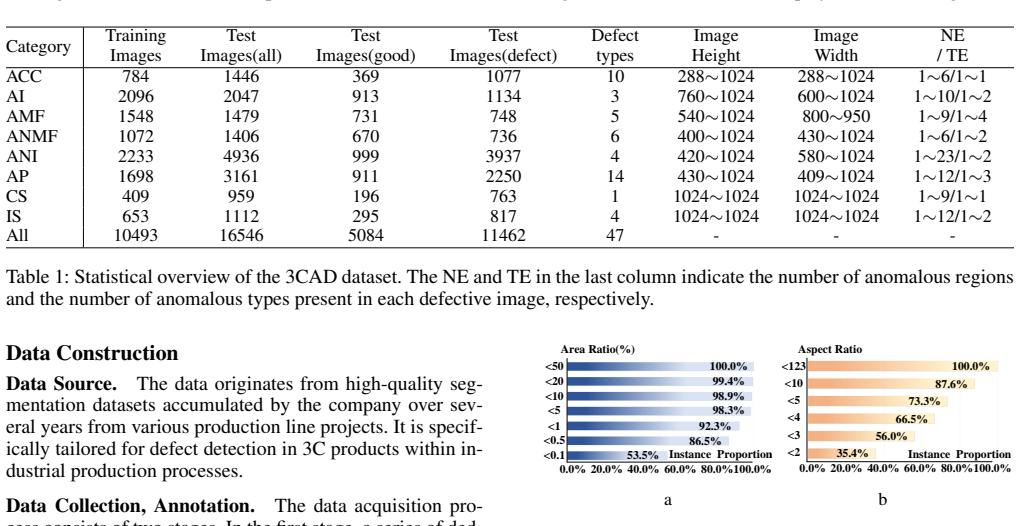
Summary. The paper introduces 3CAD, a dataset of 27,039 high-resolution images of eight 3C product types collected from real production lines, with pixel-level anomaly labels on defect images and a proposed training/test split. The authors also present CFRG, an unsupervised anomaly detection framework combining heterogeneous teacher-student distillation for coarse localization, a recovery network for normal-pattern guidance, and a segmentation module for fine localization. Benchmarks on 3CAD and MVTec-AD report that CFRG outperforms ten existing methods on 3CAD (e.g., 93.4% P-AUROC, 86.5% I-AUROC, 82.0% P-PRO, 17.6% AP) while remaining competitive on MVTec-AD. The paper's central claim is that 3CAD is the first and largest dataset dedicated to 3C product quality control with real-world defects and that it provides a more challenging benchmark than existing datasets.
Significance. If the label quality and test-set representativeness are established, 3CAD would be a valuable community resource: it targets real 3C production-line defects, includes small and multiple anomalies per image, and avoids the near-saturation of MVTec-AD. The benchmark results demonstrate that many strong existing methods degrade sharply on this data, which supports the paper's motivation for a more challenging testbed. CFRG's improvements on pixel-level localization over RD and DeSTSeg, if reproducible, would be a useful baseline. The release of data and code is a concrete strength that enables independent verification and follow-up work.
major comments (4)
- [Data Construction / Data Cleaning] The paper describes a multi-stage annotation review process (daily evaluations, team-leader assessment, re-labeling) but provides no quantitative label-quality evidence: no inter-annotator agreement, no per-category label-error audit, and no explicit policy for ambiguous defects that resemble normal surface features. Because every pixel-level metric reported in Tables 3 and 4 (P-AUROC, P-PRO, AP) treats these masks as ground truth, the benchmark's central claim is load-bearing on an unverified oracle. Please provide annotation agreement statistics, a sample-based mask-quality audit, and a release of the labeling protocol.
- [Dataset Description] The test set is described as 'carefully selected to represent the best acquisition for each product type,' but this selection criterion is not operationalized. If low-quality or ambiguous acquisitions were excluded, the reported test performance may overestimate deployment readiness on the full production-line distribution. Please specify how 'best acquisition' was defined, how many candidate images were excluded, and compare statistics (e.g., defect sizes, illumination conditions, motion blur) between selected and excluded images.
- [Experiments / Benchmark Evaluation] All benchmark numbers appear to come from a single run with no error bars or significance tests. The headline differences over strong baselines are small in several cases—e.g., 1.1% P-AUROC over RD and 1.4% over CRAD in Tables 3 and 4—so without multiple seeds (or paired tests) the claimed improvements are not statistically established. Please report mean ± std across at least three independent runs and, where feasible, a paired significance test for the main comparisons.
- [Comparison with Popular Datasets / Related Work] The paper states that the defects in Real-IAD are 'primarily artificially created' and Table 2 labels Real-IAD's defect source as 'Forged'. This appears to contradict the Real-IAD paper's own description of a real-world multi-view dataset with real defects. Because the novelty claim of 3CAD being the 'first' real-world dataset for 3C quality control rests on this characterization, please verify the source and either correct the claim or provide concrete visual or documented evidence supporting the 'Forged' categorization.
minor comments (6)
- [Abstract / Dataset Description] The abstract says 27,039 images are 'labeled with pixel-level anomalies,' but normal images are unlabeled and only defect images have pixel masks; please clarify that only the abnormal subset carries pixel-level annotations.
- [Tables 3 and 4] Some rows contain malformed entries, e.g., '92.0/83.2/' for RD++ in Table 4 and '77.2 /78.5' for Ours; please fix the formatting so that missing metrics are explicitly marked as '-'.
- [Results on 3CAD] The sentence 'CFRG achieve 93.4% AUROC, 86.5% AUPRO, 82.0% AP, and 17.6%' uses 'AUPRO' where 'P-PRO' is intended, and the final '17.6%' duplicates the AP value; please correct the metric names and remove the redundancy.
- [Equation (1)-(2)] The cosine similarity in Eq. (1) is written as a function of spatial coordinates (x,y), but the indices i and j are introduced only in the following sentence; please align the notation and clarify which index corresponds to which feature-map location.
- [Method / Training] Equation (2) uses the ground-truth mask G with synthesized anomalies during training; please specify explicitly whether G denotes the synthesized anomaly mask or the real defect mask and how it is obtained for synthetic anomalies.
- [Figure 3] The caption labels panels as 'a' and 'b' but does not describe them; please add a sentence explaining that (a) shows defect area ratio and (b) shows the aspect-ratio distribution.
Circularity Check
No load-bearing circularity; CFRG's components are externally grounded and benchmarked on independent MVTec-AD, with minor self-citations limited to related-work context.
full rationale
The central derivation chain is the 3CAD dataset construction plus the CFRG method. The dataset claim is factual and externally anchored in newly collected production-line data; the method is composed of standard distillation (Eq. 1-2), recovery (Eq. 3), and segmentation (Eq. 4) losses. Although Eq. 2 and Eq. 4 use a ground-truth mask G, this mask is the synthetic Perlin/DTD anomaly mask for the generated abnormal image xa, not the human-annotated test oracle; this is an auxiliary self-supervised objective, not a prediction that reduces to the benchmark labels. CFRG is also evaluated on MVTec-AD (Tables 7-8) with results comparable to known published numbers, so the method is not fitted only to 3CAD in a way that makes the benchmark claims circular. The self-citations (Xing and Li 2023; Xing et al. 2023, 2024a, 2024b) appear only in related-work surveys and are not used to justify a load-bearing premise or to import a uniqueness theorem. The reported hyperparameter/loss-weight choices (Table 9) are ablated on 3CAD, which is standard model selection rather than a renamed prediction. Concerns about missing inter-annotator agreement or the 'best acquisition' test-selection criterion are data-quality and representativeness risks, not circular derivation steps.
Assumptions & free parameters
free parameters (3)
- Loss weights (Ldis, Lrec, Lbce) =
1, 1, 1
- Gaussian filter sigma =
4
- SAHI crop overlap =
20%
assumptions (3)
- domain assumption Synthetic anomalies generated by DTD and Perlin noise approximate the distribution of real defects in 3C products well enough for training the anomaly detection model.
- domain assumption The pixel-level annotations provided by labeling staff under QE assessment are accurate and consistent.
- domain assumption Pre-trained ImageNet weights for the teacher network transfer to industrial 3C product images.
Cite this review
Pith. "Pith review of 3CAD: A Large-Scale Real-World 3C Product Dataset for Unsupervised Anomaly." pith.science (2026). https://pith.science/paper/XBITHO4U
@misc{pith2026250205761,
  author       = {Pith},
  title        = {Pith review of: 3CAD: A Large-Scale Real-World 3C Product Dataset for Unsupervised Anomaly},
  year         = {2026},
  howpublished = {\url{https://pith.science/paper/XBITHO4U}},
  note         = {Machine review of arXiv:2502.05761}
}
read the original abstract
Industrial anomaly detection achieves progress thanks to datasets such as MVTec-AD and VisA. However, they suffer from limitations in terms of the number of defect samples, types of defects, and availability of real-world scenes. These constraints inhibit researchers from further exploring the performance of industrial detection with higher accuracy. To this end, we propose a new large-scale anomaly detection dataset called 3CAD, which is derived from real 3C production lines. Specifically, the proposed 3CAD includes eight different types of manufactured parts, totaling 27,039 high-resolution images labeled with pixel-level anomalies. The key features of 3CAD are that it covers anomalous regions of different sizes, multiple anomaly types, and the possibility of multiple anomalous regions and multiple anomaly types per anomaly image. This is the largest and first anomaly detection dataset dedicated to 3C product quality control for community exploration and development. Meanwhile, we introduce a simple yet effective framework for unsupervised anomaly detection: a Coarse-to-Fine detection paradigm with Recovery Guidance (CFRG). To detect small defect anomalies, the proposed CFRG utilizes a coarse-to-fine detection paradigm. Specifically, we utilize a heterogeneous distillation model for coarse localization and then fine localization through a segmentation model. In addition, to better capture normal patterns, we introduce recovery features as guidance. Finally, we report the results of our CFRG framework and popular anomaly detection methods on the 3CAD dataset, demonstrating strong competitiveness and providing a highly challenging benchmark to promote the development of the anomaly detection field. Data and code are available: https://github.com/EnquanYang2022/3CAD.
Figures


Figures from the paper (6 more)


Forward citations
Cited by 1 Pith paper
-
OmniAD: Detect and Understand Industrial Anomaly via Multimodal Reasoning
OmniAD unifies industrial anomaly detection and understanding in a single multimodal model using text-encoded masks and reinforcement learning, reporting 79.1 on MMAD and strong detection scores.
Reference graph
Works this paper leans on
-
[1]
, " * write output.state after.block = add.period write newline
ENTRY address archivePrefix author booktitle chapter edition editor eid eprint howpublished institution isbn journal key month note number organization pages publisher school series title type volume year label extra.label sort.label short.list INTEGERS output.state before.all mid.sentence after.sentence after.block FUNCTION init.state.consts #0 'before.a...
-
[2]
write newline
" write newline "" before.all 'output.state := FUNCTION n.dashify 't := "" t empty not t #1 #1 substring "-" = t #1 #2 substring "--" = not "--" * t #2 global.max substring 't := t #1 #1 substring "-" = "-" * t #2 global.max substring 't := while if t #1 #1 substring * t #2 global.max substring 't := if while FUNCTION word.in bbl.in capitalize " " * FUNCT...
-
[3]
Bergmann, P.; Fauser, M.; Sattlegger, D.; and Steger, C. 2019. MVTec AD--A comprehensive real-world dataset for unsupervised anomaly detection. In Proceedings of the IEEE/CVF conference on computer vision and pattern recognition
work page 2019
-
[4]
Cao, Y.; Xu, X.; Liu, Z.; and Shen, W. 2023. Collaborative discrepancy optimization for reliable image anomaly localization. IEEE Transactions on Industrial Informatics
work page 2023
-
[5]
Cao, Y.; Xu, X.; Zhang, J.; Cheng, Y.; Huang, X.; Pang, G.; and Shen, W. 2024. A survey on visual anomaly detection: Challenge, approach, and prospect. arXiv preprint arXiv:2401.16402
arXiv 2024
-
[6]
Cimpoi, M.; Maji, S.; Kokkinos, I.; Mohamed, S.; and Vedaldi, A. 2014. Describing textures in the wild. In Proceedings of the IEEE conference on computer vision and pattern recognition
work page 2014
-
[7]
Defard, T.; Setkov, A.; Loesch, A.; and Audigier, R. 2021. Padim: a patch distribution modeling framework for anomaly detection and localization. In International Conference on Pattern Recognition. Springer
work page 2021
-
[8]
Deng, H.; and Li, X. 2022. Anomaly detection via reverse distillation from one-class embedding. In Proceedings of the IEEE/CVF conference on computer vision and pattern recognition
work page 2022
Show all 45 references
-
[9]
Gu, Z.; Zhang, J.; Liu, L.; Chen, X.; Peng, J.; Gan, Z.; Jiang, G.; Shu, A.; Wang, Y.; and Ma, L. 2024. Rethinking Reverse Distillation for Multi-Modal Anomaly Detection. In Proceedings of the AAAI Conference on Artificial Intelligence
2024
-
[10]
He, H.; Zhang, J.; Chen, H.; Chen, X.; Li, Z.; Chen, X.; Wang, Y.; Wang, C.; and Xie, L. 2024. A diffusion-based framework for multi-class anomaly detection. In Proceedings of the AAAI Conference on Artificial Intelligence
2024
-
[11]
He, Y.; Song, K.; Meng, Q.; and Yan, Y. 2019. An end-to-end steel surface defect detection approach via fusing multiple hierarchical features. IEEE transactions on instrumentation and measurement
2019
-
[12]
Hu, T.; Zhang, J.; Yi, R.; Du, Y.; Chen, X.; Liu, L.; Wang, Y.; and Wang, C. 2024. Anomalydiffusion: Few-shot anomaly image generation with diffusion model. In Proceedings of the AAAI Conference on Artificial Intelligence
2024
-
[13]
Huang, Y.; Qiu, C.; and Yuan, K. 2020. Surface defect saliency of magnetic tile. The Visual Computer
2020
-
[14]
Jezek, S.; Jonak, M.; Burget, R.; Dvorak, P.; and Skotak, M. 2021 a . Deep learning-based defect detection of metal parts: evaluating current methods in complex conditions. In 2021 13th International congress on ultra modern telecommunications and control systems and workshops...
2021
-
[15]
Jezek, S.; Jonak, M.; Burget, R.; Dvorak, P.; and Skotak, M. 2021 b . Deep learning-based defect detection of metal parts: evaluating current methods in complex conditions. In 2021 13th International congress on ultra modern telecommunications and control systems and workshops...
2021
-
[16]
C.; Kim, T.; Park, E.; Woo, S
Lee, J. C.; Kim, T.; Park, E.; Woo, S. S.; and Ko, J. H. 2024. Continuous Memory Representation for Anomaly Detection. In European conference on computer vision. Springer
2024
-
[17]
Li, C.-L.; Sohn, K.; Yoon, J.; and Pfister, T. 2021. Cutpaste: Self-supervised learning for anomaly detection and localization. In Proceedings of the IEEE/CVF conference on computer vision and pattern recognition
2021
-
[18]
Liu, J.; Wu, K.; Nie, Q.; Chen, Y.; Gao, B.-B.; Liu, Y.; Wang, J.; Wang, C.; and Zheng, F. 2024 a . Unsupervised Continual Anomaly Detection with Contrastively-Learned Prompt. In Proceedings of the AAAI Conference on Artificial Intelligence
2024
-
[19]
Liu, J.; Xie, G.; Wang, J.; Li, S.; Wang, C.; Zheng, F.; and Jin, Y. 2024 b . Deep industrial image anomaly detection: A survey. Machine Intelligence Research
2024
-
[20]
Liu, Z.; Zhou, Y.; Xu, Y.; and Wang, Z. 2023. Simplenet: A simple network for image anomaly detection and localization. In Proceedings of the IEEE/CVF Conference on Computer Vision and Pattern Recognition
2023
-
[21]
Mishra, P.; Verk, R.; Fornasier, D.; Piciarelli, C.; and Foresti, G. L. 2021. VT-ADL: A vision transformer network for image anomaly detection and localization. In 2021 IEEE 30th International Symposium on Industrial Electronics (ISIE). IEEE
2021
-
[22]
Nagata, F.; Tokuno, K.; Nakashima, K.; Otsuka, A.; Ikeda, T.; Ochi, H.; Watanabe, K.; and Habib, M. K. 2019. Fusion method of convolutional neural network and support vector machine for high accuracy anomaly detection. In 2019 IEEE International Conference on Mechatronics and ...
2019
-
[23]
Roth, K.; Pemula, L.; Zepeda, J.; Sch \"o lkopf, B.; Brox, T.; and Gehler, P. 2022. Towards total recall in industrial anomaly detection. In Proceedings of the IEEE/CVF conference on computer vision and pattern recognition
2022
-
[24]
Rudolph, M.; Wehrbein, T.; Rosenhahn, B.; and Wandt, B. 2023. Asymmetric student-teacher networks for industrial anomaly detection. In Proceedings of the IEEE/CVF winter conference on applications of computer vision
2023
-
[25]
H.; and Rabiee, H
Salehi, M.; Sadjadi, N.; Baselizadeh, S.; Rohban, M. H.; and Rabiee, H. R. 2021. Multiresolution knowledge distillation for anomaly detection. In Proceedings of the IEEE/CVF conference on computer vision and pattern recognition
2021
-
[26]
Shen, F.; Ye, H.; Zhang, J.; Wang, C.; Han, X.; and Yang, W. 2023. Advancing pose-guided image synthesis with progressive conditional diffusion models. arXiv preprint arXiv:2310.06313
2023 arXiv
-
[27]
Tan, M.; and Le, Q. 2019. Efficientnet: Rethinking model scaling for convolutional neural networks. In International conference on machine learning. PMLR
2019
-
[28]
Tang, S.; He, F.; Huang, X.; and Yang, J. 2019. Online PCB defect detector on a new PCB defect dataset. arXiv preprint arXiv:1902.06197
2019 arXiv
-
[29]
D.; Nguyen, A
Tien, T. D.; Nguyen, A. T.; Tran, N. H.; Huy, T. D.; Duong, S.; Nguyen, C. D. T.; and Truong, S. Q. 2023. Revisiting reverse distillation for anomaly detection. In Proceedings of the IEEE/CVF conference on computer vision and pattern recognition
2023
-
[30]
Wang, C.; Zhu, W.; Gao, B.-B.; Gan, Z.; Zhang, J.; Gu, Z.; Qian, S.; Chen, M.; and Ma, L. 2024. Real-iad: A real-world multi-view dataset for benchmarking versatile industrial anomaly detection. In Proceedings of the IEEE/CVF Conference on Computer Vision and Pattern Recognition
2024
-
[31]
Xing, P.; and Li, Z. 2023. Visual anomaly detection via partition memory bank module and error estimation. IEEE Transactions on Circuits and Systems for Video Technology
2023
-
[32]
Xing, P.; Sun, Y.; Zeng, D.; and Li, Z. 2023. Normal image guided segmentation framework for unsupervised anomaly detection. IEEE Transactions on Circuits and Systems for Video Technology
2023
-
[33]
Xing, P.; Tang, H.; Tang, J.; and Li, Z. 2024 a . ADPS: Asymmetric Distillation Postsegmentation for Image Anomaly Detection. IEEE Transactions on Neural Networks and Learning Systems
2024
-
[34]
Xing, P.; Zhang, D.; Tang, J.; et al. 2024 b . A Recover-then-Discriminate Framework for Robust Anomaly Detection. arXiv preprint arXiv:2406.04608
2024 arXiv
-
[35]
You, Z.; Cui, L.; Shen, Y.; Yang, K.; Lu, X.; Zheng, Y.; and Le, X. 2022. A unified model for multi-class anomaly detection. Advances in Neural Information Processing Systems
2022
-
[36]
Yu, J.; Zheng, Y.; Wang, X.; Li, W.; Wu, Y.; Zhao, R.; and Wu, L. 2021. Fastflow: Unsupervised anomaly detection and localization via 2d normalizing flows. arXiv preprint arXiv:2111.07677
2021 arXiv
-
[37]
Zagoruyko, S.; and Komodakis, N. 2016. Wide residual networks. arXiv preprint arXiv:1605.07146
2016 arXiv
-
[38]
Zavrtanik, V.; Kristan, M.; and Sko c aj, D. 2021 a . Draem-a discriminatively trained reconstruction embedding for surface anomaly detection. In Proceedings of the IEEE/CVF international conference on computer vision
2021
-
[39]
Zavrtanik, V.; Kristan, M.; and Sko c aj, D. 2021 b . Reconstruction by inpainting for visual anomaly detection. Pattern Recognition
2021
-
[40]
Zhang, C.; Chang, C.-c.; and Jamshidi, M. 2020. Concrete bridge surface damage detection using a single-stage detector. Computer-Aided Civil and Infrastructure Engineering
2020
-
[41]
Zhang, H.; Wu, Z.; Wang, Z.; Chen, Z.; and Jiang, Y.-G. 2023 a . Prototypical residual networks for anomaly detection and localization. In Proceedings of the IEEE/CVF Conference on Computer Vision and Pattern Recognition
2023
-
[42]
Zhang, X.; Li, S.; Li, X.; Huang, P.; Shan, J.; and Chen, T. 2023 b . Destseg: Segmentation guided denoising student-teacher for anomaly detection. In Proceedings of the IEEE/CVF Conference on Computer Vision and Pattern Recognition
2023
-
[43]
Zhang, X.; Xu, M.; and Zhou, X. 2024. RealNet: A feature selection network with realistic synthetic anomaly for anomaly detection. In Proceedings of the IEEE/CVF Conference on Computer Vision and Pattern Recognition
2024
-
[44]
Zou, Q.; Zhang, Z.; Li, Q.; Qi, X.; Wang, Q.; and Wang, S. 2018. Deepcrack: Learning hierarchical convolutional features for crack detection. IEEE transactions on image processing
2018
-
[45]
Zou, Y.; Jeong, J.; Pemula, L.; Zhang, D.; and Dabeer, O. 2022. Spot-the-difference self-supervised pre-training for anomaly detection and segmentation. In European Conference on Computer Vision. Springer
2022
Reviewed August 8, 2026 · model on record in the stance chip above.
Discussion (0). Continue with ORCID to comment.