REVIEW 4 major objections 6 minor 63 references
SphereFusion: Efficient Panorama Depth Estimation via Gated Fusion
T0 review · 4 major / 6 minor · reviewed 2026-08-08 · deepseek-v4-flash
Pith's one-line read SphereFusion claims that fusing equirectangular and spherical features with learned gates produces panorama depth accuracy competitive with state-of-the-art methods while running at about 60 frames per second on 512x1024 images.
desk verdict Solid fusion method for panorama depth, but the "fastest inference" claim rests on uncontrolled baseline timings and needs a same-machine re-benchmark. read the letter →
The pith
A machine-rendered reading of the paper's core claim, the machinery that carries it, and where it could break.
The reading
What carries the argument
The load-bearing mechanism is GateFuse, a fusion module that combines spherical features $F_{sp}$ and equirectangular features $F_{eq}$ in the spherical domain using a reset gate $r$ and a forget gate $z$, so the network learns which projection to trust at each location rather than assuming one is better. Supporting it are the E2S/S2E projection mappings between equirectangular pixels and spherical triangle centers, mesh convolution and pooling built on face-adjacent-face connectivity from the icosahedron mesh, and a cache that stores the adjacency structure of active meshes to avoid recomputing it per layer.
What would settle it
Run the compared baselines on the same GPU with the same 512x1024 input and the same software stack; if any of them matches or beats 17 ms per image, the paper's headline efficiency claim fails.
Extended reading notes
Core claim
The paper's discovery is that depth estimation performed entirely on an icosahedral spherical mesh can be made both accurate and fast if the mesh features are augmented with equirectangular features through a gated fusion module. SphereFusion extracts features with a ResNet18-style mesh encoder and a ResNet50 image encoder, projects both onto the sphere, and uses reset and forget gates, inspired by GRU, to select reliable features from each source before a mesh decoder produces the depth map. A cache strategy precomputes and stores the face-adjacency information needed for mesh convolutions, avoiding repeated computation. The authors report that SphereFusion achieves the best MRE and MAE on the synthetic 360D dataset and the best MRE and RMSE(log) on Stanford2D3D, with overall accuracy competitive with transformer-based methods, and inference of 0.0174 seconds per 512x1024 panorama.
Load-bearing premise
The speed comparison is the load-bearing premise: SphereFusion's own timing on one RTX 3090 is compared with baseline times reported in other papers, and those baselines may have been measured on different hardware, resolution, or software.
Editorial extensions
If this is right
- If the reported speed holds, panorama depth estimation becomes practical for real-time robotics and autonomous driving on a single consumer GPU.
- The accuracy results suggest that a simple ResNet encoder plus a well-chosen projection can rival transformer-based panorama depth models, so future work may not need heavy ViT backbones for this task.
- The cache strategy makes mesh operations affordable at 512x1024 but, as the paper states, adds GPU memory pressure and currently blocks ultra-high-resolution inputs such as 1024x2048.
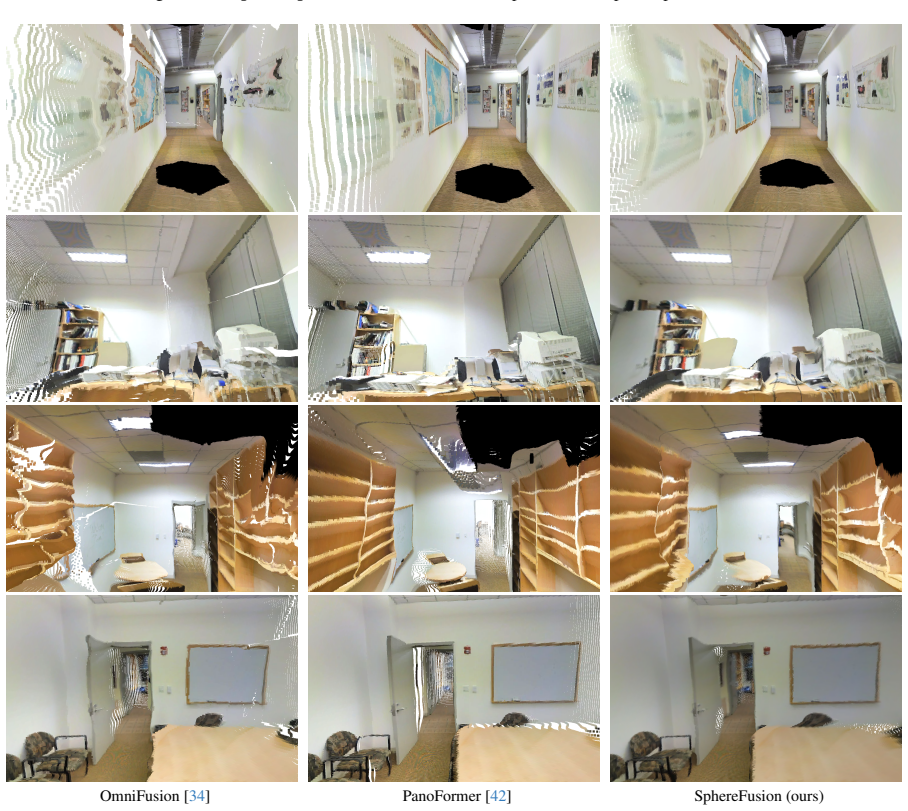
- Because the depth map is produced directly in the spherical domain, SphereFusion avoids the patch-gap artifacts seen in tangent-projection methods like OmniFusion.
Reading between the lines
- An implication the authors leave implicit is that GateFuse is a generic feature-fusion idea: it could be tested on other 360-degree dense prediction tasks such as semantic segmentation or layout estimation, where the same distortion-versus-detail tradeoff exists.
- If the fusion is the real source of accuracy, then replacing only the encoders with stronger backbones, while keeping GateFuse and the cache, should improve accuracy without sacrificing the speed advantage.
- A direct comparison of all methods on identical hardware is the obvious next test; the paper does not report re-running baselines, so the 17 ms figure is best read as a ceiling until such a benchmark exists.
- The memory cost of the FAF cache suggests the speed gain may not transfer to higher resolutions, so a sparse or on-the-fly adjacency computation would be a natural extension to test.
Editorial analysis
A structured set of objections, weighed in public.
Referee Report
Summary. SphereFusion is a panorama depth estimation method that fuses equirectangular features from a 2D ResNet encoder with spherical-mesh features from a lightweight mesh encoder, using a GRU-inspired GateFuse module to select reliable features in the spherical domain. The paper evaluates the method on 360D, Matterport3D, and Stanford2D3D, reports competitive accuracy against state-of-the-art methods, and claims the fastest inference at 17 ms per 512x1024 panorama on an RTX 3090. Ablation studies isolate the contributions of the two encoders and the fusion strategy.
Significance. If the technical result holds, the paper makes a useful engineering contribution: it shows that a lightweight fusion of equirectangular and spherical features can achieve accuracy close to transformer-based methods while running considerably faster. The evaluation on three public datasets and the ablations isolating encoder and fusion choices are strengths, as is the clear reporting of the authors' own timing procedure. However, the central efficiency claim rests on a timing comparison that is not controlled across baselines, and the GateFuse module is not specified precisely enough for independent implementation. The paper would be a solid contribution after these issues are fixed.
major comments (4)
- [Section 4.3, Table 1] The claim that SphereFusion is the most efficient method, requiring only 0.0174 seconds per image during inference, is not supported by a controlled comparison. The text describes the authors' own timing procedure (100 images on a single RTX 3090) but does not state that the baseline timings were re-measured on the same GPU, at the same resolution and precision, or using the same framework. The footnote only mentions recalculating SliceNet metrics from open-source models, not timings. Since Table 1 lists timings from different published papers with possibly different hardware, the headline speed advantage could change under identical conditions. Please re-run all baselines on the same hardware and report the exact setup for each, or, failing that, restrict the claim to 'fastest among published timings rather than a directly measured comparison.'
- [Section 4.3 and Section 8] The reported inference time of 0.0174 s does not specify whether it includes the spherical-to-equirectangular (S2E) conversion described in Section 8, which is required to produce the evaluated depth map. Since the network outputs depth in the spherical domain, the end-to-end latency to an equirectangular depth image may be larger than the raw forward pass. Please state clearly whether the 17 ms includes the S2E conversion, the cache construction, and any post-processing needed for evaluation.
- [Section 3.3.2] GateFuse, a central contribution, is described only verbally as using a reset gate and a forget gate inspired by GRU. No equations define how the reset gate r and forget gate z are computed from the concatenated features, how they select from Fsp and Feq, or how the final fused feature Ffused is formed. This makes the fusion module underspecified and not independently implementable. Please add the precise gate equations, activation functions, and the fusion formula.
- [Section 4.3 vs Section 8] The evaluation depth range is inconsistent between the main text and the supplementary material. Section 4.3 states that pixels outside 0.1-10 meters are ignored for 360D and 0.1-16 meters for Stanford2D3D and Matterport3D, whereas Section 8 of the supplementary states that the depth range is set to 0.1-10 meters. This discrepancy directly affects the computed metrics and comparability with baselines. Please correct the inconsistency and explicitly state the depth range used for each dataset.
minor comments (6)
- [Section 4.3] For Matterport3D, the text says the method ranks second on MRE, MAE, and RMSE(log), but Table 1 shows UniFuse has lower values (MRE 0.1063 vs 0.1145, MAE 0.2814 vs 0.2852, RMSE(log) 0.0701 vs 0.0733), so the method actually ranks third on these metrics.
- [Supplementary Section 8, Eq. 8] The definitions of MAE and MRE are given as sums without division by N, while RMSE and RMSE(log) divide by N; this is inconsistent and likely a typo. Please insert the missing normalization.
- [Section 4.4 and Supplementary Figures] OmniFusion is cited as [51] and PanoFormer as [29] in several places; the correct references are [34] and [42], respectively.
- [Throughout] There are several typos and stray fragments: 'SphereFuion' in Section 4.6, 'OminiFusion' in Figure 1, 'Visulization' in Section 9, 'Standard2D3D' in Table 1, and an orphaned citation fragment '[20, 23, 27, 51].' in Section 2.2. Please proofread carefully.
- [Section 3.4] The multi-scale loss weights s_i in Eq. 5 are not specified in Section 4.2 or elsewhere; please report the values used during training.
- [General] No code is released, which makes it difficult for the community to independently reproduce the accuracy and timing results; releasing code would strengthen the paper.
Circularity Check
No circularity: accuracy claims rest on external benchmarks and independent baselines; the uncontrolled timing comparison is a fairness/correctness concern, not a circular derivation.
full rationale
The paper's derivation chain is self-contained with respect to the depth-estimation task. The projections (Eqs. 1, 2, 6), mesh convolution (Eq. 3), and loss functions (Eqs. 4, 5) are standard operations defined from geometry and ground-truth depth, not from the target evaluation metrics. The accuracy comparison uses three public datasets (360D, Matterport3D, Stanford2D3D) and independent published baselines; the ablation studies implement BiFuse and UniFuse fusion inside the same framework and show empirical differences, so GateFuse is not equivalent to its inputs by construction. The only self-citation is to the authors' prior SphereDepth, used as a source of mesh operations and as a baseline; this is not load-bearing because SphereFusion's improvement over SphereDepth is an external empirical result rather than an assumed premise. The 'fastest inference' claim (0.0174 s/image) is based on the authors' own RTX 3090 timing while baseline timings appear to be quoted from original papers without a controlled same-machine re-benchmark; that is a potential benchmarking-fairness weakness, but it is not circular reasoning because no fitted parameter is renamed as a prediction and no equation reduces to its own output. Therefore the paper shows no significant circularity.
Assumptions & free parameters
free parameters (3)
- BerHu loss threshold T =
0.2
- Spherical mesh resolution ranges =
MR 2 to 7 for 360D; MR 3 to 8 for Matterport3D and Stanford2D3D
- Multi-scale loss weights s_i =
unspecified
assumptions (3)
- domain assumption The icosahedral spherical mesh at the chosen MRs is an adequate approximation of the sphere for depth estimation without significant distortion or discontinuity artifacts.
- domain assumption E2S bilinear sampling and S2E nearest-triangle assignment preserve the correspondence between equirectangular and spherical features well enough for fusion.
- domain assumption The evaluation protocol, including depth range clipping (0.1 to 10 m for 360D, 0.1 to 16 m for the real datasets), matches the protocols used in the cited baseline papers so that the published numbers are comparable.
Cite this review
Pith. "Pith review of SphereFusion: Efficient Panorama Depth Estimation via Gated Fusion." pith.science (2026). https://pith.science/paper/WN66TYLJ
@misc{pith2026250205859,
  author       = {Pith},
  title        = {Pith review of: SphereFusion: Efficient Panorama Depth Estimation via Gated Fusion},
  year         = {2026},
  howpublished = {\url{https://pith.science/paper/WN66TYLJ}},
  note         = {Machine review of arXiv:2502.05859}
}
abstract
Due to the rapid development of panorama cameras, the task of estimating panorama depth has attracted significant attention from the computer vision community, especially in applications such as robot sensing and autonomous driving. However, existing methods relying on different projection formats often encounter challenges, either struggling with distortion and discontinuity in the case of equirectangular, cubemap, and tangent projections, or experiencing a loss of texture details with the spherical projection. To tackle these concerns, we present SphereFusion, an end-to-end framework that combines the strengths of various projection methods. Specifically, SphereFusion initially employs 2D image convolution and mesh operations to extract two distinct types of features from the panorama image in both equirectangular and spherical projection domains. These features are then projected onto the spherical domain, where a gate fusion module selects the most reliable features for fusion. Finally, SphereFusion estimates panorama depth within the spherical domain. Meanwhile, SphereFusion employs a cache strategy to improve the efficiency of mesh operation. Extensive experiments on three public panorama datasets demonstrate that SphereFusion achieves competitive results with other state-of-the-art methods, while presenting the fastest inference speed at only 17 ms on a 512$\times$1024 panorama image.
Figures


Figures from the paper (12 more)


Reference graph
Works this paper leans on
-
[1]
Pano3d: A holistic benchmark and a solid baseline for 360deg depth estimation
Georgios Albanis, Nikolaos Zioulis, Petros Drakoulis, Vasileios Gkitsas, Vladimiros Sterzentsenko, Federico Al- varez, Dimitrios Zarpalas, and Petros Daras. Pano3d: A holistic benchmark and a solid baseline for 360deg depth estimation. In Proceedings of the IEEE/CVF Conference on Computer Vision and Pattern Recognition , pages 3727– 3737, 2021. 1
work page 2021
-
[2]
High quality monoc- ular depth estimation via transfer learning
Ibraheem Alhashim and Peter Wonka. High quality monoc- ular depth estimation via transfer learning. arXiv preprint arXiv:1812.11941, 2018. 2
arXiv 2018
-
[3]
Joint 2d-3d-semantic data for indoor scene understanding
Iro Armeni, Sasha Sax, Amir R Zamir, and Silvio Savarese. Joint 2d-3d-semantic data for indoor scene understanding. arXiv preprint arXiv:1702.01105, 2017. 1, 6, 7
arXiv 2017
-
[4]
Adabins: Depth estimation using adaptive bins
Shariq Farooq Bhat, Ibraheem Alhashim, and Peter Wonka. Adabins: Depth estimation using adaptive bins. In Proceed- ings of the IEEE/CVF Conference on Computer Vision and Pattern Recognition, pages 4009–4018, 2021. 2
work page 2021
-
[5]
Jia-Wang Bian, Huangying Zhan, Naiyan Wang, Zhichao Li, Le Zhang, Chunhua Shen, Ming-Ming Cheng, and Ian Reid. Unsupervised scale-consistent depth learning from video.In- ternational Journal of Computer Vision, 129(9):2548–2564,
-
[6]
Matterport3d: Learning from rgb-d data in indoor environments
Angel Chang, Angela Dai, Thomas Funkhouser, Maciej Halber, Matthias Niessner, Manolis Savva, Shuran Song, Andy Zeng, and Yinda Zhang. Matterport3d: Learning from rgb-d data in indoor environments. arXiv preprint arXiv:1709.06158, 2017. 1, 6, 7
arXiv 2017
-
[7]
Distortion-aware monocular depth estimation for omnidirectional images
Hong-Xiang Chen, Kunhong Li, Zhiheng Fu, Mengyi Liu, Zonghao Chen, and Yulan Guo. Distortion-aware monocular depth estimation for omnidirectional images. IEEE Signal Processing Letters, 28:334–338, 2021. 2, 3
work page 2021
-
[8]
Cube padding for weakly-supervised saliency prediction in 360 videos
Hsien-Tzu Cheng, Chun-Hung Chao, Jin-Dong Dong, Hao- Kai Wen, Tyng-Luh Liu, and Min Sun. Cube padding for weakly-supervised saliency prediction in 360 videos. InPro- ceedings of the IEEE Conference on Computer Vision and Pattern Recognition, pages 1420–1429, 2018. 2
work page 2018
Show all 63 references
-
[9]
Omnidirectional depth extension networks
Xinjing Cheng, Peng Wang, Yanqi Zhou, Chenye Guan, and Ruigang Yang. Omnidirectional depth extension networks. In 2020 IEEE International Conference on Robotics and Au- tomation (ICRA), pages 589–595. IEEE, 2020. 3
2020
-
[10]
Learning phrase representations using rnn encoder-decoder for statistical machine translation
Kyunghyun Cho, Bart Van Merri ¨enboer, Caglar Gulcehre, Dzmitry Bahdanau, Fethi Bougares, Holger Schwenk, and Yoshua Bengio. Learning phrase representations using rnn encoder-decoder for statistical machine translation. arXiv preprint arXiv:1406.1078, 2014. 5
2014 arXiv
-
[11]
MeshLab: an Open-Source Mesh Processing Tool
Paolo Cignoni, Marco Callieri, Massimiliano Corsini, Mat- teo Dellepiane, Fabio Ganovelli, and Guido Ranzuglia. MeshLab: an Open-Source Mesh Processing Tool. In Euro- graphics Italian Chapter Conference. The Eurographics As- sociation, 2008. 7
2008
-
[12]
Spherical cnns
Taco S Cohen, Mario Geiger, Jonas K ¨ohler, and Max Welling. Spherical cnns. arXiv preprint arXiv:1801.10130,
-
[13]
Eliminating the blind spot: Adapting 3d object detection and monocular depth estimation to 360 panoramic imagery
Greire Payen de La Garanderie, Amir Atapour Abarghouei, and Toby P Breckon. Eliminating the blind spot: Adapting 3d object detection and monocular depth estimation to 360 panoramic imagery. In Proceedings of the European Con- ference on Computer Vision (ECCV), pages 789–807, 2018. 3
2018
-
[14]
An image is worth 16x16 words: Transformers for image recognition at scale
Alexey Dosovitskiy, Lucas Beyer, Alexander Kolesnikov, Dirk Weissenborn, Xiaohua Zhai, Thomas Unterthiner, Mostafa Dehghani, Matthias Minderer, Georg Heigold, Syl- vain Gelly, Jakob Uszkoreit, and Neil Houlsby. An image is worth 16x16 words: Transformers for image recognition ...
2021
-
[15]
Pano popups: In- door 3d reconstruction with a plane-aware network
Marc Eder, Pierre Moulon, and Li Guan. Pano popups: In- door 3d reconstruction with a plane-aware network. In 2019 International Conference on 3D Vision (3DV), pages 76–84. IEEE, 2019. 3
2019
-
[16]
Mapped convolutions
Marc Eder, True Price, Thanh Vu, Akash Bapat, and Jan- Michael Frahm. Mapped convolutions. arXiv preprint arXiv:1906.11096, 2019. 3
1906 arXiv
-
[17]
Tangent images for mitigating spherical distortion
Marc Eder, Mykhailo Shvets, John Lim, and Jan-Michael Frahm. Tangent images for mitigating spherical distortion. In Proceedings of the IEEE/CVF Conference on Computer Vision and Pattern Recognition, pages 12426–12434, 2020. 1, 3, 4
2020
-
[18]
Predicting depth, surface nor- mals and semantic labels with a common multi-scale con- volutional architecture
David Eigen and Rob Fergus. Predicting depth, surface nor- mals and semantic labels with a common multi-scale con- volutional architecture. In Proceedings of the IEEE inter- national conference on computer vision , pages 2650–2658,
-
[19]
Depth map prediction from a single image using a multi-scale deep net- work
David Eigen, Christian Puhrsch, and Rob Fergus. Depth map prediction from a single image using a multi-scale deep net- work. Advances in neural information processing systems , 27, 2014. 2
2014
-
[20]
Meshnet: Mesh neural network for 3d shape rep- resentation
Yutong Feng, Yifan Feng, Haoxuan You, Xibin Zhao, and Yue Gao. Meshnet: Mesh neural network for 3d shape rep- resentation. In Proceedings of the AAAI Conference on Arti- ficial Intelligence, pages 8279–8286, 2019. 2, 3
2019
-
[21]
Corners for layout: End-to-end layout recovery from 360 images
Clara Fernandez-Labrador, Jose M Facil, Alejandro Perez- Yus, C´edric Demonceaux, Javier Civera, and Jose J Guer- rero. Corners for layout: End-to-end layout recovery from 360 images. IEEE Robotics and Automation Letters , 5(2): 1255–1262, 2020. 3
2020
-
[22]
Digging into self-supervised monocular depth estimation
Cl ´ement Godard, Oisin Mac Aodha, Michael Firman, and Gabriel J Brostow. Digging into self-supervised monocular depth estimation. In Proceedings of the IEEE/CVF Inter- national Conference on Computer Vision, pages 3828–3838,
-
[23]
Meshcnn: a network with an edge
Rana Hanocka, Amir Hertz, Noa Fish, Raja Giryes, Shachar Fleishman, and Daniel Cohen-Or. Meshcnn: a network with an edge. ACM Transactions on Graphics (TOG), 38(4):1–12,
-
[24]
Deep residual learning for image recognition
Kaiming He, Xiangyu Zhang, Shaoqing Ren, and Jian Sun. Deep residual learning for image recognition. In Proceed- ings of the IEEE conference on computer vision and pattern recognition, pages 770–778, 2016. 2, 3, 4
2016
-
[25]
Auto- matic photo pop-up
Derek Hoiem, Alexei A Efros, and Martial Hebert. Auto- matic photo pop-up. ACM Trans. Graph., pages 577–584,
-
[26]
Jittor: a novel deep learning framework with meta-operators and unified graph execution
Shi-Min Hu, Dun Liang, Guo-Ye Yang, Guo-Wei Yang, and Wen-Yang Zhou. Jittor: a novel deep learning framework with meta-operators and unified graph execution. Science China Information Sciences, 63(222103):1–21, 2020. 6
2020
-
[27]
Subdivision-based mesh convolution networks
Shi-Min Hu, Zheng-Ning Liu, Meng-Hao Guo, Jun-Xiong Cai, Jiahui Huang, Tai-Jiang Mu, and Ralph R Martin. Subdivision-based mesh convolution networks. ACM Trans- actions on Graphics (TOG), 41:1–16, 2022. 2, 3, 4
2022
-
[28]
Spherical cnns on unstructured grids
Chiyu Jiang, Jingwei Huang, Karthik Kashinath, Philip Mar- cus, Matthias Niessner, et al. Spherical cnns on unstructured grids. arXiv preprint arXiv:1901.02039, 2019. 3
1901 arXiv
-
[29]
Unifuse: Unidirectional fusion for 360 panorama depth estimation
Hualie Jiang, Zhe Sheng, Siyu Zhu, Zilong Dong, and Rui Huang. Unifuse: Unidirectional fusion for 360 panorama depth estimation. IEEE Robotics and Automation Letters, 6 (2):1519–1526, 2021. 1, 2, 3, 5, 6, 7, 8
2021
-
[30]
Geometric structure based and regularized depth estimation from 360 indoor imagery
Lei Jin, Yanyu Xu, Jia Zheng, Junfei Zhang, Rui Tang, Shugong Xu, Jingyi Yu, and Shenghua Gao. Geometric structure based and regularized depth estimation from 360 indoor imagery. In Proceedings of the IEEE/CVF Confer- ence on Computer Vision and Pattern Recognition , pages 889...
2020
-
[31]
Himode: A hybrid monocular omnidirectional depth estimation model
Masum Shah Junayed, Arezoo Sadeghzadeh, Md Baharul Is- lam, Lai-Kuan Wong, and Tarkan Aydın. Himode: A hybrid monocular omnidirectional depth estimation model. In Pro- ceedings of the IEEE/CVF Conference on Computer Vision and Pattern Recognition, pages 5212–5221, 2022. 2
2022
-
[32]
Deeper depth prediction with fully convolutional residual networks
Iro Laina, Christian Rupprecht, Vasileios Belagiannis, Fed- erico Tombari, and Nassir Navab. Deeper depth prediction with fully convolutional residual networks. In 2016 Fourth international conference on 3D vision (3DV) , pages 239–
2016
-
[33]
Spherephd: Applying cnns on 360° images with non-euclidean spherical polyhedron represen- tation
Yeonkun Lee, Jaeseok Jeong, Jongseob Yun, Wonjune Cho, and Kuk-Jin Yoon. Spherephd: Applying cnns on 360° images with non-euclidean spherical polyhedron represen- tation. IEEE Transactions on Pattern Analysis and Machine Intelligence, 2020. 3
2020
-
[34]
Omnifusion: 360 monocular depth estimation via geometry-aware fusion
Yuyan Li, Yuliang Guo, Zhixin Yan, Xinyu Huang, Ye Duan, and Liu Ren. Omnifusion: 360 monocular depth estimation via geometry-aware fusion. In Proceedings of the IEEE/CVF Conference on Computer Vision and Pattern Recognition , pages 2801–2810, 2022. 1, 2, 3, 6, 7, 4
2022
-
[35]
P3depth: Monocular depth estimation with a piecewise planarity prior
Vaishakh Patil, Christos Sakaridis, Alexander Liniger, and Luc Van Gool. P3depth: Monocular depth estimation with a piecewise planarity prior. In Proceedings of the IEEE/CVF Conference on Computer Vision and Pattern Recognition , pages 1610–1621, 2022. 2
2022
-
[36]
High-resolution depth estimation for 360-degree panoramas through perspective and panoramic depth images registration
Chi-Han Peng and Jiayao Zhang. High-resolution depth estimation for 360-degree panoramas through perspective and panoramic depth images registration. arXiv preprint arXiv:2210.10414, 2022. 2, 3
2022 arXiv
-
[37]
Slicenet: deep dense depth esti- mation from a single indoor panorama using a slice-based representation
Giovanni Pintore, Marco Agus, Eva Almansa, Jens Schnei- der, and Enrico Gobbetti. Slicenet: deep dense depth esti- mation from a single indoor panorama using a slice-based representation. In Proceedings of the IEEE/CVF Conference on Computer Vision and Pattern Recognition, pag...
2021
-
[38]
Towards robust monocular depth estimation: Mixing datasets for zero-shot cross-dataset transfer
Ren ´e Ranftl, Katrin Lasinger, David Hafner, Konrad Schindler, and Vladlen Koltun. Towards robust monocular depth estimation: Mixing datasets for zero-shot cross-dataset transfer. IEEE transactions on pattern analysis and machine intelligence, 2020. 2
2020
-
[39]
360monodepth: High-resolution 360deg monocular depth estimation
Manuel Rey-Area, Mingze Yuan, and Christian Richardt. 360monodepth: High-resolution 360deg monocular depth estimation. In Proceedings of the IEEE/CVF Conference on Computer Vision and Pattern Recognition , pages 3762– 3772, 2022. 3, 8
2022
-
[40]
U- net: Convolutional networks for biomedical image segmen- tation
Olaf Ronneberger, Philipp Fischer, and Thomas Brox. U- net: Convolutional networks for biomedical image segmen- tation. In International Conference on Medical image com- puting and computer-assisted intervention , pages 234–241. Springer, 2015. 5
2015
-
[41]
Make3d: Learning 3d scene structure from a single still image
Ashutosh Saxena, Min Sun, and Andrew Y Ng. Make3d: Learning 3d scene structure from a single still image. IEEE transactions on pattern analysis and machine intelligence , 31(5):824–840, 2008. 2
2008
-
[42]
Panoformer: Panorama transformer for indoor 360 depth estimation
Zhijie Shen, Chunyu Lin, Kang Liao, Lang Nie, Zishuo Zheng, and Yao Zhao. Panoformer: Panorama transformer for indoor 360 depth estimation. In Computer Vision–ECCV 2022: 17th European Conference, Tel Aviv, Israel, October 23–27, 2022, Proceedings, Part I, pages 195–211. Springer,
2022
-
[43]
Neural contourlet network for monocular 360 depth estimation
Zhijie Shen, Chunyu Lin, Lang Nie, Kang Liao, and Yao Zhao. Neural contourlet network for monocular 360 depth estimation. IEEE Transactions on Circuits and Systems for Video Technology, 32(12):8574–8585, 2022. 2
2022
-
[44]
Standardization status of 360 degree video coding and delivery
Robert Skupin, Yago Sanchez, Y-K Wang, Miska M Han- nuksela, J Boyce, and Mathias Wien. Standardization status of 360 degree video coding and delivery. In 2017 IEEE Vi- sual Communications and Image Processing (VCIP) , pages 1–4. IEEE, 2017. 1
2017
-
[45]
Kernel transformer net- works for compact spherical convolution
Yu-Chuan Su and Kristen Grauman. Kernel transformer net- works for compact spherical convolution. In Proceedings of the IEEE/CVF Conference on Computer Vision and Pattern Recognition, pages 9442–9451, 2019. 3
2019
-
[46]
Hohonet: 360 indoor holistic understanding with latent horizontal fea- tures
Cheng Sun, Min Sun, and Hwann-Tzong Chen. Hohonet: 360 indoor holistic understanding with latent horizontal fea- tures. In Proceedings of the IEEE/CVF Conference on Com- puter Vision and Pattern Recognition , pages 2573–2582,
-
[47]
Distortion-aware convolutional filters for dense prediction in panoramic images
Keisuke Tateno, Nassir Navab, and Federico Tombari. Distortion-aware convolutional filters for dense prediction in panoramic images. In Proceedings of the European Confer- ence on Computer Vision (ECCV), pages 707–722, 2018. 2, 3
2018
-
[48]
Bifuse: Monocular 360 depth estimation via bi-projection fusion
Fu-En Wang, Yu-Hsuan Yeh, Min Sun, Wei-Chen Chiu, and Yi-Hsuan Tsai. Bifuse: Monocular 360 depth estimation via bi-projection fusion. In Proceedings of the IEEE/CVF Con- ference on Computer Vision and Pattern Recognition, pages 462–471, 2020. 1, 2, 3, 5, 6, 7, 8
2020
-
[49]
360sd-net: 360 stereo depth estimation with learnable cost volume
Ning-Hsu Wang, Bolivar Solarte, Yi-Hsuan Tsai, Wei-Chen Chiu, and Min Sun. 360sd-net: 360 stereo depth estimation with learnable cost volume. In2020 IEEE International Con- ference on Robotics and Automation (ICRA), pages 582–588. IEEE, 2020. 3
2020
-
[50]
The temporal opportunist: Self-supervised multi-frame monocular depth
Jamie Watson, Oisin Mac Aodha, Victor Prisacariu, Gabriel Brostow, and Michael Firman. The temporal opportunist: Self-supervised multi-frame monocular depth. In Proceed- ings of the IEEE/CVF Conference on Computer Vision and Pattern Recognition, pages 1164–1174, 2021. 2
2021
-
[51]
Spheredepth: Panorama depth estima- tion from spherical domain
Qingsong Yan, Qiang Wang, Kaiyong Zhao, Bo Li, Xiaowen Chu, and Fei Deng. Spheredepth: Panorama depth estima- tion from spherical domain. In2022 Tenth international con- ference on 3D vision (3DV), 2022. 1, 2, 3, 4, 6, 7, 8
2022
-
[52]
Virtual normal: En- forcing geometric constraints for accurate and robust depth prediction
Wei Yin, Yifan Liu, and Chunhua Shen. Virtual normal: En- forcing geometric constraints for accurate and robust depth prediction. IEEE Transactions on Pattern Analysis and Ma- chine Intelligence, 2021. 2
2021
-
[53]
Flat2sphere: Learning spheri- cal convolution for fast features from 360 imagery
S Yu-Chuan and G Kristen. Flat2sphere: Learning spheri- cal convolution for fast features from 360 imagery. In Pro- ceedings of International Conference on Neural Information Processing Systems (NIPS), 2017. 3
2017
-
[54]
New crfs: Neural window fully-connected crfs for monocular depth estimation
Weihao Yuan, Xiaodong Gu, Zuozhuo Dai, Siyu Zhu, and Ping Tan. New crfs: Neural window fully-connected crfs for monocular depth estimation. arXiv preprint arXiv:2203.01502, 2022. 2
2022 arXiv
-
[55]
Joint 3d layout and depth prediction from a single indoor panorama image
Wei Zeng, Sezer Karaoglu, and Theo Gevers. Joint 3d layout and depth prediction from a single indoor panorama image. In European Conference on Computer Vision , pages 666–
-
[56]
To- wards better generalization: Joint depth-pose learning with- out posenet
Wang Zhao, Shaohui Liu, Yezhi Shu, and Yong-Jin Liu. To- wards better generalization: Joint depth-pose learning with- out posenet. In Proceedings of the IEEE/CVF Conference on Computer Vision and Pattern Recognition , pages 9151– 9161, 2020. 2
2020
-
[57]
Structured3d: A large photo-realistic dataset for structured 3d modeling
Jia Zheng, Junfei Zhang, Jing Li, Rui Tang, Shenghua Gao, and Zihan Zhou. Structured3d: A large photo-realistic dataset for structured 3d modeling. In European Conference on Computer Vision, pages 519–535. Springer, 2020. 1
2020
-
[58]
Unsupervised learning of depth and ego-motion from video
Tinghui Zhou, Matthew Brown, Noah Snavely, and David G Lowe. Unsupervised learning of depth and ego-motion from video. In Proceedings of the IEEE conference on computer vision and pattern recognition, pages 1851–1858, 2017. 2
2017
-
[59]
Omnidepth: Dense depth estimation for indoors spherical panoramas
Nikolaos Zioulis, Antonis Karakottas, Dimitrios Zarpalas, and Petros Daras. Omnidepth: Dense depth estimation for indoors spherical panoramas. In Proceedings of the Euro- pean Conference on Computer Vision (ECCV) , pages 448– 465, 2018. 1, 2, 3, 4, 6, 7, 8 SphereFusion: Effici...
2018
-
[60]
Panorama Projections To capture the texture features and avoid distortion and discontinuity, SphereFusion relies on two panorama pro- jections: the equirectangular projection and the spherical mesh. In this section, we describe the details of their con- version, and how to con...
-
[61]
Fol- lowing BiFuse [48], we use five evaluation metrics, includ- ing MAE, MRE, RMSE, RMSE(log), and δn
Evaluation To compare with other methods, we convert our depth map in the spherical domain to equirectangular projection. Fol- lowing BiFuse [48], we use five evaluation metrics, includ- ing MAE, MRE, RMSE, RMSE(log), and δn. Eq. 8 shows how to calculate them, where gt is the ...
-
[62]
On 360D [59], we compare our method with SphereDepth [51] and UniFuse [29]
Visulization In this section, we add more visualization results on three datasets and compare SphereFusion (ours) with state-of- the-art methods. On 360D [59], we compare our method with SphereDepth [51] and UniFuse [29]. Figure 10 and Figure 11 show depth maps and point cloud...
-
[63]
Figure 12 and Fig- ure 13 show depth maps generated by different methods on Matterport3D and corresponding point clouds
and Stanford2D3D [3], we compare our method with OmniFusion [51] and PanoFormer [29]. Figure 12 and Fig- ure 13 show depth maps generated by different methods on Matterport3D and corresponding point clouds. Figure 14 and Figure 15 show results generated by different meth- ods ...
Reviewed August 8, 2026 · model on record in the stance chip above.
Discussion (0). Continue with ORCID to comment.