REVIEW 3 major objections 5 minor 1 cited by
Simplicial effects and weakly associative partial groups
T0 review · 3 major / 5 minor · reviewed 2026-08-08 · deepseek-v4-flash
Pith's one-line read The paper claims that by replacing full associativity with weak associativity, quantum measurements form a new category of simplicial effects that strictly extends effect algebras and effect algebroids, and it constructs a concrete member…
desk verdict Solid categorical framework, but the paper's showcase example—the simplicial effect outside effect algebroids—has a concrete error in its defining 2-simplex, so the main application doesn't hold as written. read the letter →
The pith
A machine-rendered reading of the paper's core claim, the machinery that carries it, and where it could break.
The reading
What carries the argument
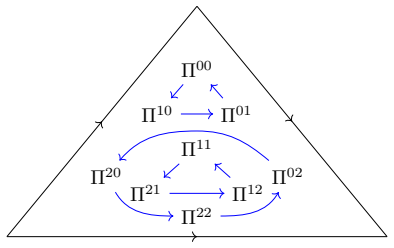
The central device is the nerve functor from partial unital magmas with associativity data to simplicial sets, together with the weak 2-Segal condition that characterizes weak partial monoids. In degree 3, the weak 2-Segal condition says that if both $(a\cdot b)\cdot c$ and $a\cdot(b\cdot c)$ are defined then they agree, which is the exact associativity notion the paper uses. The construction Z is formed by taking the full simplicial subset of the projective-measurement simplicial set PH(N Z/3) cut out by zeros in certain projector entries; this removes inverses while preserving weak 2-Segalness, and the cyclic structure supplies the orthocomplement.
What would settle it
Recompute the projector sum of the 2-simplex $\Psi$ in Construction 6.11. If the entries sum to $I - |10\rangle\langle 10| - |22\rangle\langle 22|$ rather than $I$, then $\Psi$ is not a valid 2-simplex of PH(N Z/3), and the map used to show Z is not 2-Segal is not well-defined; a different witness would be needed for that claim and for the state theorem.
Extended reading notes
Core claim
On the paper's own terms, the central claim is that a simplicial effect is exactly a spiny, inverseless, weakly 2-Segal cyclic set: spiny means the 1-Segal maps are injective, inverseless means no non-identity morphism has a left or right inverse, weakly 2-Segal is the nerve-level shadow of weak associativity, and the cyclic structure encodes the orthocomplement. The paper proves that the nerve construction yields fully faithful embeddings Eff -> EffAlgd -> SimpEff, and that the full simplicial subset Z of PH(N Z/3) whose 2-simplices satisfy $\Pi_{11}=\Pi_{21}=\Pi_{12}=0$ is a simplicial effect, is not an effect algebroid, and has state space in bijection with the density operators on $\mathbb{C}^3\otimes\mathbb{C}^3$ via the formula $\Pi \mapsto \mathrm{Tr}(\rho(\bar{\Pi}_0 - \tfrac12\Pi_2))$.
Load-bearing premise
The argument rests on a specific assignment of projectors being a valid measurement, meaning its projectors must sum to the identity; if that assignment is incorrect, the proof that Z is not an effect algebroid and the state bijection for Z both lose their stated support.
Editorial extensions
If this is right
- Every effect algebra and every effect algebroid embeds fully faithfully into SimpEff, so the new category is a common home for both classical and simplicial effect structures.
- The commutative d-torsion nerve N(Z/d, U(H)) is a weakly associative partial group, placing projective-measurement spaces at the invertible extreme of the hierarchy, while simplicial effects form the inverseless extreme.
- The object Z is a simplicial effect that is not an effect algebroid, so the weak 2-Segal condition captures measurement-like structures that full 2-Segalness misses.
- States on Z are in bijection with density operators on $\mathbb{C}^3\otimes\mathbb{C}^3$, giving a concrete state theorem in the new setting.
- Under mild hypotheses, the first cyclic cohomology of a simplicial effect is the vector space spanned by its states.
Reading between the lines
- Beyond the paper: the same full-subset cut-out that builds Z could be run on other d-torsion commutative nerves, yielding a family of simplicial effects with possibly different state spaces; the paper does not test this.
- Beyond the paper: the weak 2-Segal condition may correspond to a concrete probabilistic constraint in the simplicial-distributions picture, such as non-signalling or contextuality; the paper does not draw this connection.
- Beyond the paper: if the state bijection for Z is correct, it suggests quantum state spaces can be encoded by cyclic-simplicial structure alone, without an underlying effect algebra; the authors do not state this as a general slogan.
- Testable extension: perturbing the zero conditions $\Pi_{11}=\Pi_{21}=\Pi_{12}=0$ one at a time would show which parts of the state formula are load-bearing; the paper does not vary these conditions.
Editorial analysis
A structured set of objections, weighed in public.
Referee Report
Summary. The paper introduces weak partial monoids and weakly associative partial groups as intermediate associativity notions between Segal's partial monoids and Chermak's partial groups, then defines a category SimpEff of simplicial effects as spiny, inverseless, weakly 2-Segal cyclic sets. The main structural results characterize nerves of partial unital magmas, weak partial monoids, and partial monoids in terms of spiny reduced 2-coskeletal sets, spiny reduced weakly 2-Segal sets, and spiny reduced 2-Segal sets, respectively. The paper's advertised application is a constructed object Z, a full simplicial subset of PH(N Z/3), claimed to be a simplicial effect that is not an effect algebroid, with a Gleason-type bijection between density operators and states on Z.
Significance. If the main example were correct, the paper would extend the theory of effect algebras and effect algebroids to a weakly associative simplicial setting, unifying work on simplicial distributions, commutative nerves, and partial groups. The categorical framework in Sections 3 and 4 is detailed and appears to contain substantial contributions: the nerve equivalences for WPM and Mag are argued carefully, and the relationship with Chermak's partial associativity structures is clarified. However, the central example in Construction 6.11 and Proposition 6.12 contains a load-bearing error: the purported 2-simplex Psi is not a normalized projective measurement and the claimed face identity fails. As a result, the paper's headline claim that Z lies outside effect algebroids is not established as written. The significance of the paper therefore depends on whether that example can be repaired.
major comments (3)
- [§6.3, Construction 6.11 and Proposition 6.12] The 2-simplex Psi defined in Construction 6.11 is not a normalized projective measurement. With the stated entries, the sum over its nine projectors is Gamma_00 + Pi_01 + Gamma_+ + Gamma_- = Gamma_00 + (Gamma_01 + Gamma_11 + Gamma_21 + Gamma_12) + (Gamma_02 + Gamma_20) = I - Gamma_10 - Gamma_22. Since PH(N Z/3)_2 consists precisely of projector-valued functions summing to the identity, Psi is not an element of PH(N Z/3) and hence not an element of Z. Consequently the map Delta^2 -> Z constructed from Psi does not exist, and the proof that Z is not 2-Segal in Proposition 6.12(2) loses its witness.
- [§6.3, Construction 6.11] Independently of normalization, the asserted identity d2(Psi) = d1(Pi) is false under the fibre-sum face maps determined by Definition 2.13. For the face maps d2(P)_k = sum_b P_{k,b} and d1(P)_k = sum_{a+b=k} P_{a,b}, one obtains d2(Psi)_0 = Gamma_00, d2(Psi)_1 = Pi_01, and d2(Psi)_2 = Gamma_02 + Gamma_20, whereas d1(Pi)_0 = Gamma_00, d1(Pi)_1 = Pi_01 + Gamma_10 + Gamma_22, and d1(Pi)_2 = Gamma_02 + Gamma_20. The c=1 entries differ by Gamma_10 + Gamma_22, so the 'quick computation' asserted in the text is contradicted by the definitions.
- [§6.3, Proposition 6.12 and §6.5, Proposition 6.16] Because the only displayed witness to non-2-Segality is invalid, the paper does not currently establish that Z is a simplicial effect outside the category of effect algebroids. The state-space theorem in Proposition 6.16 is a separate claim and may be repairable, but it does not supply the missing non-2-Segal witness. The authors should provide a valid pair of 2-simplices satisfying the required face identifications, verify normalization and the Z-defining conditions, and then check the non-commutation argument for the associated unitaries A, B, C.
minor comments (5)
- [§2.4] There is a duplicate Definition 2.12: the paragraph beginning 'Definition 2.12 ([1])' ends with 'A more general version of this definition will appear in Definition 2.12,' which is circular and should be renumbered and corrected.
- [§4.1] In the proof of Proposition 4.14, 'multaplicable' should be 'multiplicable'.
- [§3.2] In the proof of Proposition 3.13, 'it is similarly easy to se that' should read 'it is similarly easy to see that'.
- [§2.5] In Example 2.19, 'On can verify all of the cyclic identities' should read 'One can verify all of the cyclic identities'.
- [§4.3, Lemma 6.9] The proof of Lemma 6.9 invokes the statement that weak 2-Segality 'amounts to' the unique extension property against Delta^w_n -> Delta^n. This equivalence is not stated explicitly in Section 4; adding a short proof or precise reference would improve clarity, since the lemma is used to show that Z is weakly 2-Segal.
Circularity Check
No significant circularity: the main claims are proved from definitions and external results, with self-citations used only as background or prior published lemmas; the chief risk is a computational error in Construction 6.11, not a circular reduction.
full rationale
The paper's claimed derivation chain is definition-driven rather than circular. The hierarchy PM ⊂ WPM ⊂ Mag ⊂ Magad is established by explicit functors (Propositions 3.13 and 3.15), and the nerve characterizations (Propositions 4.7, 4.9, 4.19, and Theorem 4.11) are proved from the definitions of spiny, reduced, weakly 2-Segal, and 2-coskeletal simplicial sets. Corollary 5.7 derives the weak associative partial group structure of commutative nerves from those characterizations rather than assuming it. The central example Z is verified property-by-property: Lemmas 6.8–6.10 show that full simplicial subsets on 2-truncations preserve spinyness, weak 2-Segality, and cyclicity, and Proposition 6.12(1) derives inverselessness from the defining condition Π11=Π21=Π12=0. The non-2-Segality claim is an attempted boundary-map computation, not a restatement of the definition, and the state bijection (Proposition 6.16) is anchored to Gleason's theorem and the external description of PH(NZ/3), not to any fitted parameter. Self-citations such as [3], [16], [19], and [27] appear as background, motivation, or prior published lemmas; even where [3, Prop. 6.3] is used to identify PH(NZ/3) with N(Z/3,U(H)), this is an independently checkable spectral fact, not a premise that already contains Z's claimed non-2-Segality or state space. A separate correctness caveat, unrelated to circularity, should be noted: the displayed 2-simplex Ψ in Construction 6.11 does not appear to be normalized (its projectors sum to I−Γ22 rather than I), and the asserted identity d2(Ψ)=d1(Π) is inconsistent with the fibre-sum face maps (the c=1 entries differ by Γ10+Γ22). This would undermine the non-2-Segal proof as written, but a false computation is not a circular reduction. The circularity score is therefore low.
Assumptions & free parameters
assumptions (4)
- domain assumption Roumen's characterization: effect algebroids correspond to cyclic 2-Segal sets satisfying conditions (U) and (Z) (Theorem 2.20).
- domain assumption Gleason's theorem: for dim H >= 3, Den(H) is bijective to St(Proj(H)) (Theorem 2.5).
- domain assumption Spectral decomposition: PH(N Z/d) is isomorphic to N(Z/d, U(H)) (Proposition 2.15).
- standard math Standard properties of nerves, coskeleta, and 2-Segal sets (e.g., Proposition 2.9 and the 2-Segal literature).
invented entities (3)
-
weak partial monoid
-
weakly 2-Segal simplicial set
-
simplicial effect
Cite this review
Pith. "Pith review of Simplicial effects and weakly associative partial groups." pith.science (2026). https://pith.science/paper/X7MRY4L2
@misc{pith2026250205958,
  author       = {Pith},
  title        = {Pith review of: Simplicial effects and weakly associative partial groups},
  year         = {2026},
  howpublished = {\url{https://pith.science/paper/X7MRY4L2}},
  note         = {Machine review of arXiv:2502.05958}
}
read the original abstract
In this paper, we introduce a new category of simplicial effects that extends the categories of effect algebras and their multi-object counterpart, effect algebroids. Our approach is based on relaxing the associativity condition satisfied by effect algebras and, more generally, partial monoids. Within this framework, simplicial effects and weakly associative partial groups arise as two extreme cases in the category of weak partial monoids. Our motivation is to capture simplicial structures from the theory of simplicial distributions and measurements that behave like effects.
Figures


Figures from the paper (1 more)

Forward citations
Cited by 1 Pith paper
-
Partial Group Symmetry in Figures I: Semidirect Products and the Six Coins
A partial-group framework encodes symmetries of individual components of disconnected figures, with semidirect product decompositions for two-component and lattice-translate figures.
Reference graph
Works this paper leans on
-
[1]
Effect algebras and unsharp quantum logics,
D. J. Foulis and M. K. Bennett, “Effect algebras and unsharp quantum logics,”Foundations of physics, vol. 24, pp. 1331–1352, 1994
work page 1994
-
[2]
Configuration-spaces and iterated loop-spaces,
G. Segal, “Configuration-spaces and iterated loop-spaces,”Invent. Math., vol. 21, pp. 213–221, 1973
work page 1973
-
[3]
Simplicial quantum contextuality,
C. Okay, A. Kharoof, and S. Ipek, “Simplicial quantum contextuality,”Quantum, vol. 7, 2023
work page 2023
-
[4]
F. Roumen,Effect Algebroids. PhD thesis. PhD Thesis. https://repository.ubn.ru.nl/ bitstream/handle/2066/181438/181438.pdf?sequence=1&isAllowed=y
-
[5]
Fusion systems and localities,
A. Chermak, “Fusion systems and localities,”Acta Math., vol. 211, no. 1, pp. 47–139, 2013. 43
work page 2013
-
[6]
F. Roumen, “Cohomology of effect algebras,”arXiv preprint arXiv:1602.00567, 2016
work page Pith review arXiv 2016
-
[7]
An introduction to effectus theory,
K. Cho, B. Jacobs, B. Westerbaan, and A. Westerbaan, “An introduction to effectus theory,” arXiv preprint arXiv:1512.05813, 2015
arXiv 2015
-
[8]
Effectalgebras,presheaves,non-localityandcontextuality,
S.StatonandS.Uijlen,“Effectalgebras,presheaves,non-localityandcontextuality,” Information and Computation, vol. 261, pp. 336–354, 2018
work page 2018
Show all 28 references
-
[9]
Topological methods for studying contextuality: N-cycle scenarios and beyond,
A. Kharoof, S. Ipek, and C. Okay, “Topological methods for studying contextuality: N-cycle scenarios and beyond,”Entropy, vol. 25, no. 8, p. 1127, 2023
2023
-
[10]
Extremal simplicial distributions on cycle scenarios with arbitrary outcomes,
A. Kharoof, C. Okay, and S. Ipek, “Extremal simplicial distributions on cycle scenarios with arbitrary outcomes,”arXiv preprint arXiv:2406.19961, 2024
2024
-
[11]
Measures on the closed subspaces of a hilbert space,
A. M. Gleason, “Measures on the closed subspaces of a hilbert space,” inThe Logico-Algebraic Approach to Quantum Mechanics: Volume I: Historical Evolution, pp. 123–133, Springer, 1975
1975
-
[12]
P. G. Goerss and J. F. Jardine,Simplicial Homotopy Theory. Birkhäuser, 1999
1999
-
[13]
J. W. Duskin,Simplicial Methods and the Interpretation of ‘Triple’ Cohomology, vol. 163. American Mathematical Soc., 1975
1975
-
[14]
Kerodon
J. Lurie, “Kerodon.”https://kerodon.net
-
[15]
Commuting elements, simplicial spaces and filtrations of classifying spaces,
A. Adem, F. R. Cohen, and E. Torres Giese, “Commuting elements, simplicial spaces and filtrations of classifying spaces,”Math. Proc. Cambridge Philos. Soc., vol. 152, no. 1, pp. 91–114, 2012
2012
-
[16]
Commutative d-torsion K-theory and its applications,
C. Okay, “Commutative d-torsion K-theory and its applications,”Journal of Mathematical Physics, vol. 62, no. 10, 2021
2021
-
[17]
Nonlocal correlations as an information-theoretic resource,
J. Barrett, N. Linden, S. Massar, S. Pironio, S. Popescu, and D. Roberts, “Nonlocal correlations as an information-theoretic resource,”Physical Review A—Atomic, Molecular, and Optical Physics, vol. 71, no. 2, p. 022101, 2005
2005
-
[18]
Loday,Cyclic homology, vol
J.-L. Loday,Cyclic homology, vol. 301. Springer Science & Business Media, 2013
2013
-
[19]
2-Segal objects and algebras in spans,
W. H. Stern, “2-Segal objects and algebras in spans,”J. Homotopy Relat. Struct., vol. 16, no. 2, pp. 297–361, 2021
2021
-
[20]
Higher Segal spaces
T. Dyckerhoff and M. Kapranov, “Higher Segal spaces.” Preprint
-
[21]
2-Segal sets and the Waldhausen construction,
J. E. Bergner, A. M. Osorno, V. Ozornova, M. Rovelli, and C. I. Scheimbauer, “2-Segal sets and the Waldhausen construction,”Topology and its Applications, vol. 235, pp. 445–484, 2018
2018
-
[22]
Equivalences of classifying spaces completed at odd primes,
B. Oliver, “Equivalences of classifying spaces completed at odd primes,”Math. Proc. Cambridge Philos. Soc., vol. 137, no. 2, pp. 321–347, 2004
2004
-
[23]
Oliver,Equivalences of classifying spaces completed at the prime two, vol
B. Oliver,Equivalences of classifying spaces completed at the prime two, vol. 180 ofMem. Amer. Math. Soc.2006. vi+102 pp. 44
2006
-
[24]
The homotopy theory of fusion systems,
C. Broto, R. Levi, and B. Oliver, “The homotopy theory of fusion systems,”J. Amer. Math. Soc., vol. 16, no. 4, pp. 779–856, 2003
2003
-
[25]
An extension theory for partial groups and localities
A. Gonzales, “An extension theory for partial groups and localities.”
-
[26]
An extension theory for partial groups,
C. Broto and A. Gonzalez, “An extension theory for partial groups,” arXiv preprint arXiv:2105.03457, 2021
2021 arXiv
-
[27]
Equivariant simplicial distributions and quantum contextuality,
C. Okay and I. Sikora, “Equivariant simplicial distributions and quantum contextuality,”arXiv preprint arXiv:2310.18135, 2023
2023 arXiv
-
[28]
Dvurecenskij,Gleason’s Theorem and its Applications, vol
A. Dvurecenskij,Gleason’s Theorem and its Applications, vol. 60. Springer Science & Business Media, 2013. 45
2013
Reviewed August 8, 2026 · model on record in the stance chip above.
Discussion (0). Continue with ORCID to comment.