REVIEW 3 major objections 7 minor 36 references
Instability of Baryonic Black Branes
T0 review · 3 major / 7 minor · reviewed 2026-08-08 · deepseek-v4-flash
Pith's one-line read The baryonic black brane phase of the conifold gauge theory becomes dynamically unstable below T/µ_B ≈ 0.2770(5), with a new ordered phase appearing at the same critical temperature.
desk verdict Plausible and carefully executed numerical result that overturns the HKPT stability conjecture, but the truncation-completeness assumption needs a check before I'd treat the critical temperature as robust. read the letter →
The pith
A machine-rendered reading of the paper's core claim, the machinery that carries it, and where it could break.
The reading
What carries the argument
The argument runs through an effective five-dimensional action: the $N=2$ consistent subtruncation of type IIB supergravity on the warped deformed conifold with fluxes, restricted by setting the three-form flux modes $b_\Omega=c_\Omega=0$ and the dilaton $\phi=0$. In that theory the HKPT baryonic black branes are a further truncation keeping only the metric, two scalars, and the baryonic gauge field. Around that background the author linearizes the equations for the graviphoton $A$ (dual to the $U(1)_R$ current), the massive vector $V$, the neutral scalar $w$, and the axion-like field $a$; the sound-channel combination $Z_0, Z_1, Z_w, Z_a$ yields the quasinormal mode spectrum. The key diagnostic is the diffusion coefficient $D = dv/dq|_{q=0}$ for the $\mathrm{Re}\,\omega=0$ branch, which must pass through zero for the instability, and the divergence of the normalizable coefficient $z_{w;2}$ of the scalar source at the homogeneous onset. The same numerical machinery, with shooting methods and holographic renormalization, then constructs the new ordered black brane phase.
What would settle it
Compute the sound-channel quasinormal spectrum in the full ten-dimensional type IIB supergravity on the warped deformed conifold background, without imposing the $N=2$ truncation. If the mode with $\mathrm{Re}\,\omega=0$ either disappears or has a diffusion coefficient that does not vanish at $T/\mu_B=0.2770(5)$, the central claim is refuted. A second check would be a thermodynamic stability analysis of the charged plasma: the paper notes it did not perform one, and a Gubser-Mitra type argument would predict a thermodynamic instability wherever the dynamical one occurs.
Extended reading notes
Core claim
The paper's central claim is that the HKPT baryonic black brane background, which encodes the quantum critical phase of the conifold gauge theory at finite baryonic chemical potential, is perturbatively unstable below $T/\mu_B = 0.2770(5)$. The instability resides in the helicity-zero (sound) sector and is carried by a combination of a neutral dimension-2 scalar, the $U(1)_R$ graviphoton, and a massive vector from the $N=2$ consistent truncation of type IIB supergravity on the warped deformed conifold. The associated quasinormal mode has dispersion $\omega = -i D q^2 + O(q^3)$ with the diffusion coefficient $D$ positive above the critical temperature and negative below it, so R-charge density clumps on the formerly translation-invariant horizon. Precisely at the same temperature a new homogeneous and isotropic 'exotic' ordered phase branches off; it has nonzero $U(1)_R$ charge density and an expectation value of a dimension-2 operator, with $\mathcal{O}_2 \propto T^2$ in the $\mu/T \to 0$ limit, but its Gibbs free energy density lies above the disordered phase. The paper also sharpens the known nonperturbative D3-brane nucleation ('Fermi seasickness') onset to $T/\mu_B = 0.2789(9)$, slightly above the perturbative critical temperature.
Load-bearing premise
The computation assumes that the chosen $N=2$ consistent truncation, with $b_\Omega=c_\Omega=\phi=0$, contains every ten-dimensional mode that can participate in the instability. If an omitted mode mixes with the sound-channel fluctuations, the dispersion relation and the numerical value $T_c/\mu_B=0.2770(5)$ could change.
Editorial extensions
If this is right
- Below $T/\mu_B=0.2770(5)$ the baryonic black brane phase is dynamically unstable, so the zero-temperature quantum critical point described by extremal baryonic branes is not reached by cooling the plasma; R-charge clumping intervenes first.
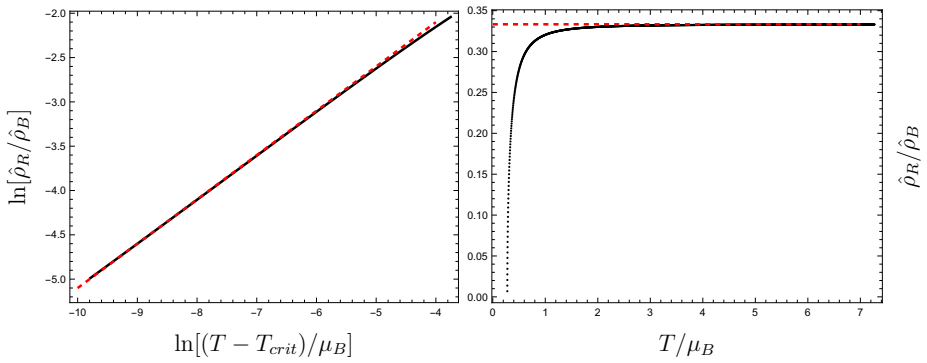
- A new homogeneous ordered phase of the conifold gauge theory exists at all temperatures above the critical point, with $\mathcal{O}_2\propto T^2$ and $\rho_R/\rho_B \to 1/3$ as $T/\mu_B\to\infty$.
- The perturbative instability occurs at a slightly higher temperature than the nonperturbative D3-brane nucleation instability, but the latter is suppressed by large $N$ and nucleated-brane volume, so the perturbative channel is the one that governs the dynamics.
- The ordered phase never dominates the grand canonical ensemble because its Gibbs free energy density is higher, so any transition to it would be metastable or dynamically driven rather than thermodynamically preferred.
Reading between the lines
- One consequence the author leaves implicit: the same 'dormant gauge field' mechanism that destabilizes the $N=4$ plasma and the conifold plasma should also destabilize other near-extremal holographic critical points whenever string-theory consistency forces additional gauge fields to be present; the paper's closing remarks point in this direction but do not demonstrate it.
- If the ordered phase is dynamically stable (not established in the paper), the clumping instability should saturate into this new phase; a time-dependent holographic simulation of the instability would be a direct test.
- The near-critical scalings $\hat{\mathcal{O}}_2 \propto \sqrt{T-T_c}$ and $\hat\rho_R \propto \sqrt{T-T_c}$ suggest a mean-field continuous transition; measuring the corresponding critical exponents for transport coefficients would test whether the phase transition retains mean-field character beyond the order parameter.
Editorial analysis
A structured set of objections, weighed in public.
Referee Report
Summary. The paper studies the stability of the HKPT baryonic black branes, which are holographic duals of the Klebanov-Witten gauge theory at finite baryonic chemical potential. Working within an N=2 consistent truncation of type IIB supergravity, the author identifies a diffusive quasinormal mode in the sound channel whose diffusion coefficient D becomes negative below T/µ_B = 0.2770(5), implying a dynamical instability toward spatial modulation of the R-charge density. At the same critical point, a new homogeneous 'ordered' phase with nonzero R-charge density and a dimension-2 operator condensate branches off; this phase extends to arbitrarily high temperatures and is subdominant in the grand canonical ensemble. The paper also computes the precise threshold for the non-perturbative D3-brane nucleation instability. The results are obtained by numerical shooting, with detailed asymptotics and thermodynamic consistency checks.
Significance. This is a potentially important result in holographic approaches to finite-density gauge theories. The paper provides a concrete counterexample to the conjecture of [1] that baryonic black branes are stable at low temperature, and it identifies a new (though subdominant) ordered phase. The strength of the paper lies in the detailed construction of the background, the explicit fluctuation equations, and the high-precision thermodynamic consistency checks (10^-7 for the first law, 10^-11 for conformality). The paper also makes a falsifiable prediction: the diffusion coefficient D changes sign at T/µ_B ≈ 0.2770(5), and the ordered phase has O2 ∝ T^2 at high T. However, the numerical results are not accompanied by code or data, and the central claim's completeness relies on a truncation whose adequacy for the fluctuation sector is not discussed. If the truncation concern is resolved, this would be a significant contribution to the study of near-extremal black brane instabilities.
major comments (3)
- [§2, Eq. (2.24); §2.2] The central instability is found in the sector {δA, δV, δw, δa} of the effective action (2.24), which is obtained from the N=2 truncation of [8,9] by further setting b_Ω = c_Ω = φ = 0. The paper does not demonstrate that this sector contains every mode of the full 10d theory that can participate in the instability at nonzero baryonic chemical potential. This matters because the original HKPT truncation (2.25) also omitted A, V, w, and a, and the new instability lives precisely in those previously omitted fields; a priori, further omitted modes (e.g., other KK modes on T^{1,1}) could also become tachyonic or mix with the retained fields and shift the onset temperature (1.1). The consistency of the truncation guarantees that a solution of (2.24) uplifts to 10d, but it does not by itself rule out instabilities in the omitted sectors setting in at higher T. To support the claim that (1.1) is the physical critical temperature, the author should either check the full 10d spectrum or provide a clear argument (e.g., a complete KK reduction of the sound-channel singlet sector) that all omitted modes have positive mass squared on the baryonic brane background. Otherwise the quantitative claim should be restricted to the effective action (2.24).
- [§2.2, Eqs. (2.48)–(2.53), (2.57)–(2.60)] The linearized fluctuation equations are presented without derivation. The paper states that it is 'straightforward to verify' that the set (2.46) decouples, but no derivation or reference is given for the ODE system (2.48)–(2.53) or the reduced system (2.57)–(2.60). Since the central numerical result—the sign change of D at µ* = 0.85501(6)—is obtained by solving these equations, the reader cannot verify the correctness of the equations without re-deriving them from (2.1)–(2.24). Please provide a derivation in an appendix or supplementary file, including the gauge-fixing (2.47) and the reduction to the Z_i variables, or point to a publicly available notebook/code that implements the same steps.
- [§2.2–2.5, Eqs. (2.68), (2.81), (2.106)] The key quantitative outputs—the critical values (1.1), (2.68), (2.81), and (2.106)—are obtained by numerical shooting, but no code or raw data are released. The paper gives the asymptotic expansions and boundary conditions, but the precision claims (e.g., 0.85501(6)) and the dispersion curves in Fig. 1 cannot be independently checked without the numerical implementation. I recommend depositing the shooting code and data files (D(µ), 1/z_{w;2}(µ), V_h^+(T/µ)) in a public repository or as ancillary material. This is particularly important because the thermodynamic consistency checks are reported to 10^-7 and 10^-11, which suggests high numerical accuracy but also makes the absence of the underlying data more salient.
minor comments (7)
- [Eq. (2.69)] The fit formula D|_red = 1 − e^{1/2 µ^2} appears to have a typo; for small µ it behaves as D ≈ −µ^2/2, contradicting the text's statement that D is positive for small µ and the plot in Fig. 1. The intended formula is likely D = e^{−µ^2/2} or a similar expression with a negative exponent.
- [§2.3] The labels 'O-I' and 'O-II' are not defined in the text; please explain the two limiting procedures in words.
- [Fig. 1, right panel] The text says the red and orange dots are unstable for T < T_crit, but the y-axis shows Im[w] negative for all q; please clarify the sign convention for growing modes and the range of q used.
- [Fig. 6 caption] The caption contains a typo 'T −Tcirt'; also the near-critical scalings (2.107) are stated in terms of µ_B but the plots use logarithms of dimensionless ratios—please spell out the normalization.
- [§2.5] The same symbol q is used for both the spatial momentum and the brane charge in Sec. 2.5; please use different symbols to avoid confusion.
- [§2.6] The paper would benefit from a brief discussion of the Gubser-Mitra conjecture [12] in light of the new instability, since the author states he did not perform the thermodynamic stability analysis; a comment on whether a thermodynamic instability is expected would help the reader.
- [Throughout] There are numerous LaTeX artifacts and typos (e.g., 'D3- D3' with odd spacing, 'µB' with missing subscript, 'f 8' fragments); a careful proofread is needed.
Circularity Check
No circularity found: the instability threshold and the ordered phase are obtained by solving the effective-action equations; self-citations supply machinery and analogy but do not fix the result.
full rationale
The claimed instability threshold (1.1) is not an input or a fit. The HKPT background is constructed by solving (2.31)-(2.35) with the asymptotics (2.36)-(2.42), and the sound-channel quasinormal-mode equations (2.57)-(2.60) are derived from the effective action (2.24) with no free parameter tuned to the target. The diffusion coefficient D is computed from the numerical dispersion relation (2.67), and D=0 determines mu*=0.85501(6) and Tc/mu_B=0.2770(5). The homogeneous ordered phase is then constructed independently in Sec. 2.4 as an R-charged black-brane family; the agreement of its onset with the dynamical instability, (2.82), is a numerical check with discrepancy 5e-7, not an input. Self-citations [8,9,10,11,16] are used for the effective action, the shooting code, and the N=4 SYM analogy, but the critical values and scaling laws (2.107)-(2.109) are computed in this paper from the equations, so the central derivation is self-contained rather than circular. The open truncation-completeness question flagged by the skeptic is a correctness/robustness risk about omitted 10d modes, not a circularity: the paper nowhere defines Tc in terms of itself or fits it to data.
Assumptions & free parameters
free parameters (1)
- small-µ diffusion fit coefficient =
1/2 in D = 1 - e^{1/2 µ^2}
assumptions (5)
- domain assumption AdS/CFT correspondence maps N=1 SU(N)×SU(N) Klebanov-Witten gauge theory at strong coupling to type IIB supergravity on AdS5×T^{1,1}.
- domain assumption The N=2 consistent truncation (2.24) of Cassani-Faedo type IIB supergravity captures all fields relevant for the instability and phases discussed.
- domain assumption Setting b_Ω=c_Ω=0 and φ=0 is a consistent truncation; the remaining S5 action is sufficient.
- domain assumption Quasinormal mode boundary conditions (incoming waves at the horizon, normalizability at the AdS boundary) yield the physical spectrum of the gauge theory plasma.
- domain assumption The probe D3-brane action (2.99), with static brane and no backreaction, reliably locates the brane nucleation instability.
Cite this review
Pith. "Pith review of Instability of Baryonic Black Branes." pith.science (2026). https://pith.science/paper/VIRWVSHA
@misc{pith2026250205971,
  author       = {Pith},
  title        = {Pith review of: Instability of Baryonic Black Branes},
  year         = {2026},
  howpublished = {\url{https://pith.science/paper/VIRWVSHA}},
  note         = {Machine review of arXiv:2502.05971}
}
abstract
Baryonic black branes describe the quantum critical phase of the conformal conifold gauge theory at strong coupling. This phase extends to zero temperature at a finite baryonic chemical potential, represented by extremal black branes with $AdS_2\times R^3\times T^{1,1}$ throat in asymptotic $AdS_5\times T^{1,1}$ geometry. We demonstrate here that this phase is dynamically unstable below some critical value of $T_c/\mu$: the instability is represented by a diffusive mode in the hydrodynamic sound channel with a negative diffusion coefficient. We also identify a new (exotic) ordered phase of the conifold gauge theory: this phase originates at the same critical value of $T_c/\mu$, but extends to arbitrary high temperatures, and is characterized by an expectation value of a dimension-2 operator, ${\cal O}_2\propto T^2$, in the limit $\frac \mu T\to 0$.
Figures


Figures from the paper (5 more)


Reference graph
Works this paper leans on
-
[1]
C. P. Herzog, I. R. Klebanov, S. S. Pufu and T. Tesileanu, Emergent Quantum Near-Criticality from Baryonic Black Branes , JHEP 03 (2010) 093, [ 0911.0400]
work page Pith review arXiv 2010
-
[6]
L. Gladden, V. Ivo, P. Kovtun and A. O. Starinets, Instability in N = 4 supersymmetric Yang-Mills theory at finite density , 2412.12353
-
[2]
I. R. Klebanov and E. Witten, Superconformal field theory on three-branes at a Calabi-Yau singularity, Nucl. Phys. B536 (1998) 199–218, [ hep-th/9807080]. 28 -10 -9 -8 -7 -6 -5 -4 -5.0 -4.5 -4.0 -3.5 -3.0 -2.5 -2.0 ln[(T −Tcrit)/µB] ln[ˆρR/ˆρB] 0 1 2 3 4 5 6 7 0.00 0.05 0.10 0.15 0.20 0.25 0.30 0.35 T/µ B ˆρR/ˆρB Figure 8: R-symmetry charge density ˆρR in ...
arXiv 1998
-
[3]
Buchel, Fluxification and scalarization of the conifold black holes , 2411.15950
A. Buchel, Fluxification and scalarization of the conifold black holes , 2411.15950
-
[4]
S. S. Gubser, C. P. Herzog, S. S. Pufu and T. Tesileanu, Superconductors from Superstrings, Phys. Rev. Lett. 103 (2009) 141601, [ 0907.3510]
arXiv 2009
-
[5]
S. A. Hartnoll, J. Polchinski, E. Silverstein and D. Tong, Towards strange metallic holography , JHEP 04 (2010) 120, [ 0912.1061]
arXiv 2010
-
[7]
A. Ceresole, G. Dall’Agata, R. D’Auria and S. Ferrara, Spectrum of type IIB supergravity on AdS(5) x T**11: Predictions on N=1 SCFT’s , Phys. Rev. D 61 (2000) 066001, [ hep-th/9905226]
arXiv 2000
-
[8]
D. Cassani and A. F. Faedo, A Supersymmetric consistent truncation for conifold solutions, Nucl. Phys. B 843 (2011) 455–484, [ 1008.0883]
arXiv 2011
Show all 36 references
-
[9]
Buchel, Effective Action of the Baryonic Branch in String Theory Flux Throats, JHEP 09 (2014) 117, [ 1405.1518]
A. Buchel, Effective Action of the Baryonic Branch in String Theory Flux Throats, JHEP 09 (2014) 117, [ 1405.1518]. 29
2014 arXiv
-
[10]
Buchel, The ordered phase of charged N=4 SYM plasma , 2501.01856
A. Buchel, The ordered phase of charged N=4 SYM plasma , 2501.01856
-
[11]
Buchel, The ordered phase of charged N=4 SYM plasma from STU , 2501.12403
A. Buchel, The ordered phase of charged N=4 SYM plasma from STU , 2501.12403
-
[12]
Buchel, A Holographic perspective on Gubser-Mitra conjecture , Nucl
A. Buchel, A Holographic perspective on Gubser-Mitra conjecture , Nucl. Phys. B731 (2005) 109–124, [ hep-th/0507275]
2005 arXiv
-
[13]
Buchel, Fate of the conformal order , Phys
A. Buchel, Fate of the conformal order , Phys. Rev. D 103 (2021) 026008, [2011.11509]
2021 arXiv
-
[14]
Minasian and D
R. Minasian and D. Tsimpis, On the geometry of nontrivially embedded branes , Nucl. Phys. B 572 (2000) 499–513, [ hep-th/9911042]
2000 arXiv
-
[15]
Buchel and J
A. Buchel and J. T. Liu, Gauged supergravity from type IIB string theory on Y**p,q manifolds , Nucl. Phys. B 771 (2007) 93–112, [ hep-th/0608002]
2007 arXiv
-
[16]
Aharony, A
O. Aharony, A. Buchel and P. Kerner, The Black hole in the throat: Thermodynamics of strongly coupled cascading gauge theori es, Phys. Rev. D76 (2007) 086005, [ 0706.1768]
2007 arXiv
-
[17]
Balasubramanian and P
V. Balasubramanian and P. Kraus, A Stress tensor for Anti-de Sitter gravity , Commun. Math. Phys. 208 (1999) 413–428, [ hep-th/9902121]
1999 arXiv
-
[18]
P. K. Kovtun and A. O. Starinets, Quasinormal modes and holography , Phys. Rev. D 72 (2005) 086009, [ hep-th/0506184]
2005 arXiv
-
[19]
D. T. Son and A. O. Starinets, Minkowski space correlators in AdS / CFT correspondence: Recipe and applications , JHEP 09 (2002) 042, [hep-th/0205051]
2002 arXiv
-
[20]
Henriksson, C
O. Henriksson, C. Hoyos and N. Jokela, Novel color superconducting phases of N = 4 super Yang-Mills at strong coupling , JHEP 09 (2019) 088, [ 1907.01562]
2019 arXiv
-
[21]
Anabalon and J
A. Anabalon and J. Oliva, Plasma-Plasma Third Order Phase Transition from Type IIB Supergravity, Phys. Rev. Lett. 133 (2024) 121601, [ 2405.04611]
2024 arXiv
-
[22]
Buchel, χSB of cascading gauge theory in de Sitter , JHEP 05 (2020) 035, [1912.03566]
A. Buchel, χSB of cascading gauge theory in de Sitter , JHEP 05 (2020) 035, [1912.03566]. 30
2020 arXiv
-
[23]
Buchel, L
A. Buchel, L. Lehner and R. C. Myers, Thermal quenches in N=2* plasmas , JHEP 08 (2012) 049, [ 1206.6785]
2012 arXiv
-
[24]
Henriksson, C
O. Henriksson, C. Hoyos and N. Jokela, Brane nucleation instabilities in non-AdS/non-CFT, JHEP 02 (2020) 007, [ 1910.06348]
2020 arXiv
-
[25]
Henriksson, N
O. Henriksson, N. Jokela and J. Junttila, Dynamics of a Higgs phase transition in the Klebanov-Witten theory , JHEP 04 (2025) 051, [ 2411.19667]
2025 arXiv
-
[26]
Buchel, Gauge theories on hyperbolic spaces and dual wormhole insta bilities, Phys
A. Buchel, Gauge theories on hyperbolic spaces and dual wormhole insta bilities, Phys. Rev. D 70 (2004) 066004, [ hep-th/0402174]
2004 arXiv
-
[27]
Buchel and C
A. Buchel and C. Pagnutti, Exotic Hairy Black Holes , Nucl. Phys. B 824 (2010) 85–94, [ 0904.1716]
2010 arXiv
-
[28]
Buchel, Singularity development and supersymmetry in holography , JHEP 08 (2017) 134, [ 1705.08560]
A. Buchel, Singularity development and supersymmetry in holography , JHEP 08 (2017) 134, [ 1705.08560]
2017 arXiv
-
[29]
Buchel, Klebanov-Strassler black hole , JHEP 01 (2019) 207, [ 1809.08484]
A. Buchel, Klebanov-Strassler black hole , JHEP 01 (2019) 207, [ 1809.08484]
2019 arXiv
-
[30]
N. Chai, S. Chaudhuri, C. Choi, Z. Komargodski, E. Rabinovici an d M. Smolkin, Thermal Order in Conformal Theories , Phys. Rev. D 102 (2020) 065014, [2005.03676]
2020 arXiv
-
[31]
Buchel, SUGRA/Strings like to be bald , Phys
A. Buchel, SUGRA/Strings like to be bald , Phys. Lett. B 814 (2021) 136111, [2007.09420]
2021 arXiv
-
[32]
Buchel, Thermal order in holographic CFTs and no-hair theorem viola tion in black branes , Nucl
A. Buchel, Thermal order in holographic CFTs and no-hair theorem viola tion in black branes , Nucl. Phys. B 967 (2021) 115425, [ 2005.07833]
2021 arXiv
-
[33]
N. Chai, A. Dymarsky, M. Goykhman, R. Sinha and M. Smolkin, A model of persistent breaking of continuous symmetry , SciPost Phys. 12 (2022) 181, [2111.02474]
2022 arXiv
-
[34]
Chaudhuri and E
S. Chaudhuri and E. Rabinovici, Symmetry breaking at high temperatures in large N gauge theories , JHEP 08 (2021) 148, [ 2106.11323]
2021 arXiv
-
[35]
Buchel, The quest for a conifold conformal order , JHEP 08 (2022) 080, [2205.00612]
A. Buchel, The quest for a conifold conformal order , JHEP 08 (2022) 080, [2205.00612]. 31
2022 arXiv
-
[36]
N. Chai, A. Dymarsky and M. Smolkin, Model of Persistent Breaking of Discrete Symmetry, Phys. Rev. Lett. 128 (2022) 011601, [ 2106.09723]. 32
2022 arXiv
Reviewed August 8, 2026 · model on record in the stance chip above.
Discussion (0). Continue with ORCID to comment.