REVIEW 3 major objections 5 minor 97 references
CANeRV: Content Adaptive Neural Representation for Video Compression
T0 review · 3 major / 5 minor · reviewed 2026-08-08 · deepseek-v4-flash
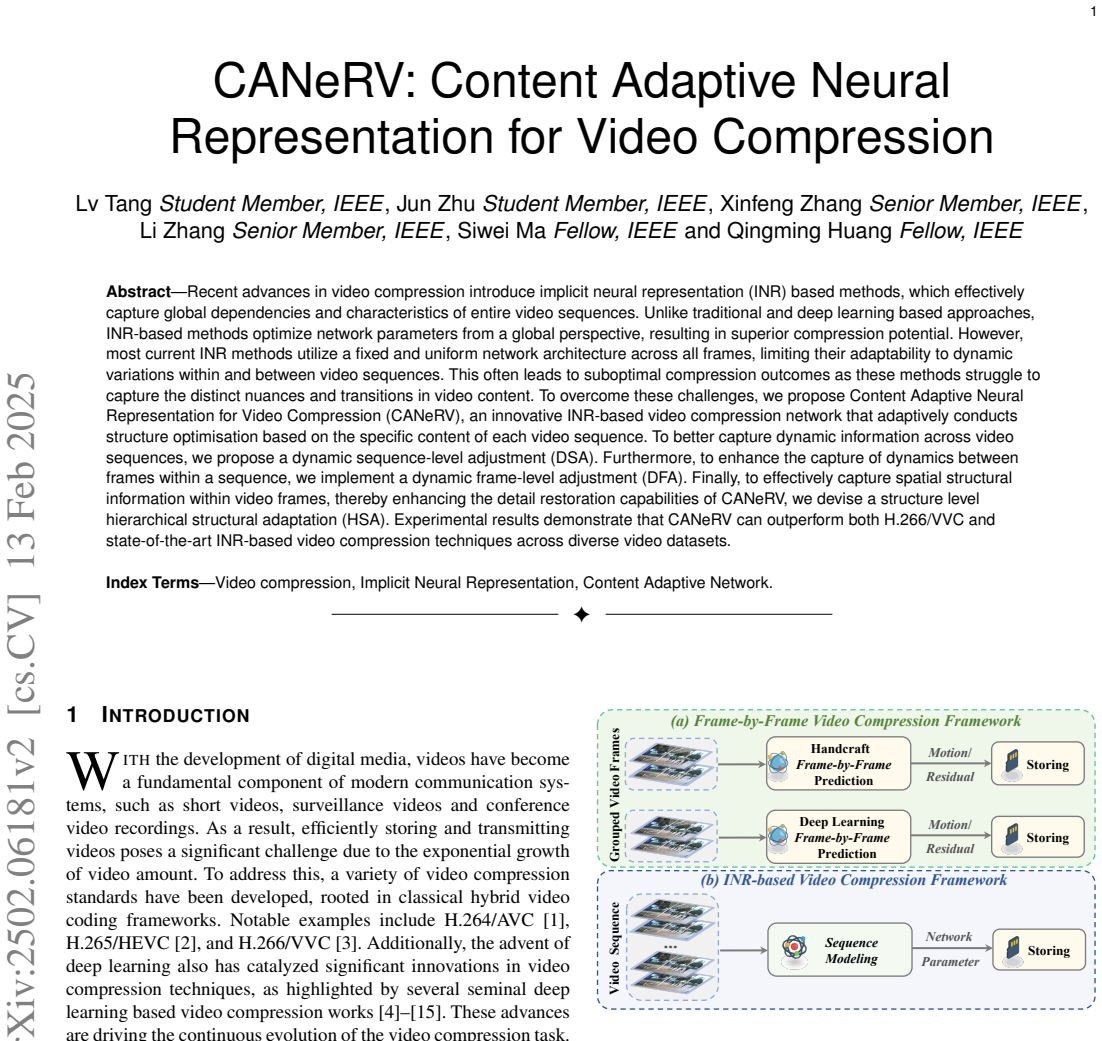
Pith's one-line read CANeRV makes neural video representation adapt to content, and for the first time an INR codec reports beating H.266/VVC on standard test sets.
desk verdict A real advance in INR video compression, but the headline claim of beating H.266/VVC is only as solid as the x266 anchor it was measured against. read the letter →
The pith
A machine-rendered reading of the paper's core claim, the machinery that carries it, and where it could break.
The reading
What carries the argument
The carrying object is the network architecture itself, treated as a searchable and frame-adaptive parameter set. DSA (dynamic sequence-level adjustment) defines a small search space over network depth, evaluates candidate depths by their rate-distortion cost via Eqn. 5, and picks the best with a binary search (Algorithm 1). DFA (dynamic frame-level adjustment) adds a layer-specific low-rank correction $\Delta W^t_l = \sum_{r=1}^R \alpha^t_r \Phi_r$ per frame, so temporal variation is captured by a few scalar coefficients on shared basis matrices rather than by full per-frame weight copies. HSA (hierarchical structural adaptation) appends a small branch that predicts Canny first-order and Laplacian second-order edge maps from the final feature map and adds the refined feature back, forcing the network to keep edge structure. These three mechanisms are what carry the reported rate-distortion gains over fixed INR architectures and over VVC.
What would settle it
Encode the same HEVC ClassB and UVG sequences with the official H.266/VVC reference encoder using a much longer intra period (for example, only one intra frame) and measure BDBR against CANeRV; if the BDBR becomes positive or close to zero, the central claim that an INR method outperforms VVC is not supported.
Extended reading notes
Core claim
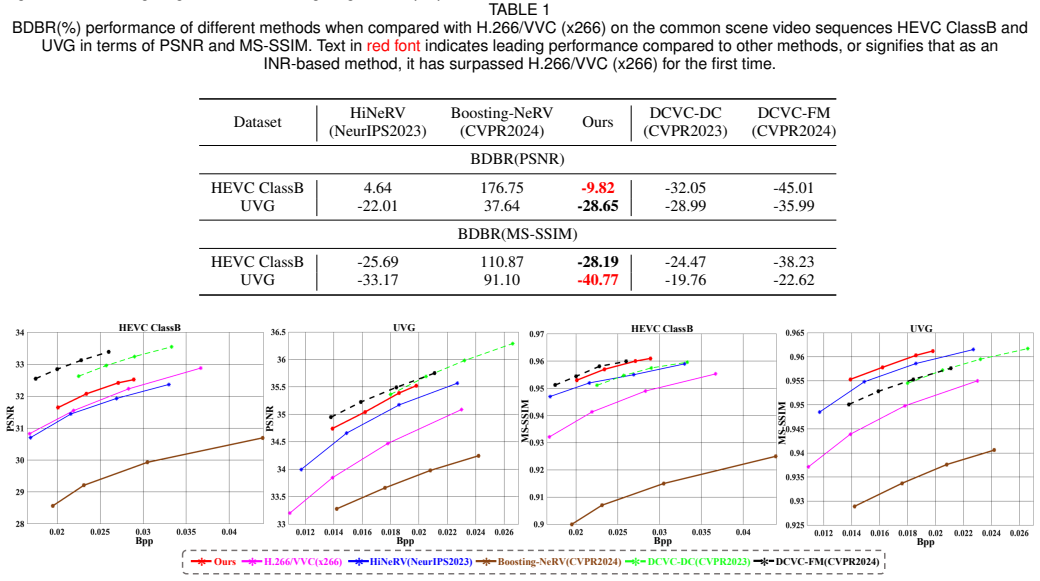
The central claim is that making the INR network content-adaptive, rather than only more expressive, is what lets a sequence-level neural representation outperform a modern hybrid codec. DSA searches over five possible depths for the whole network and selects the one with the best rate-distortion cost using a binary search; DFA adds per-frame low-rank weight updates, written as a sum of shared basis matrices weighted by frame-specific coefficients, so that each frame gets its own adaptation at negligible parameter cost; and HSA supervises the decoder's last feature map with Canny and Laplacian edge maps, forcing the network to preserve first- and second-order structure. On HEVC ClassB and UVG the method reports BDBR gains of -9.82% and -28.65% against x266, and on surveillance, conference and SCC sets it reports -55.44%, -45.27% and -77.20%, with still larger MS-SSIM gains. The authors take this as evidence that INR methods can be competitive with, and in some regimes beat, the latest video coding standard.
Load-bearing premise
The reported win over VVC rests on x266 with IntraPeriod=10, medium preset, and Passes=1 being a fair representative of H.266/VVC performance; with a stronger VVC configuration, such as the reference encoder or a much longer intra period, the margin could narrow or reverse.
Editorial extensions
If this is right
- An INR-based codec can now be the rate-distortion winner over a modern hybrid standard on standard test sets, not just on niche content.
- The same network can decode any single frame independently, giving true random access without waiting for an I-frame.
- Content-adaptivity at sequence level means the same codec can shift its structure between simple and complex videos, so a single framework can serve diverse content types.
- For static-background and screen-content video, the INR approach is reported to beat both the VVC anchor and large-scale-learned deep codecs, suggesting these content types are a natural deployment niche.
- The transfer ablations on HNeRV and Boosting-NeRV imply the three modules are portable add-ons to other INR video codecs.
Reading between the lines
- The reported margin is measured against x266 with IntraPeriod=10, medium preset, and Passes=1; a stronger H.266/VVC configuration, such as the reference encoder or a much longer intra period, would provide a different anchor and is not tested in the paper.
- DSA only varies layer depth, not width or kernel choices, so the content-adaptivity claim concerns depth allocation; richer search spaces might yield further gains but also higher encoding cost.
- The per-frame low-rank DFA updates suggest a natural extension to adaptive rank selection per frame or per shot, where still frames use R=0 and high-motion frames use larger R.
- The strong screen-content results hint that INR compressors could be tuned for text and graphics by emphasizing the HSA structural losses, a direction the paper does not explore.
Editorial analysis
A structured set of objections, weighed in public.
Referee Report
Summary. The paper proposes CANeRV, an INR-based video compression method that adapts the network structure at three levels: DSA selects the network depth per video sequence, DFA adds low-rank frame-specific weight updates, and HSA supervises reconstruction with first- and second-order structural maps. The authors report BDBR gains over an H.266/VVC (x266) anchor and over INR baselines on HEVC ClassB, UVG, surveillance, conference, and SCC datasets, and they claim that CANeRV is the first INR-based method to outperform H.266/VVC (x266).
Significance. The idea of adapting INR capacity and structure to video content is interesting and the paper provides a modular ablation on a diverse set of video types. The three mechanisms are clearly described, and the results show consistent improvement over the two recent INR baselines (HiNeRV and Boosting-NeRV). However, the headline claim of surpassing H.266/VVC is not established because the anchor is configured with a weak, non-standard setting and because the paper's own Table 1 contradicts the 'first time' statement: HiNeRV already reports -22.01% BDBR on UVG. The contribution is potentially useful, but the experimental support for the central claim needs substantial strengthening.
major comments (3)
- [Sec. 5.3, Table 1] The claim that CANeRV marks 'the first time an INR-based approach has outperformed H.266/VVC (x266)' is contradicted by the reported numbers: HiNeRV achieves -22.01% BDBR on UVG, which is a bitrate saving relative to the same x266 anchor. The novelty claim should be revised to a more defensible statement, such as being the first INR method to show consistent gains across all evaluated datasets, or should be verified against a stronger baseline.
- [Sec. 5.2] The VVC anchor is configured with IntraPeriod=10, preset medium, and Passes=1, which is not a representative random-access configuration; standard VVC evaluations use IntraPeriod of 32 or 64 and typically the VTM reference software. The reported BDBR savings (e.g., -9.82% on ClassB, -28.65% on UVG, -77.20% on SCC) are therefore relative to a weak anchor. Please include a VTM comparison or a sensitivity analysis with longer GOP sizes to support the claim of outperforming H.266/VVC.
- [Sec. 4.2, Algorithm 1] DSA selects the per-sequence network depth by directly minimizing the RD cost on the test sequence itself (Eq. 6). While this is a legitimate encoder-side optimization, the comparison with fixed-architecture baselines is not apple-to-apple unless the computational overhead and the bits needed to signal the selected depth are fully accounted for. The paper should report the per-sequence chosen depths, the additional compute required, and an ablation with a fixed depth to isolate the benefit of the adaptation.
minor comments (5)
- [Sec. 5.2] The x266 command line contains a typo: 'DecodeingRefreshType' should be 'DecodingRefreshType'.
- [Sec. 4.4] The statement that the 1x1 convolution parameters 'do not need to be compressed' is confusing; clarify whether these branches are used only for auxiliary supervision during training and are discarded at inference, or explain how they are reconstructed at decode time.
- [Tables 1 and 2] Only dataset-averaged BDBR values are reported; providing per-sequence results or standard deviations would help assess the consistency of the gains and the influence of outlier sequences.
- [Sec. 7] The statement 'there is no generalization problem for INR based video compression' is trivially true because the method trains a separate network per sequence; rephrase to avoid overclaiming and compare with methods that use a shared pretrained model.
- [Algorithm 1] The binary search assumes the RD cost as a function of depth is unimodal; if it is not, the search may return a suboptimal depth. State this assumption explicitly or add a note on robustness.
Circularity Check
No significant circularity: DSA's per-sequence network-depth search minimizes the same rate-distortion objective that any encoder must optimize, and the reported BDBR is an empirical outcome rather than an identity; the weak x266 anchor is a benchmark-fairness issue, not a circular derivation.
full rationale
CANeRV's DSA (Sec. 4.2, Eq. 5-6, Algo. 1) selects a network depth from {0,...,4} for each test sequence by evaluating the RD cost lambda*D + R on that sequence. This is not circular: the test video is the encoder's input, and choosing encoding parameters (including architecture depth) by minimizing rate-distortion on the source is the normal operation of a lossy codec; the selected depth still changes the bitrate-distortion tradeoff in a nontrivial way, and the BDBR is measured after compression with that selected architecture. Similarly, DFA (Eq. 8-9) and HSA (Sec. 4.4) are trainable modules optimized on the target sequence; training an INR on the content being encoded is the method's premise, not a backdoor. The only self-citations (e.g., [19], [55], [94]) are related-work and dataset references and carry no load-bearing mathematical premise. The ablation-based choices of HSA layer placement and DFA rank R are made on HEVC ClassB and then reported on HEVC ClassB, which is a test-set-model-selection concern for external validity, but it is not a derivation that reduces one equation to another by construction; it does not make the reported numbers true by definition. Concerns about the x266 anchor (Sec. 5.2, IntraPeriod=10, Passes=1, no VTM comparison) concern whether the baseline represents standard H.266/VVC, i.e., a correctness-risk issue, not circularity. Accordingly, no circular step is identified.
Assumptions & free parameters
free parameters (5)
- DSA depth per sequence =
Not reported per sequence; chosen from {0,1,2,3,4}
- DFA rank R =
3
- DFA insertion layer =
Layer4
- HSA insertion layers =
Layer3-4
- HSA supervision maps =
Canny and Laplacian
assumptions (4)
- domain assumption x266 with the specified settings is a valid stand-in for H.266/VVC
- domain assumption Canny and Laplacian operators capture structural information relevant to perceptual quality
- standard math Arithmetic coding achieves near-entropy bitrates for quantized network parameters
- domain assumption The baseline INR block design is identical to HiNeRV
Cite this review
Pith. "Pith review of CANeRV: Content Adaptive Neural Representation for Video Compression." pith.science (2026). https://pith.science/paper/XVIU5QZX
@misc{pith2026250206181,
  author       = {Pith},
  title        = {Pith review of: CANeRV: Content Adaptive Neural Representation for Video Compression},
  year         = {2026},
  howpublished = {\url{https://pith.science/paper/XVIU5QZX}},
  note         = {Machine review of arXiv:2502.06181}
}
read the original abstract
Recent advances in video compression introduce implicit neural representation (INR) based methods, which effectively capture global dependencies and characteristics of entire video sequences. Unlike traditional and deep learning based approaches, INR-based methods optimize network parameters from a global perspective, resulting in superior compression potential. However, most current INR methods utilize a fixed and uniform network architecture across all frames, limiting their adaptability to dynamic variations within and between video sequences. This often leads to suboptimal compression outcomes as these methods struggle to capture the distinct nuances and transitions in video content. To overcome these challenges, we propose Content Adaptive Neural Representation for Video Compression (CANeRV), an innovative INR-based video compression network that adaptively conducts structure optimisation based on the specific content of each video sequence. To better capture dynamic information across video sequences, we propose a dynamic sequence-level adjustment (DSA). Furthermore, to enhance the capture of dynamics between frames within a sequence, we implement a dynamic frame-level adjustment (DFA). {Finally, to effectively capture spatial structural information within video frames, thereby enhancing the detail restoration capabilities of CANeRV, we devise a structure level hierarchical structural adaptation (HSA).} Experimental results demonstrate that CANeRV can outperform both H.266/VVC and state-of-the-art INR-based video compression techniques across diverse video datasets.
Figures


Figures from the paper (7 more)




Reference graph
Works this paper leans on
-
[1]
Overview of the H.264/A VC video coding standard,
T. Wiegand, G. J. Sullivan, G. Bjøntegaard, and A. Luthra, “Overview of the H.264/A VC video coding standard,”IEEE Trans. Circuits Syst. Video Technol., vol. 13, no. 7, pp. 560–576, 2003
2003
-
[2]
Overview of the high efficiency video coding (HEVC) standard,
G. J. Sullivan, J. Ohm, W. Han, and T. Wiegand, “Overview of the high efficiency video coding (HEVC) standard,” IEEE Trans. Circuits Syst. Video Technol., vol. 22, no. 12, pp. 1649–1668, 2012
2012
-
[3]
Overview of the versatile video coding (VVC) standard and its applications,
B. Bross, Y .-K. Wang, Y . Ye, S. Liu, J. Chen, G. J. Sullivan, and J.-R. Ohm, “Overview of the versatile video coding (VVC) standard and its applications,” IEEE Trans. Circuits Syst. Video Technol. , vol. 31, no. 10, pp. 3736–3764, 2021
2021
-
[4]
Convolutional neural networks based intra prediction for HEVC,
W. Cui, T. Zhang, S. Zhang, F. Jiang, W. Zuo, Z. Wan, and D. Zhao, “Convolutional neural networks based intra prediction for HEVC,” in Data Compression Conference, 2017, p. 436
2017
-
[5]
An end- to-end learning framework for video compression,
G. Lu, X. Zhang, W. Ouyang, L. Chen, Z. Gao, and D. Xu, “An end- to-end learning framework for video compression,” IEEE Trans. Pattern Anal. Mach. Intell. , vol. 43, no. 10, pp. 3292–3308, 2021
2021
-
[6]
Convolutional neu- ral network-based fractional-pixel motion compensation,
N. Yan, D. Liu, H. Li, B. Li, L. Li, and F. Wu, “Convolutional neu- ral network-based fractional-pixel motion compensation,” IEEE Trans. Circuits Syst. Video Technol., vol. 29, no. 3, pp. 840–853, 2019
2019
-
[7]
DVC: an end-to-end deep video compression framework,
G. Lu, W. Ouyang, D. Xu, X. Zhang, C. Cai, and Z. Gao, “DVC: an end-to-end deep video compression framework,” in IEEE Conf. Comput. Vis. Pattern Recog., 2019, pp. 11 006–11 015
2019
-
[8]
M-LVC: multiple frames prediction for learned video compression,
J. Lin, D. Liu, H. Li, and F. Wu, “M-LVC: multiple frames prediction for learned video compression,” in IEEE Conf. Comput. Vis. Pattern Recog. , 2020, pp. 3543–3551
2020
Show all 97 references
-
[9]
FVC: A new framework towards deep video compression in feature space,
Z. Hu, G. Lu, and D. Xu, “FVC: A new framework towards deep video compression in feature space,” in IEEE Conf. Comput. Vis. Pattern Recog., 2021, pp. 1502–1511
2021
-
[10]
Deep contextual video compression,
J. Li, B. Li, and Y . Lu, “Deep contextual video compression,” in Adv. Neural Inform. Process. Syst. , 2021, pp. 18 114–18 125
2021
-
[11]
Canf- vc: Conditional augmented normalizing flows for video compression,
Y .-H. Ho, C.-P. Chang, P.-Y . Chen, A. Gnutti, and W.-H. Peng, “Canf- vc: Conditional augmented normalizing flows for video compression,” in Eur . Conf. Comput. Vis. Springer, 2022, pp. 207–223
2022
-
[12]
Neural video compression with feature modula- tion,
J. Li, B. Li, and Y . Lu, “Neural video compression with feature modula- tion,” in Proceedings of the IEEE/CVF Conference on Computer Vision and Pattern Recognition (CVPR) , June 2024, pp. 26 099–26 108
2024
-
[13]
Temporal context mining for learned video compression,
X. Sheng, J. Li, B. Li, L. Li, D. Liu, and Y . Lu, “Temporal context mining for learned video compression,” IEEE Trans. Multim. , vol. 25, pp. 7311–7322, 2023
2023
-
[14]
Neural video compression with diverse contexts,
J. Li, B. Li, and Y . Lu, “Neural video compression with diverse contexts,” in CVPR. IEEE, 2023, pp. 22 616–22 626
2023
-
[15]
FVC: an end-to- end framework towards deep video compression in feature space,
Z. Hu, D. Xu, G. Lu, W. Jiang, W. Wang, and S. Liu, “FVC: an end-to- end framework towards deep video compression in feature space,” IEEE Trans. Pattern Anal. Mach. Intell. , vol. 45, no. 4, pp. 4569–4585, 2023
2023
-
[16]
An improved framework of affine motion compensation in video coding,
K. Zhang, Y .-W. Chen, L. Zhang, W.-J. Chien, and M. Karczewicz, “An improved framework of affine motion compensation in video coding,” IEEE Transactions on Image Processing , vol. 28, no. 3, pp. 1456–1469, 2018
2018
-
[17]
Three-zone segmentation-based motion compensation for video compression,
Z. Wang, S. Wang, X. Zhang, S. Wang, and S. Ma, “Three-zone segmentation-based motion compensation for video compression,” IEEE Trans. Image Process., vol. 28, no. 10, pp. 5091–5104, 2019
2019
-
[18]
Hybrid spatial-temporal entropy modelling for neural video compression,
J. Li, B. Li, and Y . Lu, “Hybrid spatial-temporal entropy modelling for neural video compression,” in ACM Multimedia. ACM, 2022, pp. 1503– 1511
2022
-
[19]
Scene matters: Model-based deep video compression,
L. Tang, X. Zhang, G. Zhang, and X. Ma, “Scene matters: Model-based deep video compression,” in ICCV. IEEE, 2023, pp. 12 447–12 457
2023
-
[20]
Hinerv: Video compression with hierarchical encoding-based neural representation,
H. M. Kwan, G. Gao, F. Zhang, A. Gower, and D. Bull, “Hinerv: Video compression with hierarchical encoding-based neural representation,” in NeurIPS, 2023
2023
-
[21]
Hnerv: A hybrid neural representation for videos,
H. Chen, M. Gwilliam, S. Lim, and A. Shrivastava, “Hnerv: A hybrid neural representation for videos,” in CVPR. IEEE, 2023, pp. 10 270– 10 279
2023
-
[22]
Towards scalable neural representation for diverse videos,
B. He, X. Yang, H. Wang, Z. Wu, H. Chen, S. Huang, Y . Ren, S. Lim, and A. Shrivastava, “Towards scalable neural representation for diverse videos,” in CVPR. IEEE, 2023, pp. 6132–6142
2023
-
[23]
Nerv: Neural representations for videos,
H. Chen, B. He, H. Wang, Y . Ren, S. Lim, and A. Shrivastava, “Nerv: Neural representations for videos,” in NeurIPS, 2021, pp. 21 557–21 568
2021
-
[24]
E-nerv: Expedite neural video representation with disentangled spatial-temporal context,
Z. Li, M. Wang, H. Pi, K. Xu, J. Mei, and Y . Liu, “E-nerv: Expedite neural video representation with disentangled spatial-temporal context,” in ECCV, vol. 13695. Springer, 2022, pp. 267–284
2022
-
[25]
Boosting neural representations for videos with a conditional decoder,
X. Zhang, R. Yang, D. He, X. Ge, T. Xu, Y . Wang, H. Qin, and J. Zhang, “Boosting neural representations for videos with a conditional decoder,” in Proceedings of the IEEE/CVF Conference on Computer Vision and Pattern Recognition, 2024, pp. 2556–2566
2024
-
[26]
Short distance intra coding scheme for high efficiency video coding,
X. Cao, C. Lai, Y . Wang, L. Liu, J. Zheng, and Y . He, “Short distance intra coding scheme for high efficiency video coding,”IEEE Transactions on Image Processing, vol. 22, no. 2, pp. 790–801, 2012
2012
-
[27]
An intra subpartition coding mode for VVC,
S. De-Lux ´an-Hern´andez, V . George, J. Ma, T. Nguyen, H. Schwarz, D. Marpe, and T. Wiegand, “An intra subpartition coding mode for VVC,” in ICIP. IEEE, 2019, pp. 1203–1207
2019
-
[28]
Decoder-side motion vector refinement in VVC: algorithm and hardware implementa- tion considerations,
H. Gao, X. Chen, S. Esenlik, J. Chen, and E. G. Steinbach, “Decoder-side motion vector refinement in VVC: algorithm and hardware implementa- tion considerations,” IEEE Trans. Circuits Syst. Video Technol. , vol. 31, no. 8, pp. 3197–3211, 2021
2021
-
[29]
Affine direct/skip mode with motion vector differences in video coding,
T. Fu, K. Zhang, H. Liu, L. Zhang, S. Wang, S. Ma, and W. Gao, “Affine direct/skip mode with motion vector differences in video coding,” in ICME Workshops. IEEE, 2020, pp. 1–6
2020
-
[30]
An improved framework of affine motion compensation in video coding,
K. Zhang, Y . Chen, L. Zhang, W. Chien, and M. Karczewicz, “An improved framework of affine motion compensation in video coding,” IEEE Trans. Image Process., vol. 28, no. 3, pp. 1456–1469, 2019
2019
-
[31]
Joint sep- arable and non-separable transforms for next-generation video coding,
X. Zhao, J. Chen, M. Karczewicz, A. Said, and V . Seregin, “Joint sep- arable and non-separable transforms for next-generation video coding,” IEEE Transactions on Image Processing , vol. 27, no. 5, pp. 2514–2525, 2018
2018
-
[32]
Implicit-selected transform in video coding,
Y . Zhang, K. Zhang, L. Zhang, H. Liu, Y . Wang, S. Wang, S. Ma, and W. Gao, “Implicit-selected transform in video coding,” in ICME Workshops. IEEE, 2020, pp. 1–6
2020
-
[33]
Hybrid video coding with trellis-coded quantization,
H. Schwarz, T. Nguyen, D. Marpe, and T. Wiegand, “Hybrid video coding with trellis-coded quantization,” in DCC. IEEE, 2019, pp. 182– 191
2019
-
[34]
Adaptive loop filtering for video coding,
C. Tsai, C. Chen, T. Yamakage, I. S. Chong, Y . Huang, C. Fu, T. Itoh, T. Watanabe, T. Chujoh, M. Karczewicz, and S. Lei, “Adaptive loop filtering for video coding,” IEEE J. Sel. Top. Signal Process. , vol. 7, no. 6, pp. 934–945, 2013
2013
-
[35]
Low-rank-based nonlocal adaptive loop filter for high-efficiency video compression,
X. Zhang, R. Xiong, W. Lin, J. Zhang, S. Wang, S. Ma, and W. Gao, “Low-rank-based nonlocal adaptive loop filter for high-efficiency video compression,” IEEE Transactions on Circuits and Systems for Video Technology, vol. 27, no. 10, pp. 2177–2188, 2016
2016
-
[36]
Adaptive motion vector resolution for affine-inter mode coding,
H. Liu, L. Zhang, K. Zhang, J. Xu, Y . Wang, J. Luo, and Y . He, “Adaptive motion vector resolution for affine-inter mode coding,” in PCS. IEEE, 2019, pp. 1–4
2019
-
[37]
History based block vector predictor for intra block copy,
W. Yin, J. Xu, L. Zhang, K. Zhang, H. Liu, and X. Fan, “History based block vector predictor for intra block copy,” inICME Workshops. IEEE, 2020, pp. 1–6
2020
-
[38]
Recent advances on HEVC inter-frame coding: From optimization to implemen- 14 tation and beyond,
Y . Zhang, C. Zhang, R. Fan, S. Ma, Z. Chen, and C. J. Kuo, “Recent advances on HEVC inter-frame coding: From optimization to implemen- 14 tation and beyond,” IEEE Trans. Circuits Syst. Video Technol. , vol. 30, no. 11, pp. 4321–4339, 2020
2020
-
[39]
Deep learning-based video coding: A review and a case study,
D. Liu, Y . Li, J. Lin, H. Li, and F. Wu, “Deep learning-based video coding: A review and a case study,” ACM Comput. Surv., vol. 53, no. 1, pp. 11:1–11:35, 2020
2020
-
[40]
Image and video compression with neural networks: A review,
S. Ma, X. Zhang, C. Jia, Z. Zhao, S. Wang, and S. Wang, “Image and video compression with neural networks: A review,”IEEE Trans. Circuits Syst. Video Technol., vol. 30, no. 6, pp. 1683–1698, 2020
2020
-
[41]
Deepcoder: A deep neural network based video compression,
T. Chen, H. Liu, Q. Shen, T. Yue, X. Cao, and Z. Ma, “Deepcoder: A deep neural network based video compression,” inVisual Communications and Image Processing, 2017, pp. 1–4
2017
-
[42]
CU partition mode decision for HEVC hardwired intra encoder using convolution neural network,
Z. Liu, X. Yu, Y . Gao, S. Chen, X. Ji, and D. Wang, “CU partition mode decision for HEVC hardwired intra encoder using convolution neural network,” IEEE Trans. Image Process. , vol. 25, no. 11, pp. 5088–5103, 2016
2016
-
[43]
Neural network-based arithmetic coding of intra prediction modes in HEVC,
R. Song, D. Liu, H. Li, and F. Wu, “Neural network-based arithmetic coding of intra prediction modes in HEVC,” in Visual Communications and Image Processing, 2017, pp. 1–4
2017
-
[44]
Deep kalman filtering network for video compression artifact reduction,
G. Lu, W. Ouyang, D. Xu, X. Zhang, Z. Gao, and M. Sun, “Deep kalman filtering network for video compression artifact reduction,” in Eur . Conf. Comput. Vis., 2018, pp. 591–608
2018
-
[45]
Multi-frame quality enhancement for compressed video,
R. Yang, M. Xu, Z. Wang, and T. Li, “Multi-frame quality enhancement for compressed video,” in IEEE Conf. Comput. Vis. Pattern Recog., 2018, pp. 6664–6673
2018
-
[46]
Enhanced motion-compensated video coding with deep virtual reference frame generation,
L. Zhao, S. Wang, X. Zhang, S. Wang, S. Ma, and W. Gao, “Enhanced motion-compensated video coding with deep virtual reference frame generation,” IEEE Transactions on Image Processing , vol. 28, no. 10, pp. 4832–4844, 2019
2019
-
[47]
Video compression through image interpolation,
C. Wu, N. Singhal, and P. Kr ¨ahenb¨uhl, “Video compression through image interpolation,” in Eur . Conf. Comput. Vis., 2018, pp. 425–440
2018
-
[48]
Neural inter-frame compression for video coding,
A. Djelouah, J. Campos, S. Schaub-Meyer, and C. Schroers, “Neural inter-frame compression for video coding,” in Int. Conf. Comput. Vis. , 2019, pp. 6420–6428
2019
-
[49]
End-to-end learning of video compression using spatio-temporal autoencoders,
J. Pessoa, H. Aidos, P. Tom ´as, and M. A. T. Figueiredo, “End-to-end learning of video compression using spatio-temporal autoencoders,” in SiPS, 2020, pp. 1–6
2020
-
[50]
Deepsdf: Learning continuous signed distance functions for shape representation,
J. J. Park, P. Florence, J. Straub, R. A. Newcombe, and S. Lovegrove, “Deepsdf: Learning continuous signed distance functions for shape representation,” in IEEE Conf. Comput. Vis. Pattern Recog. , 2019, pp. 165–174
2019
-
[51]
Occupancy networks: Learning 3d reconstruction in function space,
L. M. Mescheder, M. Oechsle, M. Niemeyer, S. Nowozin, and A. Geiger, “Occupancy networks: Learning 3d reconstruction in function space,” in IEEE Conf. Comput. Vis. Pattern Recog. Computer Vision Foundation / IEEE, 2019, pp. 4460–4470
2019
-
[52]
Implicit neural representations for image compression,
Y . Str¨umpler, J. Postels, R. Yang, L. V . Gool, and F. Tombari, “Implicit neural representations for image compression,” in Eur . Conf. Comput. Vis., 2022
2022
-
[53]
COIN: COmpression with implicit neural representations,
E. Dupont, A. Golinski, M. Alizadeh, Y . W. Teh, and A. Doucet, “COIN: COmpression with implicit neural representations,” in Neural Compression: From Information Theory to Applications – Workshop @ Int. Conf. Learn. Represent. , 2021
2021
-
[54]
COIN++: data agnostic neural compression,
E. Dupont, H. Loya, M. Alizadeh, A. Golinski, Y . W. Teh, and A. Doucet, “COIN++: data agnostic neural compression,” CoRR, vol. abs/2201.12904, 2022
2022 arXiv
-
[55]
Enhanced quantified local implicit neural representation for image compression,
G. Zhang, X. Zhang, and L. Tang, “Enhanced quantified local implicit neural representation for image compression,” IEEE Signal Process. Lett., vol. 30, pp. 1742–1746, 2023
2023
-
[56]
COOL-CHIC: coordinate-based low complexity hierarchical image codec,
T. Ladune, P. Philippe, F. Henry, G. Clare, and T. Leguay, “COOL-CHIC: coordinate-based low complexity hierarchical image codec,” in ICCV. IEEE, 2023, pp. 13 469–13 476
2023
-
[57]
The JPEG still picture compression standard,
G. K. Wallace, “The JPEG still picture compression standard,” Commun. ACM, vol. 34, no. 4, pp. 30–44, 1991
1991
-
[58]
Variable rate image com- pression with recurrent neural networks,
G. Toderici, S. M. O’Malley, S. J. Hwang, D. Vincent, D. Minnen, S. Baluja, M. Covell, and R. Sukthankar, “Variable rate image com- pression with recurrent neural networks,” in Int. Conf. Learn. Represent., 2016
2016
-
[59]
End-to-end optimized image compression,
J. Ball ´e, V . Laparra, and E. P. Simoncelli, “End-to-end optimized image compression,” in Int. Conf. Learn. Represent. , 2017
2017
-
[60]
Soft-to-hard vector quantization for end- to-end learning compressible representations,
E. Agustsson, F. Mentzer, M. Tschannen, L. Cavigelli, R. Timofte, L. Benini, and L. V . Gool, “Soft-to-hard vector quantization for end- to-end learning compressible representations,” in Adv. Neural Inform. Process. Syst., 2017, pp. 1141–1151
2017
-
[61]
Varia- tional image compression with a scale hyperprior,
J. Ball ´e, D. Minnen, S. Singh, S. J. Hwang, and N. Johnston, “Varia- tional image compression with a scale hyperprior,” in Int. Conf. Learn. Represent., 2018
2018
-
[62]
Lossy image com- pression with compressive autoencoders,
L. Theis, W. Shi, A. Cunningham, and F. Husz ´ar, “Lossy image com- pression with compressive autoencoders,” inInt. Conf. Learn. Represent., 2017
2017
-
[63]
Real-time adaptive image compression,
O. Rippel and L. D. Bourdev, “Real-time adaptive image compression,” in Proc. Int. Conf. Machin. Learn. , vol. 70, 2017, pp. 2922–2930
2017
-
[64]
Generative adversarial networks for extreme learned image compres- sion,
E. Agustsson, M. Tschannen, F. Mentzer, R. Timofte, and L. V . Gool, “Generative adversarial networks for extreme learned image compres- sion,” in Int. Conf. Comput. Vis. , 2019, pp. 221–231
2019
-
[65]
Conditional probability models for deep image compression,
F. Mentzer, E. Agustsson, M. Tschannen, R. Timofte, and L. V . Gool, “Conditional probability models for deep image compression,” in IEEE Conf. Comput. Vis. Pattern Recog. , 2018, pp. 4394–4402
2018
-
[66]
Joint autoregressive and hierar- chical priors for learned image compression,
D. Minnen, J. Ball ´e, and G. Toderici, “Joint autoregressive and hierar- chical priors for learned image compression,” in Adv. Neural Inform. Process. Syst., 2018, pp. 10 794–10 803
2018
-
[67]
Context-adaptive entropy model for end- to-end optimized image compression,
J. Lee, S. Cho, and S. Beack, “Context-adaptive entropy model for end- to-end optimized image compression,” in Int. Conf. Learn. Represent. , 2019
2019
-
[68]
Rethinking lossy compression: The rate- distortion-perception tradeoff,
Y . Blau and T. Michaeli, “Rethinking lossy compression: The rate- distortion-perception tradeoff,” in Proc. Int. Conf. Machin. Learn. , 2019, pp. 675–685
2019
-
[69]
Learned image com- pression with discretized gaussian mixture likelihoods and attention modules,
Z. Cheng, H. Sun, M. Takeuchi, and J. Katto, “Learned image com- pression with discretized gaussian mixture likelihoods and attention modules,” in IEEE Conf. Comput. Vis. Pattern Recog. , 2020, pp. 7936– 7945
2020
-
[70]
Perceptual image compression using relativistic average least squares gans,
Z. Cheng, T. Fu, J. Hu, L. Guo, S. Wang, X. Zhao, D. Zhou, and Y . Song, “Perceptual image compression using relativistic average least squares gans,” in IEEE Conf. Comput. Vis. Pattern Recog. , 2021, pp. 1895–1900
2021
-
[71]
End-to- end learnt image compression via non-local attention optimization and improved context modeling,
T. Chen, H. Liu, Z. Ma, Q. Shen, X. Cao, and Y . Wang, “End-to- end learnt image compression via non-local attention optimization and improved context modeling,” IEEE Trans. Image Process. , vol. 30, pp. 3179–3191, 2021
2021
-
[72]
Semantic perceptual image compression with a laplacian pyramid of convolutional networks,
J. Wang, Y . Duan, X. Tao, M. Xu, and J. Lu, “Semantic perceptual image compression with a laplacian pyramid of convolutional networks,” IEEE Trans. Image Process., vol. 30, pp. 4225–4237, 2021
2021
-
[73]
End-to-end optimized versatile image compression with wavelet-like transform,
H. Ma, D. Liu, N. Yan, H. Li, and F. Wu, “End-to-end optimized versatile image compression with wavelet-like transform,” IEEE Trans. Pattern Anal. Mach. Intell. , vol. 44, no. 3, pp. 1247–1263, 2022
2022
-
[74]
Checkerboard context model for efficient learned image compression,
D. He, Y . Zheng, B. Sun, Y . Wang, and H. Qin, “Checkerboard context model for efficient learned image compression,” in IEEE Conf. Comput. Vis. Pattern Recog., 2021, pp. 14 771–14 780
2021
-
[75]
Enhanced invertible encoding for learned image compression,
Y . Xie, K. L. Cheng, and Q. Chen, “Enhanced invertible encoding for learned image compression,” in ACM Multimedia . ACM, 2021, pp. 162–170
2021
-
[76]
Generative latent coding for ultra-low bitrate image compression,
Z. Jia, J. Li, B. Li, H. Li, and Y . Lu, “Generative latent coding for ultra-low bitrate image compression,” in Proceedings of the IEEE/CVF Conference on Computer Vision and Pattern Recognition (CVPR) , June 2024, pp. 26 088–26 098
2024
-
[77]
Learned lossless image compression based on bit plane slicing,
Z. Zhang, H. Wang, Z. Chen, and S. Liu, “Learned lossless image compression based on bit plane slicing,” inProceedings of the IEEE/CVF Conference on Computer Vision and Pattern Recognition (CVPR) , June 2024, pp. 27 579–27 588
2024
-
[78]
Computationally-efficient neural image compres- sion with shallow decoders,
Y . Yang and S. Mandt, “Computationally-efficient neural image compres- sion with shallow decoders,” in ICCV. IEEE, 2023, pp. 530–540
2023
-
[79]
COMPASS: high-efficiency deep image compression with arbitrary-scale spatial scalability,
J. Park, J. Lee, and M. Kim, “COMPASS: high-efficiency deep image compression with arbitrary-scale spatial scalability,” in ICCV. IEEE, 2023, pp. 12 780–12 789
2023
-
[80]
DPICT: deep progressive image compression using trit-planes,
J. Lee, S. Jeon, K. P. Choi, Y . Park, and C. Kim, “DPICT: deep progressive image compression using trit-planes,” inCVPR. IEEE, 2022, pp. 16 092–16 101
2022
-
[81]
QARV: quantization-aware resnet V AE for lossy image compression,
Z. Duan, M. Lu, J. Ma, Y . Huang, Z. Ma, and F. Zhu, “QARV: quantization-aware resnet V AE for lossy image compression,” IEEE Trans. Pattern Anal. Mach. Intell. , vol. 46, no. 1, pp. 436–450, 2024
2024
-
[82]
Learning end-to-end lossy image compression: A benchmark,
Y . Hu, W. Yang, Z. Ma, and J. Liu, “Learning end-to-end lossy image compression: A benchmark,” IEEE Trans. Pattern Anal. Mach. Intell. , vol. 44, no. 8, pp. 4194–4211, 2022
2022
-
[83]
Learning content-weighted deep image compression,
M. Li, W. Zuo, S. Gu, J. You, and D. Zhang, “Learning content-weighted deep image compression,” IEEE Trans. Pattern Anal. Mach. Intell. , vol. 43, no. 10, pp. 3446–3461, 2021
2021
-
[84]
Implicit neural video compression,
Y . Zhang, T. van Rozendaal, J. Brehmer, M. Nagel, and T. Cohen, “Implicit neural video compression,” CoRR, vol. abs/2112.11312, 2021
2021 arXiv
-
[85]
NIRV ANA: neural implicit representations of videos with adaptive networks and autoregressive patch-wise model- ing,
S. R. Maiya, S. Girish, M. Ehrlich, H. Wang, K. S. Lee, P. Poirson, P. Wu, C. Wang, and A. Shrivastava, “NIRV ANA: neural implicit representations of videos with adaptive networks and autoregressive patch-wise model- ing,” in CVPR. IEEE, 2023, pp. 14 378–14 387
2023
-
[86]
Ps-nerv: Patch-wise stylized neural representations for videos,
Y . Bai, C. Dong, C. Wang, and C. Yuan, “Ps-nerv: Patch-wise stylized neural representations for videos,” in ICIP. IEEE, 2023, pp. 41–45. 15
2023
-
[87]
Dnerv: Modeling inherent dynamics via difference neural representation for videos,
Q. Zhao, M. S. Asif, and Z. Ma, “Dnerv: Modeling inherent dynamics via difference neural representation for videos,” in CVPR. IEEE, 2023, pp. 2031–2040
2023
-
[88]
Ffnerv: Flow-guided frame- wise neural representations for videos,
J. C. Lee, D. Rho, J. H. Ko, and E. Park, “Ffnerv: Flow-guided frame- wise neural representations for videos,” in ACM Multimedia . ACM, 2023, pp. 7859–7870
2023
-
[89]
Neural architecture search: Insights from 1000 papers,
C. White, M. Safari, R. Sukthanker, B. Ru, T. Elsken, A. Zela, D. Dey, and F. Hutter, “Neural architecture search: Insights from 1000 papers,” CoRR, vol. abs/2301.08727, 2023
2023 arXiv
-
[90]
Adam: A method for stochastic optimization,
D. P. Kingma and J. Ba, “Adam: A method for stochastic optimization,” in Int. Conf. Learn. Represent. , 2015
2015
-
[91]
SGDR: stochastic gradient descent with warm restarts,
I. Loshchilov and F. Hutter, “SGDR: stochastic gradient descent with warm restarts,” in ICLR (Poster). OpenReview.net, 2017
2017
-
[92]
UVG dataset: 50/120fps 4k sequences for video codec analysis and development,
A. Mercat, M. Viitanen, and J. Vanne, “UVG dataset: 50/120fps 4k sequences for video codec analysis and development,” inMMSys. ACM, 2020, pp. 297–302
2020
-
[93]
Ieee audio video coding working group (1857wg),
S. Ma, C. Reader, T. Huang, F. Wu, and W. Gao, “Ieee audio video coding working group (1857wg),” in IEEE https://sagroups.ieee.org/1857/
-
[94]
Enhanced surveillance video compression with dual reference frames generation,
L. Zhao, S. Wang, S. Wang, Y . Ye, S. Ma, and W. Gao, “Enhanced surveillance video compression with dual reference frames generation,” IEEE Trans. Circuits Syst. Video Technol., vol. 32, no. 3, pp. 1592–1606, 2022
2022
-
[95]
Calculation of average psnr differences between rd- curves,
G. Bjontegaard, “Calculation of average psnr differences between rd- curves,” VCEG-M33, 2001
2001
-
[96]
Neural video compression with diverse contexts,
J. Li, B. Li, and Y . Lu, “Neural video compression with diverse contexts,” in Proceedings of the IEEE/CVF Conference on Computer Vision and Pattern Recognition, 2023, pp. 22 616–22 626
2023
-
[97]
Neural video compression with feature modulation,
——, “Neural video compression with feature modulation,” in Proceed- ings of the IEEE/CVF Conference on Computer Vision and Pattern Recognition, 2024, pp. 26 099–26 108. Lv Tang (Student Member, IEEE) received the BSc degree from the School of Information Sci- ence and Technolo...
2024
Reviewed August 8, 2026 · model on record in the stance chip above.
Discussion (0). Continue with ORCID to comment.