REVIEW 6 major objections 5 minor 8 references
A multiplication formula for cluster characters in gentle algebras
T0 review · 6 major / 5 minor · reviewed 2026-08-08 · deepseek-v4-flash
Pith's one-line read This paper proves that a generating extension in a gentle algebra splits the quiver Grassmannian of X⊕S into two pieces, yielding a multiplication formula for cluster characters and, for surface algebras, an exchange relation.
desk verdict Genuine generalization with a real proof gap: the main formula is plausible, but the counting argument breaks down in exactly the cases where the auxiliary algebra B is not string. read the letter →
The pith
A machine-rendered reading of the paper's core claim, the machinery that carries it, and where it could break.
The reading
What carries the argument
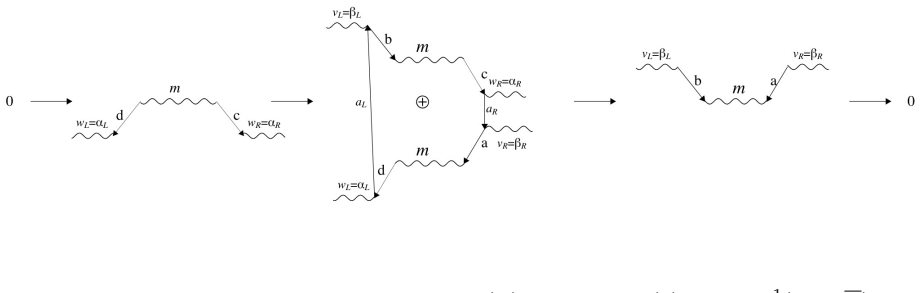
The load-bearing object is the cluster character $\mathrm{CC}(L)=\sum_e \chi(\mathrm{Gr}_e(L))x^{Be+g_L}y^e$, built from Euler characteristics of quiver Grassmannians. To obtain a two-term product, the proof cuts a generating extension $0\to X\to Y\to S\to 0$ using the submodules $\underline{X}=\ker(f)$ and $\underline{S}=\mathrm{im}(g)$ defined by the morphism $X\to\tau S$ that does not factor through an injective module and the morphism $\tau^{-1}X\to S$ that does not factor through a projective module. The correction term is the $\leq_{\mathrm{Ext}}$-minimum extension $M$ between $S/\underline{S}$ and $\underline{X}$, where the Ext-order is generated by nonsplit short exact sequences; for surface gentle algebras the extra arrows needed for $M$ already lie in $Q$, so $B=A$. The proof runs on string combinatorics: extensions of string modules are generated by arrow and overlap extensions, and $\chi(\mathrm{Gr}_e(L))$ counts successor-closed subquivers of the string diagram.
What would settle it
Find a gentle algebra A and a generating extension with one-dimensional Ext space for which the constructed B is infinite-dimensional or M has a nonzero self-extension; then the equality $\chi(\mathrm{Gr}^A_e(X\oplus S))=\chi(\mathrm{Gr}^A_e(Y))+\chi(\mathrm{Gr}^B_{e-\dim S}(M))$ would fail for some e, or the exchange-relation upgrade in Theorem 4.0.11 would not follow.
Extended reading notes
Core claim
Let $A=kQ/I$ be gentle, let $X,S$ be $A$-modules with $\dim\mathrm{Ext}^1_A(S,X)=1$, and let $\xi:0\to X\to Y\to S\to 0$ be a generating extension. Theorem 4.0.4 asserts that for every dimension vector $e$, $\chi(\mathrm{Gr}^A_e(X\oplus S))=\chi(\mathrm{Gr}^A_e(Y))+\chi(\mathrm{Gr}^B_{e-\dim S}(M))$, where $M$ is the $\leq_{\mathrm{Ext}}$-minimum extension between $S/\underline{S}$ and $\underline{X}$ in a finite-dimensional algebra $B\supseteq A$; when $A$ is the gentle algebra of a triangulation of an unpunctured surface, $B=A$. This recovers the earlier acyclic formula when $A$ is hereditary. The induced cluster-character identity (Corollary 4.0.8) is $\mathrm{CC}(X)\mathrm{CC}(S)=\mathrm{CC}(Y)x^{g_X+g_S-g_Y}+y^{\dim S}\mathrm{CC}(M)x^{B\dim S+g_X+g_S-g_M}$, and Theorem 4.0.11 upgrades it to an exchange relation when $X$ and $S$ are rigid indecomposables and $A$ is the gentle algebra of an unpunctured marked surface. Section 5 applies the formula to orthogonal modules over the symmetric algebra of a reflection-invariant triangulation of a regular polygon, proving the type-B/type-A F-polynomial and g-vector comparison.
Load-bearing premise
The formula's second term assumes that the algebra B built by adding one or two arrows is finite-dimensional and that the minimal extension module M is rigid; the paper only sketches B and asserts rigidity without a proof.
Editorial extensions
If this is right
- For every gentle algebra and every generating extension, the Euler characteristic of $\mathrm{Gr}_e(X\oplus S)$ is determined by $Y$ and one minimal extension module $M$, giving cluster character multiplication a two-term shape.
- For unpunctured surface triangulations the correction term is defined inside the same gentle algebra, so the identity is intrinsic and not an artifact of an auxiliary algebra.
- Specializing $x_i=1$ gives the F-polynomial identity $F_XF_S=F_Y+y^{\dim S}F_M$, a purely combinatorial statement about successor-closed subquivers of string diagrams.
- For rigid indecomposable modules over surface gentle algebras, the identity is an exchange relation in the cluster algebra with principal coefficients, giving a module-theoretic proof of those exchanges.
- For reflection-invariant triangulations of polygons, the formula proves the type-B/type-A restriction identities for F-polynomials and g-vectors of all orthogonal indecomposable modules, without a heredity assumption.
Reading between the lines
- The same two-term shape may hold for wider classes of string algebras or for Jacobian algebras of punctured surfaces, since the proof only needs a combinatorial basis of extensions and a finite-dimensional ambient algebra; the paper's Remark 4.0.13 already gestures at this.
- If the auxiliary algebra $B$ is made explicit and proved finite-dimensional, the formula becomes an effective algorithm for computing cluster character products from string data alone.
- The type-B/type-A application suggests a general categorical reading of restriction: symmetric-module categories over symmetric gentle algebras should categorify restriction maps between cluster algebras, with the Ext-minimal extension encoding the subtraction term in F-polynomial comparisons.
Editorial analysis
A structured set of objections, weighed in public.
Referee Report
Summary. The paper claims a multiplication formula for cluster characters (Caldero–Chapoton maps) over gentle algebras. For A-modules X, S with dim Ext^1(S,X)=1 and a generating extension 0→X→Y→S→0, Theorem 4.0.4 asserts χ(Gr_e(X⊕S)) = χ(Gr_e(Y)) + χ(Gr^B_{e-dimS}(M)), where M is an Ext-minimum extension in a finite-dimensional algebra B ⊇ A. The paper then derives a cluster-character multiplication formula (Corollary 4.0.8), shows that B=A for gentle algebras coming from unpunctured surface triangulations, and upgrades the formula to an exchange relation for rigid indecomposable modules (Theorem 4.0.11). Section 5 applies these results to give a representation-theoretic proof of a known type-B/type-A cluster variable formula (Theorem 5.0.14).
Significance. If fully established, the main theorem would generalize the acyclic-quiver result of Cerulli Irelli, Esposito, Franzen, and Reineke to all gentle algebras and would provide a uniform representation-theoretic interpretation of exchange relations in cluster algebras from unpunctured surfaces. The paper is clearly organized, the combinatorial case-by-case analysis in the overlap-extension cases with Ext^1(S,X/X)≠0 is plausible and is supported by several worked examples (Examples 4.0.10, 4.0.12), and the application to type B is natural. However, several load-bearing points in the proof of Theorem 4.0.4 and in the derivation of Theorem 5.0.14 are asserted rather than proved. The significance of the paper depends on completing those arguments.
major comments (6)
- [§4, proof of Theorem 4.0.4, Ext^1(S,X/X)=0 cases] The proof invokes Remark 2.0.4 to compute χ(Gr^B_{e-dimS}(M)) as the number of successor-closed subquivers. Remark 2.0.4 is stated for string algebras and string/band modules. In the cases treated under conditions (1) or (2), the algebra B obtained by adjoining a_L or a_R is, as the paper itself concedes in Remark 4.0.6 and Example 4.0.10(iii), not gentle, and in the second construction of Example 4.0.10(iii) it is not even a string algebra (two incoming arrows at vertex 5 compose non-trivially with e, violating condition G2). Therefore Remark 2.0.4 cannot be applied to identify the Euler characteristic with the subquiver count. The proof shows that L/S gives a successor-closed subquiver of M but does not prove that every B-submodule of M arises in this way. Equality (4.1) is thus not established in these cases.
- [Theorem 4.0.4 statement and proof] The algebra B = kQ'/I ⊇ A is never completely defined. The proof only says that one adjoins an arrow a_L or a_R to Q and does not specify the ideal I of the quotient kQ'/I, nor does it prove that the resulting algebra is finite-dimensional. Since M is defined as the Ext-minimum extension between S/S and X in B and the term χ(Gr^B_{e-dimS}(M)) is taken in B, the theorem is incomplete without a construction of B and a proof of its finite dimensionality.
- [Definition 4.0.1] The definition of X and S depends on the choice of the 'non-zero morphism f: X→τS that does not factor through an injective A-module' (and dually for g). The paper does not prove that such a morphism is unique; if several exist, ker f and im g, and hence the modules X and S, may depend on the choice. The argument in the proof of Theorem 4.0.4 selects the morphism associated with a maximal overlap but does not show that any other non-zero morphism not factoring through an injective would lead to the same submodules. Since X and S appear throughout (4.1), the well-definedness of these submodules is load-bearing.
- [Remark 4.0.5] The assertion 'The module M is rigid' is stated without proof. This rigidity is used in the proof of Theorem 4.0.11 to conclude that X ⊕ Y ⊕ M and S ⊕ Y ⊕ M are rigid and hence that (4.2) is an exchange relation via the cluster character bijection. A proof of Ext^1_B(M,M)=0, or a precise reference, is required; without it the exchange-relation theorem is not established.
- [§4, proof of Theorem 4.0.4, band module case] The theorem is stated for arbitrary A-modules, but the proof treats only string modules in detail, saying that if one or both are bands 'the argument is the same with minor adaptations.' For band modules the extension theory differs (there are no arrow extensions, only overlap extensions, cf. Theorem 1.1.8 and the subsequent remarks), and band modules are not rigid, so the reduction to the string case is not automatic. A separate argument for bands is needed to support the claimed generality.
- [§5, proof of Theorem 5.0.14(ii)] After applying Remark 4.0.9 and Proposition 5.0.1, the proof concludes 'M = L(a,¯b) ⊕ L(ρ(a),ρ(¯b))' from an equality of F-polynomials. F-polynomials do not determine modules in general, and the proof does not invoke or prove a uniqueness property of the Ext-minimum extension in this setting. Since this identification is used to derive (5.9) and (5.10), a missing step needs to be supplied.
minor comments (5)
- [Theorem 4.0.4 statement] The notation B = kQ'/I ⊇ A reuses I for the ideal of B, while I is already the ideal of A; this is confusing since the ideal of B is generally different. Please use a different symbol, e.g., I'.
- [Example 4.0.10(iii)] In the first construction, the paper states that the resulting B is still gentle, but it does not verify conditions (G1)–(G4) after the addition of the arrow a_L. A short check would make the example more convincing.
- [Theorem 5.0.14(i)] The phrase 'Res(N) = (Vi, ϕa) is indecomposable as ordinary module' should read 'as an ¯A-module'; the term 'ordinary module' is vague.
- [Definition 1.1.6(2)] The symbols a, b, c, d are sometimes arrows and sometimes the empty set (e.g., 'a = ∅'). This notation is nonstandard and should be clarified, for instance by introducing a convention for absent arrows.
- [Proof of Theorem 4.0.4] The sentence 'We show the proof for X, S both string modules' appears after a reduction to indecomposables; if the reduction is only valid for string modules, this should be stated explicitly before the reduction.
Circularity Check
No circular derivation: Theorem 4.0.4 is a direct combinatorial identity; only a minor non-load-bearing self-citation appears in the type B application.
full rationale
The main derivation chain is self-contained. Theorem 4.0.4 defines X and S via Auslander-Reiten morphisms (Definition 4.0.1), constructs M explicitly from the string data of the generating extension, and proves the Euler-characteristic equality (4.1) by a direct successor-closed-subquiver count using Remark 2.0.4. Corollary 4.0.8 and Theorem 4.0.11 are algebraic consequences of that identity plus standard cluster-character facts; no parameter is fitted and no target quantity is built into an input. The only self-reference is Section 5, where Theorem 5.0.14 is presented as an interpretation/application: its proof invokes the author's earlier Theorem 5.0.3 ([Cil25, Thm 3.7]) - for (i) as a rewriting, and for (ii) after identifying the module M via the new formula and the skein relation. Because [Cil25] is a published, parameter-free statement and the section is explicitly an application rather than independent evidence for Theorem 4.0.4, this is at most a minor non-load-bearing self-citation. The paper's own caveats (Remark 4.0.5 asserting rigidity without proof; Example 4.0.10(iii) admitting B need not be string, undermining the invocation of Remark 2.0.4 in those cases) are proof-gap/correctness concerns, not circularity, and are outside the circularity score.
Assumptions & free parameters
assumptions (6)
- standard math String/band classification and overlap description of Hom and Ext for string and gentle algebras (Theorems 1.0.13, 1.1.3, 1.1.8).
- standard math Auslander-Reiten formulas and the description τ(M(w)) = M(gr(gl(w))) for string algebras (Theorem 1.1.5, [ASS06] IV.2.13).
- standard math χ(Gre(L)) equals the number of successor-closed subquivers for string and band modules (Remark 2.0.4; [Cer11; JS24; Hau12]).
- standard math Cluster character bijection between rigid objects of the cluster category C(S,M) and cluster monomials (Theorem 4.0.11; [BZ11; ÇS17]).
- domain assumption Type B/type A cluster variable formula of [Cil25, Theorem 3.7].
- ad hoc to paper Existence of a finite-dimensional algebra B = kQ'/I ⊇ A containing an Ext-minimum extension M between S/S and X, with the Grassmannian term interpreted in B.
invented entities (1)
-
Finite-dimensional algebra B = kQ'/I ⊇ A
Cite this review
Pith. "Pith review of A multiplication formula for cluster characters in gentle algebras." pith.science (2026). https://pith.science/paper/JOEH7PT6
@misc{pith2026250206410,
  author       = {Pith},
  title        = {Pith review of: A multiplication formula for cluster characters in gentle algebras},
  year         = {2026},
  howpublished = {\url{https://pith.science/paper/JOEH7PT6}},
  note         = {Machine review of arXiv:2502.06410}
}
read the original abstract
We prove a multiplication formula for cluster characters induced by generating extensions in a gentle algebra A, generalizing a result of Cerulli Irelli, Esposito, Franzen, Reineke. In the case where A is the gentle algebra of a triangulation T of an unpunctured marked surface, this provides a representation-theoretic interpretation of the exchange relations in the cluster algebra with principal coefficients in T. As an application, we interpret a formula that relates cluster variables of type B to cluster variables of type A in the symmetric module category of the algebras arising from special triangulations of a regular polygon.
Figures


Figures from the paper (9 more)




Reference graph
Works this paper leans on
-
[49]
Generalized quivers associated to reductive groups
ISSN : 0001-8708. DOI: 10.1016/j.aim.2017.03.016 . URL: https://doi.org/10. 1016/j.aim.2017.03.016. [DW02] H. Derksen and J. Weyman. “Generalized quivers associated to reductive groups”. In: Colloq. Math. 94.2 (2002), pp. 151–173. ISSN : 0010-1354. DOI: 10.4064/cm94- 2- 1 . URL: https://doi.org/10.4064/cm94-2-1. 30 [FST08] S. Fomin, M. Shapiro, and D. Thu...
-
[179]
On the cluster category of a marked surface without punc- tures
ISSN : 0092-7872. DOI: 10.1080/00927878708823416. URL: https://doi.org/10. 1080/00927878708823416. [BZ11] T. Brüstle and J. Zhang. “On the cluster category of a marked surface without punc- tures”. In: Algebra Number Theory 5.4 (2011), pp. 529–566. ISSN : 1937-0652. DOI: 10 . 2140/ant.2011.5.529. URL: https://doi.org/10.2140/ant.2011.5.529. [Cer+21] G. Ce...
-
[194]
Quivers with potentials associated to triangulated surfaces
ISSN : 0021-8693. DOI: 10.1016/0021-8693(91)90088-P . URL: https://doi.org/ 10.1016/0021-8693(91)90088-P. [Lab09] D. Labardini-Fragoso. “Quivers with potentials associated to triangulated surfaces”. In: Proc. Lond. Math. Soc. (3) 98.3 (2009), pp. 797–839. ISSN : 0024-6115. DOI: 10.1112/ plms/pdn051. URL: https://doi.org/10.1112/plms/pdn051. [MW13] G. Musi...
arXiv 2009
-
[229]
A geometric model for the module category of a gentle algebra
ISSN : 1937-0652. DOI: 10.2140/ant.2010.4.201 . URL: https://doi.org/10. 2140/ant.2010.4.201. [ASS06] I. Assem, D. Simson, and A. Skowro ´ nski. Elements of the representation theory of associa- tive algebras. Vol. 1. Vol. 65. London Mathematical Society Student Texts. Techniques of representation theory. Cambridge University Press, Cambridge, 2006, pp. x...
-
[2080]
Skein relations for punctured surfaces
DOI: 10.4310/arkiv.2025.v63.n1.a3. URL: https://doi.org/10.4310/arkiv. 2025.v63.n1.a3. [BKK24a] E. Banaian, W. Kang, and E. Kelley. Skein relations for punctured surfaces . 2024. arXiv: 2409.04957 [math.CO]. URL: https://arxiv.org/abs/2409.04957. [BKK24b] E. Banaian, W. Kang, and E. Kelley. “Skein relations for punctured surfaces”. In: Sém. Lothar. Combin...
arXiv 2024
-
[7630]
Maps between tree and band modules
DOI: 10.1017/nmj.2023.37. URL: https://doi.org/10.1017/nmj.2023.37. [Kra91] H. Krause. “Maps between tree and band modules”. In: J. Algebra 137.1 (1991), pp. 186–
-
[7928]
On degenerations and extensions of symplectic and orthogonal quiver representations
DOI: 10.1093/imrn/rnz150. URL: https://doi.org/10.1093/imrn/rnz150. 29 [BC24] K. Baur and R. Coelho Simões. A geometric model for the module category of a string algebra. 2024. arXiv: 2403.07810 [math.RT] . URL: https://arxiv.org/abs/2403. 07810. [BC25] M. Boos and G. Cerulli Irelli. “On degenerations and extensions of symplectic and orthogonal quiver rep...
arXiv 2025
-
[9266]
On indecomposable exceptional modules over gentle algebras
DOI: 10.1090/memo/1343. URL: https://doi.org/10.1090/memo/1343. [Zha14] J. Zhang. “On indecomposable exceptional modules over gentle algebras”. In: Comm. Algebra 42.7 (2014), pp. 3096–3119. ISSN : 0092-7872. DOI: 10.1080/00927872.2013. 781369. URL: https://doi.org/10.1080/00927872.2013.781369. 31
arXiv 2014
Reviewed August 8, 2026 · model on record in the stance chip above.
Discussion (0). Continue with ORCID to comment.