REVIEW 4 major objections 6 minor 21 references
Group-CLIP Uncertainty Modeling for Group Re-Identification
T0 review · 4 major / 6 minor · reviewed 2026-08-08 · deepseek-v4-flash
Pith's one-line read The paper claims the first CLIP-based Group ReID method, using uncertain text descriptions to match groups whose member count and layout were never seen in training.
desk verdict New CLIP-based group re-id idea, but the SOTA claim rests on an undocumented 70/30 split and is not verifiable as submitted. read the letter →
The pith
A machine-rendered reading of the paper's core claim, the machinery that carries it, and where it could break.
The reading
What carries the argument
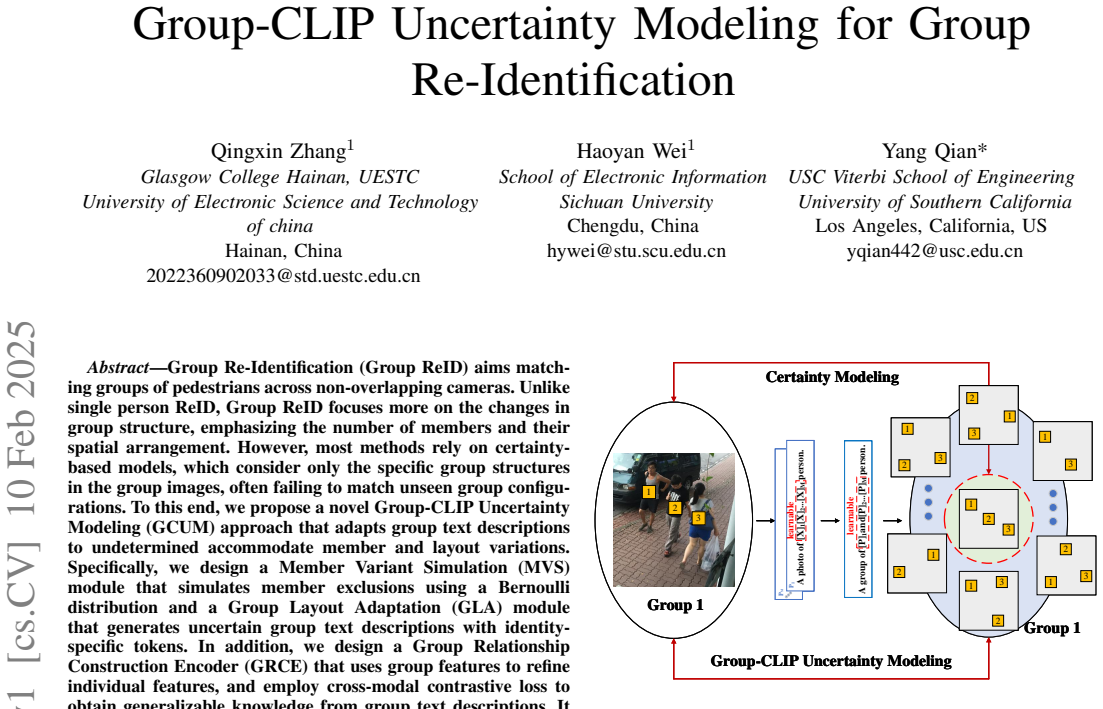
The Member Variant Simulation (MVS) module applies a Bernoulli mask to randomly remove members and re-weights the group class token with a learnable quantity-relationship matrix. The Group Layout Adaptation (GLA) module aggregates per-member learnable tokens into a group sentence with conditional options. The Group Relationship Construction Encoder (GRCE) refines individual features through cross-attention from group features and is trained with identity, triplet, and image-to-text contrastive losses. The load-bearing idea is that text descriptions can carry uncertainty explicitly where fixed visual templates cannot.
What would settle it
Retrain GCUM on an explicitly identity-disjoint split of CSG with a fixed seed, repeated for ten runs, and compare the mean Rank-1 to UMSOT's 93.6%; if the mean falls to or below that value, the claimed generalization advantage is not demonstrated.
Extended reading notes
Core claim
GCUM is the first to bring CLIP to Group Re-ID, and it works by replacing fixed group-structure descriptions with uncertain text descriptions that include identity-specific tokens plus 'potentially present' phrasing. Training with simulated member exclusions and layout adaptation lets the text encoder align with visual features of groups whose member count and layout were never seen in training. On CSG, RoadGroup, and iLIDS-MCTS the method reports Rank-1 accuracies of 94.4%, 90.1%, and 67.8%, surpassing the previous single-dataset state of the art UMSOT by 0.8, 1.2, and 3.1 points respectively. These numbers, if they hold under a fair evaluation protocol, mean that uncertainty in text descriptions is a viable route to generalizing across group structures.
Load-bearing premise
The reported gains assume the random 70/30 train/test split keeps identities disjoint between partitions; the paper does not state a seed or confirm disjointness, so if identities overlap the accuracy numbers would be inflated.
Editorial extensions
If this is right
- A model trained on a single dataset can beat baselines that were trained on multiple datasets, because the text descriptions transfer structural knowledge rather than memorized layouts.
- The MVS, GLA, and GRCE modules each contribute; ablating any of them drops Rank-1 by at least several points, so the method's gains are not from the backbone alone.
- Retrieval visualizations show correct group matches even when member count and layout differ between query and gallery, indicating the learned text tokens are robust to structural variation.
- The two-stage pipeline separates knowledge transfer from visual refinement, meaning either stage could be reused with a different backbone or a different text generator.
Reading between the lines
- The 'potentially present' mechanism is effectively a form of compositional open-vocabulary learning; a natural test is whether the learned tokens can describe group sizes beyond the predefined maximum M0.
- The same uncertainty-description recipe could be carried to other structured-object recognition tasks, such as matching vehicle convoys or animal herds, where membership is fluid.
- The evaluation rests on a random 70/30 split; an identity-disjoint protocol with repeated seeds and standard deviations would likely shrink the reported margins but would be the fair test of the generalization claim.
- One could add test-time member-mask augmentation to probe whether the model's robustness is truly continuous in the mask probability p.
Signed reviews
Editorial analysis
A structured set of objections, weighed in public.
Referee Report
Summary. This manuscript proposes GCUM, a two-stage CLIP-based method for group re-identification. The first stage introduces a Member Variant Simulation (MVS) module and a Group Layout Adaptation (GLA) module to generate uncertain group text descriptions, while the second stage employs a Group Relationship Construction Encoder (GRCE) to refine group visual features and applies identity, triplet, and image-to-text cross-entropy losses. Experiments on iLIDS-MCTS, RoadGroup, and CSG report state-of-the-art Rank-1 accuracies of 67.8%, 90.1%, and 94.4%, and the paper claims to be the first to apply CLIP to group ReID.
Significance. If the reported results are reproducible under a correct evaluation protocol, the idea of using CLIP for group ReID with uncertainty modeling is novel and potentially impactful. Strengths include a concrete two-stage framework, ablations over the proposed modules, and retrieval visualizations. The empirical central claim, however, depends on an evaluation protocol that is underspecified in Section III-A, and the claimed generalization from text descriptions is not cleanly separated from a self-distillation loop. The margins over prior state-of-the-art are small, so evaluation rigor is critical.
major comments (4)
- [Section III-A, Implementation details] The paper states only that each dataset is 'randomly divided' into a 70% training set and a 30% test set, without specifying that the split is identity-disjoint, without giving a random seed, and without reporting repeated runs. Since Table I compares against prior methods whose scores are typically reported under official identity-disjoint splits, this ambiguity makes the central SOTA claim unverifiable. If group identities appear in both training and test sets, the reported Rank-1 gains (0.8, 1.2, and 3.1 points over UMSOT) could stem entirely from protocol mismatch. Please specify the split policy, adopt the official splits if available, and report the mean and standard deviation over at least three seeds.
- [Section III-B, Compared with Other Group Re-ID Methods] The claim of 'significantly outperforming' state-of-the-art is not supported by the reported numbers, since the Rank-1 margins over UMSOT are only 0.8 (CSG), 1.2 (RoadGroup), and 3.1 (iLIDS-MCTS) percentage points. Without variance estimates or statistical significance testing, these differences are within the range of random split variation. Additionally, the 'improvement' percentages over hand-crafted methods are computed as absolute percentage-point differences (e.g., 94.4 - 19.2 = 75.2) and are described as '% improvement,' which is misleading; please report relative improvements or explicitly state that these are percentage-point increases.
- [Section II-A, Eqs. (1)-(2)] The MVS module is underspecified. The notation 'p ∼ N (µ, σ; p0, pmax)' in Eq. (1) is not defined; it is unclear whether this is a truncated normal or a clipping operation, and the roles of p0 and pmax are not explained. In Eq. (2), the text says 'a represents selecting the first elements,' which is likely a typo for 'top'; the operation 'top(|− →m|)' is not defined elsewhere. Since MVS is a core contribution, these missing details prevent reproduction.
- [Section II-C, second training stage and Eq. (7)] The learnable text tokens [X] and [P] are optimized in Stage 1 on the same training identities that later supervise the visual features via the Li2tce loss in Stage 2. Therefore the 'generalizable knowledge from group text descriptions' is not externally grounded in CLIP's pretrained semantics but is a self-distillation loop on the training identities. The paper should clarify what information is transferred beyond the identity labels, or demonstrate generalization to unseen identities through a zero-shot or cross-dataset experiment.
minor comments (6)
- [Abstract] The phrase 'adapts group text descriptions to undetermined accommodate member and layout variations' is ungrammatical; the word 'undetermined' appears to be an error and should be removed or replaced.
- [Section III-C, Ablation studies] The ablation text refers to a 'Dual-Branch' component, but the method section names this component 'GRCE'; please use consistent terminology throughout.
- [Eq. (7)] The index 'K' in 'TyK' is inconsistent with the surrounding notation; it should likely be 'Tyi', and the denominator summation index should be clarified.
- [Table I] The mAP column is empty for several prior methods; please state whether mAP is unavailable for those methods and how the table should be interpreted.
- [Section II-C] The number of learnable tokens M and the predefined maximum group size K are not specified; please provide values for each dataset.
- [Figure 2 caption] The caption does not explain the distinction between the Stage 1 and Stage 2 losses; a more detailed caption would improve readability.
Circularity Check
No significant circularity: the method is a two-stage consistency-training pipeline evaluated on held-out test data, and the self-citations are only baseline comparisons.
full rationale
The derivation chain is self-contained in the sense required by this audit. MVS, GLA, and GRCE are specified as trainable modules with explicit losses (Eqs. 1-8), and the final evaluation is performed on a held-out test portion of public datasets. The text descriptions are learned in Stage 1 from the same training identities that supervise the visual features, and the Stage-2 Li2tce loss (Eq. 7) uses those text features as soft targets; this is a two-stage consistency/self-distillation procedure, not a claim that the text descriptions are an externally grounded source of new information. The paper does not fit a parameter to a subset of data and then report that same fitted value as a prediction; the reported Rank-1 numbers are produced by a trained model on test images. The only self-citations, references [20] and [21], are prior Group-ReID methods used as comparison baselines in Table I, not load-bearing justifications for the method's correctness. The undocumented 70/30 random split, with no explicit identity-disjointness guarantee, seed, or repeated runs, is a reproducibility and validity concern about the empirical claim, but it is not a circularity of the derivation chain. No step reduces by construction to its own input, and no load-bearing premise is imported solely from the authors' prior work. Therefore the circularity score is 0.
Assumptions & free parameters
free parameters (6)
- Bernoulli mask distribution parameters (mu, sigma, p0, pmax) =
Not reported
- Learnable quantity relationship matrix Em =
Learned during training
- Learnable text tokens [X] and [P] =
Learned during training
- Maximum group size M0/K =
Preset
- Triplet margin alpha =
Not specified
- Random split ratio 70/30 =
70/30
assumptions (4)
- domain assumption The 70/30 random split is identity-disjoint and comparable to official benchmark splits.
- domain assumption CLIP's embedding space can represent group-level semantics through learned tokens without additional text supervision.
- domain assumption A Bernoulli mask with a truncated-normal probability faithfully simulates real changes in group membership.
- domain assumption The text template with conditional options can express layout-invariant group descriptions.
Cite this review
Pith. "Pith review of Group-CLIP Uncertainty Modeling for Group Re-Identification." pith.science (2026). https://pith.science/paper/DXM36RCX
@misc{pith2026250206460,
  author       = {Pith},
  title        = {Pith review of: Group-CLIP Uncertainty Modeling for Group Re-Identification},
  year         = {2026},
  howpublished = {\url{https://pith.science/paper/DXM36RCX}},
  note         = {Machine review of arXiv:2502.06460}
}
read the original abstract
Group Re-Identification (Group ReID) aims matching groups of pedestrians across non-overlapping cameras. Unlike single-person ReID, Group ReID focuses more on the changes in group structure, emphasizing the number of members and their spatial arrangement. However, most methods rely on certainty-based models, which consider only the specific group structures in the group images, often failing to match unseen group configurations. To this end, we propose a novel Group-CLIP UncertaintyModeling (GCUM) approach that adapts group text descriptions to undetermined accommodate member and layout variations. Specifically, we design a Member Variant Simulation (MVS)module that simulates member exclusions using a Bernoulli distribution and a Group Layout Adaptation (GLA) module that generates uncertain group text descriptions with identity-specific tokens. In addition, we design a Group RelationshipConstruction Encoder (GRCE) that uses group features to refine individual features, and employ cross-modal contrastive loss to obtain generalizable knowledge from group text descriptions. It is worth noting that we are the first to employ CLIP to GroupReID, and extensive experiments show that GCUM significantly outperforms state-of-the-art Group ReID methods.
Figures


Reference graph
Works this paper leans on
-
[1]
Group re-identification: Leveraging and integrating multi-grain information,
H. Xiao, W. Lin, B. Sheng, K. Lu, J. Yan, J. Wang, E. Ding, Y . Zhang, and H. Xiong, “Group re-identification: Leveraging and integrating multi-grain information,” in Proceedings of the 26th ACM international conference on Multimedia , 2018, pp. 192–200
work page 2018
-
[2]
Learning multi-attention context graph for group-based re-identification,
Y . Yan, J. Qin, B. Ni, J. Chen, L. Liu, F. Zhu, W.-S. Zheng, X. Yang, and L. Shao, “Learning multi-attention context graph for group-based re-identification,” IEEE transactions on pattern analysis and machine intelligence, vol. 45, no. 6, pp. 7001–7018, 2020
work page 2020
-
[3]
Vision Transformer based Random Walk for Group Re-Identification
G. Zhang, T. Liu, W. Fang, and Y . Zheng, “Vision transformer based ran- dom walk for group re-identification,” arXiv preprint arXiv:2410.05808, 2024
work page Pith review arXiv 2024
-
[4]
Tret: Two stream- based regionally enhanced transformers for person re-identification,
K. Lee, K.-J. Kim, P.-K. Kim, and I.-S. Jang, “Tret: Two stream- based regionally enhanced transformers for person re-identification,” in ICASSP 2024-2024 IEEE International Conference on Acoustics, Speech and Signal Processing (ICASSP) . IEEE, 2024, pp. 5795–5799
work page 2024
-
[5]
Parallel augmentation and dual enhancement for occluded person re-identification,
Z. Wang, H. Huang, A. Zheng, C. Li, and R. He, “Parallel augmentation and dual enhancement for occluded person re-identification,” in ICASSP 2024-2024 IEEE International Conference on Acoustics, Speech and Signal Processing (ICASSP) . IEEE, 2024, pp. 3590–3594
work page 2024
-
[6]
Consistent matching based on boosted salience channels for group re-identification,
F. Zhu, Q. Chu, and N. Yu, “Consistent matching based on boosted salience channels for group re-identification,” in 2016 IEEE Interna- tional Conference on Image Processing (ICIP). IEEE, 2016, pp. 4279– 4283
work page 2016
-
[7]
Dotscn: Group re-identification via domain-transferred single and couple representation learning,
Z. Huang, Z. Wang, C.-C. Tsai, S. Satoh, and C.-W. Lin, “Dotscn: Group re-identification via domain-transferred single and couple representation learning,” IEEE Transactions on Circuits and Systems for Video Tech- nology, vol. 31, no. 7, pp. 2739–2750, 2020
work page 2020
-
[8]
Dot-gnn: Domain-transferred graph neural network for group re-identification,
Z. Huang, Z. Wang, W. Hu, C.-W. Lin, and S. Satoh, “Dot-gnn: Domain-transferred graph neural network for group re-identification,” in Proceedings of the 27th ACM International Conference on Multimedia , 2019, pp. 1888–1896
work page 2019
Show all 21 references
-
[9]
Group re- identification with group context graph neural networks,
J. Zhu, H. Yang, W. Lin, N. Liu, J. Wang, and W. Zhang, “Group re- identification with group context graph neural networks,” IEEE Trans- actions on Multimedia , vol. 23, pp. 2614–2626, 2020
2020
-
[10]
Group reidentification with multigrained matching and integration,
W. Lin, Y . Li, H. Xiao, J. See, J. Zou, H. Xiong, J. Wang, and T. Mei, “Group reidentification with multigrained matching and integration,” IEEE transactions on cybernetics , vol. 51, no. 3, pp. 1478–1492, 2019
2019
-
[11]
Clip-reid: exploiting vision-language model for image re-identification without concrete text labels,
S. Li, L. Sun, and Q. Li, “Clip-reid: exploiting vision-language model for image re-identification without concrete text labels,” in Proceedings of the AAAI Conference on Artificial Intelligence , vol. 37, no. 1, 2023, pp. 1405–1413
2023
-
[12]
Bootstrapping vision-language learning with decoupled language pre-training,
Y . Jian, C. Gao, and S. V osoughi, “Bootstrapping vision-language learning with decoupled language pre-training,” Advances in Neural Information Processing Systems , vol. 36, 2024
2024
-
[13]
Embodiedgpt: Vision-language pre-training via embodied chain of thought,
Y . Mu, Q. Zhang, M. Hu, W. Wang, M. Ding, J. Jin, B. Wang, J. Dai, Y . Qiao, and P. Luo, “Embodiedgpt: Vision-language pre-training via embodied chain of thought,” Advances in Neural Information Processing Systems, vol. 36, 2024
2024
-
[14]
Enhancing vision-language pre- training with rich supervisions,
Y . Gao, K. Shi, P. Zhu, E. Belval, O. Nuriel, S. Appalaraju, S. Ghadar, Z. Tu, V . Mahadevan, and S. Soatto, “Enhancing vision-language pre- training with rich supervisions,” in Proceedings of the IEEE/CVF Conference on Computer Vision and Pattern Recognition , 2024, pp. 13 4...
2024
-
[15]
Med-unic: Unifying cross-lingual medical vision-language pre-training by diminishing bias,
Z. Wan, C. Liu, M. Zhang, J. Fu, B. Wang, S. Cheng, L. Ma, C. Quilodr´an-Casas, and R. Arcucci, “Med-unic: Unifying cross-lingual medical vision-language pre-training by diminishing bias,” Advances in Neural Information Processing Systems , vol. 36, 2024
2024
-
[16]
Associating groups of people
W.-S. Zheng, S. Gong, and T. Xiang, “Associating groups of people.” in BMVC, vol. 2, no. 6, 2009, pp. 1–11
2009
-
[17]
Matching groups of people by covariance descriptor,
Y . Cai, V . Takala, and M. Pietikainen, “Matching groups of people by covariance descriptor,” in2010 20th International Conference on Pattern Recognition. IEEE, 2010, pp. 2744–2747
2010
-
[18]
Group re- identification via unsupervised transfer of sparse features encoding,
G. Lisanti, N. Martinel, A. Del Bimbo, and G. Luca Foresti, “Group re- identification via unsupervised transfer of sparse features encoding,” in Proceedings of the IEEE International Conference on Computer Vision , 2017, pp. 2449–2458
2017
-
[19]
From pedestrian to group retrieval via siamese network and correlation,
L. Mei, J. Lai, Z. Feng, and X. Xie, “From pedestrian to group retrieval via siamese network and correlation,” Neurocomputing, vol. 412, pp. 447–460, 2020
2020
-
[20]
Uncertainty modeling with second-order transformer for group re-identification,
Q. Zhang, J.-H. Lai, Z. Feng, and X. Xie, “Uncertainty modeling with second-order transformer for group re-identification,” in Proceedings of the AAAI conference on artificial intelligence , vol. 36, no. 3, 2022, pp. 3318–3325
2022
-
[21]
Uncertainty modeling for group re-identification,
Q. Zhang, J. Lai, Z. Feng, and X. Xie, “Uncertainty modeling for group re-identification,” International Journal of Computer Vision , pp. 1–21, 2024
2024
Reviewed August 8, 2026 · model on record in the stance chip above.
Discussion (0). Continue with ORCID to comment.