REVIEW 3 major objections 4 minor 51 references
Constraints on axion-like particles using lattice QCD calculations of the rate for $J/\psi \to \gamma a$
T0 review · 3 major / 4 minor · reviewed 2026-08-08 · deepseek-v4-flash
Pith's one-line read This paper reports the first lattice QCD calculation of the form factor for $J/\psi \to \gamma a$, with total uncertainty below 2%, and uses it to set improved constraints on axion-like particles coupled to charm quarks.
desk verdict A solid first lattice QCD calculation of the J/ψ→γa form factor; the abstract overstates the mass reach but the physics within the data range is reliable. read the letter →
The pith
A machine-rendered reading of the paper's core claim, the machinery that carries it, and where it could break.
The reading
What carries the argument
The key object is the lattice three-point correlation function between a vector charmonium operator, a local vector current that couples to the photon, and a local pseudoscalar current that couples to the ALP. The paper converts it into a two-point function by summing over the photon insertion time with weight $e^{-\omega t_\gamma}$, which puts the photon on shell and sets the ALP energy and momentum for a chosen mass; this is the technique previously developed for $J/\psi \to \gamma \eta_c$ and $\eta_c \to \gamma\gamma$. The form factor is then extracted from the ground-state amplitude of a multi-exponential Bayesian fit to the resulting correlator, and a simultaneous fit to results at four lattice spacings, with monotonic cubic splines in $X$ and systematic terms for discretisation errors and sea and valence quark mistuning, produces the physical continuum curve.
What would settle it
A lattice QCD calculation that includes quark-line disconnected diagrams and ALP-$\eta_c$ mixing would falsify the extrapolation if it shifted $\tilde F$ at $X=0.8$ by more than the quoted total uncertainty of about 1.3%; alternatively, an experimental measurement of $J/\psi \to \gamma a$ at high ALP mass with sensitivity better than the predicted rate would test the curve directly.
Extended reading notes
Core claim
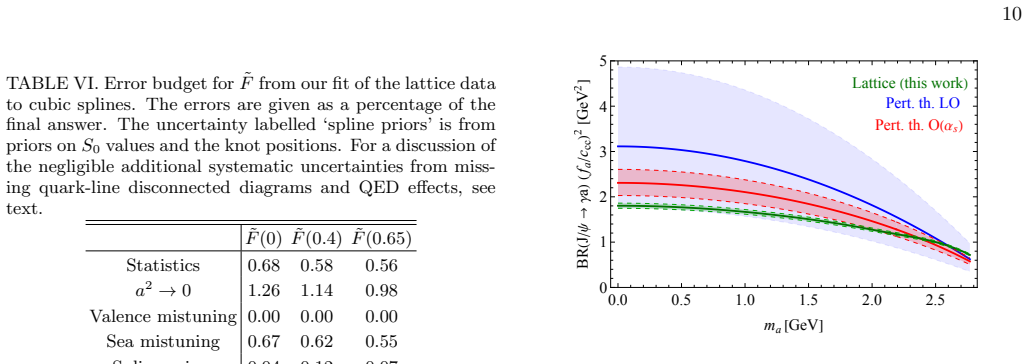
The paper's central claim is that the form factor $\tilde F$ for $J/\psi \to \gamma a$, defined by $\tilde F = (2 m_c/M_{J/\psi}) F(0,m_a)(1 - m_a^2/M_{J/\psi}^2)$, is a mildly increasing function of $X = m_a^2/M_{J/\psi}^2$, rising from $0.2017(32)$ at $m_a=0$ to $0.2544(32)$ at $X=0.65$, with total uncertainty below 2% across the calculated range. This is the first fully nonperturbative result for this quantity and it should be used, together with the lattice value of $f_{J/\psi}$, in the expression for the total $J/\psi \to \gamma a$ rate that also contains the photon-coupling amplitude. The resulting curve is not flat, as tree-level NRQCD predicts, and it lies systematically below the $\mathcal{O}(\alpha_s)$ NRQCD curve, indicating that higher-order and relativistic corrections in the perturbative approach are larger than its nominal uncertainty. The authors therefore conclude that ALP constraints from radiative $J/\psi$ searches should be derived from the lattice form factor, and they provide numerical values and a correlation matrix for that purpose.
Load-bearing premise
The result assumes that mixing between the ALP and the nearby $\eta_c$ meson is negligible all the way up to $m_a = 2.770$ GeV, which is only 214 MeV below the $\eta_c$ mass; if that mixing is not tiny, the highest-mass end of the form factor curve would be wrong.
Editorial extensions
If this is right
- The lattice form factor $\tilde F(X)$ should replace the flat tree-level value $2f_{J/\psi}/M_{J/\psi}$ and the $\mathcal{O}(\alpha_s)$ NRQCD curve when computing $J/\psi \to \gamma a$ rates for ALP searches.
- Because the perturbative curves lie above the lattice curve for most ALP masses, constraints on charm-quark ALP couplings derived from radiative-decay searches become weaker, especially for long-lived ALPs that appear as missing energy.
- In two-coupling scenarios with both $c_{cc}$ and $c_{\gamma\gamma}$ active, the cancellation region where the two amplitudes partially cancel shifts, changing the shape of allowed parameter space.
- The same first-principles approach can be extended to other radiative heavy-quarkonium decays, such as $\Upsilon \to \gamma a$, providing lattice QCD input across a wider range of ALP masses.
- The numerical $\tilde F$ values supplied as supplementary material allow any future experimental limit on $J/\psi \to \gamma a$ to be converted into ALP constraints without repeating the lattice calculation.
Reading between the lines
- If ALP-$\eta_c$ mixing is not negligible below $m_a = 2.770$ GeV, the supplied curve's high-mass tail, where the spline fit already carries extra systematic uncertainty, would be biased; a dedicated lattice study of the mixing would settle this.
- The sizeable gap between the lattice and $\mathcal{O}(\alpha_s)$ NRQCD curves suggests the perturbative uncertainty estimate based on $\alpha_s^2$ is optimistic, and the lattice result could be used to calibrate the missing higher-order or relativistic corrections.
- With the hadronic input now below 2% uncertainty, the experimental upper limits become the dominant limiting factor for ALP constraints from this decay, so improved radiative-decay searches would translate directly into stronger bounds.
- The same weighted-sum correlator technique could be applied to $B$ or $D_s$ leptonic decays with ALP radiation, giving complementary constraints on ALP couplings to different quark flavours.
Editorial analysis
A structured set of objections, weighed in public.
Referee Report
Summary. The paper presents a lattice QCD calculation of the form factor relevant for the decay J/ψ → γa, using HISQ charm quarks on six MILC ensembles with four lattice spacings and physical and unphysical sea masses. The authors extract the form factor from a 3-point correlator with a weighted time sum that enforces an on-shell photon, and then perform a simultaneous continuum/sea-mass extrapolation using monotonic cubic splines. They report the form factor at three selected X=m_a^2/M_J/ψ^2 values (0, 0.4, 0.65) with total uncertainties below 2%, compare to leading and O(αs) NRQCD perturbation theory, and use the result to update ALP constraints from BESIII searches. The abstract claims the calculation covers ALP masses up to 95% of the J/ψ mass.
Significance. If the central result stands, this is a significant methodological advance: it provides the first nonperturbative form factor for J/ψ → γa, with a claimed precision far better than the tree-level or O(αs) NRQCD approximations previously used. The paper includes machine-readable supplementary data, a transparent error budget, and a clear phenomenological application. The careful control of discretisation effects (four lattice spacings), quark-mass mistuning, and extrapolation uncertainty is a strength, and the comparison between the lattice result and perturbation theory quantifies the failure of the latter at the few-percent level. The abstract overstates the calculated range (up to 95% of the J/ψ mass) relative to the actual data coverage and spline extrapolation, which is a load-bearing issue for the headline claim.
major comments (3)
- [Abstract; Section III C] The abstract states that the form factor is determined with uncertainty less than 2% for ALP masses 'from zero up to 95% of the J/ψ mass.' However, the lattice data in Table IV are limited to X=m_a^2/M_J/ψ^2 ≤ 0.65, and the spline fit is extrapolated only to X=0.8, corresponding to m_a=2.770 GeV = 0.894 M_J/ψ. No results are provided for X>0.8, and Appendix A explains that the method degrades as m_a approaches M_J/ψ. The claimed 95% upper bound (X≈0.90) is therefore not supported by the calculation. The abstract and any similar claims elsewhere should be corrected to state the range up to X=0.8 (approximately 89% of the J/ψ mass), or a new calculation covering a larger X must be provided.
- [Section III B; Table VI] The error budget in Table VI gives total uncertainties at X=0, 0.4, and 0.65 only, with values of 1.58%, 1.43%, and 1.26% respectively. The paper's central claim, however, is that the uncertainty is below 2% across the full range up to X=0.8. The additional systematic added for 0.65<X<0.8, described in Section III B as the difference between the 3-knot and 4-knot fits, is not quantified in Table VI, nor is a total uncertainty given for X=0.8. Without that endpoint error budget, the 'less than 2%' claim is not demonstrated for the extrapolated region where the fit is least constrained. The authors should provide a value and error budget at X=0.8, or explicitly restrict the claim to X≤0.65.
- [Section III C] The paper states that it is safe to neglect ALP-ηc mixing up to X=0.8, where m_a=2.770 GeV is 214 MeV below the ηc mass, but it gives no quantitative estimate of the size of this mixing or its effect on the form factor. Since the paper claims total uncertainties below 2%, an unquantified systematic effect from mixing could in principle exceed this error at the upper end of the range. The authors should either provide a numerical estimate of the mixing contribution (for example, in terms of the ALP-quark coupling and the mass splitting) or explicitly label the results for X close to 0.8 as subject to a potentially non-negligible unquantified systematic from ηc mixing.
minor comments (4)
- [Figure 5 caption] The caption contains a typo: 'wthin' should be 'within'.
- [Section III B, Eq. (21)] The factor 10 in the denominator of Eq. (25) is not explained; a brief comment that this is a convenient scale for the sea-quark mistuning term would improve readability.
- [Section III C] The text says the supplementary material provides results for F from X=0.0 to 0.8 in steps of 0.01, but the main text only gives numerical results at three X values. It would be helpful to state the total uncertainty at X=0.8 explicitly in the table or in the text, matching what is provided in the supplementary file.
- [Section IV] The perturbative uncertainty bands in Figures 7-12 are estimated by scaling the amplitude by αs or αs^2 (0.25 and 0.06), which is an order-of-magnitude estimate rather than a rigorous error. If this is intended for illustration, it would be useful to say so explicitly in the caption or text.
Circularity Check
No significant circularity: the form factor is computed directly from lattice correlation functions and the analysis reduces to no fitted input or self-citation chain.
full rationale
The central claim, the lattice QCD determination of the form factor F̃ for J/psi to gamma a, is obtained directly from the path integral: the matrix element is extracted from three-point correlation functions through Eqs. (16)-(20), with the photon put on-shell by the weighted sum of Eq. (16). The only external parameters entering the lattice extraction are the MILC ensembles, the valence charm mass tuned in [19] so that the J/psi mass matches experiment, and the vector-current renormalisation factor Z_V from the RI-SMOM analyses [36,37]. None of these is fitted to produce the form factor; they are independent lattice or experimental inputs. The continuum physical-point curve is generated by a Bayesian cubic-spline fit, Eq. (21), to the raw lattice values in Table IV. This is an interpolation/extrapolation of directly computed matrix elements, not a fit to the final ALP constraints or to the perturbative expressions being compared. The subsequent ALP constraints in Section IV use these lattice results together with BESIII experimental limits; the experimental limits are not fitted to the lattice curve and the lattice curve is not fitted to the limits. Citations to prior HPQCD work supply f_J/psi, tuned masses, Z_V, and correlator-fitting methodology, but they are used as auxiliary standards, not as a substitute for any step of the present derivation. The skeptical concern about the abstract's 'up to 95%' range and the extrapolation from X=0.65 to X=0.8 is a matter of coverage and systematic assignment, not circularity: even if the extrapolated region carried larger uncertainty than the abstract implies, the quoted values are not defined in terms of the quantities they are used to predict. No step in the paper reduces a claimed prediction to an input by construction, and no load-bearing uniqueness claim is imported from the authors' earlier work. The derivation is therefore self-contained with respect to circularity.
Assumptions & free parameters
free parameters (3)
- Spline knot positions (X = m_a^2 / M_J/psi^2) =
-0.22(2), 0.40(2), 0.80(2)
- Spline coefficients and knot values for S0(X) and correction terms =
not quoted; fitted to lattice data
- Extra systematic error for 0.65 < X < 0.8 =
set equal to the difference between 3-knot and 4-knot fits
assumptions (5)
- standard math The lattice path integral with the HISQ action gives a valid nonperturbative definition of the QCD matrix element.
- domain assumption The PCAC relation holds for the HISQ pseudoscalar current, so 2 a m_c c gamma_5 c is absolutely normalized.
- domain assumption Quark-line disconnected diagrams and QED effects contribute below 0.2% to \tilde F.
- domain assumption ALP-eta_c mixing is negligible up to m_a = 2.770 GeV (X = 0.8).
- domain assumption BESIII upper limits in Refs. [11,44,45] can be reinterpreted as 90% C.L. limits on the ALP production rate under the stated ALP decay assumptions.
Cite this review
Pith. "Pith review of Constraints on axion-like particles using lattice QCD calculations of the rate for $J/\psi \to \gamma a$." pith.science (2026). https://pith.science/paper/E6E4NIY5
@misc{pith2026250206721,
  author       = {Pith},
  title        = {Pith review of: Constraints on axion-like particles using lattice QCD calculations of the rate for $J/\psi \to \gamma a$},
  year         = {2026},
  howpublished = {\url{https://pith.science/paper/E6E4NIY5}},
  note         = {Machine review of arXiv:2502.06721}
}
abstract
A key search mode for axion-like particles (ALPs) that couple to charm quarks is $J/\psi \to \gamma a$. Here we calculate the form factor that allows the rate of this process to be determined using lattice QCD for the first time. Our calculations use the relativistic Highly Improved Staggered Quark (HISQ) action for the valence charm quarks on gluon field configurations generated by the MILC collaboration that include $u$, $d$, $s$ and $c$ HISQ quarks in the sea at four values of the lattice spacing and both unphysical and physical sea quark masses. We determine the form factor as a function of ALP mass with an uncertainty of less than 2\% across our full range of ALP masses from zero up to 95\% of the $J/\psi$ mass. This represents a substantial improvement in accuracy of the theoretical picture of this decay compared to the previously used tree-level and $\mathcal{O}(\alpha_s)$ perturbation theory. We use our form factor to determine constraints on ALP masses and couplings to charm quarks and photons in several different scenarios using recent experimental data from BESIII. Our calculation paves the way for further lattice QCD input on new physics constraints from radiative decays.
Figures


Figures from the paper (11 more)




Reference graph
Works this paper leans on
-
[1]
R. D. Peccei and H. R. Quinn, Phys. Rev. Lett. 38, 1440 (1977)
1977
-
[2]
R. D. Peccei and H. R. Quinn, Phys. Rev. D 16, 1791 (1977)
1977
-
[3]
Weinberg, Phys
S. Weinberg, Phys. Rev. Lett. 40, 223 (1978)
1978
-
[4]
Wilczek, Phys
F. Wilczek, Phys. Rev. Lett. 40, 279 (1978)
1978
-
[5]
Navas et al
S. Navas et al. (Particle Data Group), Phys. Rev. D 110, 030001 (2024)
2024
-
[6]
O’Hare, cajohare/axionlimits: Axionlimits, https:// cajohare.github.io/AxionLimits/ (2020)
C. O’Hare, cajohare/axionlimits: Axionlimits, https:// cajohare.github.io/AxionLimits/ (2020)
2020
- [7]
-
[8]
E. Izaguirre, T. Lin, and B. Shuve, Phys. Rev. Lett. 118, 111802 (2017), arXiv:1611.09355 [hep-ph]
arXiv 2017
Show all 51 references
-
[9]
M. B. Gavela, R. Houtz, P. Quilez, R. Del Rey, and O. Sumensari, Eur. Phys. J. C 79, 369 (2019), arXiv:1901.02031 [hep-ph]
2019 arXiv
-
[10]
Bauer, M
M. Bauer, M. Neubert, S. Renner, M. Schnubel, and A. Thamm, JHEP 09, 056, arXiv:2110.10698 [hep-ph]
-
[11]
Constraints are shown on the absolute value of the couplings, under the assumption that they have the same sign , i.e
(in green). Constraints are shown on the absolute value of the couplings, under the assumption that they have the same sign , i.e. cγγ /cuu(Λ) > 0. The solid teal and green ex- clusion regions were found using our new lattice QCD results for ˜F . Corresponding bounds found usi...
-
[12]
Ablikim et al
M. Ablikim et al. (BESIII), Phys. Lett. B 838, 137698 (2023), arXiv:2211.12699 [hep-ex]
2023
-
[13]
Merlo, F
L. Merlo, F. Pobbe, S. Rigolin, and O. Sumensari, JHEP 06, 091, arXiv:1905.03259 [hep-ph]
1905 arXiv
-
[14]
Di Luzio, A
L. Di Luzio, A. W. M. Guerrera, X. Ponce D ´ ıaz, and S. Rigolin, JHEP 06, 217, arXiv:2402.12454 [hep-ph]
-
[15]
Nason, Phys
P. Nason, Phys. Lett. B 175, 223 (1986)
1986
- [16]
-
[17]
J. J. Dudek, R. G. Edwards, and D. G. Richards, Phys. Rev. D 73, 074507 (2006), arXiv:hep-ph/0601137
2006 arXiv
-
[18]
Wilczek, Phys
F. Wilczek, Phys. Rev. Lett. 39, 1304 (1977)
1977
-
[19]
Barbieri, R
R. Barbieri, R. Gatto, R. Kogerler, and Z. Kunszt, Phys. Lett. B 57, 455 (1975)
1975
-
[20]
Hatton, C
D. Hatton, C. T. H. Davies, B. Galloway, J. Koponen, G. P. Lepage, and A. T. Lytle (HPQCD), Phys. Rev. D 102, 054511 (2020), arXiv:2005.01845 [hep-lat]
2020 arXiv
-
[21]
Polchinski, S
J. Polchinski, S. R. Sharpe, and T. Barnes, Phys. Lett. B 148, 493 (1984)
1984
-
[22]
J. T. Pantaleone, M. E. Peskin, and S. H. H. Tye, Phys. Lett. B 149, 225 (1984)
1984
-
[23]
Colquhoun, C
B. Colquhoun, C. T. H. Davies, and G. P. Lepage (HPQCD), (2024), arXiv:2410.24041 [hep-lat]
2024
-
[24]
J. J. Dudek and R. G. Edwards, Phys. Rev. Lett. 97, 172001 (2006), arXiv:hep-ph/0607140
2006 arXiv
-
[25]
Colquhoun, L
B. Colquhoun, L. J. Cooper, C. T. H. Davies, and G. P. Lepage (HPQCD), Phys. Rev. D 108, 014513 (2023), 16 arXiv:2305.06231 [hep-lat]
2023 arXiv
-
[26]
Follana, Q
E. Follana, Q. Mason, C. Davies, K. Hornbostel, G. P. Lepage, J. Shigemitsu, H. Trottier, and K. Wong (HPQCD, UKQCD), Phys. Rev. D 75, 054502 (2007), arXiv:hep-lat/0610092
2007 arXiv
-
[27]
Monahan, J
C. Monahan, J. Shigemitsu, and R. Horgan, Phys. Rev. D 87, 034017 (2013), arXiv:1211.6966 [hep-lat]
2013 arXiv
-
[28]
Bazavov et al
A. Bazavov et al. (MILC), Phys. Rev. D 82, 074501 (2010), arXiv:1004.0342 [hep-lat]
2010 arXiv
-
[29]
Bazavov et al
A. Bazavov et al. (MILC), Phys. Rev. D 87, 054505 (2013), arXiv:1212.4768 [hep-lat]
2013 arXiv
-
[30]
Bors´ anyi, S
S. Bors´ anyi, S. D¨ urr, Z. Fodor, C. Hoelbling, S. D. Katz, S. Krieg, T. Kurth, L. Lellouch, T. Lippert, and C. Mc- Neile (BMW), JHEP 09, 010, arXiv:1203.4469 [hep-lat]
-
[31]
R. J. Dowdall, C. T. H. Davies, G. P. Lepage, and C. McNeile (HPQCD), Phys. Rev. D 88, 074504 (2013), arXiv:1303.1670 [hep-lat]
2013 arXiv
-
[32]
C. T. Sachrajda and G. Villadoro, Phys. Lett. B 609, 73 (2005), arXiv:hep-lat/0411033
2005 arXiv
-
[33]
Guadagnoli, F
D. Guadagnoli, F. Mescia, and S. Simula, Phys. Rev. D 73, 114504 (2006), arXiv:hep-lat/0512020
2006 arXiv
-
[34]
Ji and C.-w
X.-d. Ji and C.-w. Jung, Phys. Rev. Lett. 86, 208 (2001), arXiv:hep-lat/0101014
2001 arXiv
-
[35]
Ji and C.-w
X.-d. Ji and C.-w. Jung, Phys. Rev. D 64, 034506 (2001), arXiv:hep-lat/0103007
2001 arXiv
-
[37]
Hatton, C
D. Hatton, C. T. H. Davies, G. P. Lepage, and A. T. Lytle (HPQCD), Phys. Rev. D 100, 114513 (2019), arXiv:1909.00756 [hep-lat]
2019 arXiv
-
[38]
Hatton, C
D. Hatton, C. T. H. Davies, J. Koponen, G. P. Lepage, and A. T. Lytle (HPQCD), Phys. Rev. D 103, 054512 (2021), arXiv:2101.08103 [hep-lat]
2021 arXiv
-
[39]
Steffen, Astron
M. Steffen, Astron. Astrophys. 239, 443 (1990)
1990
-
[41]
Chakraborty, C
B. Chakraborty, C. T. H. Davies, B. Galloway, P. Knecht, J. Koponen, G. C. Donald, R. J. Dowdall, G. P. Lep- age, and C. McNeile (HPQCD), Phys. Rev. D 91, 054508 (2015), arXiv:1408.4169 [hep-lat]
2015 arXiv
-
[42]
McLean, C
E. McLean, C. T. H. Davies, A. T. Lytle, and J. Ko- ponen (HPQCD), Phys. Rev. D 99, 114512 (2019), arXiv:1904.02046 [hep-lat]
2019 arXiv
-
[43]
Bazavov et al
A. Bazavov et al. , Phys. Rev. D 98, 074512 (2018), arXiv:1712.09262 [hep-lat]
2018 arXiv
-
[44]
G. P. Lepage, lsqfit Version 13.2.4 10.5281/zen- odo.14560123 (github.com/gplepage/lsqfit)
-
[45]
Ablikim et al
M. Ablikim et al. (BESIII), Phys. Rev. D 105, 012008 (2022), arXiv:2109.12625 [hep-ex]
2022
-
[46]
Ablikim et al
M. Ablikim et al. (BESIII), Phys. Rev. D 101, 112005 (2020), arXiv:2003.05594 [hep-ex]
2020
-
[47]
Spira, A
M. Spira, A. Djouadi, D. Graudenz, and P. M. Zerwas, Nucl. Phys. B 453, 17 (1995), arXiv:hep-ph/9504378
1995 arXiv
-
[48]
K. Choi, S. H. Im, C. B. Park, and S. Yun, JHEP 11, 070, arXiv:1708.00021 [hep-ph]
-
[49]
Chala, G
M. Chala, G. Guedes, M. Ramos, and J. Santiago, Eur. Phys. J. C 81, 181 (2021), arXiv:2012.09017 [hep-ph]
2021 arXiv
-
[50]
Bauer, M
M. Bauer, M. Neubert, S. Renner, M. Schnubel, and A. Thamm, JHEP 04, 063, arXiv:2012.12272 [hep-ph]
2012 arXiv
-
[51]
K. G. Chetyrkin, B. A. Kniehl, M. Steinhauser, and W. A. Bardeen, Nucl. Phys. B 535, 3 (1998), arXiv:hep- ph/9807241
1998
-
[52]
J. A. Gallo, A. W. M. Guerrera, S. Pe˜ naranda, and S. Rigolin, Nucl. Phys. B 979, 115791 (2022), arXiv:2111.02536 [hep-ph]
2022 arXiv
-
[53]
MILC Code Repository, https://github.com/milc-qcd
Reviewed August 8, 2026 · model on record in the stance chip above.
Discussion (0). Continue with ORCID to comment.