REVIEW 3 major objections 5 minor 51 references
Vibrational parametric arrays with trapped ions: non-Hermitian topological phases and quantum sensing
T0 review · 3 major / 5 minor · reviewed 2026-08-08 · deepseek-v4-flash
Pith's one-line read This paper proposes a trapped-ion chain whose parametric drive phase varies linearly along the array, and argues that this produces a non-Hermitian topological phase in which a force on the first ion is directionally amplified to the last…
desk verdict A serious theory paper with internally consistent math and a concrete trapped-ion platform, but the headline yN sensitivity numbers rest on an ideal phase ramp with no disorder error budget. read the letter →
The pith
A machine-rendered reading of the paper's core claim, the machinery that carries it, and where it could break.
The reading
What carries the argument
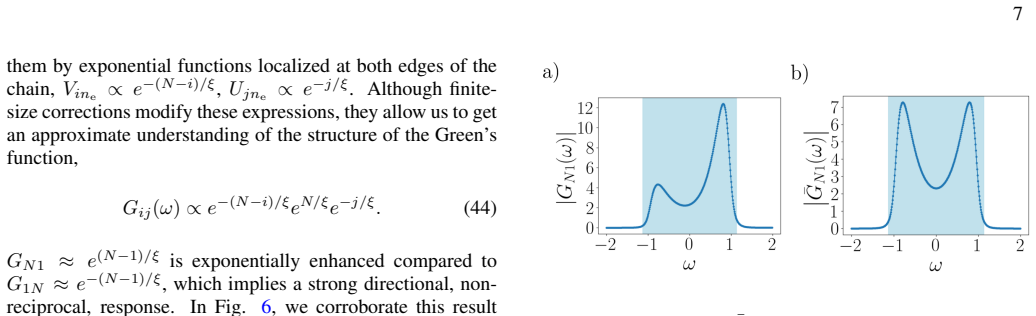
The carrying object is the non-Hermitian dynamical matrix H (Eq. 25) and its Green's function G(ω) = (ω - H)^{-1}. Topological amplification is diagnosed through the singular value decomposition of $G^{{-1}}$: in the topological phase a single singular value vanishes exponentially with the system size, and its two edge-localized singular vectors make G_N1 exponentially large while G_1N is exponentially small (Eq. 44). The essential ingredient is the linear phase gradient ϕ_i = i Δϕ of the parametric drive, which cannot be gauged away because of the pairing terms and which breaks time-reversal symmetry, producing a nonzero winding number ν(ω) (Eq. 42) in a point-gap sense.
What would settle it
Drive chains of length N = 2, 10, 20 and 30 with Δϕ = π/4, γ/J_c = 1.8 and Δ/J_c = 0.5, apply a resonant force to ion 1, and measure the displacement of ion N; the claim predicts |G_N1/G_1N| ≈ $e^{{2(N-1)/ξ}}$ with edge-localized response, so a ratio that stays of order one or a response that does not localize as N grows would refute the central claim.
Extended reading notes
Core claim
On the paper's own terms, the central discovery is that a one-dimensional array of trapped ions with site-dependent parametric driving phases, continuous cooling, and Coulomb phonon hopping realizes a stable topological amplification regime. The winding number ν(ω) computed from the non-Hermitian dynamical matrix takes nonzero values in parameter regions, and the associated zero-singular-value edge modes make the response Green's function exponentially non-reciprocal: G_N1 grows as $e^{{(N-1)/ξ}}$ while G_1N decays as $e^{{-(N-1)/ξ}}$. This directional amplification lets a force on ion 1 be read out as a large displacement of ion N, and numerical results for arrays of 2-30 ^{25}Mg^+ ions give force sensitivities as small as 1 yN·$Hz^{{-1/2}}$. The same singular-vector structure is visible in steady-state phonon numbers, which become exponentially weighted toward the amplifying edge even without any applied force.
Load-bearing premise
Everything rests on the experimental ability to imprint a linear phase gradient in the parametric drive, ϕ_i = i Δϕ, with the local trapping frequency uniform along the array; uncontrolled position dependence of either would close the point gap and destroy the topological amplification.
Editorial extensions
If this is right
- A force applied to ion 1 is read out as an amplified displacement of ion N, so the sensor does not need sub-diffraction imaging of the first ion.
- The detection band is tunable: changing the parametric drive frequency shifts the detuning Δ and therefore the frequency window in which the winding number is nonzero.
- Inside the topological regime the signal-to-noise ratio improves with chain length, in contrast with trivial chains where the response decays; this makes longer arrays useful when classical position-resolution noise dominates.
- Stability limits the usable topological window, but the paper finds a stable topological region for chain lengths up to N=50.
- The steady-state phonon correlations inherit the edge weighting, providing a topology signature that can be checked without applying any external force.
Reading between the lines
- An immediate experimental check would measure the end-to-end response ratio |G_N1/G_1N| for several chain lengths and verify the predicted exponential growth with N, which would also fix the localization length ξ.
- The predicted sensitivity depends on the linear phase gradient being realized without significant disorder; an error budget for phase and trapping-frequency inhomogeneity in realistic electrode or optical-force implementations would clarify how robust the scheme is.
- Since the system is Gaussian and bosonic, the same Green's function formalism could be used to compute the amplifier's added noise and compare its performance against the quantum limit for directional amplifiers.
Signed reviews
Editorial analysis
A structured set of objections, weighed in public.
Referee Report
Summary. This paper proposes a linear array of trapped ions whose local parametric drive has a site-dependent phase φ_i=iΔφ. After a rotating-frame and gauge transformation, the model becomes a bosonic chain with complex long-range hopping and local two-photon driving, together with laser-cooling dissipation. The authors compute the non-Hermitian dynamical matrix and Green's function, identify point-gap winding numbers, and show numerically that the SVD edge modes give an exponentially enhanced nonreciprocal response G_N1≈e^{(N-1)/ξ}. They then use this as a force sensor in which a force on ion 1 is read out through the amplified displacement of ion N, and report sensitivities down to about 1 yN·Hz^{-1/2}.
Significance. The formal content is generally sound and the paper makes concrete, falsifiable predictions: exponential nonreciprocal amplification, exponential phonon-number buildup in the steady state, and a tunable detection band set by the drive frequency. The derivations of the effective Hamiltonian, the Green's function, and the correlation matrix are internally consistent, and the numerical phase diagrams agree with the SVD/winding-number expectations. The paper is also honest about the trade-off that long chains improve the classical-resolution-limited sensitivity but not the quantum-limited one. The main gaps concern the experimental realization: no robustness analysis is given for the ideal phase gradient, and some sensing claims in Table I rest on approximations that are not valid in the quoted parameter range.
major comments (3)
- [II.B, IV.A, V] The ideal phase profile φ_i=iΔφ in Eq. (16) is a load-bearing premise for all topological and sensing claims: the winding number in Eq. (42), the zero-singular-value edge modes, and the directional gain G_N1≈e^{(N-1)/ξ} in Eq. (44) are derived for a chain whose only spatial variation is the intended phase twist. The paper motivates the phase gradient through localized electrodes or optical forces but gives no error budget for site-to-site phase disorder δφ_i, amplitude disorder δg_i, cooling-rate inhomogeneity, or the residual site-dependent trapping-frequency corrections already acknowledged in Eq. (10). These perturbations are not protected by the construction symmetry S of Eq. (73), which the authors themselves note is not a physical symmetry; they can close the point gap at the working frequency and lift the zero singular value before the claimed yN sensitivities are reached. The authors should include disorder-averaged simulations with realistic δφ_i, δg_i, and γ_i, and give the maximum permissible disorder for which ν(ω)≠0 and the exponential gain survives.
- [V, Eq. (50), Table I] The non-resonant sensitivity expression in Eq. (50) requires an integration time T satisfying T≫δf^{-1}. The N=2 rows of Table I violate this condition: for Jc=0.1, 1, and 10 kHz with δf/Jc=1.19, one has δf^{-1}=1.34, 0.134, and 0.0134 ms, respectively, while the quoted times-to-steady-state are τ=1, 0.1, and 0.01 ms. These points lie in the finite-T intermediate regime that the text explicitly sets aside as 'more challenging to analyze'. Consequently the highlighted quantum-limited sensitivity S^q=0.3 yN·Hz^{-1/2} is not supported by the analysis as presented. Please either evaluate the finite-T expression or use parameter points with T≫δf^{-1} and recompute the affected rows.
- [V, Table I] The numerical sensitivities in Table I are not reproducible unless the physical zero-point amplitude is specified. From Eq. (6), x0=sqrt(ℏ/2mωt), while Eq. (9) fixes Jc=e²/(2mωt d0³); specifying Jc and the ion mass therefore does not determine x0, since the radial trap frequency ωt (and hence d0) remains free. Varying ωt over the stated 1–10 (2π) MHz range changes x0 by a factor √10 and the force sensitivities in Table I by factors of order √10 to 10 depending on the noise contribution. The authors must state the assumed ωt and d0 for each row, or give the conversion formula used to arrive at the yN values.
minor comments (5)
- [IV.C] The phrase 'there is an interval of 1.538 > γ > 1.821' is contradictory; it should presumably read '1.538 < γ < 1.821'.
- [III.B] The sentence 'the Green's function formalism also also allows us' contains a duplicated 'also'.
- [V and Fig. 15 caption] The text contains the typo 'lenghts' for 'lengths', and the Fig. 15 caption fixes N=20 although several panels are plotted as a function of N; the symbol 'gs' in the caption should be 'g'.
- [Appendix B, Eq. (66)] The symbol Γ is not defined; please state whether Γ=γ or 2Γ=γ so that Eq. (38) and Eq. (70) are unambiguous.
- [Eq. (44)] The intermediate factor e^{N/ξ} appears without explanation; it would improve readability to note that it comes from the inverse of the exponentially small singular value s_ne∝e^{-N/ξ}.
Circularity Check
No material circularity: the topological-amplification framework is cited from the authors' prior work but re-derived in Appendix C, and the sensing numbers are computed from the model's Green's functions rather than fitted.
full rationale
This paper's derivation chain is self-contained at the level of its central claims. The model Hamiltonian (Eqs. 14-15) is obtained from a standard Coulomb expansion plus rotating-wave and gauge transformations, with the linear phase gradient (Eq. 16) stated as an explicit assumption rather than derived from the target result. The Green's function G(ω)=1/(ω-H) follows from the linearized equations of motion (Eqs. 22-31), and the winding number ν(ω) is computed explicitly for this chain's plane-wave dynamical matrix (Eqs. 42, 75-79). The exponential directional response (Eqs. 43-44) is justified by the SVD of the specific G^{-1}, with the singular-vector localization shown numerically in Fig. 5 and Appendix C sketching the bulk-boundary argument. The sensing figures (Fmin, S in Table I and Fig. 15) are obtained by evaluating the derived Green's functions and noise correlators (Eqs. 38, 49-55) at chosen parameters; no parameter is fitted to data and then renamed a prediction. The main reliance on the authors' prior work [25,28] is the general SVD-based topological-amplification theorem, but the paper re-derives the needed correspondence in Appendix C using standard Altland-Zirnbauer classification, so the self-citation is not load-bearing in the circularity sense. The reviewer-flagged phase-disorder sensitivity is an experimental robustness concern, not a logical circularity.
Assumptions & free parameters
free parameters (6)
- Parametric drive amplitude g =
g/Jc = 1
- Detuning Delta =
Delta/Jc = 0.5, 1, 1.5
- Cooling rate gamma =
gamma/Jc = 1.8
- Phase gradient Delta-phi =
pi/4
- Signal detuning delta_f =
delta_f/Jc = 1.19
- Classical spatial resolution (delta_x)_c =
0.2-0.5 um
assumptions (5)
- domain assumption Rotating-wave approximation and neglect of counter-rotating terms (Eqs. 8, 14, 20)
- domain assumption Markovian, local, zero-temperature laser cooling (Eq. 18)
- standard math SVD bulk-boundary correspondence for topological amplification (Eqs. 42-44)
- domain assumption Equal ion spacing and single x-motion
- ad hoc to paper Linear phase gradient implementable
Cite this review
Pith. "Pith review of Vibrational parametric arrays with trapped ions: non-Hermitian topological phases and quantum sensing." pith.science (2026). https://pith.science/paper/R5UG3X24
@misc{pith2026250206960,
  author       = {Pith},
  title        = {Pith review of: Vibrational parametric arrays with trapped ions: non-Hermitian topological phases and quantum sensing},
  year         = {2026},
  howpublished = {\url{https://pith.science/paper/R5UG3X24}},
  note         = {Machine review of arXiv:2502.06960}
}
abstract
We consider a linear array of trapped ions subjected to local parametric modulation of the trapping potential and continuous laser cooling. In our model, the phase of the parametric modulation varies linearly along the array, breaking time-reversal symmetry and inducing non-trivial topological effects. The linear response to an external force is investigated with the Green's function formalism. We predict the appearance of topological amplification regimes in which the trapped ion array behaves as a directional amplifier of vibrational excitations. The emergence of topological phases is determined by a winding number related to non-Hermitian point-gap topology. Beyond its fundamental interests as a topological driven-dissipative system, our setup can be used for quantum sensing of ultra-weak forces and electric fields. We consider a scheme in which a trapped ion at one edge of the array acts as a sensor of an ultra-weak force, and the vibrational signal gets amplified towards the last trapped ion, which acts as a detector. We consider arrays of 2-30 $^{25}$Mg$^+$ ions, assuming that the detector ion's displacement is measured via fluorescence with a spatial resolution of 200-500 nm, and predict sensitivities as small as 1 yN $\cdot$ Hz$^{-1/2}$. Our system has the advantage that the detected force frequency can be tuned by adjusting the frequency of the periodic drive.
Figures


Figures from the paper (12 more)




Reference graph
Works this paper leans on
-
[1]
T. Ramos further acknowledges support from the Ramón y Cajal program RYC2021-032473-I, financed by MCIN/AEI/10.13039/501100011033 and the European Union NextGenerationEU/PRTR. A. CONTINUOUS LASER COOLING In this section we derive the continuous laser cooling Liou- villian (18) by using the theoretical framework first presented in Ref. [5]. The fundamental...
-
[2]
Blatt and C
R. Blatt and C. F. Roos, Quantum simulations with trapped ions, Nat. Phys. 8, 277 (2012)
2012
-
[3]
D. Leibfried, R. Blatt, C. Monroe, and D. Wineland, Quan- tum dynamics of single trapped ions, Rev. Mod. Phys. 75, 281 (2003). 16
work page 2003
-
[4]
Monroe, W
C. Monroe, W. C. Campbell, L.-M. Duan, Z.-X. Gong, A. V . Gorshkov, P. W. Hess, R. Islam, K. Kim, N. M. Linke, G. Pagano, P. Richerme, C. Senko, and N. Y . Yao, Pro- grammable quantum simulations of spin systems with trapped ions, Rev. Mod. Phys. 93, 025001 (2021)
2021
-
[5]
Schneider, D
C. Schneider, D. Porras, and T. Schaetz, Experimental quantum simulations of many-body physics with trapped ions, Rep. Prog. Phys. 75, 024401 (2012)
2012
-
[6]
M. J. Biercuk, H. Uys, J. W. Britton, A. P. VanDevender, and J. J. Bollinger, Ultrasensitive detection of force and displace- ment using trapped ions, Nat. Nanotechnol. 5, 646 (2010)
work page 2010
-
[7]
J. I. Cirac, R. Blatt, P. Zoller, and W. D. Phillips, Laser cool- ing of trapped ions in a standing wave, Phys. Rev. A 46, 2668 (1992)
work page 1992
-
[8]
K. A. Gilmore, M. Affolter, Lewis-Swan, R. J., D. Barberena, E. Jordan, A. M. Rey, and J. J. Bollinger, Quantum-enhanced sensing of displacements and electric fields with large trapped- ion crystals, Science 373, 673 (2021)
work page 2021
Show all 51 references
-
[9]
P. A. Ivanov, Steady-state force sensing with single trapped ion, Phys. Scr. 95, 025103 (2020)
2020
-
[10]
X.-L. Deng, D. Porras, and J. I. Cirac, Quantum phases of in- teracting phonons in ion traps, Phys. Rev. A77, 033403 (2008)
2008
-
[11]
Porras and J
D. Porras and J. I. Cirac, Bose-einstein condensation and strong-correlation behavior of phonons in ion traps, Phys. Rev. Lett. 93, 263602 (2004)
2004
-
[12]
Toyoda, R
K. Toyoda, R. Hiji, A. Noguchi, and S. Urabe, Hong–ou– mandel interference of two phonons in trapped ions, Nature 527, 74 (2015)
2015
-
[13]
S. Haze, Y . Tateishi, A. Noguchi, K. Toyoda, and S. Urabe, Observation of phonon hopping in radial vibrational modes of trapped ions, Phys. Rev. A 85, 031401 (2012)
2012
-
[14]
Kiefer, F
P. Kiefer, F. Hakelberg, M. Wittemer, A. Bermúdez, D. Porras, U. Warring, and T. Schaetz, Floquet-engineered vibrational dy- namics in a two-dimensional array of trapped ions, Phys. Rev. Lett. 123, 213605 (2019)
2019
-
[15]
Bermudez, T
A. Bermudez, T. Schaetz, and D. Porras, Synthetic Gauge Fields for Vibrational Excitations of Trapped Ions, Phys. Rev. Lett. 107, 150501 (2011)
2011
-
[16]
P. A. Ivanov, S. S. Ivanov, N. V . Vitanov, A. Mering, M. Fleis- chhauer, and K. Singer, Simulation of a quantum phase transi- tion of polaritons with trapped ions, Phys. Rev. A 80, 060301 (2009)
2009
-
[17]
Porras, F
D. Porras, F. Marquardt, J. von Delft, and J. I. Cirac, Meso- scopic spin-boson models of trapped ions, Phys. Rev. A 78, 010101 (2008)
2008
-
[18]
Ohira, S
R. Ohira, S. Kume, H. Takahashi, and K. Toyoda, Polariton blockade in the jaynes–cummings–hubbard model with trapped ions, Quantum Sci. Technol. 6, 024015 (2021)
2021
-
[19]
Debnath, N
S. Debnath, N. M. Linke, S.-T. Wang, C. Figgatt, K. A. Lands- man, L.-M. Duan, and C. Monroe, Observation of hopping and blockade of bosons in a trapped ion spin chain, Phys. Rev. Lett. 120, 073001 (2018)
2018
-
[20]
The yellowish regions are topological with Jc = 1(2 π) kHz, g/Jc = 1, γ/Jc = 1.8 and ∆ϕ = π/4. FIG. 17. Time dependence of the coherence at the 20’th ion site in logarithmic scale. The steady-state oscillates around a fixed value, which we obtained by averaging over the oscill...
-
[21]
Katz and C
O. Katz and C. Monroe, Programmable quantum simulations of bosonic systems with trapped ions, Phys. Rev. Lett. 131, 033604 (2023)
2023
-
[22]
S. Ding, G. Maslennikov, R. Hablützel, H. Loh, and D. Mat- sukevich, Quantum parametric oscillator with trapped ions, Phys. Rev. Lett. 119, 150404 (2017)
2017
-
[23]
S. C. Burd, R. Srinivas, H. M. Knaack, W. Ge, A. C. Wilson, D. J. Wineland, D. Leibfried, J. J. Bollinger, D. T. C. Allcock, and D. H. Slichter, Quantum amplification of boson-mediated interactions, Nat. Phys. 17, 898 (2021)
2021
-
[24]
P.-Y . Hou, J. J. Wu, S. D. Erickson, G. Zarantonello, A. D. Brandt, D. C. Cole, A. C. Wilson, D. H. Slichter, and D. Leibfried, Indirect cooling of weakly coupled trapped-ion mechanical oscillators, Phys. Rev. X 14, 021003 (2024)
2024
-
[25]
B ˇazˇavan, S
O. B ˇazˇavan, S. Saner, E. Tirrito, G. Araneda, R. Srinivas, and A. Bermudez, Synthetic Z2 gauge theories based on paramet- ric excitations of trapped ions, Communications Physics 7, 229 (2024)
2024
-
[26]
Bermudez, M
A. Bermudez, M. Bruderer, and M. B. Plenio, Controlling and measuring quantum transport of heat in trapped-ion crystals, Phys. Rev. Lett. 111, 040601 (2013)
2013
-
[27]
Porras and S
D. Porras and S. Fernández-Lorenzo, Topological amplification in photonic lattices, Phys. Rev. Lett. 122, 143901 (2019)
2019
-
[28]
C. C. Wanjura, M. Brunelli, and A. Nunnenkamp, Topological framework for directional amplification in driven-dissipative cavity arrays, Nature communications 11, 3149 (2020)
2020
-
[29]
Ramos, J
T. Ramos, J. J. García-Ripoll, and D. Porras, Topological input- output theory for directional amplification, Phys. Rev. A 103, 033513 (2021)
2021
-
[30]
Gómez-León, T
Á. Gómez-León, T. Ramos, A. González-Tudela, and D. Porras, Driven-dissipative topological phases in parametric resonator arrays, Quantum 7, 1016 (2023)
2023
-
[31]
McDonald, T
A. McDonald, T. Pereg-Barnea, and A. Clerk, Phase-dependent chiral transport and effective non-hermitian dynamics in a bosonic kitaev-majorana chain, Phys. Rev. X8, 041031 (2018)
2018
-
[32]
J. H. Busnaina, Z. Shi, A. McDonald, D. Dubyna, I. Nsanzineza, J. S. Hung, C. S. Chang, A. A. Clerk, and C. M. Wilson, Quantum simulation of the bosonic kitaev chain, Na- ture Communications 15, 3065 (2024)
2024
-
[33]
J. J. Slim, C. C. Wanjura, M. Brunelli, J. Del Pino, A. Nun- nenkamp, and E. Verhagen, Optomechanical realization of the bosonic kitaev chain, Nature 627, 767 (2024)
2024
-
[34]
Pagano, P
G. Pagano, P. W. Hess, H. B. Kaplan, W. L. Tan, P. Richerme, P. Becker, A. Kyprianidis, J. Zhang, E. Birckelbaw, M. R. Her- nandez, Y . Wu, and C. Monroe, Cryogenic trapped-ion system for large scale quantum simulation, Quantum Science and Tech- nology 4, 014004 (2018)
2018
-
[35]
D. F. James, Quantum dynamics of cold trapped ions with ap- plication to quantum computation , Tech. Rep. (1997)
1997
-
[36]
Gómez-León, T
Á. Gómez-León, T. Ramos, A. González-Tudela, and D. Porras, Bridging the gap between topological non-hermitian physics and open quantum systems, Phys. Rev. A106, L011501 (2022)
2022
-
[37]
Gardiner and P
C. Gardiner and P. Zoller, Quantum noise: a handbook of Markovian and non-Markovian quantum stochastic methods with applications to quantum optics (Springer Science & Busi- ness Media, 2004)
2004
-
[38]
Ughrelidze, V
M. Ughrelidze, V . Flynn, E. Cobanera, and L. Viola, The in- terplay of finite and infinite size stability in quadratic bosonic lindbladians, Bull. Am. Phys. Soc. (2024)
2024
-
[39]
Okuma and M
N. Okuma and M. Sato, Non-hermitian topological phenomena: A review, Annual Review of Condensed Matter Physics 14, 83 (2023)
2023
-
[40]
M. Z. Hasan and C. L. Kane, Colloquium: topological insula- tors, Rev. Mod. Phys. 82, 3045 (2010)
2010
-
[41]
P. A. Ivanov, N. V . Vitanov, and K. Singer, High-precision force sensing using a single trapped ion, Sci. Rep. 6, 28078 (2016)
2016
-
[42]
Di Candia, F
R. Di Candia, F. Minganti, K. Petrovnin, G. Paraoanu, and S. Felicetti, Critical parametric quantum sensing, npj Quantum Inf. 9, 23 (2023)
2023
-
[43]
E. W. Streed, B. G. Norton, A. Jechow, T. J. Weinhold, and D. Kielpinski, Imaging of trapped ions with a microfabricated optic for quantum information processing, Phys. Rev. Lett.106, 010502 (2011). 17
2011
-
[44]
Drechsler, S
M. Drechsler, S. Wolf, C. T. Schmiegelow, and F. Schmidt- Kaler, Optical superresolution sensing of a trapped ion’s wave packet size, Phys. Rev. Lett. 127, 143602 (2021)
2021
-
[45]
Hasse, D
F. Hasse, D. Palani, R. Thomm, U. Warring, and T. Schaetz, Phase-stable traveling waves stroboscopically matched for su- perresolved observation of trapped-ion dynamics, Phys. Rev. A 109, 053105 (2024)
2024
-
[46]
C. L. Degen, F. Reinhard, and P. Cappellaro, Quantum sensing, Rev. Mod. Phys. 89, 035002 (2017)
2017
-
[47]
Liang, S
T. Liang, S. Zhu, P. He, Z. Chen, Y . Wang, C. Li, Z. Fu, X. Gao, X. Chen, N. Li, et al. , Yoctonewton force detection based on optically levitated oscillator, Fundam. Res. 3, 57 (2023)
2023
-
[48]
Maiwald, D
R. Maiwald, D. Leibfried, J. Britton, J. C. Bergquist, G. Leuchs, and D. J. Wineland, Stylus ion trap for enhanced access and sensing, Nat. Phys. 5, 551 (2009)
2009
-
[49]
Peano, M
V . Peano, M. Houde, F. Marquardt, and A. A. Clerk, Topolog- ical quantum fluctuations and traveling wave amplifiers, Phys. Rev. X 6, 041026 (2016)
2016
-
[50]
C. Vega, A. M. de las Heras, D. Porras, and A. González- Tudela, Topological, multi-mode amplification induced by non-reciprocal, long-range dissipative couplings (2024), arXiv:2405.10176 [quant-ph]
2024
-
[51]
Altland and M
A. Altland and M. R. Zirnbauer, Nonstandard symmetry classes in mesoscopic normal-superconducting hybrid structures, Phys. Rev. B 55, 1142 (1997)
1997
Reviewed August 8, 2026 · model on record in the stance chip above.
Discussion (0). Continue with ORCID to comment.