REVIEW 2 major objections 4 minor 23 references
Active Inference through Incentive Design in Markov Decision Processes
T0 review · 2 major / 4 minor · reviewed 2026-08-08 · deepseek-v4-flash
Pith's one-line read This paper shows that a leader can design side payments in a Markov decision process to make different follower types behaviorally distinguishable, and that this active-inference problem reduces to a single smooth optimization via softmax…
desk verdict A genuinely new incentive-design variant with a clean gradient algorithm, but the single-level reduction silently changes the follower model from exact to softmax-rational; fixable but load-bearing. read the letter →
The pith
A machine-rendered reading of the paper's core claim, the machinery that carries it, and where it could break.
The reading
What carries the argument
The load-bearing identity is softmax temporal consistency: in an entropy-regularized MDP, the optimal policy is the softmax of the optimal Q-function, $\pi^*(s,a) = \exp(Q^*(s,a;R)/\tau) / \sum_{a'} \exp(Q^*(s,a';R)/\tau)$, and $Q^*$ is defined by the entropy-regularized Bellman equation. This makes the follower's best response a unique, differentiable function of the reward $R$, which includes the leader's side payments $x$. Combined with the chain rule $DJ(x) = DJ_1(Q^*(R(x))) \cdot DQ^*(R(x)) \cdot DR(x) + Dh(x)$, and with observable operators in the induced hidden Markov model for computing $DJ_1$ (the gradient of conditional entropy), the paper turns a bilevel game into a gradient-descent optimization.
What would settle it
Run the algorithm on a deterministic MDP with a reward tie, where the exact expected-reward optimal policy is indifferent between two actions but the softmax policy strictly prefers one. If the side payments computed under the softmax assumption, when used with exact argmax tie-breaking, fail to push the posterior over types toward 1 (or if the conditional entropy is not minimized), then the reduction does not solve the originally stated bilevel problem.
Extended reading notes
Core claim
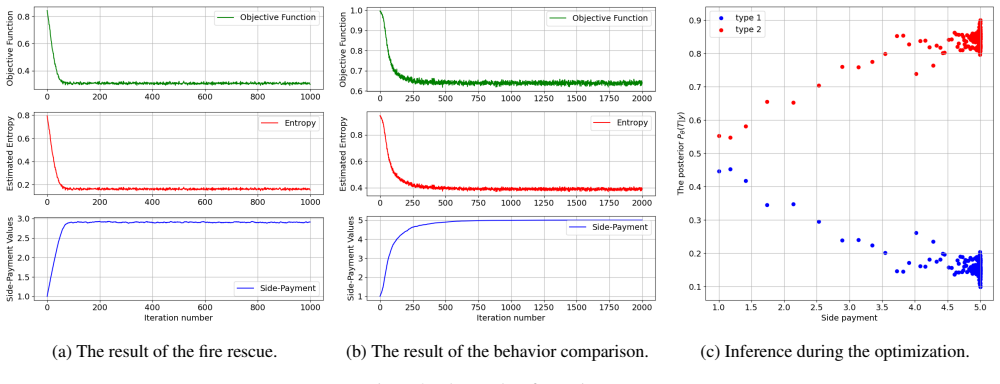
The central claim is that the leader's side-payment design problem, Problem 2, can be solved by minimizing $H(T\mid O_{0:T}, M(\pi^*(x))) + h(x)$ over side payments $x$, where $\pi^*(x)$ is the profile of entropy-regularized optimal policies. Because the entropy-regularized Bellman optimality equation yields a unique softmax policy $\pi^*(s,a) \propto \exp(Q^*(s,a)/\tau)$, the follower's best response is a smooth, unique function of the side payments. This removes the need to solve the lower-level argmax constraint explicitly: substituting $\pi^*(x)$ into the leader's conditional-entropy objective yields a single-level program whose gradient can be computed. The paper's experiments in stochastic grid worlds show that as the optimized side payments are offered, the conditional entropy drops (e.g., from 0.793 to 0.153 in the fire rescue task), and the posterior over types moves close to 1 for the true type.
Load-bearing premise
The entire reduction assumes each follower chooses the unique entropy-regularized (softmax) optimal policy, while the problem statement defines followers as exact expected-reward maximizers; for exact maximizers the single-level program can solve a different problem.
Editorial extensions
If this is right
- The side-payment design problem is computationally tractable via gradient descent for finite state-action MDPs.
- The reduction applies to any finite set of follower types differing in dynamics, rewards, initial distributions, or discount factors.
- The algorithm balances inference accuracy and incentive cost, as measured by conditional entropy and an $\ell^1$ side-payment cost.
- When side payments are limited to a subset of state-action pairs, complexity drops with the number of decision variables.
- The method extends to partial observations of both states and actions by augmenting the state space.
Reading between the lines
- A testable conjecture the authors leave implicit is that the same single-level reduction holds for any regularized follower whose best response remains a unique softmax-like function of the Q-function; if so, the observable-operator gradient machinery transfers directly.
- The conditional-entropy objective turns the leader's problem into an information-seeking experiment design: one could compare this long-horizon design against a myopic one-step greedy design to see when the temporal horizon materially changes the optimal side payments.
- The paper assumes known follower MDPs; a model-free extension would need to estimate the observable-operator terms from data, and the gradient formulas indicate exactly which conditional probabilities such an estimator would need to recover.
- The convergence results are empirical (gradient descent finds a stationary point); a formal convexity or local-optimality guarantee for the single-level objective would be needed before claiming global optimality, which the paper does not provide.
Editorial analysis
A structured set of objections, weighed in public.
Referee Report
Summary. The paper proposes a leader-follower framework for active inference via incentive design. A leader provides side payments to a follower whose type (unknown transition dynamics or reward) is to be inferred from partial observations, with the objective of minimizing the conditional entropy of the type given observations while penalizing the cost of side payments. The authors formulate a bi-level optimization (Problem 2) assuming followers maximize expected total reward, and then claim a reduction to a single-level problem (Eq. (6)) by replacing followers' policies with the unique entropy-regularized softmax optimal policies. They use observable operators to compute the gradient of the entropy objective with respect to policy parameters and cite a result from Ma et al. (2024) for the derivative of the entropy-regularized Q-function, leading to a gradient-based algorithm. Experiments on grid-world tasks demonstrate convergence of the objective and reduced entropy.
Significance. If the proposed reduction were valid for the stated problem, the paper would make a solid contribution: it introduces an information-theoretic objective into leader-follower incentive design, and the use of observable operators for gradient computation is a technically interesting and potentially efficient approach. The paper is also careful in attributing the Q-derivative result to prior work and provides a self-contained derivation of the HMM gradient. However, the central claim is currently not supported because the reduction relies on a different follower model from the one in Problem 2, and the experiments do not report the key temperature parameter. With a corrected problem statement and additional experiments, the approach could be a useful addition to the active-inference and mechanism-design literature.
major comments (2)
- [Section 3.1, Eq. (6)] The single-level reduction is not equivalent to Problem 2. The lower-level constraint in Eq. (3) is the set of maximizers of the expected total reward Vi(µ_i, R_i(x), π), without any entropy regularization. In contrast, Eq. (5) is the unique optimal policy of the entropy-regularized MDP with temperature τ>0, which maximizes a regularized objective and is generally stochastic. The sentence 'the lower-level problem in equation (3) has a unique solution πQ⋆(Ri(x))' is therefore false for the unregularized problem: the unregularized optimal policy need not equal the softmax of Q⋆(R_i(x)), and multiple optimal policies may exist. Everything downstream—Definition of θ in Section 3.2, the chain rule in Eq. (8), the use of Proposition 2, and the experiments—depends on the softmax model. The paper must either explicitly redefine Problem 2 as one with entropy-regularized followers (and adjust the abstract and introduction accordingly) or provide a rigorous limiting argument for τ→0 with quantitative error bounds and report the chosen τ values. As it stands, the algorithm solves a different problem than the one stated.
- [Section 4 (experiments)] The temperature parameter τ is never specified in either experiment. The softmax policy in Eq. (5) and the entropy-regularized Bellman equation in Eq. (4) depend quantitatively on τ, and the values of the converged entropy (0.153 and 0.390), side payments (0.291 and 5), and the qualitative narrative that a positive side payment induces a deterministic choice 'the agent will always choose the action with the positive reward' all depend on the regularization level. Without τ, the experiments are not reproducible, and we cannot tell whether the regularized model is a good approximation to the exact-rational follower described in the abstract and Problem 2. The paper should report τ for each experiment and, ideally, show sensitivity of the results to τ.
minor comments (4)
- [Eq. (14)] The summation in Eq. (14) is written as i ∈ {0,1}, which conflicts with the earlier notation T for the type set; it should be i ∈ T.
- [Definition 2 and Eq. (9)] The entropy in Definition 2 uses an unspecified logarithm base, while Eq. (9) and Eq. (14) explicitly use log2. The base should be fixed throughout, since it changes the numerical values of entropy and the balance with the cost h(x).
- [Section 4, Example 1] The text states that with a positive side payment at a sink state 'the agent will always choose the action with the positive reward when computing the optimal policy.' This describes deterministic optimal behavior, whereas the entropy-regularized optimal policy in Eq. (5) is stochastic for any finite τ. The narrative should be reconciled with the actual policy model or the value of τ should be disclosed.
- [Section 3.2] The sample-based gradient estimator in Eq. (14) is unbiased only if fresh observation sequences are drawn from the current policy at each iteration. The paper does not state whether this is done; if the same samples are reused across iterations, the estimator is biased. This should be clarified.
Circularity Check
No significant circularity: the single-level reduction and gradient computation are not equivalent to their inputs by construction; the main caveat is a model mismatch between the stated standard best-response problem and the entropy-regularized follower assumption.
full rationale
The paper's derivation chain is not circular. The leader's objective H(T|O0:T, M(π⋆(x))) is a well-defined function of the policy profile, and the policy profile is computed from the entropy-regularized Q-function via Eq. (5); no step assumes the optimal side payment or defines the objective in terms of itself. The reduction from Problem 2 to Eq. (6) relies on the softmax temporal-consistency result of entropy-regularized MDPs, which is a standard external theorem (Nachum et al., 2017) and not an input of the paper. The gradient computation uses Proposition 2 in Section 3.2, cited to Ma et al. (2024), whose authors overlap with the present paper; however, that proposition is a parameter-free Bellman-style identity for ∂Q⋆/∂R under stated softmax-MDP assumptions and does not contain the target result, so it counts as independent support under the stated criteria. The genuine concern is not circularity but an assumption mismatch: Problem 2's lower-level constraint in Eq. (3) is written as the standard value-function argmax, while the softmax policy in Eq. (5) is optimal for the entropy-regularized objective; the single-level reduction is therefore valid only for the modified entropy-regularized follower model, and the paper does not report the temperature τ in experiments. This is a correctness and reporting issue, not a self-referential derivation.
Assumptions & free parameters
free parameters (2)
- Entropy-regularization temperature tau =
not stated (used in Eqs. 4, 5, 7)
- Side payment cost weight beta =
0.05 (both experiments)
assumptions (5)
- standard math Entropy-regularized Bellman optimality equation (Eq. 4) defines the optimal value and policy for the entropy-regularized MDP (Nachum et al., 2017).
- standard math Observable operator representation of HMM observation probabilities (Jaeger, 2000), Eq. (11) and its gradient Eq. (12).
- standard math Derivative formula for the entropy-regularized Q-function (Proposition 2, proven in Ma et al., 2024).
- ad hoc to paper Each follower is an entropy-regularized (softmax) optimal policy, not an exact maximizer as stated in Problem 2.
- domain assumption The leader knows the true MDP models, observation functions, and prior distribution over types for all followers.
Cite this review
Pith. "Pith review of Active Inference through Incentive Design in Markov Decision Processes." pith.science (2026). https://pith.science/paper/LEJGMRBU
@misc{pith2026250207065,
  author       = {Pith},
  title        = {Pith review of: Active Inference through Incentive Design in Markov Decision Processes},
  year         = {2026},
  howpublished = {\url{https://pith.science/paper/LEJGMRBU}},
  note         = {Machine review of arXiv:2502.07065}
}
read the original abstract
We present a method for active inference with partial observations in stochastic systems through incentive design, also known as the leader-follower game. Consider a leader agent who aims to infer a follower agent's type given a finite set of possible types. Different types of followers differ in either the dynamical model, the reward function, or both. We assume the leader can partially observe a follower's behavior in the stochastic system modeled as a Markov decision process, in which the follower takes an optimal policy to maximize a total reward. To improve inference accuracy and efficiency, the leader can offer side payments (incentives) to the followers such that different types of them, under the incentive design, can exhibit diverging behaviors that facilitate the leader's inference task. We show the problem of active inference through incentive design can be formulated as a special class of leader-follower games, where the leader's objective is to balance the information gain and cost of incentive design. The information gain is measured by the entropy of the estimated follower's type given partial observations. Furthermore, we demonstrate that this problem can be solved by reducing a single-level optimization through softmax temporal consistency between followers' policies and value functions. This reduction allows us to develop an efficient gradient-based algorithm. We utilize observable operators in the hidden Markov model (HMM) to compute the necessary gradients and demonstrate the effectiveness of our approach through experiments in stochastic grid world environments.
Figures

Reference graph
Works this paper leans on
-
[1]
An incentive based dynamic pricing in smart grid: a customer’s perspective
Thamer Alquthami, Ahmad H Milyani, Muhammad Awais, and Muhammad B Rasheed. An incentive based dynamic pricing in smart grid: a customer’s perspective. Sustainability , 13(11):6066, 2021
work page 2021
-
[2]
A POMDP extension with belief-dependent rewards
Mauricio Araya, Olivier Buffet, Vincent Thomas, and Fran c cois Charpillet. A POMDP extension with belief-dependent rewards. In J. Lafferty, C. Williams, J. Shawe-Taylor, R. Zemel, and A. Culotta, editors, Advances in Neural Information Processing Systems , volume 23. Curran Associates, Inc., 2010
work page 2010
-
[3]
Patrick Bolton and Mathias Dewatripont. Contract Theory . MIT Press Books , 1, 2005. Publisher: The MIT Press
work page 2005
-
[4]
Incentives and rate designs for efficiency and demand response
Steven Braithwait, Daniel G Hansen, and Laurence D Kirsch. Incentives and rate designs for efficiency and demand response. Lawrence Berkeley National Laboratory. LBNL-60132 , 2006
work page 2006
-
[5]
Behavioral mechanism design: Optimal crowdsourcing contracts and prospect theory
David Easley and Arpita Ghosh. Behavioral mechanism design: Optimal crowdsourcing contracts and prospect theory. In Proceedings of the Sixteenth ACM Conference on Economics and Computation , pages 679--696, 2015
work page 2015
-
[6]
Target surveillance in adversarial environments using POMDPs
Maxim Egorov, Mykel J Kochenderfer, and Jaak J Uudmae. Target surveillance in adversarial environments using POMDPs . In Proceedings of the Thirtieth AAAI Conference on Artificial Intelligence , pages 2473--2479. AAAI Press, 2016
work page 2016
-
[7]
Information structure, stackelberg games, and incentive controllability
Yu-Chi Ho, P Luh, and Ramal Muralidharan. Information structure, stackelberg games, and incentive controllability. IEEE Transactions on Automatic Control , 26(2):454--460, 1981
work page 1981
-
[8]
Observable Operator Models for Discrete Stochastic Time Series
Herbert Jaeger. Observable Operator Models for Discrete Stochastic Time Series . Neural Computation , 12(6):1371--1398, 06 2000
work page 2000
Show all 23 references
-
[9]
Using gamification to incentivize sustainable urban mobility
Raman Kazhamiakin, Annapaola Marconi, Mirko Perillo, Marco Pistore, Giuseppe Valetto, Luca Piras, Francesco Avesani, and Nicola Perri. Using gamification to incentivize sustainable urban mobility. In 2015 IEEE first international smart cities conference (ISC2) , pages 1--6. IEEE, 2015
2015
-
[10]
Khouzani and Pasquale Malacaria
MHR. Khouzani and Pasquale Malacaria. Leakage-minimal design: Universality, limitations, and applications. In 2017 IEEE 30th Computer Security Foundations Symposium (CSF) , pages 305--317, 2017
2017
-
[11]
Scalable agent alignment via reward modeling: a research direction
Jan Leike, David Krueger, Tom Everitt, Miljan Martic, Vishal Maini, and Shane Legg. Scalable agent alignment via reward modeling: a research direction. arXiv preprint arXiv:1811.07871 , 2018
2018 arXiv
-
[12]
Game-theoretic analysis of cooperation incentive strategies in mobile ad hoc networks
Ze Li and Haiying Shen. Game-theoretic analysis of cooperation incentive strategies in mobile ad hoc networks. IEEE Transactions on mobile computing , 11(8):1287--1303, 2011
2011
-
[13]
Adaptive incentive design for Markov decision processes with unknown rewards
Haoxiang Ma, Shuo Han, Ahmed Hemida, Charles Kamhoua, and Jie Fu. Adaptive incentive design for Markov decision processes with unknown rewards. 2024. OpenReview
2024
-
[14]
A game-theory based incentive framework for an intelligent traffic system as part of a smart city initiative
Haibo Mei, Stefan Poslad, and Shuang Du. A game-theory based incentive framework for an intelligent traffic system as part of a smart city initiative. Sensors , 17(12):2874, 2017
2017
-
[15]
Optimal auction design
Roger B Myerson. Optimal auction design. Mathematics of operations research , 6(1):58--73, 1981
1981
-
[16]
Bridging the gap between value and policy based reinforcement learning
Ofir Nachum, Mohammad Norouzi, Kelvin Xu, and Dale Schuurmans. Bridging the gap between value and policy based reinforcement learning. Advances in neural information processing systems , 30, 2017
2017
-
[17]
Adaptive incentive design
Lillian J Ratliff and Tanner Fiez. Adaptive incentive design. IEEE Transactions on Automatic Control , 66(8):3871--3878, 2020
2020
-
[18]
Macheng Shen and Jonathan P. How. Active perception in adversarial scenarios using maximum entropy deep reinforcement learning. In 2019 International Conference on Robotics and Automation (ICRA) , page 3384–3390. IEEE Press, 2019
2019
-
[19]
Active perception with initial-state uncertainty: A policy gradient method
Chongyang Shi, Shuo Han, Michael Dorothy, and Jie Fu. Active perception with initial-state uncertainty: A policy gradient method. IEEE Control Systems Letters , 8:3147--3152, 2024
2024
-
[20]
Aligning superintelligence with human interests: A technical research agenda
Nate Soares and Benja Fallenstein. Aligning superintelligence with human interests: A technical research agenda. Machine Intelligence Research Institute (MIRI) technical report , 8, 2014
2014
-
[21]
Persistent private information
Noah Williams. Persistent private information. Econometrica , 79(4):1233--1275, 2011
2011
-
[22]
A learning-based incentive mechanism for federated learning
Yufeng Zhan, Peng Li, Zhihao Qu, Deze Zeng, and Song Guo. A learning-based incentive mechanism for federated learning. IEEE Internet of Things Journal , 7(7):6360--6368, 2020
2020
-
[23]
write newline
" write newline "" before.all 'output.state := FUNCTION fin.entry add.period write newline FUNCTION new.block output.state before.all = 'skip after.block 'output.state := if FUNCTION new.sentence output.state after.block = 'skip output.state before.all = 'skip after.sentence '...
Reviewed August 8, 2026 · model on record in the stance chip above.
Discussion (0). Continue with ORCID to comment.