REVIEW 3 major objections 6 minor 57 references
Effects of Flagellar Morphology on Swimming Performance and Directional Control in Microswimmers
T0 review · 3 major / 6 minor · reviewed 2026-08-08 · deepseek-v4-flash
Pith's one-line read A single-flagellated microswimmer with a 1 µm spherical body swims fastest and most efficiently when its flagellar helix radius is 0.2–0.3 µm and its pitch angle lies between 30° and 45°, with the speed-maximizing pitch angle up to 4.5°…
desk verdict A systematic design map whose quantitative claims rest on an unvalidated, self-cited solver and a few overreaching biological extrapolations. read the letter →
The pith
A machine-rendered reading of the paper's core claim, the machinery that carries it, and where it could break.
The reading
What carries the argument
The central object is the Twin Multipole Moment (TMM) resistance matrix, which solves the linear Stokes equations (Eq. 2) for the coupled system of a spherical cell body and a chain of spheres forming a rigid helical flagellum. The matrix encodes the hydrodynamic interactions between every pair of elements, and with the force/torque balance conditions (Eq. 6) it yields the swimming velocity, rotation, and the resulting forward speed U_f, efficiency ε = F_f·U_f/|T_b·Ω_m|, and yaw angle β for each geometry. The parameter sweep then varies filament radius a, helix radius R, pitch angle θ, and contour length Λ while reading off these three performance metrics, producing the contour maps and optimum ranges.
What would settle it
Recompute the same morphology sweep using a higher-order boundary-element solver or a fully resolved immersed-boundary simulation at helix radii 0.05, 0.2, 0.3, and 0.6 µm; if the plateau in maximum efficiency beyond 0.3 µm disappears, or the optimum shifts outside 0.2–0.3 µm, the central design rule is wrong. Experimentally, one could track the speed and yaw of a bead–flagellum construct with adjustable helix radius and pitch angle in a viscous fluid and check whether the fastest geometry indeed falls in the predicted ranges.
Extended reading notes
Core claim
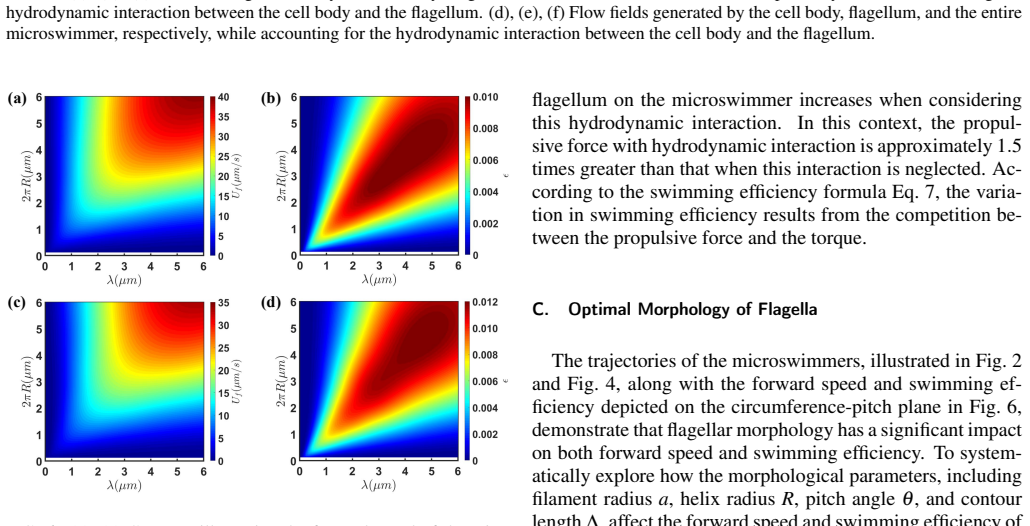
On the paper's own terms, the discovery is a morphological optimum map for a single-flagellated microswimmer: forward speed and propulsive efficiency are governed by the flagellum's filament radius, pitch angle, and contour length, whereas the yaw angle—the deviation of the swimming direction from the flagellar axis—is governed by helix radius and contour length. For a 1 µm-radius cell body rotating its flagellum at 100 Hz, the simulations show maximum forward speed and maximum efficiency improve with contour length up to about 10 µm, then plateau; increasing helix radius beyond approximately 0.3 µm no longer improves efficiency and instead enlarges the yaw angle and the diameter of the helical trajectory, so the optimal helix radius is 0.2–0.3 µm. The optimal pitch angle lies in 30–45° for filament radii of 0.01–0.02 µm, and within this range the pitch angle for peak speed is up to 4.5° below the pitch angle for peak efficiency. The paper further reports that accounting for hydrodynamic interaction between the cell body and flagellum increases the propulsive force by roughly 1.5 times while lowering forward speed and raising efficiency.
Load-bearing premise
Every result depends on the numerical method that computes how the cell body and the rotating flagellum push on each other through the fluid; if that method is inaccurate for some flagellum shapes, the reported optimum ranges could shift.
Editorial extensions
If this is right
- A 1 µm-scale synthetic microswimmer should target a helix radius of 0.2–0.3 µm and a pitch angle of 30–45° to balance speed, efficiency, and directional stability.
- Because the speed-optimal and efficiency-optimal pitch angles differ by at most 4.5°, a single flagellum design can switch between fast and efficient modes with a small bending or rotation of the pitch angle.
- Extending contour length beyond about 10 µm gives little efficiency gain, so longer flagella are not automatically better.
- Hydrodynamic interaction between the cell body and the flagellum raises propulsive force by roughly 1.5×, so any model or microrobot that neglects this interaction will mispredict both speed and efficiency.
- Smaller helix radii give smaller yaw angles and tighter helical trajectories, which improves directional control and nutrient capture, but only down to the point where speed and efficiency drop.
Reading between the lines
- One extension the paper does not make: if the 4.5° speed–efficiency pitch offset is robust, it predicts that bacterial populations under selection for speed versus efficiency should show measurably different flagellar pitch distributions clustered around 30–45°.
- The parameter sweep is restricted to a rigid flagellum with no hook and Newtonian fluid; in viscoelastic fluids or with a flexible hook the optimal radius and pitch could shift, so the 0.2–0.3 µm rule should be treated as a Newtonian-rigid baseline.
- The claim that yaw angle depends only on helix radius and contour length, not pitch angle, is a sharp falsifiable scaling that could be checked by tracking fluorescently labeled flagella of swimming bacteria with varied geometry.
- For microrobot manufacturing, the narrow optimum ranges imply that pitch angle must be controlled within a few degrees and helix radius within roughly ±0.05 µm to stay in the high-performance window.
Signed reviews
Editorial analysis
A structured set of objections, weighed in public.
Referee Report
Summary. This manuscript reports a computational study of a single-flagellated microswimmer composed of a spherical cell body (Rb = 1 μm) and a rigid helical flagellum. The hydrodynamics are solved with the Twin Multipole Moment (TMM) resistance matrix, and the force/torque balance is used to compute the swimmer's translation, rotation, trajectory, and induced flow field. Parameter sweeps over the flagellar helix radius, pitch angle, contour length, and filament radius yield the claims that the optimal helix radius is 0.2–0.3 μm, the optimal pitch angle is 30–45°, and the pitch angle maximizing forward speed is up to 4.5° smaller than that maximizing efficiency. The paper also argues that flagellar orientation gives directional control and that the results explain the high Young's modulus of bacterial flagella.
Significance. The paper addresses a relevant problem in low-Reynolds-number locomotion, and if the quantitative design rules are correct, they would be practically useful for microrobot design and for interpreting morphological trends in bacteria. The systematic parameter sweeps are a strength, and the main qualitative conclusions—that helix radius and contour length affect yaw while pitch angle and filament radius affect speed and efficiency—are plausible and broadly consistent with earlier work in the literature. The optima are produced without fitted parameters, which makes them falsifiable. However, the central numbers are computed with a single, unvalidated numerical solver, and the evolutionary/elasticity interpretation is not supported by the model as presented.
major comments (3)
- [Sec. II A, Eq. (2); Sec. III C, Figs. 8–11] The headline quantitative results—optimal helix radius 0.2–0.3 μm, optimal pitch angle 30–45°, and the ≤4.5° separation between speed- and efficiency-maximizing pitch angles—all come from the TMM resistance matrix, whose implementation is cited only to the authors' ref. 38. The manuscript does not report the number of spheres N used to discretize the flagellum, the bead spacing or overlap treatment, any grid-convergence study, or a comparison with an independent method (boundary element, slender body, or experimental data). Because the reported optima are extracted from this resistance matrix, an unquantified discretization error could shift all of them. Please add convergence tests with respect to N and at least one benchmark validation case before the quantitative design rules can be accepted.
- [Sec. III C and Sec. IV] The statements that a low Young's modulus would be detrimental to bacterial survival and that the results explain why the Young's modulus of most flagella is relatively high go beyond the model, which treats the flagellum as a rigid body and contains no elasticity or buckling mechanics. This conclusion is not derived from the simulations; it should be removed or explicitly labelled as speculation, or supported by a separate model of flagellar compliance.
- [Sec. III B, Eq. (17)] The flow-field visualization relies on a Stokeslet/rotlet superposition over the spheres, but the manuscript does not specify whether the per-sphere forces and torques inserted into Eqs. (14)–(17) come from the full TMM resistance matrix or from isolated-sphere formulas, nor how the phase average is taken. This ambiguity matters because Figs. 5 and 6 are used to claim that hydrodynamic interaction enhances the flagellar flow field and propulsive force. Please clarify the computation and, ideally, verify the flow-field reconstruction against the TMM forces.
minor comments (6)
- [Sec. III C, text near Fig. 8] The phrase "when the helix radius R ≤ 3 µm" appears to be a typo for R ≤ 0.3 µm; please correct it.
- [Sec. II B and Eq. (4)] The symbol φ is used both for the initial phase in Eq. (4) and for the precession angle in Sec. II B; please use distinct symbols for these two quantities.
- [Sec. III B, after Eq. (17)] The text says the flow field consists of N spheres along the flagellum plus a spherical cell body, but Sec. II A states that the flagellum has N−1 spheres and the total number of spheres is N; please make the counting consistent.
- [Abstract and Sec. III C] The abstract states that forward speed is closely related to filament radius, but Fig. 11(a) shows that the filament radius has minimal impact on maximum forward speed; please reconcile the wording with the data.
- [Sec. IV] The claim that the optimal contour length is around 10 μm and that improvements beyond 9 μm are negligible needs a quantitative criterion for what counts as "negligible," since no error estimates are provided.
- [Acknowledgments] The word "umder" should be "under."
Circularity Check
Central claims rest on the authors' self-cited TMM solver with no external validation, but the optima are not fitted to the target quantities; the derivation is self-contained modulo the cited method.
-
self citation load bearing
[Sec. II A, Eq. (2) and text following; ref. 38]
"The resistance matrix of the system, denoted as R, can be calculated using TMM 38."
The quantitative design rules (optimal helix radius 0.2-0.3 um, pitch angle 30-45 deg, <=4.5 deg pitch-angle offset) are all outputs of the TMM resistance matrix sweep. The TMM is cited only to the authors' own prior work (ref. 38), which is code-reproduced here in the sense that the same authors apply it, but this paper provides no independent benchmark, convergence test, bead-number sensitivity, or comparison to boundary-element, slender-body, or experimental results. This is a load-bearing self-citation: the central quantitative predictions inherit all their numerical content from an unvalidated in-house solver. It is not definitional circularity because the target quantities (speed, efficiency, yaw angle) are computed from the Stokes equations, not fitted to those quantities.
-
other
[Sec. III C, Figs. 8-11 and corresponding text]
"Therefore, for a cell body radius of Rb = 1 um, the optimal helix radius is approximately in the range of 0.2 <= R <= 0.3 um, and the corresponding optimal pitch angles range from 30 to 45 deg."
These headline optima are obtained by maximizing forward speed and efficiency as computed from the TMM resistance matrix with no independent check of the solver's accuracy in the relevant geometric regime (filament radius a << helix radius R and pitch lambda). The absence of convergence or external validation means the numbers are as trustworthy as the self-cited TMM; however, the optimization is not fitted to the claimed outputs, so the circularity is methodological reliance rather than definitional equivalence.
full rationale
The paper's derivation chain is not circular by construction: it solves the Stokes equations for a prescribed flagellar geometry, imposes force/torque balance, and extracts forward speed, efficiency, and yaw angle. No parameter is fitted to the claimed optimal ranges, and the pitch-angle offset (<=4.5 deg) is a computed difference, not an input. The only significant circularity concern is the sole reliance on the authors' own Twin Multipole Moment method (ref. 38) for the resistance matrix in Eq. (2). Because the paper offers no convergence test, bead-resolution study, or comparison against boundary-element, slender-body, or experimental data, the quantitative optima are entirely inherited from that self-cited solver. That is a load-bearing self-citation, but it is not a logical tautology: the target outputs are not defined in terms of the input parameters, and the model is self-contained given the cited method. The qualitative trends (e.g., smaller filament radius increases efficiency, smaller helix radius improves directional stability) are physically plausible and are not enforced by the definitions. I therefore set the circularity score to 2: one important self-citation that is load-bearing but not equivalent-to-input circularity.
Assumptions & free parameters
free parameters (2)
- cell body radius Rb =
1.0 µm
- motor rotation frequency f =
100 Hz
assumptions (5)
- standard math Stokes equations and linear resistance/mobility relations describe the fluid (Eqs. 1 to 3).
- domain assumption Flagellum is a rigid left-handed helix of Stokeslet spheres; hook flexibility and Brownian fluctuations are neglected.
- domain assumption TMM resistance matrix from ref 38 accurately models near- and far-field hydrodynamic interactions.
- standard math A freely swimming microswimmer has zero net force and torque (Eq. 6).
- domain assumption Phase-averaged Stokeslet/rotlet superposition represents the full flow field (Eqs. 14 to 17).
Cite this review
Pith. "Pith review of Effects of Flagellar Morphology on Swimming Performance and Directional Control in Microswimmers." pith.science (2026). https://pith.science/paper/RTDPMYWO
@misc{pith2026250207224,
  author       = {Pith},
  title        = {Pith review of: Effects of Flagellar Morphology on Swimming Performance and Directional Control in Microswimmers},
  year         = {2026},
  howpublished = {\url{https://pith.science/paper/RTDPMYWO}},
  note         = {Machine review of arXiv:2502.07224}
}
read the original abstract
In a fluid environment, flagellated microswimmers propel themselves by rotating their flagella. The morphology of these flagella significantly influences forward speed, swimming efficiency, and directional stability, which are critical for their survival. This study begins by simulating the three-dimensional motion trajectories of microswimmers to analyze their kinematic characteristics. The simulation results demonstrate that microswimmers can actively adjust their forward direction by modifying the orientation of their flagella. We subsequently perform numerical simulations to visualize the flow fields generated by a microswimmer and examine the hydrodynamic interactions between the cell body and the flagella, focusing on their impacts on forward speed and swimming efficiency. We conclude that forward speed and swimming efficiency are closely related to the filament radius, pitch angle, and contour length of the flagella, while the yaw angle of locomotion is determined by the helix radius and contour length of the flagella. We conclude that the pitch angle for maximum forward speed is slightly smaller than that for maximum swimming efficiency, which suggests that microswimmers can effectively alternate between states of maximum forward speed and maximum swimming efficiency by fine-tuning their pitch angle and adapting to varying ecological conditions. These morphological characteristics of microswimmers may result from species competition and natural selection. This research establishes an optimized model for microswimmers, providing valuable insights for the design of enhanced microrobots tailored to specific applications.
Figures


Figures from the paper (5 more)



Reference graph
Works this paper leans on
-
[1]
author author M. Silverman \ and\ author M. Simon ,\ title title Flagellar rotation and the mechanism of bacterial motility , \ @noop journal journal Nature \ volume 249 ,\ pages 73--74 ( year 1974 ) NoStop
work page 1974
-
[2]
Lauga \ and\ author T
author author E. Lauga \ and\ author T. R. \ Powers ,\ title title The hydrodynamics of swimming microorganisms , \ @noop journal journal Reports on progress in physics \ volume 72 ,\ pages 096601 ( year 2009 ) NoStop
2009
-
[3]
Lauga ,\ title title Bacterial hydrodynamics , \ @noop journal journal Annual Review of Fluid Mechanics \ volume 48 ,\ pages 105--130 ( year 2016 ) NoStop
author author E. Lauga ,\ title title Bacterial hydrodynamics , \ @noop journal journal Annual Review of Fluid Mechanics \ volume 48 ,\ pages 105--130 ( year 2016 ) NoStop
2016
-
[4]
author author J. S. \ Guasto , author R. Rusconi , \ and\ author R. Stocker ,\ title title Fluid mechanics of planktonic microorganisms , \ @noop journal journal Annual Review of Fluid Mechanics \ volume 44 ,\ pages 373--400 ( year 2012 ) NoStop
work page 2012
-
[5]
author author D. Roszak \ and\ author R. Colwell ,\ title title Survival strategies of bacteria in the natural environment , \ @noop journal journal Microbiological reviews \ volume 51 ,\ pages 365--379 ( year 1987 ) NoStop
work page 1987
-
[6]
author author K. D. \ Young ,\ title title The selective value of bacterial shape , \ @noop journal journal Microbiology and molecular biology reviews \ volume 70 ,\ pages 660--703 ( year 2006 ) NoStop
work page 2006
-
[7]
author author J. G. \ Mitchell \ and\ author K. Kogure ,\ title title Bacterial motility: links to the environment and a driving force for microbial physics , \ @noop journal journal FEMS microbiology ecology \ volume 55 ,\ pages 3--16 ( year 2006 ) NoStop
work page 2006
-
[8]
author author S. S. \ Justice , author D. A. \ Hunstad , author L. Cegelski , \ and\ author S. J. \ Hultgren ,\ title title Morphological plasticity as a bacterial survival strategy , \ @noop journal journal Nature Reviews Microbiology \ volume 6 ,\ pages 162--168 ( year 2008 ) NoStop
work page 2008
Show all 57 references
-
[9]
author author S. E. \ Spagnolie \ and\ author E. Lauga ,\ title title Comparative hydrodynamics of bacterial polymorphism , \ @noop journal journal Physical review letters \ volume 106 ,\ pages 058103 ( year 2011 ) NoStop
2011
-
[10]
author author M. C. \ van Teeseling , author M. A. \ de Pedro , \ and\ author F. Cava ,\ title title Determinants of bacterial morphology: from fundamentals to possibilities for antimicrobial targeting , \ @noop journal journal Frontiers in microbiology \ volume 8 ,\ pages 126...
2017
-
[11]
Maki , author J
author author N. Maki , author J. E. \ Gestwicki , author E. M. \ Lake , author L. L. \ Kiessling , \ and\ author J. Adler ,\ title title Motility and chemotaxis of filamentous cells of escherichia coli , \ @noop journal journal Journal of Bacteriology \ volume 182 ,\ pages 43...
2000
-
[12]
Stocker \ and\ author J
author author R. Stocker \ and\ author J. R. \ Seymour ,\ title title Ecology and physics of bacterial chemotaxis in the ocean , \ @noop journal journal Microbiology and Molecular Biology Reviews \ volume 76 ,\ pages 792--812 ( year 2012 ) NoStop
2012
-
[13]
author author E. M. \ Purcell ,\ title title The efficiency of propulsion by a rotating flagellum , \ @noop journal journal Proceedings of the National Academy of Sciences \ volume 94 ,\ pages 11307--11311 ( year 1997 ) NoStop
1997
-
[14]
Li \ and\ author J
author author G. Li \ and\ author J. X. \ Tang ,\ title title Low flagellar motor torque and high swimming efficiency of caulobacter crescentus swarmer cells , \ @noop journal journal Biophysical journal \ volume 91 ,\ pages 2726--2734 ( year 2006 ) NoStop
2006
-
[15]
Chattopadhyay , author R
author author S. Chattopadhyay , author R. Moldovan , author C. Yeung , \ and\ author X. Wu ,\ title title Swimming efficiency of bacterium escherichia coli , \ @noop journal journal Proceedings of the National Academy of Sciences \ volume 103 ,\ pages 13712--13717 ( year 2006...
2006
-
[16]
Najafi , author M
author author J. Najafi , author M. R. \ Shaebani , author T. John , author F. Altegoer , author G. Bange , \ and\ author C. Wagner ,\ title title Flagellar number governs bacterial spreading and transport efficiency , \ @noop journal journal Science advances \ volume 4 ,\ pag...
2018
-
[17]
author author F. T. \ Nguyen \ and\ author M. D. \ Graham ,\ title title Impacts of multiflagellarity on stability and speed of bacterial locomotion , \ @noop journal journal Physical Review E \ volume 98 ,\ pages 042419 ( year 2018 ) NoStop
2018
-
[18]
author author L. J. \ Fauci \ and\ author R. Dillon ,\ title title Biofluidmechanics of reproduction , \ @noop journal journal Annu. Rev. Fluid Mech. \ volume 38 ,\ pages 371--394 ( year 2006 ) NoStop
2006
-
[19]
Bianchi , author F
author author S. Bianchi , author F. Saglimbeni , \ and\ author R. Di Leonardo ,\ title title Holographic imaging reveals the mechanism of wall entrapment in swimming bacteria , \ @noop journal journal Physical Review X \ volume 7 ,\ pages 011010 ( year 2017 ) NoStop
2017
-
[20]
Thawani \ and\ author M
author author A. Thawani \ and\ author M. S. \ Tirumkudulu ,\ title title Trajectory of a model bacterium , \ @noop journal journal Journal of Fluid Mechanics \ volume 835 ,\ pages 252--270 ( year 2018 ) NoStop
2018
-
[21]
Z \"o ttl \ and\ author J
author author A. Z \"o ttl \ and\ author J. M. \ Yeomans ,\ title title Enhanced bacterial swimming speeds in macromolecular polymer solutions , \ @noop journal journal Nature Physics \ volume 15 ,\ pages 554--558 ( year 2019 ) NoStop
2019
-
[22]
Colin , author B
author author R. Colin , author B. Ni , author L. Laganenka , \ and\ author V. Sourjik ,\ title title Multiple functions of flagellar motility and chemotaxis in bacterial physiology , \ @noop journal journal FEMS microbiology reviews \ volume 45 ,\ pages fuab038 ( year 2021 ) NoStop
2021
-
[23]
Drescher , author R
author author K. Drescher , author R. E. \ Goldstein , author N. Michel , author M. Polin , \ and\ author I. Tuval ,\ title title Direct measurement of the flow field around swimming microorganisms , \ @noop journal journal Physical Review Letters \ volume 105 ,\ pages 168101 ...
2010
-
[24]
Drescher , author J
author author K. Drescher , author J. Dunkel , author L. H. \ Cisneros , author S. Ganguly , \ and\ author R. E. \ Goldstein ,\ title title Fluid dynamics and noise in bacterial cell--cell and cell--surface scattering , \ @noop journal journal Proceedings of the National Acade...
2011
-
[25]
author author A. J. \ Mathijssen , author D. O. \ Pushkin , \ and\ author J. M. \ Yeomans ,\ title title Tracer trajectories and displacement due to a micro-swimmer near a surface , \ @noop journal journal Journal of Fluid Mechanics \ volume 773 ,\ pages 498--519 ( year 2015 ) NoStop
2015
-
[26]
Shum , author E
author author H. Shum , author E. A. \ Gaffney , \ and\ author D. J. \ Smith ,\ title title Modelling bacterial behaviour close to a no-slip plane boundary: the influence of bacterial geometry , \ @noop journal journal Proceedings of the Royal Society A: Mathematical, Physical...
2010
-
[27]
Son , author F
author author K. Son , author F. Menolascina , \ and\ author R. Stocker ,\ title title Speed-dependent chemotactic precision in marine bacteria , \ @noop journal journal Proceedings of the National Academy of Sciences \ volume 113 ,\ pages 8624--8629 ( year 2016 ) NoStop
2016
-
[28]
author author S. M. \ Mousavi , author G. Gompper , \ and\ author R. G. \ Winkler ,\ title title Wall entrapment of peritrichous bacteria: a mesoscale hydrodynamics simulation study , \ @noop journal journal Soft Matter \ volume 16 ,\ pages 4866--4875 ( year 2020 ) NoStop
2020
-
[29]
Tang , author L
author author J. Tang , author L. W. \ Rogowski , author X. Zhang , \ and\ author M. J. \ Kim ,\ title title Flagellar nanorobot with kinetic behavior investigation and 3d motion , \ @noop journal journal Nanoscale \ volume 12 ,\ pages 12154--12164 ( year 2020 ) NoStop
2020
-
[30]
Tok \'a rov \'a , author A
author author V. Tok \'a rov \'a , author A. Sudalaiyadum Perumal , author M. Nayak , author H. Shum , author O. Ka s par , author K. Rajendran , author M. Mohammadi , author C. Tremblay , author E. A. \ Gaffney , author S. Martel , et al. ,\ title title Patterns of bacterial ...
2021
-
[31]
author author B. J. \ Nelson , author I. K. \ Kaliakatsos , \ and\ author J. J. \ Abbott ,\ title title Microrobots for minimally invasive medicine , \ @noop journal journal Annual review of biomedical engineering \ volume 12 ,\ pages 55--85 ( year 2010 ) NoStop
2010
-
[32]
author author F. Z. \ Temel \ and\ author S. Yesilyurt ,\ title title Confined swimming of bio-inspired microrobots in rectangular channels , \ @noop journal journal Bioinspiration & biomimetics \ volume 10 ,\ pages 016015 ( year 2015 ) NoStop
2015
-
[33]
author author C. S. X. \ Ng , author M. W. M. \ Tan , author C. Xu , author Z. Yang , author P. S. \ Lee , \ and\ author G. Z. \ Lum ,\ title title Locomotion of miniature soft robots , \ @noop journal journal Advanced Materials \ volume 33 ,\ pages 2003558 ( year 2021 ) NoStop
2021
-
[34]
Palagi \ and\ author P
author author S. Palagi \ and\ author P. Fischer ,\ title title Bioinspired microrobots , \ @noop journal journal Nature Reviews Materials \ volume 3 ,\ pages 113--124 ( year 2018 ) NoStop
2018
-
[35]
Zhou , author C
author author H. Zhou , author C. C. \ Mayorga-Martinez , author S. Pan \'e , author L. Zhang , \ and\ author M. Pumera ,\ title title Magnetically driven micro and nanorobots , \ @noop journal journal Chemical Reviews \ volume 121 ,\ pages 4999--5041 ( year 2021 ) NoStop
2021
-
[36]
\ Huang , author F
author author H.-W. \ Huang , author F. E. \ Uslu , author P. Katsamba , author E. Lauga , author M. S. \ Sakar , \ and\ author B. J. \ Nelson ,\ title title Adaptive locomotion of artificial microswimmers , \ @noop journal journal Science advances \ volume 5 ,\ pages eaau1532...
2019
-
[37]
Jeffrey \ and\ author Y
author author D. Jeffrey \ and\ author Y. Onishi ,\ title title Calculation of the resistance and mobility functions for two unequal rigid spheres in low-reynolds-number flow , \ @noop journal journal Journal of Fluid Mechanics \ volume 139 ,\ pages 261--290 ( year 1984 ) NoStop
1984
-
[38]
Liu , author L
author author B. Liu , author L. Chen , \ and\ author J. Zhang ,\ title title Effective and efficient modeling of the hydrodynamics for bacterial flagella , \ @noop journal journal Physics of Fluids \ volume 37 ( year 2025 ) NoStop
2025
-
[39]
Happel \ and\ author H
author author J. Happel \ and\ author H. Brenner ,\ @noop title Low Reynolds number hydrodynamics: with special applications to particulate media ,\ Vol. volume 1 \ ( publisher Springer Science & Business Media ,\ year 2012 ) NoStop
2012
-
[40]
Kim \ and\ author S
author author S. Kim \ and\ author S. J. \ Karrila ,\ @noop title Microhydrodynamics: principles and selected applications \ ( publisher Butterworth-Heinemann ,\ year 2013 ) NoStop
2013
-
[41]
author author A. L. \ Nord , author A. Biquet-Bisquert , author M. Abkarian , author T. Pigaglio , author F. Seduk , author A. Magalon , \ and\ author F. Pedaci ,\ title title Dynamic stiffening of the flagellar hook , \ @noop journal journal Nature Communications \ volume 13 ...
2022
-
[42]
author author J. J. \ Abbott , author K. E. \ Peyer , author M. C. \ Lagomarsino , author L. Zhang , author L. Dong , author I. K. \ Kaliakatsos , \ and\ author B. J. \ Nelson ,\ title title How should microrobots swim? \ @noop journal journal The international journal of Robo...
2009
-
[43]
Acemoglu \ and\ author S
author author A. Acemoglu \ and\ author S. Yesilyurt ,\ title title Effects of geometric parameters on swimming of micro organisms with single helical flagellum in circular channels , \ @noop journal journal Biophysical journal \ volume 106 ,\ pages 1537--1547 ( year 2014 ) NoStop
2014
-
[44]
Vizsnyiczai , author G
author author G. Vizsnyiczai , author G. Frangipane , author S. Bianchi , author F. Saglimbeni , author D. Dell’Arciprete , \ and\ author R. Di Leonardo ,\ title title A transition to stable one-dimensional swimming enhances e. coli motility through narrow channels , \ @noop j...
2020
-
[45]
author author M. A. \ Constantino , author M. Jabbarzadeh , author H. C. \ Fu , \ and\ author R. Bansil ,\ title title Helical and rod-shaped bacteria swim in helical trajectories with little additional propulsion from helical shape , \ @noop journal journal Science Advances \...
2016
-
[46]
Benhal , author D
author author P. Benhal , author D. Quashie , author U. K. \ Cheang , \ and\ author J. Ali ,\ title title Propulsion kinematics of achiral microswimmers in viscous fluids , \ @noop journal journal Applied Physics Letters \ volume 118 ( year 2021 ) NoStop
2021
-
[47]
Kamdar , author S
author author S. Kamdar , author S. Shin , author P. Leishangthem , author L. F. \ Francis , author X. Xu , \ and\ author X. Cheng ,\ title title The colloidal nature of complex fluids enhances bacterial motility , \ @noop journal journal Nature \ volume 603 ,\ pages 819--823 ...
2022
-
[48]
author author J. S. \ Dai ,\ title title Euler--rodrigues formula variations, quaternion conjugation and intrinsic connections , \ @noop journal journal Mechanism and Machine Theory \ volume 92 ,\ pages 144--152 ( year 2015 ) NoStop
2015
-
[49]
author author R. M. \ Murray , author Z. Li , \ and\ author S. S. \ Sastry ,\ @noop title A mathematical introduction to robotic manipulation \ ( publisher CRC press ,\ year 2017 ) NoStop
2017
-
[50]
author author M. J. \ K \"u hn , author F. K. \ Schmidt , author B. Eckhardt , \ and\ author K. M. \ Thormann ,\ title title Bacteria exploit a polymorphic instability of the flagellar filament to escape from traps , \ @noop journal journal Proceedings of the National Academy ...
2017
-
[51]
author author T. H. \ Tan , author A. Mietke , author J. Li , author Y. Chen , author H. Higinbotham , author P. J. \ Foster , author S. Gokhale , author J. Dunkel , \ and\ author N. Fakhri ,\ title title Odd dynamics of living chiral crystals , \ @noop journal journal Nature ...
2022
-
[52]
Yawata , author O
author author Y. Yawata , author O. X. \ Cordero , author F. Menolascina , author J.-H. \ Hehemann , author M. F. \ Polz , \ and\ author R. Stocker ,\ title title Competition--dispersal tradeoff ecologically differentiates recently speciated marine bacterioplankton populations...
2014
-
[53]
author author N. C. \ Darnton \ and\ author H. C. \ Berg ,\ title title Force-extension measurements on bacterial flagella: triggering polymorphic transformations , \ @noop journal journal Biophysical journal \ volume 92 ,\ pages 2230--2236 ( year 2007 ) NoStop
2007
-
[54]
Son , author J
author author K. Son , author J. S. \ Guasto , \ and\ author R. Stocker ,\ title title Bacteria can exploit a flagellar buckling instability to change direction , \ @noop journal journal Nature physics \ volume 9 ,\ pages 494--498 ( year 2013 ) NoStop
2013
-
[55]
Vogel \ and\ author H
author author R. Vogel \ and\ author H. Stark ,\ title title Rotation-induced polymorphic transitions in bacterial flagella , \ @noop journal journal Physical review letters \ volume 110 ,\ pages 158104 ( year 2013 ) NoStop
2013
-
[56]
Koyasu \ and\ author Y
author author S. Koyasu \ and\ author Y. Shirakihara ,\ title title Caulobacter crescentus flagellar filament has a right-handed helical form , \ @noop journal journal Journal of molecular biology \ volume 173 ,\ pages 125--130 ( year 1984 ) NoStop
1984
-
[57]
Fujii , author S
author author M. Fujii , author S. Shibata , \ and\ author S.-I. \ Aizawa ,\ title title Polar, peritrichous, and lateral flagella belong to three distinguishable flagellar families , \ @noop journal journal Journal of molecular biology \ volume 379 ,\ pages 273--283 ( year 20...
2008
Reviewed August 8, 2026 · model on record in the stance chip above.
Discussion (0). Continue with ORCID to comment.