REVIEW 2 major objections 5 minor 300 references
The Evolution of Machine Learning Potentials for Molecules, Reactions and Materials
T0 review · 2 major / 5 minor · reviewed 2026-08-08 · deepseek-v4-flash
Pith's one-line read A review of two decades of machine learning potentials charts the shift from global descriptor fits to local descriptors, equivariant message-passing networks, and universal pretrained models.
desk verdict A solid, current review of MLPs that is useful as an entry point but has a few factual table slips and a comparison figure that is less controlled than it looks. read the letter →
The pith
A machine-rendered reading of the paper's core claim, the machinery that carries it, and where it could break.
The reading
What carries the argument
The organizing machinery is the choice of atomic representation. The review classifies models by how they build symmetry-invariant structure descriptors: global polynomial or kernel maps of all internuclear distances (PIP, FI-NN, GDML); local atom-centered descriptors such as ACSFs, SOAP, and moment or atomic-cluster expansions; and learned features from message-passing neural networks, including equivariant tensors built from spherical harmonics and Clebsch-Gordan couplings (NequIP, MACE, EquiREANN). A second mechanism is range separation, where total energy is split into a short-range learned term plus explicit electrostatics, dispersion, or charge-equilibration terms to capture long-range physics. These two mechanisms, representation and range separation, carry the narrative and structure the authors' comparison tables and timeline.
What would settle it
An independent benchmark that re-trains one representative model from each era on identical datasets and finds that a local-descriptor model matches or beats equivariant models in force accuracy would directly contradict the review's claimed progression.
Extended reading notes
Core claim
The authors' core assertion is that the past two decades of MLP research can be organized as a series of architectural discoveries about how to encode atomic environments. The breakthrough of local decomposition, writing total energy as a sum of atomic energies each depending on a symmetry-preserving descriptor of the surrounding atoms, made high-dimensional and periodic systems tractable. Message-passing networks then replaced fixed descriptors with features learned by repeatedly exchanging information between neighbors, and equivariant networks added explicit rotational tensors to gain data efficiency. The review closes with universal potentials trained on datasets with tens of millions of structures, arguing that these are the emerging frontier even though they are not yet validated for reactive chemistry. Throughout, the paper claims that no single architecture dominates: global-descriptor models remain best for small, high-accuracy spectroscopy and reaction dynamics, while local and equivariant models dominate extended systems.
Load-bearing premise
The review's conclusions depend on the cited studies being representative and accurately summarized; none of the model comparisons it highlights are independently reproduced in the review itself.
Editorial extensions
If this is right
- Small-molecule and reaction-dynamics studies should continue to favor global-descriptor fits such as PIP and FI-NN, which deliver spectroscopic accuracy with far less data than local models.
- For extended materials, biomolecules, and heterogeneous interfaces, equivariant message-passing models are positioned as the default because they combine accuracy with data efficiency.
- Long-range interactions remain the main structural weakness of local and message-passing potentials, so range-separated schemes and charge-equilibration networks are the practical remedies until a cheaper complete representation appears.
- Universal potentials are a real trend, but the review expects their current coverage of crystals and equilibrium structures to be insufficient for reactive and non-equilibrium chemistry, so fine-tuning and broader sampling will be needed.
Reading between the lines
- A consequence the authors leave implicit is that if data efficiency is the limiting resource, the practical question is not global versus local versus equivariant architecture, but how each architecture behaves under active learning on a fixed ab initio budget; the review's comparisons do not settle this.
- The completeness failures of low-body-order descriptors suggest that test suites built from deliberately 'pathological' geometries would provide a sharper test of equivariant networks than the standard benchmarks.
- The universal-potential trend points toward a future of foundation models fine-tuned per system; the review's own open challenges imply that hybrid designs with a pretrained backbone plus a physical long-range correction are a plausible next step.
Editorial analysis
A structured set of objections, weighed in public.
Referee Report
Summary. This review traces the evolution of machine learning potentials (MLPs) from early global descriptor-based fits to modern local descriptor models, message-passing neural networks (including equivariant variants), long-range corrections, and universal potentials. It surveys representative applications in gas-phase reactions, gas-surface dynamics, condensed phases, heterogeneous catalysis, energy materials, and biomolecules, and it compiles software packages and universal-potential models in two tables. The paper's central claim is that MLP development has followed a clear progression from global to local representations, from invariant to equivariant features, and from specialized to general-purpose models.
Significance. If its factual content is reliable, the review is a useful entry point for researchers seeking to navigate the field: it provides a coherent taxonomy of methodological families, a broad table of software packages with links, a second table of universal potentials with model sizes and data sizes, and an informed discussion of open challenges such as many-body completeness, long-range electrostatics, and the data requirements for universal models. The review does not contain new derivations or benchmarks, but it does reproduce learning curves and comparisons from primary sources, which is appropriate for a review when properly credited. The explicit compilation of training-data sizes and architectures for universal potentials is a distinctive feature that makes the paper a practical reference.
major comments (2)
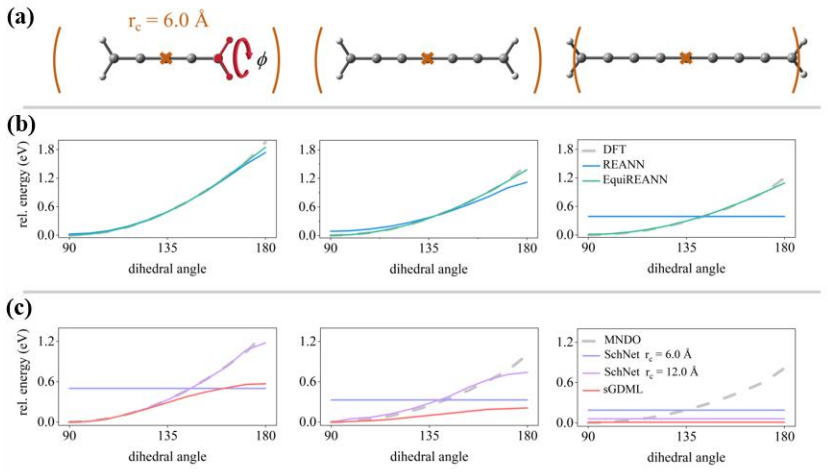
- [Section III.C, Figure 5] The claim that EquiREANN captures subtle torsional energy variations in cumulenes that are 'difficult to be accurately captured by invariant MPNNs such as SchNet, REANN, and even sGDML' rests on Figure 5, whose panels (b) and (c) use reference data generated at different electronic-structure levels (DFT and MNDO). The caption asserts this does not affect the comparison of the energy trend, but this assertion is not self-evident; MNDO is a semi-empirical method and may not reproduce the same torsional barrier shapes as DFT. Because the figure is used to support a general message about the advantage of equivariant MPNNs for nonlocal pi-systems, the authors should either restrict the claim to the specific DFT-referenced cases, provide a consistent reference level across all panels, or explicitly discuss why the mixed references do not alter the qualitative ordering.
- [Section IV, Table II] The GNoME row in Table II lists the training data size as '-' and the training set as 'MP, OQMD, WBM', while the main text states that GNoME was trained on '89 million inorganic crystal structures.' This is an internal inconsistency in one of the paper's central summary tables; the table should be corrected to include the 89 million number (or the text amended) so that readers can rely on the table as an accurate comparison of universal potentials.
minor comments (5)
- [Section II] The sentence 'This was perhaps the earliest scheme of active learning' should be softened to 'one of the earliest examples' or supported by a specific citation, because without this hedge the historical claim is difficult to verify.
- [Section III.C] The sentence 'These three-body feature-based MPNNs, such as REANN and SpookyNet, significantly outperformed ... on a representative CH4 dataset' would benefit from a specific reference to the figure or table in Ref. 163 that supports the quantitative comparison.
- [Section IV] The claim that the sGDML double-walled nanotube is 'the largest molecule studied to date using global descriptor-based methods' should include a 'to our knowledge' qualifier and a date, since this is a fast-moving area.
- [Section III.A] The phrase 'end-ot-end manner' appears to be a typo for 'end-to-end manner.'
- [Section V] The sentence 'Atomistic MLP methods have made significant successes in simulating extended systems' is awkward; consider 'have achieved significant successes.'
Circularity Check
No derivation-level circularity; self-citations are descriptive and the survey remains anchored in external literature.
full rationale
This manuscript is a literature review, not an original derivation or fitting study. It contains no equations in which a target quantity is defined in terms of itself, and no fitted parameter is later relabeled as a prediction. The authors' own models (EANN, REANN, EquiREANN) are discussed, and Figure 5 displays a comparison reproduced from the authors' Ref. 187, but this is presented as reported empirical evidence rather than as a result forced by construction; the review's central narrative—the evolution from global descriptors to local descriptors to equivariant message passing and universal potentials—is supported by a broad set of independent primary literature. The GNoME training-data inconsistency (text: '89 million inorganic crystal structures' vs Table II: '-') is a factual verification issue, not a circularity. No circular step can be exhibited by quoting an equation or a fitted/predicted quantity, so the appropriate finding is no significant circularity, with a minor note that self-cited comparisons are not independently re-benchmarked in this review.
Assumptions & free parameters
assumptions (2)
- domain assumption Born-Oppenheimer approximation separates nuclear and electronic motion so that a potential energy surface exists.
- domain assumption The cited primary papers accurately report the methods and performance used in this review.
Cite this review
Pith. "Pith review of The Evolution of Machine Learning Potentials for Molecules, Reactions and Materials." pith.science (2026). https://pith.science/paper/JSEVTZBC
@misc{pith2026250207335,
  author       = {Pith},
  title        = {Pith review of: The Evolution of Machine Learning Potentials for Molecules, Reactions and Materials},
  year         = {2026},
  howpublished = {\url{https://pith.science/paper/JSEVTZBC}},
  note         = {Machine review of arXiv:2502.07335}
}
read the original abstract
Recent years have witnessed the fast development of machine learning potentials (MLPs) and their widespread applications in chemistry, physics, and material science. By fitting discrete ab initio data faithfully to continuous and symmetry-preserving mathematical forms, MLPs have enabled accurate and efficient atomistic simulations in a large scale from first principles. In this review, we provide an overview of the evolution of MLPs in the past two decades and focus on the state-of-the-art MLPs proposed in the last a few years for molecules, reactions, and materials. We discuss some representative applications of MLPs and the trend of developing universal potentials across a variety of systems. Finally, we outline a list of open challenges and opportunities in the development and applications of MLPs.
Figures
Reference graph
Works this paper leans on
-
[1]
J. I. Steinfeld, J. S. Francisco and W. L. Hase, Chemical Kinetics and Dynamics, Prentice Hall, Englewood Cliffs, NJ, 1989
1989
-
[2]
B. R. Brooks, R. E. Bruccoleri, B. D. Olafson, D. J. States, S. Swaminathan and M. Karplus, CHARMM: A program for macromolecular energy, minimization, and dynamics calculations, J. Comput. Chem., 1983, 4, 187-217
1983
-
[3]
M. S. Daw and M. I. Baskes, Embedded -atom method: Derivation and application to impurities, surfaces, and other defects in metals, Phys. Rev. B, 1984, 29, 6443-6453
1984
-
[4]
Tersoff, New empirical approach for the structure and energy of covalent systems, Phys
J. Tersoff, New empirical approach for the structure and energy of covalent systems, Phys. Rev. B, 1988, 37, 6991-7000
1988
-
[5]
W. L. Jorgensen, J. Chandrasekhar, J. D. Madura, R. W. Impey and M. L. Klein, Comparison of simple potential functions for simulating liquid water, J. Chem. Phys. , 1983, 79, 926- 935
1983
-
[6]
Chenoweth, A
K. Chenoweth, A. C. T. van Duin and W. A. Goddard, ReaxFF reactive force field for molecular dynamics simulations of hydrocarbon oxidation, J. Phys. Chem. A , 2008, 112, 1040-1053
2008
-
[7]
Sathyamurthy and L
N. Sathyamurthy and L. M. Raff, Quasiclassical trajectory studies using 3D spline interpolation of ab initio surfaces, J. Chem. Phys., 1975, 63, 464-473
1975
-
[8]
A. J. C. Varandas, Intermolecular and intramolecular potentials: Topographical aspects, calculation, and functional representation via a double many -body expansion method, Adv. Chem. Phys., 1988, 74, 255-338
1988
Show all 300 references
-
[9]
Ischtwan and M
J. Ischtwan and M. A. Collins, Molecular potential energy surfaces by interpolation, J. Chem. Phys., 1994, 100, 8080-8088
1994
-
[10]
Hastie, R
T. Hastie, R. Tibshirani and J. Friedman, The Elements of Statistical Learning: Data Mining, Inference, and Prediction, Springer, New York, 2016
2016
-
[11]
W. L. Hase, K. Song and M. S. Gordon, Direct dynamics simulations, Comput. Sci. Eng. , 2003, 5, 36-44
2003
-
[12]
Marx and J
D. Marx and J. Hutter, in Modern Methods and Algorithms of Quantum Chemistry , ed. J. Grotendorst, Cambridge University Press, Cambridge, 2009
2009
-
[13]
Lasorne, M
B. Lasorne, M. A. Robb and G. A. Worth, Direct quantum dynamics using variational multi- configuration Gaussian wavepackets. Implementation details and test case, Phys. Chem. Chem. Phys., 2007, 9, 3210-3227
2007
-
[14]
B. G. Levine and T. J. Martínez, Ab initio multiple spawning dynamics of excited butadiene: Role of charge transfer, J. Phys. Chem. A, 2009, 113, 12815-12824
2009
-
[15]
L. M. Raff, R. Komanduri, M. Hagan and S. T. S. Bukkapatnam, Neural Networks in Chemical Reaction Dynamics, Oxford University Press, Oxford, 2012
2012
-
[16]
C. E. Rasmussen and C. K. I. Williams, Gaussian Processes for Machine Learning , The MIT Press, Cambridge, MA, 2006
2006
-
[17]
Carleo, I
G. Carleo, I. Cirac, K. Cranmer, L. Daudet, M. Schuld, N. Tishby, L. Vogt -Maranto and L. Zdeborová, Machine learning and the physical sciences, Reviews of Modern Physics, 2019, 91, 045002
2019
-
[18]
Manzhos, R
S. Manzhos, R. Dawes and T. Carrington Jr., Neural network -based approaches for building high dimensional and quantum dynamics-friendly potential energy surfaces, Int. 69 J. Quant. Chem., 2015, 115, 1012–1020
2015
-
[19]
Manzhos and T
S. Manzhos and T. Carrington, Neural Network Potential Energy Surfaces for Small Molecules and Reactions, Chem. Rev., 2021, 121, 10187-10217
2021
-
[20]
Meuwly, Machine Learning for Chemical Reactions, Chem
M. Meuwly, Machine Learning for Chemical Reactions, Chem. Rev., 2021, 121, 10218 - 10239
2021
-
[21]
R. V. Krems, Bayesian machine learning for quantum molecular dynamics, Phys. Chem. Chem. Phys., 2019, 21, 13392-13410
2019
-
[22]
Chmiela, A
S. Chmiela, A. Tkatchenko, H. E. Sauceda, I. Poltavsky, K. T. Schutt and K. R. Muller, Machine learning of accurate energy -conserving mo lecular force fields, Sci. Adv. , 2017, 3, e1603015
2017
-
[23]
P. O. Dral, MLatom: A program package for quantum chemical research assisted by machine learning, J. Comput. Chem., 2019, 40, 2339-2347
2019
-
[24]
Fu and D
B. Fu and D. H. Zhang, Accurate fundamental invariant -neural network representation of ab initio potential energy surfaces, Natl. Sci. Rev., 2023, 10, nwad321
2023
-
[25]
V. L. Deringer, M. A. Caro and G. Csányi, Machine Learning Interatomic Potentials as Emerging Tools for Materials Science, Advanced Materials, 2019, 31, 1902765
2019
-
[26]
T. Wen, L. Zhang, H. Wang, W. E and D. J. Srolovitz, Deep potentials for materials science, Materials Futures, 2022, 1, 022601
2022
-
[27]
Mortazavi, Recent Advances in Machine Learning-Assisted Multiscale Design of Energy Materials, Advanced Energy Materials, 2024, n/a, 2403876
B. Mortazavi, Recent Advances in Machine Learning-Assisted Multiscale Design of Energy Materials, Advanced Energy Materials, 2024, n/a, 2403876
2024
-
[28]
Mishin, Machine-learning interatomic potentials for materials science, Acta Materialia, 2021, 214, 116980
Y. Mishin, Machine-learning interatomic potentials for materials science, Acta Materialia, 2021, 214, 116980
2021
-
[29]
Friederich, F
P. Friederich, F. Häse, J. Proppe and A. Aspuru -Guzik, Machine -learned potentials for next-generation matter simulations, Nature Materials, 2021, 20, 750-761
2021
-
[30]
Xie, Z.-X
X.-T. Xie, Z.-X. Yang, D. Chen, Y.-F. Shi, P.-L. Kang, S. Ma, Y.-F. Li, C. Shang and Z.-P. Liu, LASP to the Future of Atomic Simulation: Intelligence and Automation, Precis. Chem., 2024, 2, 612-627
2024
-
[31]
Cheng, C
X. Cheng, C. Wu, J. Xu, Y. Han, W. Xie and P. Hu, Leveraging Machine Learning Potentials for In-Situ Searching of Active sites in Heterogeneous Ca talysis, Precis. Chem., 2024, 2, 570-586
2024
-
[32]
K. Wan, J. He and X. Shi, Construction of High Accuracy Machine Learning Interatomic Potential for Surface/Interface of Nanomaterials —A Review, Advanced Materials , 2024, 36, 2305758
2024
-
[33]
T. Mou, H. S. Pillai, S. Wang, M. Wan, X. Han, N. M. Schweitzer, F. Che and H. Xin, Bridging the complexity gap in computational heterogeneous catalysis with machine learning, Nat. Catal., 2023, 6, 122-136
2023
-
[34]
Chen, X.-Y
W.-K. Chen, X.-Y. Liu, W.-H. Fang, P. O. Dral and G. Cui, Deep Learning for Nonadiabatic Excited-State Dynamics, J. Phys. Chem. Lett., 2018, 9, 6702-6708
2018
-
[35]
D. Hu, Y. Xie, X. Li, L. Li and Z. Lan, Inclusion of Machine Learning Kernel Ridge Regression Potential Energy Surfaces in On-the-Fly Nonadiabatic Molecular Dynamics Simulation, J. Phys. Chem. Lett., 2018, 9, 2725-2732
2018
-
[36]
P. O. Dral and M. Barbatti, Molecular excited states through a machine learning lens, Nat. Rev. Chem., 2021, 5, 388-405
2021
-
[37]
Westermayr and P
J. Westermayr and P. Marquetand, Machine Learning for Electronically Exc ited States of 70 Molecules, Chem. Rev., 2021, 121, 9873-9926
2021
-
[38]
Li and S
J. Li and S. A. Lopez, Machine learning accelerated photodynamics simulations, Chemical Physics Reviews, 2023, 4, 031309
2023
-
[39]
Gastegger, J
M. Gastegger, J. Behler and P. Marquetand, Machine learning molecular dynamics for the simulation of infrared spectra, Chem. Sci., 2017, 8, 6924-6935
2017
-
[40]
Raimbault, A
N. Raimbault, A. Grisafi, M. Ceriotti and M. Rossi, Using Gaussian process regression to simulate the vibrational Raman spectra of molecular crystals, New J. Phys. , 20 19, 21, 105001
-
[41]
Zhang, S
Y. Zhang, S. Ye, J. Zhang, C. Hu, J. Jiang and B. Jiang, Efficient and Accurate Simulations of Vibrational and Electronic Spectra with Symmetry -Preserving Neural Network Models for Tensorial Properties, J. Phys. Chem. B, 2020, 124, 7284-7290
2020
-
[42]
Westermayr and P
J. Westermayr and P. Marquetand, Deep learning for UV absorption spectra with SchNarc: First steps toward transferability in chemical compound space, J. Chem. Phys., 2020, 153, 154112
2020
-
[43]
Schütt, O
K. Schütt, O. Unke and M. Gastegger, presented in pa rt at the Proceedings of the 38th International Conference on Machine Learning, Proceedings of Machine Learning Research, 2021
2021
-
[44]
Z. Zou, Y. Zhang, L. Liang, M. Wei, J. Leng, J. Jiang, Y. Luo and W. Hu, A deep learning model for predicting selected organic molecular spectra, Nat. Comput. Sci., 2023, 3, 957- 964
2023
-
[45]
S. Ye, W. Hu, X. Li, J. Zhang, K. Zhong, G. Zhang, Y. Luo, S. Mukamel and J. Jiang, A neural network protocol for electronic excitations of N-methylacetamide, Proc. Natl. Acad. Sci. U.S.A., 2019, 116, 11612-11617
2019
-
[46]
S. Ye, K. Zhong, J. Zhang, W. Hu, J. D. Hirst, G. Zhang, S. Mukamel and J. Jiang, A Machine Learning Protocol for Predicting Protein Infrared Spectra, J. Am. Chem. Soc. , 2020, 142, 19071-19077
2020
-
[47]
R. Han, R. Ketkaew and S. Luber, A Concise Review on Recent Developments of Machine Learning for the Prediction of Vibrational Spectra, J. Phys. Chem. A, 2022, 126, 801-812
2022
-
[48]
O. T. Unke, S. Chmiela, H. E. Sauceda, M. Gastegger, I. Poltavsky, K. T. Schütt, A. Tkatchenko and K.-R. Müller, Machine Learning Force Fields, Chem. Rev., 2021, 121, 10142-10186
2021
-
[49]
V. L. Deringer, A. P. Bartók, N. Bernstein, D. M. Wilkins, M. Ceriotti and G. Csányi, Gaussian Process Regression for Materials and Molecules, Chem. Rev., 2021, 121, 10073-10141
2021
-
[50]
Behler, Four Generations of High -Dimensional Neural Network Potentials, Chem
J. Behler, Four Generations of High -Dimensional Neural Network Potentials, Chem. Rev., 2021, 121, 10037-10072
2021
-
[51]
Musil, A
F. Musil, A. Grisafi, A. P. Bartók, C. Ortner, G. Csányi and M. Ceriotti, Physics -Inspired Structural Representations for Molecules and Mater ials, Chem. Rev. , 2021, 121, 9759 - 9815
2021
-
[52]
Behler and G
J. Behler and G. Csányi, Machine learning potentials for extended systems: a perspective, The European Physical Journal B, 2021, 94, 142
2021
-
[53]
Kocer, T
E. Kocer, T. W. Ko and J. Behler, Neural Network Potentials: A Concise Overview of Methods, Annual Review of Physical Chemistry, 2022, 73, 163-186
2022
-
[54]
G. Wang, C. Wang, X. Zhang, Z. Li, J. Zhou and Z. Sun, Machine learning interatomic potential: Bridge the gap between small -scale models and realistic device -scale simulations, iScience, 2024, 27. 71
2024
-
[55]
Zhang, V
Y.-W. Zhang, V. Sorkin, Z. H. Aitken, A. Politano, J. Behler, A. Thompson, T. W. Ko, S. P. Ong, O. Chalykh, D. Korogod, E. Podryabinkin, A. V. Shapeev, J. Li, Y. Mishin, Z. Pei, X. Liu, J. Kim, Y. Park, S. Hwang, S. Han, K. Sheri ff, Y. Cao and R. Freitas, Roadmap for the deve...
2024
-
[56]
Batzner, A
S. Batzner, A. Musaelian and B. Kozinsky, Advancing molecular simulation with equivariant interatomic potentials, Nature Reviews Physics, 2023, 5, 437-438
2023
-
[57]
Martin -Barrios, E
R. Martin -Barrios, E. Navas -Conyedo, X. Zhang, Y. Chen and J. Gulín -González, An overview about neural networks potentials in molecular dynamics simulation, International Journal of Quantum Chemistry, 2024, 124, e27389
2024
-
[58]
Y. Yang, S. Zhang, K. D. Ranasinghe, O. Isayev and A. E. Roitberg, Machine Learning of Reactive Potentials, Annual Review of Physical Chemistry, 2024, 75, 371-395
2024
-
[59]
T. B. Blank, S. D. Brown, A. W. Cal houn and D. J. Doren, Neural -network models of potential-energy surfaces, J. Chem. Phys., 1995, 103, 4129-4137
1995
-
[60]
D. F. R. Brown, M. N. Gibbs and D. C. Clary, Combining ab initio computations, neural networks, and diffusion Monte Carlo: An efficient meth od to treat weakly bound molecules, J. Chem. Phys., 1996, 105, 7597-7604
1996
-
[61]
Hobday, R
S. Hobday, R. Smith and J. Belbruno, Applications of neural networks to fitting interatomic potential functions, Modelling and Simulation in Materials Science and Engineering, 1999, 7, 397-412
1999
-
[62]
F. V. Prudente, P. H. Acioli and J. J. Soares Neto, The fitting of potential energy surfaces using neural networks: Application to the study of vibrational levels of H3 + , J. Chem. Phys., 1998, 109, 8801-8808
1998
-
[63]
Gassner, M
H. Gassner, M. Probst, A. Lauenstein and K. Hermansson, Representation of intermolecular potential functions by neural networks, J. Phys. Chem. A, 1998, 102, 4596-4605
1998
-
[64]
L. M. Raff, M. Malshe, M. Hagan, D. I. Doughan, M. G. Rockley and R. Komanduri, Ab initio potential-energy surfaces for complex, multichannel systems using modified novelty sampling and feedforward neural networks, J. Chem. Phys., 2005, 122, 084104
2005
-
[65]
H. M. Le and L. M. Raff, Cis →trans, trans→cis isomerizations and N-O bond dissociation of nitrous acid (HONO) on an ab initio potential surface obtained by novelty sampling and fee-forward neural network fitting., J. Chem. Phys., 2008, 128, 194310
2008
-
[66]
M. H. Le, S. Huynh and L. M. Raff, Molecular dissociation of hydrogen peroxide (HOOH) on a neural network ab initio potential surface with a new configuration sampling method involving gradient fitting, J. Chem. Phys., 2009, 131, 014107
2009
-
[67]
Manzhos and T
S. Manzhos and T. Carrington Jr., Using neural networks to represent potential surfaces as sums of products, J. Chem. Phys., 2006, 125, 194105
2006
-
[68]
Manzhos and T
S. Manzhos and T. Carrington Jr., A random -sampling high dimensional model representation neural network for building potential energy surfaces, J. Chem. Phys., 2006, 125, 084109
2006
-
[69]
Manzhos and T
S. Manzhos and T. C. Jr., Using neural networks, optimized coordinates, and high - dimensional model representations to obtain a vinyl bromide potential surface, J. Chem. Phys., 2008, 129, 224104
2008
-
[70]
Manzhos and T
S. Manzhos and T. Carrington, Using redundant coordinates to represent potential energy surfaces with lower-dimensional functions, J. Chem. Phys., 2007, 127, 014103. 72
2007
-
[71]
Malshe, R
M. Malshe, R. Narulkar, L. M. Raff, M. Hagan, S. Bukkapatnam, P. M. Agrawal and R. Komanduri, Development of generalized potential -energy surfaces using many -body expansions, neural networks, and moiety energy approximations, J. Chem. Phys. , 2009, 130, 184102
2009
-
[72]
Lorenz, A
S. Lorenz, A. Groß and M. Scheffler, Representing high -dimensional potential -energy surfaces for reactions at surfaces by neural networks, Chem. Phys. Lett., 2004, 395, 210- 215
2004
-
[73]
Behler, S
J. Behler, S. Lorenz and K. Reuter, Representing molecule -surface interactions with symmetry-adapted neural networks, J. Chem. Phys., 2007, 127, 014705
2007
-
[74]
Hollebeek, T.-S
T. Hollebeek, T.-S. Ho and H. Rabitz, Constructing multidimensional molecular potential energy surfaces from ab initio data, Annu. Rev. Phys. Chem., 1999, 50, 537-570
1999
-
[75]
Dawes, D
R. Dawes, D. L. Thompson, Y. Guo, A. F. Wagner and M. Minkoff, Interpolating moving least-squares methods for fitting potential energy surfaces: Computing high -density potential energy surface data from low-density ab initio data points, J. Chem. Phys., 2007, 126, 184108
2007
-
[76]
B. J. Braams and J. M. Bowman, Permutationally invariant potential energy surfaces in high dimensionality, Int. Rev. Phys. Chem., 2009, 28, 577–606
2009
-
[77]
Behler, Perspective: Machine learning potentials for atomistic simulations, J
J. Behler, Perspective: Machine learning potentials for atomistic simulations, J. Chem. Phys., 2016, 145, 170901
2016
-
[78]
M. A. Collins, Molecular potential -energy surfaces for chemical reaction dynamics, Theoretical Chemistry Accounts, 2002, 108, 313-323
2002
-
[79]
Huang, B
X. Huang, B. J. Braams and J. M. Bowman, Ab initio potential energy and dipole moment surfaces for H5O2 + , J. Chem. Phys., 2005, 122, 044308
2005
-
[80]
Xie and J
Z. Xie and J. M. Bowman, Permutationally invariant polynomial basis for molecular energy surface fitting via monomial symmetrization, J. Chem. Theory Comput., 2010, 6, 26–34
2010
-
[81]
Bholoa, S
A. Bholoa, S. D. Kenny and R. Smith, A new approach to potential fitting using neural networks, Nuclear Instruments and Methods in Physics Research Section B, 2007, 255, 1- 7
2007
-
[82]
Behler and M
J. Behler and M. Parrinello, Generalized neural -network representation of high - dimensional potential-energy surfaces, Phys. Rev. Lett., 2007, 98, 146401
2007
-
[83]
Behler, Atom -centered symmetry functions for constructing high -dimensional neural network potentials, J
J. Behler, Atom -centered symmetry functions for constructing high -dimensional neural network potentials, J. Chem. Phys., 2011, 134, 074106
2011
-
[84]
A. P. Bartók, M. C. Payne, R. Kondor and G. Csányi, Gaussian approximation potentials: The accuracy of quantum mechanics, without the electrons, Phys. Rev. Lett. , 2010, 104, 136403
2010
-
[85]
Derksen and G
H. Derksen and G. Kemper, Computational Invariant Theory, Springer-Verlag, Berlin, 2002
2002
-
[86]
Chmiela, H
S. Chmiela, H. E. Sauceda, K. -R. Müller and A. Tkatchenko, Towards exact molecular dynamics simulations with machine-learned force fields, Nat. Commun., 2018, 9, 3887
2018
-
[87]
P. O. Dral, A. Owens, S. N. Yurchenko and W. Thiel, Structure -based sampling and self - correcting machine learning for accurate calculations of potential energy surfaces and vibrational levels, J Chem Phys, 2017, 146, 244108
2017
-
[88]
K. T. Schütt, F. Arbabzadah, S. Chmiela, K. R. Müller and A. Tkatchenko, Quantum-chemical insights from deep tensor neural networks, Nat. Commun., 2017, 8, 13890
2017
-
[89]
Gilmer, S
J. Gilmer, S. S. Schoenholz, P. F. Riley, O. Vinyals and G. E. Dahl, presented in part at the 73 Proceedings o f the 34th International Conference on Machine Learning - Volume 70, Sydney, NSW, Australia, 2017
2017
-
[90]
C. Qu, Q. Yu and J. M. Bowman, Permutationally invariant potential energy surfaces, Annu. Rev. Phys. Chem., 2018, 69, 151-175
2018
-
[91]
Nandi, C
A. Nandi, C. Qu and J. M. Bowman, Full and fragmented permutationally invariant polynomial potential energy surfaces for trans and cis N -methyl acetamide and isomerization saddle points, J. Chem. Phys., 2019, 151, 084306
2019
-
[92]
C. Qu, P. L. Houston, R. Conte, A. Nandi and J. M. Bowman, Breaking the Coupled Cluster Barrier for Machine -Learned Potentials of Large Molecules: The Case of 15 -Atom Acetylacetone, J. Phys. Chem. Lett., 2021, 12, 4902-4909
2021
-
[93]
C. Qu, R. Conte, P. L. Houston and J. M. Bowman, Full -dimensional potential ene rgy surface for acetylacetone and tunneling splittings, Phys. Chem. Chem. Phys. , 2021, 23, 7758-7767
2021
-
[94]
Nandi, G
A. Nandi, G. Laude, S. S. Khire, N. D. Gurav, C. Qu, R. Conte, Q. Yu, S. Li, P. L. Houston, S. R. Gadre, J. O. Richardson, F. A. Evangelista and J. M. Bowman, Ring-Polymer Instanton Tunneling Splittings of Tropolone and Isotopomers using a Δ -Machine Learned CCSD(T) Potential:...
2023
-
[95]
P. L. Houston, C. Qu, Q. Yu, P. Pandey, R. Conte, A. Nandi and J. M. Bowman, No Headache for PIPs: A PIP Potential for Aspirin Runs Much Faster and with Similar Precision Than Other Machine-Learned Potentials, J. Chem. Theory Comput, 2024, 20, 3008-3018
2024
-
[96]
Q. Yu, C. Qu, P. L. Houston, R. Conte, A. Nandi and J. M. Bowman, q-AQUA: A Many-Body CCSD(T) Water Potential, Including Four -Body Interactions, Demonstrates the Quantum Nature of Water from Clusters to the Liquid Phase, J. Phys. Chem. Lett., 2022, 13, 5068- 5074
2022
-
[97]
X. Zhu, M. Riera, E. F. Bull -Vulpe and F. Paesani, MB -pol(2023): Sub-chemical Accuracy for Water Simulations from the Gas to the Liquid Phase, J. Chem. Theory Comput , 2023, 19, 3551-3566
2023
-
[98]
G old Standard
Q. Yu, C. Qu, P. L. Houston, A. Nandi, P. Pandey, R. Conte and J. M. Bowman, A Status Report on “G old Standard” Machine -Learned Potentials for Water, J. Phys. Chem. Lett. , 2023, 14, 8077-8087
2023
-
[99]
E. F. Bull -Vulpe, M. Riera, S. L. Bore and F. Paesani, Data -Driven Many -Body Potential Energy Functions for Generic Molecules: Linear Alkanes as a Proof -of-Concept Application, J. Chem. Theory Comput, 2023, 19, 4494-4509
2023
-
[100]
J. M. Bowman, C. Qu, R. Conte, A. Nandi, P. L. Houston and Q. Yu, The MD17 datasets from the perspective of datasets for gas-phase “small” molecule potentials, J. Chem. Phys., 2022, 156, 240901
2022
-
[101]
Nandi, C
A. Nandi, C. Qu and J. M. Bowman, Using Gradients in Permutationally Invariant Polynomial Potential Fitting: A Demonstration for CH4 Using as Few as 100 Configurations, J. Chem. Theory Comput, 2019, 15, 2826-2835
2019
-
[102]
X. Wang, L. Houston Pau l and M. Bowman Joel, A new (multi -reference configuration interaction) potential energy surface for H 2CO and preliminary studies of roaming, Phil. Trans. Royal Soc. A, 2017, 375, 20160194
2017
-
[103]
C. Qu, P. L. Houston, T. Allison, B. I. Schneider and J. M. B owman, DFT -Based Permutationally Invariant Polynomial Potentials Capture the Twists and Turns of C14H30, 74 J. Chem. Theory Comput, 2024, 20, 9339-9353
2024
-
[104]
P. L. Houston, C. Qu, Q. Yu, R. Conte, A. Nandi, J. K. Li and J. M. Bowman, PESPIP: Software to fit complex molecular and many -body potential energy surfaces with permutationally invariant polynomials, J. Chem. Phys., 2023, 158, 044109
2023
-
[105]
M. S. Drehwald , A. Jamali and R. A. Vargas -Hernández, MOLPIPx: An end -to-end differentiable package for permutationally invariant polynomials in Python and Rust, J. Chem. Phys., 2025, 162, 084115
2025
-
[106]
Jiang and H
B. Jiang and H. Guo, Permutation invariant polynomial neural network approach to fitting potential energy surfaces, J. Chem. Phys., 2013, 139, 054112
2013
-
[107]
J. Li, B. Jiang and H. Guo, Permutation invariant polynomial neural network approach to fitting potential energy surfaces. II. Four-atom systems, J. Chem. Phys., 2013, 139, 204103
2013
-
[108]
Jiang and H
B. Jiang and H. Guo, Permutation invariant polynomial neural network approach to fitting potential energy surfaces. III. Molecule -surface interactions, J. Chem. Phys. , 2014, 141, 034109
2014
-
[109]
Song and J
K. Song and J. Li, The neural network based Δ -machine learning approach efficiently brings the DFT potential energy surface to the CCSD(T) quality: a case for the OH + CH3OH reaction, Phys. Chem. Chem. Phys., 2023, 25, 11192-11204
2023
-
[110]
J. Chen, X. Zhou, Y. Zhang and B. Jiang, Vibrational control of s elective bond cleavage in dissociative chemisorption of methanol on Cu(111), Nat. Commun., 2018, 9, 4039
2018
-
[111]
Jiang, J
B. Jiang, J. Li and H. Guo, Potential energy surfaces from high fidelity fitting of ab initio points: The permutation invariant polynomial -neural network approach, Int. Rev. Phys. Chem., 2016, 35, 479-506
2016
-
[112]
Jiang, J
B. Jiang, J. Li and H. Guo, High-Fidelity Potential Energy Surfaces for Gas-Phase and Gas– Surface Scattering Processes from Machine Learning, J. Phys. Chem. Lett., 2020, 11, 5120- 5131
2020
-
[113]
Li and H
J. Li and H. Guo, Permutationally invariant fitting of intermolecular potential energy surfaces: A case study of the Ne-C2H2 system, J. Chem. Phys., 2015, 143, 214304
2015
-
[114]
K. Shao, J. Chen, Z. Zhao and D. H. Zhang, Communication: Fitting potential energy surfaces with fundamental invariant neural network, J. Chem. Phys., 2016, 145, 071101
2016
-
[115]
R. Chen, K. Shao, B. Fu and D. H. Zhang, Fitting potential energy surfaces with fundamental invariant neural network. II. Generating fundamental invariants for molecular systems with up to ten atoms, J. Chem. Phys., 2020, 152, 204307
2020
-
[116]
X. Lu, C. Shang, L. Li, R. Chen, B. Fu, X. Xu and D. H. Zhang, Unexpected steric hindrance failure in the gas phase F− + (CH3)3CI SN2 reaction, Nat. Commun., 2022, 13, 4427
2022
-
[117]
S. N. Pozdnyakov, M. J. Willatt, A. P. Bartók, C. Ortner, G. Csányi and M. Ceriotti, Incompleteness of Atomic Structure Representations, Phys. Rev. Lett., 2020, 125, 166001
2020
-
[118]
S. N. Pozdnyakov and M. Ceriotti, Incompleteness of graph neural networks for points clouds in three dimensions, Mach. Learn.: Sci. Technol., 2022, 3, 045020
2022
-
[119]
Nigam, S
J. Nigam, S. N. Pozdnyakov, K. K. Huguenin -Dumittan and M. Ceriotti, Completeness of atomic structure representations, APL Mach. Learn., 2024, 2, 016110
2024
-
[120]
Kamath, R
A. Kamath, R. A. Vargas-Hernández, R. V. Krems, T. CarringtonJr. and S. Manzhos, Neural networks vs Gaussian process regression for representing potential energy surfaces: A comparative study of fit quality and vibrational spectrum accuracy, J. Chem. Phys., 2018, 75 148, 241702
2018
-
[121]
Dai and R
J. Dai and R. V. Krems, Interpolation and Extrapolation of Global Potential Energy Surfaces for Polyatomic Systems by Gaussian Processes with Composite Kernels, J. Chem. Theory Comput, 2020, 16, 1386-1395
2020
-
[122]
Sugisawa, T
H. Sugisawa, T. Ida and R. V. Krems, Gaussian process model of 51-dimensional potential energy surface for protonated imidazole dimer, J. Chem. Phys., 2020, 153
2020
-
[123]
C. Qu, Q. Yu, B. L. Van Hoozen, J. M. Bowman and R. A. Vargas -Hernández, Assessing Gaussian Process Regression and Permutationally Invariant Polynomial Approaches To Represent High-Dimensional Potential Energy Surfaces, J. Chem. Theory Comput., 2018, 14, 3381-3396
2018
-
[124]
Pinheiro, F
M. Pinheiro, F. Ge, N. Ferré, P. O. Dral and M. Barbatti, Choosing the right molecular machine learning potential, Chem. Sci., 2021, 12, 14396-14413
2021
-
[125]
Y.-F. Hou, F. Ge and P. O. Dral, Explicit Learning of Derivatives with the KREG and pK REG Models on the Example of Accurate Representation of Molecular Potential Energy Surfaces, J. Chem. Theory Comput, 2023, 19, 2369-2379
2023
-
[126]
Chmiela, V
S. Chmiela, V. Vassilev-Galindo, O. T. Unke, A. Kabylda, H. E. Sauceda, A. Tkatchenko and K.-R. Müller, Accurate global machine learning force fields for molecules with hundreds of atoms, Sci. Adv., 2023, 9, eadf0873
2023
-
[127]
H. E. Sauceda, L. E. Gálvez -González, S. Chmiela, L. O. Paz -Borbón, K.-R. Müller and A. Tkatchenko, BIGDML —Towards accurate quantum machine learni ng force fields for materials, Nat. Commun., 2022, 13, 3733
2022
-
[128]
Kocer, J
E. Kocer, J. K. Mason and H. Erturk, Continuous and optimally complete description of chemical environments using Spherical Bessel descriptors, AIP Advances , 2020, 10, 015021
2020
-
[129]
M. P. Bircher, A. Singraber and C. Dellago, Improved description of atomic environments using low-cost polynomial functions with compact support, Mach. Learn.: Sci. Technol. , 2021, 2, 035026
2021
-
[130]
S. D. Huang, C. Shang, P. L. Kang and Z. P. Liu, Atomic structure of boron resolved using machine learning and global sampling, Chem. Sci., 2018, 9, 8644-8655
2018
-
[131]
Zhang, C
Y. Zhang, C. Hu and B. Jiang, Accelerating atomistic simulations with piecewise machine - learned ab Initio potentials at a classical force field -like cost, Phys. Chem. Chem. Phys. , 2021, 23, 1815-1821
2021
-
[132]
J. S. Smith, O. Isayev and A. E. Roitberg, ANI -1: an extensible neural network potential with DFT accuracy at force field computational cost, Chem. Sci., 2017, 8, 3192-3203
2017
-
[133]
Gastegger, L
M. Gastegger, L. Schwiedrzik, M. Bittermann, F. Berzsenyi and P. Marquetand, wACSF — Weighted atom -centered symmetry functions as descriptors in machine learning potentials, J. Chem. Phys., 2018, 148, 241709
2018
-
[134]
Imbalzano, A
G. Imbalzano, A. Anelli, D. Giofré, S. Klees, J. Behler and M. Ceriotti, A utomatic selection of atomic fingerprints and reference configurations for machine -learning potentials, J. Chem. Phys., 2018, 148, 241730
2018
-
[135]
K. Yao, J. E. Herr, David W. Toth, R. McKintyre and J. Parkhill, The TensorMol -0.1 model chemistry: a neural net work augmented with long -range physics, Chem. Sci. , 2018, 9, 2261-2269
2018
-
[136]
Behler, Constructing high-dimensional neural network potentials: A tutorial review, Int
J. Behler, Constructing high-dimensional neural network potentials: A tutorial review, Int. 76 J. Quant. Chem., 2015, 115, 1032-1050
2015
-
[137]
Artrith and A
N. Artrith and A. Urban, An implementation of artificial neural -network potentials for atomistic materials simulations: Performance for TiO2, Comput. Mater. Sci. , 2016, 114, 135-150
2016
-
[138]
Singraber, T
A. Singraber, T. Morawietz, J. Behler and C. Dellago, Parallel Multistream Training of High- Dimensional Neural Network Potentials, J. Chem. Theory Comput, 2019, 15, 3075-3092
2019
-
[139]
A. S. Christensen, L. A. Bratholm, F. A. Faber and O. Anatole von Lilienfeld, FCHL revisited: Faster and more accurate quantum machine learning, J. Chem. Phys., 2020, 152, 044107
2020
-
[140]
Zhang, J
L. Zhang, J. Han, H. Wang, W. A. Saidi, R. Car and E. Weinan, presented in part at the Proceedings of the 32nd International Conference on Neural Information Processing Systems, Montreal, Canada, 2018
2018
-
[141]
H. Wang, L. Zhang, J. Han and W. E, DeePMD -kit: A deep learning package for many - body potential energy representation and molecular dynamics, Comput. Phys. Commun., 2018, 228, 178-184
2018
-
[142]
Zhang, C
Y. Zhang, C. Hu and B. Jiang, Embedded atom neural network potenti als: Efficient and accurate machine learning with a physically inspired representation, J. Phys. Chem. Lett., 2019, 10, 4962-4967
2019
-
[143]
P.-L. Kang, C. Shang and Z. -P. Liu, Large-Scale Atomic Simulation via Machine Learning Potentials Constructed by Global Potential Energy Surface Exploration, Acc. Chem. Res. , 2020, 53, 2119-2129
2020
-
[144]
A. P. Bartók, R. Kondor and G. Csányi, On representing chemical environments, Phys. Rev. B, 2013, 87, 184115
2013
-
[145]
A. P. Thompson, L. P. Swiler, C. R. Trott, S. M. Foiles and G. J. Tucker, Spectral neighbor analysis method for automated generation of quantum -accurate interatomic potentials, J. Comput. Phys., 2015, 285, 316-330
2015
-
[146]
A. V. Shapeev, Moment Tensor Potentials: A Class of Systematically Improvable Interatomic Potentials, Multiscale Model. Sim., 2016, 14, 1153-1173
2016
-
[147]
Zaverkin and J
V. Zaverkin and J. Kästner, Gaussian Moments as Physically Inspired Molecular Descriptors for Accurate and Scalable Machine Learning Potentials, J. Chem. Theory Comput , 2020, 16, 5410-5421
2020
-
[148]
Drautz, Atomic cluster expansion for accurate and transferable interatomic potentials, Phys
R. Drautz, Atomic cluster expansion for accurate and transferable interatomic potentials, Phys. Rev. B, 2019, 99, 014104
2019
-
[149]
Nigam, S
J. Nigam, S. Pozdnyakov and M. Ceriotti, Recursive evaluation and iterative contraction of N-body equivariant features, J. Chem. Phys., 2020, 153, 121101
2020
-
[150]
A. E. A. Allen, G. Dusson, C. Ortner and G. Csányi, Atomic permutationally invariant polynomials for fitting molecular force fields, Mach. Learn.: Sci. Technol., 2021, 2, 025017
2021
-
[151]
Z. Fan, Z. Zeng, C. Zhang, Y. Wang, K. So ng, H. Dong, Y. Chen and T. Ala -Nissila, Neuroevolution machine learning potentials: Combining high accuracy and low cost in atomistic simulations and application to heat transport, Phys. Rev. B, 2021, 104, 104309
2021
-
[152]
D. K. Duvenaud, D. Maclaurin, J. Iparraguirre, R. Bombarell, T. Hirzel, A. Aspuru-Guzik and R. P. Adams, Convolutional networks on graphs for learning molecular fingerprints, Advances in neural information processing systems, 2015, 28
2015
-
[153]
F. A. Faber, L. Hutchison, B. Huang, J. Gilmer, S. S. Schoenholz, G. E. Dahl, O. Vinyals, S. Kearnes, P. F. Riley and O. A. von Lilienfeld, Prediction Errors of Molecular Machine 77 Learning Models Lower than Hybrid DFT Error, J. Chem. Theory Comput, 2017, 13, 5255- 5264
2017
-
[154]
Lubbers, J
N. Lubbers, J. S. Smith and K. Barros, Hierarchical modeling of molecular energies using a deep neural network, J. Chem. Phys., 2018, 148, 241715
2018
-
[155]
K. He, X. Zhang, S. Ren and J. Sun, 2016
2016
-
[156]
K. T. Schütt, H. E. Sauceda, P.-J. Kindermans, A. Tkatchenko and K. -R. Müller, SchNet – A deep learning architecture for molecules and materials, J. Chem. Phys., 2018, 148, 241722
2018
-
[157]
O. T. Unke and M. Meuwly, PhysNet: A Neural Network for Predicting Energies, Forces, Dipole Moments, and Partial Charges, J. Chem. Theory Comput, 2019, 15, 3678-3693
2019
-
[158]
Zhang, J
Y. Zhang, J. Xia and B. Jiang, Physically motivated recursively embedded atom neural networks: Incorporating local completeness and nonlocality, Phys. Rev. Lett. , 2021, 127, 156002
2021
-
[159]
Johannes, G
K. Johannes, G. Janek and G. Stephan, presented in part a t the International Conference on Learning Representations, 2020
2020
-
[160]
Anderson, T
B. Anderson, T. S. Hy and R. Kondor, presented in part at the Advances in Neural Information Processing Systems 32, Vancouver, Canada, 2019
2019
-
[161]
O. T. Unke, S. Chmiela, M. Gastegger, K . T. Schütt, H. E. Sauceda and K. -R. Müller, SpookyNet: Learning force fields with electronic degrees of freedom and nonlocal effects, Nat. Commun., 2021, 12, 7273
2021
-
[162]
Zubatyuk, S
R. Zubatyuk, S. Smith Justin, J. Leszczynski and O. Isayev, Accurate and transferable multitask prediction of chemical properties with an atoms -in-molecules neural network, Sci. Adv., 2021, 5, eaav6490
2021
-
[163]
Zhang, J
Y. Zhang, J. Xia and B. Jiang, REANN: A PyTorch-based end-to-end multi-functional deep neural network package for molecular, reactive, and periodic systems, J. Chem. Phys., 2022, 156, 114801
2022
-
[164]
Nigam, S
J. Nigam, S. Pozdnyakov, G. Fraux and M. Ceriotti, Unified theory of atom -centered representations and message -passing machine-learning schemes, J. Chem. Phys., 2022, 156, 204115
2022
-
[165]
J. Xia, Y. Zhang and B. Jiang, Accuracy Assessment of Atomistic Neural Network Potentials: The Impact of Cutoff Radius and Message Passing, J. Phys. Chem. A , 2023, 127, 9874- 9883
2023
-
[166]
Batzner, A
S. Batzner, A. Musaelian, L. Sun, M. Geiger, J. P. Mailoa, M. Kornbluth, N. Mol inari, T. E. Smidt and B. Kozinsky, E(3) -equivariant graph neural networks for data -efficient and accurate interatomic potentials, Nat. Commun., 2022, 13, 2453
2022
-
[167]
Gasteiger, F
J. Gasteiger, F. Becker and S. Günnemann, Gemnet: Universal directional graph neural networks for molecules, Advances in Neural Information Processing Systems , 2021, 34, 6790-6802
2021
-
[168]
Musaelian, S
A. Musaelian, S. Batzner, A. Johansson, L. Sun, C. J. Owen, M. Kornbluth and B. Kozinsky, Learning local equivariant representations for large -scale atomistic d ynamics, Nat. Commun., 2023, 14, 579
2023
-
[169]
Batatia, S
I. Batatia, S. Batzner, D. P. Kovács, A. Musaelian, G. N. Simm, R. Drautz, C. Ortner, B. Kozinsky and G. Csányi, The design space of e (3)-equivariant atom-centered interatomic potentials, arXiv preprint arXiv:2205.06643, 2022
2022 arXiv
-
[170]
Brandstetter, R
J. Brandstetter, R. Hesselink, E. van der Pol, E. J. Bekkers and M. Welling, Geometric and 78 physical quantities improve e (3) equivariant message passing, arXiv preprint arXiv:2110.02905, 2021
2021 arXiv
-
[171]
Y. Wang, T. Wang, S. Li, X. He, M. Li, Z. Wang, N. Zheng, B. Shao and T.-Y. Liu, Enhancing geometric representations for molecules with equivariant vector -scalar interactive message passing, Nat. Commun., 2024, 15, 313
2024
- [172]
-
[173]
Y.-L. Liao, B. M. Wood, A. Das and T. Smidt, presented in part at the The 12th International Conference on Learning Representations, 2024
2024
-
[174]
Batatia, D
I. Batatia, D. P. Kovacs, G. Simm, C. Ortner and G. Csanyi, presented in part at the Advances in Neural Information Processing Systems, 2022, 2022
2022
-
[175]
J. Hu, L. Zhou and J. Jiang, Efficient Machine Learning Force Field for Large -Scale Molecular Simulations of Organic Systems, CCS Chemistry, 0, 1-15
-
[176]
Z. Qiao, A. S. Christensen, M. Welborn, F. R. Manby, A. Anandkumar and T. F. Miller III, Unite: Unitary n-body tensor equivariant network with applications to quantum chemistry, arXiv preprint arXiv:2105.14655, 2021, 3
2021 arXiv
-
[177]
Thomas, T
N. Thomas, T. Smidt, S. Kearnes, L. Yang, L. Li, K. Kohlhoff and P. Riley, Tensor field networks: Rotation - and translation -equivariant neural networks for 3D point clouds, arXiv e-prints, 2018, arXiv:1802.08219
2018 arXiv
-
[178]
Kondor, N -body Networks: a Cov ariant Hierarchical Neural Network Architecture for Learning Atomic Potentials, ArXiv, 2018, abs/1803.01588
R. Kondor, N -body Networks: a Cov ariant Hierarchical Neural Network Architecture for Learning Atomic Potentials, ArXiv, 2018, abs/1803.01588
2018 arXiv
-
[179]
Ramakrishnan, P
R. Ramakrishnan, P. O. Dral, M. Rupp and O. A. von Lilienfeld, Quantum chemistry structures and properties of 134 kilo molecules, Scientific Data, 2014, 1, 140022
2014
-
[180]
Geiger and T
M. Geiger and T. E. Smidt, e3nn: Euclidean Neural Networks, arXiv preprint arXiv:2207.09453, 2022
2022 arXiv
-
[181]
Haghighatlari, J
M. Haghighatlari, J. Li, X. Guan, O. Zhang, A. Das, C. J. Stein, F. Heidar -Zadeh, M. Liu, M. Head-Gordon, L. Bertels, H. Hao, I. Leven and T. Head-Gordon, NewtonNet: a Newtonian message passing network for deep learning of interatomic potentials and forces, Digital Discovery,...
2022
-
[182]
Thölke and G
P. Thölke and G. De Fabritiis, 2022
2022
-
[183]
Takamoto, S
S. Takamoto, S. Izumi and J. Li, TeaNet : Universal neural network interatomic potential inspired by iterative electronic relaxations, Comput. Mater. Sci., 2022, 207, 111280
2022
-
[184]
Cheng, Cartesian atomic cluster expansion for machine learning interatomic potentials, npj Comput
B. Cheng, Cartesian atomic cluster expansion for machine learning interatomic potentials, npj Comput. Mater., 2024, 10, 157
2024
-
[185]
J. Wang, Y. Wang, H. Zhang, Z. Yang, Z. Liang, J. Shi, H.-T. Wang, D. Xing and J. Sun, E(n)- Equivariant cartesian tensor message passing interatomic potential, Nat. Commun., 2024, 15, 7607
2024
-
[186]
Wen, W.-F
M. Wen, W.-F. Huang, J. Dai and S. Adhikari, Cartesian Atomic Moment Machine Learning Interatomic Potentials, arXiv preprint arXiv:2411.12096, 2024
2024 arXiv
-
[187]
Y. Wu, J. Xia, Y. Zhang and B. Jiang, Simple and Efficient Equivariant Message -Passing Neural Network Model for Non -local Potential Energy Surfaces, J. Phys. Chem. A , 2024, 128, 11061-11067
2024
-
[188]
J. T. Frank, O. T. Unke, K. -R. Müller and S. Chmiela, A Euclidean transformer for fast and stable machine learned force fields, Nat. Commun., 2024, 15, 6539. 79
2024
-
[189]
S. P. Niblett, M. Galib and D. T. Limmer, Lear ning intermolecular forces at liquid –vapor interfaces, J. Chem. Phys., 2021, 155
2021
-
[190]
Thorben Frank, O
J. Thorben Frank, O. T. Unke and K.-R. Müller, 2022
2022
-
[191]
Artrith, T
N. Artrith, T. Morawietz and J. Behler, High -dimensional neural -network potentials for multicomponent systems: Applications to zinc oxide, Phys. Rev. B, 2011, 83, 153101
2011
-
[192]
Morawietz, V
T. Morawietz, V. Sharma and J. Behler, A neural network potential -energy surface for the water dimer based on environment -dependent atomic energies and charges, J. Chem. Phys., 2012, 136, 064103
2012
-
[193]
P. P. Ewald, Die Berechnung optischer und elektrostatischer Gitterpotentiale, Annalen der physik, 1921, 369, 253-287
1921
-
[194]
Z. Deng, C. Chen, X. -G. Li and S. P. Ong, An electrostatic spectral neighbor analysis potential for lithium nitride, npj Comput. Mater., 2019, 5, 75
2019
-
[195]
Z. Song, J. Han, G. Henkelman and L. Li, Charge-Optimized Electrostatic Interaction Atom- Centered Neural Network Algorithm, J. Chem. Theory Comput, 2024, 20, 2088-2097
2024
-
[196]
A. K. Rappe and W. A. Goddard, III, Charge equilib ration for molecular dynamics simulations, The Journal of Physical Chemistry, 1991, 95, 3358-3363
1991
-
[197]
S. A. Ghasemi, A. Hofstetter, S. Saha and S. Goedecker, Interatomic potentials for ionic systems with density functional accuracy based on charge densities obtained by a neural network, Phys. Rev. B, 2015, 92, 045131
2015
-
[198]
E. R. Khajehpasha, J. A. Finkler, T. D. Kühne and S. A. Ghasemi, CENT2: Improved charge equilibration via neural network technique, Phys. Rev. B, 2022, 105, 144106
2022
-
[199]
T. W. Ko, J. A. Finkler, S. Goedecker and J. Behler, A fourth -generation high-dimensional neural network potential with accurate electrostatics including non-local charge transfer, Nat. Commun., 2021, 12, 398
2021
-
[200]
L. D. Jacobson, J. M. Stevenson, F. Ramezanghorbani, D. Ghoreishi, K. Leswing, E. D. Harder and R. Abel, Transferable Neural Network Potential Energy Surfaces f or Closed -Shell Organic Molecules: Extension to Ions, J. Chem. Theory Comput, 2022, 18, 2354-2366
2022
-
[201]
X. Xie, K. A. Persson and D. W. Small, Incorporating Electronic Information into Machine Learning Potential Energy Surfaces via Approaching the Ground -State Electronic Energy as a Function of Atom-Based Electronic Populations, J. Chem. Theory Comput, 2020, 16, 4256-4270
2020
-
[202]
C. G. Staacke, S. Wengert, C. Kunkel, G. Csányi, K. Reuter and J. T. Margraf, Kernel charge equilibration: efficient and accurate p rediction of molecular dipole moments with a machine-learning enhanced electron density model, Mach. Learn.: Sci. Technol., 2022, 3, 015032
2022
-
[203]
Shaidu, F
Y. Shaidu, F. Pellegrini, E. Küçükbenli, R. Lot and S. de Gironcoli, Incorporating long-range electrostatics in neural network potentials via variational charge equilibration from shortsighted ingredients, npj Comput. Mater., 2024, 10, 47
2024
-
[204]
Zhang, H
L. Zhang, H. Wang, M. C. Muniz, A. Z. Panagiotopoulos, R. Car and W. E, A deep potential model with long-range electrostatic interactions, J. Chem. Phys., 2022, 156, 124107
2022
-
[205]
Gao and R
A. Gao and R. C. Remsing, Self -consistent determination of long -range electrostatics in neural network potentials, Nat. Commun., 2022, 13, 1572
2022
-
[206]
Grisafi and M
A. Grisafi and M. Ceriotti, Incorporating long -range physics in atomic -scale machine learning, J. Chem. Phys., 2019, 151, 204105. 80
2019
-
[207]
Grisafi, J
A. Grisafi, J. Nigam and M. Ceriotti, Multi-scale approach for the prediction of atomic scale properties, Chem. Sci., 2021, 12, 2078-2090
2021
-
[208]
P.-L. Kang, Z. -X. Yang, C. Shang and Z. -P. Liu, Global Neural Network Potential with Explicit Many -Body Functions for Improved Descriptions of Complex Potential Energy Surface, J. Chem. Theory Comput, 2023, 19, 7972-7981
2023
-
[209]
Yang, X.-T
Z.-X. Yang, X.-T. Xie, P.-L. Kang, Z.-X. Wang, C. Shang and Z.-P. Liu, Many-Body Function Corrected Neural Network with Atomic Attention (MBNN -att) for Molecular Property Prediction, J. Chem. Theory Comput, 2024, 20, 6717-6727
2024
-
[210]
Y. Li, Y. Zhai and H. Li, MLRNet: Combining the Physics -Motivated Potential Models with Neural Networks for Intermolecular Potential Energy Surface Construction, J. Chem. Theory Comput, 2023, 19, 1421-1431
2023
-
[211]
Xie, Z.-X
X.-T. Xie, Z.-X. Yang, D. Chen, Y.-F. Shi, P.-L. Kang, S. Ma, Y.-F. Li, C. Shang and Z.-P. Liu, LASP to the Future of Atomic Simulation: Intelligence and Automation, Precis. Chem., 2024, DOI: 10.1021/prechem.4c00060
2024 doi
-
[212]
D. Lu, J. Li and H. Guo, Stereodynamical cont rol of product branching in multi -channel barrierless hydrogen abstraction of CH3OH by F, Chem. Sci., 2019, 10, 7994-8001
2019
-
[213]
M. L. Weichman, J. A. DeVine, M. C. Babin, J. Li, L. Guo, J. Ma, H. Guo and D. M. Neumark, Feshbach resonances in the exit chann el of the F + CH3OH → HF + CH3O reaction observed using transition-state spectroscopy, Nat. Chem., 2017, 9, 950-955
2017
-
[214]
D. Yang, J. Huang, X. Hu, H. Guo and D. Xie, Breakdown of energy transfer gap laws revealed by full-dimensional quantum scattering between HF molecules, Nat. Commun., 2019, 10, 4658
2019
-
[215]
X. Zhou, Y. Zhang, R. Yin, C. Hu and B. Jiang, Neural Network Representations for Studying Gas-Surface Reaction Dynamics: Beyond the Born -Oppenheimer Static Surface Approximation†, Chin. J. Chem., 2021, 39, 2917-2930
2021
-
[216]
X. Zhou, G. Meng, H. Guo and B. Jiang, First -Principles Insights into Adiabatic and Nonadiabatic Vibrational Energy -Transfer Dynamics during Molecular Scattering from Metal Surfaces: The Importance of Surface Reactivity, J. Phys. Chem. Lett., 2022, 13, 3450- 3461
2022
-
[217]
R. Yin, Y. Zhang and B. Jiang, Strong Vibrational Relaxation of NO Scattered from Au(111): Importance of the Adiabatic Potential Energy Surface, J. Phys. Chem. Lett., 2019, 10, 5969- 5974
2019
-
[218]
Yin and B
R. Yin and B. Jiang, Mechanic al Vibrational Relaxation of NO Scattering from Metal and Insulator Surfaces: When and Why They Are Different, Phys. Rev. Lett., 2021, 126, 156101
2021
-
[219]
Gerrits, Accurate Simulations of the Reaction of H2 on a Curved Pt Crystal through Machine Learning, J
N. Gerrits, Accurate Simulations of the Reaction of H2 on a Curved Pt Crystal through Machine Learning, J. Phys. Chem. Lett., 2021, 12, 12157-12164
2021
-
[220]
A. S. Muzas, A. Serrano Jiménez, Y. Zhang, B. Jiang, J. I. Juaristi and M. Alducin, Multicoverage Study of Femtosecond Laser -Induced Desorption of CO from Pd(111), J. Phys. Chem. Lett., 2024, 15, 2587-2594
2024
-
[221]
Žugec, A
I. Žugec, A. Tetenoire, A. S. Muzas, Y. Zhang, B. Jiang, M. Alducin and J. I. Juaristi, Understanding the Photoinduced Desorption and Oxidation of CO on Ru(0001) Using a Neural Network Potential Energy Surface, JACS Au, 2024, 4, 1997-2004
2024
-
[222]
Gu and S
K. Gu and S. Lin, Sustained Hydrogen Spillover on Pt/Cu(111) Single-Atom Alloy: Dynamic Insights into Gas -Induced Chemical Processes, Angew. Chem. Int. Ed. , 2023, 62, 81 e202312796
2023
-
[223]
W. G. Stark, C. van der Oord, I. Batatia, Y. Zhang, B. Jiang, G. Csányi and R. J. Maurer, Benchmarking of machine learning interatomic potentials for reactive hydrogen dynamics at metal surfaces, Mach. Learn.: Sci. Technol., 2024, 5, 030501
2024
-
[224]
A. P. Bartók, J. Kermode, N. Bernstein and G. Csányi, Machine Learning a General-Purpose Interatomic Potential for Silicon, Phys. Rev. X, 2018, 8, 041048
2018
-
[225]
V. L. Deringer, M. A. Caro and G. Csányi, A general-purpose machine-learning force field for bulk and nanostructured phosphorus, Nat. Commun., 2020, 11, 5461
2020
-
[226]
S. Yin, Y. Zuo, A. Abu-Odeh, H. Zheng, X.-G. Li, J. Ding, S. P. Ong, M. Asta and R. O. Ritchie, Atomistic simulations of dislocation mobility in refractory high -entropy alloys and the effect of chemical short-range order, Nat. Commun., 2021, 12, 4873
2021
-
[227]
Morawietz, A
T. Morawietz, A. Singraber, C. Dellago and J. Behler, How van der Waals interactions determine the unique properties of water, Proc. Natl. Acad. Sci. U.S.A. , 2016, 113, 8368- 8373
2016
-
[228]
Cheng, E
B. Cheng, E. A. Engel, J. Behler, C. Dellago and M. Ceriotti, Ab initio thermodynamics of liquid and solid water, Proc. Natl. Acad. Sci. U.S.A., 2019, 116, 1110-1115
2019
-
[229]
Zhang, H
L. Zhang, H. Wang, R. Car and W. E, Phase Diagram of a Deep Potential Water Model, Phys. Rev. Lett., 2021, 126, 236001
2021
-
[230]
Calegari Andrade, R
M. Calegari Andrade, R. Car and A. Selloni, Probing the self-ionization of liquid water with ab initio deep potential mol ecular dynamics, Proc. Natl. Acad. Sci. U.S.A. , 2023, 120, e2302468120
2023
-
[231]
B. Lin, J. Jiang, X. C. Zeng and L. Li, Temperature -pressure phase diagram of confined monolayer water/ice at first-principles accuracy with a machine-learning force field, Nat. Commun., 2023, 14, 4110
2023
-
[232]
J. Zeng, L. Cao, M. Xu, T. Zhu and J. Z. H. Zhang, Complex reaction processes in combustion unraveled by neural network -based molecular dynamics simulation, Nat. Commun., 2020, 11, 5713
2020
-
[233]
Galib and D
M. Galib and D. T. Limmer, Reactive uptake of N<sub>2</sub>O<sub>5</sub> by atmospheric aerosol is dominated by interfacial processes, Science, 2021, 371, 921-925
2021
-
[234]
Zhang, M
S. Zhang, M. Z. Makoś , R. B. Jadrich, E. Kraka, K. Barros, B. T. Nebgen, S. Tretiak, O. Isayev, N. Lubbers, R. A. Messerly and J. S. Smith, Exploring the frontiers of condensed -phase chemistry with a general reactive machine learning potential, Nature Chemistry, 2024, 16, 727-734
2024
-
[235]
Shang and Z
C. Shang and Z. -P. Liu, Stochastic Surface Walking Method for Structure Prediction and Pathway Searching, J. Chem. Theory Comput, 2013, 9, 1838-1845
2013
-
[236]
Huang, C
S. Huang, C. Shang, P. Kang, X. Zhang and Z. Liu, LASP: Fast global potential energy surface exploration, WIREs Comput. Mol. Sci., 2019, 9, e1415
2019
-
[237]
Ma, S.-D
S. Ma, S.-D. Huang and Z.-P. Liu, Dynamic coordination of cations and catalytic selectivity on zinc–chromium oxide alloys during syngas conversion, Nat. Catal., 2019, 2, 671-677
2019
-
[238]
D. Chen, L. Chen, Q. -C. Zhao, Z. -X. Yang, C. Shang and Z. -P. Liu, Square -pyramidal subsurface oxygen [Ag4OAg] dr ives selective ethene epoxidation on silver, Nat. Catal., 2024, 7, 536-545
2024
-
[239]
M. L. Paleico and J. Behler, Global optimization of copper clusters at the ZnO(101¯0) surface using a DFT -based neural network potential and genetic algorithms, J. Chem. 82 Phys., 2020, 153, 054704
2020
-
[240]
J. Xu, W. Xie, Y. Han and P. Hu, Atomistic Insights into the Oxidation of Flat and Stepped Platinum Surfaces Using Large-Scale Machine Learning Potential-Based Grand-Canonical Monte Carlo, ACS Catal., 2022, 12, 14812-14824
2022
-
[241]
X. Yang, A. Bhowmik, T. Vegge and H. A. Hansen, Neural network potentials for accelerated metadynamics of oxygen reduction kinetics at Au–water interfaces, Chem. Sci., 2023, 14, 3913-3922
2023
-
[242]
Zhang, J
L. Zhang, J. Han, H. Wang, R. Car and W. E, Deep Potential Molecular Dynamics: A Scalable Model with the Accuracy of Quantum Mechanics, Phys. Rev. Lett., 2018, 120, 143001
2018
-
[243]
Gong, Y.-P
F.-Q. Gong, Y.-P. Liu, Y. Wang, W. E, Z.-Q. Tian and J. Cheng, Machine Learning Molecular Dynamics Shows Anomalous Entropic Effect on Cataly sis through Surface Pre-melting of Nanoclusters, Angew. Chem. Int. Ed., 2024, 63, e202405379
2024
-
[244]
R. J. Bunting, F. Wodaczek, T. Torabi and B. Cheng, Reactivity of Single -Atom Alloy Nanoparticles: Modeling the Dehydrogenation of Propane, J. Am. Chem. Soc., 2023, 145, 14894-14902
2023
-
[245]
M. Yang, U. Raucci and M. Parrinello, Reactant-induced dynamics of lithium imide surfaces during the ammonia decomposition process, Nat. Catal., 2023, 6, 829-836
2023
-
[246]
C. W. Park, M. Kornbluth, J. Vandermause, C. Wolverton, B . Kozinsky and J. P. Mailoa, Accurate and scalable graph neural network force field and molecular dynamics with direct force architecture, npj Comput. Mater., 2021, 7, 73
2021
-
[247]
J. Qi, S. Banerjee, Y. Zuo, C. Chen, Z. Zhu, M. L. Holekevi Chandrappa, X. Li and S. P. Ong, Bridging the gap between simulated and experimental ionic conductivities in lithium superionic conductors, Mater. Today Phys., 2021, 21, 100463
2021
-
[248]
S. Wang, Y. Liu and Y. Mo, Frustration in Super-Ionic Conductors Unraveled by the Density of Atomistic States, Angew. Chem. Int. Ed., 2023, 62, e202215544
2023
-
[249]
Zhang, J
Y. Zhang, J. -D. Luo, H. -B. Yao and B. Jiang, Size dependent lithium -ion conductivity of solid electrolytes in machine learning molecular dynamics simulations, Artif. Intell. Chem., 2024, 2, 100051
2024
-
[250]
M. Lin, X. Liu, Y. Xiang, F. Wang, Y. Liu, R. Fu, J. Cheng and Y. Yang, Unravelling the Fast Alkali-Ion Dynamics in Paramagnetic Battery Materials Combined with NMR and Deep - Potential Molecular Dynamics Simulation, Angew. Chem. Int. Ed., 2021, 60, 12547-12553
2021
-
[251]
M. L. Holekevi Chandrappa, J. Qi, C. Chen, S. Banerjee and S. P. Ong, Thermodynamics and Kinetics of the Cathode –Electrolyte Interface in All -Solid-State Li–S Batteries, J. Am. Chem. Soc., 2022, 144, 18009-18022
2022
-
[252]
Y. Ling, K. Li, M. Wang, J. Lu, C. Wang, Y. Wang and H. He, Revisiting the structure, interaction, and dynamical property of ionic liquid from the deep learning force field, Journal of Power Sources, 2023, 555, 232350
2023
-
[253]
Q.-J. Li, E. Küçükbenli, S. Lam, B. Khaykovich, E. Kaxiras and J. Li, Development of robust neural-network interatomic potential for molten salt, Cell Reports Physical Science, 2021, 2, 100359
2021
-
[254]
Tovey, A
S. Tovey, A. Narayanan Krishnamoorthy, G. Sivaraman, J. G uo, C. Benmore, A. Heuer and C. Holm, DFT Accurate Interatomic Potential for Molten NaCl from Machine Learning, J. Phys. Chem. C, 2020, 124, 25760-25768
2020
-
[255]
Z. A. H. Goodwin, M. B. Wenny, J. H. Yang, A. Cepellotti, J. Ding, K. Bystrom, B. R. Duschatko, 83 A. Johansson, L. Sun, S. Batzner, A. Musaelian, J. A. Mason, B. Kozinsky and N. Molinari, Transferability and Accuracy of Ionic Liquid Simulations with Equivariant Machine Learni...
2024
-
[256]
O. T. Unke, M. Stöhr, S. Ganscha, T. Unterthiner, H. Maennel, S. Kashubin, D. Ahlin, M. Gastegger, L. Medrano Sandonas, J. T. Berryman, A. Tkatchenko and K. -R. Müller, Biomolecular dynamics with machine -learned quantum-mechanical force fields trained on diverse chemical frag...
-
[257]
Jaffrelot Inizan, T
T. Jaffrelot Inizan, T. Plé, O. Adjoua, P. Ren, H. Gökcan, O. Isayev, L. Lagardère and J. -P. Piquemal, Scalable hybrid deep neural networks/polarizable potentials biomolecular simulations including long-range effects, Chem. Sci., 2023, 14, 5438-5452
2023
-
[258]
Kozinsky, A
B. Kozinsky, A. Musaelian, A. Johansson and S. Batzner
-
[259]
T. Wang, X. He, M. Li, Y. Li, R. Bi, Y. Wang, C. Cheng, X. Shen, J. Meng, H. Zhang, H. Liu, Z. Wang, S. Li, B. Shao and T.-Y. Liu, Ab initio characterization of protein molecular dynamics with AI2BMD, Nature, 2024, 635, 1019-1027
2024
-
[260]
A. Jain, S. P. Ong, G. Hautier, W. Chen, W. D. Richards, S. Dacek, S. Cholia, D. Gunter, D. Skinner, G. Ceder and K. A. Persson, Commentary: The Materials Project: A materials genome approach to accelerating materials innovation, APL Mater., 2013, 1, 011002
2013
-
[261]
C. Chen, W. Ye, Y. Zuo, C. Zheng and S. P. Ong, Graph Networks as a Universal Machine Learning Framework for Molecules and Crystals, Chemistry of Materials, 2019, 31, 3564- 3572
2019
-
[262]
Chen and S
C. Chen and S. P. Ong, A universal graph deep learning interatomic potential for the periodic table, Nat. Comput. Sci., 2022, 2, 718-728
2022
-
[263]
B. Deng, P. Zhong, K. Jun, J. Riebesell, K. Han, C. J. Bartel and G. Ceder, CHGNet as a pretrained universal neural network potential for charge -informed atomistic modelling, Nat. Mach. Intell., 2023, 5, 1031-1041
2023
-
[264]
J. Qi, T. W. Ko, B. C. Wood, T. A. Pham and S. P. Ong, Robust training of machine learning interatomic potentials with dimensionality reduction and stratified sampling, npj Comput. Mater., 2024, 10, 43
2024
-
[265]
Batatia, P
I. Batatia, P. Benner, Y. Chiang, A. M. Elena, D . P. Kovács, J. Riebesell, X. R. Advincula, M. Asta, M. Avaylon and W. J. Baldwin, A foundation model for atomistic materials chemistry, arXiv preprint arXiv:2401.00096, 2023
2023 arXiv
-
[266]
Merchant, S
A. Merchant, S. Batzner, S. S. Schoenholz, M. Aykol, G. Cheon and E. D. Cub uk, Scaling deep learning for materials discovery, Nature, 2023, 624, 80-85
2023
-
[267]
H. Yang, C. Hu, Y. Zhou, X. Liu, Y. Shi, J. Li, G. Li, Z. Chen, S. Chen and C. Zeni, Mattersim: A deep learning atomistic model across elements, temperatures and pressures, arXiv preprint arXiv:2405.04967, 2024
2024 arXiv
-
[268]
Schmidt, T
J. Schmidt, T. F. T. Cerqueira, A. H. Romero, A. Loew, F. Jäger, H.-C. Wang, S. Botti and M. A. L. Marques, Improving machine -learning models in materials science through large datasets, Mater. Today Phys., 2024, 48, 101560
2024
-
[269]
Barroso-Luque, M
L. Barroso-Luque, M. Shuaibi, X. Fu, B. M. Wood, M. Dzamba, M. Gao, A. Rizvi, C. L. Zitnick and Z. W. Ulissi, Open materials 2024 (omat24) inorganic materials dataset and models, arXiv preprint arXiv:2410.12771, 2024
2024 arXiv
-
[270]
Riebesell, R
J. Riebesell, R. E. Goodall, A. Jain, P. Benner, K. A. Persson and A. A. Lee, Matbench Discovery--An evaluation framework for machine learning crystal stability prediction, 84 arXiv preprint arXiv:2308.14920, 2023
2023 arXiv
-
[271]
Choudhary, B
K. Choudhary, B. DeCost, L. Major, K. Butler, J. Thiyag alingam and F. Tavazza, Unified graph neural network force -field for the periodic table: solid state applications, Digital Discovery, 2023, 2, 346-355
2023
-
[272]
Choudhary, K
K. Choudhary, K. F. Garrity, A. C. E. Reid, B. DeCost, A. J. Biacchi, A. R. Hight Walker, Z. Trautt, J. Hattrick -Simpers, A. G. Kusne, A. Centrone, A. Davydov, J. Jiang, R. Pachter, G. Cheon, E. Reed, A. Agrawal, X. Qian, V. Sharma, H. Zhuang, S. V. Kalinin, B. G. Sumpter, G....
2020
-
[273]
Takamoto, C
S. Takamoto, C. Shinagawa, D. Motoki, K. Nakago, W. Li, I. Kurata, T. Watanabe, Y. Yayama, H. Iriguchi, Y. Asano, T. Onodera, T. Ishii, T. Kudo, H. Ono, R. Sawada, R. Ishitani, M. Ong, T. Yamaguchi, T. Kataoka, A. Hayashi, N. Charoenphakdee and T. Ibuka, Towards universal neur...
2022
-
[274]
Zhang, H
D. Zhang, H. Bi, F.-Z. Dai, W. Jiang, X. Liu, L. Zhang and H. Wang, Pretraining of attention- based deep learning potential model for molecular simulation, npj Comput. Mater., 2024, 10, 94
2024
-
[275]
Chanussot, A
L. Chanussot, A. Das, S. Goyal, T. Lavril, M. Shuaibi, M. Riviere, K. Tran, J. Heras-Domingo, C. Ho and W. Hu, Open catalyst 2020 (OC20) dataset and community challenges, ACS Catal., 2021, 11, 6059-6072
2020
-
[276]
Zhang, X
D. Zhang, X. Liu, X. Zhang, C. Zhang, C. Cai, H. Bi, Y. Du, X. Qin, A. Peng, J. Huang, B. Li, Y. Shan, J. Zeng, Y. Zhang, S. Liu, Y. Li, J. Chang, X. Wang, S. Zhou, J. Liu, X. Luo, Z. Wang, W. Jiang, J. Wu, Y. Yang, J. Yang, M. Yang, F.-Q. Gong, L. Zhang, M. Shi, F.-Z. Dai, D....
2024
-
[277]
F. Xie, T. Lu, S. Meng and M. Liu, GPTFF: A high -accuracy out-of-the-box universal AI force field for arbitrary inorganic materials, Sci. Bull., 2024
2024
-
[278]
K. Song, R. Zhao, J. Liu, Y. Wang, E. Lindgren, Y. Wang, S. Chen, K. Xu, T. Liang, P. Ying, N. Xu, Z. Zhao, J. Shi, J. Wang, S. Lyu, Z. Zeng, S. Liang, H. Dong, L. Sun, Y. Chen, Z. Zhang, W. Guo, P. Qia n, J. Sun, P. Erhart, T. Ala -Nissila, Y. Su and Z. Fan, General -purpose ...
2024
-
[279]
Z. Fan, Y. Wang, P. Ying, K. Song, J. Wang, Y. Wang, Z. Zeng, K. Xu, E. Lindgren, J. M. Rahm, A. J. Gabourie, J. Liu, H. Dong, J. Wu, Y. Chen, Z. Zhong, J. Sun, P. Erhart, Y. Su and T. Ala- Nissila, GPUMD: A package for constructing accurate machine -learned potentials and per...
2022
-
[280]
J. S. Smith, B. T. Nebgen, R. Zubatyuk, N. Lubbers, C. Devereux, K. Barros, S. Tretiak, O. Isayev and A. E. Roitberg, Approaching coupled cluster accuracy with a general -purpose neural network potential through transfer learning, Nat. Commun., 2019, 10, 2903
2019
-
[281]
S. F. Alavi, Y. Chen, Y. -F. Hou, F. Ge, P. Zheng and P. O. Dral, ANI -1ccx-gelu Universal Interatomic Potential and Its Fine -Tuning: Toward Accurate and Efficient Anharmonic Vibrational Frequencies, J. Phys. Chem. Lett., 2025, DOI: 10.1021/acs.jpclett.4c03031, 483- 493. 85
2025 doi
-
[282]
Y. Hao, X. Lu, B. Fu and D. H. Zhang, New Algorithms to Generate Permutationally Invariant Polynomials and Fundamental Invariants for Potential Energy Surface Fitting, J. Chem. Theory Comput, 2025, DOI: 10.1021/acs.jctc.4c01447
2025 doi
-
[283]
Y. Guan, C. Xie, D. R. Yarkony and H. Guo, High -fidelity first principles nonadiabaticity: diabatization, analytic representation of global diabatic potential energy matrices, and quantum dynamics, Phys. Chem. Chem. Phys., 2021, 23, 24962-24983
2021
-
[284]
Z. Yin, B. J. Braams, B. Fu and D. H. Zhang, Neural Network Representation of Three-State Quasidiabatic Hamiltonians Based on the Transformation Properties from a Valence Bond Model: Three Singlet States of H3+, J. Chem. Theory Comput, 2021, 17, 1678-1690
2021
-
[285]
Y. Shu, Z. Varga, A. G. Sampaio de Oliveira -Filho and D. G. Truhlar, Permutationally Restrained Diabatization by Machine Intelligence, J. Chem. Theory Comput , 2021, 17, 1106-1116
2021
-
[286]
C. Li, S. Hou and C. Xie, Constructing Diabatic Potential Energy Matrices with Neural Networks Based on Adiabatic Energies and Physical Considerations: Toward Quantum Dynamic Accuracy, J. Chem. Theory Comput, 2023, 19, 3063-3079
2023
-
[287]
Y. Shu, Z. Varga, A. M. Parameswaran and D. G. Truhlar, Fit ting of Coupled Potential Energy Surfaces via Discovery of Companion Matrices by Machine Intelligence, J. Chem. Theory Comput, 2024, 20, 7042-7051
2024
-
[288]
Kosmala, J
A. Kosmala, J. Gasteiger, N. Gao and S. Günnemann, presented in part at the the 40th International Conference on Machine Learning, 2023
2023
-
[289]
Gastegger, K
M. Gastegger, K. T. Schütt and K. -R. Müller, Machine learning of solvent effects on molecular spectra and reactions, Chem. Sci., 2021, 12, 11473-11483
2021
-
[290]
Zhang and B
Y. Zhang and B. Jiang, Universal machine learning for the re sponse of atomistic systems to external fields, Nat. Commun., 2023, 14, 6424
2023
-
[291]
K. Joll, P. Schienbein, K. M. Rosso and J. Blumberger, Machine learning the electric field response of condensed phase systems using perturbed neural network potentials, Nat. Commun., 2024, 15, 8192
2024
-
[292]
M. J. S. Dewar and W. Thiel, Ground states of molecules. 38. The MNDO method. Approximations and parameters, J. Am. Chem. Soc., 1977, 99, 4899-4907
1977
-
[293]
W. C. Witt, C. van der Oord, E. Gelžinyt ė , T. Järvinen, A. Ross, J. P. Darby, C. H. Ho, W. J. Baldwin, M. Sachs, J. Kermode, N. Bernstein, G. Cs ányi and C. Ortner, ACEpotentials.jl: A Julia implementation of the atomic cluster expansion, J. Chem. Phys., 2023, 159, 164101
2023
-
[294]
Anstine, R
D. Anstine, R. Zubatyuk and O. Isayev, AIMNet2: a neural network potential to meet your neutral, charged, organic, and elemental-organic needs, 2024
2024
-
[295]
Choudhary and B
K. Choudhary and B. DeCost, Atomistic Line Graph Neural Network for improved materials property predictions, npj Comput. Mater., 2021, 7, 185
2021
-
[296]
Khorshidi and A
A. Khorshidi and A. A. Peterson, Amp: A modular approach to machine learning in atomistic simulations, Comput. Phys. Commun., 2016, 207, 310-324
2016
-
[297]
Wines and K
D. Wines and K. Choudhary, CHIPS-FF: Evaluating Universal Machine Learning Force Fields for Material Properties, arXiv preprint arXiv:2412.10516, 2024
2024 arXiv
-
[298]
Zhang, Y
J. Zhang, Y. Zhou, Y. -K. Lei, Y. I. Yang and Y. Q. Gao, Molecular CT: Unifying Geometry and Representation Learning for Molecules at Different Scales, arXiv e -prints, 2020, arXiv:2012.11816
2020 arXiv
-
[299]
O'Reilly Media, Inc
B. Ramsundar, P. Eastman, P. Walters and V. Pande, Deep learning for the life sciences: 86 applying deep learning to genomics, microscopy, drug discovery, and more , " O'Reilly Media, Inc.", 2019
2019
-
[300]
J. Zeng, D. Zhang, D. Lu, P. Mo, Z. Li, Y. Chen, M. Rynik, L. a. Hu ang, Z. Li and S. Shi, DeePMD-kit v2: A software package for deep potential models, J. Chem. Phys., 2023, 159
2023
Reviewed August 8, 2026 · model on record in the stance chip above.
Discussion (0). Continue with ORCID to comment.