REVIEW 4 major objections 5 minor 61 references
Wheeled Lab: Modern Sim2Real for Low-cost, Open-source Wheeled Robotics
T0 review · 4 major / 5 minor · reviewed 2026-08-08 · deepseek-v4-flash
Pith's one-line read A low-cost, open-source wheeled-robot ecosystem built on Isaac Lab achieves zero-shot sim-to-real transfer for drifting, elevation traversal, and visual navigation.
desk verdict Worth reading for the open-source ecosystem, but the 'first zero-shot drift' claim overreaches the evidence. read the letter →
The pith
A machine-rendered reading of the paper's core claim, the machinery that carries it, and where it could break.
The reading
What carries the argument
The central object is the Wheeled Lab training stack, which extends Isaac Lab with modular run, agent, and environment configurations so that scene, observation, reward, and hyperparameter choices are bundled and reproducible. The policies are trained with PPO in massively parallel simulation (1,024 parallel agents for drift and elevation; over 2,000 for visual map generation) using domain randomization across friction, actuator gains, and visual appearance, plus perturbation simulation and observation corruption. Drifting also required physical changes to the platform—tape on the tires and a rear-wheel-drive conversion—and a friction estimate made with a cheap spring scale (about 0.4), used as the center of the randomization; several simulation-to-simulation cycles narrowed the actuator gain ranges. Hand-designed rewards carry much of the task: the drifting reward includes cross-track distance, speed, side-slip stability, progress, turn energy, and a "turn-left-go-right" term that encourages the policy to discover counter-steering as an alternate mode, while the visual policy uses velocity and traversability rewards plus image augmentation such as color jittering and Gaussian blur.
What would settle it
Take the released open-source drifting stack, set it up on a second unit of the same platform without any retraining, and run it on a different indoor surface whose friction is measured with the same spring-scale method to be below the 0.4 training midpoint (say 0.3). The paper's zero-shot claim predicts the policy should still complete laps reliably; if it consistently spins out and fails to finish a lap, the claim would be falsified.
Extended reading notes
Core claim
The central claim is that a coherent, reproducible training stack—built on the Isaac Lab simulator and organized into run, agent, and environment abstractions—can close the sim-to-real gap for three distinct tasks on low-cost wheeled platforms. For drifting, the paper claims the first direct Sim2Real transfer that requires no online fine-tuning: the policy learns to cut throttle, steer sharply inward to throw out the rear wheels, then counter-steer while throttling through the turn, and it keeps full laps at about 1.6 m/s with controlled slip angles reaching 58 degrees. For elevation, the policy learns to use a local body-centric elevation map to approach and climb ramps while avoiding walls, something the baseline policy trained without parallelization, perturbation, and domain randomization cannot do reliably. For vision, the paper shows that a grayscale 40 by 60 pixel observation with aggressive image augmentation transfers to a real white-on-black figure-eight course, whereas policies without augmentation fail; in five trials the best configuration succeeds three times. These are stated as demonstrations of a pipeline, not as guarantees of performance on all surfaces or all hardware.
Load-bearing premise
The central claim depends on the assumption that the Isaac Lab simulation, together with hand-designed rewards and coarse physical measurements (a spring-scale friction estimate of about 0.4 and actuator gains taken from datasheets and narrowed in simulation-to-simulation cycles), models the real HOUND and MuSHR platforms faithfully enough that policies transfer to real hardware with no real-world policy updates.
Editorial extensions
If this is right
- Agile driving research becomes accessible to budget-constrained labs, since a drifting policy can be trained in simulation and deployed on a roughly $3,000 RC car without real-world fine-tuning.
- Elevation-based traversability reasoning, previously standard for legged robots, can be trained end-to-end on wheeled platforms using local elevation maps and transferred to real ramps and obstacles.
- Camera-based reinforcement learning becomes approachable with simple grayscale observations and aggressive image augmentation, lowering the data and rendering demands of visual Sim2Real.
- Classrooms and hobbyists can learn the full modern robotics loop—designing rewards, training in parallel simulation, deploying on hardware, and iterating—on open-source platforms rather than proprietary or expensive ones.
- The strong baseline failures indicate that earlier low-fidelity wheeled-robot ecosystems omit the very techniques (massive parallelization, perturbation, domain randomization) that make modern Sim2Real work.
Reading between the lines
- A natural testable extension is to run the same training recipe on other open-source wheeled platforms, such as an F1Tenth-style car, to see whether the framework's platform-agnostic abstractions generalize as the paper's design implies.
- The spring-scale friction measurement and the several simulation-to-simulation gain-narrowing cycles suggest that this zero-shot pipeline is not fully parameter-free; a likely next step, which the paper names as robust adaptation, is online adjustment of friction and actuator parameters on more varied surfaces.
- The grayscale simplification strategy suggests a testable design principle: reducing sensor complexity may beat increasing rendering fidelity for visual Sim2Real on structured tasks, and comparing the current grayscale pipeline to a photorealistic RGB pipeline on the same figure-eight course would settle this.
- Because the paper's educational claim is not yet backed by a user study, a controlled classroom evaluation of how quickly novices can go from simulation to deployment would be the natural way to test the accessibility argument.
Editorial analysis
A structured set of objections, weighed in public.
Referee Report
Summary. The paper presents Wheeled Lab, an open-source ecosystem that integrates low-cost wheeled robots (HOUND and MuSHR) with Isaac Lab for reinforcement-learning-based Sim2Real research and education. The authors contribute modular environment and configuration abstractions, then demonstrate three learned policies trained with PPO in Isaac Lab and deployed on real hardware: aggressive drifting, elevation traversal, and visual navigation. The manuscript includes ablations over domain randomization, perturbations, parallelization, architecture, and image augmentation, and it makes a central novelty claim that this is the first direct Sim2Real transfer for drifting without online fine-tuning.
Significance. If the claims hold, Wheeled Lab would be a valuable community resource: it lowers the cost barrier to modern Sim2Real methods, provides reproducible baseline configurations for accessible platforms, and demonstrates end-to-end pipelines for three distinct tasks. The paper's concrete strengths are the breadth of the integrated hardware/software stack, the comparative survey of existing ecosystems, and the public release of code, configurations, and videos. However, the quantitative evaluation is currently too thin to support the strongest novelty claims, and the appendix documents real-world calibration steps that are downplayed in the main text. The infrastructure contribution is solid; the 'first zero-shot drifting' claim is the main risk.
major comments (4)
- [Section 1, Section 5, Appendix B.1.1-B.1.2] The claim of 'first zero-shot transfer' for drifting is not supported as stated. Appendix B.1.1 describes 'a few Sim2Real2Sim cycles were spent narrowing the randomized gain ranges for the throttle actuator settings,' and Appendix B.1.2 describes a 'long thread of Sim2Sim cycles' plus a real spring-scale measurement used to set the friction randomization midpoint to about 0.4. These are real-world calibration and system-identification steps, and the Related Work paragraph explicitly says the authors distance their methods from 'gain tuning and extensive system identification.' The term 'zero-shot' therefore needs a precise definition, and the claim should be softened to something like 'without online policy fine-tuning after simulator calibration,' or the paper must show that no real-world information entered policy training. Section 6's admission that the released policies 'must be met with patience and an intent to iterate' further weakens the out-of-the-box zero-shot framing.
- [Section 4.1] The drift experiments lack quantitative trial-level statistics. The text reports complete laps, a maximum controlled slip angle of 58 degrees, and an average speed of about 1.6 m/s, but it gives no number of trials, success rate, failure count, or a precise definition of 'complete laps.' The setup also says that motion capture is used for evaluation and occasional 1 Hz integrator-drift correction, while successful VIO-only runs are only shown on the website and are 'not used for data collection.' The reported deployment is therefore not demonstrated under the stated onboard state-estimation conditions, and the 'first' claim cannot be distinguished from a policy tuned into existence. Please report trial counts and success/failure rates, and either use onboard VIO for the reported runs or explicitly acknowledge the motion-capture assistance in the main-text results.
- [Section 4.3, Table 3] The quantitative visual-policy comparison rests on five trials per setting. The conclusion that image augmentation is 'essential' is supported by 0/5 versus 3/5 and 0/5 versus 1/5, but the CNN-versus-MLP generalization conclusion (3/5 versus 1/5) is within the range of random variation; no confidence intervals, per-trial descriptions, or failure-mode analyses are given. Additionally, linear and angular velocities are obtained from the motion capture system, so the policy is not evaluated under fully onboard state estimation. More trials or a statistical treatment is needed before drawing architecture-level conclusions.
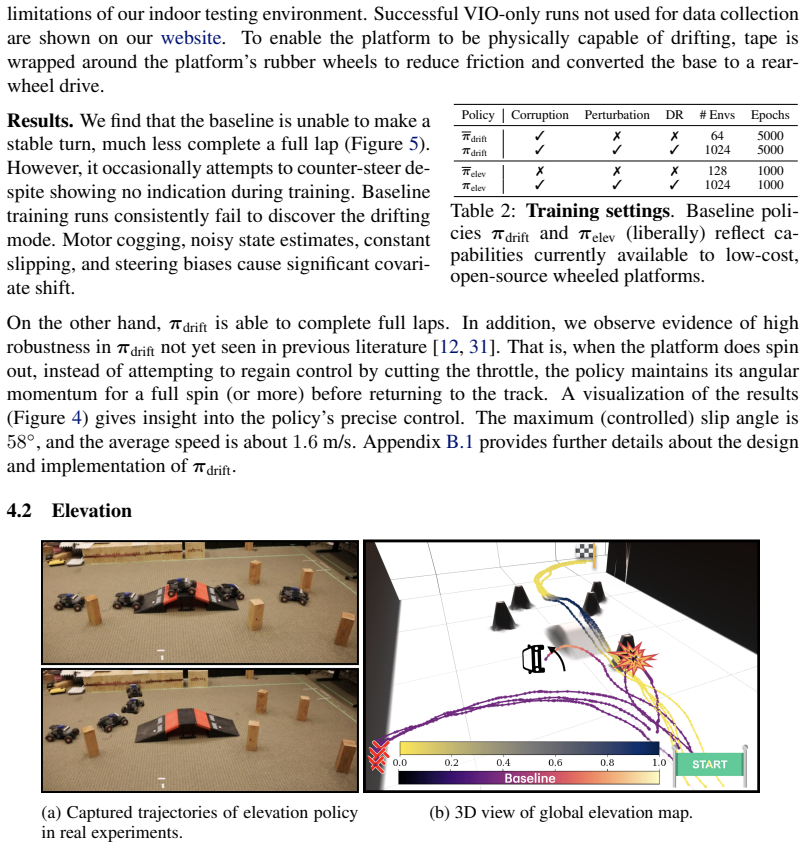
- [Section 4.2, Figure 6] The elevation policy evaluation is qualitative only. The text states that the baseline 'primarily deviates from any elevation features' and that the trained policy 'can both traverse the ramp safely and navigate through subsequent obstacles,' but no trial counts, success rates, or failure statistics are reported. Since elevation traversal is one of the three headline demonstrations, quantitative evaluation should be added or the claims should be scaled back to match the evidence.
minor comments (5)
- [Section B.1.4] The 'Turn-Left-Go-Right' reward explicitly rewards counter-steering when the angular velocity and steering command are opposite, so the drifting behavior is partly shaped by the reward design; the main text should acknowledge this when describing the behavior as discovered rather than engineered.
- [Section 4.1] The sentence 'Successful VIO-only runs not used for data collection' is missing punctuation and is easy to misread; please clarify whether the VIO-only runs were used for qualitative demonstration only.
- [Table 3] The header '# of Success / Trial' is ambiguous; it should read '# successes out of 5 trials' for each condition.
- [Algorithm 1] Lines 18-22 use a non-standard 'Do ... do While' pseudo-code structure; a conventional repeat-until loop with an explicit condition would be clearer.
- [References] References [39]-[43] contain incomplete bibliographic entries, with missing publication dates and venues; please complete them.
Circularity Check
No significant circularity: the paper is an empirical systems contribution; the 'zero-shot' claim is weakened by disclosed Sim2Real2Sim tuning and friction measurement, but no derivation reduces to its own inputs.
full rationale
This is an empirical systems paper, not a formal derivation, so the circularity analysis focuses on whether any claimed result is equivalent to its inputs by construction. The central claims are the three deployed policies and the 'first zero-shot drift' headline. No equation or fitted parameter is presented whose output is the conclusion by construction. The drifting reward includes shaped terms (Side-Slip, Turn-Left-Go-Right in Appendix B.1.4) that explicitly reward counter-steering and stable side-slip; this means the learned maneuver is partially induced by the reward, but the policy still has to discover and stabilize the dynamics, and the paper openly documents these rewards rather than presenting them as emergent predictions. The more serious issue is that the 'zero-shot' label is strained by the paper's own appendix: B.1.1 admits 'a few Sim2Real2Sim ... cycles were spent narrowing the randomized gain ranges for the throttle actuator settings,' and B.1.2 describes measuring friction with a spring scale on the deployment carpet and using it as the randomization midpoint, while Section 6 cautions that the released policies 'must be met with patience and an intent to iterate.' Those admissions weaken the zero-shot claim as an evidentiary matter, but they are real-world system identification and iterative debugging, not a circular reduction: the deployed policy is not the same object as the measured friction value, and success on the task is not logically entailed by the fitted parameters. Self-citations (HOUND [1], MuSHR [2], and the authors' earlier RL/off-road work) are used to document hardware and prior art, not as an unverified premise that forces the conclusion. No uniqueness theorem is imported from the authors, and no known result is merely renamed. Verdict: no significant circularity.
Assumptions & free parameters
free parameters (4)
- friction coefficient midpoint =
~0.4
- reward weights =
not reported
- domain randomization ranges =
friction 0.2-0.8 initially, narrowed; gain ranges narrowed
- image augmentation parameters =
aggressive color jitter, Gaussian blur (not quantified)
assumptions (4)
- domain assumption Isaac Lab simulation is a sufficiently faithful model of the HOUND and MuSHR platforms for zero-shot policy transfer.
- domain assumption Motion capture provides ground-truth state estimates used in evaluation and in visual policy observations.
- domain assumption Grayscale black/white tile task is a representative visual navigation task.
- domain assumption Hand-designed reward functions capture the intended task objectives.
Cite this review
Pith. "Pith review of Wheeled Lab: Modern Sim2Real for Low-cost, Open-source Wheeled Robotics." pith.science (2026). https://pith.science/paper/CPBS3KET
@misc{pith2026250207380,
  author       = {Pith},
  title        = {Pith review of: Wheeled Lab: Modern Sim2Real for Low-cost, Open-source Wheeled Robotics},
  year         = {2026},
  howpublished = {\url{https://pith.science/paper/CPBS3KET}},
  note         = {Machine review of arXiv:2502.07380}
}
read the original abstract
Reinforcement Learning (RL) has been pivotal in recent robotics milestones and is poised to play a prominent role in the future. However, these advances can rely on proprietary simulators, expensive hardware, and a daunting range of tools and skills. As a result, broader communities are disconnecting from the state-of-the-art; education curricula are poorly equipped to teach indispensable modern robotics skills involving hardware, deployment, and iterative development. To address this gap between the broader and scientific communities, we contribute Wheeled Lab, an ecosystem which integrates accessible, open-source wheeled robots with Isaac Lab, an open-source robot learning and simulation framework, that is widely adopted in the state-of-the-art. To kickstart research and education, this work demonstrates three state-of-the-art zero-shot policies for small-scale RC cars developed through Wheeled Lab: controlled drifting, elevation traversal, and visual navigation. The full stack, from hardware to software, is low-cost and open-source. Videos and additional materials can be found at: https://uwrobotlearning.github.io/WheeledLab/
Figures


Figures from the paper (5 more)




Reference graph
Works this paper leans on
-
[1]
S. Talia, M. Schmittle, A. Lambert, A. Spitzer, C. Mavrogiannis, and S. S. Srinivasa. Demonstrating HOUND: A Low-cost Research Platform for High-speed Off-road Underactu- ated Nonholonomic Driving, July 2024. URL http://arxiv.org/abs/2311.11199. arXiv:2311.11199 [cs]
work page Pith review arXiv 2024
-
[2]
S. S. Srinivasa, P. Lancaster, J. Michalove, M. Schmittle, C. Summers, M. Rockett, R. Scalise, J. R. Smith, S. Choudhury, C. Mavrogiannis, and F. Sadeghi. MuSHR: A Low-Cost, Open- Source Robotic Racecar for Education and Research, Dec. 2023. URL http://arxiv. org/abs/1908.08031. arXiv:1908.08031 [cs]
arXiv 2023
-
[3]
M. O’Kelly, H. Zheng, D. Karthik, and R. Mangharam. F1TENTH: An Open-source Evaluation Environment for Continuous Control and Reinforcement Learning. In Proceed- ings of the NeurIPS 2019 Competition and Demonstration Track , pages 77–89. PMLR, Aug. 2020. URL https://proceedings.mlr.press/v123/o-kelly20a.html. ISSN: 2640-3498
work page 2019
-
[4]
M. Mittal, C. Yu, Q. Yu, J. Liu, N. Rudin, D. Hoeller, J. L. Yuan, R. Singh, Y . Guo, H. Mazhar, A. Mandlekar, B. Babich, G. State, M. Hutter, and A. Garg. Orbit: A Unified Simulation Framework for Interactive Robot Learning Environments. IEEE Robotics and Automation Letters, 8(6):3740–3747, June 2023. ISSN 2377-3766, 2377-3774. doi:10.1109/LRA.2023. 3270...
arXiv 2023
-
[5]
T. Miki, J. Lee, J. Hwangbo, L. Wellhausen, V . Koltun, and M. Hutter. Learning robust per- ceptive locomotion for quadrupedal robots in the wild.Science Robotics, 7(62):eabk2822, Jan
-
[6]
D. Hoeller, N. Rudin, D. Sako, and M. Hutter. ANYmal parkour: Learning agile nav- igation for quadrupedal robots. Science Robotics , 9(88):eadi7566, Mar. 2024. doi:10. 1126/scirobotics.adi7566. URL https://www.science.org/doi/full/10.1126/ scirobotics.adi7566. Publisher: American Association for the Advancement of Sci- ence
work page 2024
-
[7]
E. Kaufmann, L. Bauersfeld, A. Loquercio, M. M ¨uller, V . Koltun, and D. Scaramuzza. Champion-level drone racing using deep reinforcement learning. Nature, 620(7976):982– 987, Aug. 2023. ISSN 1476-4687. doi:10.1038/s41586-023-06419-4. URL https: //www.nature.com/articles/s41586-023-06419-4 . Publisher: Nature Pub- lishing Group
- [8]
Show all 61 references
-
[9]
Huang, R
K. Huang, R. Rana, A. Spitzer, G. Shi, and B. Boots. DATT: Deep Adaptive Trajectory Track- ing for Quadrotor Control, Dec. 2023. URL http://arxiv.org/abs/2310.09053. arXiv:2310.09053 [cs]
2023 arXiv
-
[10]
Q. Liao, B. Zhang, X. Huang, X. Huang, Z. Li, and K. Sreenath. Berkeley Humanoid: A Research Platform for Learning-based Control, July 2024. URL http://arxiv.org/ abs/2407.21781. arXiv:2407.21781 [cs]
2024 arXiv
-
[11]
T. V . Samak, C. V . Samak, S. Kandhasamy, V . Krovi, and M. Xie. AutoDRIVE: A Compre- hensive, Flexible and Integrated Digital Twin Ecosystem for Enhancing Autonomous Driving Research and Education. Robotics, 12(3):77, May 2023. ISSN 2218-6581. doi:10.3390/ 10 robotics1203007...
2023 arXiv
-
[12]
Williams, N
G. Williams, N. Wagener, B. Goldfain, P. Drews, J. M. Rehg, B. Boots, and E. A. Theodorou. Information theoretic MPC for model-based reinforcement learning. In 2017 IEEE Interna- tional Conference on Robotics and Automation (ICRA) , pages 1714–1721, May 2017. doi: 10.1109/ICRA...
2017
-
[13]
T. Han, A. Liu, A. Li, A. Spitzer, G. Shi, and B. Boots. Model Predictive Control for Aggressive Driving Over Uneven Terrain, June 2024. URLhttp://arxiv.org/abs/2311.12284. arXiv:2311.12284 [cs]
2024 arXiv
-
[14]
T. Han, S. Talia, R. Panicker, P. Shah, N. Jawale, and B. Boots. Dynamics Models in the Ag- gressive Off-Road Driving Regime, May 2024. URL http://arxiv.org/abs/2405. 16487. arXiv:2405.16487 [cs]
2024 arXiv
-
[15]
Datar, C
A. Datar, C. Pan, M. Nazeri, and X. Xiao. Toward Wheeled Mobility on Vertically Challenging Terrain: Platforms, Datasets, and Algorithms. In 2024 IEEE International Conference on Robotics and Automation (ICRA), pages 16322–16329, May 2024. doi:10.1109/ICRA57147. 2024.10610079....
2024
-
[16]
Horv ´ath, G
E. Horv ´ath, G. Ign ´eczi, N. Mark ´o, R. Krecht, and M. Unger. Teaching Aspects of ROS 2 and Autonomous Vehicles. Engineering Proceedings, 79(1):49, 2024. ISSN 2673-4591. doi: 10.3390/engproc2024079049. URL https://www.mdpi.com/2673-4591/79/1/49. Number: 1 Publisher: Multidi...
2024 doi
-
[17]
B. D. Evans, R. Trumpp, M. Caccamo, F. Jahncke, J. Betz, H. W. Jordaan, and H. A. Engel- brecht. Unifying F1TENTH Autonomous Racing: Survey, Methods and Benchmarks, Apr
-
[18]
Dosovitskiy, G
A. Dosovitskiy, G. Ros, F. Codevilla, A. Lopez, and V . Koltun. CARLA: An Open Ur- ban Driving Simulator. In Proceedings of the 1st Annual Conference on Robot Learn- ing, pages 1–16. PMLR, Oct. 2017. URL https://proceedings.mlr.press/v78/ dosovitskiy17a.html. ISSN: 2640-3498
2017
-
[19]
Brunnbauer, L
A. Brunnbauer, L. Berducci, A. Brandst ¨atter, M. Lechner, R. Hasani, D. Rus, and R. Grosu. Latent Imagination Facilitates Zero-Shot Transfer in Autonomous Racing, Feb. 2022. URL http://arxiv.org/abs/2103.04909. arXiv:2103.04909 [cs]
2022 arXiv
-
[20]
Hamilton, P
N. Hamilton, P. Musau, D. M. Lopez, and T. T. Johnson. Zero-Shot Policy Transfer in Autonomous Racing: Reinforcement Learning vs Imitation Learning. In 2022 IEEE In- ternational Conference on Assured Autonomy (ICAA) , pages 11–20, Mar. 2022. doi:10. 1109/ICAA52185.2022.00011. ...
2022
-
[21]
X. Cai, J. Queeney, T. Xu, A. Datar, C. Pan, M. Miller, A. Flather, P. R. Osteen, N. Roy, X. Xiao, and J. P. How. PIETRA: Physics-Informed Evidential Learning for Traversing Out- of-Distribution Terrain. IEEE Robotics and Automation Letters , pages 1–8, 2025. ISSN 2377-3766. d...
2025
-
[22]
Deitke, W
M. Deitke, W. Han, A. Herrasti, A. Kembhavi, E. Kolve, R. Mottaghi, J. Salvador, D. Schwenk, E. VanderBilt, M. Wallingford, L. Weihs, M. Yatskar, and A. Farhadi. RoboTHOR: An Open Simulation-to-Real Embodied AI Platform. In 2020 IEEE/CVF Conference on Com- puter Vision and Pat...
2020
-
[23]
Balaji, S
B. Balaji, S. Mallya, S. Genc, S. Gupta, L. Dirac, V . Khare, G. Roy, T. Sun, Y . Tao, B. Townsend, E. Calleja, S. Muralidhara, and D. Karuppasamy. DeepRacer: Au- tonomous Racing Platform for Experimentation with Sim2Real Reinforcement Learn- ing. In 2020 IEEE International Co...
2020
-
[24]
Salimpour, J
S. Salimpour, J. Pe ˜na-Queralta, D. Paez-Granados, J. Heikkonen, and T. Westerlund. Sim- to-Real Transfer for Mobile Robots with Reinforcement Learning: from NVIDIA Isaac Sim to Gazebo and Real ROS 2 Robots, Jan. 2025. URL http://arxiv.org/abs/2501. 02902. arXiv:2501.02902 [cs]
2025 arXiv
-
[25]
Samak, T
C. Samak, T. Samak, and V . Krovi. Towards Sim2Real Transfer of Autonomy Algorithms using AutoDRIVE Ecosystem. IFAC-PapersOnLine, 56(3):277–282, Jan. 2023. ISSN 2405-
2023
-
[26]
W. Xiao, H. Xue, T. Tao, D. Kalaria, J. M. Dolan, and G. Shi. AnyCar to Anywhere: Learning Universal Dynamics Model for Agile and Adaptive Mobility, Sept. 2024. URL http:// arxiv.org/abs/2409.15783. arXiv:2409.15783 [cs]
2024 arXiv
-
[27]
Cutler and J
M. Cutler and J. P. How. Autonomous drifting using simulation-aided reinforcement learning. In 2016 IEEE International Conference on Robotics and Automation (ICRA) , pages 5442– 5448, Stockholm, Sweden, May 2016. IEEE. ISBN 978-1-4673-8026-3. doi:10.1109/ICRA. 2016.7487756. UR...
2016
-
[28]
B. D. Evans, H. W. Jordaan, and H. A. Engelbrecht. Comparing deep reinforcement learning architectures for autonomous racing. Machine Learning with Applications , 14:100496, Dec
-
[29]
Gonzales, F
J. Gonzales, F. Zhang, K. Li, and F. Borrelli. Autonomous drifting with onboard sensors. In Advanced Vehicle Control. CRC Press, 2016. ISBN 978-1-315-26528-5. Num Pages: 6
2016
-
[30]
P. Cai, X. Mei, L. Tai, Y . Sun, and M. Liu. High-Speed Autonomous Drifting With Deep Reinforcement Learning. IEEE Robotics and Automation Letters, 5(2):1247–1254, Apr. 2020. ISSN 2377-3766. doi:10.1109/LRA.2020.2967299. URL https://ieeexplore.ieee. org/document/8961997/?arnum...
2020
-
[31]
Djeumou, M
F. Djeumou, M. Thompson, M. Suminaka, and J. Subosits. Reference-Free Formula Drift with Reinforcement Learning: From Driving Data to Tire Energy-Inspired, Real-World Policies, Oct. 2024. URL http://arxiv.org/abs/2410.20990. arXiv:2410.20990 [cs]
2024 arXiv
-
[32]
G. Chen, X. Zhao, Z. Gao, and M. Hua. Dynamic Drifting Control for General Path Tracking of Autonomous Vehicles. IEEE Transactions on Intelligent Vehicles , 8(3):2527–2537, Mar
-
[33]
J. Frey, M. Patel, D. Atha, J. Nubert, D. Fan, A. Agha, C. Padgett, P. Spieler, M. Hutter, and S. Khattak. RoadRunner – Learning Traversability Estimation for Autonomous Off-road Driving, Aug. 2024. URL http://arxiv.org/abs/2402.19341. arXiv:2402.19341 [cs]. 12
2024 arXiv
-
[34]
Gibson, B
J. Gibson, B. Vlahov, D. Fan, P. Spieler, D. Pastor, A.-a. Agha-mohammadi, and E. A. Theodorou. A Multi-step Dynamics Modeling Framework For Autonomous Driving In Multiple Environments, May 2023. URL http://arxiv.org/abs/2305.02241. arXiv:2305.02241 [cs]
2023 arXiv
-
[35]
Stachowicz, D
K. Stachowicz, D. Shah, A. Bhorkar, I. Kostrikov, and S. Levine. FastRLAP: A System for Learning High-Speed Driving via Deep RL and Autonomous Practicing. In Proceedings of The 7th Conference on Robot Learning, pages 3100–3111. PMLR, Dec. 2023. URL https: //proceedings.mlr.pre...
2023
-
[36]
T. Xu, C. Pan, and X. Xiao. Reinforcement Learning for Wheeled Mobility on Ver- tically Challenging Terrain. In 2024 IEEE International Symposium on Safety Se- curity Rescue Robotics (SSRR) , pages 125–130, Nov. 2024. doi:10.1109/SSRR62954. 2024.10770034. URL https://ieeexplor...
2024
-
[37]
K. Kang, S. Belkhale, G. Kahn, P. Abbeel, and S. Levine. Generalization through Simulation: Integrating Simulated and Real Data into Deep Reinforcement Learning for Vision-Based Au- tonomous Flight. In 2019 International Conference on Robotics and Automation (ICRA), pages 6008...
2019
-
[38]
Z. Yuan, T. Wei, S. Cheng, G. Zhang, Y . Chen, and H. Xu. Learning to Manipulate Anywhere: A Visual Generalizable Framework For Reinforcement Learning, Oct. 2024. URL http: //arxiv.org/abs/2407.15815. arXiv:2407.15815 [cs]
2024 arXiv
-
[39]
doi:10.1109/TIV .2023.3235007
ISSN 2379-8904. doi:10.1109/TIV .2023.3235007. URL https://ieeexplore. ieee.org/document/10011537/?arnumber=10011537. Conference Name: IEEE Transactions on Intelligent Vehicles
2023
-
[40]
URL https://agilityrobotics.com/content/ crossing-sim2real-gap-with-isaaclab
Crossing the Sim2Real Gap With NVIDIA Isaac Lab, . URL https://agilityrobotics.com/content/ crossing-sim2real-gap-with-isaaclab
-
[41]
URL https://support.bostondynamics.com/s/article/ Get-Started-with-Reinforcement-Learning-for-Spot-49966
Get Started with Reinforcement Learning for Spot, . URL https://support.bostondynamics.com/s/article/ Get-Started-with-Reinforcement-Learning-for-Spot-49966
-
[42]
URL https://fieldai.com/news/ field-ai-nvidia-partnership
NVIDIA Isaac Lab Blog, . URL https://fieldai.com/news/ field-ai-nvidia-partnership
-
[43]
URL https://menteebot.com/blog/ #shopping-companion-2024
MenteeBot, . URL https://menteebot.com/blog/ #shopping-companion-2024
2024
-
[44]
Y . J. Ma, W. Liang, G. Wang, D.-A. Huang, O. Bastani, D. Jayaraman, Y . Zhu, L. Fan, and A. Anandkumar. Eureka: Human-Level Reward Design via Coding Large Language Models, Apr. 2024. URL http://arxiv.org/abs/2310.12931. arXiv:2310.12931 [cs]
2024 arXiv
-
[45]
S. Tao, F. Xiang, A. Shukla, Y . Qin, X. Hinrichsen, X. Yuan, C. Bao, X. Lin, Y . Liu, T.-k. Chan, Y . Gao, X. Li, T. Mu, N. Xiao, A. Gurha, Z. Huang, R. Calandra, R. Chen, S. Luo, and H. Su. ManiSkill3: GPU Parallelized Robotics Simulation and Rendering for Generalizable Embo...
2024 arXiv
-
[46]
Technologies
X. Technologies. 1X Technologies | Safe, Intelligent Humanoids. URL https://www.1x. tech/
-
[47]
T. Han, Y . Bao, B. Mehta, G. Guo, A. Vishwakarma, E. Kang, S. Jung, R. Scalise, J. Zhou, B. Xu, and B. Boots. Model Predictive Adversarial Imitation Learning for Planning from Ob- servation, July 2025. URL http://arxiv.org/abs/2507.21533. arXiv:2507.21533 [cs]
2025
-
[48]
Schulman, F
J. Schulman, F. Wolski, P. Dhariwal, A. Radford, and O. Klimov. Proximal Policy Op- timization Algorithms, Aug. 2017. URL http://arxiv.org/abs/1707.06347. arXiv:1707.06347
2017 arXiv
-
[49]
J. Lee, J. Hwangbo, L. Wellhausen, V . Koltun, and M. Hutter. Learning quadrupedal lo- comotion over challenging terrain. Science Robotics , 5(47):eabc5986, Oct. 2020. doi: 10.1126/scirobotics.abc5986. URL https://www.science.org/doi/10.1126/ scirobotics.abc5986. Publisher: Am...
2020 doi
-
[50]
Acosta, S
M. Acosta, S. Kanarachos, and M. E. Fitzpatrick. A Hybrid Hierarchical Rally Driver Model for Autonomous Vehicle Agile Maneuvering on Loose Surfaces:. In Proceedings of the 14th International Conference on Informatics in Control, Automation and Robotics , pages 216–225, Madrid...
2017 doi
-
[51]
S. Jung, J. Lee, X. Meng, B. Boots, and A. Lambert. V-STRONG: Visual Self-Supervised Traversability Learning for Off-road Navigation. In 2024 IEEE International Conference on Robotics and Automation (ICRA) , pages 1766–1773, May 2024. doi:10.1109/ICRA57147. 2024.10611227. URL ...
2024
-
[52]
Y . D. V . Yasuda, L. E. G. Martins, and F. A. M. Cappabianco. Autonomous Visual Navigation for Mobile Robots: A Systematic Literature Review. ACM Computing Surveys, 53(1):1–34, Jan. 2021. ISSN 0360-0300, 1557-7341. doi:10.1145/3368961. URL https://dl.acm. org/doi/10.1145/3368961
2021 doi
-
[53]
Y . Yang, G. Shi, C. Lin, X. Meng, R. Scalise, M. G. Castro, W. Yu, T. Zhang, D. Zhao, J. Tan, and B. Boots. Agile Continuous Jumping in Discontinuous Terrains, Sept. 2024. URL http://arxiv.org/abs/2409.10923. arXiv:2409.10923 [cs]. 13
2024 arXiv
-
[54]
Sim2Real2Sim
K. Bousmalis, A. Irpan, P. Wohlhart, Y . Bai, M. Kelcey, M. Kalakrishnan, L. Downs, J. Ibarz, P. Pastor, K. Konolige, S. Levine, and V . Vanhoucke. Using Simulation and Do- main Adaptation to Improve Efficiency of Deep Robotic Grasping. In 2018 IEEE Interna- tional Conference ...
2018
-
[60]
S. Choi, S. Jung, H. Yun, J. T. Kim, S. Kim, and J. Choo. RobustNet: Improving Domain Generalization in Urban-Scene Segmentation via Instance Selective Whitening. pages 11580–11590, 2021. URL https://openaccess.thecvf.com/content/ CVPR2021/html/Choi_RobustNet_Improving_Domain_...
2021
- [2019]
-
[2020]
ISBN 978-1-72817-168-5
IEEE. ISBN 978-1-72817-168-5. doi:10.1109/CVPR42600.2020.00323. URL https: //ieeexplore.ieee.org/document/9157346/. 11
2020
-
[2022]
URL https://www.science.org/doi/abs/ 10.1126/scirobotics.abk2822
doi:10.1126/scirobotics.abk2822. URL https://www.science.org/doi/abs/ 10.1126/scirobotics.abk2822. Publisher: American Association for the Advance- ment of Science
-
[2023]
doi:10.1016/j.mlwa.2023.100496
ISSN 26668270. doi:10.1016/j.mlwa.2023.100496. URL https://linkinghub. elsevier.com/retrieve/pii/S266682702300049X
2023
- [2024]
-
[8963]
URL https://www.sciencedirect.com/ science/article/pii/S2405896323023704
doi:10.1016/j.ifacol.2023.12.037. URL https://www.sciencedirect.com/ science/article/pii/S2405896323023704
2023 doi
Reviewed August 8, 2026 · model on record in the stance chip above.
Discussion (0). Continue with ORCID to comment.