REVIEW 4 major objections 5 minor 33 references
Robotic In-Hand Manipulation for Large-Range Precise Object Movement: The RGMC Champion Solution
T0 review · 4 major / 5 minor · reviewed 2026-08-08 · deepseek-v4-flash
Pith's one-line read This paper claims that precise, large-range in-grasp object movement can be achieved by a kinematic optimizer that fixes fingertip positions, allows full rolling, and closes the loop with replanning—with no object geometry or training.
desk verdict A useful, honest systems paper that extends relaxed-rigidity optimization by allowing all-fingertip rolling; the simplified contact model is a real limitation but the closed-loop empirical results carry the claim. read the letter →
The pith
A machine-rendered reading of the paper's core claim, the machinery that carries it, and where it could break.
The reading
What carries the argument
The load-bearing object is the cost $J = J_{\text{object}} + J_{\text{finger}} + J_{\text{joint}}$, where $J_{\text{object}}$ penalizes the terminal pose error via the weighted SE(3) distance $d(T_1,T_2,W)$ with error $e=[p_e; r_e]$, $J_{\text{finger}}$ penalizes changes in each fingertip's pose relative to the object frame with orientation weights near zero, and $J_{\text{joint}}$ regularizes the joint trajectory. The constant-stable-grasp requirement is replaced by the surrogate 'fingertip positions fixed in the object frame', which ignores rolling-induced contact migration and is justified by an assumption of smooth, low-curvature surfaces and quasi-static motion. Analytic gradients come from perturbing the SE(3) pose, using the left Jacobian of SO(3) and a relative Jacobian between fingertip and object frames; the non-convex problem is solved sequentially with SLSQP. A closed-loop scheme re-plans and re-executes until planned error, replanning count, or time budget is met.
What would settle it
Measure fingertip contact migration during a 40-waypoint closed-loop run, for example with a tactile array or a high-speed camera; if the accumulated contact migration exceeds the hemispherical fingertip radius, the fixed-position surrogate no longer predicts the actual motion. Alternatively, run the identical pipeline on a small-radius sphere (about 2 cm radius) with the same replanning cap: if the object drops or average execution error grows well beyond the reported 5 mm, the low-curvature premise is falsified.
Extended reading notes
Core claim
The paper's central claim is that in-grasp object movement—moving an object's pose using only finger motion under a constant stable grasp—can be solved by a geometry-free kinematic trajectory optimizer. The constant-grasp requirement is reduced to a surrogate: keep each fingertip's position fixed in the object frame, but allow all fingertips to roll. Assigning zero orientation weight in the fingertip cost makes rolling free, and optimizing the object pose as a decision variable frees the thumb from the rigid-contact assumption that limited prior relaxed-rigidity approaches. Closed-loop replanning from the current measured state to the goal compensates for the rolling simplification, and returning the fingers to the initial grasp between waypoints preserves long-horizon robustness. On the RGMC task this yields average execution errors near 5 mm over 40 continuous waypoints inside a 5×5×5 cm cube, on both the known cylinder and novel objects, without using object geometry.
Load-bearing premise
The approach assumes that ignoring fingertip rolling and contact migration—treating a stable grasp as fixed fingertip positions in the object frame—still produces the planned motion, which holds only if the object surface is smooth and low-curvature and the motion is quasi-static.
Editorial extensions
If this is right
- Allowing rolling at every fingertip, rather than keeping the thumb contact rigid, enlarges the object's reachable space and improves both planned and executed accuracy compared with the rigid-thumb baseline.
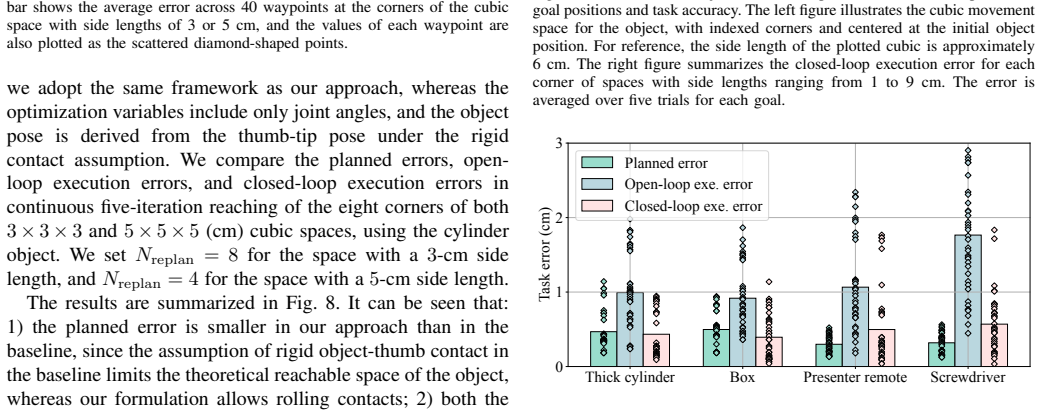
- Closed-loop replanning roughly halves execution error, from about 10 mm open-loop to about 5 mm, and keeps errors stable across 40 consecutive waypoints when the replanning cap is moderate.
- The same pipeline, with no object model, transfers to novel everyday objects—thick cylinder lid, box, presenter remote, and screwdriver—with average errors around 5 mm, even though high curvature and weight increase error.
- Accuracy degrades gracefully with distance: sub-millimeter errors at 1 cm cube corners, and roughly 2 cm average error at the extremes of a 9×9×9 cm space, showing the planner exploits the fingers' workspace.
- Excessive replanning degrades contact quality, so the competition strategy used a conservative replanning cap in one run and an aggressive cap in the other to balance robustness and precision.
Reading between the lines
- Editorial extension: the fixed-fingertip-position surrogate could serve as a cheap warm-start or feasibility filter for contact-implicit or learning-based planners, because it produces joint-limit- and collision-respecting trajectories in seconds rather than the per-step cost of rigorous rolling models.
- Editorial extension: since the object cost can carry orientation weights, the formulation implies reachable pose goals with rotation; the paper demonstrates only three such goals, leaving full six-dimensional waypoint sequences as a natural open test.
- Editorial extension: the documented failure mode under excessive replanning suggests a closed-loop regulator that monitors contact quality (for instance by tactile sensing) could outperform the fixed replanning cap, an option the authors do not explore.
- Editorial extension: the screwdriver results, which required occasional manual grasp resets, hint that the low-curvature assumption is the method's boundary; a systematic sweep over surface curvature would quantify where the surrogate breaks.
Editorial analysis
A structured set of objections, weighed in public.
Referee Report
Summary. This paper presents a trajectory-optimization approach to in-grasp object movement for a multi-fingered hand. The method fixes only the fingertip positions in the object frame while allowing rolling contacts, adds a joint-space smoothness cost, and uses SLSQP with analytical gradients to plan full trajectories. A closed-loop scheme re-plans and re-executes until a target error, a replanning budget, or a time limit is reached, and the pipeline returns the fingers to the initial state between waypoints. The authors report winning the RGMC in-hand manipulation track, with average execution errors around 5 mm over 40 waypoints in a 5x5x5 cm cube on a known cylinder and on novel everyday objects, and they compare their approach with a modified re-implementation of a relaxed-rigidity baseline.
Significance. If the reported results hold, the paper shows that a simple, geometry-free kinematic optimizer can achieve practically useful precision and range for in-hand object movement, without pretraining or object models. The strengths include real-world validation on a physical hand, a competition win with externally recorded waypoints, open-source code, and detailed appendices on analytic gradients and variance. The main contribution over prior kinematic in-grasp work is the relaxation of the rigid-thumb-contact assumption, which plausibly enlarges the reachable space while keeping the optimization tractable. The empirical claims are valuable, but the current evidence for the comparative advantage over existing work is weakened by the modified baseline and by missing statistical detail in the central comparison figures.
major comments (4)
- [IV-D and Fig. 4] The pipeline described in Section IV-D returns the fingers to the initial state along the forward trajectory after each waypoint, and Appendix C.2 confirms that the object falls in the second iteration when this return is omitted. This means the reported 40-waypoint experiments are likely 40 out-and-back trials from the center of the cube rather than a continuous traversal from one waypoint directly to the next. The paper should state explicitly whether the object returns to the initial position between waypoints and, if so, reword claims such as 'continuously reach' and 'long-term robustness' so that they describe repeated departures from and returns to the center. This distinction is important for interpreting the difficulty and the validity of the large-range continuous movement claim.
- [V-C and Appendix F] The baseline implemented for comparison in Section V-C is not the original algorithm of Sundaralingam and Hermans but a modified re-implementation with three deliberate differences: no in-trajectory object-pose cost, joint velocity/movement limits treated as a soft penalty, and the same hyperparameters as the proposed method. These modifications could disadvantage the baseline, so the comparison in Fig. 8 does not by itself support the contribution claim that the proposed approach achieves a larger object reachable space while ensuring task accuracy compared with existing works. The authors should either use the original baseline implementation, justify that each modification is neutral or favors the baseline, or temper the comparative claim to be against this particular re-implementation.
- [V-C, Fig. 8] The central comparison between the proposed approach and the baseline in Fig. 8 reports only average errors over 40 waypoints without error bars or repeated-trial statistics. Appendix C.1 provides variance data for the proposed method, but no equivalent variance data are given for the baseline. Since the comparative improvement is a stated contribution, the paper should report repeated trials and error bars for both methods, or at least state clearly that the comparison is based on a single continuous run per condition and therefore should be interpreted as anecdotal.
- [IV-B and Appendix C.3] The contact simplification in Section IV-B fixes each fingertip center in the object frame and fully allows rolling, but it places no constraint that the actual contact point remains on the hemispherical fingertip cap. Appendix C.3 documents that with excessive replanning, unmodeled contact occurs between the object and non-spherical parts of the fingers, leading to significant slippage. Because maintaining a constant stable grasp is a central claim, the paper should provide quantitative evidence that for the reported 5 cm motions with the chosen replanning budgets, the contact points remain on the spherical caps (for example, from tracked fingertip-object contact positions or rolling-angle estimates), or explicitly qualify the constant-grasp guarantee as an empirical property of the closed-loop hardware system rather than a property guaranteed by the optimization formulation.
minor comments (5)
- [Section I] The introduction states that in-grasp manipulation can be achieved 'without altering the contact locations,' but Section IV-B explicitly allows rolling contacts that alter contact locations; the terminology should be made consistent, for example by referring to maintaining contact without breaking and re-making contacts.
- [Figs. 6, 7, 8, 10] The 'planned error' metric is the terminal pose error of the trajectory that the optimizer minimizes; presenting it as a task-performance benchmark is somewhat circular. Consider relabeling it as 'planned terminal error' and clarifying that it is an optimizer property, with closed-loop execution error being the actual task metric.
- [Fig. 7] The comparison of different Nreplan values in Fig. 7 shows averages over eight corners per iteration without error bars; the variability is visible in the scatter points but should be summarized, especially since the conclusion that Nreplan = 8 degrades accuracy in later iterations is based on these averages alone.
- [Eq. (5)] The collision constraint Fcollision(Qt) is described only as constraining distances between four critical points on the index and ring fingers; the exact definition of Fcollision and the critical points should be stated in the main text or referenced to a specific appendix location for reproducibility.
- [Table III] The pose-goal experiments in Appendix D report a single run for each of the three goals; the paper should state how many trials were performed and whether the reported position and orientation errors are representative, since the appendix elsewhere emphasizes trial-to-trial variability.
Circularity Check
No significant circularity: accuracy claims are execution measurements against external waypoints, and the planned-error metric is transparently the optimized objective rather than an empirical prediction.
full rationale
The derivation chain is self-contained. The trajectory optimization in Eqs. (2)-(5) directly minimizes the terminal pose distance d(W To,T, W To,d, Wo), and the paper reports this quantity only under the transparent label 'planned error' (Section V), not as an empirical prediction. The headline accuracy claims (average closed-loop error of about 5 mm on the cylinder and novel objects; Table II competition errors of 0.054 cm and 0.063 cm) are measured against externally supplied waypoints by an AprilTag tracker, so they do not reduce to the optimized cost. Open-loop and closed-loop execution errors are real-world measurements independent of the planning objective. No parameter is fitted to a subset of the reported waypoints and then renamed a prediction; the hand-tuned hyperparameters (Wo, Wf, lambda, Nreplan, T) are not the quantities claimed as results. The two self-citations ([20] and [31]) are used for related-work context and for an IK solver, respectively, and neither carries the central claim. The main limitation, that rolling is simplified to fixed fingertip positions in the object frame (Section IV-B) with Appendix C.3 documenting unmodeled contact under excessive replanning, is an acknowledged modeling gap rather than a circular reduction. The larger reachable space compared with the baseline is partly a mathematical consequence of relaxing the rigid-thumb constraint, but the paper supports it with open-loop and closed-loop execution errors, which are external benchmarks. No circular step meeting the quoted-evidence bar was found.
Assumptions & free parameters
free parameters (4)
- Cost weights W_o, W_f, lambda =
W_o = diag(10,10,10,0.01,0.01,0.0); W_f = diag(10,10,10,0.001,0.001,0.001); lambda = 4e-4 (full trajectory), 5e-3…
- Trajectory steps T =
T=3 for first plan, T=1 for replanning
- Replanning budget Nreplan =
4 (first competition run), 8 (second run)
- Initial grasp inset offset =
Not quantified in text
assumptions (5)
- domain assumption The object can be treated as rigid.
- domain assumption Motion is quasi-static with negligible inertial effects.
- domain assumption Object surfaces near contacts are smooth and low-curvature.
- ad hoc to paper A constant stable grasp can be approximated by holding each fingertip center fixed in the object frame.
- domain assumption The human-supplied initial grasp is stable and manipulable.
Cite this review
Pith. "Pith review of Robotic In-Hand Manipulation for Large-Range Precise Object Movement: The RGMC Champion Solution." pith.science (2026). https://pith.science/paper/KFJKHWGK
@misc{pith2026250207472,
  author       = {Pith},
  title        = {Pith review of: Robotic In-Hand Manipulation for Large-Range Precise Object Movement: The RGMC Champion Solution},
  year         = {2026},
  howpublished = {\url{https://pith.science/paper/KFJKHWGK}},
  note         = {Machine review of arXiv:2502.07472}
}
read the original abstract
In-hand manipulation using multiple dexterous fingers is a critical robotic skill that can reduce the reliance on large arm motions, thereby saving space and energy. This letter focuses on in-grasp object movement, which refers to manipulating an object to a desired pose through only finger motions within a stable grasp. The key challenge lies in simultaneously achieving high precision and large-range movements while maintaining a constant stable grasp. To address this problem, we propose a simple and practical approach based on kinematic trajectory optimization with no need for pretraining or object geometries, which can be easily applied to novel objects in real-world scenarios. Adopting this approach, we won the championship for the in-hand manipulation track at the 9th Robotic Grasping and Manipulation Competition (RGMC) held at ICRA 2024. Implementation details, discussion, and further quantitative experimental results are presented in this letter, which aims to comprehensively evaluate our approach and share our key takeaways from the competition. Supplementary materials including video and code are available at https://rgmc-xl-team.github.io/ingrasp_manipulation .
Figures


Figures from the paper (8 more)




Reference graph
Works this paper leans on
-
[1]
Trends and challenges in robot manipulation,
A. Billard and D. Kragic, “Trends and challenges in robot manipulation,” Science, vol. 364, no. 6446, p. eaat8414, 2019
2019
-
[2]
Hand– object configuration estimation using particle filters for dexterous in- hand manipulation,
K. Hang, W. G. Bircher, A. S. Morgan, and A. M. Dollar, “Hand– object configuration estimation using particle filters for dexterous in- hand manipulation,” Int. J. Robot. Res. , vol. 39, no. 14, pp. 1760–1774, 2020
work page 2020
-
[3]
Manipulation for self-identification, and self-identification for better manipulation,
——, “Manipulation for self-identification, and self-identification for better manipulation,” Sci. Robot., vol. 6, no. 54, p. eabe1321, 2021
work page 2021
-
[4]
J. T. Grace, P. Chanrungmaneekul, K. Hang, and A. M. Dollar, “Di- rect self-identification of inverse jacobians for dexterous manipulation through particle filtering,” in IEEE Int. Conf. Robot. Autom. IEEE, 2024, pp. 13 862–13 868
work page 2024
-
[5]
Relaxed-rigidity constraints: In- grasp manipulation using purely kinematic trajectory optimization,
B. Sundaralingam and T. Hermans, “Relaxed-rigidity constraints: In- grasp manipulation using purely kinematic trajectory optimization,” in Robotics: Science and Systems XIII , 2017
work page 2017
-
[6]
——, “Relaxed-rigidity constraints: kinematic trajectory optimization and collision avoidance for in-grasp manipulation,” Autonomous Robots, vol. 43, pp. 469–483, 2019
work page 2019
-
[7]
9th Robotic Grasping and Manipulation Competition
“9th Robotic Grasping and Manipulation Competition.” [Online]. Available: https://cse.usf.edu/∼yusun/rgmc/2024.html
work page 2024
-
[8]
Learning dexterous in-hand manipulation,
O. M. Andrychowicz, B. Baker, M. Chociej, R. Jozefowicz, B. McGrew, J. Pachocki, A. Petron, M. Plappert, G. Powell, A. Ray et al., “Learning dexterous in-hand manipulation,” Int. J. Robot. Res. , vol. 39, no. 1, pp. 3–20, 2020
work page 2020
Show all 33 references
-
[9]
General in-hand object rotation with vision and touch,
H. Qi, B. Yi, S. Suresh, M. Lambeta, Y . Ma, R. Calandra, and J. Malik, “General in-hand object rotation with vision and touch,” in Conf. Robot. Learn. PMLR, 2023, pp. 2549–2564
2023
-
[10]
Visual dexterity: In-hand reorientation of novel and complex object shapes,
T. Chen, M. Tippur, S. Wu, V . Kumar, E. Adelson, and P. Agrawal, “Visual dexterity: In-hand reorientation of novel and complex object shapes,” Sci. Robot., vol. 8, no. 84, p. eadc9244, 2023
2023
-
[11]
Learning a shape-conditioned agent for purely tactile in-hand manipulation of various objects,
J. Pitz, L. R ¨ostel, L. Sievers, D. Burschka, and B. B ¨auml, “Learning a shape-conditioned agent for purely tactile in-hand manipulation of various objects,” in IEEE/RSJ Int. Conf. Intell. Robots Syst. , 2024
2024
-
[12]
Dexterous in-hand manipulation of slender cylindrical objects through deep reinforcement learning with tactile sensing,
W. Hu, B. Huang, W. W. Lee, S. Yang, Y . Zheng, and Z. Li, “Dexterous in-hand manipulation of slender cylindrical objects through deep reinforcement learning with tactile sensing,” arXiv preprint arXiv:2304.05141, 2023
2023 arXiv
-
[13]
Dex- cap: Scalable and portable mocap data collection system for dexterous manipulation,
C. Wang, H. Shi, W. Wang, R. Zhang, L. Fei-Fei, and C. K. Liu, “Dex- cap: Scalable and portable mocap data collection system for dexterous manipulation,” in Robotics: Science and Systems (RSS) , 2024
2024
-
[14]
3d diffusion policy: Generalizable visuomotor policy learning via simple 3d representations,
Y . Ze, G. Zhang, K. Zhang, C. Hu, M. Wang, and H. Xu, “3d diffusion policy: Generalizable visuomotor policy learning via simple 3d representations,” in Robotics: Science and Systems (RSS) , 2024
2024
-
[15]
See to touch: Learning tactile dexterity through visual incentives,
I. Guzey, Y . Dai, B. Evans, S. Chintala, and L. Pinto, “See to touch: Learning tactile dexterity through visual incentives,” in IEEE Int. Conf. Robot. Autom., 2024, pp. 13 825–13 832
2024
-
[16]
Tra- jectotree: Trajectory optimization meets tree search for planning multi- contact dexterous manipulation,
C. Chen, P. Culbertson, M. Lepert, M. Schwager, and J. Bohg, “Tra- jectotree: Trajectory optimization meets tree search for planning multi- contact dexterous manipulation,” in IEEE/RSJ Int. Conf. Intell. Robots Syst., 2021, pp. 8262–8268
2021
-
[17]
Efficient object manipulation planning with monte carlo tree search,
H. Zhu, A. Meduri, and L. Righetti, “Efficient object manipulation planning with monte carlo tree search,” in IEEE/RSJ Int. Conf. Intell. Robots Syst., 2023, pp. 10 628–10 635
2023
-
[18]
Enhancing dexterity in robotic manipulation via hierarchical contact exploration,
X. Cheng, S. Patil, Z. Temel, O. Kroemer, and M. T. Mason, “Enhancing dexterity in robotic manipulation via hierarchical contact exploration,” IEEE Robot. Autom. Lett. , vol. 9, no. 1, pp. 390–397, 2024
2024
-
[19]
Global planning for contact-rich manipulation via local smoothing of quasi-dynamic contact models,
T. Pang, H. T. Suh, L. Yang, and R. Tedrake, “Global planning for contact-rich manipulation via local smoothing of quasi-dynamic contact models,” IEEE Trans. Robot. , 2023
2023
-
[20]
Contact-implicit model predictive control for dexterous in-hand manipulation: A long- horizon and robust approach,
Y . Jiang, M. Yu, X. Zhu, M. Tomizuka, and X. Li, “Contact-implicit model predictive control for dexterous in-hand manipulation: A long- horizon and robust approach,” in IEEE/RSJ Int. Conf. Intell. Robots Syst., 2024
2024
-
[21]
Complementarity-free multi-contact modeling and optimization for dexterous manipulation,
W. Jin, “Complementarity-free multi-contact modeling and optimization for dexterous manipulation,” arXiv preprint arXiv:2408.07855 , 2024
2024 arXiv
-
[22]
LEAP Hand: Low-cost, efficient, and anthropomorphic hand for robot learning,
K. Shaw, A. Agarwal, and D. Pathak, “LEAP Hand: Low-cost, efficient, and anthropomorphic hand for robot learning,” Robotics: Science and Systems (RSS), 2023
2023
-
[23]
Dextrous manipulation with multifingered robot hands includ- ing rolling and slipping of the fingertips,
H. Hartl, “Dextrous manipulation with multifingered robot hands includ- ing rolling and slipping of the fingertips,” Robotics Auton. Syst., vol. 14, no. 1, pp. 29–53, 1995
1995
-
[24]
Grasping and coordinated manipulation by a multifingered robot hand,
Z. Li, P. Hsu, and S. Sastry, “Grasping and coordinated manipulation by a multifingered robot hand,” Int. J. Robot. Res. , vol. 8, no. 4, pp. 33–50, 1989
1989
-
[25]
Multi-finger manipulation via trajectory optimization with differentiable rolling and geometric constraints,
F. Yang, T. Power, S. A. Marinovic, S. Iba, R. S. Zarrin, and D. Berenson, “Multi-finger manipulation via trajectory optimization with differentiable rolling and geometric constraints,” arXiv preprint arXiv:2408.13229, 2024
2024 arXiv
-
[26]
Essential Skill Sub-Track 2: In-Hand Manipulation
“Essential Skill Sub-Track 2: In-Hand Manipulation.” [Online]. Available: https://hangkaiyu.github.io/RGMC in hand manipulation subtrack.html
-
[27]
R. M. Murray, Z. Li, and S. S. Sastry, A Mathematical Introduction to Robotic Manipulation. CRC Press, 1994
1994
-
[28]
A software package for sequential quadratic programming,
D. Kraft, “A software package for sequential quadratic programming,” DLR German Aerospace Center — Institute for Flight Mechanics, Koln, Germany, Tech. Rep. DFVLR-FB 88-28, 1988
1988
-
[29]
T. D. Barfoot, State estimation for robotics . Cambridge University Press, 2024
2024
-
[30]
A more compact expression of relative jacobian based on individual manipulator jacobians,
R. S. Jamisola Jr and R. G. Roberts, “A more compact expression of relative jacobian based on individual manipulator jacobians,” Robotics Auton. Syst., vol. 63, pp. 158–164, 2015
2015
-
[31]
In-hand following of deformable linear objects using dexterous fingers with tactile sensing,
M. Yu, B. Liang, X. Zhang, X. Zhu, L. Sun, C. Wang, S. Song, X. Li, and M. Tomizuka, “In-hand following of deformable linear objects using dexterous fingers with tactile sensing,” in IEEE/RSJ Int. Conf. Intell. Robots Syst., 2024
2024
-
[32]
Benchmarking in-hand manipulation,
S. Cruciani, B. Sundaralingam, K. Hang, V . Kumar, T. Hermans, and D. Kragic, “Benchmarking in-hand manipulation,” IEEE Robot. Autom. Lett., vol. 5, no. 2, pp. 588–595, 2020. JOURNAL OF LATEX CLASS FILES 9 APPENDIX A ANALYTICAL GRADIENTS OF THE OPTIMIZATION In this section, we...
2020
-
[33]
we do not include the cost of in-trajectory object poses, JOURNAL OF LATEX CLASS FILES 13 whose references are obtained by linear interpolation between the start and goal object poses in theirs; 2) we treat the joint velocity/movement limits as a soft constraint (penalty) inst...
Reviewed August 8, 2026 · model on record in the stance chip above.
Discussion (0). Continue with ORCID to comment.