REVIEW 4 major objections 8 minor 2 cited by
PRVQL: Progressive Knowledge-guided Refinement for Robust Egocentric Visual Query Localization
T0 review · 4 major / 8 minor · reviewed 2026-08-08 · deepseek-v4-flash
Pith's one-line read Self-mined video cues lift egocentric query localization by 5 points.
desk verdict A solid, incremental EgoVQL SOTA with consistent gains and honest ablations, but the central 'knowledge guidance' story is under-verified—no oracle test of whether the self-mined knowledge is actually target-accurate. read the letter →
The pith
A machine-rendered reading of the paper's core claim, the machinery that carries it, and where it could break.
The reading
What carries the argument
The load-bearing mechanism is the progressive knowledge-guided refinement loop, composed of appearance knowledge generation (AKG), spatial knowledge generation (SKG), query feature refinement (QFR), and video feature refinement (VFR). AKG estimates target boxes with multi-scale anchors, keeps regions whose confidence exceeds a threshold, takes the top three, and runs RoIAlign on the current video features to form appearance knowledge. SKG forms spatial knowledge as a weighted sum of the cross-attention map and the interpolated diagonal of the masked self-attention map, reflecting where the target is. QFR injects appearance knowledge into the query via cross-attention, while VFR multiplies the spatial knowledge onto the initial video features with a residual term. This loop is what lets the model use its own improving predictions to sharpen features across stages.
What would settle it
Train PRVQL with AKG given ground-truth target boxes instead of its own predicted boxes; if validation tAP25 does not improve or even drops, the refinement is not actually driven by the learned knowledge. A cheaper check is to add noise to the confidence scores at inference and observe whether the reported 4–5 point gains disappear.
Extended reading notes
Core claim
The central claim is that PRVQL, a multi-stage progressive refinement framework, shows that target appearance and spatial knowledge mined directly from the video can serve as effective guidance for improving EgoVQL. In each non-final stage, AKG uses confidence scores predicted by the same network to select top target regions, extracts appearance knowledge via RoIAlign from the current video features, and feeds that knowledge through a cross-attention block to refine the query feature; SKG combines the cross-attention maps and the diagonal of the masked self-attention maps into a spatial knowledge map that modulates the initial video features with a residual connection. The refined features enter the next stage, generating better knowledge, and the final stage performs spatio-temporal prediction. The paper reports that this progressive loop yields the best Ego4D results on all four metrics, with tAP25 of 0.35 and stAP25 of 0.27 on validation and 0.37 and 0.28 on test, surpassing VQLoC by 4–5 percentage points. The paper also shows through ablations that appearance knowledge contributes more than spatial knowledge, and that three stages outperform one, two, and four stages.
Load-bearing premise
The load-bearing premise is that the model's own predicted confidence scores and target boxes are good enough to serve as knowledge: AKG and SKG both take their cues from the same network they are meant to improve, so incorrect predictions can be reinforced rather than corrected.
Editorial extensions
If this is right
- If PRVQL's central claim is correct, query-based localization in egocentric video can be improved by exploiting appearance and spatial cues already present in the video, not just the query crop.
- The reported gains imply that the model's confidence-based region selection, despite relying on the network's own predictions, yields useful appearance knowledge on the Ego4D benchmark.
- The stage ablation suggests that refinement saturates: three stages help, while a fourth stage degrades performance, so progressive refinement has a sweet spot rather than monotonically improving.
- The combination of AKG and SKG outperforms either alone, indicating that appearance and spatial knowledge carry complementary information for localization.
Reading between the lines
- Because AKG's knowledge source is the network's own confidence scores, a natural extension is to calibrate those scores or to verify regions with an external objectness signal; the paper does not test whether such verification would prevent error amplification.
- The paper's scale-wise comparison suggests the method's gains concentrate on medium and large objects while small objects remain difficult, so a testable extension is to add multi-scale feature pooling to AKG for small targets.
- The same progressive self-knowledge loop could transfer to other query-based tasks with a query-video appearance gap, such as spatio-temporal video grounding or one-shot object tracking, though the paper does not claim this.
Editorial analysis
A structured set of objections, weighed in public.
Referee Report
Summary. The paper proposes PRVQL, a multi-stage progressive framework for egocentric visual query localization (EgoVQL). At each non-final stage, an appearance knowledge generation (AKG) module mines high-confidence target regions from the model's own video-feature predictions and extracts their features via RoIAlign, while a spatial knowledge generation (SKG) module combines attention maps from cross-attention and masked self-attention blocks. These appearance and spatial knowledge signals are then used by query feature refinement (QFR) and video feature refinement (VFR) to update features for the next stage, with a final stage producing spatio-temporal localization predictions. Experiments on the Ego4D VQ2D benchmark report state-of-the-art results, e.g., tAP25 0.35 and stAP25 0.27 on validation and 0.37/0.28 on test, outperforming VQLoC by 4-5 points. Additional ablations study the contribution of AKG/SKG, number of stages, threshold, number of boxes, RoIAlign size, and several hyperparameters.
Significance. If the central claim holds, the paper makes a useful contribution: it is, to the authors' knowledge, the first EgoVQL method to explicitly mine target appearance and spatial knowledge from the video itself and use it to progressively refine query and video features. The framework is cleanly described, and the reported consistent gains over a strong baseline (VQLoC) across four metrics on both validation and test are encouraging. The release of code and models is a strength. However, the central mechanism is not directly validated: the 'knowledge' is generated by the model from its own predictions and attention maps, and the paper provides no oracle experiment, no metric for the accuracy of the selected regions, and no control for additional refinement depth. The supplementary small-object results (Table 11) show that PRVQL underperforms both CocoFormer and VQLoC on small objects, which tempers the robustness claim. With the requested controls, the contribution would be substantially stronger.
major comments (4)
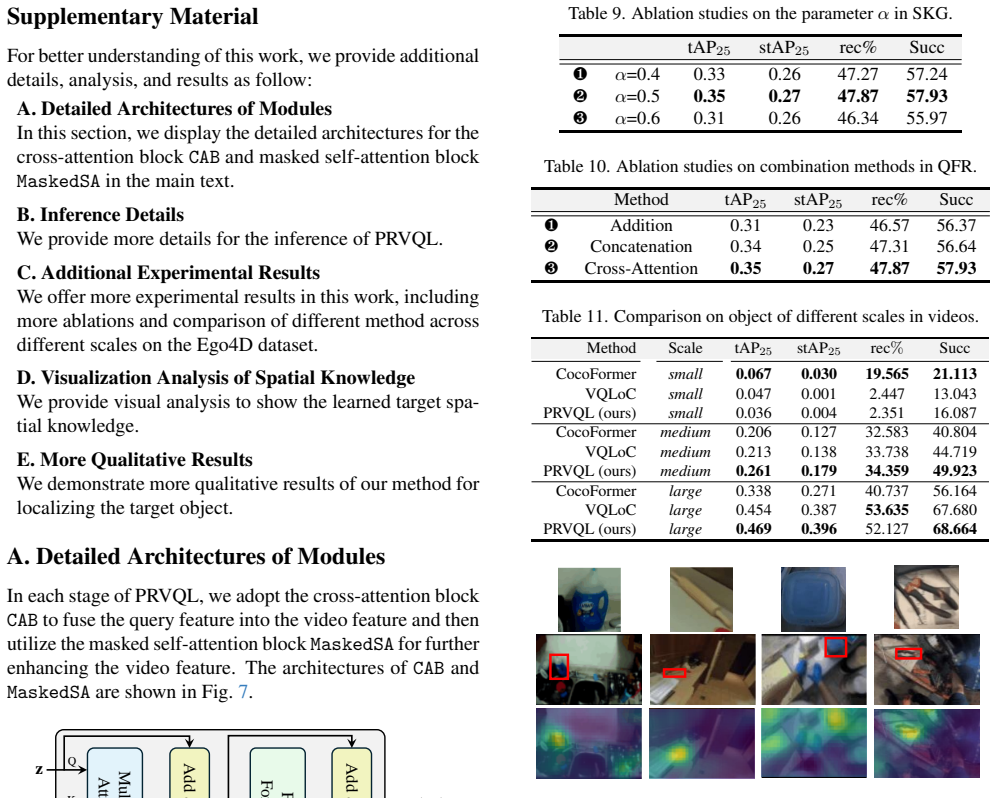
- [Sec. 3.2, Eqs. (9)-(10); Tables 4-8] The appearance knowledge K^a_k is mined from boxes B^top_k selected by the confidence scores C_k predicted by the same network that is being refined. If these boxes are inaccurate, the RoIAlign features in Eq. (10) are background features, and QFR in Eq. (13) injects non-target appearance into the query. The ablation tables show that adding AKG improves final metrics, but they do not establish that the content of the knowledge is target-accurate; the gain could come from the extra parameters, the RoIAlign pathway, or a training signal that tolerates noisy masks. Please provide an oracle experiment where AKG uses ground-truth boxes, and also report the IoU or precision of the selected boxes B^top_k against ground truth. This is necessary to support the paper's central claim that video-derived target knowledge drives the improvement.
- [Sec. 4.3, Table 5] The number-of-stages ablation increases K from 1 to 4, but each additional stage simultaneously adds both the knowledge modules (AKG/SKG) and additional cross-attention/masked self-attention processing. There is no control that iterates the base architecture for K=2 or K=3 without AKG/SKG. Without such a control, the observed gains in Table 5 cannot be attributed to the knowledge content; they may reflect simply the increased depth or number of refinement iterations. Please add a depth-matched baseline (K=2 and K=3 with the same CAB/MaskedSA blocks but no AKG/SKG) to isolate the effect of the knowledge.
- [Sec. 3.3 and Sec. 3.4, Eqs. (12)-(14)] There is a dimension mismatch in the VFR formulation. In Eq. (12), K^s_k is a combination of S_k (per-frame HW×HW cross-attention maps) and interpolated diagonal maps from T_k, so K^s_k has shape L×HW×HW per stage. In Eq. (14), K^s_k is applied as an elementwise mask to V_1, which has shape L×HW×C. Since the attention maps are matrices over spatial positions, not per-location mask weights, the product K^s_k ⊙ V_1 is not well-defined unless one first reduces K^s_k (e.g., taking its diagonal or mean over one axis). Please specify the exact reduction or reformulate VFR as an attention-like operation; as written, the central VFR equation cannot be implemented as stated.
- [Supplementary Table 11] The scale breakdown in the supplementary material shows that PRVQL performs substantially worse than both CocoFormer and VQLoC on small objects: tAP25 is 0.036 for PRVQL versus 0.067 for CocoFormer and 0.047 for VQLoC, and stAP25 is 0.004 versus 0.030 for CocoFormer. This directly contradicts the abstract's claim of 'largely surpasses other methods' and the robustness claim in Section 4.4, because small targets are common in egocentric video. The paper should either report this limitation prominently in the main text or provide an analysis and remedy (e.g., multi-scale features or higher-resolution inputs for small objects).
minor comments (8)
- [Abstract] The phrase 'Despite recent progressive, existing methods...' appears to be missing a noun; it should read 'Despite recent progress' or 'Despite recent progressive methods'.
- [Sec. 3.1, Overview paragraph] The text refers to 'Sec. 7' for the AKG module, but the AKG module is described in Sec. 3.2; the reference should be corrected.
- [Sec. 3.3, after Eq. (11)] 'elects' should be 'elements' in the sentence about extracting diagonal elements.
- [Sec. 4.1] The text says 'Ego4D validate test' and '50 epoches'; these should be 'validation set' and '50 epochs'.
- [Sec. 4.4] The qualitative description refers to 'video in (d)' twice; the second reference should be 'video in (e)'.
- [Supplementary Sec. E] The phrase 'with the hlep of target knowledge' contains a typo; it should be 'help'.
- [Related Work] In the progressive learning paragraph, 'sptio-temporal' should be 'spatio-temporal'.
- [Experiments] No error bars, repeated-run statistics, or significance tests are reported for any of the key comparisons in Tables 1, 2, and 4-10. Given that several ablation differences are small (e.g., 0.34 vs 0.35 tAP25 in Table 7), the paper should report variance over at least a few seeds or otherwise indicate the stability of the reported numbers.
Circularity Check
No significant circularity: PRVQL's self-generated knowledge is an internal, end-to-end-trained bootstrapping mechanism, and the claimed gains are benchmarked against external Ego4D results.
full rationale
PRVQL's central claim is empirical: adding AKG/SKG modules and progressive refinement stages improves Ego4D VQ2D metrics relative to published methods. The 'knowledge' in Eqs. (9)-(14) is generated internally by the same network (top-confidence boxes from Eq. (9), RoIAlign features from Eq. (10), and attention maps from Eqs. (11)-(12)) and then fed back through QFR/VFR. This is a self-referential bootstrapping architecture, not a derivation whose conclusion is assumed in its premise. The refinement is trained end-to-end against Ego4D ground-truth boxes and temporal scores via Eq. (15), and the final results are measured on an external benchmark. No target metric is a fitted parameter renamed as a prediction: hyperparameters such as K, tau, n, alpha, and beta are chosen on validation and fixed, and Tables 1-2 compare against independent baselines. The absence of an oracle analysis of the selected boxes and attention maps is a robustness or experimental-design limitation, but without an explicit reduction such as one equation equaling another by construction or a fitted value being relabeled as a prediction, it does not constitute circularity. There is also no load-bearing self-citation or imported uniqueness theorem; citations to VQLoC are for baseline architecture and prediction heads, not as proof of PRVQL's efficacy. Therefore no circular step is identified.
Assumptions & free parameters
free parameters (8)
- Number of stages K =
3
- AKG confidence threshold tau =
0.7
- Number of AKG target boxes n =
3
- SKG balance parameter alpha =
0.5
- VFR balance parameter beta =
0.1
- Loss weights lambda1 and lambda2 =
0.3 and 100
- RoIAlign feature size =
5
- Inference thresholds =
0.79 and 0.585
assumptions (4)
- domain assumption DINOv2 pretrained backbone provides a shared feature space for query and video frames.
- standard math Cross-attention and masked self-attention accurately capture target-related relations in first-person video.
- ad hoc to paper The model's own high-confidence region predictions and attention maps contain reliable target information.
- domain assumption Ego4D VQ2D annotations and metrics correctly measure localization performance.
Cite this review
Pith. "Pith review of PRVQL: Progressive Knowledge-guided Refinement for Robust Egocentric Visual Query Localization." pith.science (2026). https://pith.science/paper/D3PCRQB6
@misc{pith2026250207707,
  author       = {Pith},
  title        = {Pith review of: PRVQL: Progressive Knowledge-guided Refinement for Robust Egocentric Visual Query Localization},
  year         = {2026},
  howpublished = {\url{https://pith.science/paper/D3PCRQB6}},
  note         = {Machine review of arXiv:2502.07707}
}
read the original abstract
Egocentric visual query localization (EgoVQL) focuses on localizing the target of interest in space and time from first-person videos, given a visual query. Despite recent progressive, existing methods often struggle to handle severe object appearance changes and cluttering background in the video due to lacking sufficient target cues, leading to degradation. Addressing this, we introduce PRVQL, a novel Progressive knowledge-guided Refinement framework for EgoVQL. The core is to continuously exploit target-relevant knowledge directly from videos and utilize it as guidance to refine both query and video features for improving target localization. Our PRVQL contains multiple processing stages. The target knowledge from one stage, comprising appearance and spatial knowledge extracted via two specially designed knowledge learning modules, are utilized as guidance to refine the query and videos features for the next stage, which are used to generate more accurate knowledge for further feature refinement. With such a progressive process, target knowledge in PRVQL can be gradually improved, which, in turn, leads to better refined query and video features for localization in the final stage. Compared to previous methods, our PRVQL, besides the given object cues, enjoys additional crucial target information from a video as guidance to refine features, and hence enhances EgoVQL in complicated scenes. In our experiments on challenging Ego4D, PRVQL achieves state-of-the-art result and largely surpasses other methods, showing its efficacy. Our code, model and results will be released at https://github.com/fb-reps/PRVQL.
Figures


Figures from the paper (5 more)




Forward citations
Cited by 2 Pith papers
-
Online Episodic Memory Visual Query Localization with Egocentric Streaming Object Memory
The paper defines the online episodic-memory query task OVQ2D and shows ESOM, a detect-track-memorize-retrieve system, achieves only ~4% success on Ego4D, rising to 81.92% with oracle detection and tracking.
-
EgoHieraLoc: A Cortically Inspired Hierarchical Segmentation-Guided Framework for Egocentric Visual Query Localization
A unified 2D/3D visual query localization pipeline using SAM-guided parsing, a closed-form correlation filter, and a multiplicative semantic-geometric confidence weighting scheme reports state-of-the-art results on Ego4D-VQ.
Reference graph
Works this paper leans on
-
[1]
Fully-convolutional siamese networks for object tracking
Luca Bertinetto, Jack Valmadre, Joao F Henriques, Andrea Vedaldi, and Philip HS Torr. Fully-convolutional siamese networks for object tracking. In ECCVW, 2016. 2
work page 2016
-
[2]
Cascade r-cnn: Delving into high quality object detection
Zhaowei Cai and Nuno Vasconcelos. Cascade r-cnn: Delving into high quality object detection. In CVPR, 2018. 3
work page 2018
-
[3]
Progressively guided alternate refinement network for rgb-d salient object detection
Shuhan Chen and Yun Fu. Progressively guided alternate refinement network for rgb-d salient object detection. In ECCV, 2020. 3
work page 2020
-
[4]
Seqtrack: Sequence to sequence learning for visual ob- ject tracking
Xin Chen, Houwen Peng, Dong Wang, Huchuan Lu, and Han Hu. Seqtrack: Sequence to sequence learning for visual ob- ject tracking. In CVPR, 2023. 2
work page 2023
-
[5]
Masked-attention mask transformer for universal image segmentation
Bowen Cheng, Ishan Misra, Alexander G Schwing, Alexan- der Kirillov, and Rohit Girdhar. Masked-attention mask transformer for universal image segmentation. In CVPR,
-
[6]
Transvg: End-to-end visual ground- ing with transformers
Jiajun Deng, Zhengyuan Yang, Tianlang Chen, Wengang Zhou, and Houqiang Li. Transvg: End-to-end visual ground- ing with transformers. In ICCV, 2021. 2
work page 2021
-
[7]
An image is worth 16x16 words: Transformers for image recognition at scale
Alexey Dosovitskiy, Lucas Beyer, Alexander Kolesnikov, Dirk Weissenborn, Xiaohua Zhai, Thomas Unterthiner, Mostafa Dehghani, Matthias Minderer, Georg Heigold, Syl- vain Gelly, Jakob Uszkoreit, and Neil Houlsby. An image is worth 16x16 words: Transformers for image recognition at scale. In ICLR, 2021. 6
2021
-
[8]
Siamese cascaded region pro- posal networks for real-time visual tracking
Heng Fan and Haibin Ling. Siamese cascaded region pro- posal networks for real-time visual tracking. InCVPR, 2019. 3
work page 2019
Show all 38 references
-
[9]
Ego4d: Around the world in 3,000 hours of egocentric video
Kristen Grauman, Andrew Westbury, Eugene Byrne, Zachary Chavis, Antonino Furnari, Rohit Girdhar, Jackson Hamburger, Hao Jiang, Miao Liu, Xingyu Liu, et al. Ego4d: Around the world in 3,000 hours of egocentric video. In CVPR, 2022. 1, 2, 6, 7
2022
-
[10]
Context-guided spatio-temporal video grounding
Xin Gu, Heng Fan, Yan Huang, Tiejian Luo, and Libo Zhang. Context-guided spatio-temporal video grounding. In CVPR,
-
[11]
Mask r-cnn
Kaiming He, Georgia Gkioxari, Piotr Doll ´ar, and Ross Gir- shick. Mask r-cnn. In ICCV, 2017. 5, 8
2017
-
[12]
One-shot object detection with co-attention and co-excitation
Ting-I Hsieh, Yi-Chen Lo, Hwann-Tzong Chen, and Tyng- Luh Liu. One-shot object detection with co-attention and co-excitation. In NeurIPS, 2019. 2
2019
-
[13]
Progressive semantic segmentation
Chuong Huynh, Anh Tuan Tran, Khoa Luu, and Minh Hoai. Progressive semantic segmentation. In CVPR, 2021. 3
2021
-
[14]
Single-stage visual query localization in egocen- tric videos
Hanwen Jiang, Santhosh Kumar Ramakrishnan, and Kristen Grauman. Single-stage visual query localization in egocen- tric videos. NeurIPS, 2023. 1, 2, 4, 6, 7, 11, 12
2023
-
[15]
Person search with natural lan- guage description
Shuang Li, Tong Xiao, Hongsheng Li, Bolei Zhou, Dayu Yue, and Xiaogang Wang. Person search with natural lan- guage description. In CVPR, 2017. 2
2017
-
[16]
Tracking meets lora: Faster training, larger model, stronger performance
Liting Lin, Heng Fan, Zhipeng Zhang, Yaowei Wang, Yong Xu, and Haibin Ling. Tracking meets lora: Faster training, larger model, stronger performance. In ECCV, 2024. 2
2024
-
[17]
Grounding dino: Marrying dino with grounded pre-training for open-set object detection
Shilong Liu, Zhaoyang Zeng, Tianhe Ren, Feng Li, Hao Zhang, Jie Yang, Qing Jiang, Chunyuan Li, Jianwei Yang, Hang Su, et al. Grounding dino: Marrying dino with grounded pre-training for open-set object detection. In ECCV, 2024. 2
2024
-
[18]
Decoupled weight decay regularization
Ilya Loshchilov and Frank Hutter. Decoupled weight decay regularization. In ICLR, 2019. 6
2019
-
[19]
Maxime Oquab, Timoth ´ee Darcet, Th´eo Moutakanni, Huy V . V o, Marc Szafraniec, Vasil Khalidov, Pierre Fernandez, Daniel Haziza, Francisco Massa, Alaaeldin El-Nouby, Mido Assran, Nicolas Ballas, Wojciech Galuba, Russell Howes, Po-Yao Huang, Shang-Wen Li, Ishan Misra, Michael ...
2024
-
[20]
Pytorch: An imperative style, high-performance deep learning library
Adam Paszke, Sam Gross, Francisco Massa, Adam Lerer, James Bradbury, Gregory Chanan, Trevor Killeen, Zeming Lin, Natalia Gimelshein, Luca Antiga, et al. Pytorch: An imperative style, high-performance deep learning library. In NeurIPS, 2019. 6
2019
-
[21]
Girshick, and Jian Sun
Shaoqing Ren, Kaiming He, Ross B. Girshick, and Jian Sun. Faster R-CNN: towards real-time object detection with re- gion proposal networks. In NIPS, 2015. 4
2015
-
[22]
Generalized in- tersection over union: A metric and a loss for bounding box regression
Hamid Rezatofighi, Nathan Tsoi, JunYoung Gwak, Amir Sadeghian, Ian Reid, and Silvio Savarese. Generalized in- tersection over union: A metric and a loss for bounding box regression. In CVPR, 2019. 6
2019
-
[23]
Gomez, Lukasz Kaiser, and Illia Polosukhin
Ashish Vaswani, Noam Shazeer, Niki Parmar, Jakob Uszko- reit, Llion Jones, Aidan N. Gomez, Lukasz Kaiser, and Illia Polosukhin. Attention is all you need. In NIPS, 2017. 2, 3, 4
2017
-
[24]
Siam r-cnn: Visual tracking by re-detection
Paul V oigtlaender, Jonathon Luiten, Philip HS Torr, and Bas- tian Leibe. Siam r-cnn: Visual tracking by re-detection. In CVPR, 2020. 7
2020
-
[25]
Cascade rpn: Delving into high-quality region proposal net- work with adaptive convolution
Thang Vu, Hyunjun Jang, Trung X Pham, and Chang Yoo. Cascade rpn: Delving into high-quality region proposal net- work with adaptive convolution. In NeurIPS, 2019. 3
2019
-
[26]
Nega- tive frames matter in egocentric visual query 2d localization
Mengmeng Xu, Cheng-Yang Fu, Yanghao Li, Bernard Ghanem, Juan-Manuel Perez-Rua, and Tao Xiang. Nega- tive frames matter in egocentric visual query 2d localization. arXiv, 2022. 1, 2, 7
2022
-
[27]
Where is my wallet? modeling object proposal sets for egocentric visual query localization
Mengmeng Xu, Yanghao Li, Cheng-Yang Fu, Bernard Ghanem, Tao Xiang, and Juan-Manuel P ´erez-R´ua. Where is my wallet? modeling object proposal sets for egocentric visual query localization. In CVPR, 2023. 1, 2, 6, 7
2023
-
[28]
Learning spatio-temporal transformer for vi- sual tracking
Bin Yan, Houwen Peng, Jianlong Fu, Dong Wang, and Huchuan Lu. Learning spatio-temporal transformer for vi- sual tracking. In ICCV, 2021. 7
2021
-
[29]
Tubedetr: Spatio-temporal video ground- ing with transformers
Antoine Yang, Antoine Miech, Josef Sivic, Ivan Laptev, and Cordelia Schmid. Tubedetr: Spatio-temporal video ground- ing with transformers. In CVPR, 2022. 2
2022
-
[30]
9 Balanced and hierarchical relation learning for one-shot ob- ject detection
Hanqing Yang, Sijia Cai, Hualian Sheng, Bing Deng, Jian- qiang Huang, Xian-Sheng Hua, Yong Tang, and Yu Zhang. 9 Balanced and hierarchical relation learning for one-shot ob- ject detection. In CVPR, 2022. 2
2022
-
[31]
Step: Spatio-temporal pro- gressive learning for video action detection
Xitong Yang, Xiaodong Yang, Ming-Yu Liu, Fanyi Xiao, Larry S Davis, and Jan Kautz. Step: Spatio-temporal pro- gressive learning for video action detection. In CVPR, 2019. 3
2019
-
[32]
Cascade-detr: delv- ing into high-quality universal object detection
Mingqiao Ye, Lei Ke, Siyuan Li, Yu-Wing Tai, Chi-Keung Tang, Martin Danelljan, and Fisher Yu. Cascade-detr: delv- ing into high-quality universal object detection. In ICCV,
-
[33]
Cas- cade transformers for end-to-end person search
Rui Yu, Dawei Du, Rodney LaLonde, Daniel Davila, Christopher Funk, Anthony Hoogs, and Brian Clipp. Cas- cade transformers for end-to-end person search. In CVPR,
-
[34]
Progressive attention guided recurrent net- work for salient object detection
Xiaoning Zhang, Tiantian Wang, Jinqing Qi, Huchuan Lu, and Gang Wang. Progressive attention guided recurrent net- work for salient object detection. In CVPR, 2018. 3
2018
-
[35]
Icnet for real-time semantic segmentation on high-resolution images
Hengshuang Zhao, Xiaojuan Qi, Xiaoyong Shen, Jianping Shi, and Jiaya Jia. Icnet for real-time semantic segmentation on high-resolution images. In ECCV, 2018. 3
2018
-
[36]
Semantic-aligned fu- sion transformer for one-shot object detection
Yizhou Zhao, Xun Guo, and Yan Lu. Semantic-aligned fu- sion transformer for one-shot object detection. In CVPR,
-
[37]
Seqtr: A simple yet universal network for visual grounding
Chaoyang Zhu, Yiyi Zhou, Yunhang Shen, Gen Luo, Xingjia Pan, Mingbao Lin, Chao Chen, Liujuan Cao, Xiaoshuai Sun, and Rongrong Ji. Seqtr: A simple yet universal network for visual grounding. In ECCV, 2022. 2
2022
-
[38]
Progressive pose attention transfer for person image generation
Zhen Zhu, Tengteng Huang, Baoguang Shi, Miao Yu, Bofei Wang, and Xiang Bai. Progressive pose attention transfer for person image generation. In CVPR, 2019. 3 10 Supplementary Material For better understanding of this work, we provide additional details, analysis, and results a...
2019
Reviewed August 8, 2026 · model on record in the stance chip above.
Discussion (0). Continue with ORCID to comment.