REVIEW 3 major objections 8 minor 20 references
Measuring the Distances to Asteroids from One Observatory in One Night with Upcoming All-Sky Telescopes
T0 review · 3 major / 8 minor · reviewed 2026-08-08 · deepseek-v4-flash
Pith's one-line read The distance to a near-Earth asteroid can be recovered from a single night of observations at one observatory by measuring the tiny daily wobble that Earth's rotation imprints on the asteroid's right ascension.
desk verdict A solid real-data validation of an existing parallax technique; the headline sub-percent forecast for 0.5 AU is not yet supported by the simulations as presented. read the letter →
The pith
A machine-rendered reading of the paper's core claim, the machinery that carries it, and where it could break.
The reading
What carries the argument
The engine of the method is the parallax-sinusoid model of Eq. 1: the asteroid's right ascension is assumed to be a linear drift plus a one-day sinusoid whose amplitude is the topocentric parallax. That amplitude, converted by $A_{\mathrm{radians}} = R_{\mathrm{Earth}} / \mathrm{distance}$ (with the latitude and declination corrections), is the distance estimate. The fixed one-day period is what lets a single night of data constrain the sinusoid, provided the hour angle changes enough—ideally with observations on both sides of zenith.
What would settle it
Generate synthetic RA observations for a close-approaching asteroid whose distance changes by about 5% across the night, fit Eq. 1 with the same least-squares procedure, and check whether the recovered distance is biased by more than the quoted uncertainty; a bias larger than the reported error would show the constant-amplitude model is the limiting factor.
Extended reading notes
Core claim
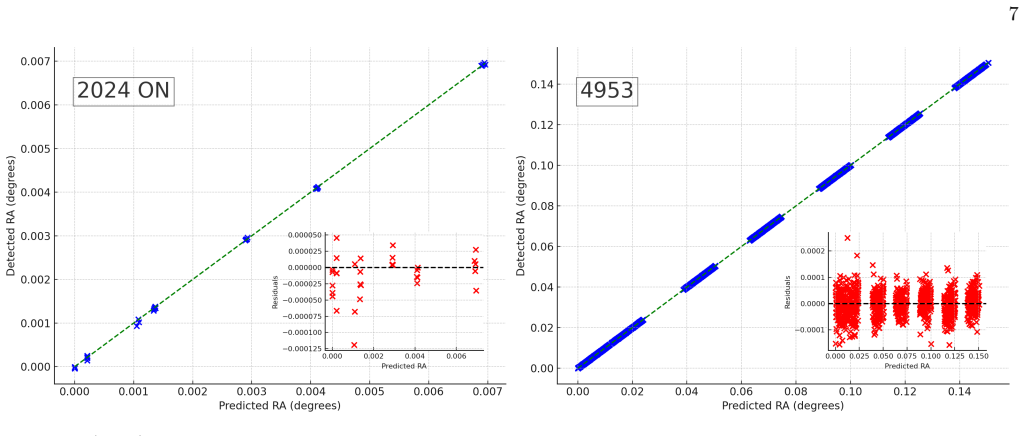
The central claim is that the amplitude $A$ of the one-day sinusoid in an asteroid's right ascension is a direct measure of its geocentric distance: $\mathrm{distance} = R_{\mathrm{Earth}} \cos(\mathrm{latitude}) / (A \cos(\mathrm{declination}))$, where $R_{\mathrm{Earth}}$ is the Earth's radius. Fitting the model $\mathrm{RA}(t) = A \sin(2\pi t + \phi) + \alpha + \beta t$ to a handful of RA measurements taken over one night, with observations spread across the sky and ideally on both sides of zenith, recovers that amplitude accurately enough to yield percent-level distance uncertainties for nearby NEOs. The paper demonstrates this on synthetic data for 19 asteroids from 0.05 to 2.4 AU and on real PROMPT observations of two asteroids, with the measured distances agreeing with Horizons ephemerides to 0.78% and 2.61%.
Load-bearing premise
The fit assumes the asteroid's distance (and hence the parallax amplitude) stays fixed over the night, but the paper itself notes distances can change by 1–2% during the observation window and does not correct for this.
Editorial extensions
If this is right
- Newly discovered NEOs could get a distance estimate on the discovery night itself, letting impact-risk assessors and follow-up planners act immediately rather than waiting for multi-night arcs.
- All-sky surveys such as VRO and Argus, which re-image large areas several times per night, could produce these distances as a routine by-product of their normal cadence.
- The forecast quantifies how much distance precision depends on hour-angle coverage: splitting observations across zenith improves the result by roughly a factor of three, which is actionable for survey scheduler design.
- For the closest objects (under about 0.3 AU), the method already reaches roughly 1% precision, which is comparable to or better than the dominant distance uncertainty in short-arc orbit determination.
Reading between the lines
- At sub-percent precision the neglected 1–2% nightly distance change will become the dominant systematic; a natural next step is to fit a time-varying amplitude (for instance $A + \Theta t$) or to marginalize over a distance-rate parameter, testing on the same synthetic sample.
- The single-observatory geometry cannot cleanly separate a changing distance from a changing phase; combining the right-ascension fit with the Declination residuals, or with a second observatory as the authors plan, would break this degeneracy and is the obvious extension.
Editorial analysis
A structured set of objections, weighed in public.
Referee Report
Summary. This paper develops and tests a method for measuring the geocentric distance to an asteroid from a single night of single-observatory right-ascension astrometry. The model fits RA(t) = A sin(2πt + φ) + α + βt, with an optional quadratic term, and converts the fitted parallax amplitude to a distance via Eqs. (3)–(4). The method is demonstrated on synthetic Horizons ephemerides for 19 NEOs (0.05–2.4 AU), on real PROMPT observations of 2024 ON and 4953, and on toy-model simulations intended to forecast the performance of VRO and Argus. The headline claim is that distances to NEOs at ~0.5 AU can be constrained to below the percent level within a single night, depending on the spacing of observations.
Significance. The technique is potentially valuable because it would allow rapid distance estimates for NEOs from survey data without dedicated follow-up, directly addressing the distance-uncertainty bottleneck in short-arc orbit determination. The paper has clear strengths: a transparent derivation of the parallax–distance relation, public code, real observations of two asteroids with ~0.1″ astrometry, and honest discussion of the constant-amplitude limitation. The demonstrated real-data accuracies (0.78% and 2.61%) and the 1.3% scatter for the <0.3 AU subset in Fig. 3 are meaningful. However, the abstract's sub-percent forecast for 0.5 AU rests on a toy model that (i) uses noise levels below those quoted for VRO/Argus, and (ii) generates and refits the same functional form, so it cannot validate the method against the very approximation errors the paper identifies. The forecast is not yet supported by the presented evidence.
major comments (3)
- [§4.1, Table 2] The astrometric noise values in Table 2 run from 4×10^−7 deg to 1×10^−5 deg, i.e., 0.0014″ to 0.036″, yet the text in §4.1 states that the simulated astrometric uncertainty range is 0.036″ to 0.18″ and quotes VRO astrometric precision of 0.1″ and Argus of 0.3″. No Table 2 row corresponds to 0.1″ or 0.3″, and the 0.18″ upper bound never appears in the table. The sub-percent entries in Table 2 are therefore achieved at noise levels far below those of the surveys the forecast is meant to cover; extrapolating the 0.6-day, 4-observation row to 0.1″ gives roughly 3–5% rather than sub-percent. The abstract's claim that 'distances to NEOs on the scale of ~0.5 AU can be constrained to below the percent level within a single night' is not supported by this table unless rows at 0.1″ and 0.3″ are added and the forecast is recomputed.
- [§4.1, §2.3, §4.2] The toy-model forecast is generated by drawing RA from Eq. 1 and then refitting Eq. 1; this is a self-consistency check and cannot reveal the consequences of the model misspecification that the paper itself identifies. In §2.3 the authors note that the distance to the target changes by as much as 0.005 AU per 12 hours and that the parallax amplitude is therefore time-dependent, and §4.2 repeats that the distance can change by 1–2% within a night; their attempt to model this with A→A+Θt produced degeneracies and was dropped. For a 0.5 AU object, a 1–2% change in distance across the night can translate into a percent-level bias in the constant-amplitude fit, which is the same order as the claimed sub-percent precision. The forecast should be validated with realistic (e.g., Horizons) ephemerides for targets near 0.5 AU at the proposed cadence and noise, or the abstract and §4.1 conclusions should be softened.
- [§5] The concluding sentence 'We showed how the topocentric parallax technique can retrieve distances to the level of ~1.3% for distances up to ~2.4 AU' is not supported by Fig. 3, where the 1.3% scatter is specifically for the subset with true distances <0.3 AU and the full sample spanning 0.05–2.4 AU has a 7.5% fractional-distance scatter. This overstatement should be corrected to reflect the distance-dependent accuracy, as the abstract itself does.
minor comments (8)
- [Table 1] For 4953, the reported amplitude uncertainty in radians is '±0.000000'; this is a rounding artifact, as the propagated distance uncertainty implies an amplitude uncertainty of about 8×10^−7 rad. Please quote more significant figures so the table does not imply a zero uncertainty.
- [§2.3] The statement 'The χ² of the fractional residuals is 19.45' is undefined because Eq. 6 defines an RMS scatter, not a chi-square statistic; please state the per-point uncertainties and the number of degrees of freedom used to compute this χ².
- [§4.1] In the simulation description, 'A set between 0.00008 and 0.0004' should specify the units (radians) explicitly.
- [§4.1] The sentence 'We assume perfect depth in these observations and do not relate distances to astrometric uncertainty' is confusing; clarify that detection completeness is not modeled and that astrometric uncertainty is the only noise source.
- [§4.1] The sentence 'the distance equation is then unconstrained' for fewer than 4 observations should refer to the number of free parameters in Eq. 1 (A, φ, α, β) and say 'fewer than four' for consistency.
- [§3] The phrase 'multiple exposures per second' in the 4953 description should be 'multiple exposures per pointing' or similar; exposures cannot be taken at rates of one per second with these telescopes.
- [Table 4] The 'JD (days)' column in Table 4 starts at 0.000000; please give the full Julian Date of the first observation for each entry so that the table is self-contained.
- [Eq. 1] If t is a Julian Date in solar days, the fixed period of the parallax sinusoid should be one sidereal day (0.99727 solar days), not 1 solar day; at the claimed percent-level precision, this 0.27% frequency offset should either be corrected or explicitly shown to be negligible for the arc lengths used.
Circularity Check
No significant circularity: distances are derived from the fitted parallax amplitude and validated against external Horizons ephemerides and real PROMPT observations.
full rationale
The paper's central distance measurement is not an input to the fit: the parallax amplitude A is estimated from RA data via Eq. 1, and the distance is then computed from A using Eqs. 3 and 4. The synthetic tests in Section 2.3 draw RA from Horizons ephemerides, which are generated by numerical integration, not from Eq. 1, and the real-time observations in Section 3 are checked against Horizons true distances, providing external benchmarks. The Section 4.1 toy-model simulation does generate ephemerides using Eq. 1 and then refits Eq. 1, so it is a self-consistency exercise that cannot capture model misspecification; however, this is explicitly acknowledged as a limitation in Sections 2.3 and 4.2 (time-varying amplitude, attempted A + Θt correction, and degeneracies). That limitation affects the reliability of the forecast, but it is not a circular derivation because the forecasted fractional distance uncertainty is a Monte Carlo error propagation, not a quantity defined to equal its input. The self-citations to Zhai et al. (2022) supply the initial method, but the present paper independently re-derives the model, tests it on 19 synthetic asteroids, and validates it with its own observations of two asteroids, so the self-citation is not load-bearing. No quoted step reduces to its own inputs by construction.
Assumptions & free parameters
assumptions (3)
- domain assumption The asteroid's apparent right ascension over one night is well modeled as a constant plus a linear drift plus a 1-day sinusoidal parallax term (Eq. 1).
- ad hoc to paper The period of the parallax sinusoid is exactly 1 day (24 hours).
- domain assumption The geocentric distance is recovered from the fitted amplitude using a fixed Earth radius (6371 km) and the observatory latitude, ignoring altitude and Earth flattening (Eqs. 3-4).
Cite this review
Pith. "Pith review of Measuring the Distances to Asteroids from One Observatory in One Night with Upcoming All-Sky Telescopes." pith.science (2026). https://pith.science/paper/B4TKW3OW
@misc{pith2026250207881,
  author       = {Pith},
  title        = {Pith review of: Measuring the Distances to Asteroids from One Observatory in One Night with Upcoming All-Sky Telescopes},
  year         = {2026},
  howpublished = {\url{https://pith.science/paper/B4TKW3OW}},
  note         = {Machine review of arXiv:2502.07881}
}
abstract
Upcoming telescopes like the Vera Rubin Observatory (VRO) and the Argus Array will image large fractions of the sky multiple times per night yielding numerous Near Earth Object (NEO) discoveries. When asteroids are measured with short observation time windows, the dominant uncertainty in orbit construction is due to distance uncertainty to the NEO. One approach to recover distances is from topocentric parallax, which is a technique that leverages the rotation of the Earth, causing a small but detectable sinusoidal additive signal to the Right Ascension (RA) of the NEO following a period of 1 day. In this paper, we further develop and evaluate this technique to recover distances in as quickly as a single night. We first test the technique on synthetic data of 19 different asteroids ranging from $\sim0.05 \,\text{AU}$ to $\sim2.4 \,\text{AU}$. We modify previous algorithms and quantify the limitations of the method, recovering distances with uncertainties as low as the $\sim1.3\%$ level for more nearby objects ($\lesssim$ 0.3 AU) assuming typical astrometric uncertainties. We then acquire our own observations of two asteroids within a single night with $\sim0.1''$ uncertainties on RA, and we find we are able to recover distances to the $3\%$ level. We forecast likely scenarios with the VRO and the Argus Array with varying levels of astrometric precision and expected pointings per night. Our analysis indicates that distances to NEOs on the scale of $\sim0.5$ AU can be constrained to below the percent level within a single night, depending on spacing of observations from one observatory. In a follow-up paper, we will compare these constraints with synchronous and asynchronous observations from two separate observatories to measure parallax even more efficiently, an exciting and likely possibility over the upcoming decade.
Figures


Figures from the paper (4 more)



Reference graph
Works this paper leans on
-
[1]
Alvarez, E. M., Buchheim, R. K., 2012, Society for Astronomical Sciences Annual Symposium, 31, 45
work page 2012
-
[2]
R., 2009, PASP, 121, 886, 1419, arXiv:0910.3250
Bellini, A., Bedin, L. R., 2009, PASP, 121, 886, 1419, arXiv:0910.3250
arXiv 2009
-
[3]
L., 2005, Celestial Mechanics and Dynamical Astronomy, 93, 1-4, 53
Branham, R. L., 2005, Celestial Mechanics and Dynamical Astronomy, 93, 1-4, 53
work page 2005
-
[4]
50 of AAS/Division for Planetary Sciences Meeting Abstracts, 310.10
Christensen, E., Africano, B., Farneth, G., et al., 2018, in AAS/Division for Planetary Sciences Meeting Abstracts #50, vol. 50 of AAS/Division for Planetary Sciences Meeting Abstracts, 310.10
work page 2018
-
[5]
Kuchynka, P., 2014, Interplanetary Network Progress Report, 42-196, 1
work page 2014
- [6]
-
[7]
Precise Distances for Main-Belt Asteroids in Only Two Nights
Heinze, A. N., Metchev, S., 2015, AJ, 150, 4, 124, arXiv:1508.06331
work page Pith review arXiv 2015
-
[8]
K., 2015, in Asteroids IV, edited by Michel, P., DeMeo, F
Yeomans, D. K., 2015, in Asteroids IV, edited by Michel, P., DeMeo, F. E., Bottke, W. F., 795–813
work page 2015
Show all 20 references
-
[9]
Kruk, S., Garc ´ ıa Mart ´ ın, P., Popescu, M., et al., 2022, A&A, 661, A85, arXiv:2202.00246
2022 arXiv
-
[10]
M., Corbett, H., Galliher, N
Law, N. M., Corbett, H., Galliher, N. W., et al., 2022, PASP, 134, 1033, 035003, arXiv:2107.00664
2022 arXiv
-
[11]
Lee, J., Acevedo, M., Sako, M., et al., 2023, AJ, 165, 6, 222, arXiv:2304.01858
2023 arXiv
-
[12]
Shao, M., Nemati, B., Zhai, C., et al., 2014, ApJ, 782, 1, 1, arXiv:1309.3248
2014 arXiv
-
[13]
Teets, D., Whitehead, K., 1999, Mathematics Magazine, 72, 2, 83
1999
-
[14]
L., Denneau, L., Heinze, A
Tonry, J. L., Denneau, L., Heinze, A. N., et al., 2018, PASP, 130, 988, 064505, arXiv:1802.00879
2018 arXiv
-
[15]
F., McGilvray, A., 2023, Acta Astronautica, 210, 610 Vera C
Zambrano-Marin, L. F., McGilvray, A., 2023, Acta Astronautica, 210, 610 Vera C. Rubin Observatory LSST Solar System Science
2023
-
[16]
L., Bannister, M
Collaboration, Jones, R. L., Bannister, M. T., et al., 2020, arXiv e-prints, arXiv:2009.07653, arXiv:2009.07653
2020 arXiv
-
[17]
54 of AAS/Division for Planetary Sciences Meeting Abstracts, 504.01
Wainscoat, R., Weryk, R., Ramanjooloo, Y., et al., 2022, in AAS/Division for Planetary Sciences Meeting Abstracts, vol. 54 of AAS/Division for Planetary Sciences Meeting Abstracts, 504.01
2022
-
[18]
Zhai, C., Shao, M., Saini, N., et al., 2024, PASP, 136, 3, 034401, arXiv:2401.03255
2024 arXiv
-
[19]
S., et al., 2018, AJ, 156, 2, 65, arXiv:1805.01107
Zhai, C., Shao, M., Saini, N. S., et al., 2018, AJ, 156, 2, 65, arXiv:1805.01107
2018 arXiv
-
[20]
S., et al., 2022, PASP, 134, 1031, 015005
Zhai, C., Shao, M., Saini, N. S., et al., 2022, PASP, 134, 1031, 015005
2022
Reviewed August 8, 2026 · model on record in the stance chip above.
Discussion (0). Continue with ORCID to comment.