REVIEW 4 major objections 4 minor 17 references
Franken-Adapter: Cross-Lingual Adaptation of LLMs by Embedding Surgery
T0 review · 4 major / 4 minor · reviewed 2026-08-08 · deepseek-v4-flash
Pith's one-line read Franken-Adapter claims that training only a new embedding layer and custom tokenizer, then attaching it to an instruction-tuned model, gives up to 20% gains across 96 low-resource languages with under 1% English regression.
desk verdict Embedding surgery has real gains for low-resource classification, but the headline 'up to 20%' is not isolated from the LoRA stage's extra multilingual data, and the English regression claim is overstated. read the letter →
The pith
A machine-rendered reading of the paper's core claim, the machinery that carries it, and where it could break.
The reading
What carries the argument
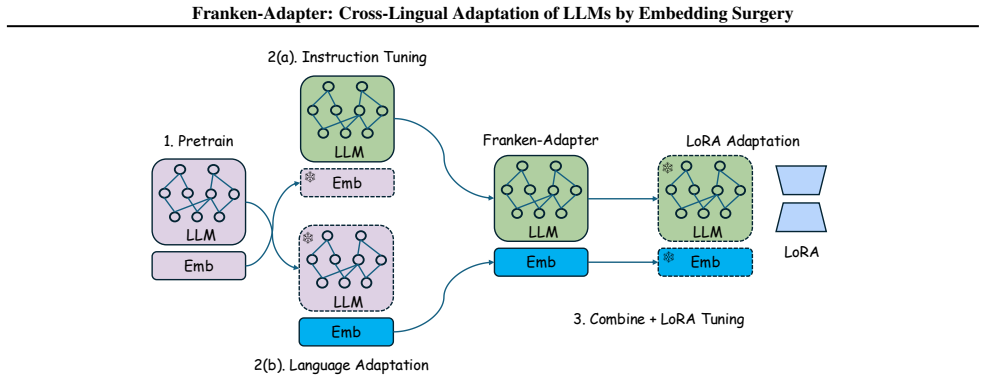
The carrying mechanism is embedding surgery: freezing the transformer body and training only the token embedding matrix on multilingual data, based on the assumption that the body holds language-general knowledge while the embedding layer carries language-specific form. The second piece is the Prune-with-Extension vocabulary: prune non-English tokens from the original tokenizer, extend with BPE tokens for the target language group, keep the vocabulary size constant, and initialize new embeddings by copying overlapping token embeddings and averaging subtoken embeddings for new tokens. The third piece is composition: the adapted embeddings are paired with an instruction-tuned transformer body, and LoRA tuning on a mixed multilingual-plus-instruction corpus reconnects the two halves for generative tasks.
What would settle it
Take an English-centric decoder-only model with no multilingual continued pre-training, apply the full Franken-Adapter recipe (pruned-and-extended BPE vocabulary, embedding-only tuning, composition with an instruction-tuned body) on a language group such as SEA, and measure zero-shot FLORES-200 and BELEBELE scores: if the gains over the vanilla model disappear or English scores drop by more than the reported under-1%, the universality assumption is refuted. The paper itself reports exactly this failure for Gemma2-2B without a multilingual warmup, so reproducing it on a second architecture would settle the matter.
Extended reading notes
Core claim
The central discovery is that embedding tuning suffices for language adaptation of modern decoder-only LLMs, provided the tokenizer treats target languages fairly. The paper constructs a customized vocabulary by pruning the original tokenizer down to English tokens and extending it with BPE tokens trained on low-resource language data, keeping the total vocabulary size fixed. It trains only the embedding matrix on multilingual data while the transformer is frozen, then composes those embeddings with a transformer body instruction-tuned on English alignment data, calling the result Franken-Adapter, with optional LoRA weights to reconcile the two independently trained components. In this setup, language-adapted Gemma2, Aya23, and PaLM2 models beat their pre-trained and instruction-tuned baselines across five multilingual benchmarks, and math-tuned models gain 14% over their base across 20 languages when fitted with the new embeddings.
Load-bearing premise
The load-bearing premise is that the transformer body of a pre-trained LLM already contains universal cross-lingual knowledge and only the embedding layer is language-specific; if the base model has too little multilingual ability to begin with, embedding-only tuning cannot transfer knowledge, and the paper's own Figure 23 shows this failure for Gemma2-2B without a multilingual warmup.
Editorial extensions
If this is right
- Embedding-only tuning with customized tokenizers can serve as a low-cost alternative to full continued pre-training for adapting LLMs to many low-resource languages, with no extra inference cost at decode time.
- Language-adapted embeddings can be combined with any instruction-tuned version of the same base model, enabling zero-shot cross-lingual transfer without training per language or per task.
- Custom vocabularies improve inference efficiency, with throughput gains up to 28% on low-resource languages, as well as improving accuracy.
- The approach transfers reasoning skills post hoc: math-tuned and RL-aligned models gain up to 14% over their base across 20 languages when fitted with adapted embeddings.
- Franken-Adapter's modularity lets multiple skills share one set of adapted embeddings, avoiding the redundant full-parameter training that continued pre-training baselines require.
Reading between the lines
- Beyond the paper: if the universality assumption holds, the same surgery might adapt LLMs to non-language domains, such as specialized code or scientific vocabularies, by treating the embedding layer as the only domain-specific surface; the paper hints at this in its impact statement but does not test it.
- Beyond the paper: the inverse correlation between tokenizer fertility and downstream score suggests a design rule that tokenizers can be optimized directly for low-resource task performance rather than corpus likelihood, which could be validated by training tokenizers under explicit fertility constraints.
- Beyond the paper: because custom vocabularies give the largest relative gains on smaller models, embedding surgery may be a particularly effective lever for making small on-device models serve low-resource languages.
- Beyond the paper: the paper leaves open whether adapted embeddings preserve alignment and safety behavior after being attached to instruction-tuned bodies; a targeted safety benchmark in target languages would determine whether the under-1% English regression masks larger alignment regressions elsewhere.
Editorial analysis
A structured set of objections, weighed in public.
Referee Report
Summary. The paper proposes Franken-Adapter, a modular cross-lingual adaptation method for decoder-only LLMs. It first builds a customized BPE tokenizer by pruning the original vocabulary and extending it with target-language tokens, then trains new embeddings on multilingual data while freezing the transformer body. These embeddings are swapped into an instruction-tuned version of the same base model to obtain zero-shot cross-lingual transfer, optionally followed by LoRA adaptation on a mixture of multilingual and instruction data. Experiments cover Gemma2 2B/9B/27B, PaLM2, and Aya23 across classification, translation, summarization, and mathematical reasoning benchmarks, with a wide set of ablations on tokenizer construction, data mixtures, initialization, and inference efficiency. The central claims are that embedding tuning alone is effective for language adaptation and that the assembled Franken-Adapter improves low-resource language performance with only minimal regressions in English.
Significance. If the mechanism is fully validated, the paper offers a cheap, modular route to post-hoc multilingual adaptation of existing LLMs, reusing one language-adapted embedding set across multiple instruction-tuned or skill-tuned bodies. The empirical scope is unusually broad: 96 languages, three model families, and both discriminative and generative tasks. The paper also ships careful ablations that isolate the contribution of customized tokenizers, embedding initialization, and data mixtures, and it provides a comparison against continued pre-training that quantifies catastrophic forgetting. These strengths make the paper a potentially valuable contribution. The main caveat is that the headline LoRA-based results do not yet isolate the embedding-surgery mechanism from the effect of additional LoRA training on a multilingual-instruction mixture, and the English-regression claim in the abstract is not backed by reported aggregates.
major comments (4)
- [§3.1, §3.5.2, Table 3] The LoRA-Adapt rows in Table 3 are trained on Dmix = Dla ∪ 10% Dit as defined in §3.1, while the ∗-FLAN baseline is trained on Dit only. The comparison therefore conflates two interventions: the embedding swap and additional LoRA training on a mixed multilingual-instruction corpus. The paper never reports the control of running LoRA on Dmix with the original embeddings, so the reader cannot attribute the Table 3 gains to embedding surgery. This is load-bearing for the headline 'up to 20%' claim and for Figure 1, and the control should be added.
- [Abstract, Appendix B, Figure 11] The abstract claims 'minimal regressions (<1%) in English,' but Figure 11 shows regressions on all eight English tasks for both Franken-Adapter variants across all model sizes, and no aggregate regression number is reported anywhere. The paper should provide the exact average English regression with variance across the three embeddings; as it stands, the <1% claim is unsupported and appears inconsistent with the plotted data.
- [§2.2, Figure 23] The load-bearing assumption that 'the pre-trained transformer body encapsulates universal cross-lingual knowledge' is shown by the paper's own Figure 23 to fail for Gemma-2B: without a multilingual continued-pretraining warmup, language adaptation does not succeed. This limits the scope of contribution 1 ('embedding tuning is effective for language adaptation of LLMs') to models with sufficient initial multilingual ability. The main text should state this boundary condition explicitly and qualify the claim.
- [§3.5.2, Table 2, Table 3] The paper claims Franken-Adapter consistently improves mathematical reasoning (Table 2) while simultaneously noting in §3.5.2 that Franken-Adapter alone is inconsistent on generative tasks, with red entries in Table 3. The small language counts in GSM8K-NTL (20 languages) make the averaged gains in Table 2 sensitive to a few languages; reporting per-language standard errors or significance tests would strengthen the claim. The paper should also specify which benchmark and metric support the 'up to 20%' figure in the abstract.
minor comments (4)
- [Footnote 4, §2.1] Footnote 4 states that '440% of the tokens are discarded'; this should be '40%' given the claim of over 60% token overlap in the final vocabulary.
- [Appendix E, Figure 15] The caption of Figure 15 says the tokenization comparison is 'on Gemma2,' but the figure shows PaLM2 and Aya23; the caption should be corrected.
- [Table 3] The 'Avg.' column in Table 3 should explicitly state whether English scores are included in the average; the text says English is excluded, but the table layout places an 'ENGLISH' column immediately before the Avg column, which is confusing.
- [Figure 2] The normalization procedure for Figure 2 (baseline model, metric, and aggregation across benchmarks) is not fully specified in the main text or caption; please clarify how 'Normalized Performance' is computed.
Circularity Check
No significant circularity: the claimed gains are measured on external benchmarks, and no fitted parameter or self-citation reduces the predictions to the method's own inputs.
full rationale
The derivation chain is empirical end-to-end. Embedding tuning trains on Dla (NTL plus Wikipedia/mC4) and is evaluated on external benchmarks (BELEBELE, SIB-200, FLORES-200, XORQA-IN, XSUM-IN, GSM8K-NTL) that are not used as supervision for the reported predictions; no target-task label or evaluation metric is used as a training signal. The LoRA stage trains on Dmix = Dla ∪ 10% Dit, but its gains are measured on held-out benchmarks rather than on Dmix itself, so the result is not an identity or a fitted parameter renamed as a prediction. The tokenizer-fertility analysis is a post-hoc correlation study: the paper explicitly varies tokenizer fertility and measures downstream performance, reporting a correlation rather than deriving benchmark scores from a fitted fertility model. The central assumption that the transformer body encodes universal cross-lingual knowledge while the embedding layer is language-specific is cited from independent prior work (Zhao et al., Wendler et al., Tang et al.) and is not a self-citation; moreover, the paper includes a falsification check (Figure 23) showing the assumption fails for Gemma2-2B without warmup. No equation in the paper defines an output in terms of its own input. The only notable caveat is an experimental confound between the embedding swap and the additional LoRA training on Dmix, but a confound is a correctness risk rather than circularity, and the FA-without-LoRA rows show genuine classification gains from the embedding surgery itself. Therefore no circular steps are identified.
Assumptions & free parameters
free parameters (6)
- Max sampled lines per language =
500,000
- Dla sentence/document ratio =
65/35
- UniMax sampling N =
5
- LoRA rank =
64
- Embedding training tokens =
200B
- Learning rates =
1e-4 (PaLM2), 1e-5 (Gemma2, Aya23)
assumptions (5)
- domain assumption The transformer body of a pretrained LLM contains universal cross-lingual knowledge; the embedding layer is language-specific.
- domain assumption Reusing English tokens preserves the model's pretrained knowledge.
- ad hoc to paper A BPE tokenizer trained on up to 500K lines per language yields a fair representation for low-resource languages.
- domain assumption LoRA adaptation on Dmix reconciles the mismatch between the new embeddings and the instruction-tuned body.
- ad hoc to paper Averaging subtoken embeddings is a sufficient initialization for new tokens.
Cite this review
Pith. "Pith review of Franken-Adapter: Cross-Lingual Adaptation of LLMs by Embedding Surgery." pith.science (2026). https://pith.science/paper/YEQBCKEW
@misc{pith2026250208037,
  author       = {Pith},
  title        = {Pith review of: Franken-Adapter: Cross-Lingual Adaptation of LLMs by Embedding Surgery},
  year         = {2026},
  howpublished = {\url{https://pith.science/paper/YEQBCKEW}},
  note         = {Machine review of arXiv:2502.08037}
}
abstract
The capabilities of Large Language Models (LLMs) in low-resource languages lag far behind those in English, making their universal accessibility a significant challenge. To alleviate this, we present $\textit{Franken-Adapter}$, a modular language adaptation approach for decoder-only LLMs with embedding surgery. Our method begins by creating customized vocabularies for target languages and performing language adaptation through embedding tuning on multilingual data. These pre-trained embeddings are subsequently integrated with LLMs that have been instruction-tuned on English alignment data to enable zero-shot cross-lingual transfer. Our experiments on $\texttt{Gemma2}$ models with up to 27B parameters demonstrate improvements of up to 20% across 96 languages, spanning both discriminative and generative tasks, with minimal regressions ($<$1%) in English. Further in-depth analysis reveals the critical role of customizing tokenizers in enhancing language adaptation, while boosting inference efficiency. Additionally, we show the versatility of our method by achieving a 14% improvement over a math-optimized LLM across 20 languages, offering a modular solution to transfer reasoning abilities across languages post hoc.
Figures


Figures from the paper (14 more)


Reference graph
Works this paper leans on
-
[1]
Pretrain MATH Emb LLM AFR Emb LLM IND Emb FLAN FLAN IND Emb FLAN AFR Emb SEA Emb IND Emb AFR Emb MATH MATH MATH LLM Emb
-
[2]
Language AdaptationCopy SEA Emb SEA LLM SEA Emb AFR LLM AFR Emb AFR LLM AFR Emb IND LLM IND Emb IND LLM IND Emb
-
[3]
Instruction Tuning SEA LLM Initialize FLAN MATH FLAN MATH FLAN MATH Franken-Adapter Continued Pre-training Freeze Trainable Figure 13. The difference between our Franken-Adapter and the continued pre-training (CPT) baseline for zero-shot cross-lingual transfer. The same customized tokenizers are used by CPT. For M language groups and N target skills to be...
work page 2023
-
[8]
doi: 10.18653/v1/2020.emnlp-main.617
Association for Computational Linguistics. doi: 10.18653/v1/2020.emnlp-main.617. URL https:// aclanthology.org/2020.emnlp-main.617. Pfeiffer, J., Vuli´c, I., Gurevych, I., and Ruder, S. UNKs everywhere: Adapting multilingual language models to new scripts. In Proceedings of the 2021 Conference on Empirical Methods in Natural Language Processing, pp. 10186...
-
[11]
Shi, H., Xu, Z., Wang, H., Qin, W., Wang, W., Wang, Y ., Wang, Z., Ebrahimi, S., and Wang, H
URL https://openreview.net/forum? id=fR3wGCk-IXp. Shi, H., Xu, Z., Wang, H., Qin, W., Wang, W., Wang, Y ., Wang, Z., Ebrahimi, S., and Wang, H. Continual learning of large language models: A comprehensive survey, 2024. URL https://arxiv.org/abs/2404.16789. Singh, H., Gupta, N., Bharadwaj, S., Tewari, D., and Taluk- dar, P. IndicGenBench: A multilingual be...
arXiv 2024
-
[12]
URL https://openreview.net/forum? id=6ruVLB727MC. 12 Franken-Adapter: Cross-Lingual Adaptation of LLMs by Embedding Surgery Üstün, A., Aryabumi, V ., Yong, Z., Ko, W.-Y ., D’souza, D., Onilude, G., Bhandari, N., Singh, S., Ooi, H.-L., Kayid, A., Vargus, F., Blunsom, P., Longpre, S., Muennighoff, N., Fadaee, M., Kreutzer, J., and Hooker, S. Aya model: An i...
arXiv 2024
-
[13]
URL https://aclanthology.org/2022
Association for Machine Translation in the Amer- icas. URL https://aclanthology.org/2022. amta-research.8. Zhao, J., Zhang, Z., Gao, L., Zhang, Q., Gui, T., and Huang, X. Llama beyond english: An empirical study on language capability transfer, 2024a. URL https: //arxiv.org/abs/2401.01055. Zhao, Y ., Zhang, W., Chen, G., Kawaguchi, K., and Bing, L. How do...
arXiv 2023
-
[15]
Pretrain SEA LLM SEA Emb AFR LLM AFR Emb IND LLM IND Emb
Show all 17 references
-
[74]
findings-acl.74
URL https://aclanthology.org/2021. findings-acl.74. Dua, D., Wang, Y ., Dasigi, P., Stanovsky, G., Singh, S., and Gardner, M. DROP: A reading comprehension 10 Franken-Adapter: Cross-Lingual Adaptation of LLMs by Embedding Surgery benchmark requiring discrete reasoning over par...
2021 arXiv
-
[338]
findings-acl.338
URL https://aclanthology.org/2023. findings-acl.338. Muennighoff, N., Wang, T., Sutawika, L., Roberts, A., Bi- derman, S., Le Scao, T., Bari, M. S., Shen, S., Yong, Z. X., Schoelkopf, H., Tang, X., Radev, D., Aji, A. F., Almubarak, K., Albanie, S., Alyafeai, Z., Webson, A., Ra...
2023
-
[579]
coling-main.579
URL https://aclanthology.org/2020. coling-main.579. Chen, P., Ji, S., Bogoychev, N., Kutuzov, A., Haddow, B., and Heafield, K. Monolingual or multilingual instruction tuning: Which makes a better alpaca. In Graham, Y . and Purver, M. (eds.), Findings of the Association for Com...
2020 arXiv
-
[614]
emnlp-main.614
URL https://aclanthology.org/2023. emnlp-main.614. Ahuja, K., Diddee, H., Hada, R., Ochieng, M., Ramesh, K., Jain, P., Nambi, A., Ganu, T., Segal, S., Ahmed, M., Bali, K., and Sitaram, S. MEGA: Multilingual evaluation of generative AI. In Bouamor, H., Pino, J., and Bali, K. (e...
2023 arXiv
-
[800]
emnlp-main.800
URL https://aclanthology.org/2021. emnlp-main.800. Pfeiffer, J., Goyal, N., Lin, X., Li, X., Cross, J., Riedel, S., and Artetxe, M. Lifting the curse of multilinguality by pre- training modular transformers. InProceedings of the 2022 Conference of the North American Chapter of...
2021
-
[891]
acl-long.891
URL https://aclanthology.org/2023. acl-long.891. Pfeiffer, J., Vuli´c, I., Gurevych, I., and Ruder, S. MAD- X: An Adapter-Based Framework for Multi-Task Cross- Lingual Transfer. In Proceedings of the 2020 Confer- ence on Empirical Methods in Natural Language Pro- cessing (EMNL...
2023
-
[2020]
cc/paper_files/paper/2020/file/ 1457c0d6bfcb4967418bfb8ac142f64a-Paper
URL https://proceedings.neurips. cc/paper_files/paper/2020/file/ 1457c0d6bfcb4967418bfb8ac142f64a-Paper. pdf. Caswell, I., Breiner, T., van Esch, D., and Bapna, A. Lan- guage ID in the wild: Unexpected challenges on the path to a thousand-language web text corpus. In Proceedin...
2020 doi
-
[2022]
doi: 10.18653/v1/2022.naacl-main.255
Association for Computational Linguistics. doi: 10.18653/v1/2022.naacl-main.255. URL https:// aclanthology.org/2022.naacl-main.255. Riviere, M. et al. Gemma 2: Improving open language models at a practical size, 2024. Robinson, N., Ogayo, P., Mortensen, D. R., and Neubig, G. C...
2022 doi
-
[2023]
doi: 10.18653/v1/2023.emnlp-main.813
Association for Computational Linguistics. doi: 10.18653/v1/2023.emnlp-main.813. URL https:// aclanthology.org/2023.emnlp-main.813. Liu, H., Tam, D., Mohammed, M., Mohta, J., Huang, T., Bansal, M., and Raffel, C. Few-shot parameter-efficient fine-tuning is better and cheaper t...
2023 arXiv
Reviewed August 8, 2026 · model on record in the stance chip above.
Discussion (0). Continue with ORCID to comment.