REVIEW 3 major objections 5 minor 83 references
Phase transition in a doubly holographic model of closed $\mathbf{dS_{2} }$ spacetime
T0 review · 3 major / 5 minor · reviewed 2026-08-08 · deepseek-v4-flash
Pith's one-line read This paper claims a third extremal surface, beyond the Hartman-Maldacena and island surfaces, controls the low-temperature phase of a doubly holographic dS2 model.
desk verdict The claimed new saddle S2 is a regulator-dependent boundary configuration rather than a genuine extremal surface, so the three-phase structure is unsupported despite some solid standard analysis. read the letter →
The pith
A machine-rendered reading of the paper's core claim, the machinery that carries it, and where it could break.
The reading
What carries the argument
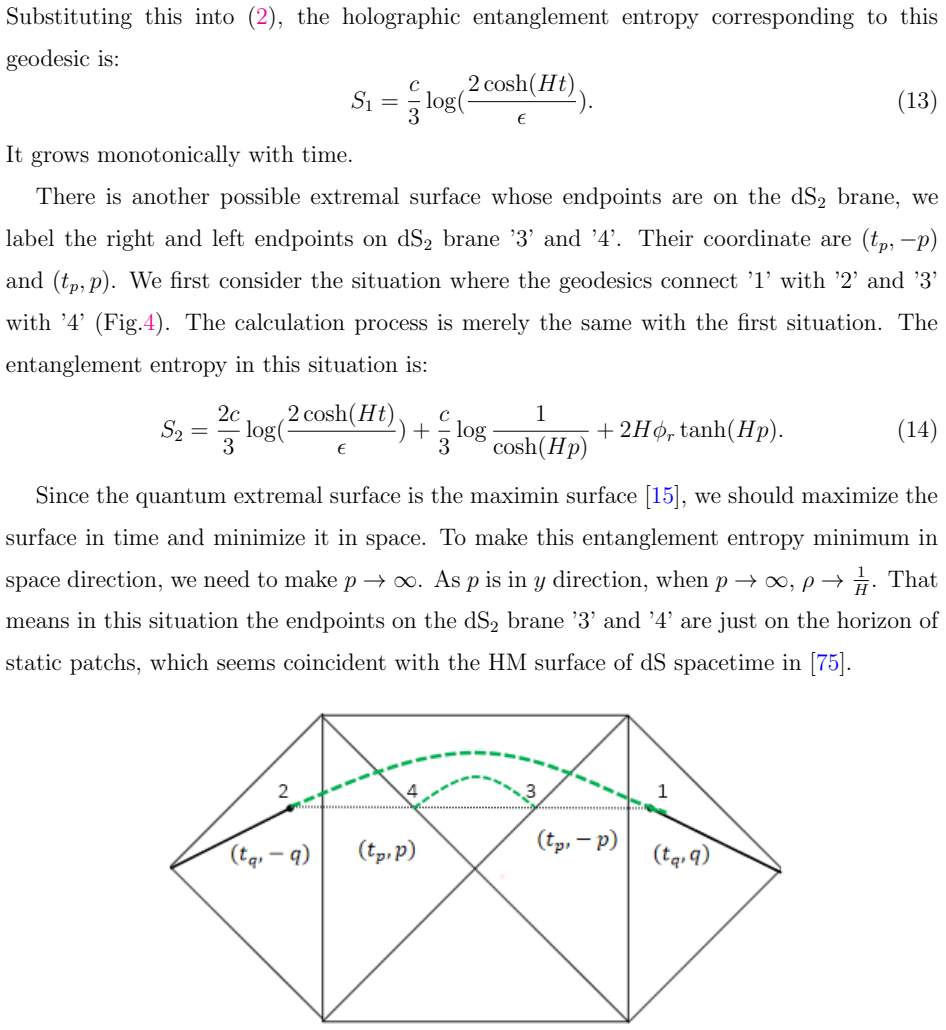
The machinery is the doubly holographic rewriting of the island formula as $S_R=\min\{\mathrm{ext}[\Gamma/(4G_N^{(3)})+A(\partial I)/(4G_N^{(2)})]\}$, with $\Gamma$ an extremal surface in the $\mathrm{AdS}_3$ bulk. In this embedding the brane location is fixed by the gluing condition $z_{\mathrm{dS}_2}=\epsilon |1-\omega_+\omega_-|/2$, and the three saddles are classified by which endpoints they connect. The new $S_2$ saddle is defined by taking the brane endpoints to the horizon, $p\to\infty$, with a regulator $\varepsilon$; its defining feature is the geodesic length $L_{34}=2\log(2\varepsilon^2\cosh(Ht)/\epsilon)$, which becomes negative when the saddle dominates. The generalized mutual information $I_i=2S_0-S_i$ is the diagnostic quantity whose zeros line up with the phase-transition curves $X_{ij}$.
What would settle it
Compute the fully regularized length of the $S_2$ configuration without splitting it into the two geodesic pieces used in Eq. (27): if the total length is positive while $S_2$ still beats $S_1$ and $S_3$ at low temperature, the negative-length effect is an artifact of how the surface was decomposed, whereas if the total length is negative and the entropy functional has no lower bound, the $S_2$ saddle is not a valid competitor and the predicted three-phase diagram would not appear in a consistent quantization.
Extended reading notes
Core claim
Working in the doubly holographic model in which a closed $\mathrm{dS}_2$ brane is glued to flat thermal baths and embedded in a BTZ bulk, the paper finds three competing extremal surfaces that contribute to the radiation entropy: the surface connecting the two bath intervals ($S_1$), a Hartman-Maldacena-type surface that connects the two baths and also joins the two $\mathrm{dS}_2$ brane endpoints at the horizon ($S_2$), and the island surface ($S_3$). The claim is that the true entropy is $S=\min\{S_1,S_2,S_3\}$, so the new $S_2$ saddle dominates at low temperature and creates a three-phase diagram with two critical temperatures. The paper further proposes that the transitions are diagnosed by a generalized mutual information $I_{\mathrm{gen}}=2S_0-S_i$, which vanishes along the transition curves; the same structure is found for the $\mathrm{AdS}_2$ eternal black hole with a thermal bath. The price is that, when $S_2$ dominates, the geodesic segment on the $\mathrm{dS}_2$ brane has negative length, because its endpoints lie inside the bulk horizon, and the paper proposes to count coincident bulk geodesics only once.
Load-bearing premise
The load-bearing assumption is that taking the endpoints to the horizon with a small cutoff is a legitimate way to define a surface's entropy, even though part of the surface comes out with a negative length when this surface wins; if a piece of a surface cannot have negative length, the new saddle and the three-phase transition disappear.
Editorial extensions
If this is right
- If the claim is right, the Page-curve transition in this $\mathrm{dS}_2$ model is not two-phase but three-phase: at low temperature the new saddle mediates between the connected phase and the island phase.
- The vanishing of the generalized mutual information $I_{\mathrm{gen}}=2S_0-S_i$ provides a diagnostic for when the dominant saddle changes, extending the known role of $I(A;B)=0$ in Page transitions.
- The same three-way phase structure appears in the $\mathrm{AdS}_2$ eternal black hole with a thermal bath, so the new saddle is not an artifact of de Sitter signature.
- The negative geodesic length inside the bulk horizon implies that bulk geodesic contributions inside horizons must be counted without multiplicity for the entropy to be bounded below.
- The phase structure predicts a critical temperature where all three saddles meet; below it the connected $S_1$ phase never dominates.
Reading between the lines
- The paper's fix, counting coincident geodesics once, restores a lower bound but leaves open why a bulk geodesic inside a horizon should be assigned length at all; a more systematic prescription would follow from a replica calculation of the $S_2$ saddle, which this paper does not do.
- The three-phase diagram has a triple point where $S_1$, $S_2$, and $S_3$ meet; if it is physical, similar triple points should appear in other doubly holographic de Sitter models with two boundaries, and the low-temperature connected phase would be governed by a horizon-anchored surface rather than by the usual Hartman-Maldacena surface.
- The generalized mutual information $I_2=2S_0-S_2$ may plausibly be interpreted as a conditional or reflected entropy of the two radiation intervals; testing that interpretation in a boundary conformal field theory calculation would give a dual check of the phase transition beyond the bulk geodesic computation.
Editorial analysis
A structured set of objections, weighed in public.
Referee Report
Summary. This paper studies a doubly holographic model of two-dimensional closed de Sitter spacetime following the construction of [26]. It computes three candidate holographic entanglement entropies: the connected Hartman-Maldacena-type surface S1, an island surface S3, and a new configuration S2 whose endpoints lie on the dS2 brane near the horizon. The paper claims that S2 can dominate at low temperature, producing a three-way phase transition, and it introduces a generalized mutual information I_gen to interpret the transitions. It also notes that the S2 saddle contains a geodesic with negative length when dominant, attributes this to endpoints inside the bulk BTZ horizon, and proposes to count coincident geodesics only once. Section VI repeats the analysis for an AdS2 eternal black hole and finds a similar phase structure.
Significance. If the S2 saddle were legitimate, the paper would provide a concrete doubly holographic dS2 setup with a three-saddle phase structure and a possible mutual-information interpretation. The computations of S1 and S3 from standard geodesic lengths are explicit, and the paper is commendably honest about the negative-length subtlety, even proposing a resolution. No parameters are fitted to data; all phase boundaries are analytic. However, the legitimacy of S2 is the load-bearing element of the paper, and I do not find it established: S2 is a regulator-dependent boundary limit rather than an interior extremum of the generalized entropy, and the proposed fix does not remove the negative length. The central claim therefore rests on an ad hoc prescription.
major comments (3)
- [§II, Eqs. (14)–(15)] S2 is not an interior extremum of the generalized entropy. Differentiating Eq. (14) with respect to p gives dS2/dp = -(cH/3) tanh(Hp) + 2H^2 φ_r sech^2(Hp); no finite-p stationary point is a minimum for positive φ_r, and the p-dependent part is minimized only at p → ∞, i.e. on the horizon. The second cutoff ε introduced in Eq. (15) is therefore an ad hoc regulator for a boundary configuration, and the phase boundaries X_12 and X_23 in Eq. (19) depend on this regulator. Since the existence of S2 as a legitimate saddle is the basis for the claimed three-phase structure and for the generalized mutual information interpretation, this is a load-bearing issue and not a presentation detail.
- [§IV, Eq. (27) and §V] The negative geodesic length is not resolved by the proposed counting rule. The paper states that when S2 dominates, L34 < 0, and Eq. (29) shows the endpoints lie inside the bulk BTZ horizon. The rule in Section V, that coincident geodesics contribute only once, prevents the entropy from being made arbitrarily negative by adding many geodesics, but it does not make L34 positive and is not derived from the replica or quantum-extremal-surface prescriptions. Without a positive-length definition of this saddle, the entropy S = min(S1, S2, S3) in Eq. (18) and the phase diagram in Fig. 6 are not supported.
- [Abstract vs. §II and §VII] The abstract claims there exists "a new extremal surface besides the Hartman-Maldacena surface and the island surface," but §II (after Eq. (14)) says the S2 saddle "seems coincident with the HM surface of dS spacetime," and §VII says "we wonder whether it could be regarded as a kind of HM surface." These statements are inconsistent about the central novelty of the paper. The authors need to state unambiguously whether S2 is a genuinely new surface or a realization of the HM surface, and adjust the abstract and discussion accordingly.
minor comments (5)
- [Abstract and §VII] There are typos: "We purpose a simple solution" should be "We propose a simple solution," and in Section VII "ths issue" and "transtion" should be corrected.
- [Fig. 6 caption] The caption contains a stray "3" in "q= 0.2 3"; this should be cleaned up.
- [Notation throughout] The two cutoffs ϵ (embedding scale) and ε (horizon cutoff) are visually very similar; Eqs. (15), (27), and (29) would benefit from distinct symbols and clear definitions at first use.
- [§III, Eq. (21)] The generalized mutual information is defined only for i = 1, 2 in the expression I_gen = 2S0 - S_i; the text should clarify how it is meant to apply to the island phase i = 3, or why it is only needed for the connected-type saddles.
- [§VI, Eqs. (41)–(44)] The matching of X'_23 with I'_2 = 0 is explicitly qualitative since both diverge in the H → 0 limit; this should be stated as a consistency check rather than as an exact coincidence.
Circularity Check
No circular derivation: phase comparison and mutual-information check are independent; only minor background self-citations.
full rationale
The central derivation is self-contained. The entropies S1, S2 and S3 are computed as independent geodesic lengths (Eqs. 13, 15, 17) from the doubly holographic embedding taken from [26], and the phase rule S = min[S1, S2, S3] (Eq. 18) is a direct comparison rather than a fit. The equality conditions X_ij (Eq. 19) are algebraic consequences of equating pairs of these entropies. The proposed generalized mutual information I_gen = 2S0 - S_i (Eq. 21) is defined from the same entropies, but checking I_i = 0 against the transition curves is a genuine consistency test: the coincidence at low temperature is shown by explicit approximate algebra (Eqs. 25-26, 42-44), not imposed by construction. The regulator dependence and negative geodesic length of the S2 saddle (Eqs. 27-29) are substantive correctness concerns about whether S2 is a legitimate extremal surface, but they are not circularity: they do not reduce a claimed output to an input. The self-citations, e.g. [42] and [59], occur in background lists of dS island literature and carry no load in the derivation. Hence the paper is not circular; the score reflects only the minor, non-load-bearing self-citations.
Assumptions & free parameters
free parameters (3)
- cutoff ε for p→∞ =
small, typically 0.01 in figures
- cutoff ξ for outer bath endpoint =
ξ→0
- AdS3 embedding scale ϵ =
set ϵbH=ϵg=ϵ
assumptions (3)
- domain assumption The island formula (Eq. 2) with the extremal surface prescription min{ext} is valid for doubly holographic constructions in dS spacetime.
- domain assumption The embedding of the dS2 brane and flat bath into AdS3 via z_dS2 = (ϵ_g/2)|1-ω+ω-| and z_bath = ϵ_b H/(sqrt(ω+ω-)) is the correct bulk description.
- ad hoc to paper Contributions from bulk geodesics with the same limiting endpoints should be counted without multiplicity.
invented entities (1)
-
Generalized mutual information I_gen
Cite this review
Pith. "Pith review of Phase transition in a doubly holographic model of closed $\mathbf{dS_{2} }$ spacetime." pith.science (2026). https://pith.science/paper/ZZL2SDBX
@misc{pith2026250208380,
  author       = {Pith},
  title        = {Pith review of: Phase transition in a doubly holographic model of closed $\mathbfdS_2 $ spacetime},
  year         = {2026},
  howpublished = {\url{https://pith.science/paper/ZZL2SDBX}},
  note         = {Machine review of arXiv:2502.08380}
}
abstract
Double holography has been proved to be a powerful method in comprehending the spacetime entanglement. In this paper we investigate the doubly holographic construction in ${\mathrm{dS_{2}} }$ spacetime. We find that in this model there exists a new extremal surface besides the Hartman-Maldacena surface and the island surface, which could lead to a more complex phase structure. We then propose a generalized mutual entropy to interpret the phase transition. However, this extremal surface has a subtle property that the length of a part of the geodesic is negative when this saddle is dominant. This is because the negative part of the geodesic is within the horizon of the bulk geometry. We move to the ${\mathrm{AdS_{2}} }$ spacetime and find this subtlety still exists. We purpose a simple solution to this issue.
Figures


Figures from the paper (7 more)


Reference graph
Works this paper leans on
-
[75]
Shaghoulian, The central dogma and cosmological horizons , JHEP 01 (2022) 132 [2110.13210]
E. Shaghoulian, The central dogma and cosmological horizons , JHEP 01 (2022) 132 [2110.13210]
arXiv 2022
-
[26]
Island formula in Planck brane
J.-C. Chang, S. He, Y.-X. Liu and L. Zhao, Island formula in Planck brane , JHEP 11 (2023) 006 [2308.03645]
work page Pith review arXiv 2023
-
[1]
Hawking, Breakdown of Predictability in Gravitational Collapse , Phys
S.W. Hawking, Breakdown of Predictability in Gravitational Collapse , Phys. Rev. D 14 (1976) 2460
1976
- [2]
-
[3]
Page, Information in black hole radiation , Phys
D.N. Page, Information in black hole radiation , Phys. Rev. Lett. 71 (1993) 3743 [hep-th/9306083]
arXiv 1993
-
[4]
Page, Time Dependence of Hawking Radiation Entropy , JCAP 09 (2013) 028 [1301.4995]
D.N. Page, Time Dependence of Hawking Radiation Entropy , JCAP 09 (2013) 028 [1301.4995]
arXiv 2013
-
[5]
G. Penington, Entanglement Wedge Reconstruction and the Information Paradox , JHEP 09 (2020) 002 [ 1905.08255]
arXiv 2020
-
[6]
G. Penington, S.H. Shenker, D. Stanford and Z. Yang, Replica wormholes and the black hole interior, JHEP 03 (2022) 205 [ 1911.11977]
arXiv 2022
Show all 83 references
-
[7]
Almheiri, N
A. Almheiri, N. Engelhardt, D. Marolf and H. Maxfield, The entropy of bulk quantum fields and the entanglement wedge of an evaporating black hole , JHEP 12 (2019) 063 [1905.08762]
2019 arXiv
-
[8]
Almheiri, R
A. Almheiri, R. Mahajan, J. Maldacena and Y. Zhao, The Page curve of Hawking radiation from semiclassical geometry, JHEP 03 (2020) 149 [ 1908.10996]
2020 arXiv
-
[9]
Almheiri, T
A. Almheiri, T. Hartman, J. Maldacena, E. Shaghoulian and A. Tajdini, Replica Wormholes and the Entropy of Hawking Radiation , JHEP 05 (2020) 013 [ 1911.12333]
2020 arXiv
-
[10]
Almheiri, R
A. Almheiri, R. Mahajan and J.E. Santos, Entanglement islands in higher dimensions , SciPost Phys. 9 (2020) 001 [ 1911.09666]
2020 arXiv
-
[11]
Almheiri, R
A. Almheiri, R. Mahajan and J. Maldacena, Islands outside the horizon , 1910.11077
1910 arXiv
-
[12]
Engelhardt and A.C
N. Engelhardt and A.C. Wall, Quantum Extremal Surfaces: Holographic Entanglement Entropy beyond the Classical Regime , JHEP 01 (2015) 073 [ 1408.3203]
2015 arXiv
-
[13]
Ryu and T
S. Ryu and T. Takayanagi, Holographic derivation of entanglement entropy from AdS/CFT , 19 Phys. Rev. Lett. 96 (2006) 181602 [ hep-th/0603001]
2006 arXiv
-
[14]
Ryu and T
S. Ryu and T. Takayanagi, Aspects of Holographic Entanglement Entropy , JHEP 08 (2006) 045 [hep-th/0605073]
2006 arXiv
-
[15]
Hubeny, M
V.E. Hubeny, M. Rangamani and T. Takayanagi, A Covariant holographic entanglement entropy proposal, JHEP 07 (2007) 062 [ 0705.0016]
2007 arXiv
-
[16]
Faulkner, A
T. Faulkner, A. Lewkowycz and J. Maldacena, Quantum corrections to holographic entanglement entropy, JHEP 11 (2013) 074 [ 1307.2892]
2013 arXiv
-
[17]
Li, M.-K
T. Li, M.-K. Yuan and Y. Zhou, Defect extremal surface for reflected entropy , JHEP 01 (2022) 018 [ 2108.08544]
2022 arXiv
-
[18]
Gautason, L
F.F. Gautason, L. Schneiderbauer, W. Sybesma and L. Thorlacius, Page Curve for an Evaporating Black Hole , JHEP 05 (2020) 091 [ 2004.00598]
2020 arXiv
-
[19]
Dong, X.-L
X. Dong, X.-L. Qi, Z. Shangnan and Z. Yang, Effective entropy of quantum fields coupled with gravity, JHEP 10 (2020) 052 [ 2007.02987]
2020 arXiv
-
[20]
Alishahiha, A
M. Alishahiha, A. Faraji Astaneh and A. Naseh, Island in the presence of higher derivative terms, JHEP 02 (2021) 035 [ 2005.08715]
2021 arXiv
-
[21]
Y. Ling, Y. Liu and Z.-Y. Xian, Island in Charged Black Holes , JHEP 03 (2021) 251 [2010.00037]
2021 arXiv
-
[22]
Matsuo, Islands and stretched horizon , JHEP 07 (2021) 051 [ 2011.08814]
Y. Matsuo, Islands and stretched horizon , JHEP 07 (2021) 051 [ 2011.08814]
2021 arXiv
-
[23]
S. He, Y. Sun, L. Zhao and Y.-X. Zhang, The universality of islands outside the horizon , JHEP 05 (2022) 047 [ 2110.07598]
2022 arXiv
-
[24]
Miao, Massless Entanglement Island in Wedge Holography , 2212.07645
R.-X. Miao, Massless Entanglement Island in Wedge Holography , 2212.07645
-
[25]
Li and R.-X
D. Li and R.-X. Miao, Massless entanglement islands in cone holography , JHEP 06 (2023) 056 [2303.10958]
2023 arXiv
-
[27]
Ahn, S.-E
B. Ahn, S.-E. Bak, H.-S. Jeong, K.-Y. Kim and Y.-W. Sun, Islands in charged linear dilaton black holes , Phys. Rev. D 105 (2022) 046012 [ 2107.07444]
2022 arXiv
-
[28]
Jeong, K.-Y
H.-S. Jeong, K.-Y. Kim and Y.-W. Sun, Entanglement entropy analysis of dyonic black holes using doubly holographic theory , Phys. Rev. D 108 (2023) 126016 [ 2305.18122]
2023 arXiv
-
[29]
Liu, Z.-Y
Y. Liu, Z.-Y. Xian, C. Peng and Y. Ling, Black holes entangled by radiation , JHEP 09 (2022) 179 [ 2205.14596]. 20
2022 arXiv
-
[30]
Ye and Y.-S
G. Ye and Y.-S. Piao, Is the Hubble tension a hint of AdS phase around recombination? , Phys. Rev. D 101 (2020) 083507 [ 2001.02451]
2020 arXiv
-
[31]
Jiang and Y.-S
J.-Q. Jiang and Y.-S. Piao, Testing AdS early dark energy with Planck, SPTpol, and LSS data, Phys. Rev. D 104 (2021) 103524 [ 2107.07128]
2021 arXiv
-
[32]
G. Ye, J. Zhang and Y.-S. Piao, Alleviating both H0 and S8 tensions: Early dark energy lifts the CMB-lockdown on ultralight axion , Phys. Lett. B 839 (2023) 137770 [ 2107.13391]
2023 arXiv
-
[33]
Wang and Y.-S
H. Wang and Y.-S. Piao, Dark energy in light of recent DESI BAO and Hubble tension , 2404.18579
-
[34]
Wang, Z.-Y
H. Wang, Z.-Y. Peng and Y.-S. Piao, Can recent DESI BAO measurements accommodate a negative cosmological constant?, 2406.03395
-
[35]
Huang, Y
H.-L. Huang, Y. Cai, J.-Q. Jiang, J. Zhang and Y.-S. Piao, Supermassive Primordial Black Holes for Nano-Hertz Gravitational Waves and High-redshift JWST Galaxies , Res. Astron. Astrophys. 24 (2024) 091001 [ 2306.17577]
2024 arXiv
-
[36]
Y. Cai, M. Zhu and Y.-S. Piao, Primordial Black Holes from Null Energy Condition Violation during Inflation , Phys. Rev. Lett. 133 (2024) 021001 [ 2305.10933]
2024 arXiv
-
[37]
Hartman, Y
T. Hartman, Y. Jiang and E. Shaghoulian, Islands in cosmology , JHEP 11 (2020) 111 [2008.01022]
2020 arXiv
-
[38]
Y. Chen, V. Gorbenko and J. Maldacena, Bra-ket wormholes in gravitationally prepared states, JHEP 02 (2021) 009 [ 2007.16091]
2021 arXiv
-
[39]
Balasubramanian, A
V. Balasubramanian, A. Kar and T. Ugajin, Islands in de Sitter space , JHEP 02 (2021) 072 [2008.05275]
2021 arXiv
-
[40]
Aguilar-Gutierrez, A
S.E. Aguilar-Gutierrez, A. Chatwin-Davies, T. Hertog, N. Pinzani-Fokeeva and B. Robinson, Islands in Multiverse Models , JHEP 11 (2021) 212 [ 2108.01278]
2021 arXiv
-
[41]
Levine and E
A. Levine and E. Shaghoulian, Encoding beyond cosmological horizons in de Sitter JT gravity, JHEP 02 (2023) 179 [ 2204.08503]
2023 arXiv
-
[42]
Piao, Implication of the island rule for inflation and primordial perturbations , Phys
Y.-S. Piao, Implication of the island rule for inflation and primordial perturbations , Phys. Rev. D 107 (2023) 123509 [ 2301.07403]
2023 arXiv
-
[43]
Yadav and N
G. Yadav and N. Joshi, Cosmological and black hole islands in multi-event horizon spacetimes, Phys. Rev. D 107 (2023) 026009 [ 2210.00331]
2023 arXiv
-
[44]
Esp ´ ındola, B
R. Esp ´ ındola, B. Najian and D. Nikolakopoulou,Islands in FR W Cosmologies, 2203.04433
-
[45]
Ben-Dayan, M
I. Ben-Dayan, M. Hadad and E. Wildenhain, Islands in the fluid: islands are common in 21 cosmology, JHEP 03 (2023) 077 [ 2211.16600]
2023 arXiv
-
[46]
Kames-King, E.M.H
J. Kames-King, E.M.H. Verheijden and E.P. Verlinde, No Page curves for the de Sitter horizon, JHEP 03 (2022) 040 [ 2108.09318]
2022 arXiv
-
[47]
Aalsma and W
L. Aalsma and W. Sybesma, The Price of Curiosity: Information Recovery in de Sitter Space, JHEP 05 (2021) 291 [ 2104.00006]
2021 arXiv
-
[48]
Baek and K.-S
J.-H. Baek and K.-S. Choi, Islands in proliferating de Sitter spaces , JHEP 05 (2023) 098 [2212.14753]
2023 arXiv
-
[49]
Aalsma, S.E
L. Aalsma, S.E. Aguilar-Gutierrez and W. Sybesma, An outsider’s perspective on information recovery in de Sitter space , JHEP 01 (2023) 129 [ 2210.12176]
2023 arXiv
-
[50]
Teresi, Islands and the de Sitter entropy bound , JHEP 10 (2022) 179 [ 2112.03922]
D. Teresi, Islands and the de Sitter entropy bound , JHEP 10 (2022) 179 [ 2112.03922]
2022 arXiv
-
[51]
Seo, Information paradox and island in quasi-de Sitter space , Eur
M.-S. Seo, Information paradox and island in quasi-de Sitter space , Eur. Phys. J. C 82 (2022) 1082 [ 2204.04585]
2022 arXiv
-
[52]
Azarnia, R
S. Azarnia, R. Fareghbal, A. Naseh and H. Zolfi, Islands in flat-space cosmology , Phys. Rev. D 104 (2021) 126017 [ 2109.04795]
2021 arXiv
-
[53]
Choudhury, S
S. Choudhury, S. Chowdhury, N. Gupta, A. Mishara, S.P. Selvam, S. Panda et al., Circuit Complexity from Cosmological Islands , Symmetry 13 (2021) 1301 [ 2012.10234]
2021 arXiv
-
[54]
Choudhury, Entanglement Negativity in de Sitter Biverse from Stringy Axionic Bell Pair: An Analysis Using Bunch-Davies Vacuum , Fortsch
S. Choudhury, Entanglement Negativity in de Sitter Biverse from Stringy Axionic Bell Pair: An Analysis Using Bunch-Davies Vacuum , Fortsch. Phys. 72 (2024) 2300063 [ 2301.05203]
2024 arXiv
-
[55]
Aguilar-Gutierrez and F
S.E. Aguilar-Gutierrez and F. Landgren, A multiverse model in dS wedge holography , 2311.02074
-
[56]
Aguilar-Gutierrez, R
S.E. Aguilar-Gutierrez, R. Esp ´ ındola and E.K. Morvan-Benhaim,A teleportation protocol in Schwarzschild-de Sitter space , 2308.13516
-
[57]
Franken and F
V. Franken and F. Rondeau, On the Quantum Bousso Bound in de Sitter JT gravity , 2311.17152
-
[58]
Aguilar-Gutierrez, A.K
S.E. Aguilar-Gutierrez, A.K. Patra and J.F. Pedraza, Entangled universes in dS wedge holography, JHEP 10 (2023) 156 [ 2308.05666]
2023 arXiv
-
[59]
Jiang and Y.-S
W.-H. Jiang and Y.-S. Piao, Bounded islands in dS 2 multiverse model, 2403.18420
-
[60]
Suzuki and T
K. Suzuki and T. Takayanagi, BCFT and Islands in two dimensions , JHEP 06 (2022) 095 [2202.08462]
2022 arXiv
-
[61]
Chen, R.C
H.Z. Chen, R.C. Myers, D. Neuenfeld, I.A. Reyes and J. Sandor, Quantum Extremal Islands Made Easy, Part I: Entanglement on the Brane , JHEP 10 (2020) 166 [ 2006.04851]. 22
2020 arXiv
-
[62]
Takayanagi, Holographic Dual of BCFT , Phys
T. Takayanagi, Holographic Dual of BCFT , Phys. Rev. Lett. 107 (2011) 101602 [ 1105.5165]
2011 arXiv
-
[63]
Fujita, T
M. Fujita, T. Takayanagi and E. Tonni, Aspects of AdS/BCFT, JHEP 11 (2011) 043 [1108.5152]
2011 arXiv
-
[64]
Karch and L
A. Karch and L. Randall, Open and closed string interpretation of SUSY CFT’s on branes with boundaries, JHEP 06 (2001) 063 [ hep-th/0105132]
2001 arXiv
-
[65]
Randall and R
L. Randall and R. Sundrum, A Large mass hierarchy from a small extra dimension , Phys. Rev. Lett. 83 (1999) 3370 [ hep-ph/9905221]
1999 arXiv
-
[66]
Randall and R
L. Randall and R. Sundrum, An Alternative to compactification , Phys. Rev. Lett. 83 (1999) 4690 [hep-th/9906064]
1999 arXiv
-
[67]
Gubser, AdS / CFT and gravity , Phys
S.S. Gubser, AdS / CFT and gravity , Phys. Rev. D 63 (2001) 084017 [ hep-th/9912001]
2001 arXiv
-
[68]
Karch and L
A. Karch and L. Randall, Locally localized gravity, JHEP 05 (2001) 008 [ hep-th/0011156]
2001 arXiv
-
[69]
Izumi, T
K. Izumi, T. Shiromizu, K. Suzuki, T. Takayanagi and N. Tanahashi, Brane dynamics of holographic BCFTs, JHEP 10 (2022) 050 [ 2205.15500]
2022 arXiv
-
[70]
H. Geng, A. Karch, C. Perez-Pardavila, S. Raju, L. Randall, M. Riojas et al., Jackiw-Teitelboim Gravity from the Karch-Randall Braneworld , Phys. Rev. Lett. 129 (2022) 231601 [2206.04695]
2022 arXiv
-
[71]
Geng, Aspects of AdS2 quantum gravity and the Karch-Randall braneworld , JHEP 09 (2022) 024 [ 2206.11277]
H. Geng, Aspects of AdS2 quantum gravity and the Karch-Randall braneworld , JHEP 09 (2022) 024 [ 2206.11277]
2022 arXiv
-
[72]
Deng, Y.-S
F. Deng, Y.-S. An and Y. Zhou, JT gravity from partial reduction and defect extremal surface, JHEP 02 (2023) 219 [ 2206.09609]
2023 arXiv
-
[73]
Y. Liu, Q. Chen, Y. Ling, C. Peng, Y. Tian and Z.-Y. Xian, Addendum to: Entanglement of defect subregions in double holography , JHEP 09 (2024) 194 [ 2312.08025]
2024 arXiv
-
[74]
Hartman and J
T. Hartman and J. Maldacena, Time Evolution of Entanglement Entropy from Black Hole Interiors, JHEP 05 (2013) 014 [ 1303.1080]
2013 arXiv
-
[76]
Jackiw, Lower Dimensional Gravity , Nucl
R. Jackiw, Lower Dimensional Gravity , Nucl. Phys. B 252 (1985) 343
1985
-
[77]
Teitelboim, Gravitation and Hamiltonian Structure in Two Space-Time Dimensions , Phys
C. Teitelboim, Gravitation and Hamiltonian Structure in Two Space-Time Dimensions , Phys. Lett. B 126 (1983) 41
1983
-
[78]
Geng, Non-local entanglement and fast scrambling in de-Sitter holography , Annals Phys
H. Geng, Non-local entanglement and fast scrambling in de-Sitter holography , Annals Phys. 426 (2021) 168402 [ 2005.00021]. 23
2021 arXiv
-
[79]
Roy Chowdhury, A
A. Roy Chowdhury, A. Saha and S. Gangopadhyay, Mutual information of subsystems and the Page curve for the Schwarzschild–de Sitter black hole , Phys. Rev. D 108 (2023) 026003 [2303.14062]
2023 arXiv
-
[80]
A. Saha, S. Gangopadhyay and J.P. Saha, Mutual information, islands in black holes and the Page curve , Eur. Phys. J. C 82 (2022) 476 [ 2109.02996]
2022 arXiv
-
[81]
Roy Chowdhury, A
A. Roy Chowdhury, A. Saha and S. Gangopadhyay, Role of mutual information in the Page curve, Phys. Rev. D 106 (2022) 086019 [ 2207.13029]
2022 arXiv
-
[82]
Kudler-Flam, V
J. Kudler-Flam, V. Narovlansky and S. Ryu, Distinguishing Random and Black Hole Microstates, PRX Quantum 2 (2021) 040340 [ 2108.00011]
2021 arXiv
-
[83]
Kudler-Flam, R´ enyi Mutual Information in Quantum Field Theory, Phys
J. Kudler-Flam, R´ enyi Mutual Information in Quantum Field Theory, Phys. Rev. Lett. 130 (2023) 021603 [ 2211.01392]. 24
2023 arXiv
Reviewed August 8, 2026 · model on record in the stance chip above.
Discussion (0). Continue with ORCID to comment.