REVIEW 3 major objections 6 minor 69 references
Explanation based In-Context Demonstrations Retrieval for Multilingual Grammatical Error Correction
T0 review · 3 major / 6 minor · reviewed 2026-08-08 · deepseek-v4-flash
Pith's one-line read The paper claims that selecting few-shot correction examples by matching LLM-generated grammatical error explanations, rather than by input-text similarity, improves multilingual grammatical error correction across five languages and four…
desk verdict Genuinely new retrieval idea for few-shot GEC, with broad but noisy gains; the mechanism is plausible but not directly verified. read the letter →
The pith
A machine-rendered reading of the paper's core claim, the machinery that carries it, and where it could break.
The reading
What carries the argument
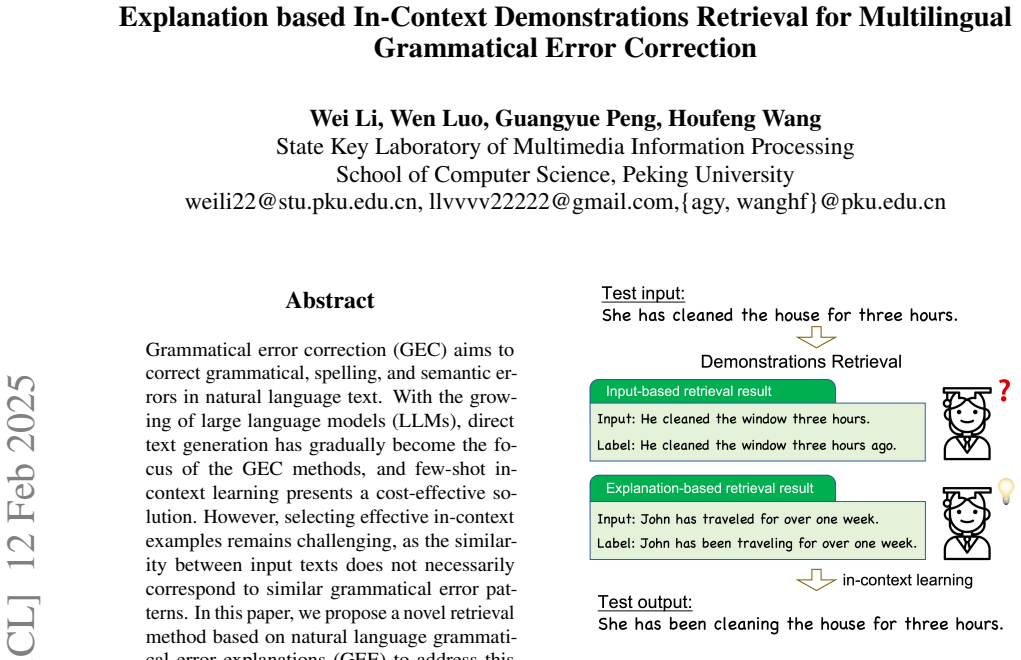
The load-bearing mechanism is the grammatical error explanation (GEE) used as the retrieval key: a short natural-language statement of what is wrong in a sentence and the grammar rule behind the correction. The paper has the teacher model Llama-3.1-8B-Instruct generate these explanations for each erroneous labeled sample, stores them in a database, embeds both the test input's detection-prompt explanation and the database explanations with xlm-roberta-large, and retrieves the nearest neighbors by cosine distance. Because the explanation describes the error rather than the topic of the sentence, two sentences about completely different subjects can be paired if they contain the same mistake. This is what allows the method to decouple demonstration selection from input-text similarity and to transfer across languages and test sets.
What would settle it
Take a test set with known error types, such as those extracted by ERRANT, and compute whether the top-$k$ demonstrations retrieved by explanation matching share at least one error type with the test input. If explanation-based retrieval does not achieve higher error-type overlap than input-text retrieval, or if the overlap is no better than random, the central claim that error patterns drive the gains would be falsified.
Extended reading notes
Core claim
The central discovery claimed is that natural-language grammatical error explanations make a better retrieval key than the input sentence itself when choosing in-context demonstrations for GEC. The paper creates two databases from labeled data: erroneous samples whose keys are teacher-generated explanations of the error, and correct samples whose keys are the raw input texts because error-free sentences have no explanation. At inference, a detection prompt converts the test input into an initial explanation $d_T$, which is embedded and matched against the explanation keys with kNN ($k_E=4$); the correct-sample query is the raw input ($k_C=4$). The retrieved text pairs are concatenated into a fixed few-shot prompt without including the explanations. The authors find that this method generally outperforms semantic and BM25 retrieval in F0.5 across English, Chinese, German, Russian, and Estonian, and that the same database carries over to a second English test set, leading them to conclude that matching error patterns is key to selecting examples.
Load-bearing premise
The method assumes that the detection prompt's initial explanation of the test input lands near the teacher-generated explanations of genuinely similar errors in the shared embedding space, even though the same explanation is too unreliable to serve as a chain-of-thought for the final correction.
Editorial extensions
If this is right
- Few-shot multilingual GEC can be improved for a new language without fine-tuning, provided a small labeled database with LLM-generated explanations exists for that language.
- A single explanation-indexed database transfers to multiple test sets in the same language, as shown on BEA-19 with a database built from W&I+LOCNESS.
- The finding that matching error patterns matters more than text similarity should carry over to other editing tasks, such as text simplification or style transfer, where the input-output relation is local.
- Balancing erroneous and correct demonstrations (here 4 and 4) sits near the optimum of the precision-recall tradeoff measured by F0.5.
Reading between the lines
- The method uses the detection-prompt explanation only as a retrieval key, and the paper's own experiments show the same explanation is harmful when inserted as a chain of thought; a likely general lesson is that noisy intermediate representations can still be useful for selecting examples even when they are not useful for reasoning.
- With better explanation generators, retrieval quality should improve without changing the pipeline, so the approach's ceiling is partly set by the teacher model rather than by the retriever.
- The Estonian correct-sample database contains only two examples while the method asks for four, so the reported gains there are probably driven almost entirely by the erroneous-sample retrieval; this suggests the correct-sample pool could be omitted in very low-resource settings or supplemented with synthetic error-free sentences.
Editorial analysis
A structured set of objections, weighed in public.
Referee Report
Summary. The paper proposes a retrieval method for few-shot in-context demonstrations in multilingual grammatical error correction (GEC). It constructs a database of erroneous samples whose keys are LLM-generated grammatical error explanations (GEE), and a database of correct samples keyed by input text. At inference, a detection prompt produces an initial explanation dT from the test input; kNN retrieval matches dT against the erroneous-sample keys and the test text against the correct-sample keys, and the retrieved (x,y) pairs are used as few-shot demonstrations for the final prediction. Experiments across five languages and four LLMs compare against Random, Semantic embedding, and BM25 retrieval using F0.5. The central claim is that explanation-based retrieval outperforms semantic and BM25 baselines without additional training or language adaptation, suggesting that matching error patterns is the key to demonstration selection.
Significance. Demo selection for GEC is a real problem, and replacing input-to-input similarity with error-pattern similarity is a plausible and useful idea. The paper's strengths are its training-free pipeline, its cross-lingual scope, the extension to BEA-19 in Section 5.1, the analysis of the correct/erroneous ratio in Section 5.3, and the release of code. If the mechanism is validated, the method would be a practical contribution to multilingual GEC and to interpretable in-context learning. However, the current evidence does not yet establish the mechanism: effect sizes over the Semantic baseline are often below one F0.5 point, several per-language/per-model cells show the proposed method underperforming Semantic, no statistical significance is reported, and the claim that retrieval operates on error-pattern similarity rests on only two case studies. The paper would be substantially strengthened by retrieval-quality measurements (e.g., error-type agreement between test inputs and retrieved demonstrations) and by a broader sensitivity analysis of the free parameters.
major comments (3)
- [Section 3.2 and Section 5.2] The load-bearing assumption of the method is that the label-free detection explanation dT (Eq. 4) is a reliable query in the xlm-roberta-large embedding space for retrieving samples with similar error patterns. Section 5.2 and Table 3 show that the same dT, when inserted as chain-of-thought, drastically reduces F0.5 (e.g., Llama3.1 English drops from 51.70 to 42.24 in zero-shot), and the authors attribute this to poor label-free explanation quality. That finding does not by itself invalidate dT as a retrieval key, but the paper currently provides no direct evidence that dT-based retrieval actually retrieves demonstrations with matching errors: the only qualitative support is the two selected case studies in Appendix C, and there is no measurement of error-type or edit overlap between test sentences and retrieved demonstrations. Because database keys are generated with gold labels while dT is generated without them, a query/key distribution shift is at the heart of the method. Please add quantitative retrieval-quality analysis (e.g., error-type precision@k, or a comparison of retrieval using dT versus using gold-label explanations) to substantiate the stated mechanism and the abstract's claim that matching error patterns is key.
- [Section 4.3, Table 1] The claimed consistent superiority over semantic retrieval is not supported by the reported effect sizes. For instance, Qwen2.5 on German obtains Explanation F0.5 55.08 versus Semantic 55.76; Deepseek2.5 on Chinese obtains 37.62 versus Semantic 38.44; and on Llama3.1 CoNLL-14 the gain over Semantic is only 0.16 (54.60 vs 54.44). No error bars, confidence intervals, or significance tests are reported; the Random baseline averages three seeds while the other methods are reported from single runs. Because the central claim is that the proposed method 'consistently outperforms' semantic and BM25 retrieval, please report variance (e.g., bootstrap over test samples or multiple seeds for API models) and a paired significance test, and discuss the fraction of language/model settings in which the improvement is statistically reliable.
- [Sections 4.2 and 5.3, Table 6] The number of correct demonstrations kC=4 is selected from a sweep on the evaluation datasets (Figure 3) rather than fixed a priori or chosen on a held-out set, so the comparison may be favorable to the proposed method relative to baselines evaluated only at the default setting. Additionally, the Estonian database contains only 2 correct samples after filtering (Table 6), while Section 4.2 states kC=4 for all methods; it is unclear how four correct demonstrations are obtained for Estonian. Please clarify the Estonian procedure (e.g., retrieval with replacement, duplication, or fewer correct demonstrations) and provide a validation strategy or sensitivity analysis showing that the main conclusions are robust to the choice of kC.
minor comments (6)
- [Limitations] The Limitations section states that experiments were conducted on '2 open-source LLMs and 1 closed-source LLM,' but Table 1 reports results for two closed-source models (Deepseek2.5 and GPT4o-mini) in addition to Llama3.1 and Qwen2.5; please correct this count.
- [Section 4.2 and Table 1] BM25 results are missing for Estonian in Table 1, and the text notes in the Limitations that LlamaIndex encountered issues with the Estonian dataset. Please state this explicitly in the table or caption (e.g., 'not available') so readers do not infer that BM25 is inapplicable by design.
- [Section 5.2, Table 3] The comparison in Table 3 is run only with Llama3.1, and the 'Post' condition places the explanation after the corrected text, which is not a chain-of-thought condition; the statement that using the initial explanation as an intermediate reasoning step is harmful should be restricted to the single model tested and to the 'Pre' condition.
- [Section 3.3, Eq. (7)] Equation (7) defines D as DE ⊕ DC without specifying the concatenation order; please define whether erroneous demonstrations always precede correct demonstrations and whether the order is shuffled, since demonstration ordering is known to affect ICL performance.
- [Abstract] The concluding sentence 'This also suggests that matching error patterns is key to selecting examples' goes beyond the correlational evidence; the paper demonstrates that explanation-based retrieval helps in some settings, but does not isolate error-pattern matching from other differences (e.g., the extra detection call, the correct-sample retrieval, or prompt wording). Please soften this claim or add the proposed retrieval-quality analysis.
- [Table 7] Qwen2.5 uses a different, shorter detection prompt than the other three models (Table 7). This is a potential confound in cross-model comparisons of dT quality and final F0.5; please either report results with a common detection prompt or discuss the implications.
Circularity Check
No significant circularity: the method is an empirical retrieval pipeline that does not reduce to its inputs; the only mild concern is selecting kC from test data, which is hyperparameter fitting rather than a claim-forcing circular step.
full rationale
The derivation chain here is an empirical retrieval pipeline rather than a formal derivation. The query for the erroneous-sample database is dT = LLMp(promptd(xT)) (Eq. 4), and the database keys are teacher-generated GEE from labeled (x,y) pairs (Eq. 2); the final demonstrations are only (x,y) text pairs (Eq. 7), so no gold label or explanation is injected at inference. The central comparison (Table 1) pits explanation-keyed retrieval against input-keyed semantic and BM25 retrieval under the same kE=kC=4 setting and the same few-shot prompt template, so the reported advantage is not forced by construction. The self-citation to Li and Wang (2024) appears only in a related-work sentence about detection-correction structures and is not load-bearing. Section 5.2's finding that the initial explanation is harmful as CoT does not create circularity, because the explanation is used as a retrieval key, not as a reasoning step in the final prompt; at most it leaves the retrieval-quality mechanism empirically under-validated, which is an evidence gap rather than a definitional reduction. The one mild fitting concern is Section 5.3's choice of kC=4 after observing that F0.5 peaks at 4-5 correct samples on the test sets; this is test-set hyperparameter selection, but it is applied equally to the baselines, so it does not make the method's relative claim self-fulfilling. Overall, no step in the paper reduces a predicted quantity to an input by definition or via a self-citation chain.
Assumptions & free parameters
free parameters (4)
- kC (number of correct demonstrations) =
4
- kE (number of erroneous demonstrations) =
4
- Token length filter bounds =
10 to 60 tokens
- Database size cap =
25,000 samples
assumptions (3)
- domain assumption xlm-roberta-large embeddings capture semantically meaningful similarity between natural-language explanations across English, Chinese, German, Russian, and Estonian.
- domain assumption The detection prompt applied to the prediction model produces an explanation whose embedding is a useful proxy for the error pattern in the test input.
- domain assumption Teacher-generated explanations are consistent enough with the error patterns in the (x,y) pairs to serve as reliable keys.
Cite this review
Pith. "Pith review of Explanation based In-Context Demonstrations Retrieval for Multilingual Grammatical Error Correction." pith.science (2026). https://pith.science/paper/2AZK4NQG
@misc{pith2026250208507,
  author       = {Pith},
  title        = {Pith review of: Explanation based In-Context Demonstrations Retrieval for Multilingual Grammatical Error Correction},
  year         = {2026},
  howpublished = {\url{https://pith.science/paper/2AZK4NQG}},
  note         = {Machine review of arXiv:2502.08507}
}
read the original abstract
Grammatical error correction (GEC) aims to correct grammatical, spelling, and semantic errors in natural language text. With the growing of large language models (LLMs), direct text generation has gradually become the focus of the GEC methods, and few-shot in-context learning presents a cost-effective solution. However, selecting effective in-context examples remains challenging, as the similarity between input texts does not necessarily correspond to similar grammatical error patterns. In this paper, we propose a novel retrieval method based on natural language grammatical error explanations (GEE) to address this issue. Our method retrieves suitable few-shot demonstrations by matching the GEE of the test input with that of pre-constructed database samples, where explanations for erroneous samples are generated by LLMs. We conducted multilingual GEC few-shot experiments on both major open-source and closed-source LLMs. Experiments across five languages show that our method outperforms existing semantic and BM25-based retrieval techniques, without requiring additional training or language adaptation. This also suggests that matching error patterns is key to selecting examples.
Figures


Figures from the paper (2 more)


Reference graph
Works this paper leans on
-
[1]
Josh Achiam, Steven Adler, Sandhini Agarwal, Lama Ahmad, Ilge Akkaya, Florencia Leoni Aleman, Diogo Almeida, Janko Altenschmidt, Sam Altman, Shyamal Anadkat, et al. 2023. Gpt-4 technical report. arXiv preprint arXiv:2303.08774
arXiv 2023
-
[2]
Sweta Agrawal, Chunting Zhou, Mike Lewis, Luke Zettlemoyer, and Marjan Ghazvininejad. 2023. https://doi.org/10.18653/v1/2023.findings-acl.564 In-context examples selection for machine translation . In Findings of the Association for Computational Linguistics: ACL 2023, pages 8857--8873, Toronto, Canada. Association for Computational Linguistics
-
[3]
Abhijeet Awasthi, Sunita Sarawagi, Rasna Goyal, Sabyasachi Ghosh, and Vihari Piratla. 2019. https://doi.org/10.18653/v1/D19-1435 Parallel iterative edit models for local sequence transduction . In Proceedings of the 2019 Conference on Empirical Methods in Natural Language Processing and the 9th International Joint Conference on Natural Language Processing...
-
[4]
Adriane Boyd. 2018. https://doi.org/10.18653/v1/W18-6111 Using W ikipedia edits in low resource grammatical error correction . In Proceedings of the 2018 EMNLP Workshop W- NUT : The 4th Workshop on Noisy User-generated Text , pages 79--84, Brussels, Belgium. Association for Computational Linguistics
-
[5]
Tom B Brown. 2020. Language models are few-shot learners. arXiv preprint arXiv:2005.14165
arXiv 2020
-
[6]
Christopher Bryant, Mariano Felice, istein E. Andersen, and Ted Briscoe. 2019. https://doi.org/10.18653/v1/W19-4406 The BEA -2019 shared task on grammatical error correction . In Proceedings of the Fourteenth Workshop on Innovative Use of NLP for Building Educational Applications, pages 52--75, Florence, Italy. Association for Computational Linguistics
-
[7]
Christopher Bryant, Mariano Felice, and Ted Briscoe. 2017. https://doi.org/10.18653/v1/P17-1074 Automatic annotation and evaluation of error types for grammatical error correction . In Proceedings of the 55th Annual Meeting of the Association for Computational Linguistics (Volume 1: Long Papers), pages 793--805, Vancouver, Canada. Association for Computat...
-
[8]
Christopher Bryant, Zheng Yuan, Muhammad Reza Qorib, Hannan Cao, Hwee Tou Ng, and Ted Briscoe. 2023. https://doi.org/10.1162/coli_a_00478 Grammatical Error Correction: A Survey of the State of the Art . Computational Linguistics, 49(3):643--701
Show all 69 references
-
[9]
Andrew Caines, Luca Benedetto, Shiva Taslimipoor, Christopher Davis, Yuan Gao, Oeistein Andersen, Zheng Yuan, Mark Elliott, Russell Moore, Christopher Bryant, et al. 2023. On the application of large language models for language teaching and assessment technology. arXiv prepri...
2023 arXiv
-
[10]
Alexis Conneau, Kartikay Khandelwal, Naman Goyal, Vishrav Chaudhary, Guillaume Wenzek, Francisco Guzm \' a n, Edouard Grave, Myle Ott, Luke Zettlemoyer, and Veselin Stoyanov. 2019. https://arxiv.org/abs/1911.02116 Unsupervised cross-lingual representation learning at scale . C...
2019 arXiv
-
[11]
Steven Coyne, Keisuke Sakaguchi, Diana Galvan-Sosa, Michael Zock, and Kentaro Inui. 2023. Analyzing the performance of gpt-3.5 and gpt-4 in grammatical error correction. arXiv preprint arXiv:2303.14342
2023 arXiv
-
[12]
Daniel Dahlmeier and Hwee Tou Ng. 2012. https://aclanthology.org/N12-1067 Better evaluation for grammatical error correction . In Proceedings of the 2012 Conference of the North A merican Chapter of the Association for Computational Linguistics: Human Language Technologies , p...
2012
-
[13]
Christopher Davis, Andrew Caines, O Andersen, Shiva Taslimipoor, Helen Yannakoudakis, Zheng Yuan, Christopher Bryant, Marek Rei, and Paula Buttery. 2024. https://doi.org/10.18653/v1/2024.findings-acl.711 Prompting open-source and commercial language models for grammatical erro...
2024 doi
-
[14]
DeepSeek-AI. 2024. https://arxiv.org/abs/2405.04434 Deepseek-v2: A strong, economical, and efficient mixture-of-experts language model . Preprint, arXiv:2405.04434
2024 arXiv
-
[15]
Jacob Devlin, Ming-Wei Chang, Kenton Lee, and Kristina Toutanova. 2019. https://doi.org/10.18653/v1/N19-1423 BERT : Pre-training of deep bidirectional transformers for language understanding . In Proceedings of the 2019 Conference of the North A merican Chapter of the Associat...
2019 doi
-
[16]
Abhimanyu Dubey, Abhinav Jauhri, Abhinav Pandey, Abhishek Kadian, Ahmad Al-Dahle, Aiesha Letman, Akhil Mathur, Alan Schelten, Amy Yang, Angela Fan, et al. 2024. The llama 3 herd of models. arXiv preprint arXiv:2407.21783
2024 arXiv
-
[17]
Yaxin Fan, Feng Jiang, Peifeng Li, and Haizhou Li. 2023. Grammargpt: Exploring open-source llms for native chinese grammatical error correction with supervised fine-tuning. In CCF International Conference on Natural Language Processing and Chinese Computing, pages 69--80
2023
-
[18]
Yuejiao Fei, Leyang Cui, Sen Yang, Wai Lam, Zhenzhong Lan, and Shuming Shi. 2023. https://doi.org/10.18653/v1/2023.acl-long.413 Enhancing grammatical error correction systems with explanations . In Proceedings of the 61st Annual Meeting of the Association for Computational Lin...
2023 doi
-
[19]
Yao Fu, Hao Peng, Ashish Sabharwal, Peter Clark, and Tushar Khot. 2022. Complexity-based prompting for multi-step reasoning. In The Eleventh International Conference on Learning Representations
2022
-
[20]
SU Hongjin, Jungo Kasai, Chen Henry Wu, Weijia Shi, Tianlu Wang, Jiayi Xin, Rui Zhang, Mari Ostendorf, Luke Zettlemoyer, Noah A Smith, et al. 2022. Selective annotation makes language models better few-shot learners. In The Eleventh International Conference on Learning Representations
2022
-
[21]
Marcin Junczys-Dowmunt, Roman Grundkiewicz, Shubha Guha, and Kenneth Heafield. 2018. https://doi.org/10.18653/v1/N18-1055 Approaching neural grammatical error correction as a low-resource machine translation task . In Proceedings of the 2018 Conference of the North A merican C...
2018 doi
-
[22]
Masahiro Kaneko and Naoaki Okazaki. 2024. https://aclanthology.org/2024.lrec-main.350 Controlled generation with prompt insertion for natural language explanations in grammatical error correction . In Proceedings of the 2024 Joint International Conference on Computational Ling...
2024
-
[23]
Masahiro Kaneko, Sho Takase, Ayana Niwa, and Naoaki Okazaki. 2022. https://doi.org/10.18653/v1/2022.acl-long.496 Interpretability for language learners using example-based grammatical error correction . In Proceedings of the 60th Annual Meeting of the Association for Computati...
2022 doi
-
[24]
Anisia Katinskaia and Roman Yangarber. 2021. https://aclanthology.org/2021.bea-1.15 Assessing grammatical correctness in language learning . In Proceedings of the 16th Workshop on Innovative Use of NLP for Building Educational Applications, pages 135--146, Online. Association ...
2021
-
[25]
Satoru Katsumata and Mamoru Komachi. 2020. https://aclanthology.org/2020.aacl-main.83 Stronger baselines for grammatical error correction using a pretrained encoder-decoder model . In Proceedings of the 1st Conference of the Asia-Pacific Chapter of the Association for Computat...
2020
-
[26]
Urvashi Khandelwal, Angela Fan, Dan Jurafsky, Luke Zettlemoyer, and Mike Lewis. 2020. Nearest neighbor machine translation. arXiv preprint arXiv:2010.00710
2020 arXiv
-
[27]
Shaopeng Lai, Qingyu Zhou, Jiali Zeng, Zhongli Li, Chao Li, Yunbo Cao, and Jinsong Su. 2022. https://doi.org/10.18653/v1/2022.findings-acl.254 Type-driven multi-turn corrections for grammatical error correction . In Findings of the Association for Computational Linguistics: AC...
2022 doi
-
[28]
Mike Lewis, Yinhan Liu, Naman Goyal, Marjan Ghazvininejad, Abdelrahman Mohamed, Omer Levy, Veselin Stoyanov, and Luke Zettlemoyer. 2020 a . https://doi.org/10.18653/v1/2020.acl-main.703 BART : Denoising sequence-to-sequence pre-training for natural language generation, transla...
2020 doi
-
[29]
u ttler, Mike Lewis, Wen-tau Yih, Tim Rockt \
Patrick Lewis, Ethan Perez, Aleksandra Piktus, Fabio Petroni, Vladimir Karpukhin, Naman Goyal, Heinrich K \"u ttler, Mike Lewis, Wen-tau Yih, Tim Rockt \"a schel, et al. 2020 b . Retrieval-augmented generation for knowledge-intensive nlp tasks. Advances in Neural Information P...
2020
-
[30]
Aitor Lewkowycz, Anders Andreassen, David Dohan, Ethan Dyer, Henryk Michalewski, Vinay Ramasesh, Ambrose Slone, Cem Anil, Imanol Schlag, Theo Gutman-Solo, Yuhuai Wu, Behnam Neyshabur, Guy Gur-Ari, and Vedant Misra. 2022. https://proceedings.neurips.cc/paper_files/paper/2022/fi...
2022
-
[31]
Junyi Li, Tianyi Tang, Wayne Xin Zhao, Jian-Yun Nie, and Ji-Rong Wen. 2024. Pre-trained language models for text generation: A survey. ACM Computing Surveys, 56(9):1--39
2024
-
[32]
Wei Li and Houfeng Wang. 2024. https://doi.org/10.18653/v1/2024.acl-long.96 Detection-correction structure via general language model for grammatical error correction . In Proceedings of the 62nd Annual Meeting of the Association for Computational Linguistics (Volume 1: Long P...
2024 doi
-
[33]
Xiaonan Li and Xipeng Qiu. 2023. Finding supporting examples for in-context learning. arXiv preprint arXiv:2302.13539, 3
2023 arXiv
-
[34]
Wong, Yang Gao, Heyan Huang, and Min Zhang
Yinghao Li, Xuebo Liu, Shuo Wang, Peiyuan Gong, Derek F. Wong, Yang Gao, Heyan Huang, and Min Zhang. 2023. https://doi.org/10.18653/v1/2023.acl-long.380 T emplate GEC : Improving grammatical error correction with detection template . In Proceedings of the 61st Annual Meeting o...
2023 doi
-
[35]
Kai-Hui Liang, Sam Davidson, Xun Yuan, Shehan Panditharatne, Chun-Yen Chen, Ryan Shea, Derek Pham, Yinghua Tan, Erik Voss, and Luke Fryer. 2023. https://doi.org/10.18653/v1/2023.bea-1.7 C hat B ack: Investigating methods of providing grammatical error feedback in a GUI -based ...
2023 doi
-
[36]
Jerry Liu. 2022. https://doi.org/10.5281/zenodo.1234 LlamaIndex
2022 doi
-
[37]
Mengsay Loem, Masahiro Kaneko, Sho Takase, and Naoaki Okazaki. 2023. https://doi.org/10.18653/v1/2023.bea-1.18 Exploring effectiveness of GPT -3 in grammatical error correction: A study on performance and controllability in prompt-based methods . In Proceedings of the 18th Wor...
2023 doi
-
[38]
Agnes Luhtaru, Elizaveta Korotkova, and Mark Fishel. 2024. https://aclanthology.org/2024.eacl-long.73 No error left behind: Multilingual grammatical error correction with pre-trained translation models . In Proceedings of the 18th Conference of the European Chapter of the Asso...
2024
-
[39]
Man Luo, Xin Xu, Zhuyun Dai, Panupong Pasupat, Mehran Kazemi, Chitta Baral, Vaiva Imbrasaite, and Vincent Y Zhao. 2023. Dr. icl: Demonstration-retrieved in-context learning. arXiv preprint arXiv:2305.14128
2023 arXiv
-
[40]
Junghwan Maeng, Jinghang Gu, and Sun-A Kim. 2023. https://aclanthology.org/2023.paclic-1.46 Effectiveness of C hat GPT in K orean grammatical error correction . In Proceedings of the 37th Pacific Asia Conference on Language, Information and Computation, pages 464--472, Hong Ko...
2023
-
[41]
Hwee Tou Ng, Siew Mei Wu, Ted Briscoe, Christian Hadiwinoto, Raymond Hendy Susanto, and Christopher Bryant. 2014. https://doi.org/10.3115/v1/W14-1701 The C o NLL -2014 shared task on grammatical error correction . In Proceedings of the Eighteenth Conference on Computational Na...
2014 doi
-
[42]
Kostiantyn Omelianchuk, Vitaliy Atrasevych, Artem Chernodub, and Oleksandr Skurzhanskyi. 2020. https://doi.org/10.18653/v1/2020.bea-1.16 GECT o R -- grammatical error correction: Tag, not rewrite . In Proceedings of the Fifteenth Workshop on Innovative Use of NLP for Building ...
2020 doi
-
[43]
Maria Carolina Penteado and F \'a bio Perez. 2023. Evaluating gpt-3.5 and gpt-4 on grammatical error correction for brazilian portuguese. arXiv preprint arXiv:2306.15788
2023 arXiv
-
[44]
Libo Qin, Qiguang Chen, Yuhang Zhou, Zhi Chen, Yinghui Li, Lizi Liao, Min Li, Wanxiang Che, and Philip S Yu. 2024. Multilingual large language model: A survey of resources, taxonomy and frontiers. arXiv preprint arXiv:2404.04925
2024 arXiv
-
[45]
Vipul Raheja, Dimitris Alikaniotis, Vivek Kulkarni, Bashar Alhafni, and Dhruv Kumar. 2024. https://doi.org/10.18653/v1/2024.naacl-long.56 m E d IT : Multilingual text editing via instruction tuning . In Proceedings of the 2024 Conference of the North American Chapter of the As...
2024 doi
-
[46]
N Reimers. 2019. Sentence-bert: Sentence embeddings using siamese bert-networks. arXiv preprint arXiv:1908.10084
2019 arXiv
-
[47]
Stephen Robertson, Hugo Zaragoza, et al. 2009. The probabilistic relevance framework: Bm25 and beyond. Foundations and Trends in Information Retrieval , 3(4):333--389
2009
-
[48]
Sascha Rothe, Jonathan Mallinson, Eric Malmi, Sebastian Krause, and Aliaksei Severyn. 2021. https://doi.org/10.18653/v1/2021.acl-short.89 A simple recipe for multilingual grammatical error correction . In Proceedings of the 59th Annual Meeting of the Association for Computatio...
2021 doi
-
[49]
Alla Rozovskaya and Dan Roth. 2019. https://doi.org/10.1162/tacl_a_00251 Grammar Error Correction in Morphologically Rich Languages: The Case of Russian . Transactions of the Association for Computational Linguistics, 7:1--17
2019 doi
-
[50]
Yixiao Song, Kalpesh Krishna, Rajesh Bhatt, Kevin Gimpel, and Mohit Iyyer. 2024. https://doi.org/10.18653/v1/2024.findings-naacl.49 GEE ! grammar error explanation with large language models . In Findings of the Association for Computational Linguistics: NAACL 2024, pages 754-...
2024 doi
-
[51]
Hao Sun, Yong Jiang, Bo Wang, Yingyan Hou, Yan Zhang, Pengjun Xie, and Fei Huang. 2024. Retrieved in-context principles from previous mistakes. arXiv preprint arXiv:2407.05682
2024 arXiv
-
[52]
Xin Sun, Tao Ge, Shuming Ma, Jingjing Li, Furu Wei, and Houfeng Wang. 2022. https://doi.org/10.24963/ijcai.2022/606 A unified strategy for multilingual grammatical error correction with pre-trained cross-lingual language model . In Proceedings of the Thirty-First International...
2022 doi
-
[53]
Chenming Tang, Fanyi Qu, and Yunfang Wu. 2024. https://doi.org/10.18653/v1/2024.naacl-long.99 Ungrammatical-syntax-based in-context example selection for grammatical error correction . In Proceedings of the 2024 Conference of the North American Chapter of the Association for C...
2024 doi
-
[54]
Qwen Team. 2024. https://qwenlm.github.io/blog/qwen2.5/ Qwen2.5: A party of foundation models
2024
-
[55]
Hugo Touvron, Thibaut Lavril, Gautier Izacard, Xavier Martinet, Marie-Anne Lachaux, Timoth \'e e Lacroix, Baptiste Rozi \`e re, Naman Goyal, Eric Hambro, Faisal Azhar, et al. 2023. Llama: Open and efficient foundation language models. arXiv preprint arXiv:2302.13971
2023 arXiv
-
[56]
Justin Vasselli and Taro Watanabe. 2023. https://doi.org/10.18653/v1/2023.bea-1.19 A closer look at k-nearest neighbors grammatical error correction . In Proceedings of the 18th Workshop on Innovative Use of NLP for Building Educational Applications (BEA 2023), pages 220--231,...
2023 doi
-
[57]
A Vaswani. 2017. Attention is all you need. Advances in Neural Information Processing Systems
2017
-
[58]
Xin Xu, Yue Liu, Panupong Pasupat, Mehran Kazemi, et al. 2024. In-context learning with retrieved demonstrations for language models: A survey. arXiv preprint arXiv:2401.11624
2024 arXiv
-
[59]
Jingheng Ye, Shang Qin, Yinghui Li, Xuxin Cheng, Libo Qin, Hai-Tao Zheng, Peng Xing, Zishan Xu, Guo Cheng, and Zhao Wei. 2024. Excgec: A benchmark of edit-wise explainable chinese grammatical error correction. arXiv preprint arXiv:2407.00924
2024 arXiv
-
[60]
Zheng Yuan and Ted Briscoe. 2016. https://doi.org/10.18653/v1/N16-1042 Grammatical error correction using neural machine translation . In Proceedings of the 2016 Conference of the North A merican Chapter of the Association for Computational Linguistics: Human Language Technolo...
2016 doi
-
[61]
Min Zeng, Jiexin Kuang, Mengyang Qiu, Jayoung Song, and Jungyeul Park. 2024. https://aclanthology.org/2024.lrec-main.569 Evaluating prompting strategies for grammatical error correction based on language proficiency . In Proceedings of the 2024 Joint International Conference o...
2024
-
[62]
Baolin Zhang. 2009. Features and functions of the hsk dynamic composition corpus. International Chinese Language Education, 4:71--79
2009
-
[63]
Ying Zhang, Hidetaka Kamigaito, and Manabu Okumura. 2023. https://doi.org/10.18653/v1/2023.findings-acl.234 Bidirectional transformer reranker for grammatical error correction . In Findings of the Association for Computational Linguistics: ACL 2023, pages 3801--3825, Toronto, ...
2023 doi
-
[64]
Yue Zhang, Zhenghua Li, Zuyi Bao, Jiacheng Li, Bo Zhang, Chen Li, Fei Huang, and Min Zhang. 2022 a . https://doi.org/10.18653/v1/2022.naacl-main.227 M u CGEC : a multi-reference multi-source evaluation dataset for C hinese grammatical error correction . In Proceedings of the 2...
2022 doi
-
[65]
Yue Zhang, Bo Zhang, Zhenghua Li, Zuyi Bao, Chen Li, and Min Zhang. 2022 b . https://doi.org/10.18653/v1/2022.emnlp-main.162 S yn GEC : Syntax-enhanced grammatical error correction with a tailored GEC -oriented parser . In Proceedings of the 2022 Conference on Empirical Method...
2022 doi
-
[66]
Yuanyuan Zhao, Nan Jiang, Weiwei Sun, and Xiaojun Wan. 2018. Overview of the nlpcc 2018 shared task: Grammatical error correction. In Natural Language Processing and Chinese Computing, pages 439--445, Cham. Springer International Publishing
2018
-
[67]
Houquan Zhou, Yumeng Liu, Zhenghua Li, Min Zhang, Bo Zhang, Chen Li, Ji Zhang, and Fei Huang. 2023. https://doi.org/10.18653/v1/2023.findings-emnlp.495 Improving S eq2 S eq grammatical error correction via decoding interventions . In Findings of the Association for Computation...
2023 doi
-
[68]
online" 'onlinestring :=
ENTRY address archivePrefix author booktitle chapter edition editor eid eprint eprinttype howpublished institution journal key month note number organization pages publisher school series title type volume year doi pubmed url lastchecked label extra.label sort.label short.list...
-
[69]
write newline
" write newline "" before.all 'output.state := FUNCTION n.dashify 't := "" t empty not t #1 #1 substring "-" = t #1 #2 substring "--" = not "--" * t #2 global.max substring 't := t #1 #1 substring "-" = "-" * t #2 global.max substring 't := while if t #1 #1 substring * t #2 gl...
Reviewed August 8, 2026 · model on record in the stance chip above.
Discussion (0). Continue with ORCID to comment.