REVIEW 6 major objections 4 minor 27 references
Style Extraction on Text Embeddings Using VAE and Parallel Dataset
T0 review · 6 major / 4 minor · reviewed 2026-08-08 · deepseek-v4-flash
Pith's one-line read A VAE trained on KJV-minus-ASV embedding differences can separate the American Standard Version's style from five other Bible translations with 84.7 percent accuracy.
desk verdict A plausible parallel-subtraction idea with one informative control, but the model isn't a VAE, the algorithm doesn't match the text, and the evaluation leaks test data—desk-reject as is. read the letter →
The pith
A machine-rendered reading of the paper's core claim, the machinery that carries it, and where it could break.
The reading
What carries the argument
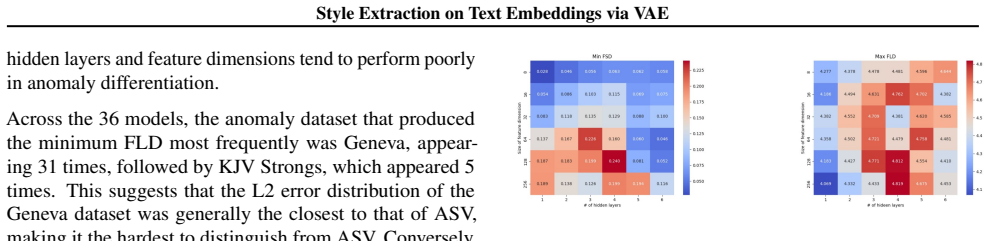
The load-bearing identity is the additive decomposition $$\text{embedding} = \text{style embedding} + \text{content embedding}$$, together with the claim that parallel Bible verses have identical content embeddings, so $\text{KJV embedding} - \text{ASV embedding}$ equals a pure style difference. The variational autoencoder (a neural network that compresses 1536-dimensional inputs through a low-dimensional latent space and reconstructs them, trained here with mean-squared-error loss) is the anomaly detector: reconstruction error is low for style differences seen in training and higher for unseen styles. Fisher's linear discriminant on the L2-error distributions of ASV versus each other translation selects the hyperparameters and scores how separable the styles are.
What would settle it
Train the identical VAE on KJV-minus-KJV differences obtained by aligning the same translation against itself, or against a near-identical version such as ASV versus ASVS, and run the same anomaly-detection protocol; if the model still reports separable style distributions with high Fisher linear discriminant, the reported separation is not evidence of translation style.
Extended reading notes
Core claim
The paper's central claim is that a variational autoencoder trained on the vector differences between two parallel translations learns the stylistic signature of one translation relative to the other. Since every verse appears in both versions with the same content, the paper assumes the content terms cancel in the subtraction, leaving a pure style vector; the VAE's reconstruction error on new difference vectors then acts as an anomaly detector. The paper reports that this separates ASV from NET, ASVS, Coverdale, Geneva, and KJV Strongs with 84.7 percent accuracy, that the hardest pair is ASV versus Geneva, and that removing the KJV subtraction drops the mean minimum Fisher linear discriminant from 1.111 to 0.116, a factor of about 9.6.
Load-bearing premise
The whole procedure rests on the premise that a verse's embedding splits cleanly into content and style, so that subtracting two translations of the same verse leaves only style; if the embedding carries content-dependent differences such as word order, punctuation, archaic spelling, or translation choices, the 'style' vectors are contaminated and the anomaly scores measure something else.
Editorial extensions
If this is right
- If the result is correct, any two parallel texts can be turned into a training set for a style detector without human labels.
- The style of a text becomes a vector: the difference between the reconstruction errors of two translations quantifies stylistic distance, so one can order translations or authors by similarity.
- The 9.6-fold drop in Fisher linear discriminant when context subtraction is removed indicates that subtraction is what isolates style, so a practical pipeline should always use parallel data.
- Because the VAE is here optimized for one reference style, the method is currently limited to one-versus-rest style questions rather than joint separation of many styles.
Reading between the lines
- A direct test not run in the paper would be to train the same VAE on differences between two halves of the same translation, such as KJV versus KJV on aligned verses; if it still finds separable distributions, the separation is an artifact of embedding geometry rather than translation style.
- The model's ranking of translation pairs, with Coverdale easiest to distinguish and Geneva hardest, could be checked against human stylistic similarity judgments or against known historical and linguistic distances between the translations.
- Because the embedding model was trained for semantic similarity, one should verify that the style vectors are stable across different embedding models; if they are not, the style signature is an artifact of one encoder.
Editorial analysis
A structured set of objections, weighed in public.
Referee Report
Summary. The paper proposes a method for extracting textual style from sentence embeddings using a Variational Autoencoder (VAE) and a parallel Bible corpus. The authors embed verses from multiple translations with OpenAI's text-embedding-3-small, compute KJV-minus-ASV embedding differences, train an autoencoder on these differences, and then use reconstruction L2 error with a threshold to distinguish ASV from five other translations. The abstract and conclusion claim that the VAE is 'proficient in capturing and differentiating textual styles' and that each translation has a unique stylistic distribution, supported by a reported accuracy of 84.7%. The paper also compares a version with and without KJV subtraction and reports Fisher's Linear Discriminant values for model selection.
Significance. If the method worked as claimed, it would provide a cheap, automatic style metric useful for evaluating text-style transfer and measuring stylistic similarity across translations. The parallel-corpus design is an attractive way to hold content fixed while varying style, and using reconstruction error for anomaly detection is a reasonable and interpretable framework. However, the manuscript as submitted does not validate the central claim: the training objective is not a VAE objective, the inference algorithm does not implement the described subtraction, the threshold and hyperparameters are chosen on test data, the evaluation is circular, and the reported accuracy numbers are internally inconsistent. I see a potentially salvageable idea, but the current evidence does not support the abstract's conclusions.
major comments (6)
- [Section 3.3] The displayed assumption 'text embedding = style embedding + content embedding', together with the claim that parallel Bible verses have identical content embeddings, is neither derived nor supported. Table 3 shows that translations differ in orthography ('begynnynge' vs. 'beginning'), punctuation, and word choice ('heauen' vs. 'heavens'), all of which change the input to a nonlinear semantic embedding model. The KJV−ASV difference vectors are therefore content-contaminated, and the paper provides no control experiment to separate content from style.
- [Algorithm 1] Algorithm 1 optimizes only an MSE reconstruction loss and has no KL divergence term and no sampling from a latent posterior; this is a plain autoencoder, not a variational autoencoder. The abstract and conclusion repeatedly attribute VAE-specific capabilities to the model, and the discussion of learned distributions and normality is not supported by the stated architecture.
- [Algorithm 2] Algorithm 2 feeds a(i) and y_j(i) directly into an encoder trained on x(i), and never subtracts the corresponding KJV embedding k(i) at test time. This contradicts Section 3.5, which states that 'the anomaly data ... will be processed by subtracting the corresponding KJV sentence vectors'. Consequently, the FLD values and accuracy figures in Section 4 do not test the KJV−ASV style-difference hypothesis as described. In addition, line 16 compares the FLD S_j to gamma = mu_a + alpha sigma_a, which is an L2-error threshold, so the decision rule mixes incommensurable quantities.
- [Section 3.5 and Algorithm 2] The threshold gamma is chosen by minimizing total error on the test set, and the best hyperparameter set among 36 is selected by FLD computed on held-out test translations. Hence the reported 84.7% accuracy is optimistically biased by test-set fitting; a separate validation set and a pre-specified threshold are needed before the method can be honestly evaluated.
- [Section 4.3 and Discussion] The anomaly detection is circular. The training vectors are x(i) = KJV−ASV, so the 'normal' class (ASV, after the intended subtraction) is in-distribution by construction; lower reconstruction error for ASV than for other translations is expected even without any genuine stylistic content. No baseline such as raw-embedding distance, a one-class SVM, or a random-label permutation is provided, so the claim that the model captures 'unique stylistic distributions' is not established.
- [Section 5 and Table 2] The central accuracy numbers are inconsistent. The text reports 84.7% accuracy with 8.7% Type I error and 6.7% Type II error, totaling 15.3%, while Table 2 reports average accuracy 83.3% and average total error 16.8%, and the threshold at mean + 0.8 std is said to give an overall error of 16.8%. These discrepancies must be reconciled before the headline result can be assessed.
minor comments (4)
- [Figures 2 and 3] Figures 2 and 3 list feature dimensions of 8, 64, and 256, while Section 3.4 states that the feature dimension ranges from 23 to 28; the hyperparameter reporting is inconsistent.
- [Introduction] The introduction claims that the geometric method 'aligns well with human evaluations', but no human evaluation or comparison with human judgments appears anywhere in the paper.
- [Discussion] The statement that 'the styles of each Bible translation followed a normal distribution' is asserted without any normality test or distributional evidence.
- [General] No code or data release instructions are provided, which limits reproducibility of the reported experiments.
Circularity Check
Partially circular: ASV is both the target used to define the training-difference vectors and the evaluated 'normal' class, and the 84.7% accuracy is obtained after threshold tuning on the reported test set.
-
self definitional
[Section 3.3 to 3.5, Table 1, Algorithm 2]
"During the training process of the V AE, we used the distribution differences between KJV embedding and ASV embedding. The V AE learned the difference between KJV and ASV embeddings in the latent space and then measured the similarity between the reconstructed distribution and the original distribution. For the test dataset (not used during model training), ASV will serve as the normal data, and the other five translations (NET, ASVS, Coverdale, Geneva, and KJV Strongs) will serve as anomaly data."
The training vector is x(i)=k(i)-a(i) (KJV embedding minus ASV embedding), so ASV is the one translation whose embedding is baked into every training sample. The same class, ASV, is then labelled 'normal data' in the evaluation, and the paper concludes that 'each translation exhibits a unique stylistic distribution' with ASV specially recognizable. This is a restatement of the training design: the model was fitted on a distribution defined by the ASV difference, and the 'unique style' of ASV is therefore built into the input rather than discovered from independent style labels. Held-out ASV reconstruction inherits the fitted distribution, so the reported separation is partially by construction and is not independent evidence of style generalization.
-
fitted input called prediction
[Section 5 (Discussion), Accuracy Test Dataset paragraph]
"To measure the overall accuracy, False Positive Rate (FPR), and False Negative Rate (FNR) of the model, we created an Accuracy Test Dataset using data not included in the training set. ... The binary classification results showed that the lowest overall error rate was achieved when the threshold was set at mean + 0.8 std."
The threshold γ=μ_a+ασ_a is selected by minimizing the total error on the very Accuracy Test Dataset that is then used to report the error rates. Thus the headline accuracy of 84.7% is the minimum achievable error on that set, not an out-of-sample prediction; the threshold is a fitted parameter whose value is chosen using the test labels. Any conclusion that the VAE 'predicts' styles with 84.7% accuracy therefore reduces to the fitting procedure, at least for the quoted number.
full rationale
The paper has no problematic self-citation chain: the references are external, and no uniqueness theorem is imported from prior work by the same authors. The two reductions I can quote are: (1) the VAE is trained on KJV−ASV difference vectors while ASV is at the same time designated as the 'normal' class to be separated from five anomaly translations, so the claimed unique stylistic distribution of ASV is partly a restatement of the training setup; and (2) the reported 84.7% accuracy is obtained after threshold selection that minimizes error on the same Accuracy Test Dataset used for the report, making the headline number a fitted optimum rather than an out-of-sample prediction. The additive style/content decomposition in Section 3.3 is a strong and unvalidated assumption, but an unjustified assumption is not itself circularity; it would be better classified as a correctness risk. Similarly, Algorithm 2's failure to subtract KJV at inference is an internal consistency problem, not a circularity. Because the two identified reductions affect the central claim about the system's ability to detect a distinct ASV style, the score is 6 rather than 0-2.
Assumptions & free parameters
free parameters (3)
- feature dimension (latent size) =
32 to 128 (3 hidden layers best)
- number of hidden layers =
3
- threshold coefficient alpha =
0.8
assumptions (5)
- domain assumption text embedding = style embedding + content embedding
- domain assumption Parallel Bible verses have identical content embeddings across translations
- domain assumption Differences between translation embeddings reflect style differences only
- domain assumption text-embedding-3-small encodes stylistic features suitable for linear subtraction
- domain assumption L2 reconstruction error is a valid anomaly score for style
invented entities (1)
-
style embedding vector
Cite this review
Pith. "Pith review of Style Extraction on Text Embeddings Using VAE and Parallel Dataset." pith.science (2026). https://pith.science/paper/KTEHNBKP
@misc{pith2026250208668,
  author       = {Pith},
  title        = {Pith review of: Style Extraction on Text Embeddings Using VAE and Parallel Dataset},
  year         = {2026},
  howpublished = {\url{https://pith.science/paper/KTEHNBKP}},
  note         = {Machine review of arXiv:2502.08668}
}
read the original abstract
This study investigates the stylistic differences among various Bible translations using a Variational Autoencoder (VAE) model. By embedding textual data into high-dimensional vectors, the study aims to detect and analyze stylistic variations between translations, with a specific focus on distinguishing the American Standard Version (ASV) from other translations. The results demonstrate that each translation exhibits a unique stylistic distribution, which can be effectively identified using the VAE model. These findings suggest that the VAE model is proficient in capturing and differentiating textual styles, although it is primarily optimized for distinguishing a single style. The study highlights the model's potential for broader applications in AI-based text generation and stylistic analysis, while also acknowledging the need for further model refinement to address the complexity of multi-dimensional stylistic relationships. Future research could extend this methodology to other text domains, offering deeper insights into the stylistic features embedded within various types of textual data.
Figures


Figures from the paper (3 more)


Reference graph
Works this paper leans on
-
[1]
https://www.biblesupersearch.com/Bible
Bible SuperSearch . https://www.biblesupersearch.com/Bible. Accessed: 2024-08-22
work page 2024
-
[2]
Abdulqader, K. A., Sha’ar, M. Y. M. A., and Alyasery, A. H. Corpus Stylistics: Style and Corpora Applications . International Journal of Creative Research Thoughts (IJCRT), pp.\ 2555, 07 2020
work page 2020
-
[3]
LINGUISTIC STYLISTICS , pp.\ 61--80
Babatunji, A. LINGUISTIC STYLISTICS , pp.\ 61--80. Publisher Name, 05 2024. ISBN 978-136-553-6
work page 2024
-
[4]
Banerjee, S. and Lavie, A. METEOR : An automatic metric for MT evaluation with improved correlation with human judgments. In Goldstein, J., Lavie, A., Lin, C.-Y., and Voss, C. (eds.), Proceedings of the ACL Workshop on Intrinsic and Extrinsic Evaluation Measures for Machine Translation and/or Summarization , pp.\ 65--72, Ann Arbor, Michigan, June 2005. As...
work page 2005
-
[5]
Gatys, L. A., Ecker, A. S., and Bethge, M. A Neural Algorithm of Artistic Style . arXiv preprint arXiv:1508.06576, 2015. URL https://arxiv.org/abs/1508.06576
arXiv 2015
-
[6]
Reinforcement learning based text style transfer without parallel training corpus, 2019
Gong, H., Bhat, S., Wu, L., Xiong, J., and mei Hwu, W. Reinforcement learning based text style transfer without parallel training corpus, 2019. URL https://arxiv.org/abs/1903.10671
arXiv 2019
-
[7]
A Probabilistic Formulation of Unsupervised Text Style Transfer
He, J., Wang, X., Neubig, G., and Berg-Kirkpatrick, T. A probabilistic formulation of unsupervised text style transfer, 2020. URL https://arxiv.org/abs/2002.03912
work page Pith review arXiv 2020
-
[8]
Hinton, G. and Salakhutdinov, R. Reducing the dimensionality of data with neural networks. Science (New York, N.Y.), 313: 0 504--7, 08 2006. doi:10.1126/science.1127647
Show all 27 references
-
[9]
Deep learning for text style transfer: A survey
Jin, D., Jin, Z., Hu, Z., Vechtomova, O., and Mihalcea, R. Deep learning for text style transfer: A survey. Computational Linguistics, 48 0 (1): 0 155--205, March 2022. doi:10.1162/coli_a_00426. URL https://aclanthology.org/2022.cl-1.6
2022 doi
-
[10]
Kingma, D. P. and Welling, M. Auto-encoding variational bayes, 2022. URL https://arxiv.org/abs/1312.6114
2022 arXiv
-
[11]
The Social Stratification of (r) in New York City Department Stores, pp.\ 168--178
Labov, W. The Social Stratification of (r) in New York City Department Stores, pp.\ 168--178. Macmillan Education UK, London, 1997. ISBN 978-1-349-25582-5. doi:10.1007/978-1-349-25582-5_14. URL https://doi.org/10.1007/978-1-349-25582-5_14
1997 doi
-
[12]
Delete, retrieve, generate: a simple approach to sentiment and style transfer
Li, J., Jia, R., He, H., and Liang, P. Delete, retrieve, generate: a simple approach to sentiment and style transfer. In Walker, M., Ji, H., and Stent, A. (eds.), Proceedings of the 2018 Conference of the North A merican Chapter of the Association for Computational Linguistics...
2018 doi
-
[13]
ROUGE : A package for automatic evaluation of summaries
Lin, C.-Y. ROUGE : A package for automatic evaluation of summaries. In Text Summarization Branches Out, pp.\ 74--81, Barcelona, Spain, July 2004. Association for Computational Linguistics. URL https://aclanthology.org/W04-1013
2004
-
[14]
T., Ting, K
Liu, F. T., Ting, K. M., and Zhou, Z.-H. Isolation forest. In 2008 Eighth IEEE International Conference on Data Mining, pp.\ 413--422, 2008. doi:10.1109/ICDM.2008.17
2008 doi
-
[15]
P., Pham, H., Hovy, E., Póczos, B., Salakhutdinov, R., and Morency, L.-P
Lyu, Y., Liang, P. P., Pham, H., Hovy, E., Póczos, B., Salakhutdinov, R., and Morency, L.-P. StylePTB: A Compositional Benchmark for Fine-grained Controllable Text Style Transfer , 2021. URL https://arxiv.org/abs/2104.05196
2021 arXiv
-
[16]
Distributed Representations of Words and Phrases and their Compositionality
Mikolov, T., Sutskever, I., Chen, K., Corrado, G., and Dean, J. Distributed Representations of Words and Phrases and their Compositionality . arXiv preprint arXiv:1310.4546, 2013 a . URL https://arxiv.org/abs/1310.4546
2013 arXiv
-
[17]
Linguistic Regularities in Continuous Space Word Representations
Mikolov, T., Yih, W.-t., and Zweig, G. Linguistic Regularities in Continuous Space Word Representations . In Vanderwende, L., Daum \'e III, H., and Kirchhoff, K. (eds.), Proceedings of the 2013 Conference of the North American Chapter of the Association for Computational Lingu...
2013
-
[18]
and Lee, L
Pang, B. and Lee, L. Opinion mining and sentiment analysis. Found. Trends Inf. Retr., 2 0 (1–2): 0 1–135, jan 2008. ISSN 1554-0669. doi:10.1561/1500000011. URL https://doi.org/10.1561/1500000011
2008 doi
-
[19]
B leu: a method for automatic evaluation of machine translation
Papineni, K., Roukos, S., Ward, T., and Zhu, W.-J. B leu: a method for automatic evaluation of machine translation. In Isabelle, P., Charniak, E., and Lin, D. (eds.), Proceedings of the 40th Annual Meeting of the Association for Computational Linguistics, pp.\ 311--318, Philad...
2002
-
[20]
Prabhumoye, S., Tsvetkov, Y., Salakhutdinov, R., and Black, A. W. Style transfer through back-translation. In Gurevych, I. and Miyao, Y. (eds.), Proceedings of the 56th Annual Meeting of the Association for Computational Linguistics (Volume 1: Long Papers), pp.\ 866--876, Melb...
2018 doi
-
[21]
o lkopf, B., Williamson, R. C., Smola, A., Shawe-Taylor, J., and Platt, J. Support vector method for novelty detection. In Solla, S., Leen, T., and M\
Sch\" o lkopf, B., Williamson, R. C., Smola, A., Shawe-Taylor, J., and Platt, J. Support vector method for novelty detection. In Solla, S., Leen, T., and M\" u ller, K. (eds.), Advances in Neural Information Processing Systems, volume 12. MIT Press, 1999. URL https://proceedin...
1999
-
[22]
On the Evaluation Metrics for Paraphrase Generation
Shen, L., Liu, L., Jiang, H., and Shi, S. On the Evaluation Metrics for Paraphrase Generation . arXiv preprint arXiv:2202.08479, 2022. URL https://arxiv.org/abs/2202.08479
2022 arXiv
-
[23]
Style transfer from non-parallel text by cross-alignment
Shen, T., Lei, T., Barzilay, R., and Jaakkola, T. Style transfer from non-parallel text by cross-alignment. In Guyon, I., Luxburg, U. V., Bengio, S., Wallach, H., Fergus, R., Vishwanathan, S., and Garnett, R. (eds.), Advances in Neural Information Processing Systems, volume 30...
2017
-
[24]
and Gievska, S
Toshevska, M. and Gievska, S. A review of text style transfer using deep learning. IEEE Transactions on Artificial Intelligence, 3 0 (5): 0 669–684, October 2022. ISSN 2691-4581. doi:10.1109/tai.2021.3115992. URL http://dx.doi.org/10.1109/TAI.2021.3115992
2022
-
[25]
P., Shibaev, V., Khlebnikov, N., and Tikhonov, A
Yamshchikov, I. P., Shibaev, V., Khlebnikov, N., and Tikhonov, A. Style-transfer and paraphrase: Looking for a sensible semantic similarity metric. Proceedings of the AAAI Conference on Artificial Intelligence, 35 0 (16): 0 14213–14220, May 2021. ISSN 2159-5399. doi:10.1609/aa...
2021 doi
-
[26]
Q., and Artzi, Y
Zhang, T., Kishore, V., Wu, F., Weinberger, K. Q., and Artzi, Y. Bertscore: Evaluating text generation with bert, 2020. URL https://arxiv.org/abs/1904.09675
2020 arXiv
-
[27]
write newline
" write newline "" before.all 'output.state := FUNCTION n.dashify 't := "" t empty not t #1 #1 substring "-" = t #1 #2 substring "--" = not "--" * t #2 global.max substring 't := t #1 #1 substring "-" = "-" * t #2 global.max substring 't := while if t #1 #1 substring * t #2 gl...
Reviewed August 8, 2026 · model on record in the stance chip above.
Discussion (0). Continue with ORCID to comment.