Black Hole Spin-down in Collapsars in 3D Neutrino Transport GRMHD Simulations
Pith reviewed 2026-05-23 03:05 UTC · model grok-4.3
The pith
Black holes in neutrino-cooled collapsar disks equilibrate at spin 0.13, yielding stronger jets
A machine-rendered reading of the paper's core claim, the machinery that carries it, and where it could break.
Core claim
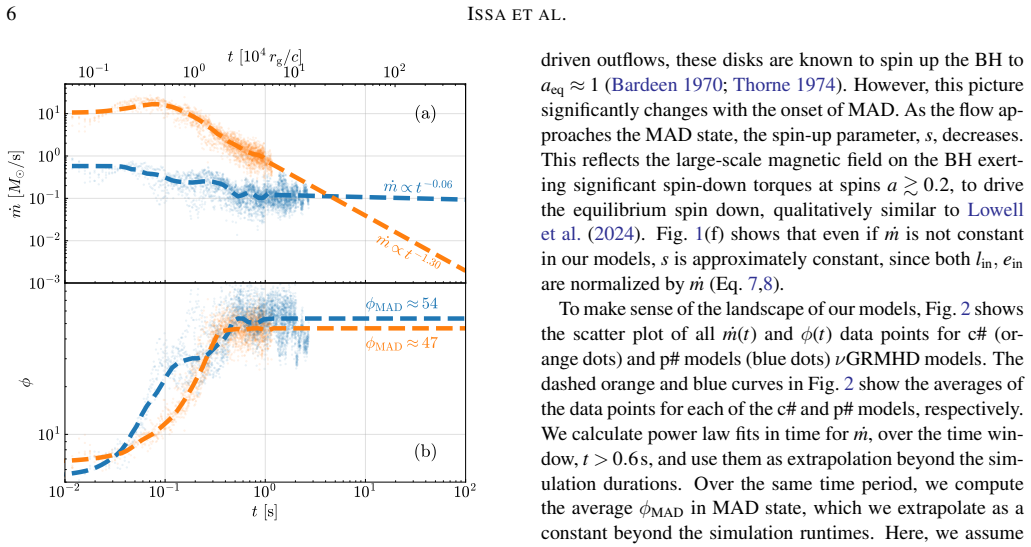
Using 3D two-moment neutrino-transport general relativistic magnetohydrodynamic simulations, successful collapsar jets powered by neutrino-cooled disks still rapidly spin down their black holes to an equilibrium spin a_eq ≈ 0.13, a value 2-4 times higher than for non-radiative magnetically arrested disks and resulting in 4-16 times more powerful jets.
What carries the argument
The equilibrium black hole spin a_eq reached when neutrino cooling reduces disk thickness and increases angular momentum supply to balance the electromagnetic jet torque in a magnetically arrested state.
If this is right
- Black holes reach a_eq ≈ 0.13 by the end of typical LGRB durations t ≳ 30 s.
- Shorter or lower-accretion-rate bursts leave black holes with higher final spins.
- Jet power is 4-16 times higher than in non-radiative models.
- The equilibrium spin value is consistent with LIGO/Virgo/KAGRA measurements.
Where Pith is reading between the lines
- Observed LGRB jet energies could constrain the distribution of initial black hole spins before spin-down.
- Similar neutrino-driven angular momentum transport may set equilibrium spins in other high-accretion systems.
- Refinements to neutrino transport closures could shift the precise value of a_eq.
Load-bearing premise
The two-moment neutrino transport method accurately computes the net cooling rate and angular-momentum transport in the optically thick neutrino-dominated disk.
What would settle it
A measured black hole spin significantly below 0.13 in the remnant of a long-duration gamma-ray burst with typical accretion rate and duration would contradict the predicted equilibrium.
Figures



read the original abstract
Collapsars -- massive stars whose cores promptly collapse into black holes (BHs) -- can power long-duration gamma-ray bursts (LGRBs) via relativistic, collimated, electromagnetically-driven outflows, or jets. Their power depends on the BH magnetic field strength and spin. To survive the infalling stellar material, jets need the central BH to attain dynamically important magnetic fields that can suppress the mass inflow and lead to a magnetically arrested disk (MAD). Previous work found that non-radiative MADs can spin down their BHs to an equilibrium spin, $a_{\rm eq}^\text{nr}=0.035-0.07$. Such low spins result in extremely low power jets that may struggle to escape out of the star. However, the dense and hot collapsar disks emit neutrinos that cool the disk, reduce its thickness, and increase the angular momentum supply to the BH. Using 3D two-moment neutrino-transport general relativistic magnetohydrodynamic simulations, we show for the first time that successful collapsar jets powered by neutrino-cooled disks still rapidly spin down their BHs, although to a higher $a_{\rm eq}\approx 0.13$. This value is consistent with LIGO/Virgo/KAGRA inferred spins, is $2-4$x higher than for non-radiative MADs, and results in $4-16$x more powerful LGRB jets, which are more capable of drilling out of the progenitor star. This value of $a_{\rm eq}$ holds across a wide range of progenitor structures and mass accretion rates, $\dot{m} \sim(0.1-10)M_{\odot}/\rm{s}$. We find that for typical LGRB durations, $t\gtrsim30$~s, such BHs consume sufficient mass to reach $a_{\rm eq} \approx 0.13$ by LGRB's end. However, shorter or lower-$\dot{m}$ LGRBs can leave behind more rapidly spinning BHs.
Editorial analysis
A structured set of objections, weighed in public.
Referee Report
Summary. The manuscript reports 3D two-moment neutrino-transport GRMHD simulations of collapsar disks, claiming that neutrino cooling raises the black-hole spin equilibrium from the non-radiative MAD value a_eq^nr=0.035-0.07 to a_eq≈0.13. This higher spin is stated to hold across progenitor structures and accretion rates 0.1-10 M_⊙ s^{-1}, yielding 4-16× more powerful jets while remaining consistent with LIGO/Virgo/KAGRA spin measurements; the simulations also indicate that typical LGRB durations allow the BH to reach this equilibrium.
Significance. If robust, the result supplies a concrete mechanism by which neutrino cooling alters MAD spin-down, directly affecting jet power and the ability of jets to escape the star. The 3D neutrino-transport treatment constitutes a technical advance over prior non-radiative work and supplies a falsifiable prediction for the spin distribution of LGRB remnants.
major comments (2)
- [Methods (neutrino transport)] Methods section on neutrino transport: the central claim that neutrino-cooled disks reach a_eq≈0.13 (rather than the non-radiative value) rests on the two-moment closure correctly supplying the net cooling rate, disk thickness, and angular-momentum flux in the optically thick regime. No resolution studies, error bars on a_eq, or cross-checks against Monte Carlo or discrete-ordinates transport on the same backgrounds are reported, leaving the torque balance that sets a_eq vulnerable to systematic bias from the closure relation.
- [Results / Abstract] Results and abstract: the assertion that a_eq≈0.13 is independent of progenitor and accretion rate is presented without tabulated run-by-run values, quantified uncertainties, or explicit sensitivity tests to numerical parameters, making it difficult to evaluate whether the quoted equilibrium is load-bearing or an artifact of the specific setups.
minor comments (2)
- [Figures] Figure captions and text should explicitly state the simulation time or mass accreted at which a_eq is measured for each run.
- [Introduction / Methods] A short paragraph comparing the adopted two-moment implementation to the closures used in prior neutrino-transport collapsar studies would improve context.
Simulated Author's Rebuttal
We thank the referee for their constructive comments on our manuscript. We address each major comment below and indicate the revisions we will make.
read point-by-point responses
-
Referee: Methods section on neutrino transport: the central claim that neutrino-cooled disks reach a_eq≈0.13 (rather than the non-radiative value) rests on the two-moment closure correctly supplying the net cooling rate, disk thickness, and angular-momentum flux in the optically thick regime. No resolution studies, error bars on a_eq, or cross-checks against Monte Carlo or discrete-ordinates transport on the same backgrounds are reported, leaving the torque balance that sets a_eq vulnerable to systematic bias from the closure relation.
Authors: We acknowledge that the manuscript does not report resolution studies, error bars on a_eq, or direct cross-checks with Monte Carlo or discrete-ordinates methods. The two-moment closure is a standard approach previously validated in the literature for optically thick regimes. Performing new cross-validation simulations is not feasible within the scope of this work. In the revised manuscript we will expand the Methods section with additional justification of the closure, citations to validation studies, and an explicit discussion of possible systematic effects on the torque balance. revision: partial
-
Referee: Results and abstract: the assertion that a_eq≈0.13 is independent of progenitor and accretion rate is presented without tabulated run-by-run values, quantified uncertainties, or explicit sensitivity tests to numerical parameters, making it difficult to evaluate whether the quoted equilibrium is load-bearing or an artifact of the specific setups.
Authors: We agree that tabulating individual run results and discussing numerical sensitivities would improve clarity. The revised manuscript will add a table summarizing progenitor structures, accretion rates, and measured a_eq values for each simulation, together with a paragraph addressing sensitivity to grid resolution and initial conditions based on the existing runs. revision: yes
Circularity Check
No circularity: a_eq emerges directly from simulation time evolution
full rationale
The reported equilibrium spin a_eq≈0.13 is obtained from the direct time evolution of the black-hole spin parameter a in the 3D two-moment neutrino-transport GRMHD runs. No equation or fitting procedure inside the paper reduces this value to a quantity defined by the same run or to a prior self-citation. The comparison to non-radiative a_eq^nr=0.035-0.07 is presented only as external context, not as a load-bearing premise that forces the new result. The derivation chain is therefore self-contained and simulation-driven rather than tautological.
Axiom & Free-Parameter Ledger
free parameters (2)
- progenitor density and angular-momentum profiles
- mass accretion rate range
axioms (2)
- standard math The equations of general relativistic magnetohydrodynamics accurately describe the plasma and magnetic-field evolution near the black hole.
- domain assumption The two-moment neutrino transport closure sufficiently approximates the neutrino energy and momentum exchange in the optically thick disk.
Reference graph
Works this paper leans on
-
[1]
, " * write output.state after.block = add.period write newline
ENTRY address archivePrefix author booktitle chapter doi edition editor eprint howpublished institution journal key month number organization pages publisher school series title misctitle type volume year version url label extra.label sort.label short.list INTEGERS output.state before.all mid.sentence after.sentence after.block FUNCTION init.state.consts ...
-
[2]
" write newline "" before.all 'output.state := FUNCTION format.url url empty "" new.block "" url * "" * if FUNCTION format.eprint eprint empty "" archivePrefix empty "" archivePrefix "arXiv" = new.block " " eprint * " " * new.block " " eprint * " " * if if if FUNCTION format.doi doi empty "" " " doi * " " * if FUNCTION format.pid doi empty eprint empty ""...
-
[4]
- [1] #1 = = ^ ^ ^ .\!\!^ d .\!\!^ h .\!\!^ m .\!\!^ s .\!\!^ @mss
thebibliography [1] 20pt to REFERENCES 6pt =0pt -12pt 10pt plus 3pt =0pt =0pt =1pt plus 1pt =0pt =0pt -12pt =13pt plus 1pt =20pt =13pt plus 1pt \@M =10000 =-1.0em =0pt =0pt 0pt =0pt =1.0em @enumiv\@empty 10000 10000 `\.\@m \@noitemerr \@latex@warning Empty `thebibliography' environment \@ifnextchar \@reference \@latexerr Missing key on reference command E...
-
[5]
2022, The Astrophysical Journal, 933, 17, 10.3847/1538-4357/ac6604
Arcier, B., & Atteia, J.-L. 2022, The Astrophysical Journal, 933, 17, 10.3847/1538-4357/ac6604
-
[6]
2025, GRB 221009A and the Apparently Most Energetic Gamma - Ray Bursts , 10.48550/arXiv.2501.13505
Atteia, J.-L., Bouchet, L., Dezalay, J.-P., et al. 2025, GRB 221009A and the Apparently Most Energetic Gamma - Ray Bursts , 10.48550/arXiv.2501.13505 . https://ui.adsabs.harvard.edu/abs/2025arXiv250113505A
-
[8]
Bardeen , J. M. 1970, , 226, 64, 10.1038/226064a0
-
[9]
Batta , A., & Lee , W. H. 2014, , 437, 2412, 10.1093/mnras/stt2061
-
[10]
S., Fragos, T., Zapartas, E., et al
Bavera, S. S., Fragos, T., Zapartas, E., et al. 2022, Astronomy and Astrophysics, 657, L8, 10.1051/0004-6361/202141979
-
[11]
Blandford , R. D., & Znajek , R. L. 1977, , 179, 433, 10.1093/mnras/179.3.433
-
[12]
2016, , 456, 1739, 10.1093/mnras/stv2591
Bromberg , O., & Tchekhovskoy , A. 2016, , 456, 1739, 10.1093/mnras/stv2591
-
[13]
Callister, T. A., Miller, S. J., Chatziioannou, K., & Farr, W. M. 2022, The Astrophysical Journal Letters, 937, L13, 10.3847/2041-8213/ac847e
-
[14]
2023, arXiv e-prints, arXiv:2311.00432, 10.48550/arXiv.2311.00432
Chatterjee , K., Liska , M., Tchekhovskoy , A., & Markoff , S. 2023, arXiv e-prints, arXiv:2311.00432, 10.48550/arXiv.2311.00432
-
[15]
Chen, W.-X., & Beloborodov, A. M. 2007, The Astrophysical Journal, 657, 383, 10.1086/508923
-
[16]
Chevalier , R. A. 1989, , 346, 847, 10.1086/168066
-
[17]
M., Lalakos , A., Tchekhovskoy , A., et al
Christie , I. M., Lalakos , A., Tchekhovskoy , A., et al. 2019, , 490, 4811, 10.1093/mnras/stz2552
-
[18]
2023, The Astrophysical Journal, 946, 16, 10.3847/1538-4357/acb5ed
Edelman, B., Farr, B., & Doctor, Z. 2023, The Astrophysical Journal, 946, 16, 10.3847/1538-4357/acb5ed
-
[19]
2019, , 482, 3373, 10.1093/mnras/sty2932
Fern \'a ndez , R., Tchekhovskoy , A., Quataert , E., Foucart , F., & Kasen , D. 2019, , 482, 3373, 10.1093/mnras/sty2932
-
[20]
2021, The Astrophysical Journal Letters, 921, L15, 10.3847/2041-8213/ac2f3c
Galaudage, S., Talbot, C., Nagar, T., et al. 2021, The Astrophysical Journal Letters, 921, L15, 10.3847/2041-8213/ac2f3c
-
[21]
Gammie , C. F., Shapiro , S. L., & McKinney , J. C. 2004, , 602, 312, 10.1086/380996
-
[22]
Goldstein, A., Connaughton, V., Briggs, M. S., & Burns, E. 2016, The Astrophysical Journal, 818, 18, 10.3847/0004-637X/818/1/18
-
[23]
2023, , 952, L32, 10.3847/2041-8213/ace779
Gottlieb , O., Jacquemin-Ide , J., Lowell , B., Tchekhovskoy , A., & Ramirez-Ruiz , E. 2023, , 952, L32, 10.3847/2041-8213/ace779
-
[24]
2022, Monthly Notices of the Royal Astronomical Society, 510, 4962, 10.1093/mnras/stab3784
Gottlieb, O., Lalakos, A., Bromberg, O., Liska, M., & Tchekhovskoy, A. 2022, Monthly Notices of the Royal Astronomical Society, 510, 4962, 10.1093/mnras/stab3784
-
[25]
2022, , 933, L9, 10.3847/2041-8213/ac7530
Gottlieb , O., Liska , M., Tchekhovskoy , A., et al. 2022, , 933, L9, 10.3847/2041-8213/ac7530
-
[26]
Gottlieb , O., Renzo , M., Metzger , B. D., Goldberg , J. A., & Cantiello , M. 2024, , 976, L13, 10.3847/2041-8213/ad856310.1134/S1063772908080027
work page doi:10.3847/2041-8213/ad856310.1134/s1063772908080027 2024
-
[27]
2023, , 944, L38, 10.3847/2041-8213/acb702
Halevi , G., Wu , B., M \"o sta , P., et al. 2023, , 944, L38, 10.3847/2041-8213/acb702
-
[28]
2024, arXiv e-prints, arXiv:2410.02852, 10.48550/arXiv.2410.02852
Issa , D., Gottlieb , O., Metzger , B., et al. 2024, arXiv e-prints, arXiv:2410.02852, 10.48550/arXiv.2410.02852
-
[29]
2024, , 961, 212, 10.3847/1538-4357/ad02f0
Jacquemin-Ide , J., Gottlieb , O., Lowell , B., & Tchekhovskoy , A. 2024, , 961, 212, 10.3847/1538-4357/ad02f0
-
[30]
2021, Astronomy & Astrophysics, 647, A192, 10.1051/0004-6361/202039322
Jacquemin-Ide, J., Lesur, G., & Ferreira, J. 2021, Astronomy & Astrophysics, 647, A192, 10.1051/0004-6361/202039322
-
[31]
2024, Monthly Notices of the Royal Astronomical Society, 532, 1522, 10.1093/mnras/stae1538
Jacquemin-Ide, J., Rincon, F., Tchekhovskoy, A., & Liska, M. 2024, Monthly Notices of the Royal Astronomical Society, 532, 1522, 10.1093/mnras/stae1538
-
[32]
F., Capozziello, S., & Dainotti, M
Komissarov , S. S., & Barkov , M. V. 2009, , 397, 1153, 10.1111/j.1365-2966.2009.14831.x
-
[33]
2024, The Astrophysical Journal, 964, 79, 10.3847/1538-4357/ad0974
Lalakos, A., Tchekhovskoy, A., Bromberg, O., et al. 2024, The Astrophysical Journal, 964, 79, 10.3847/1538-4357/ad0974
-
[34]
Liska , M. T. P., Chatterjee , K., Issa , D., et al. 2022, , 263, 26, 10.3847/1538-4365/ac9966
-
[35]
2024, , 960, 82, 10.3847/1538-4357/ad09af
Lowell , B., Jacquemin-Ide , J., Tchekhovskoy , A., & Duncan , A. 2024, , 960, 82, 10.3847/1538-4357/ad09af
-
[36]
2025, arXiv e-prints, to be submitted february
Lowell , B., Jacquemin-Ide , J., Tchekhovskoy , A., & Liska , M. 2025, arXiv e-prints, to be submitted february
work page 2025
-
[37]
2002, Astronomy and Astrophysics, 393, L29, 10.1051/0004-6361:20021073
McBreen, S., McBreen, B., Hanlon, L., & Quilligan, F. 2002, Astronomy and Astrophysics, 393, L29, 10.1051/0004-6361:20021073
-
[39]
1996, , 283, 854, 10.1093/mnras/283.3.854
Moderski , R., & Sikora , M. 1996, , 283, 854, 10.1093/mnras/283.3.854
-
[40]
2022, Monthly Notices of the Royal Astronomical Society, 511, 3795, 10.1093/mnras/stac285
Narayan, R., Chael, A., Chatterjee, K., Ricarte, A., & Curd, B. 2022, Monthly Notices of the Royal Astronomical Society, 511, 3795, 10.1093/mnras/stac285
-
[41]
S., Georganopoulos , M., Guiriec , S., et al
Nemmen , R. S., Georganopoulos , M., Guiriec , S., et al. 2012, Science, 338, 1445, 10.1126/science.1227416
-
[42]
Novikov, I. D., & Thorne, K. S. 1973, Astrophysics of black holes. https://ui.adsabs.harvard.edu/abs/1973blho.conf..343N
work page 1973
-
[43]
1998, , 494, L45, 10.1086/311148
Paczy \'n ski , B. 1998, , 494, L45, 10.1086/311148
-
[44]
2023, The Astrophysical Journal Letters, 954, L22, 10.3847/2041-8213/aceda5
Ricarte, A., Narayan, R., & Curd, B. 2023, The Astrophysical Journal Letters, 954, L22, 10.3847/2041-8213/aceda5
-
[45]
T.-L., Ioka, K., & Sekiguchi, Y
Shibata, M., Fujibayashi, S., Lam, A. T.-L., Ioka, K., & Sekiguchi, Y. 2024, Physical Review D, 109, 043051, 10.1103/PhysRevD.109.043051
-
[46]
Siegel , D. M. 2022, Nature Reviews Physics, 4, 306, 10.1038/s42254-022-00439-1
-
[47]
M., Barnes , J., & Metzger , B
Siegel , D. M., Barnes , J., & Metzger , B. D. 2019, , 569, 241, 10.1038/s41586-019-1136-0
-
[49]
2015, , 447, 327, 10.1093/mnras/stu2229
Tchekhovskoy , A., & Giannios , D. 2015, , 447, 327, 10.1093/mnras/stu2229
-
[50]
D., Giannios , D., & Kelley , L
Tchekhovskoy , A., Metzger , B. D., Giannios , D., & Kelley , L. Z. 2014, , 437, 2744, 10.1093/mnras/stt2085
-
[51]
Tchekhovskoy , A., Narayan , R., & McKinney , J. C. 2011, , 418, L79, 10.1111/j.1745-3933.2011.01147.x
-
[52]
The LIGO Scientific Collaboration , the Virgo Collaboration , the KAGRA Collaboration , et al. 2021, GWTC -3: Compact Binary Coalescences Observed by LIGO and Virgo During the Second Part of the Third Observing Run , 10.48550/arXiv.2111.03606 . https://ui.adsabs.harvard.edu/abs/2021arXiv211103606T
work page internal anchor Pith review Pith/arXiv arXiv doi:10.48550/arxiv.2111.03606 2021
-
[53]
The population of merging compact binaries inferred using gravitational waves through GWTC-3
The LIGO Scientific Collaboration , the Virgo Collaboration, the KAGRA Collaboration, et al. 2022, The population of merging compact binaries inferred using gravitational waves through GWTC -3, arXiv, 10.48550/arXiv.2111.03634 . http://arxiv.org/abs/2111.03634
work page internal anchor Pith review Pith/arXiv arXiv doi:10.48550/arxiv.2111.03634 2022
-
[54]
Thorne , K. S. 1974, , 191, 507, 10.1086/152991
-
[55]
Timmes , F. X., & Swesty , F. D. 2000, , 126, 501, 10.1086/313304
-
[56]
Tong, H., Galaudage, S., & Thrane, E. 2022, The population properties of spinning black holes using Gravitational -wave Transient Catalog 3, arXiv, 10.48550/arXiv.2209.02206 . http://arxiv.org/abs/2209.02206
-
[57]
von Kienlin, A., Meegan, C. A., Paciesas, W. S., et al. 2020, The Astrophysical Journal, 893, 46, 10.3847/1538-4357/ab7a18
-
[58]
Woosley , S. E. 1993, , 405, 273, 10.1086/172359
-
[59]
Wu, T. Y., & Fishbach, M. 2024, The Astrophysical Journal, 977, 239, 10.3847/1538-4357/ad98ed
-
[60]
2024, arXiv e-prints, arXiv:2411.12850, 10.48550/arXiv.2411.12850
Wu , Z.-F., Damoulakis , M., Beniamini , P., & Giannios , D. 2024, arXiv e-prints, arXiv:2411.12850, 10.48550/arXiv.2411.12850
discussion (0)
Sign in with ORCID, Apple, or X to comment. Anyone can read and Pith papers without signing in.