REVIEW 3 major objections 6 minor 1 cited by
BrainWavLM: Fine-tuning Speech Representations with Brain Responses to Language
T0 review · 3 major / 6 minor · reviewed 2026-08-07 · deepseek-v4-flash
Pith's one-line read Fine-tuning WavLM on brain responses with LoRA lifts speech encoding accuracy by 12.5% over the frozen pretrained model.
desk verdict Brain fine-tuning with LoRA is a solid incremental contribution that deserves serious review, but the 12.5% headline rests on one held-out story and needs statistical support. read the letter →
The pith
A machine-rendered reading of the paper's core claim, the machinery that carries it, and where it could break.
The reading
What carries the argument
The central mechanism is the low-rank adaptation (LoRA) procedure applied to WavLM's attention matrices ($W_Q$, $W_K$, $W_V$) plus a rank-100 linear bottleneck on the 9th-layer hidden states, trained with a loss that maximizes spatial correlation between predicted and actual fMRI volumes. This lets the model adjust its representations to brain data with few learnable parameters (166K LoRA parameters plus a per-subject linear bottleneck), and the paper shows this is more stable than full fine-tuning and sufficient to match its performance.
What would settle it
Compute encoding performance of the same BrainWavLM models on a larger, independently collected set of held-out stories (or another fMRI narrative dataset) and check whether the average 12.5% improvement over the pretrained linearized model persists; a substantial shrinkage or reversal would undermine the claim that brain fine-tuning yields best-in-class speech encoding.
Extended reading notes
Core claim
Fine-tuning a WavLM Base+ speech model end-to-end on fMRI responses, with LoRA updates to the attention matrices and a low-rank linear readout, produces encoding models that predict held-out brain responses better than the linearized baseline. The average gain is 12.5% over the pretrained model, and it is more stable than full fine-tuning. This gain is uneven: low-level auditory cortex loses some accuracy, but fine-tuning specifically on auditory-cortex voxels reverses that loss while preserving most of the whole-cortex gain. Models fine-tuned on one subject improve encoding in other subjects, and linear probes show the representations become more semantic and less acoustic, comparable to fine-tuning on large language model features, all without annotations.
Load-bearing premise
The numerical gains are measured on a single held-out story per participant, with validation on two other stories; if those particular stories are not representative of narrative speech in general, the reported improvements and tradeoffs may not hold for other stories.
Editorial extensions
If this is right
- If correct, the standard linearized encoding model pipeline can be superseded by end-to-end fine-tuning even on neuroscience-scale datasets, yielding more accurate voxelwise predictions.
- Brain responses can serve as an annotation-free supervisory signal that makes speech representations more semantic, matching the effect of supervision from a large language model.
- The auditory-cortex tradeoff is a tunable property: choosing which voxels to fine-tune on controls whether the model favors low-level acoustic fidelity or high-level semantic content.
- Cross-subject transfer of fine-tuned models suggests that at least part of the learned representation captures shared, subject-general brain-like structure, not just individual noise.
- The stability benefit of LoRA over full fine-tuning matters for reproducibility in small-data regimes.
Reading between the lines
- The same LoRA fine-tuning recipe could be applied to other self-supervised speech or language models (e.g., larger checkpoints) to test whether brain-supervision gains scale with model size.
- The observed semantic/acoustic tradeoff suggests a Pareto frontier: one could fine-tune a family of models with different cortical targets and select among them for a desired balance, which may be useful for brain-computer interfaces that decode either acoustics or meaning.
- Because the gains are measured on only three held-out stories, a natural next step is to evaluate on a larger battery of unseen narratives to quantify how much of the improvement is story-specific versus truly generalizable.
Editorial analysis
A structured set of objections, weighed in public.
Referee Report
Summary. The paper proposes BrainWavLM, a WavLM Base+ speech model fine-tuned with low-rank adaptation (LoRA) on fMRI responses to natural narrative speech. Fine-tuning uses a spatial-correlation loss and a rank-100 linear bottleneck to predict voxel responses, and the best epoch is selected by re-fitting a linearized encoding model on validation stories. On a single held-out story per subject, the authors report that whole-cortex fine-tuning improves average voxelwise encoding correlation by 12.5% over the frozen WavLM features, at the cost of auditory-cortex (AC) performance; selective fine-tuning on AC restores AC performance. The fine-tuned features are also reported to transfer across subjects and, according to linear probes, to become more semantic and less acoustic.
Significance. If the improvement is robust, the paper makes a useful contribution: it demonstrates that LoRA fine-tuning can improve speech encoding models, that low-level and high-level cortical areas impose competing objectives during brain fine-tuning, and that brain responses can act as an unsupervised semantic supervisory signal. The use of the public LeBel/Tang dataset, the clearly described fine-tuning and evaluation protocol, and the inclusion of cross-subject transfer and probe analyses are strengths. However, the current evidence is limited by the single-story test set and by the absence of a capacity-matched control for the rank-100 bottleneck, so the headline claims are not yet fully established.
major comments (3)
- [2.1, 3.1] The central 12.5% improvement claim is measured on a single held-out story ('wheretheressmoke') per subject, with two stories ('fromboyhoodtofatherhood' and 'onapproachtopluto') used only for validation; all subsequent analyses in Sections 3.2-3.4 are evaluated on this same test story. With approximately 100 stories available per subject, this design does not test generalization to novel narrative material, and no per-story variability, confidence intervals, or significance tests are reported. I recommend using multiple held-out stories (e.g., leave-several-stories-out cross-validation) or at least reporting per-story and per-subject results with appropriate statistics before the headline claim is considered established.
- [2.3.1, 3.1] The fine-tuned BrainWavLM model includes a rank-100 linear bottleneck in the output projection, whereas the pre-trained baseline is a linearized encoding model fit to the full WavLM features with ridge regression. The reported improvement may therefore be due in part to the bottleneck itself rather than to the LoRA brain fine-tuning. The paper should include a control in which the same rank-100 bottleneck is applied to the frozen pre-trained WavLM features, with the projection fit on training data, before the linearized encoding model is evaluated. The LLaMA-tuned baseline already shows that most of the gain (11.1% vs. 12.5%) can be obtained by fine-tuning toward LLaMA features with the same setup, which further motivates this control.
- [3.3] The cross-subject transfer results in Figure 3 use the same single test story ('wheretheressmoke') for all subjects, so they demonstrate robustness across subjects for that story but not across stories. This limitation should be acknowledged explicitly, and the transfer claim would be considerably strengthened by re-evaluating the transferred features on multiple held-out stories.
minor comments (6)
- [1] The abstract and introduction state that fine-tuned models yield 'significantly better' prediction performance, but no significance tests are reported; please qualify the claim or add appropriate statistical tests.
- [2.3.1] The sentence 'the first 100 principal components of the pre-trained model’s encoding weights capture more than 70% of the variance across voxels' is unclear; please specify over which dimension PCA is computed and how this justifies the rank-100 bottleneck.
- [Figure 1B] The error bars are SEM across n=3 subjects after subtracting each subject's mean; with three subjects this provides little information about between-story variability, so please show individual subject points as well.
- [2.3.3] The LLaMA-tuned baseline is described as using layer 18, which had the highest encoding performance; please specify how this layer was selected and whether the selection was made on held-out data.
- [Conclusion] The claim of producing 'best-in-class speech encoding models' is not supported by comparisons to other published encoding models; please temper this claim or add quantitative comparisons.
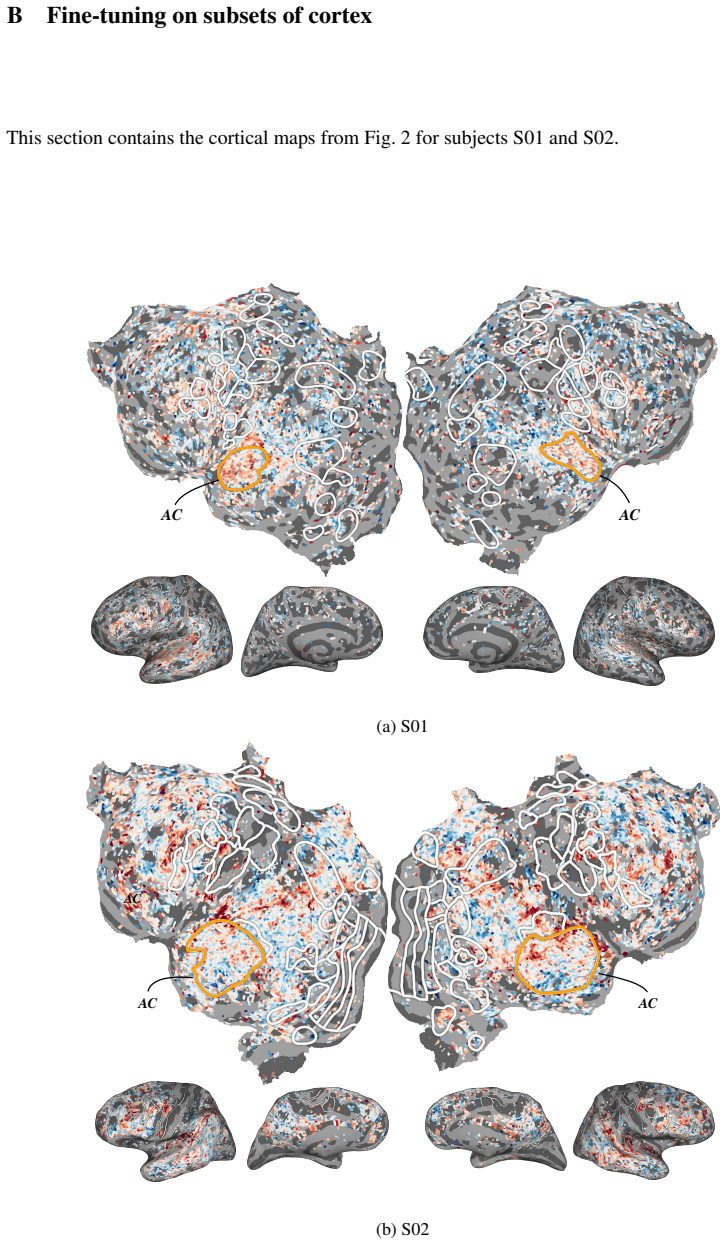
- [2.1, Figure 2C caption] There are minor typographical errors: '17.8 h–19.7 hhours' should read '17.8–19.7 hours', and 'V oxels' in the Figure 2C caption should read 'Voxels'.
Circularity Check
No significant circularity: the central claims rest on out-of-sample evaluations with held-out stories, and no equation reduces to its inputs.
full rationale
The paper's central claims are empirical comparisons on a held-out story ('wheretheressmoke') and two validation stories, with model selection performed on the validation set before test evaluation (Sec. 2.1, 2.3.2). The end-to-end training loss (Eq. 2, spatial correlation) is explicitly distinct from the evaluation metric (Eq. 1, temporal correlation), and the authors state this difference, so the reported gains are not identities. The semantic-probe experiment trains probes on 26 stories and tests on the three held-out stories, so the strengthened semantic representations are measured out-of-sample rather than read off the training objective. Cross-subject transfer fits encoding models on each target subject's training data and evaluates on that subject's held-out story, so transfer is not forced. Self-citations (LeBel et al. dataset; Antonello et al. layer selection) are to public data and a published empirical result; the layer choice is held fixed for both the linearized baseline and the fine-tuned model, so it does not predetermine the reported improvement. No equation in the paper reduces to its input, and no fitted parameter is renamed as a prediction. Therefore no circular step is exhibited.
Assumptions & free parameters
free parameters (3)
- LoRA rank r =
4
- Linear bottleneck rank =
100
- Training hyperparameters =
lr=1e-4, batch=50, epochs=20
assumptions (5)
- domain assumption fMRI BOLD responses are linearly predictable from delayed speech features via ridge regression
- domain assumption WavLM layer 9 hidden states are the best fixed substrate for brain encoding
- ad hoc to paper A 100-dimensional linear bottleneck preserves enough information for accurate brain prediction
- domain assumption The LeBel et al. atlas correctly localizes auditory cortex
- ad hoc to paper The single held-out story is representative of natural narrative speech
Cite this review
Pith. "Pith review of BrainWavLM: Fine-tuning Speech Representations with Brain Responses to Language." pith.science (2026). https://pith.science/paper/DB6RKJCS
@misc{pith2026250208866,
  author       = {Pith},
  title        = {Pith review of: BrainWavLM: Fine-tuning Speech Representations with Brain Responses to Language},
  year         = {2026},
  howpublished = {\url{https://pith.science/paper/DB6RKJCS}},
  note         = {Machine review of arXiv:2502.08866}
}
read the original abstract
Speech encoding models use auditory representations to predict how the human brain responds to spoken language stimuli. Most performant encoding models linearly map the hidden states of artificial neural networks to brain data, but this linear restriction may limit their effectiveness. In this work, we use low-rank adaptation (LoRA) to fine-tune a WavLM-based encoding model end-to-end on a brain encoding objective, producing a model we name BrainWavLM. We show that fine-tuning across all of cortex improves average encoding performance with greater stability than without LoRA. This improvement comes at the expense of low-level regions like auditory cortex (AC), but selectively fine-tuning on these areas improves performance in AC, while largely retaining gains made in the rest of cortex. Fine-tuned models generalized across subjects, indicating that they learned robust brain-like representations of the speech stimuli. Finally, by training linear probes, we showed that the brain data strengthened semantic representations in the speech model without any explicit annotations. Our results demonstrate that brain fine-tuning produces best-in-class speech encoding models, and that non-linear methods have the potential to bridge the gap between artificial and biological representations of semantics.
Figures


Figures from the paper (5 more)




Forward citations
Cited by 1 Pith paper
-
Abstraction Induces the Brain Alignment of Language and Speech Models
Middle layers of language and speech models align with brain responses due to high intrinsic dimension reflecting semantic abstraction rather than next-token prediction.
Reference graph
Works this paper leans on
-
[8]
doi: 10.1038/s41597-023-02437-z
ISSN 2052-4463. doi: 10.1038/s41597-023-02437-z. B. Lipkin, G. Tuckute, J. Affourtit, H. Small, Z. Mineroff, H. Kean, O. Jouravlev, L. Rakocevic, B. Pritchett, M. Siegelman, C. Hoeflin, A. Pongos, I. A. Blank, M. K. Struhl, A. Ivanova, S. Shan- non, A. Sathe, M. Hoffmann, A. Nieto-Castañón, and E. Fedorenko. Probabilistic atlas for the language network ba...
-
[9]
doi: 10.1038/s41597-022-01645-3
ISSN 2052-4463. doi: 10.1038/s41597-022-01645-3. J. Millet, C. Caucheteux, P. Orhan, Y . Boubenec, A. Gramfort, E. Dunbar, C. Pallier, and J.-R. King. Toward a realistic model of speech processing in the brain with self-supervised learning, June
-
[10]
ISSN 1053-8119. doi: 10.1016/j.neuroimage.2010.07.073. S. A. Nastase, Y .-F. Liu, H. Hillman, A. Zadbood, L. Hasenfratz, N. Keshavarzian, J. Chen, C. J. Honey, Y . Yeshurun, M. Regev, M. Nguyen, C. H. C. Chang, C. Baldassano, O. Lositsky, E. Simony, M. A. Chow, Y . C. Leong, P. P. Brooks, E. Micciche, G. Choe, A. Goldstein, T. Vanderwal, Y . O. Halchenko,...
-
[12]
doi: 10.1016/j.cub.2011.08.031
ISSN 0960-9822. doi: 10.1016/j.cub.2011.08.031. S. R. Oota, E. Çelik, F. Deniz, and M. Toneva. Speech language models lack important brain- relevant semantics. In L.-W. Ku, A. Martins, and V . Srikumar, editors,Proceedings of the 62nd Annual Meeting of the Association for Computational Linguistics (Volume 1: Long Papers), pages 8503–8528, Bangkok, Thailand, Aug
-
[14]
doi: 10.1101/2024.05.15.594172
ISSN 2692-8205. doi: 10.1101/2024.05.15.594172. A. Pasad, J.-C. Chou, and K. Livescu. Layer-wise Analysis of a Self-supervised Speech Representa- tion Model. arXiv:2107.04734 [cs, eess], Oct
arXiv 2024
-
[15]
J. Pennington, R. Socher, and C. Manning. Glove: Global Vectors for Word Representation. In Proceedings of the 2014 Conference on Empirical Methods in Natural Language Processing (EMNLP), pages 1532–1543, Doha, Qatar,
work page 2014
-
[17]
doi: 10.1038/s41593-023-01304-9
ISSN 1546-1726. doi: 10.1038/s41593-023-01304-9. H. Touvron, T. Lavril, G. Izacard, X. Martinet, M.-A. Lachaux, T. Lacroix, B. Rozière, N. Goyal, E. Hambro, F. Azhar, A. Rodriguez, A. Joulin, E. Grave, and G. Lample. LLaMA: Open and Efficient Foundation Language Models, Feb
-
[18]
ISSN 1545-7885. doi: 10.1371/journal.pbio. 3002366. A. R. Vaidya, S. Jain, and A. Huth. Self-Supervised Models of Audio Effectively Explain Human Cortical Responses to Speech. In Proceedings of the 39th International Conference on Machine Learning, pages 21927–21944. PMLR, June
Show all 22 references
-
[19]
Wehbe, A
L. Wehbe, A. Vaswani, K. Knight, and T. Mitchell. Aligning context-based statistical models of language with brain activity during reading. In Proceedings of the 2014 Conference on Empirical Methods in Natural Language Processing (EMNLP) , pages 233–243, Doha, Qatar, Oct
2014
-
[20]
doi: 10.3115/v1/D14-1030
Association for Computational Linguistics. doi: 10.3115/v1/D14-1030. H. Weissbart and A. E. Martin. The structure and statistics of language jointly shape cross-frequency neural dynamics during spoken language comprehension. Nature Communications, 15(1):8850, Oct
-
[21]
doi: 10.1038/s41467-024-53128-1
ISSN 2041-1723. doi: 10.1038/s41467-024-53128-1. M. C.-K. Wu, S. V . David, and J. L. Gallant. Complete functional characterization of sensory neurons by system identification. Annual Review of Neuroscience , 29(1):477–505, July
-
[2006]
doi: 10.1146/annurev.neuro.29.051605.113024
ISSN 0147-006X, 1545-4126. doi: 10.1146/annurev.neuro.29.051605.113024. S.-w. Yang, P.-H. Chi, Y .-S. Chuang, C.-I. J. Lai, K. Lakhotia, Y . Y . Lin, A. T. Liu, J. Shi, X. Chang, G.- T. Lin, T.-H. Huang, W.-C. Tseng, K.-t. Lee, D.-R. Liu, Z. Huang, S. Dong, S.-W. Li, S. Watana...
-
[2007]
doi: 10.1038/nrn2113
ISSN 1471-0048. doi: 10.1038/nrn2113. 9 E. J. Hu, Y . Shen, P. Wallis, Z. Allen-Zhu, Y . Li, S. Wang, L. Wang, and W. Chen. LoRA: Low-Rank Adaptation of Large Language Models, Oct
-
[2011]
doi: 10.1073/pnas.1112937108. A. Goldstein, A. Dabush, B. Aubrey, M. Schain, S. A. Nastase, Z. Zada, E. Ham, Z. Hong, A. Feder, H. Gazula, E. Buchnik, W. Doyle, S. Devore, P. Dugan, D. Friedman, M. Brenner, A. Hassidim, O. Devinsky, A. Flinker, and U. Hasson. Brain embeddings ...
-
[2014]
doi: 10.3115/v1/D14-1162
Association for Computational Linguistics. doi: 10.3115/v1/D14-1162. 10 D. Povey, A. Ghoshal, G. Boulianne, L. Burget, O. Glembek, N. Goel, M. Hannemann, P. Motlicek, Y . Qian, P. Schwarz, J. Silovsky, G. Stemmer, and K. Vesely. The kaldi speech recognition toolkit. In IEEE 20...
-
[2016]
doi: 10.1038/nature17637
ISSN 1476-4687. doi: 10.1038/nature17637. A. A. Ivanova, M. Schrimpf, S. Anzellotti, N. Zaslavsky, E. Fedorenko, and L. Isik. Beyond linear regression: Mapping models in cognitive neuroscience should align with research goals. Neurons, Behavior, Data analysis, and Theory, 1, Aug
-
[2017]
doi: 10.1523/JNEUROSCI.3267-16.2017
ISSN 0270-6474, 1529-2401. doi: 10.1523/JNEUROSCI.3267-16.2017. E. Fedorenko, M. K. Behr, and N. Kanwisher. Functional specificity for high-level linguistic processing in the human brain. Proceedings of the National Academy of Sciences , 108(39): 16428–16433, Sept
2017 doi
-
[2020]
doi: 10.1126/science.aaz3468. R. Antonello, A. Vaidya, and A. Huth. Scaling laws for language encoding models in fMRI.Advances in Neural Information Processing Systems, 36:21895–21907, Dec
-
[2021]
doi: 10.1038/s41597-021-01033-3
ISSN 2052-4463. doi: 10.1038/s41597-021-01033-3. S. Nishimoto, A. T. Vu, T. Naselaris, Y . Benjamini, B. Yu, and J. L. Gallant. Reconstructing Visual Experiences from Brain Activity Evoked by Natural Movies. Current Biology, 21(19):1641–1646, Oct
-
[2022]
doi: 10.51628/001c.37507
ISSN 2690-2664. doi: 10.51628/001c.37507. D. P. Kingma and J. Ba. Adam: A Method for Stochastic Optimization. arXiv:1412.6980 [cs], Jan
-
[2023]
doi: 10.1038/s41562-022-01516-2
ISSN 2397-3374. doi: 10.1038/s41562-022-01516-2. S. Chen, C. Wang, Z. Chen, Y . Wu, S. Liu, Z. Chen, J. Li, N. Kanda, T. Yoshioka, X. Xiao, J. Wu, L. Zhou, S. Ren, Y . Qian, Y . Qian, J. Wu, M. Zeng, and F. Wei. WavLM: Large-Scale Self- Supervised Pre-Training for Full Stack S...
-
[2024]
doi: 10.18653/v1/2024.acl-long.462
Association for Computational Linguistics. doi: 10.18653/v1/2024.acl-long.462. O. Ozernov-Palchik, A. M. O’Brien, E. Jiachen Lee, H. Richardson, R. Romeo, B. Lipkin, H. Small, J. Capella, A. Nieto-Castañón, R. Saxe, J. D. E. Gabrieli, and E. Fedorenko. Precision fMRI reveals t...
2024 doi
Reviewed August 7, 2026 · model on record in the stance chip above.
Discussion (0). Continue with ORCID to comment.