REVIEW 5 major objections 5 minor 1 cited by
CP violation studies at Super Tau-Charm Facility
T0 review · 5 major / 5 minor · reviewed 2026-08-07 · deepseek-v4-flash
Pith's one-line read At the projected event yields of the Super Tau-Charm Facility, hyperon CP-violation asymmetries become measurable at the 10^-4 Standard Model level, tau decay asymmetries reach the sensitivity needed to test the existing anomaly, and…
desk verdict A comprehensive, honest STCF prospects review; the headline sensitivities are plausible design goals but rest on fast simulation and statistical-only errors. read the letter →
The pith
A machine-rendered reading of the paper's core claim, the machinery that carries it, and where it could break.
The reading
What carries the argument
The argument rides on three objects. First, the quantum-correlated, CP-odd baryon-antibaryon pairs from J/psi decays, whose joint angular distributions are described by modular decay matrices, let one separate the alpha, beta, and gamma decay parameters for hyperon and antihyperon and construct the CP observables A_CP and B_CP. Second, the empirical scaling relation sigma_ACP sqrt(N_fin) = k with k = 7.82, obtained from fast-simulation samples between 0.01 and 0.1 trillion J/psi events and extrapolated to 3.4 trillion, converts sample size into projected sensitivity. Third, for the kaon CPT test, strangeness-tagged K0 and Kbar0 events in J/psi -> K- pi+ K0 decays and the Bell-Steinberger relation tie the measurable interference phases to the CPT-violating parameter delta and to the mass difference bound.
What would settle it
A concrete check is to run the same fast-simulation analysis at 0.2, 0.5, and 1.0 trillion J/psi events: if sigma_ACP times the square root of the final event count departs from 7.82 by more than the fit uncertainty, or if a detector prototype measures the Lambda-Lambda selection efficiency below 38.2% at |cos $\theta$| < 0.93 with background above 0.5%, the projected O($10^{-4}$) hyperon sensitivities and the 4e-17 MeV CPT limit do not follow.
Extended reading notes
Core claim
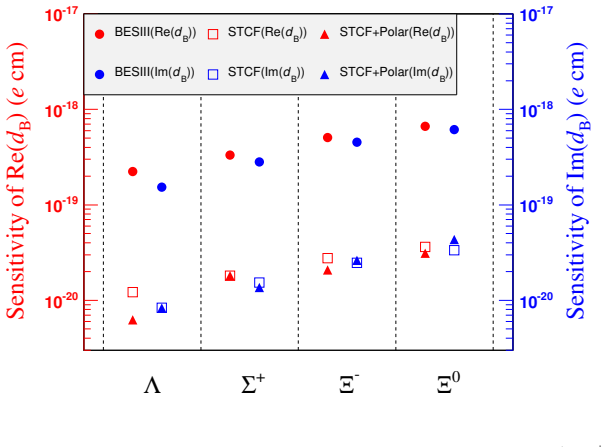
On the paper's own terms, the central claim is that the STCF program turns the tau-charm energy region into a CP-violation discovery laboratory. The projected samples translate into concrete numbers: hyperon weak-phase differences at O($10^{-4}$), hyperon EDMs at O($10^{-20}$) to O($10^{-21}$) e cm, tau EDM form-factor sensitivity near $10^{-18}$ e cm, statistical precision of 9.7e-4 per $ab^{-1}$ on A_CP(tau -> K_S pi nu), charm mixing parameters x and y with uncertainties of order 0.04%, and a CPT test reaching |M_K0bar - M_K0| near 4e-17 MeV. The paper also shows that the Standard Model prediction for the tau-channel asymmetry, about 0.36% after efficiency corrections, deviates from the current experimental value by 2.8 standard deviations, making this channel a concrete target for the facility. If the projections hold, STCF would be the first experiment able to test the Standard Model's predicted hyperon CP violation rather than merely bound it.
Load-bearing premise
The quoted sensitivities assume the statistical scaling sigma_ACP times the square root of the final event count equals 7.82, a constant fitted on Monte Carlo samples of 0.01 to 0.1 trillion J/psi events, and that this scaling continues to hold at 3.4 trillion J/psi with the same selection efficiency, background below 0.5%, vertex resolution, and particle identification performance in the final detector.
Editorial extensions
If this is right
- Hyperon decay CP asymmetries A_CP and B_CP would be measured at O(10^-4), reaching the weak-phase differences the Standard Model predicts and constraining new CP phases in the strange-quark sector.
- Lambda, Sigma, and Xi electric dipole moments would be probed at 10^-20 to 10^-21 e cm, five orders of magnitude beyond the current Lambda limit.
- A_CP(tau -> K_S pi nu) with 1 ab^-1 would reach 9.7e-4, sharpening the 2.8-sigma tension with the Standard Model; 10 ab^-1 would reach 3.1e-4.
- Charm mixing parameters and indirect CP-violating observables would be determined at the 10^-4 level from quantum-correlated D-Dbar pairs, complementing time-dependent measurements at hadron colliders.
- The neutral-kaon CPT test would improve |M_K0bar - M_K0| to about 4e-17 MeV, an order of magnitude better than the current Bell-Steinberger bound.
Reading between the lines
- If the 1/sqrt(N) scaling holds and the electron beam is 80% polarized, the roughly threefold sensitivity gain quoted for hyperons implies per-year A_CP precisions near 10^-5 for Lambda, edging into territory where Standard Model weak phases become visible in a single run.
- The same quantum-correlated D-Dbar samples that yield charm mixing parameters can provide strong-phase difference inputs with ultimate uncertainties, and those inputs are also required for CP analyses at B factories, so the facility's impact may reach beyond its own CP asymmetries.
- A decisive STCF measurement of the tau asymmetry that agrees with the Standard Model after efficiency and regeneration corrections would rule out the surviving tensor-interaction explanations of the existing anomaly, effectively closing it.
- The fast-simulation scaling methodology could be transported to charmed-baryon pairs at higher center-of-mass energies; the paper's quoted 0.25-0.5% sensitivity for T-odd observables suggests a dedicated scaling study could show whether larger samples push charm-baryon CP violation below the Standard Model benchmark of about 0.1%.
Editorial analysis
A structured set of objections, weighed in public.
Referee Report
Summary. This Physics Reports submission reviews the physics case for CP-violation and CPT studies at the proposed Super Tau-Charm Facility (STCF), covering four sectors: hyperon decays, tau decays, charm mixing and direct CP violation, and neutral-kaon CPT tests. The analytical backbone is the modular spin-density-matrix formalism for entangled baryon-antibaryon production and the standard hyperon, tau, and D-meson CP-violation observables. The paper combines a review of existing BESIII, Belle, LHCb, and PDG results with original feasibility studies based on fast Monte Carlo simulations, and it presents concrete projected sensitivities: O(10^-4) hyperon A_CP, hyperon EDM sensitivities of O(10^-20) to O(10^-21) e cm, a statistical sensitivity of 9.7e-4 for A_CP(tau -> KS pi nu) per ab^-1, and a projected CPT limit |M_Kbar0 - M_K0| near 4e-17 MeV. The central claim is that STCF would reach Standard Model levels for hyperon CPV, provide a decisive test of the BaBar tau anomaly, and improve the neutral-kaon CPT limit by an order of magnitude.
Significance. If the projected sensitivities hold after full detector validation, the physics case is strong and timely: the hyperon CPV measurements would probe the Standard Model weak phases in the strange sector, the tau asymmetry would address the BaBar anomaly, and the kaon CPT test would improve a three-decade-old limit. The paper's strengths include the use of well-established BESIII and PDG inputs, a clear modular formulation of spin observables, and explicit fast-MC studies that convert event yields into quantitative projections. The projections are falsifiable and the paper is candid about many of its limitations. However, the headline numbers rest on an internally fitted MC scaling constant, statistical-only extrapolations, and a qualitative systematics discussion, so the significance of the central claims is conditional on additional validation rather than fully established by the manuscript.
major comments (5)
- [Section 2.6, Eq. (59)] The headline hyperon sensitivity O(10^-4) is obtained by fitting k = 7.82 in Eq. (59), sigma_ACP x sqrt(N_fin) = k, to MC samples between 0.01 and 0.1 trillion J/psi events and then extrapolating to 3.4 trillion J/psi, a factor of 34 beyond the fitted range. The paper does not quote an uncertainty on k, nor does it demonstrate that the Poisson scaling, the 38.2% selection efficiency, the <0.5% background fraction, or the simplified p > 500 MeV/c PID rule remain valid at the extrapolated luminosity. At minimum, a full-simulation cross-check at a statistically meaningful sample size and a propagation of the uncertainty on k are needed before the statement in Section 6 that STCF 'will reach levels of precision compatible with SM predictions' is supported.
- [Section 2.6, systematic uncertainties] The text asserts that selection-related uncertainty sources for the hyperon CP test 'are statistically related, and are estimated to be in a level of 10^-4 ~ 10^-5', but no derivation, control-sample strategy, or numerical budget is provided. Since the BESIII measurements quoted in Section 1 carry ~0.2% systematic errors, and the projected statistical floor is 10^-4, the systematic discussion is a load-bearing gap: charge-asymmetric tracking and PID, material asymmetries, and fit biases must be quantified before the SM-reach claim is credible.
- [Section 3.6, tau CPV projection] The 9.7e-4 statistical sensitivity for A_CP(tau -> KS pi nu) is derived from a fast simulation with simplified Breit-Wigner form factors in Eqs. (72)-(73), and the systematic discussion lists sources without numerically estimating them. In particular, the K0/K0bar nuclear-interaction asymmetry in STCF material is only addressed by analogy to K± nucleon cross sections from Ref. [192]; no material-budget calculation or expected correction uncertainty is provided. Because the BaBar anomaly is a 2.8-sigma effect, a measurement intended to settle it requires an end-to-end systematic error estimate, not only a statement that control samples will reduce the errors.
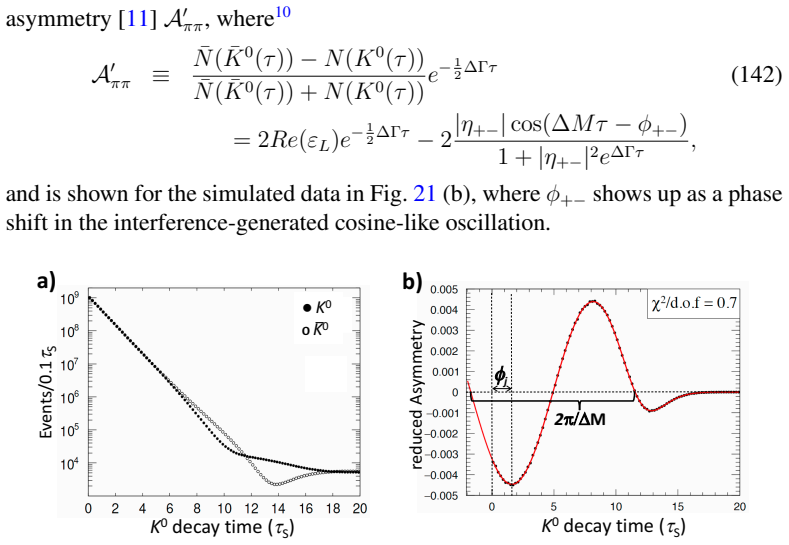
- [Section 5.6, CPT projection] The claimed order-of-magnitude improvement to |M_Kbar0 - M_K0| ~ 4e-17 MeV, via Eq. (129) and the fit result in Eq. (143), is based on a MC sample of 3.9e9 tagged K -> pi+pi- decays generated with a phase-space model under the assumption of a nearly perfect detector (|cos theta| <= 0.85) and a background ratio below 0.5%, with statistical-only errors. The listed systematic sources (time resolution, background, regeneration, fixed parameters) are not assigned numerical values, even though the CPLEAR and E773 systematic errors quoted in Eq. (144) show that systematics dominate at this precision. Without a realistic detector simulation and a numerical systematic budget, the 'order of magnitude improvement' statement in Section 6 is not yet established.
- [Section 4.7, charm mixing projections] The projected sensitivities for x, y, r_CP, and phi in Tables 8-10 and in the global fit (sigma(x)=0.036%, sigma(y)=0.015%, sigma(r_CP)=0.028, sigma(phi)=2.14 deg) are statistical-only and assume external strong-phase parameters with their current uncertainties; the text acknowledges strong phases as a prerequisite but does not propagate their uncertainties into the quoted numbers. Since the C-odd strong-phase measurements at STCF are themselves part of the program, the global sensitivities in Fig. 16 should either include a systematic component from the strong-phase inputs or be explicitly labeled as statistical-only.
minor comments (5)
- [Abstract] The sentence 'opportunities for improved tests of CPT invariance test in K0-Kbar0 mixing' contains a duplicated and grammatically inconsistent 'test'; it should be rephrased, for example as 'improved tests of CPT invariance in K0-Kbar0 mixing'.
- [Section 2.6, Eq. (57)] The normalization constant C is used in Eq. (57) before it is defined in the following sentence, and the text 'estimated the NMC events generated with the phase space model' appears to be missing a word such as 'using'; the undefined term 'mDIY MC' should also be clarified.
- [Figure 1 caption] The caption first states 'figures taken from arXiv:1712.06147' and then says the figure was 'created using a modified script from Ref. [16]'; these attributions are inconsistent and should be reconciled.
- [Section 5.3, Eq. (119)] The notation in Eq. (119) mixes psi and Psi and uses both lambda_k and lambda_K for the eigenvalue; the equation should be made internally consistent.
- [Table 1] The column header 'Lumi Samples sigma Numbers (ab^-1) (nb) of Events' is unclear; the units should be attached to the individual columns and the sample labels separated for readability.
Circularity Check
No significant circularity: the projected sensitivities are Monte-Carlo extrapolations and PDG-input simulations, not redefinitions of fitted inputs.
full rationale
The paper's central numerical claims do not reduce to their inputs by construction. The hyperon A_CP projection is obtained by fitting Eq. (59), sigma_ACP sqrt(N_fin) = k with k = 7.82, to fast-simulation samples between 0.01 and 0.1 trillion J/psi events, and then extrapolating to 3.4 trillion J/psi. This is an internal calibration of a statistical scaling law, not a definition of the CP-violating observable; the target A_CP is extracted from a maximum-likelihood fit to the joint angular distribution. The tau-sector sensitivity of 9.7 x 10^-4 per ab^-1 follows from efficiency-corrected MC event counts and the standard 1/sqrt(N) scaling, with input values checked against generated samples rather than being used to define the asymmetry. The kaon CPT projection uses PDG values of eta_+- and phi_SW to simulate K0 and K0bar decay-time distributions, then fits phi_SW + Delta_phi_CPT; the quoted |M_K0bar - M_K0| limit follows from the independently derived relation in Eq. (129). The charm prospects use external strong-phase inputs from BESIII/CLEO and explicit formulas for coherent D-Dbar decays. Some sensitivity estimates cite prior work by overlapping authors, notably Refs. [19, 65, 69] for hyperon polarization formulas and EDM pseudo-data studies, but these are used as supporting methodological references rather than as a substitute for the derivation, and the authors' own manuscript describes the relevant fit procedure and inputs. No equation or fitted parameter is renamed as a prediction, and no uniqueness claim is imported from the authors' prior work to force a choice. The extrapolation of k to 3.4 trillion J/psi is an assumption about statistical scaling and detector performance, which is a validity risk rather than circularity.
Assumptions & free parameters
free parameters (2)
- MC sensitivity constant k in sigma_ACP x sqrt(N_fin) = k =
7.82
- Effective tau form-factor coefficients a_K0*(800) and a_K*(1410) =
Complex coefficients from Ref. [190]
assumptions (5)
- domain assumption STCF will reach a peak luminosity of 0.5 x 10^35 cm^-2 s^-1 and deliver about 1 ab^-1 per year at the relevant energies.
- domain assumption Charmonium decays into particle-antiparticle pairs produce a pure CP-odd quantum-correlated state when the production process conserves CP.
- domain assumption Fast simulation and simplified selection efficiencies faithfully represent the final STCF detector response.
- domain assumption Known measured inputs such as BESIII alpha_psi, Delta_Phi_psi, PDG branching fractions, form factors, and CKM parameters are correct and applicable.
- standard math The Bell-Steinberger unitarity relation and the Wigner-Weisskopf effective Hamiltonian describe neutral kaon time evolution.
Cite this review
Pith. "Pith review of CP violation studies at Super Tau-Charm Facility." pith.science (2026). https://pith.science/paper/FHZBRJIJ
@misc{pith2026250208907,
  author       = {Pith},
  title        = {Pith review of: CP violation studies at Super Tau-Charm Facility},
  year         = {2026},
  howpublished = {\url{https://pith.science/paper/FHZBRJIJ}},
  note         = {Machine review of arXiv:2502.08907}
}
abstract
Charge-parity ($C\!P$) violation in the tau-charm energy region is a promising area for sensitive tests of Standard Model (SM) predictions and searches for new, beyond the SM physics. A future Tau-Charm Facility that operates at center-of-mass energies between 2.0 and 7.0 GeV, with a peak luminosity of $0.5\times10^{35}$~cm$^{-2}$s$^{-1}$, would provide huge numbers of hadrons and tau ($\tau$) leptons that are produced in low-background environments and with well understood kinematic properties. In this report, prospects for unique studies of $C\!P$ violation in the decay of charmed hadrons, and in the production and decay of hyperons and $\tau$ leptons at a next-generation tau-charm facility are discussed. In addition, opportunities for improved tests of $CPT$ invariance test in $K^{0}-\bar{K}^{0}$ mixing are presented.
Figures


Figures from the paper (18 more)




Forward citations
Cited by 1 Pith paper
-
Unified study of two-meson and axion-meson production from semileptonic tau decays within resonance chiral framework
Within a resonance chiral model, hadron resonances boost predicted tau decays into pion/K plus axion by factors of 7.5 and 19.2, with branching ratios and forward-backward asymmetries also predicted.
Reference graph
Works this paper leans on
-
[192]
B. R. Ko, E. Won, B. Golob, P. Pakhlov, Effect of nuclear interac- tions of neutral kaons on CP asymmetry measurements, Phys. Rev. D 84 (2011) 111501. arXiv:1006.1938, doi:10.1103/PhysRevD. 84.111501
arXiv 2011
-
[1]
Achasov, et al., STCF conceptual design report (V olume 1): Physics & detector, Front
M. Achasov, et al., STCF conceptual design report (V olume 1): Physics & detector, Front. Phys. (Beijing) 19 (1) (2024) 14701. arXiv:2303. 15790, doi:10.1007/s11467-023-1333-z
-
[2]
Weinberg, Essay: Half a Century of the Standard Model, Phys
S. Weinberg, Essay: Half a Century of the Standard Model, Phys. Rev. Lett. 121 (22) (2018) 220001. doi:10.1103/PhysRevLett.121. 220001
-
[3]
Cabibbo, Unitary Symmetry and Leptonic Decays, Phys
N. Cabibbo, Unitary Symmetry and Leptonic Decays, Phys. Rev. Lett. 10 (1963) 531–533. doi:10.1103/PhysRevLett.10.531
-
[4]
Kobayashi, T
M. Kobayashi, T. Maskawa, CP Violation in the Renormalizable Theory of Weak Interaction, Prog. Theor. Phys. 49 (1973) 652–657. doi:10. 1143/PTP.49.652
1973
-
[5]
Wolfenstein, Parametrization of the Kobayashi-Maskawa Matrix, Phys
L. Wolfenstein, Parametrization of the Kobayashi-Maskawa Matrix, Phys. Rev. Lett. 51 (1983) 1945. doi:10.1103/PhysRevLett.51.1945
-
[6]
Navas, et al., Review of particle physics, Phys
S. Navas, et al., Review of particle physics, Phys. Rev. D 110 (3) (2024) 030001. doi:10.1103/PhysRevD.110.030001. 92
-
[7]
Tandean, G
J. Tandean, G. Valencia, CP violation in hyperon nonleptonic decays within the standard model, Phys. Rev. D 67 (2003) 056001. doi:10.1103/ PhysRevD.67.056001
2003
Show all 289 references
-
[8]
Ablikim, et al., Probing CP symmetry and weak phases with entangled double-strange baryons, Nature 606 (7912) (2022) 64–69.arXiv:2105
M. Ablikim, et al., Probing CP symmetry and weak phases with entangled double-strange baryons, Nature 606 (7912) (2022) 64–69.arXiv:2105. 11155, doi:10.1038/s41586-022-04624-1
2022 doi
-
[9]
Ablikim, et al., Precise Measurements of Decay Parameters and CP Asymmetry with Entangled Λ − ¯Λ Pairs Pairs, Phys
M. Ablikim, et al., Precise Measurements of Decay Parameters and CP Asymmetry with Entangled Λ − ¯Λ Pairs Pairs, Phys. Rev. Lett. 129 (13) (2022) 131801. doi:10.1103/PhysRevLett.129.131801
2022 doi
-
[10]
Ablikim, et al., Tests of CP symmetry in entangled Ξ0-Ξ¯0 pairs, Phys
M. Ablikim, et al., Tests of CP symmetry in entangled Ξ0-Ξ¯0 pairs, Phys. Rev. D 108 (3) (2023) L031106. arXiv:2305.09218, doi: 10.1103/PhysRevD.108.L031106
2023
-
[11]
Apostolakis, et al., A Determination of the CP violation parameter η+− from the decay of strangeness tagged neutral kaons, Phys
A. Apostolakis, et al., A Determination of the CP violation parameter η+− from the decay of strangeness tagged neutral kaons, Phys. Lett. B 458 (1999) 545–552. doi:10.1016/S0370-2693(99)00596-1
1999 doi
-
[12]
Angelopoulos, et al., A Determination of the CPT violation parameter Re(delta) from the semileptonic decay of strangeness tagged neutral kaons, Phys
A. Angelopoulos, et al., A Determination of the CPT violation parameter Re(delta) from the semileptonic decay of strangeness tagged neutral kaons, Phys. Lett. B 444 (1998) 52–60. doi:10.1016/S0370-2693(98) 01357-4
1998 doi
-
[13]
I. I. Bigi, A. I. Sanda, CP violation, V ol. 9, Cambridge University Press,
-
[14]
M. S. Sozzi, On the direct CP violation parameter ϵ ′ , Eur. Phys. J. C 36 (2004) 37–42. doi:10.1140/epjc/s2004-01868-3
2004 doi
-
[16]
Gisbert, A
H. Gisbert, A. Pich, Direct CP violation in K 0 → ππ: Standard Model Status, Rept. Prog. Phys. 81 (7) (2018) 076201. doi:10.1088/ 1361-6633/aac18e
2018
-
[17]
Bai, et al., Standard Model Prediction for Direct CP Violation in K→ππ Decay, Phys
Z. Bai, et al., Standard Model Prediction for Direct CP Violation in K→ππ Decay, Phys. Rev. Lett. 115 (21) (2015) 212001.doi:10.1103/ PhysRevLett.115.212001. 93
2015
-
[18]
Abbott, et al., Direct CP violation and the ∆I = 1/2 rule in K → ππ decay from the standard model, Phys
R. Abbott, et al., Direct CP violation and the ∆I = 1/2 rule in K → ππ decay from the standard model, Phys. Rev. D 102 (5) (2020) 054509.doi: 10.1103/PhysRevD.102.054509
2020 doi
-
[19]
Salone, P
N. Salone, P. Adlarson, V . Batozskaya, A. Kupsc, S. Leupold, J. Tandean, Study of CP violation in hyperon decays at super-charm-tau factories with a polarized electron beam, Phys. Rev. D 105 (11) (2022) 116022. doi: 10.1103/PhysRevD.105.116022
2022 doi
-
[20]
T. D. Lee, C.-N. Yang, General Partial Wave Analysis of the Decay of a Hyperon of Spin 1/2, Phys. Rev. 108 (1957) 1645–1647.doi:10.1103/ PhysRev.108.1645
1957
-
[21]
Perotti, G
E. Perotti, G. Fäldt, A. Kupsc, S. Leupold, J. J. Song, Polarization observ- ables in e+e− annihilation to a baryon-antibaryon pair, Phys. Rev. D 99 (5) (2019) 056008. doi:10.1103/PhysRevD.99.056008
2019 doi
-
[22]
Tanabashi, et al., Review of Particle Physics, Phys
M. Tanabashi, et al., Review of Particle Physics, Phys. Rev. D 98 (3) (2018) 030001. doi:10.1103/PhysRevD.98.030001
2018 doi
-
[23]
Ablikim, et al., Investigation of the ∆I=1/2 Rule and Test of CP Sym- metry through the Measurement of Decay Asymmetry Parameters in Ξ- Decays, Phys
M. Ablikim, et al., Investigation of the ∆I=1/2 Rule and Test of CP Sym- metry through the Measurement of Decay Asymmetry Parameters in Ξ- Decays, Phys. Rev. Lett. 132 (10) (2024) 101801.arXiv:2309.14667, doi:10.1103/PhysRevLett.132.101801
2024
-
[24]
Ablikim, et al., Polarization and Entanglement in Baryon-Antibaryon Pair Production in Electron-Positron Annihilation, Nature Phys
M. Ablikim, et al., Polarization and Entanglement in Baryon-Antibaryon Pair Production in Electron-Positron Annihilation, Nature Phys. 15 (2019) 631–634. doi:10.1038/s41567-019-0494-8
2019 doi
-
[25]
D. G. Ireland, M. Döring, D. I. Glazier, J. Haidenbauer, M. Mai, R. Murray- Smith, D. Rönchen, Kaon Photoproduction and the Λ Decay Parameter α−, Phys. Rev. Lett. 123 (18) (2019) 182301. arXiv:1904.07616, doi:10.1103/PhysRevLett.123.182301
2019 arXiv
-
[26]
Ablikim, et al., Σ+ and ¯Σ− polarization in the J/ψ and ψ(3686) decays, Phys
M. Ablikim, et al., Σ+ and ¯Σ− polarization in the J/ψ and ψ(3686) decays, Phys. Rev. Lett. 125 (5) (2020) 052004. arXiv:2004.07701, doi: 10.1103/PhysRevLett.125.052004
2020
-
[27]
Ablikim, et al., Test of C PSymmetry in Hyperon to Neutron Decays, Phys
M. Ablikim, et al., Test of C PSymmetry in Hyperon to Neutron Decays, Phys. Rev. Lett. 131 (19) (2023) 191802. arXiv:2304.14655, doi: 10.1103/PhysRevLett.131.191802. 94
2023
-
[29]
Ablikim, et al., Model-Independent Determination of the Spin of the Ω− and Its Polarization Alignment in ψ(3686) → Ω− ¯Ω+, Phys
M. Ablikim, et al., Model-Independent Determination of the Spin of the Ω− and Its Polarization Alignment in ψ(3686) → Ω− ¯Ω+, Phys. Rev. Lett. 126 (9) (2021) 092002. arXiv:2007.03679, doi:10.1103/ PhysRevLett.126.092002
2021
-
[30]
O. E. Overseth, S. Pakvasa, Final-state interactions in nonleptonic hyperon decay, Phys. Rev. 184 (1969) 1663–1667. doi:10.1103/PhysRev. 184.1663
1969 doi
-
[31]
Holmstrom, et al., Search for CP violation in charged-Xi and Lambda hyperon decays, Phys
T. Holmstrom, et al., Search for CP violation in charged-Xi and Lambda hyperon decays, Phys. Rev. Lett. 93 (2004) 262001. doi:10.1103/ PhysRevLett.93.262001
2004
-
[33]
J. F. Donoghue, X.-G. He, S. Pakvasa, Hyperon Decays and CP Noncon- servation, Phys. Rev. D 34 (1986) 833.doi:10.1103/PhysRevD.34. 833
1986 doi
-
[34]
X.-G. He, H. Murayama, S. Pakvasa, G. Valencia, CP violation in hyperon decays from supersymmetry, Phys. Rev. D 61 (2000) 071701. doi:10. 1103/PhysRevD.61.071701
2000
-
[35]
S. R. Beane, P. F. Bedaque, A. Parreno, M. J. Savage, Exploring hyperons and hypernuclei with lattice QCD, Nucl. Phys. A 747 (2005) 55–74. doi: 10.1016/j.nuclphysa.2004.09.081
2005 doi
-
[36]
J. G. Korner, M. Kuroda, e+e− Annihilation Into Baryon-anti-Baryon Pairs, Phys. Rev. D 16 (1977) 2165. doi:10.1103/PhysRevD.16.2165
1977 doi
-
[37]
Fäldt, A
G. Fäldt, A. Kupsc, Hadronic structure functions in the e+e− → ¯ΛΛ re- action, Phys. Lett. B772 (2017) 16–20. doi:10.1016/j.physletb. 2017.06.011. 95
2017 doi
-
[38]
Ablikim, et al., Study of J/ψ and ψ(3686) decay to Λ¯Λ and Σ0 ¯Σ0 final states, Phys
M. Ablikim, et al., Study of J/ψ and ψ(3686) decay to Λ¯Λ and Σ0 ¯Σ0 final states, Phys. Rev. D 95 (5) (2017) 052003. arXiv:1701.07191, doi: 10.1103/PhysRevD.95.052003
2017 arXiv
-
[39]
Ablikim, et al., First measurements of J/Psi decays into Sigma+ anti- Sigma- and Xi0 anti-Xi0, Phys
M. Ablikim, et al., First measurements of J/Psi decays into Sigma+ anti- Sigma- and Xi0 anti-Xi0, Phys. Rev. D 78 (2008) 092005.arXiv:0810. 1896, doi:10.1103/PhysRevD.78.092005
2008 doi
-
[40]
Ablikim, et al., Strong and Weak CP Tests in Sequential Decays of Polarized Σ0 Hyperons, Phys
M. Ablikim, et al., Strong and Weak CP Tests in Sequential Decays of Polarized Σ0 Hyperons, Phys. Rev. Lett. 133 (10) (2024) 101902.arXiv: 2406.06118, doi:10.1103/PhysRevLett.133.101902
2024
-
[41]
Ablikim, et al., Study of J/ψ and ψ(3686) → Σ(1385)0 ¯Σ(1385)0 and Ξ0 ¯Ξ0, Phys
M. Ablikim, et al., Study of J/ψ and ψ(3686) → Σ(1385)0 ¯Σ(1385)0 and Ξ0 ¯Ξ0, Phys. Lett. B 770 (2017) 217–225. arXiv:1612.08664, doi: 10.1016/j.physletb.2017.04.048
2017 arXiv
-
[43]
Ablikim, et al., Precision Measurement of the Decay Σ+→pγ in the Process J/ψ→Σ+Σ¯-, Phys
M. Ablikim, et al., Precision Measurement of the Decay Σ+→pγ in the Process J/ψ→Σ+Σ¯-, Phys. Rev. Lett. 130 (21) (2023) 211901. arXiv: 2302.13568, doi:10.1103/PhysRevLett.130.211901
2023
-
[44]
Ablikim, et al., Measurement of the Decay Ξ0 → Λγ with Entangled Ξ0 ¯Ξ0 Pairs (8 2024)
M. Ablikim, et al., Measurement of the Decay Ξ0 → Λγ with Entangled Ξ0 ¯Ξ0 Pairs (8 2024). arXiv:2408.16654
2024
-
[45]
Batozskaya, A
V . Batozskaya, A. Kupsc, N. Salone, J. Wiechnik, Semileptonic decays of spin-entangled baryon-antibaryon pairs, Phys. Rev. D 108 (1) (2023) 016011. arXiv:2302.07665, doi:10.1103/PhysRevD.108. 016011
2023
-
[46]
Ablikim, et al., Measurement of the Absolute Branching Fraction and Decay Asymmetry of Λ→nγ, Phys
M. Ablikim, et al., Measurement of the Absolute Branching Fraction and Decay Asymmetry of Λ→nγ, Phys. Rev. Lett. 129 (21) (2022) 212002. arXiv:2206.10791, doi:10.1103/PhysRevLett. 129.212002
2022
-
[47]
G. R. Farrar, Weak radiative decay of the sigma+ and lambda hyperons, Phys. Rev. D 4 (1971) 212–220. doi:10.1103/PhysRevD.4.212
1971 doi
-
[48]
J. R. Batley, et al., First observation and branching fraction and decay pa- rameter measurements of the weak radiative decay Xi0 — > Lambda e+ 96 e-, Phys. Lett. B 650 (2007) 1–8. arXiv:hep-ex/0703023, doi: 10.1016/j.physletb.2007.04.066
2007 arXiv
-
[49]
Park, et al., Evidence for the decay Sigma+ — > p mu+ mu-, Phys
H. Park, et al., Evidence for the decay Sigma+ — > p mu+ mu-, Phys. Rev. Lett. 94 (2005) 021801. arXiv:hep-ex/0501014, doi:10.1103/ PhysRevLett.94.021801
2005 arXiv
-
[50]
Aaij, et al., Evidence for the rare decay Σ+ → pµ+µ−, Phys
R. Aaij, et al., Evidence for the rare decay Σ+ → pµ+µ−, Phys. Rev. Lett. 120 (22) (2018) 221803. arXiv:1712.08606, doi:10.1103/ PhysRevLett.120.221803
2018 arXiv
-
[51]
X.-G. He, J. Tandean, G. Valencia, The Decay Sigma+ — > p l+ l- within the standard model, Phys. Rev. D 72 (2005) 074003. arXiv:hep-ph/ 0506067, doi:10.1103/PhysRevD.72.074003
2005 doi
-
[52]
X.-G. He, J. Tandean, G. Valencia, Decay rate and asymmetries of Σ+ → pµ+µ−, JHEP 10 (2018) 040. arXiv:1806.08350, doi:10.1007/ JHEP10(2018)040
2018 arXiv
-
[53]
Erben, V
F. Erben, V . Gülpers, M. T. Hansen, R. Hodgson, A. Portelli, Prospects for a lattice calculation of the rare decay Σ+ → pℓ+ℓ−, JHEP 04 (2023) 108. arXiv:2209.15460, doi:10.1007/JHEP04(2023)108
2023 arXiv
-
[54]
Pospelov, A
M. Pospelov, A. Ritz, Electric dipole moments as probes of new physics, Annals Phys. 318 (2005) 119–169. arXiv:hep-ph/0504231, doi: 10.1016/j.aop.2005.04.002
2005 arXiv
-
[55]
S. S. Nair, E. Perotti, S. Leupold, Constraining P and CP violation in the main decay of the neutral Sigma hyperon, Phys. Lett. B 788 (2019) 535–
2019
-
[56]
Kadeer, J
A. Kadeer, J. G. Korner, U. Moosbrugger, Helicity analysis of semilep- tonic hyperon decays including lepton mass effects, Eur. Phys. J. C 59 (2009) 27–47. arXiv:hep-ph/0511019, doi:10.1140/epjc/ s10052-008-0801-5
2009 arXiv
-
[57]
Cabibbo, E
N. Cabibbo, E. C. Swallow, R. Winston, Semileptonic hyperon decays, Ann. Rev. Nucl. Part. Sci. 53 (2003) 39–75.arXiv:hep-ph/0307298, doi:10.1146/annurev.nucl.53.013103.155258. 97
2003 arXiv
-
[58]
Sasaki, Hyperon vector form factor from 2+1 flavor lattice QCD, Phys
S. Sasaki, Hyperon vector form factor from 2+1 flavor lattice QCD, Phys. Rev. D 86 (2012) 114502. arXiv:1209.6115, doi:10.1103/ PhysRevD.86.114502
2012 arXiv
-
[59]
A. N. Cooke, Lattice QCD study of octet hyperon semi-leptonic decays, Ph.D. thesis, Edinburgh U. (2014)
2014
-
[60]
Pondrom, R
L. Pondrom, R. Handler, M. Sheaff, P. T. Cox, J. Dworkin, O. E. Overseth, T. Devlin, L. Schachinger, K. J. Heller, New Limit on the Electric Dipole Moment of the Λ Hyperon, Phys. Rev. D 23 (1981) 814–816. doi:10. 1103/PhysRevD.23.814
1981
-
[61]
Guo, U.-G
F.-K. Guo, U.-G. Meissner, Baryon electric dipole moments from strong CP violation, JHEP 12 (2012) 097. arXiv:1210.5887, doi:10.1007/ JHEP12(2012)097
2012 arXiv
-
[62]
Atwood, A
D. Atwood, A. Soni, Chiral perturbation theory constraint on the electric dipole moment of the Lambda hyperon, Phys. Lett. B 291 (1992) 293–296. doi:10.1016/0370-2693(92)91048-E
1992 doi
-
[63]
A. Pich, E. de Rafael, Strong CP violation in an effective chiral La- grangian approach, Nucl. Phys. B 367 (1991) 313–333. doi:10.1016/ 0550-3213(91)90019-T
1991
-
[64]
Borasoy, The Electric dipole moment of the neutron in chiral perturba- tion theory, Phys
B. Borasoy, The Electric dipole moment of the neutron in chiral perturba- tion theory, Phys. Rev. D 61 (2000) 114017.arXiv:hep-ph/0004011, doi:10.1103/PhysRevD.61.114017
2000 arXiv
-
[65]
X. G. He, J. P. Ma, Testing of P and CP symmetries with e+e− → Λ¯Λ , Phys. Lett. B 839 (2023) 137834. arXiv:2212.08243, doi:10. 1016/j.physletb.2023.137834
2023 arXiv
-
[66]
Du, X.-G
Y . Du, X.-G. He, J.-P. Ma, X.-Y . Du, Fundamental Tests of P and CP Sym- metries Using Octet Baryons at the J/ψ Threshold (5 2024). arXiv: 2405.09625
2024 arXiv
-
[67]
X.-G. He, J. P. Ma, B. McKellar, CP violation in J / psi — > Lambda anti-Lambda, Phys. Rev. D 47 (1993) R1744–R1746. arXiv:hep-ph/ 9211276, doi:10.1103/PhysRevD.47.R1744. 98
1993 doi
-
[68]
X.-G. He, J. P. Ma, B. McKellar, CP violation in fermion pair decays of neutral boson particles, Phys. Rev. D 49 (1994) 4548–4552. arXiv: hep-ph/9310243, doi:10.1103/PhysRevD.49.4548
1994 arXiv
-
[69]
Fu, H.-B
J. Fu, H.-B. Li, J.-P. Wang, F.-S. Yu, J. Zhang, Probing hyperon electric dipole moments with a full angular analysis, Phys. Rev. D 108 (9) (2023) L091301. arXiv:2307.04364, doi:10.1103/PhysRevD.108. L091301
2023 arXiv
-
[70]
Bondar, A
A. Bondar, A. Grabovsky, A. Reznichenko, A. Rudenko, V . V orobyev, Mea- surement of the weak mixing angle at a Super Charm-Tau factory with data-driven monitoring of the average electron beam polarization, JHEP 03 (2020) 076. arXiv:1912.09760, doi:10.1007/JHEP03(2020) 076
2020 arXiv
-
[71]
L. K. Li, et al., Search for CP violation and measurement of branching fractions and decay asymmetry parameters forΛc+→Λh+ and Λc+→Σ0h+ (h=K,π), Sci. Bull. 68 (2023) 583–592. arXiv:2208.08695, doi: 10.1016/j.scib.2023.02.017
2023 arXiv
-
[72]
J. H. Kuhn, E. Mirkes, Structure functions in tau decays, Z. Phys. C 56 (1992) 661–672, [Erratum: Z.Phys.C 67, 364 (1995)]. doi:10.1007/ BF01474741
1992
-
[73]
Cirigliano, J
V . Cirigliano, J. Jenkins, M. Gonzalez-Alonso, Semileptonic decays of light quarks beyond the Standard Model, Nucl. Phys. B 830 (2010) 95–
2010
-
[74]
E. A. Garcés, M. Hernández Villanueva, G. López Castro, P. Roig, Effective-field theory analysis of the τ − → η(′)π−ντ decays, JHEP 12 (2017) 027. arXiv:1708.07802, doi:10.1007/JHEP12(2017) 027
2017 arXiv
-
[75]
Cirigliano, A
V . Cirigliano, A. Crivellin, M. Hoferichter, No-go theorem for non- standard explanations of the τ → KSπντ CP asymmetry, Phys. Rev. Lett. 120 (14) (2018) 141803. arXiv:1712.06595, doi:10.1103/ PhysRevLett.120.141803
2018 arXiv
-
[76]
Arteaga, L.-Y
S. Arteaga, L.-Y . Dai, A. Guevara, P. Roig, Tension between e+e-→ηπ-π+ and τ-→ηπ-π0ντ data and nonstandard interactions, Phys. Rev. D 106 (9) 99 (2022) 096016. arXiv:2209.15537, doi:10.1103/PhysRevD. 106.096016
2022 arXiv
-
[77]
G. P. Lepage, S. J. Brodsky, Exclusive Processes in Perturbative Quan- tum Chromodynamics, Phys. Rev. D 22 (1980) 2157. doi:10.1103/ PhysRevD.22.2157
1980
-
[78]
Gasser, H
J. Gasser, H. Leutwyler, Chiral Perturbation Theory to One Loop, Annals Phys. 158 (1984) 142. doi:10.1016/0003-4916(84)90242-2
1984 doi
-
[79]
Gasser, H
J. Gasser, H. Leutwyler, Chiral Perturbation Theory: Expansions in the Mass of the Strange Quark, Nucl. Phys. B 250 (1985) 465–516. doi: 10.1016/0550-3213(85)90492-4
1985 doi
-
[80]
Ananthanarayan, G
B. Ananthanarayan, G. Colangelo, J. Gasser, H. Leutwyler, Roy equation analysis of pi pi scattering, Phys. Rept. 353 (2001) 207–279. arXiv: hep-ph/0005297, doi:10.1016/S0370-1573(01)00009-6
2001 arXiv
-
[81]
Garcia-Martin, R
R. Garcia-Martin, R. Kaminski, J. R. Pelaez, J. Ruiz de Elvira, F. J. Yn- durain, The Pion-pion scattering amplitude. IV: Improved analysis with once subtracted Roy-like equations up to 1100 MeV, Phys. Rev. D 83 (2011) 074004. arXiv:1102.2183, doi:10.1103/PhysRevD. 83.074004
2011 arXiv
-
[82]
Gómez Dumm, P
D. Gómez Dumm, P. Roig, Dispersive representation of the pion vector form factor in τ → ππν τ decays, Eur. Phys. J. C 73 (8) (2013) 2528. arXiv:1301.6973, doi:10.1140/epjc/ s10052-013-2528-1
2013 arXiv
-
[83]
Gonzàlez-Solís, P
S. Gonzàlez-Solís, P. Roig, A dispersive analysis of the pion vec- tor form factor and τ − → K −KSντ decay, Eur. Phys. J. C 79 (5) (2019) 436. arXiv:1902.02273, doi:10.1140/epjc/ s10052-019-6943-9
2019 arXiv
-
[84]
Z. Y . Zhou, G. Y . Qin, P. Zhang, Z. Xiao, H. Q. Zheng, N. Wu, The Pole structure of the unitary, crossing symmetric low energy pi pi scat- tering amplitudes, JHEP 02 (2005) 043. arXiv:hep-ph/0406271, doi:10.1088/1126-6708/2005/02/043. 100
2005 arXiv
-
[85]
L. Y . Dai, X. G. Wang, H. Q. Zheng, Pole Analysis on UnitarizedSU (3) × SU (3) One Loop χPT Amplitudes, Commun. Theor. Phys. 57 (2012) 841–
2012
-
[86]
Z.-H. Guo, J. A. Oller, Resonances from meson-meson scattering in U(3) CHPT, Phys. Rev. D 84 (2011) 034005. arXiv:1104.2849, doi:10. 1103/PhysRevD.84.034005
2011 arXiv
-
[87]
Z.-H. Guo, J. A. Oller, J. Ruiz de Elvira, Chiral dynamics in form fac- tors, spectral-function sum rules, meson-meson scattering and semi-local duality, Phys. Rev. D 86 (2012) 054006. arXiv:1206.4163, doi: 10.1103/PhysRevD.86.054006
2012 arXiv
-
[88]
J. R. Pelaez, A. Rodas, J. Ruiz De Elvira, Global parameterization of ππ scattering up to 2 GeV, Eur. Phys. J. C 79 (12) (2019) 1008. arXiv: 1907.13162, doi:10.1140/epjc/s10052-019-7509-6
2019 arXiv
-
[89]
Yao, L.-Y
D.-L. Yao, L.-Y . Dai, H.-Q. Zheng, Z.-Y . Zhou, A review on partial- wave dynamics with chiral effective field theory and dispersion relation, Rept. Prog. Phys. 84 (7) (2021) 076201. arXiv:2009.13495, doi: 10.1088/1361-6633/abfa6f
2021 arXiv
-
[90]
Moussallam, Analyticity constraints on the strangeness changing vec- tor current and applications to tau — > K pi nu(tau), tau — > K pi pi nu(tau), Eur
B. Moussallam, Analyticity constraints on the strangeness changing vec- tor current and applications to tau — > K pi nu(tau), tau — > K pi pi nu(tau), Eur. Phys. J. C 53 (2008) 401–412. arXiv:0710.0548, doi: 10.1140/epjc/s10052-007-0464-7
2008 arXiv
-
[91]
D. R. Boito, R. Escribano, M. Jamin, K pi vector form-factor, dis- persive constraints and tau — > nu(tau) K pi decays, Eur. Phys. J. C 59 (2009) 821–829. arXiv:0807.4883, doi:10.1140/epjc/ s10052-008-0834-9
2009 arXiv
-
[92]
D. R. Boito, R. Escribano, M. Jamin, K π vector form factor constrained by τ − > K piντ and Kl3 decays, JHEP 09 (2010) 031. arXiv:1007. 1858, doi:10.1007/JHEP09(2010)031
2010 doi
-
[93]
Bernard, First determination of f+(0)|Vus| from a combined analy- sis of τ → Kπν τ decay and πK scattering with constraints from Kℓ3 decays, JHEP 06 (2014) 082
V . Bernard, First determination of f+(0)|Vus| from a combined analy- sis of τ → Kπν τ decay and πK scattering with constraints from Kℓ3 decays, JHEP 06 (2014) 082. arXiv:1311.2569, doi:10.1007/ JHEP06(2014)082. 101
2014 arXiv
-
[94]
Escribano, S
R. Escribano, S. González-Solís, M. Jamin, P. Roig, Combined analysis of the decays τ − → KSπ−ντ and τ − → K −ηντ, JHEP 09 (2014) 042. arXiv:1407.6590, doi:10.1007/JHEP09(2014)042
2014 arXiv
-
[95]
Escribano, S
R. Escribano, S. Gonzalez-Solis, P. Roig, τ − → K −η(′)ντ decays in Chi- ral Perturbation Theory with Resonances, JHEP 10 (2013) 039. arXiv: 1307.7908, doi:10.1007/JHEP10(2013)039
2013 arXiv
-
[96]
Stamen, D
D. Stamen, D. Hariharan, M. Hoferichter, B. Kubis, P. Stoffer, Kaon electromagnetic form factors in dispersion theory, Eur. Phys. J. C 82 (5) (2022) 432. arXiv:2202.11106, doi:10.1140/epjc/ s10052-022-10348-3
2022 arXiv
-
[97]
Leroy, J
C. Leroy, J. Pestieau, Tau Decay and Second Class Currents, Phys. Lett. B 72 (1978) 398–399. doi:10.1016/0370-2693(78)90148-X
1978 doi
-
[98]
Pich, ’Anomalous’ η Production in Tau Decay, Phys
A. Pich, ’Anomalous’ η Production in Tau Decay, Phys. Lett. B 196 (1987) 561–565. doi:10.1016/0370-2693(87)90821-5
1987 doi
-
[99]
Descotes-Genon, B
S. Descotes-Genon, B. Moussallam, Analyticity of ηπ isospin-violating form factors and the τ → ηπν second-class decay, Eur. Phys. J. C 74 (2014) 2946. arXiv:1404.0251, doi:10.1140/epjc/ s10052-014-2946-8
2014 arXiv
-
[100]
Escribano, S
R. Escribano, S. Gonzalez-Solis, P. Roig, Predictions on the second-class current decays τ − → π−η(′)ντ, Phys. Rev. D 94 (3) (2016) 034008. arXiv:1601.03989, doi:10.1103/PhysRevD.94.034008
2016 arXiv
-
[101]
Shi, C.-Y
Y .-J. Shi, C.-Y . Seng, F.-K. Guo, B. Kubis, U.-G. Meißner, W. Wang, Two- Meson Form Factors in Unitarized Chiral Perturbation Theory, JHEP 04 (2021) 086. arXiv:2011.00921, doi:10.1007/JHEP04(2021) 086
2021 arXiv
-
[102]
Döring, U.-G
M. Döring, U.-G. Meißner, W. Wang, Chiral Dynamics and S-wave Con- tributions in Semileptonic B decays, JHEP 10 (2013) 011. arXiv: 1307.0947, doi:10.1007/JHEP10(2013)011
2013 arXiv
-
[103]
Ropertz, C
S. Ropertz, C. Hanhart, B. Kubis, A new parametrization for the scalar pion form factors, Eur. Phys. J. C 78 (12) (2018) 1000.arXiv:1809.06867, doi:10.1140/epjc/s10052-018-6416-6. 102
2018 arXiv
-
[104]
Bernard, N
V . Bernard, N. Kaiser, U. G. Meissner,πK scattering in chiral perturbation theory to one loop, Nucl. Phys. B 357 (1991) 129–152. doi:10.1016/ 0550-3213(91)90461-6
1991
-
[105]
Jamin, J
M. Jamin, J. A. Oller, A. Pich, S wave K pi scattering in chiral perturba- tion theory with resonances, Nucl. Phys. B 587 (2000) 331–362. arXiv: hep-ph/0006045, doi:10.1016/S0550-3213(00)00479-X
2000 arXiv
-
[106]
H. Q. Zheng, Z. Y . Zhou, G. Y . Qin, Z. Xiao, J. J. Wang, N. Wu, The kappa resonance in s wave pi K scatterings, Nucl. Phys. A 733 (2004) 235–
2004
-
[107]
Jamin, J
M. Jamin, J. A. Oller, A. Pich, Strangeness changing scalar form-factors, Nucl. Phys. B 622 (2002) 279–308. arXiv:hep-ph/0110193, doi: 10.1016/S0550-3213(01)00605-8
2002 arXiv
-
[108]
V on Detten, F
L. V on Detten, F. Noël, C. Hanhart, M. Hoferichter, B. Kubis, On the scalar πK form factor beyond the elastic region, Eur. Phys. J. C 81 (5) (2021) 420. arXiv:2103.01966, doi:10.1140/epjc/ s10052-021-09169-7
2021 arXiv
-
[109]
J. A. Miranda, P. Roig, Effective-field theory analysis of the τ − → π−π0ντ decays, JHEP 11 (2018) 038. arXiv:1806.09547, doi:10.1007/ JHEP11(2018)038
2018 arXiv
-
[110]
Rendón, P
J. Rendón, P. Roig, G. Toledo Sánchez, Effective-field theory analysis of the τ − → (Kπ )−ντ decays, Phys. Rev. D 99 (9) (2019) 093005. arXiv: 1902.08143, doi:10.1103/PhysRevD.99.093005
2019 arXiv
-
[111]
Gonzàlez-Solís, A
S. Gonzàlez-Solís, A. Miranda, J. Rendón, P. Roig, Effective-field the- ory analysis of the τ − → K −(η(′), K0)ντ decays, Phys. Rev. D 101 (3) (2020) 034010. arXiv:1911.08341, doi:10.1103/PhysRevD. 101.034010
2020 arXiv
-
[112]
Colangelo, M
G. Colangelo, M. Finkemeier, R. Urech, Tau decays and chiral perturbation theory, Phys. Rev. D 54 (1996) 4403–4418.arXiv:hep-ph/9604279, doi:10.1103/PhysRevD.54.4403. 103
1996 arXiv
-
[113]
Gomez Dumm, A
D. Gomez Dumm, A. Pich, J. Portoles, tau — > pi pi pi nu(tau) decays in the resonance effective theory, Phys. Rev. D 69 (2004) 073002. arXiv: hep-ph/0312183, doi:10.1103/PhysRevD.69.073002
2004 arXiv
-
[114]
D. G. Dumm, P. Roig, A. Pich, J. Portoles, tau — > pi pi pi nu(tau) decays and the a(1)(1260) off-shell width revisited, Phys. Lett. B 685 (2010) 158–
2010
-
[115]
arXiv:0908.1754, doi:10.1016/j.nuclphysb.2009. 12.020
2009 arXiv
-
[116]
I. M. Nugent, T. Przedzinski, P. Roig, O. Shekhovtsova, Z. Was, Resonance chiral Lagrangian currents and experimental data for τ − → π−π−π+ντ, Phys. Rev. D 88 (2013) 093012. arXiv:1310.1053, doi:10.1103/ PhysRevD.88.093012
2013 arXiv
-
[117]
D. G. Dumm, P. Roig, A. Pich, J. Portoles, Hadron structure in tau —> KK pi nu (tau) decays, Phys. Rev. D 81 (2010) 034031.arXiv:0911.2640, doi:10.1103/PhysRevD.81.034031
2010 arXiv
-
[118]
Gomez Dumm, P
D. Gomez Dumm, P. Roig, Resonance Chiral Lagrangian analysis ofτ − → η(′)π−π0ντ decays, Phys. Rev. D 86 (2012) 076009.arXiv:1208.1212, doi:10.1103/PhysRevD.86.076009
2012 arXiv
-
[119]
Guo, Study of tau- — > V P- nu(tau) in the framework of resonance chiral theory, Phys
Z.-H. Guo, Study of tau- — > V P- nu(tau) in the framework of resonance chiral theory, Phys. Rev. D 78 (2008) 033004. arXiv:0806.4322, doi:10.1103/PhysRevD.78.033004
2008 arXiv
-
[120]
Ecker, R
G. Ecker, R. Unterdorfer, Four pion production in e+ e- annihilation, Eur. Phys. J. C 24 (2002) 535–545. arXiv:hep-ph/0203075, doi:10. 1007/s10052-002-0960-8
2002 arXiv
-
[121]
Shekhovtsova, T
O. Shekhovtsova, T. Przedzinski, P. Roig, Z. Was, Resonance chi- ral Lagrangian currents and τ decay Monte Carlo, Phys. Rev. D 86 (2012) 113008. arXiv:1203.3955, doi:10.1103/PhysRevD. 86.113008
2012 arXiv
-
[122]
Z.-H. Guo, P. Roig, One meson radiative tau decays, Phys. Rev. D 82 (2010) 113016. arXiv:1009.2542, doi:10.1103/PhysRevD. 82.113016
2010 arXiv
-
[123]
J. A. Miranda, P. Roig, New τ-based evaluation of the hadronic contri- bution to the vacuum polarization piece of the muon anomalous mag- netic moment, Phys. Rev. D 102 (2020) 114017. arXiv:2007.11019, doi:10.1103/PhysRevD.102.114017
2020 arXiv
-
[124]
Guevara, G
A. Guevara, G. L. Castro, P. Roig, Improved description of dilepton pro- duction in τ-→ντ P- decays, Phys. Rev. D 105 (7) (2022) 076007.arXiv: 2111.09994, doi:10.1103/PhysRevD.105.076007
2022 arXiv
-
[125]
M. A. Arroyo-Ureña, G. Hernández-Tomé, G. López-Castro, P. Roig, I. Rosell, Radiative corrections to τ→π(K)ντ [γ]: A reliable new physics test, Phys. Rev. D 104 (9) (2021) L091502. arXiv:2107.04603, doi:10.1103/PhysRevD.104.L091502
2021 arXiv
-
[126]
M. A. Arroyo-Ureña, G. Hernández-Tomé, G. López-Castro, P. Roig, I. Rosell, One-loop determination of τ → π(K)ντ [γ] branching ratios and new physics tests, JHEP 02 (2022) 173. arXiv:2112.01859, doi:10.1007/JHEP02(2022)173
2022 arXiv
-
[127]
Cirigliano, G
V . Cirigliano, G. Ecker, H. Neufeld, Radiative tau decay and the magnetic moment of the muon, JHEP 08 (2002) 002. arXiv:hep-ph/0207310, doi:10.1088/1126-6708/2002/08/002. 104
2002 arXiv
-
[128]
Escribano, J
R. Escribano, J. A. Miranda, P. Roig, Radiative corrections to the τ- →(P1P2)−vτ (P1,2=π,K) decays, Phys. Rev. D 109 (5) (2024) 053003. arXiv:2303.01362, doi:10.1103/PhysRevD.109.053003
2024 arXiv
-
[129]
H. B. Meyer, Lattice QCD and the Timelike Pion Form Factor, Phys. Rev. Lett. 107 (2011) 072002. arXiv:1105.1892, doi:10.1103/ PhysRevLett.107.072002
2011 arXiv
-
[130]
X. Feng, S. Aoki, S. Hashimoto, T. Kaneko, Timelike pion form factor in lattice QCD, Phys. Rev. D 91 (5) (2015) 054504. arXiv:1412.6319, doi:10.1103/PhysRevD.91.054504
2015 arXiv
-
[131]
Andersen, J
C. Andersen, J. Bulava, B. Hörz, C. Morningstar, The I = 1 pion-pion scattering amplitude and timelike pion form factor from Nf = 2 + 1 lattice 105 QCD, Nucl. Phys. B 939 (2019) 145–173. arXiv:1808.05007, doi: 10.1016/j.nuclphysb.2018.12.018
2019 arXiv
-
[132]
Baroni, R
A. Baroni, R. A. Briceño, M. T. Hansen, F. G. Ortega-Gama, Form fac- tors of two-hadron states from a covariant finite-volume formalism, Phys. Rev. D 100 (3) (2019) 034511. arXiv:1812.10504, doi:10.1103/ PhysRevD.100.034511
2019 arXiv
-
[133]
Chen, C.-G
C. Chen, C.-G. Duan, Z.-H. Guo, Triple-product asymmetry in the radiative two-pion tau decay, JHEP 08 (2022) 144. arXiv:2201.12764, doi: 10.1007/JHEP08(2022)144
2022 arXiv
-
[134]
S. Y . Choi, K. Hagiwara, M. Tanabashi, CP violation in tau — > 3 pi tau-neutrino, Phys. Rev. D 52 (1995) 1614–1626. arXiv:hep-ph/ 9412203, doi:10.1103/PhysRevD.52.1614
1995 doi
-
[135]
S. Y . Choi, J. Lee, J. Song, CP violation in the Cabibbo suppressed de- cay tau — > K pi tau-neutrino with polarized tau leptons, Phys. Lett. B 437 (1998) 191–200. arXiv:hep-ph/9804268, doi:10.1016/ S0370-2693(98)00872-7
1998 arXiv
-
[136]
I. I. Bigi, A. I. Sanda, A ’Known’ CP asymmetry in tau decays, Phys. Lett. B 625 (2005) 47–52. arXiv:hep-ph/0506037, doi:10.1016/j. physletb.2005.08.033
2005 arXiv
-
[137]
I. I. Bigi, CP Violation in τ Decays at SuperB & Super-Belle II Ex- periments - like Finding Signs of Dark Matter, Nucl. Phys. B Proc. Suppl. 253-255 (2014) 91–94. arXiv:1210.2968, doi:10.1016/ j.nuclphysbps.2014.09.022
2014 arXiv
-
[138]
Delepine, G
D. Delepine, G. Lopez Castro, L. T. Lopez Lozano, CP violation in semileptonic tau lepton decays, Phys. Rev. D 72 (2005) 033009. arXiv: hep-ph/0503090, doi:10.1103/PhysRevD.72.033009
2005 arXiv
-
[139]
J. H. Kuhn, E. Mirkes, CP violation in semileptonic tau decays with un- polarized beams, Phys. Lett. B 398 (1997) 407–414. arXiv:hep-ph/ 9609502, doi:10.1016/S0370-2693(97)00233-5
1997 doi
-
[140]
Datta, K
A. Datta, K. Kiers, D. London, P. J. O’Donnell, A. Szynkman, CP Vi- olation in Hadronic tau Decays, Phys. Rev. D 75 (2007) 074007, [Er- ratum: Phys.Rev.D 76, 079902 (2007)]. arXiv:hep-ph/0610162, doi:10.1103/PhysRevD.76.079902
2007 arXiv
-
[141]
Kiers, K
K. Kiers, K. Little, A. Datta, D. London, M. Nagashima, A. Szynkman, CP violation in tau — > K pi pi nu(tau), Phys. Rev. D 78 (2008) 113008. arXiv:0808.1707, doi:10.1103/PhysRevD.78.113008
2008 arXiv
-
[142]
Huang, J.-M
T. Huang, J.-M. Yang, B.-L. Young, X.-M. Zhang, Effective CP vio- lating operators of the tau lepton and some of their phenomenologies, Phys. Rev. D 58 (1998) 073007. arXiv:hep-ph/9803334, doi: 10.1103/PhysRevD.58.073007
1998 arXiv
-
[143]
Huang, W
T. Huang, W. Lu, Z.-j. Tao, Search for nonstandard model CP/T violation at tau charm factory, Phys. Rev. D 55 (1997) 1643–1652.arXiv:hep-ph/ 9609220, doi:10.1103/PhysRevD.55.1643
1997 doi
-
[144]
Kilian, J
U. Kilian, J. G. Korner, K. Schilcher, Y . L. Wu, Lepton hadron angular correlations in semileptonic tau decays, Z. Phys. C 62 (1994) 413–419. doi:10.1007/BF01555900
1994 doi
-
[145]
Delepine, G
D. Delepine, G. Faisel, C. A. Ramirez, Exploring new physics con- tributions to CP violation in τ − → K −π0ντ, Eur. Phys. J. C 81 (4) (2021) 368. arXiv:1806.05090, doi:10.1140/epjc/ s10052-021-09150-4. 106
2021 arXiv
-
[146]
Y . S. Tsai, Production of polarized tau pairs and tests of CP violation using polarized e+- colliders near threshold, Phys. Rev. D 51 (1995) 3172–3181. arXiv:hep-ph/9410265, doi:10.1103/PhysRevD.51.3172
1995 arXiv
-
[147]
Tsai, The Investigation of CP violation through the decay of polar- ized tau leptons, Phys
Y .-s. Tsai, The Investigation of CP violation through the decay of polar- ized tau leptons, Phys. Lett. B 378 (1996) 272–278. doi:10.1016/ 0370-2693(96)00403-0
1996
-
[148]
Wang, X.-H
C. Wang, X.-H. Guo, Y . Liu, R.-C. Li, Direct CP violation in τ ± → K ±ρ0(ω)ντ → K ±π+π−ντ, Eur. Phys. J. C 74 (11) (2014) 3140. arXiv: 1408.0086, doi:10.1140/epjc/s10052-014-3140-8
2014 arXiv
-
[149]
Mileo, K
N. Mileo, K. Kiers, A. Szynkman, Probing sensitivity to charged scalars through partial differential widths: τ → Kππν τ decays, Phys. Rev. 107 D 91 (7) (2015) 073006. arXiv:1410.1909, doi:10.1103/ PhysRevD.91.073006
2015 arXiv
-
[150]
I. I. Bigi, Probing CP Violation in τ − → ν(Kπ/K 2π/3K/K3π)− Decays (4 2012). arXiv:1204.5817
2012 arXiv
-
[151]
Lopez Castro, L
G. Lopez Castro, L. Lopez-Lozano, A. Rosado, Violation of CP and T in semileptonic decays due to scalar interactions, Phys. Rev. D 80 (2009) 096004. arXiv:0911.1148, doi:10.1103/PhysRevD. 80.096004
2009 arXiv
-
[152]
Kimura, K
D. Kimura, K. Y . Lee, T. Morozumi, The Form factors ofτ → Kπ (η)ν and the predictions for CP violation beyond the standard model, PTEP 2013 (2013) 053B03, [Erratum: PTEP 2013, 099201 (2013), Erratum: PTEP 2014, 089202 (2014)]. arXiv:1201.1794, doi:10.1093/ptep/ ptt013
2013 arXiv
-
[153]
Zhang, X.-W
L. Zhang, X.-W. Kang, X.-H. Guo, L.-Y . Dai, T. Luo, C. Wang, A compre- hensive study on the semileptonic decay of heavy flavor mesons, JHEP 02 (2021) 179. arXiv:2012.04417, doi:10.1007/JHEP02(2021) 179
2021 arXiv
-
[154]
R. N. Faustov, V . O. Galkin, X.-W. Kang, Semileptonic decays ofD and Ds mesons in the relativistic quark model, Phys. Rev. D 101 (1) (2020) 013004. arXiv:1911.08209, doi:10.1103/PhysRevD.101.013004
2020 arXiv
-
[155]
R. N. Faustov, V . O. Galkin, X.-W. Kang, Relativistic description of the semileptonic decays of bottom mesons, Phys. Rev. D 106 (1) (2022) 013004. arXiv:2206.10277, doi:10.1103/PhysRevD.106. 013004
2022 arXiv
-
[156]
Calderon, D
G. Calderon, D. Delepine, G. L. Castro, Is there a paradox in CP asym- metries of tau+- — > K(L,S)pi+- nu decays?, Phys. Rev. D 75 (2007) 076001. arXiv:hep-ph/0702282, doi:10.1103/PhysRevD. 75.076001
2007 arXiv
-
[157]
Shi, X.-W
X.-D. Shi, X.-W. Kang, I. Bigi, W.-P. Wang, H.-P. Peng, Prospects for CP and P violation in Λ+ c decays at Super Tau Charm Facility, Phys. Rev. D 100 (11) (2019) 113002. arXiv:1904.12415, doi:10.1103/ PhysRevD.100.113002
2019 arXiv
-
[158]
Grossman, Y
Y . Grossman, Y . Nir, CP Violation in τ ± → π±KSν and D± → π±KS: The Importance of KS − KL Interference, JHEP 04 (2012) 002. arXiv: 1110.3790, doi:10.1007/JHEP04(2012)002
2012 arXiv
-
[159]
H. Z. Devi, L. Dhargyal, N. Sinha, Can the observed CP asymmetry in τ → Kπν τ be due to nonstandard tensor interactions?, Phys. Rev. D 90 (1) (2014) 013016. arXiv:1308.4383, doi:10.1103/PhysRevD. 90.013016
2014 arXiv
-
[160]
K. M. Watson, Some general relations between the photoproduction and scattering of pi mesons, Phys. Rev. 95 (1954) 228–236. doi:10.1103/ PhysRev.95.228
1954
-
[161]
Chen, X.-Q
F.-Z. Chen, X.-Q. Li, Y .-D. Yang, X. Zhang, CP asymmetry inτ → KSπντ decays within the Standard Model and beyond, Phys. Rev. D 100 (11) (2019) 113006. arXiv:1909.05543, doi:10.1103/PhysRevD. 100.113006
2019 arXiv
-
[162]
Chen, X.-Q
F.-Z. Chen, X.-Q. Li, S.-C. Peng, Y .-D. Yang, H.-H. Zhang, CP asymmetry in the angular distributions ofτ → KSπν τ decays. Part II. General effective field theory analysis, JHEP 01 (2022) 108. arXiv:2107.12310, doi: 10.1007/JHEP01(2022)108
2022 arXiv
-
[163]
J. P. Lees, et al., Search for CP Violation in the Decay τ −− > π−K 0 S(>= 0π0)νtau, Phys. Rev. D 85 (2012) 031102, [Erratum: Phys.Rev.D 85, 099904 (2012)]. arXiv:1109.1527, doi:10.1103/PhysRevD. 85.031102. 108
2012 arXiv
-
[164]
arXiv:0911.4436, doi:10.1016/j.physletb.2010. 01.059
2010 arXiv
-
[165]
H. Sang, X. Shi, X. Zhou, X. Kang, J. Liu, Feasibility study of CP violation in τ → KSπντ decays at the Super Tau Charm Facility, Chin. Phys. C 45 (5) (2021) 053003. arXiv:2012.06241, doi:10.1088/1674-1137/ abeb07
2021 arXiv
-
[166]
Bischofberger, et al., Search for CP violation in τ → K 0 Sπντ decays at Belle, Phys
M. Bischofberger, et al., Search for CP violation in τ → K 0 Sπντ decays at Belle, Phys. Rev. Lett. 107 (2011) 131801. arXiv:1101.0349, doi: 10.1103/PhysRevLett.107.131801
2011 arXiv
-
[167]
Bonvicini, et al., Search for CP violation in tau — > K pi tau-neutrino decays, Phys
G. Bonvicini, et al., Search for CP violation in tau — > K pi tau-neutrino decays, Phys. Rev. Lett. 88 (2002) 111803. arXiv:hep-ex/0111095, doi:10.1103/PhysRevLett.88.111803. 109
2002 arXiv
-
[169]
D. A. L. Aguilar, J. Rendón, P. Roig, CP violation in two-meson Tau decays induced by heavy new physics (9 2024). arXiv:2409.05588
2024 arXiv
-
[170]
Dighe, S
A. Dighe, S. Ghosh, G. Kumar, T. S. Roy, Tensors for tending to tensions in τ decays (2 2019). arXiv:1902.09561
2019 arXiv
-
[171]
Achard, et al., Muon pair and tau pair production in two photon collisions at LEP, Phys
P. Achard, et al., Muon pair and tau pair production in two photon collisions at LEP, Phys. Lett. B 585 (2004) 53–62. arXiv:hep-ex/0402037, doi:10.1016/j.physletb.2004.02.012
2004 arXiv
-
[172]
Lohmann, Electromagnetic and weak moments of the tau-lepton, Nucl
W. Lohmann, Electromagnetic and weak moments of the tau-lepton, Nucl. Phys. B Proc. Suppl. 144 (2005) 122–127. arXiv:hep-ex/0501065, doi:10.1016/j.nuclphysbps.2005.02.017
2005 arXiv
-
[173]
Inami, et al., Search for the electric dipole moment of the tau lepton, Phys
K. Inami, et al., Search for the electric dipole moment of the tau lepton, Phys. Lett. B 551 (2003) 16–26. arXiv:hep-ex/0210066, doi:10. 1016/S0370-2693(02)02984-2
2003 arXiv
-
[174]
Biebel, T
J. Biebel, T. Riemann, Predictions for anomalous tau+ tau- gamma produc- tion at LEP-1, Z. Phys. C 76 (1997) 53–58. arXiv:hep-ph/9610437, doi:10.1007/s002880050526
1997 arXiv
-
[175]
Abdallah, et al., Study of tau-pair production in photon-photon collisions at LEP and limits on the anomalous electromagnetic moments of the tau lepton, Eur
J. Abdallah, et al., Study of tau-pair production in photon-photon collisions at LEP and limits on the anomalous electromagnetic moments of the tau lepton, Eur. Phys. J. C 35 (2004) 159–170. arXiv:hep-ex/0406010, doi:10.1140/epjc/s2004-01852-y
2004 arXiv
-
[176]
Cornet, J
F. Cornet, J. I. Illana, Tau pair production via photon-photon collisions at LEP, Phys. Rev. D 53 (1996) 1181–1184. arXiv:hep-ph/9503466, doi:10.1103/PhysRevD.53.1181
1996 arXiv
-
[177]
Bernreuther, O
W. Bernreuther, O. Nachtmann, P. Overmann, The CP violating electric and weak dipole moments of the tau lepton from threshold to 500-GeV, Phys. Rev. D 48 (1993) 78–88. doi:10.1103/PhysRevD.48.78. 110
1993 doi
-
[178]
X. Chen, Y . Wu, Search for the Electric Dipole Moment and anomalous magnetic moment of the tau lepton at tau factories, JHEP 10 (2019) 089. arXiv:1803.00501, doi:10.1007/JHEP10(2019)089
2019 arXiv
-
[179]
Bernreuther, L
W. Bernreuther, L. Chen, O. Nachtmann, Electric dipole moment of the tau lepton revisited, Phys. Rev. D 103 (9) (2021) 096011. arXiv:2101. 08071, doi:10.1103/PhysRevD.103.096011
2021 doi
-
[180]
Acciarri, et al., Measurement of the weak dipole moments of the tau lepton, Phys
M. Acciarri, et al., Measurement of the weak dipole moments of the tau lepton, Phys. Lett. B 426 (1998) 207–216. doi:10.1016/ S0370-2693(98)00290-1
1998
-
[181]
S. S. Gau, T. C. Paul, J. Swain, L. Taylor, Radiative tau lepton pair pro- duction as a probe of anomalous electromagnetic couplings of the tau, Nucl. Phys. B 523 (1998) 439–449. arXiv:hep-ph/9712360, doi: 10.1016/S0550-3213(98)00121-7
1998 arXiv
-
[182]
Acciarri, et al., Measurement of the anomalous magnetic and electric dipole moments of the tau lepton, Phys
M. Acciarri, et al., Measurement of the anomalous magnetic and electric dipole moments of the tau lepton, Phys. Lett. B 434 (1998) 169–179.doi: 10.1016/S0370-2693(98)00736-9
1998 doi
-
[183]
Köksal, A
M. Köksal, A. A. Billur, A. Gutiérrez-Rodríguez, M. A. Hernández-Ruíz, Model-independent sensitivity estimates for the electromagnetic dipole moments of the τ-lepton at the CLIC, Phys. Rev. D 98 (1) (2018) 015017. arXiv:1804.02373, doi:10.1103/PhysRevD.98.015017
2018 arXiv
-
[184]
Köksal, Model-independent study on the anomalous τ τ¯γ couplings at the ILC, Nucl
M. Köksal, Model-independent study on the anomalous τ τ¯γ couplings at the ILC, Nucl. Phys. B 971 (2021) 115520. arXiv:2104.01003, doi:10.1016/j.nuclphysb.2021.115520
2021 arXiv
-
[185]
Gutiérrez-Rodríguez, C
A. Gutiérrez-Rodríguez, C. Pérez-Mayorga, A. González-Sánchez, Sensi- tivity Estimates on the Electromagnetic Dipole Moments of the τ-Lepton at Future e +e− Linear Colliders, Int. J. Theor. Phys. 61 (5) (2022) 132. doi:10.1007/s10773-022-05119-5
2022 doi
-
[186]
Sun, et al., Search for the electric dipole moment of the tau lepton at the Super Tau-Charm Facility (2024)
X. Sun, et al., Search for the electric dipole moment of the tau lepton at the Super Tau-Charm Facility (2024). arXiv:2411.19469
2024 arXiv
-
[187]
Heister, et al., Search for anomalous weak dipole moments of the tau lepton, Eur
A. Heister, et al., Search for anomalous weak dipole moments of the tau lepton, Eur. Phys. J. C 30 (2003) 291–304. arXiv:hep-ex/0209066, doi:10.1140/epjc/s2003-01286-1
2003 arXiv
-
[188]
M. J. Booth, The Electric dipole moment of the W and electron in the Stan- dard Model (1 1993). arXiv:hep-ph/9301293
1993 arXiv
-
[189]
Was, TAUOLA the library for tau lepton decay, and KKMC / KORALB / KORALZ /
Z. Was, TAUOLA the library for tau lepton decay, and KKMC / KORALB / KORALZ /... status report, Nucl. Phys. B Proc. Suppl. 98 (2001) 96–102. arXiv:hep-ph/0011305, doi:10.1016/ S0920-5632(01)01200-2
2001 arXiv
-
[190]
Epifanov, et al., Study of tau- — > K(S) pi- nu(tau) decay at Belle, Phys
D. Epifanov, et al., Study of tau- — > K(S) pi- nu(tau) decay at Belle, Phys. Lett. B 654 (2007) 65–73. arXiv:0706.2231, doi:10.1016/ j.physletb.2007.08.045
2007 arXiv
-
[191]
Barlow, Systematic errors: Facts and fictions, in: Conference on Ad- vanced Statistical Techniques in Particle Physics, 2002, pp
R. Barlow, Systematic errors: Facts and fictions, in: Conference on Ad- vanced Statistical Techniques in Particle Physics, 2002, pp. 134–144. arXiv:hep-ex/0207026
2002 arXiv
-
[193]
Shi, X.-R
X.-D. Shi, X.-R. Zhou, X.-S. Qin, H.-P. Peng, A fast simulation package for STCF detector, JINST 16 (03) (2021) P03029.arXiv:2011.01654, doi:10.1088/1748-0221/16/03/P03029. 111
2021 arXiv
-
[194]
Jadach, B
S. Jadach, B. F. L. Ward, Z. Was, The Precision Monte Carlo event generator K K for two fermion final states in e+ e- collisions, Com- put. Phys. Commun. 130 (2000) 260–325. arXiv:hep-ph/9912214, doi:10.1016/S0010-4655(00)00048-5
2000 arXiv
-
[195]
Aaij, et al., Measurement of the Time-Integrated CP Asymmetry in D0→K-K+ Decays, Phys
R. Aaij, et al., Measurement of the Time-Integrated CP Asymmetry in D0→K-K+ Decays, Phys. Rev. Lett. 131 (9) (2023) 091802. arXiv: 2209.03179, doi:10.1103/PhysRevLett.131.091802
2023 arXiv
-
[196]
Iguro, U
S. Iguro, U. Nierste, E. Overduin, M. Schüßler, SU(3)F sum rules for CP asymmetry of D(s) decays (8 2024). arXiv:2408.03227
2024 arXiv
-
[197]
Xing, A U-spin prediction for the CP-forbidden transition e+e− → D0 ¯D0 → (K +K −)D(π+π−)D, Mod
Z.-z. Xing, A U-spin prediction for the CP-forbidden transition e+e− → D0 ¯D0 → (K +K −)D(π+π−)D, Mod. Phys. Lett. A 34 (29) (2019) 1950238. arXiv:1903.09566, doi:10.1142/ S0217732319502389. 112
2019 arXiv
-
[198]
Cheng, C.-W
H.-Y . Cheng, C.-W. Chiang, Direct CP violation in two-body hadronic charmed meson decays, Phys. Rev. D 85 (2012) 034036, [Erratum: Phys.Rev.D 85, 079903 (2012)]. arXiv:1201.0785, doi:10.1103/ PhysRevD.85.034036
2012 arXiv
-
[199]
Xing, An overview of D0 anti-D0 mixing and CP violation, Chin
Z.-Z. Xing, An overview of D0 anti-D0 mixing and CP violation, Chin. Phys. C 32 (2008) 483–487. doi:10.1088/1674-1137/32/6/015
2008 doi
-
[200]
Aaij, et al., Observation of CP Violation in Charm Decays, Phys
R. Aaij, et al., Observation of CP Violation in Charm Decays, Phys. Rev. Lett. 122 (21) (2019) 211803. arXiv:1903.08726, doi:10.1103/ PhysRevLett.122.211803
2019 arXiv
-
[201]
Saur, F.-S
M. Saur, F.-S. Yu, Charm CP V: observation and prospects, Sci. Bull. 65 (2020) 1428–1431. arXiv:2002.12088, doi:10.1016/j.scib. 2020.04.020
2020 arXiv
-
[202]
Chau, H.-Y
L.-L. Chau, H.-Y . Cheng, CP Violation in the Partial Decay Rates of Charm and Beauty Mesons, Phys. Rev. Lett. 53 (1984) 1037. doi:10.1103/ PhysRevLett.53.1037
1984
-
[203]
Buccella, M
F. Buccella, M. Lusignoli, G. Mangano, G. Miele, A. Pugliese, P. San- torelli, CP Violating asymmetries in charged D meson decays, Phys. Lett. B 302 (1993) 319–325. arXiv:hep-ph/9212253, doi:10.1016/ 0370-2693(93)90402-4
1993 arXiv
-
[204]
Buccella, M
F. Buccella, M. Lusignoli, G. Miele, A. Pugliese, P. Santorelli, Nonlep- tonic weak decays of charmed mesons, Phys. Rev. D 51 (1995) 3478–3486. arXiv:hep-ph/9411286, doi:10.1103/PhysRevD.51.3478
1995 arXiv
-
[205]
Cheng, C.-W
H.-Y . Cheng, C.-W. Chiang, SU(3) symmetry breaking and CP violation in D -> PP decays, Phys. Rev. D 86 (2012) 014014. arXiv:1205.0580, doi:10.1103/PhysRevD.86.014014
2012 arXiv
-
[206]
Li, C.-D
H.-n. Li, C.-D. Lu, F.-S. Yu, Branching ratios and direct CP asymmetries in D → P Pdecays, Phys. Rev. D 86 (2012) 036012. arXiv:1203.3120, doi:10.1103/PhysRevD.86.036012
2012 arXiv
-
[207]
Cheng, C.-W
H.-Y . Cheng, C.-W. Chiang, Revisiting CP violation in D → P Pand V Pdecays, Phys. Rev. D 100 (9) (2019) 093002. arXiv:1909.03063, doi:10.1103/PhysRevD.100.093002. 113
2019 arXiv
-
[208]
Cheng, C.-W
H.-Y . Cheng, C.-W. Chiang, CP violation in quasi-two-body D → V P decays and three-body D decays mediated by vector resonances, Phys. Rev. D 104 (7) (2021) 073003. arXiv:2104.13548, doi:10.1103/ PhysRevD.104.073003
2021 arXiv
-
[209]
Jia, H.-Y
C.-P. Jia, H.-Y . Jiang, J.-P. Wang, F.-S. Yu, Final-state rescattering mech- anism of charmed baryon decays, JHEP 11 (2024) 072. arXiv:2408. 14959, doi:10.1007/JHEP11(2024)072
2024 doi
-
[210]
Geng, X.-G
C.-Q. Geng, X.-G. He, X.-N. Jin, C.-W. Liu, C. Yang, Complete determi- nation of SU(3)F amplitudes and strong phase in Λc+→Ξ0K+, Phys. Rev. D 109 (7) (2024) L071302. arXiv:2310.05491, doi:10.1103/ PhysRevD.109.L071302
2024 arXiv
-
[211]
Qin, H.-n
Q. Qin, H.-n. Li, C.-D. Lü, F.-S. Yu, Branching ratios and direct CP asymmetries in D → P Vdecays, Phys. Rev. D 89 (5) (2014) 054006. arXiv:1305.7021, doi:10.1103/PhysRevD.89.054006
2014 arXiv
-
[212]
Li, C.-D
H.-N. Li, C.-D. Lü, F.-S. Yu, Implications on the first observation of charm CPV at LHCb, arXiv:1903.10638
1903 arXiv
-
[213]
He, C.-W
X.-G. He, C.-W. Liu, Large CP violation in charmed baryon decays (4 2024). arXiv:2404.19166
2024 arXiv
-
[214]
J. M. Link, et al., Study of the decay asymmetry parameter and CP viola- tion parameter in the Lambda(c)+ — > Lambda pi+ decay, Phys. Lett. B 634 (2006) 165–172. arXiv:hep-ex/0509042, doi:10.1016/j. physletb.2006.01.017
2006 arXiv
-
[215]
Y . B. Li, et al., Measurements of the branching fractions of the semileptonic decays Ξ0 c → Ξ−ℓ+νℓ and the asymmetry parameter of Ξ0 c → Ξ−π+, Phys. Rev. Lett. 127 (12) (2021) 121803. arXiv:2103.06496, doi:10. 1103/PhysRevLett.127.121803
2021 arXiv
-
[216]
Aaij, et al., A measurement of the CP asymmetry difference in Λ+ c → pK −K + and pπ−π+ decays, JHEP 03 (2018) 182
R. Aaij, et al., A measurement of the CP asymmetry difference in Λ+ c → pK −K + and pπ−π+ decays, JHEP 03 (2018) 182. arXiv: 1712.07051, doi:10.1007/JHEP03(2018)182
2018 arXiv
-
[217]
Zhong, F
H. Zhong, F. Xu, H.-Y . Cheng, Topological Diagrams and Hadronic Weak Decays of Charmed Baryons (1 2024). arXiv:2401.15926
2024 arXiv
-
[218]
Zhong, F
H. Zhong, F. Xu, H.-Y . Cheng, Analysis of hadronic weak decays of charmed baryons in the topological diagrammatic approach, Phys. Rev. D 109 (11) (2024) 114027. arXiv:2404.01350, doi:10.1103/ PhysRevD.109.114027
2024 arXiv
-
[219]
J.-P. Wang, Q. Qin, F.-S. Yu, CP violation observables in baryon decays, arXiv:2411.18323
-
[220]
Ablikim, et al., Precision measurement of the e+e− → Λ+ c ¯Λ− c cross section near threshold, Phys
M. Ablikim, et al., Precision measurement of the e+e− → Λ+ c ¯Λ− c cross section near threshold, Phys. Rev. Lett. 120 (13) (2018) 132001. arXiv: 1710.00150, doi:10.1103/PhysRevLett.120.132001
2018 arXiv
-
[221]
Ablikim, et al., Measurement of the Energy-Dependent Electromagnetic Form Factors of a Charmed Baryon (7 2023)
M. Ablikim, et al., Measurement of the Energy-Dependent Electromagnetic Form Factors of a Charmed Baryon (7 2023). arXiv:2307.07316
2023
-
[222]
Ablikim, et al., Measurements of absolute hadronic branching fractions of Λ+ c baryon, Phys
M. Ablikim, et al., Measurements of absolute hadronic branching fractions of Λ+ c baryon, Phys. Rev. Lett. 116 (5) (2016) 052001. arXiv:1511. 08380, doi:10.1103/PhysRevLett.116.052001
2016 doi
-
[223]
I. I. Bigi, Probing CP Asymmetries in Charm Baryons Decays (6 2012). arXiv:1206.4554. 114
2012 arXiv
-
[224]
Aaij, et al., Search for CP violation in Ξ + c → pK −π+ de- cays using model-independent techniques, Eur
R. Aaij, et al., Search for CP violation in Ξ + c → pK −π+ de- cays using model-independent techniques, Eur. Phys. J. C 80 (10) (2020) 986. arXiv:2006.03145, doi:10.1140/epjc/ s10052-020-8365-0
2020
-
[225]
Wang, P.-F
D. Wang, P.-F. Guo, W.-H. Long, F.-S. Yu, K0 S − K0 L asymmetries and CP violation in charmed baryon decays into neutral kaons, JHEP 03 (2018)
2018
-
[226]
L. B. Okun, B. M. Pontecorvo, V . I. Zakharov, On the Possible Violation of CP-Invariance in the Decays of Charmed Particles, Lett. Nuovo Cim. 13 (1975) 218. doi:10.1007/BF02742679
1975 doi
-
[227]
A. Pais, S. B. Treiman, CP Violation in Charmed Particle Decays, Phys. Rev. D 12 (1975) 2744–2750, [Erratum: Phys.Rev.D 16, 2390 (1977)]. doi:10.1103/PhysRevD.12.2744. 115
1975 doi
-
[228]
J. J. Aubert, et al., Experimental Observation of a Heavy Particle J, Phys. Rev. Lett. 33 (1974) 1404–1406. doi:10.1103/PhysRevLett.33. 1404
1974 doi
-
[229]
Aaij, et al., Amplitude analysis of the Λ+ c → pK −π+ decay and Λ+ c baryon polarization measurement in semileptonic beauty hadron decays, Phys
R. Aaij, et al., Amplitude analysis of the Λ+ c → pK −π+ decay and Λ+ c baryon polarization measurement in semileptonic beauty hadron decays, Phys. Rev. D 108 (1) (2023) 012023. arXiv:2208.03262, doi:10. 1103/PhysRevD.108.012023
2023
-
[230]
Detmold, C
W. Detmold, C. Lehner, S. Meinel, Λb → pℓ−¯νℓ and Λb → Λcℓ−¯νℓ form factors from lattice QCD with relativistic heavy quarks, Phys. Rev. D 92 (3) (2015) 034503. arXiv:1503.01421, doi:10.1103/PhysRevD. 92.034503
2015 arXiv
-
[231]
T. Ohl, G. Ricciardi, E. H. Simmons, D - anti-D mixing in heavy quark effective field theory: The Sequel, Nucl. Phys. B 403 (1993) 605–
1993
-
[232]
arXiv:1709.09873, doi:10.1007/JHEP03(2018)066
2018 arXiv
-
[233]
A. F. Falk, Y . Grossman, Z. Ligeti, A. A. Petrov, SU(3) breaking and D0 - anti-D0 mixing, Phys. Rev. D 65 (2002) 054034. arXiv:hep-ph/ 0110317, doi:10.1103/PhysRevD.65.054034
2002 doi
-
[234]
A. F. Falk, Y . Grossman, Z. Ligeti, Y . Nir, A. A. Petrov, The D0 - anti- D0 mass difference from a dispersion relation, Phys. Rev. D 69 (2004) 114021. arXiv:hep-ph/0402204, doi:10.1103/PhysRevD. 69.114021
2004 arXiv
-
[235]
Amhis, et al., Averages of b-hadron, c-hadron, and τ-lepton properties as of 2021, Phys
Y . Amhis, et al., Averages of b-hadron, c-hadron, and τ-lepton properties as of 2021, Phys. Rev. D 107 (2023) 052008. arXiv:2206.07501, doi:10.1103/PhysRevD.107.052008
2023 arXiv
-
[236]
J. E. Augustin, et al., Discovery of a Narrow Resonance in e+e− An- nihilation, Phys. Rev. Lett. 33 (1974) 1406–1408. doi:10.1103/ PhysRevLett.33.1406
1974
-
[237]
Georgi, D - anti-D mixing in heavy quark effective field theory, Phys
H. Georgi, D - anti-D mixing in heavy quark effective field theory, Phys. Lett. B 297 (1992) 353–357. arXiv:hep-ph/9209291, doi:10. 1016/0370-2693(92)91274-D
1992 arXiv
-
[238]
Pakvasa, D0 - anti-D0 mixing and new physics, Pramana 72 (2009) 205–
S. Pakvasa, D0 - anti-D0 mixing and new physics, Pramana 72 (2009) 205–
2009
-
[239]
Xing, D0 - anti-D0 mixing and CP violation in neutral D meson de- cays, Phys
Z.-z. Xing, D0 - anti-D0 mixing and CP violation in neutral D meson de- cays, Phys. Rev. D 55 (1997) 196–218. arXiv:hep-ph/9606422, doi:10.1103/PhysRevD.55.196
1997 arXiv
-
[240]
I. I. Y . Bigi, N. G. Uraltsev, D0 - anti-D0 oscillations as a probe of quark hadron duality, Nucl. Phys. B 592 (2001) 92–106. arXiv:hep-ph/ 0005089, doi:10.1016/S0550-3213(00)00604-0
2001 doi
-
[241]
J. R. Fry, T. Ruf, Prospects of studying CP violation and mixing in D decays at a tau charm factory, Conf. Proc. C 930601 (1993) 387–405
1993
-
[242]
Blaylock, A
G. Blaylock, A. Seiden, Y . Nir, The Role of CP violation in D0 anti-D0 mixing, Phys. Lett. B 355 (1995) 555–560. arXiv:hep-ph/9504306, doi:10.1016/0370-2693(95)00787-L
1995 arXiv
-
[243]
Z.-z. Xing, S. Zhou, D0 - anti-bar0 Mixing and CP Violation in D0 vs anti-D0 —> K*+- K-+ Decays, Phys. Rev. D 75 (2007) 114006. arXiv: 0704.0971, doi:10.1103/PhysRevD.75.114006
2007 arXiv
-
[244]
Golowich, J
E. Golowich, J. Hewett, S. Pakvasa, A. A. Petrov, Implications of D0 - ¯D0 Mixing for New Physics, Phys. Rev. D 76 (2007) 095009. arXiv: 0705.3650, doi:10.1103/PhysRevD.76.095009
2007 arXiv
-
[245]
K. Blum, Y . Grossman, Y . Nir, G. Perez, Combining K0 - anti-K0 mixing and D0 - anti-D0 mixing to constrain the flavor structure of new physics, 116 Phys. Rev. Lett. 102 (2009) 211802. arXiv:0903.2118, doi:10. 1103/PhysRevLett.102.211802
2009 arXiv
-
[246]
Abe, et al., Observation of the decay B0 — > D+- D*-+, Phys
K. Abe, et al., Observation of the decay B0 — > D+- D*-+, Phys. Rev. Lett. 89 (2002) 122001. arXiv:hep-ex/0206014, doi:10.1103/ PhysRevLett.89.122001
2002 arXiv
-
[247]
doi:10.1007/s12043-009-0017-8
-
[248]
I. I. Y . Bigi, A. I. Sanda, On D0 - anti-D0 Mixing and CP Violation, Phys. Lett. B 171 (1986) 320–324. doi:10.1016/0370-2693(86) 91557-1
1986 doi
-
[249]
I. I. Y . Bigi, D0 Anti-d0 Mixing and CP Violation inD Decays: Can There Be High Impact Physics in Charm Decays?, Conf. Proc. C 890523 (1989) 169–195
1989
-
[250]
D. M. Asner, W. M. Sun, Time-independent measurements of D0 - anti-D0 mixing and relative strong phases using quantum correlations, Phys. Rev. D 73 (2006) 034024, [Erratum: Phys.Rev.D 77, 019901 (2008)]. arXiv: hep-ph/0507238, doi:10.1103/PhysRevD.73.034024
2006 arXiv
-
[251]
Du, CP violation for neutral charmed meson decays to CP eigenstates, Eur
D.-s. Du, CP violation for neutral charmed meson decays to CP eigenstates, Eur. Phys. J. C 50 (2007) 579–584. arXiv:hep-ph/0608313, doi: 10.1140/epjc/s10052-007-0242-6
2007 arXiv
-
[252]
I. I. Bigi, Matter-antimatter oscillations and CP violation as manifested through quantum mysteries, Rept. Prog. Phys. 70 (2007) 1869–1936.doi: 10.1088/0034-4885/70/11/R03
2007 doi
-
[253]
Grossman, A
Y . Grossman, A. L. Kagan, Y . Nir, New physics and CP violation in singly Cabibbo suppressed D decays, Phys. Rev. D 75 (2007) 036008. arXiv: hep-ph/0609178, doi:10.1103/PhysRevD.75.036008
2007 arXiv
-
[254]
Xing, Measuring CP violation and testing factorization in B(d) —> D*+- D-+ and B(s) — > D*(s)+- D(s)-+ decays, Phys
Z.-z. Xing, Measuring CP violation and testing factorization in B(d) —> D*+- D-+ and B(s) — > D*(s)+- D(s)-+ decays, Phys. Lett. B 443 (1998) 365–372. arXiv:hep-ph/9809496, doi:10.1016/ S0370-2693(98)01285-4
1998 arXiv
-
[255]
H. J. Lipkin, Z.-z. Xing, Flavor symmetry, K0 - anti-K0 mixing and new physics effects on CP violation in D+- and D+-(s) decays, Phys. Lett. B 450 (1999) 405–411. arXiv:hep-ph/9901329, doi:10.1016/ S0370-2693(99)00170-7
1999 arXiv
-
[256]
Aubert, et al., Measurement of time-dependent CP asymmetries inB0 → D(∗)±D∓ decays, Phys
B. Aubert, et al., Measurement of time-dependent CP asymmetries inB0 → D(∗)±D∓ decays, Phys. Rev. Lett. 95 (2005) 131802. arXiv:hep-ex/ 0505092, doi:10.1103/PhysRevLett.95.131802. 117
2005 doi
-
[257]
Shen, W.-J
Y .-F. Shen, W.-J. Song, Q. Qin, CP violation induced by neutral meson mixing interference, Phys. Rev. D 110 (3) (2024) L031301. arXiv: 2301.05848, doi:10.1103/PhysRevD.110.L031301
2024 arXiv
-
[258]
Du, Searching for Possible Large CP Violation Effects in Neutral Charm Meson Decays, Phys
D.-s. Du, Searching for Possible Large CP Violation Effects in Neutral Charm Meson Decays, Phys. Rev. D 34 (1986) 3428. doi:10.1103/ PhysRevD.34.3428
1986
-
[259]
Cronin-Hennessy, et al., Measurement of Charm Production Cross Sections in e+e- Annihilation at Energies between 3.97 and 4.26-GeV, Phys
D. Cronin-Hennessy, et al., Measurement of Charm Production Cross Sections in e+e- Annihilation at Energies between 3.97 and 4.26-GeV, Phys. Rev. D 80 (2009) 072001. arXiv:0801.3418, doi:10.1103/ PhysRevD.80.072001
2009 arXiv
-
[260]
Ablikim, et al., Measurement of the D → K −π+π+π− and D → K −π+π0 coherence factors and average strong-phase differences in quantum-correlated D ¯D decays, JHEP 05 (2021) 164
M. Ablikim, et al., Measurement of the D → K −π+π+π− and D → K −π+π0 coherence factors and average strong-phase differences in quantum-correlated D ¯D decays, JHEP 05 (2021) 164. arXiv:2103. 05988, doi:10.1007/JHEP05(2021)164
2021 doi
- [261]
-
[262]
Xing, Effect of K0 - anti-K0 mixing on CP asymmetries in weak decays of D and B mesons, Phys
Z.-Z. Xing, Effect of K0 - anti-K0 mixing on CP asymmetries in weak decays of D and B mesons, Phys. Lett. B 353 (1995) 313–318, [Erratum: Phys.Lett.B 363, 266 (1995)]. arXiv:hep-ph/9505272, doi:10. 1016/0370-2693(95)92845-D
1995 arXiv
-
[263]
I. I. Y . Bigi, H. Yamamoto, Interference between Cabibbo allowed and dou- bly forbidden transitions in D — > K(S), K(L) + pi’s decays, Phys. Lett. B 349 (1995) 363–366. arXiv:hep-ph/9502238, doi:10.1016/ 0370-2693(95)00285-S
1995 arXiv
-
[264]
Chekanov, et al., Search for contact interactions, large extra dimensions and finite quark radius in e p collisions at HERA, Phys
S. Chekanov, et al., Search for contact interactions, large extra dimensions and finite quark radius in e p collisions at HERA, Phys. Lett. B 591 (2004) 23–41. arXiv:hep-ex/0401009, doi:10.1016/j.physletb. 2004.03.081
2004 arXiv
-
[265]
F.-S. Yu, D. Wang, H.-n. Li, CP asymmetries in charm decays into neutral kaons, Phys. Rev. Lett. 119 (18) (2017) 181802. arXiv:1707.09297, doi:10.1103/PhysRevLett.119.181802. 118
2017 arXiv
-
[266]
F. J. Dyson, The Radiation theories of Tomonaga, Schwinger, and Feyn- man, Phys. Rev. 75 (1949) 486–502. doi:10.1103/PhysRev.75. 486
1949 doi
-
[267]
Song, Y .-F
W.-J. Song, Y .-F. Shen, Q. Qin, Double-mixing CP violation in B decays, Eur. Phys. J. C 84 (2024) 1030.arXiv:2403.01904, doi:10.1140/ epjc/s10052-024-13350-z
2024 arXiv
-
[268]
Weinberg, E
S. Weinberg, E. Witten, Limits on Massless Particles, Phys. Lett. B 96 (1980) 59–62. doi:10.1016/0370-2693(80)90212-9
1980 doi
-
[269]
P. A. Zyla, et al., Review of Particle Physics, PTEP 2020 (8) (2020) 083C01. doi:10.1093/ptep/ptaa104
2020 doi
-
[270]
M. Ablikim, et al., Model-independent determination of the relative strong- phase difference between D0 and ¯D0 → K 0 S,Lπ+π− and its impact on the measurement of the CKM angle γ/ϕ3, Phys. Rev. D 101 (11) (2020) 112002. arXiv:2003.00091, doi:10.1103/PhysRevD.101. 112002
2020
-
[271]
Aaij, et al., Observation of the Mass Difference Between Neutral Charm- Meson Eigenstates, Phys
R. Aaij, et al., Observation of the Mass Difference Between Neutral Charm- Meson Eigenstates, Phys. Rev. Lett. 127 (11) (2021) 111801. arXiv: 2106.03744, doi:10.1103/PhysRevLett.127.111801
2021
-
[272]
J. S. Schwinger, The Theory of quantized fields. 1., Phys. Rev. 82 (1951) 914–927. doi:10.1103/PhysRev.82.914
1951 doi
-
[273]
Colangelo, J
G. Colangelo, J. Gasser, H. Leutwyler, ππ scattering, Nucl. Phys. B 603 (2001) 125–179. arXiv:hep-ph/0103088, doi:10.1016/ S0550-3213(01)00147-X
2001 arXiv
-
[274]
H. A. Bethe, The Electromagnetic shift of energy levels, Phys. Rev. 72 (1947) 339–341. doi:10.1103/PhysRev.72.339. 119
1947 doi
-
[275]
D’Ambrosio, G
G. D’Ambrosio, G. Isidori, Determination of CP and CPT violation pa- rameters in the neutral kaon system using the Bell-Steinberger relation and data from the KLOE experiment, JHEP 12 (2006) 011. arXiv: hep-ex/0610034, doi:10.1088/1126-6708/2006/12/011. 120
2006 arXiv
-
[276]
K. G. Wilson, J. B. Kogut, The Renormalization group and the ep- silon expansion, Phys. Rept. 12 (1974) 75–199. doi:10.1016/ 0370-1573(74)90023-4
1974
-
[277]
Cheng, Radiative kaon decaysK ± → π±π0γ and direct CP violation, Phys
H.-Y . Cheng, Radiative kaon decaysK ± → π±π0γ and direct CP violation, Phys. Rev. D 49 (1994) 3771–3774. arXiv:hep-ph/9308204, doi: 10.1103/PhysRevD.49.3771
1994 arXiv
-
[278]
D’Ambrosio, G
G. D’Ambrosio, G. Isidori, CP violation in kaon decays, Int. J. Mod. Phys. A 13 (1998) 1–94. arXiv:hep-ph/9611284, doi:10.1142/ S0217751X98000020
1998 arXiv
-
[279]
K. R. Schubert, T Violation and CPT Tests in Neutral-Meson Systems, Prog. Part. Nucl. Phys. 81 (2015) 1–38. arXiv:1409.5998, doi: 10.1016/j.ppnp.2014.12.001
2015 arXiv
-
[280]
J. R. Batley, et al., A Precision measurement of direct CP viola- tion in the decay of neutral kaons into two pions, Phys. Lett. B 544 (2002) 97–112. arXiv:hep-ex/0208009, doi:10.1016/ S0370-2693(02)02476-0
2002 arXiv
-
[281]
Abouzaid, et al., Precise Measurements of Direct CP Violation, CPT Symmetry, and Other Parameters in the Neutral Kaon System, Phys
E. Abouzaid, et al., Precise Measurements of Direct CP Violation, CPT Symmetry, and Other Parameters in the Neutral Kaon System, Phys. Rev. D 83 (2011) 092001. arXiv:1011.0127, doi:10.1103/PhysRevD. 83.092001
2011 arXiv
-
[282]
Alavi-Harati, et al., A Measurement of the KL Charge Asymmetry, Phys
A. Alavi-Harati, et al., A Measurement of the KL Charge Asymmetry, Phys. Rev. Lett. 88 (2002) 181601. arXiv:hep-ex/0202016, doi: 10.1103/PhysRevLett.88.181601
2002 arXiv
-
[283]
J. S. Bell, J. Steinberger, Weak Interactions of Kaons, in: Proceedings of the Oxford Int. Conf. on Elementary Particles, 1965, pp. 195–222
1965
-
[284]
Schwingenheuer, et al., CPT tests in the neutral kaon system, Phys
B. Schwingenheuer, et al., CPT tests in the neutral kaon system, Phys. Rev. Lett. 74 (1995) 4376–4379. doi:10.1103/PhysRevLett.74. 4376
1995 doi
-
[285]
Antonelli, G
M. Antonelli, G. D’Ambrosio, M. Sozzi, CPT Invariance Testa in Neu- tral Kaon Decay (PDG review article), PTEP 2022 (2022) 871. doi: 10.1093/ptep/ptac097
2022 doi
-
[288]
Zou, et al., New measurement of the amplitude of the CP conserving decay K 0 S → π+π−π0, Phys
Y . Zou, et al., New measurement of the amplitude of the CP conserving decay K 0 S → π+π−π0, Phys. Lett. B 369 (1996) 362–366. doi:10. 1016/0370-2693(96)00040-8
1996
-
[289]
Adler, et al., CPLEAR results on the CP parameters of neutral kaons decaying to π+π−π0, Phys
R. Adler, et al., CPLEAR results on the CP parameters of neutral kaons decaying to π+π−π0, Phys. Lett. B 407 (1997) 193–200.doi:10.1016/ S0370-2693(97)00757-0
1997
-
[290]
Babusci, et al., A new limit on the CP violating decay KS → 3π0 with the KLOE experiment, Phys
D. Babusci, et al., A new limit on the CP violating decay KS → 3π0 with the KLOE experiment, Phys. Lett. B 723 (2013) 54–60. arXiv:1301. 7623, doi:10.1016/j.physletb.2013.05.008
2013 doi
-
[292]
Anastasi, et al., Measurement of the charge asymmetry for the KS → πeν decay and test of CPT symmetry with the KLOE detector, JHEP 09 (2018) 021
A. Anastasi, et al., Measurement of the charge asymmetry for the KS → πeν decay and test of CPT symmetry with the KLOE detector, JHEP 09 (2018) 021. arXiv:1806.08654, doi:10.1007/JHEP09(2018) 021
2018 arXiv
-
[294]
R. A. Briere, B. Winstein, Determining the phase of a strong scattering amplitude from its momentum dependence to better than 1-degree: The Example of Kaon regeneration, Phys. Rev. Lett. 75 (1995) 402–405, [Erra- tum: Phys.Rev.Lett. 75, 2070 (1995)]. doi:10.1103/PhysRevLett. 7...
1995 doi
-
[541]
arXiv:1802.02801, doi:10.1016/j.physletb.2018. 09.065
2018 arXiv
-
[632]
arXiv:hep-ph/9301212, doi:10.1016/0550-3213(93) 90364-U
-
[848]
arXiv:1108.1451, doi:10.1088/0253-6102/57/5/15
-
[2009]
doi:10.1017/CBO9780511581014
Reviewed August 7, 2026 · model on record in the stance chip above.
Discussion (0). Continue with ORCID to comment.