REVIEW 4 major objections 5 minor 13 references
What exactly has TabPFN learned to do?
T0 review · 4 major / 5 minor · reviewed 2026-08-07 · deepseek-v4-flash
Pith's one-line read TabPFN's accuracy reflects a learned 'world model' of small-data classification, not memorized benchmark quirks.
desk verdict A genuinely useful behavioral probe of TabPFN with a few striking new observations, but the 'world model' conclusion rests on a single checkpoint and mostly qualitative probes, so treat it as an exploratory toolkit rather than a settled verdict. read the letter →
The pith
A machine-rendered reading of the paper's core claim, the machinery that carries it, and where it could break.
The reading
What carries the argument
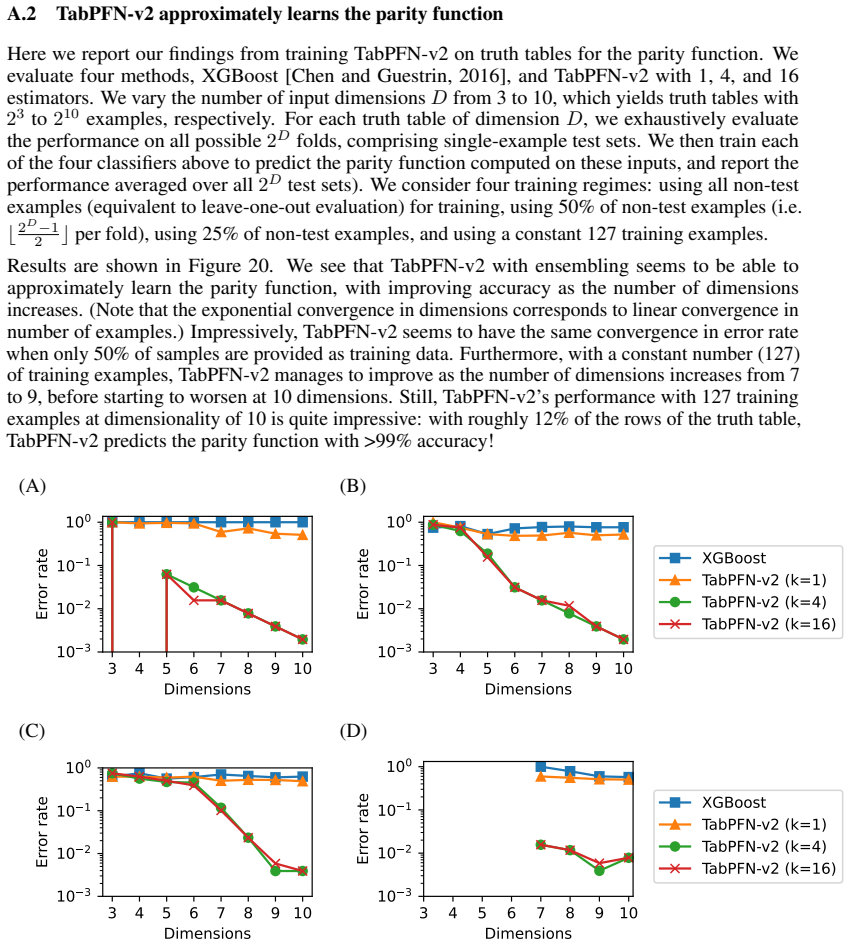
The key mechanism is the interpretation of TabPFN as a function-approximator generator: after 'fitting' on a training set D (which is merely storing it as context), the model defines a prediction function f_{D,θ}(x) → y for fixed weights θ. By plotting this function over x for hand-crafted training sets—two points on a line, one sample per class in 2D, periodic patterns, repeated features or samples—the paper turns the in-context learner into an observable statistical prior. The second mechanism is ensembling: repeated forward passes with permuted features and labels, which the paper shows is needed to expose the model's learned nearest-neighbor behavior in 2D and which smooths its 1D probability curves. In the appendix, the same black-box view is applied to truth tables, revealing that TabPFN-v2 can implement a parity computation from partial data.
What would settle it
A direct falsifier would be a large, systematic sample of fresh synthetic classification problems drawn from a wide range of structural causal models: if TabPFN's accuracy on those problems is no better than a baseline that has simply memorized the marginal statistics of popular tabular benchmarks, the world-model claim would fail. Concretely, one could generate SCMs that are structurally unlike anything in TabPFN's pretraining distribution and test whether its learning curve still beats logistic regression; if it does not, the transferable inductive-bias story is unsupported.
Extended reading notes
Core claim
On the paper's own terms, the central discovery is that TabPFN, examined as a black-box generator of function approximations, behaves like a model that has meta-learned a simple 'world model' of small-n statistical learning for tabular classification. The evidence is behavioral: ensembled TabPFN reproduces 1-nearest-neighbor Voronoi partitions when each class has one sample; it nearly matches logistic regression on a 57-sample, 22,283-feature cancer classification task despite being used far outside its intended regime; and TabPFN-v2 can infer the parity function across a truth table from roughly 12% of its rows. The paper explicitly finds no evidence that TabPFN's results are solely the result of overfitting a large network to public benchmarks, and interprets the model's oddities (duplication asymmetry, no periodic extrapolation, ensembling dependence) as properties of that learned model rather than as memorization artifacts.
Load-bearing premise
The conclusion rests on the assumption that a handful of hand-picked probe tasks—two points on a line, one point per class in 2D, one gene-expression dataset, MNIST/CIFAR as flat vectors, and parity truth tables—are enough to distinguish a generalizable 'world model' from overfitting to public benchmarks, and that the observed quirks are stable properties of the learned model rather than checkpoint-specific noise.
Editorial extensions
If this is right
- TabPFN can be deployed with confidence on small tabular problems even outside its intended domain: it nearly matched logistic regression on a high-dimensional gene-expression classification task and was competitive on MNIST/CIFAR at small sample sizes.
- Ensembling is not merely a permutation-invariance trick; it also lowers variance, implying that future PFNs could be trained to achieve the same stability directly.
- TabPFN's failure to detect periodic patterns or to behave sensibly under class duplication marks concrete limitations that a practitioner should expect.
- The analysis applies to a specific checkpoint, not to TabPFN-the-method, so performance claims should be tied to the exact pretrained weights.
- Probing with simple, out-of-distribution tasks should become a standard complement to benchmark evaluation for PFNs.
Reading between the lines
- If the world-model interpretation is right, then a single general-purpose PFN is unlikely to be optimal; one should expect modality-specific PFNs (e.g., for gene expression) trained on matching synthetic priors, which the paper hints at but does not claim.
- The parity-learning result suggests TabPFN-v2 can represent nonlinear Boolean functions from few examples; a testable extension would be whether it can learn parity in higher dimensions and whether that transfers to categorical feature interactions in real tabular data.
- The checkpoint-specific caveat implies that benchmark comparisons of PFNs should be redone per checkpoint, not per method; this is an inference about evaluation practice that the paper gestures at but does not develop.
- One could formalize the 'hand-picked probes' approach into a battery of synthetic prior tests with known ground truth, turning the paper's qualitative observations into a quantitative inductive-bias benchmark.
Editorial analysis
A structured set of objections, weighed in public.
Referee Report
Summary. This manuscript treats the TabPFN transformer as a black-box function-approximator generator and probes its learned inductive biases through a series of small, hand-designed experiments: one-dimensional binary classification with various sample configurations, two-dimensional multiclass Voronoi-like settings, high-dimensional gene-expression classification, MNIST/CIFAR treated as tabular data, and an appendix on TabPFN-v2's ability to learn the parity function from partial truth tables. The paper argues that TabPFN's behaviors, including duplication asymmetry, lack of periodic extrapolation, and ensembling dependence, indicate that it has learned transferable statistical principles rather than memorized peculiarities of public benchmarks, and it concludes that TabPFN learns a simple 'world model' of small-n tabular classification. The appendix re-runs parts of the analysis on TabPFN-v2 and reports that TabPFN-v2 can approximately learn the parity function.
Significance. If the conclusions were fully supported, the paper would make a useful contribution to the debate about whether prior-data fitted networks generalize through learned inductive biases or simply overfit to benchmark regularization. The interactive black-box probe methodology is complementary to both benchmark evaluations and mechanistic interpretability, and several observations, such as duplication asymmetry and the absence of periodic extrapolation, are concrete and falsifiable. The release of code and the effort to include a v2 re-analysis are also strengths. However, the current significance is limited because the central claim is stated at the method level while the evidence is checkpoint-specific, and because the quantitative OOD comparisons lack variance reporting and significance testing. These gaps prevent the paper from supporting its strongest interpretive conclusion as written.
major comments (4)
- [Section 6, final paragraph] The paper's central claim that 'TabPFN learns a simple world model of small-n statistical learning' is stated at the level of the method, but the same paragraph explicitly concedes that all results apply to a single checkpoint, prior_diff_real_checkpoint_n_0_epoch_42.cpkt, not to TabPFN-the-method. A single point in parameter space cannot distinguish a property of the pretraining objective from a checkpoint-specific artifact. Because the title, abstract, and closing inference are framed method-level, this concession is load-bearing and must be addressed by either restricting all claims to the studied checkpoint or adding a stability analysis over multiple checkpoints or seeds.
- [Section 4, Figures 8 and 9; Section 5, Figure 11] The quantitative OOD comparisons that carry the anti-memorization argument are aggregated over only 10 random splits with no confidence intervals, error bars, or significance tests. Statements such as 'handily beating SVC and XGBoost' and 'almost matching logistic regression' are therefore not established as stable findings. For the claims to support the conclusion, the authors should report per-split variability, paired statistical tests, or at minimum bootstrap confidence intervals.
- [Appendix A.2, Figure 20] The headline parity result, that TabPFN-v2 exceeds 99% accuracy with roughly 12% of truth-table rows at 10 dimensions, is reported as a mean over all single-example folds without any variance measure. Since the conclusion is based on an average over 2^D folds, the authors should report the distribution or confidence intervals. Additionally, this result is specific to TabPFN-v2, so it cannot provide evidence for the v1-based world-model conclusion in the main text; the main text should state this explicitly if the parity result is intended to support the overall argument.
- [Section 6] The inference from 'we found no evidence that would suggest overfitting' to 'our results suggest that TabPFN learns a simple world model' is an argument from absence of evidence. The probe tasks are not generated from a defined null model that would operationalize what benchmark-overfitting would look like, nor is there a statistical test separating stable learned behavior from checkpoint-specific noise. At minimum, the conclusion should be explicitly hedged as a preliminary, hypothesis-generating observation rather than a tested inference, or the authors should design a null model and a decision rule for distinguishing the two hypotheses.
minor comments (5)
- [Section 2, Figure 1] The statement 'likely this is because TabPFN has learned that features are have right-skewed distributions' contains a typo and, more importantly, is presented without a supporting control experiment; if this explanation is retained, it should be labeled as speculative, or tested with symmetric and left-skewed feature distributions.
- [Section 3 and throughout] The spelling 'V oronoi' appears in captions and text where 'Voronoi' is intended; please fix the spacing.
- [Section 5] The feature counts for MNIST and CIFAR-10 are written as '28 ∗ 282 and 3 ∗ 322,' which should be '28 × 28 and 3 × 32 × 32' to avoid confusion.
- [Appendix A.2] The statement that 'exponential convergence in dimensions corresponds to linear convergence in number of examples' is not generally accurate: if N = 2^D, exponential decay in D corresponds to polynomial decay in N, not linear decay. Please clarify the intended relationship.
- [Section 2, Figures 3-5] The paper claims 'no discernible effect' from replicating both red and green samples, but the plotted curves appear to vary slightly across conditions; a quantitative threshold for 'discernible' would make the claim more precise.
Circularity Check
No significant circularity: TabPFN is treated as an external black-box checkpoint, and the paper's interpretive conclusion rests on probe experiments rather than on any fitted parameter, self-citation, or definitional equivalence.
full rationale
The paper contains no derivation chain of the kind that could be circular. Its central activity is to query a released TabPFN checkpoint on hand-designed probe problems (1d and 2d classification, gene-expression classification, MNIST/CIFAR-as-vectors, parity truth tables) and to compare it with standard baselines. None of these evaluations fits a parameter that is then renamed as a prediction; there are no equations in which the output quantity is defined in terms of the input quantity. The closest self-referential elements are the citation to the author's earlier work on confounded domain adaptation (Section 4) used only to describe the BladderBatch batch-effect structure, and the footnote identifying the initial manuscript as an ICLR blogpost; neither is load-bearing for the 'world model' conclusion. The appendix's parity result concerns TabPFN-v2 [Hollmann et al., 2025], not work by this author, and is an external empirical finding. The paper's own Section 6 caveat that the analysis applies to a specific checkpoint rather than to TabPFN-the-method is an evidentiary limitation, not a circular step: it weakens generalization but does not make any claim equivalent to its input. No self-citation is invoked to forbid alternatives or to import a uniqueness theorem. Under the stated review rule, evidence limitations and interpretive leaps belong in a correctness assessment, not in the circularity score.
Assumptions & free parameters
assumptions (3)
- domain assumption Black-box probing of isolated training configurations reveals TabPFN's learned inductive biases rather than artifacts of optimization or ensembling.
- domain assumption Default hyperparameters simulate practical small-sample use and produce representative comparisons.
- domain assumption The released TabPFN-v1 checkpoint prior_diff_real_checkpoint_n_0_epoch_42.cpkt is representative of 'TabPFN-the-method' for the purpose of the conclusions.
Cite this review
Pith. "Pith review of What exactly has TabPFN learned to do?." pith.science (2026). https://pith.science/paper/AHKVIWRY
@misc{pith2026250208978,
  author       = {Pith},
  title        = {Pith review of: What exactly has TabPFN learned to do?},
  year         = {2026},
  howpublished = {\url{https://pith.science/paper/AHKVIWRY}},
  note         = {Machine review of arXiv:2502.08978}
}
read the original abstract
TabPFN [Hollmann et al., 2023], a Transformer model pretrained to perform in-context learning on fresh tabular classification problems, was presented at the last ICLR conference. To better understand its behavior, we treat it as a black-box function approximator generator and observe its generated function approximations on a varied selection of training datasets. Exploring its learned inductive biases in this manner, we observe behavior that is at turns either brilliant or baffling. We conclude this post with thoughts on how these results might inform the development, evaluation, and application of prior-data fitted networks (PFNs) in the future.
Figures


Figures from the paper (17 more)


Reference graph
Works this paper leans on
-
[1]
Xgboost: A scalable tree boosting system
Tianqi Chen and Carlos Guestrin. Xgboost: A scalable tree boosting system. In Proceedings of the 22nd acm sigkdd international conference on knowledge discovery and data mining, pages 785--794, 2016
2016
-
[2]
Tab PFN : A transformer that solves small tabular classification problems in a second
Noah Hollmann, Samuel M \"u ller, Katharina Eggensperger, and Frank Hutter. Tab PFN : A transformer that solves small tabular classification problems in a second. In The Eleventh International Conference on Learning Representations, 2023. URL https://openreview.net/forum?id=cp5PvcI6w8_
work page 2023
-
[3]
u ller, Lennart Purucker, Arjun Krishnakumar, Max K \
Noah Hollmann, Samuel M \"u ller, Lennart Purucker, Arjun Krishnakumar, Max K \"o rfer, Shi Bin Hoo, Robin Tibor Schirrmeister, and Frank Hutter. Accurate predictions on small data with a tabular foundation model. Nature, 637 0 (8045): 0 319--326, 2025
2025
-
[4]
bladderbatch: Bladder gene expression data illustrating batch effects
JT Leek. bladderbatch: Bladder gene expression data illustrating batch effects. R package version, 1 0 (0): 0 17, 2016
work page 2016
-
[5]
Valeriy Manokhin. When it comes to tabpfn f stands for ``frankenstein.'' would you trust an opaque monstrosity trained on ``millions of synthetic'' (real unreal and dubious) datasets to make predictions in critical applications like human health, finance and self driving cars? no reasonable person will., 2022. URL https://x.com/predict_addict/status/17262...
-
[6]
Towards Backwards-Compatible Data with Confounded Domain Adaptation
Calvin McCarter. Towards backwards-compatible data with confounded domain adaptation. arXiv preprint arXiv:2203.12720, 2022
work page Pith review arXiv 2022
-
[7]
When do neural nets outperform boosted trees on tabular data? arXiv preprint arXiv:2305.02997, 2023
Duncan McElfresh, Sujay Khandagale, Jonathan Valverde, Ganesh Ramakrishnan, Micah Goldblum, Colin White, et al. When do neural nets outperform boosted trees on tabular data? arXiv preprint arXiv:2305.02997, 2023. URL https://openreview.net/pdf?id=CjVdXey4zT
arXiv 2023
-
[8]
Transformers can do bayesian inference
Samuel M \"u ller, Noah Hollmann, Sebastian Pineda Arango, Josif Grabocka, and Frank Hutter. Transformers can do bayesian inference. In International Conference on Learning Representations, 2022. URL https://openreview.net/forum?id=KSugKcbNf9
work page 2022
Show all 13 references
-
[9]
Statistical foundations of prior-data fitted networks
Thomas Nagler. Statistical foundations of prior-data fitted networks. arXiv preprint arXiv:2305.11097, 2023. URL https://proceedings.mlr.press/v202/nagler23a
2023 arXiv
-
[10]
Causality
Judea Pearl. Causality. Cambridge university press, 2009
2009
-
[11]
Scikit-learn: Machine learning in python
Fabian Pedregosa, Ga \"e l Varoquaux, Alexandre Gramfort, Vincent Michel, Bertrand Thirion, Olivier Grisel, Mathieu Blondel, Peter Prettenhofer, Ron Weiss, Vincent Dubourg, et al. Scikit-learn: Machine learning in python. the Journal of machine Learning research, 12: 0 2825--2...
2011
-
[12]
I am sorry, but this all sounds too inconsequential imho
Bojan Tunguz. I am sorry, but this all sounds too inconsequential imho. these are extremely small datasets that are very easy to overfit., 2022. URL https://x.com/tunguz/status/1583417038965334017
2022
-
[13]
Attention is all you need
Ashish Vaswani, Noam Shazeer, Niki Parmar, Jakob Uszkoreit, Llion Jones, Aidan N Gomez, ukasz Kaiser, and Illia Polosukhin. Attention is all you need. Advances in neural information processing systems, 30, 2017
2017
Reviewed August 7, 2026 · model on record in the stance chip above.
Discussion (0). Continue with ORCID to comment.