REVIEW 5 major objections 5 minor 33 references
ViRAC: A Vision-Reasoning Agent Head Movement Control Framework in Arbitrary Virtual Environments
T0 review · 5 major / 5 minor · reviewed 2026-08-07 · deepseek-v4-flash
Pith's one-line read This paper proposes a vision–reasoning loop, built from a vision-language model and a large language model, that generates virtual agents' head rotations close to real human head movements across diverse scenarios without hand-tuned…
desk verdict A plausible VLM/LLM head-rotation framework, but the paper never shows how a symbolic action becomes a quaternion, and the evaluation leans on circular human data; worth reviewing but far from established. read the letter →
The pith
A machine-rendered reading of the paper's core claim, the machinery that carries it, and where it could break.
The reading
What carries the argument
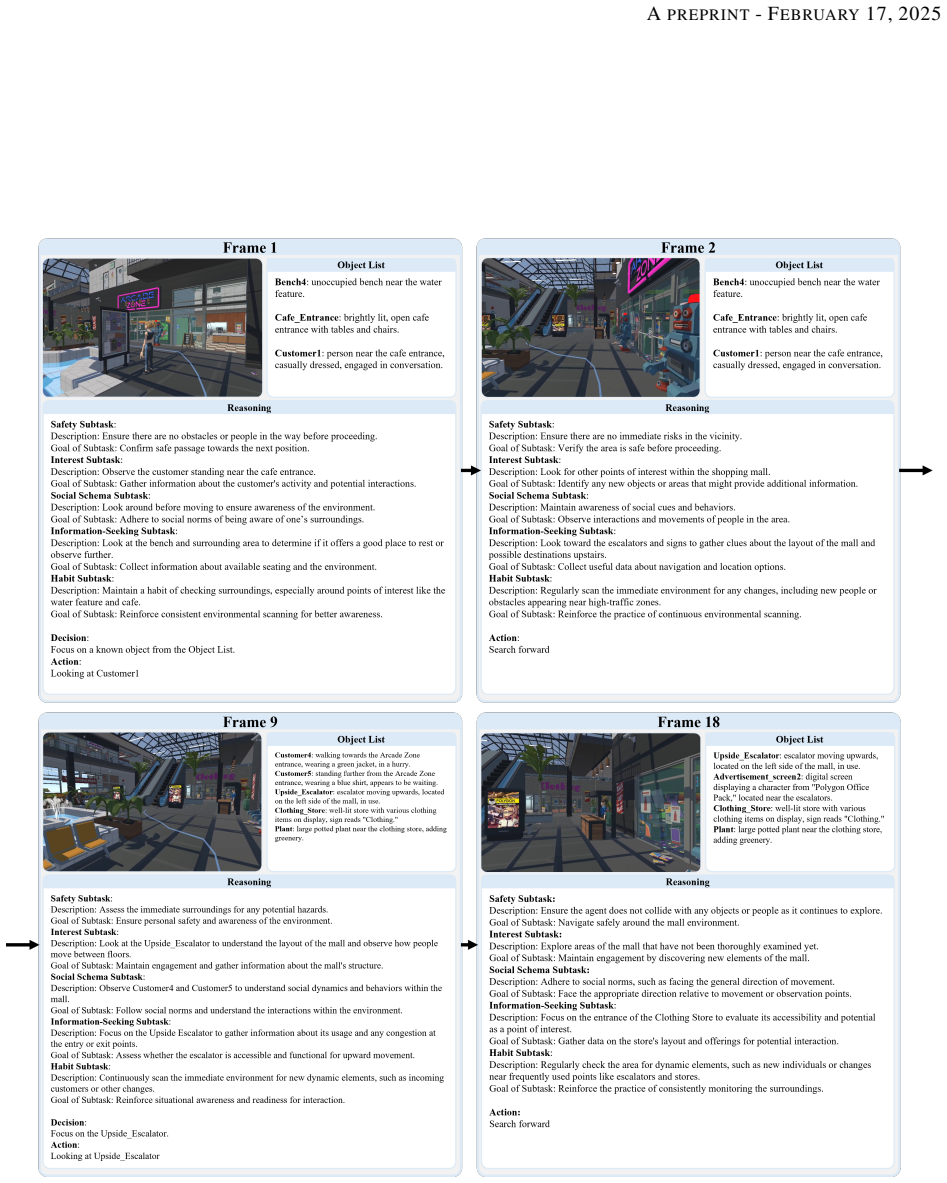
The framework's central object is the perception–decision loop. At each step the Perception Module (a vision-language model plus a Foundational Memory Module) turns the current first-person image into textual object descriptions and an updatable memory of previously seen objects; the Decision-making Module (a large language model plus an Action History Module) takes those descriptions, the cognitive goal $G$, the walking velocity $V_t$, and the action history $H_t$ to pick the next action $a_t$. The environment update $E(a_t)$ then converts the chosen action into the next viewpoint $(I_{t+1}, O_{t+1})$, which includes the head-rotation quaternion. The comparison machinery is dynamic time warping applied to the angular distance between quaternions, $d(q_1,q_2) = 2\arccos(|q_1 \cdot q_2|)$, which quantifies how close the generated trajectory is to the human trajectory.
What would settle it
The paper's own bus scenario is a near-falsifier: when a visually prominent but unusual figure (Santa Claus) drew participants' attention, the LLM did not treat it as noteworthy and ViRAC's DTW score was worse than Track's. A concrete test would be to run the framework in a scene containing a single highly unusual, brightly colored object with no semantic label the VLM recognizes, and check whether the head rotates toward it; if it does not, the 'arbitrary environments' claim fails.
Extended reading notes
Core claim
ViRAC claims that a perception–reasoning loop—a vision-language model that describes salient objects in the agent's first-person view and feeds an object memory, paired with a large language model that chooses the next action in terms of 'look at X' or 'search direction D' from the object descriptions, the current goal, walking velocity, and an action history—yields head rotations close to human ones when the chosen action is applied to the environment's head state. Over five virtual scenarios (bus, café, crosswalk, mall, street) and two attention conditions, the DTW distance between the generated quaternion head trajectories and real participant trajectories is lower than that of the Track baseline in most scenario–condition pairs, and human raters score ViRAC at or near the level of real human motion on naturalness, goal compatibility, safety, curiosity, and social schema. The key quantitative result is that, except for the bus-with-distractor case, the framework tracks human head behavior better than the best saliency-based competitor without any training data specific to the scenarios.
Load-bearing premise
The framework assumes that each language action selected by the LLM can be reliably converted into a concrete head-rotation direction and magnitude inside the agent's coordinate frame, but the paper does not specify how this grounding is done or how failures in it are handled.
Editorial extensions
If this is right
- If ViRAC holds up, virtual agents in games, VR, and films can generate context-aware head movements for new scenes with no scene-specific data collection or hand-written motion rules.
- The success of the framework would imply that the cognitive priors in pre-trained vision-language and large language models are rich enough to stand in for explicit models of curiosity, safety, and social convention in head movement.
- The perception–decision loop is a template: the same VLM–LLM structure could be applied to other attention-driven micro-behaviors, including eye gaze direction, posture shifts, and reaching.
- The paper's limitation passages note that combining ViRAC with a path-planning system would produce agents whose head and body movements are jointly coordinated, which is a direct next step if the head-rotation claim is accepted.
Reading between the lines
- Editorial inference: the real test of 'arbitrary environments' is the implicit action-to-quaternion grounding, so a natural ablation is to replace the LLM's symbolic action with a direct regression from the same visual features to a quaternion and compare the two.
- Editorial inference: since the LLM's prompts were built from the Experiment 1 rationales, the framework's output likely varies with prompt phrasing; systematic prompt perturbation could reveal how much of the human-likeness comes from the model priors versus the prompt structure.
- Editorial inference: the Santa failure suggests an addition of an explicit novelty or surprise detector in the perception module; a testable extension is to weight unusual objects more heavily in the LLM's context, which might recover the lost alignment in that scenario.
- Editorial inference: because the agent's body trajectory in the evaluation is taken from human participants, the head-rotation results are conditional on given locomotion; a fully autonomous test requires joint body-and-head generation, which the paper leaves to future work.
Editorial analysis
A structured set of objections, weighed in public.
Referee Report
Summary. The paper proposes ViRAC, a framework that combines a Vision-Language Model (VLM) and a Large-Language Model (LLM) to generate natural head rotations for virtual agents. The Perception Module uses a VLM to detect and describe objects and a Foundational Memory Module to retain salient information; the Decision-making Module uses an Action History Module and an LLM to decompose a cognitive goal into sub-goals and select actions such as 'look at object' or 'search direction.' The framework is evaluated in five virtual scenarios under two distraction conditions, comparing against the TRACK baseline and against human head-rotation data collected in an earlier user study (Experiment 1). Quantitative results are reported as normalized DTW scores, and a subjective user study rates naturalness, compatibility, safety, curiosity, and social schema. The paper claims that ViRAC produces more natural and context-aware head rotations than recent state-of-the-art techniques and operates across arbitrary virtual environments without task-specific data.
Significance. The idea of using a VLM/LLM perception–reasoning loop for generating context-aware head rotations is timely and potentially valuable for computer graphics applications such as games, VR, and autonomous character animation. If the results hold, the framework would offer a genuinely different alternative to saliency-based and trajectory-based head-movement methods, and the collected human head-rotation trajectories with rationales (Experiment 1) could be a useful resource. The authors also provide a modular framework and attempt both objective (DTW) and subjective validation. However, the current evidence does not yet support the strong claims of 'arbitrary virtual environments' and 'data-free operation' because of the unspecified action-to-rotation grounding, the circular use of Experiment 1 data in both prompt design and evaluation, and the lack of statistical rigor in the quantitative comparisons.
major comments (5)
- [Section 5.3] Section 5.3, Environment Update: the paper defines (I_{t+1}, O_{t+1}) = E(a_t) but never specifies how a symbolic action such as 'look at Mall Map' or 'Search direction' is converted into a concrete head rotation (e.g., yaw/pitch angles or a quaternion increment) in the agent's coordinate frame. The quaternion trajectories evaluated in Table 1 and Figure 4 are the output of this unspecified function, so the results cannot be reproduced and the claim that ViRAC generates head rotations via a perception–reasoning loop is not verifiable. The authors should provide the full action-to-rotation grounding procedure, including how object locations are mapped to rotation magnitudes and directions, and discuss failure cases when an object is not visible or the action is ambiguous.
- [Sections 5.2 and 6.1] Section 5.2 states that 'we exploit categorized rationales and behaviors obtained from Experiment 1 to form prompts for LLM decomposing,' and Section 6.1 uses the same Experiment 1 head-rotation data as the DTW ground truth. This means the prompt design is informed by the very data against which the method is evaluated, which is a form of circularity that can inflate the reported quantitative performance. To support the claim of data-free operation, the authors should either evaluate on a held-out set of participants or scenarios not used in prompt construction, or demonstrate through an ablation that the prompt content derived from Experiment 1 does not bias the DTW comparisons.
- [Table 1 and Sections 6.1–6.2] The normalized DTW scores are reported as single numbers with no error bars, confidence intervals, or statistical tests, despite the text stating that five runs were generated per scenario–condition pair. Without a measure of dispersion, it is impossible to assess whether the observed differences (e.g., ViRAC better in Mall MDC, 0.4409 vs 0.6645; worse in Bus APC, 0.5861 vs 0.3888) are meaningful or within run-to-run noise. The authors should report per-run results and perform a paired statistical test across the five runs, or justify why such a test is not applicable.
- [Section 6.2] The explanation for the Bus scenario failure, namely that the LLM overlooked a 'Santa Claus character,' is introduced as 'one plausible explanation' without supporting evidence, such as an inspection of the LLM's object list, an ablation with a modified prompt, or a comparison with alternative prompts. A post hoc narrative about a single failure case does not support the broader claim that ViRAC adapts to arbitrary environments; the authors should either provide evidence for this explanation or present the Bus result as an unexplained failure rather than a diagnosed limitation.
- [Section 7] In the subjective evaluation, each video is shown 'accompanied by a concise text describing the agent's actions and the rationale behind them.' Since the rationale text is generated by the same LLM that selects the actions, participants may be rating the quality of the textual rationale rather than the head-motion trajectories themselves. This confound is especially problematic for the comparisons against Human, where the rationale text may be absent or not directly comparable. The authors should separate the text from the video presentation, for example by showing videos without rationale text in a control condition, to ensure the ratings reflect the visual head movements.
minor comments (5)
- [Section 5.3] The text says 'the AMH records the executed action,' but the module is called AHM (Action History Module) elsewhere in the paper; this is a typo.
- [References] The paper contains two reference lists; the second list (beginning with Kour and Saabne) appears to be an unintended leftover template and should be removed.
- [Figures 7 and 8] Figures 7 and 8, which show head-rotation quaternions, are not referenced in the main text, and their axes are not labeled, making them difficult to interpret.
- [Section 6.1] The phrase 'using two different methods of ViRAC and Track' is grammatically unclear; presumably it means comparing two methods, ViRAC and Track.
- [Abstract and Section 1] The paper claims operation 'without hand-tuned heuristics,' yet the LLM prompts are manually designed and explicitly informed by Experiment 1; the authors should clarify what counts as a hand-tuned heuristic.
Circularity Check
LLM prompts are built from Experiment 1 rationales, and the same Experiment 1 head rotations serve as the DTW ground truth, making the quantitative human-likeness claim partly circular.
-
fitted input called prediction
[Section 5.2 (Decision-making Module) and Section 6 (Evaluation)]
"When constructing sub-goals, we exploit categorized rationales and behaviors obtained from Experiment 1 to form prompts for LLM decomposing."
Section 6 uses the same Experiment 1 data as the evaluation target: 'we compared our method against a baseline approach called Track [8] and user-generated motion data from Experiment 1 (henceforth “Human”)' and computes normalized DTW between ViRAC trajectories and these Human trajectories. The LLM prompts that drive action selection are therefore constructed from the rationales elicited from the same participants whose head rotations are used as the DTW ground truth. This is test-set influence: the framework is explicitly shaped to reproduce the behaviors of the evaluation set, so the reported DTW improvement over Track is not an independent measure of human-likeness. No held-out split or separate validation set is described.
full rationale
The main circularity is confined to the quantitative evaluation: the LLM prompt design uses categorized rationales from Experiment 1, and the DTW target is the head-rotation data from that same experiment. This makes the headline quantitative comparison with 'Human' partly a self-comparison rather than a prediction against independent data. The framework's architecture (VLM perception, FMM, AHM, LLM action selection) and the subjective user study have independent content, and there are no load-bearing self-citations or imported uniqueness theorems. The unspecified environment update E(a_t) is a serious gap in substantiating the 'arbitrary environment / data-free' claim, but it is a missing specification rather than a circular reduction, so it does not raise the circularity score. Overall, one significant test-set-influence step gives a score of 6.
Assumptions & free parameters
assumptions (4)
- domain assumption Large-scale VLMs and LLMs have internalized human-like attentional patterns and common-sense reasoning sufficient to drive natural head movements without task-specific training.
- domain assumption The self-reported rationales from 20 VR participants (Experiment 1) are representative of general human head-movement reasoning.
- ad hoc to paper The action space consisting of 'look at object' and 'search direction' is sufficient to reproduce natural head rotations.
- ad hoc to paper The selected text action can be unambiguously grounded to a head rotation in arbitrary environments (e.g., knowing the object's location in the image and the required rotation magnitude).
invented entities (2)
-
Foundational Memory Module (FMM)
-
Action History Module (AHM)
Cite this review
Pith. "Pith review of ViRAC: A Vision-Reasoning Agent Head Movement Control Framework in Arbitrary Virtual Environments." pith.science (2026). https://pith.science/paper/NJD2KVHL
@misc{pith2026250210046,
  author       = {Pith},
  title        = {Pith review of: ViRAC: A Vision-Reasoning Agent Head Movement Control Framework in Arbitrary Virtual Environments},
  year         = {2026},
  howpublished = {\url{https://pith.science/paper/NJD2KVHL}},
  note         = {Machine review of arXiv:2502.10046}
}
read the original abstract
Creating lifelike virtual agents capable of interacting with their environments is a longstanding goal in computer graphics. This paper addresses the challenge of generating natural head rotations, a critical aspect of believable agent behavior for visual information gathering and dynamic responses to environmental cues. Although earlier methods have made significant strides, many rely on data-driven or saliency-based approaches, which often underperform in diverse settings and fail to capture deeper cognitive factors such as risk assessment, information seeking, and contextual prioritization. Consequently, generated behaviors can appear rigid or overlook critical scene elements, thereby diminishing the sense of realism. In this paper, we propose \textbf{ViRAC}, a \textbf{Vi}sion-\textbf{R}easoning \textbf{A}gent Head Movement \textbf{C}ontrol framework, which exploits the common-sense knowledge and reasoning capabilities of large-scale models, including Vision-Language Models (VLMs) and Large-Language Models (LLMs). Rather than explicitly modeling every cognitive mechanism, ViRAC leverages the biases and patterns internalized by these models from extensive training, thus emulating human-like perceptual processes without hand-tuned heuristics. Experimental results in multiple scenarios reveal that ViRAC produces more natural and context-aware head rotations than recent state-of-the-art techniques. Quantitative evaluations show a closer alignment with real human head-movement data, while user studies confirm improved realism and cognitive plausibility.
Figures


Figures from the paper (11 more)




Reference graph
Works this paper leans on
-
[1]
Context-dependent crowd evaluation
Alon Lerner, Yiorgos Chrysanthou, Ariel Shamir, and Daniel Cohen-Or. Context-dependent crowd evaluation. In Computer Graphics Forum , volume 29, pages 2197--2206. Wiley Online Library, 2010
work page 2010
-
[2]
Context-aware virtual agents in open environments
Travis Steel, Dane Kuiper, and RZ Wenkstern. Context-aware virtual agents in open environments. In 2010 Sixth International Conference on Autonomic and Autonomous Systems , pages 90--96. IEEE, 2010
work page 2010
-
[3]
Pedvr: Simulating gaze-based interactions between a real user and virtual crowds
Sahil Narang, Andrew Best, Tanmay Randhavane, Ari Shapiro, and Dinesh Manocha. Pedvr: Simulating gaze-based interactions between a real user and virtual crowds. In Proceedings of the 22nd ACM conference on virtual reality software and technology , pages 91--100, 2016
work page 2016
-
[4]
Toward believable acting for autonomous animated characters
Cassidy Curtis, Sigurdur Orn Adalgeirsson, Horia Stefan Ciurdar, Peter McDermott, JD Vel \'a squez, W Bradley Knox, Alonso Martinez, Dei Gaztelumendi, Norberto Adrian Goussies, Tianyu Liu, et al. Toward believable acting for autonomous animated characters. In Proceedings of the 15th ACM SIGGRAPH Conference on Motion, Interaction and Games , pages 1--15, 2022
work page 2022
-
[5]
Gaze prediction in dynamic 360 immersive videos
Yanyu Xu, Yanbing Dong, Junru Wu, Zhengzhong Sun, Zhiru Shi, Jingyi Yu, and Shenghua Gao. Gaze prediction in dynamic 360 immersive videos. In proceedings of the IEEE Conference on Computer Vision and Pattern Recognition , pages 5333--5342, 2018
work page 2018
-
[6]
Learning a deep agent to predict head movement in 360-degree images
Yucheng Zhu, Guangtao Zhai, Xiongkuo Min, and Jiantao Zhou. Learning a deep agent to predict head movement in 360-degree images. ACM Transactions on Multimedia Computing, Communications, and Applications (TOMM) , 16(4):1--23, 2020
work page 2020
-
[7]
Hierarchical bayesian lstm for head trajectory prediction on omnidirectional images
Li Yang, Mai Xu, Yichen Guo, Xin Deng, Fangyuan Gao, and Zhenyu Guan. Hierarchical bayesian lstm for head trajectory prediction on omnidirectional images. IEEE Transactions on Pattern Analysis and Machine Intelligence , 44(11):7563--7580, 2021
work page 2021
-
[8]
MFR Rondon, L Sassatelli, R Aparicio-Pardo, and F Precioso. Track: A new method from a re-examination of deep architectures for head motion prediction in 360° videos. IEEE Transactions on Pattern Analysis and Machine Intelligence , 44(9):5681--5699, 2022
work page 2022
Show all 33 references
-
[9]
Generalized odin: Detecting out-of-distribution image without learning from out-of-distribution data
Yen-Chang Hsu, Yilin Shen, Hongxia Jin, and Zsolt Kira. Generalized odin: Detecting out-of-distribution image without learning from out-of-distribution data. In Proceedings of the IEEE/CVF conference on computer vision and pattern recognition , pages 10951--10960, 2020
2020
-
[10]
An Yang, Baosong Yang, Beichen Zhang, Binyuan Hui, Bo Zheng, Bowen Yu, Chengyuan Li, Dayiheng Liu, Fei Huang, Haoran Wei, et al. Qwen2. 5 technical report. arXiv preprint arXiv:2412.15115 , 2024
2024 arXiv
-
[11]
Glore: When, where, and how to improve llm reasoning via global and local refinements
Alex Havrilla, Sharath Raparthy, Christoforus Nalmpantis, Jane Dwivedi-Yu, Maksym Zhuravinskyi, Eric Hambro, and Roberta Raileanu. Glore: When, where, and how to improve llm reasoning via global and local refinements. arXiv preprint arXiv:2402.10963 , 2024
2024 arXiv
-
[12]
Optimizing 360 video delivery over cellular networks
Feng Qian, Lusheng Ji, Bo Han, and Vijay Gopalakrishnan. Optimizing 360 video delivery over cellular networks. In Proceedings of the 5th Workshop on All Things Cellular: Operations, Applications and Challenges , pages 1--6, 2016
2016
-
[13]
Prioritized buffer control in two-tier 360 video streaming
Fanyi Duanmu, Eymen Kurdoglu, S Amir Hosseini, Yong Liu, and Yao Wang. Prioritized buffer control in two-tier 360 video streaming. In Proceedings of the Workshop on Virtual Reality and Augmented Reality Network , pages 13--18, 2017
2017
-
[14]
Your attention is unique: Detecting 360-degree video saliency in head-mounted display for head movement prediction
Anh Nguyen, Zhisheng Yan, and Klara Nahrstedt. Your attention is unique: Detecting 360-degree video saliency in head-mounted display for head movement prediction. In Proceedings of the 26th ACM international conference on Multimedia , pages 1190--1198, 2018
2018
-
[15]
Long short-term memory
S Hochreiter. Long short-term memory. Neural Computation MIT-Press , 1997
1997
-
[16]
Structural-rnn: Deep learning on spatio-temporal graphs
Ashesh Jain, Amir R Zamir, Silvio Savarese, and Ashutosh Saxena. Structural-rnn: Deep learning on spatio-temporal graphs. In Proceedings of the ieee conference on computer vision and pattern recognition , pages 5308--5317, 2016
2016
-
[17]
Ccp: Configurable crowd profiles
Andreas Panayiotou, Theodoros Kyriakou, Marilena Lemonari, Yiorgos Chrysanthou, and Panayiotis Charalambous. Ccp: Configurable crowd profiles. In ACM SIGGRAPH 2022 conference proceedings , pages 1--10, 2022
2022
-
[18]
Greil-crowds: crowd simulation with deep reinforcement learning and examples
Panayiotis Charalambous, Julien Pettre, Vassilis Vassiliades, Yiorgos Chrysanthou, and Nuria Pelechano. Greil-crowds: crowd simulation with deep reinforcement learning and examples. ACM Transactions on Graphics (TOG) , 42(4):1--15, 2023
2023
-
[19]
Text-guided synthesis of crowd animation
Xuebo Ji, Zherong Pan, Xifeng Gao, and Jia Pan. Text-guided synthesis of crowd animation. In ACM SIGGRAPH 2024 Conference Papers , pages 1--11, 2024
2024
-
[20]
Human trajectory prediction via neural social physics
Jiangbei Yue, Dinesh Manocha, and He Wang. Human trajectory prediction via neural social physics. In European conference on computer vision , pages 376--394. Springer, 2022
2022
-
[21]
End-to-end trajectory distribution prediction based on occupancy grid maps
Ke Guo, Wenxi Liu, and Jia Pan. End-to-end trajectory distribution prediction based on occupancy grid maps. In Proceedings of the IEEE/CVF Conference on Computer Vision and Pattern Recognition , pages 2242--2251, 2022
2022
-
[22]
Progressive pretext task learning for human trajectory prediction
Xiaotong Lin, Tianming Liang, Jianhuang Lai, and Jian-Fang Hu. Progressive pretext task learning for human trajectory prediction. In European Conference on Computer Vision , pages 197--214. Springer, 2025
2025
-
[23]
View vertically: A hierarchical network for trajectory prediction via fourier spectrums
Conghao Wong, Beihao Xia, Ziming Hong, Qinmu Peng, Wei Yuan, Qiong Cao, Yibo Yang, and Xinge You. View vertically: A hierarchical network for trajectory prediction via fourier spectrums. In European Conference on Computer Vision , pages 682--700. Springer, 2022
2022
-
[24]
From goals, waypoints & paths to long term human trajectory forecasting
Karttikeya Mangalam, Yang An, Harshayu Girase, and Jitendra Malik. From goals, waypoints & paths to long term human trajectory forecasting. In Proceedings of the IEEE/CVF International Conference on Computer Vision , pages 15233--15242, 2021
2021
-
[25]
Simulator sickness questionnaire: An enhanced method for quantifying simulator sickness
Robert S Kennedy, Norman E Lane, Kevin S Berbaum, and Michael G Lilienthal. Simulator sickness questionnaire: An enhanced method for quantifying simulator sickness. The international journal of aviation psychology , 3(3):203--220, 1993
1993
-
[26]
Development and validation of a simulation workload measure: the simulation task load index (sim-tlx)
David Harris, Mark Wilson, and Samuel Vine. Development and validation of a simulation workload measure: the simulation task load index (sim-tlx). Virtual Reality , 24(4):557--566, 2020
2020
-
[27]
Bridging zero-shot object navigation and foundation models through pixel-guided navigation skill
Wenzhe Cai, Siyuan Huang, Guangran Cheng, Yuxing Long, Peng Gao, Changyin Sun, and Hao Dong. Bridging zero-shot object navigation and foundation models through pixel-guided navigation skill. In 2024 IEEE International Conference on Robotics and Automation (ICRA) , pages 5228--...
2024
-
[28]
Dynamic programming algorithm optimization for spoken word recognition
Hiroaki Sakoe and Seibi Chiba. Dynamic programming algorithm optimization for spoken word recognition. IEEE transactions on acoustics, speech, and signal processing , 26(1):43--49, 1978
1978
-
[29]
Soft-dtw: a differentiable loss function for time-series
Marco Cuturi and Mathieu Blondel. Soft-dtw: a differentiable loss function for time-series. In International conference on machine learning , pages 894--903. PMLR, 2017
2017
-
[30]
Approximating dtw with a convolutional neural network on eeg data
Hugo Lerogeron, Romain Picot-Clemente, Alain Rakotomamonjy, and Laurent Heutte. Approximating dtw with a convolutional neural network on eeg data. arXiv preprint arXiv:2301.12873 , 2023
2023 arXiv
-
[31]
Real-time segmentation of on-line handwritten arabic script
George Kour and Raid Saabne. Real-time segmentation of on-line handwritten arabic script. In Frontiers in Handwriting Recognition (ICFHR), 2014 14th International Conference on , pages 417--422. IEEE, 2014
2014
-
[32]
Fast classification of handwritten on-line arabic characters
George Kour and Raid Saabne. Fast classification of handwritten on-line arabic characters. In Soft Computing and Pattern Recognition (SoCPaR), 2014 6th International Conference of , pages 312--318. IEEE, 2014
2014
-
[33]
Estimate and replace: A novel approach to integrating deep neural networks with existing applications
Guy Hadash, Einat Kermany, Boaz Carmeli, Ofer Lavi, George Kour, and Alon Jacovi. Estimate and replace: A novel approach to integrating deep neural networks with existing applications. arXiv preprint arXiv:1804.09028 , 2018
2018 arXiv
Reviewed August 7, 2026 · model on record in the stance chip above.
Discussion (0). Sign in to comment.