REVIEW 3 major objections 5 minor 47 references
Acceleration noise due to Space Magnetic Field for Heliocentric Gravitational Wave Detector
T0 review · 3 major / 5 minor · reviewed 2026-08-07 · deepseek-v4-flash
Pith's one-line read Using 25 years of solar-wind magnetic field data, this paper shows that the interplanetary magnetic field produces a median acceleration noise of about 1e-17 m/s^2/√Hz at 1 mHz for LISA — two orders of magnitude below the mission…
desk verdict The 25-year LISA statistical estimate is a useful addition, but the reported noise floor doesn't follow from the paper's own equations and parameters, so the numbers need correction before use. read the letter →
The pith
A machine-rendered reading of the paper's core claim, the machinery that carries it, and where it could break.
The reading
What carries the argument
The analysis uses two force models: the magnetic moment force a_M = (1/m ξ_m) [(2 χ_m V_m B_sp / μ_0) · ∇] B_sc, where the dominant term is the gradient of the spacecraft field acting on the induced magnetic moment produced by the space field, and the Lorentz force a_L = (η/m) q v × B_sp on the charged test mass moving at spacecraft velocity (about 30 km/s for LISA). Daily time series of a_M and a_L are built from 60-second OMNI interplanetary magnetic field measurements, and their amplitude spectral densities are computed for every day from 1998 to 2022; the resulting daily ASD ensemble yields the median, 1σ/2σ/3σ bands, and cumulative occurrence statistics, from which the χ–ξ design maps are derived.
What would settle it
Place a magnetometer on a spacecraft trailing Earth by roughly 50 million km along LISA's proposed orbit, record 60-second interplanetary magnetic field data over at least one full solar cycle, and recompute the daily ASDs of a_M and a_L with the paper's test-mass parameters. If the resulting median total acceleration noise at 1 mHz exceeds 3 × $10^{-15}$ m $s^{-2}$ $Hz^{-1}$/2, or if the 3σ band crosses the LISA requirement curve, the paper's central claim would be falsified. A cheaper check is to compare OMNI L1 data with any existing magnetometer data from a spacecraft at a similar heliocentric distance outside L1.
Extended reading notes
Core claim
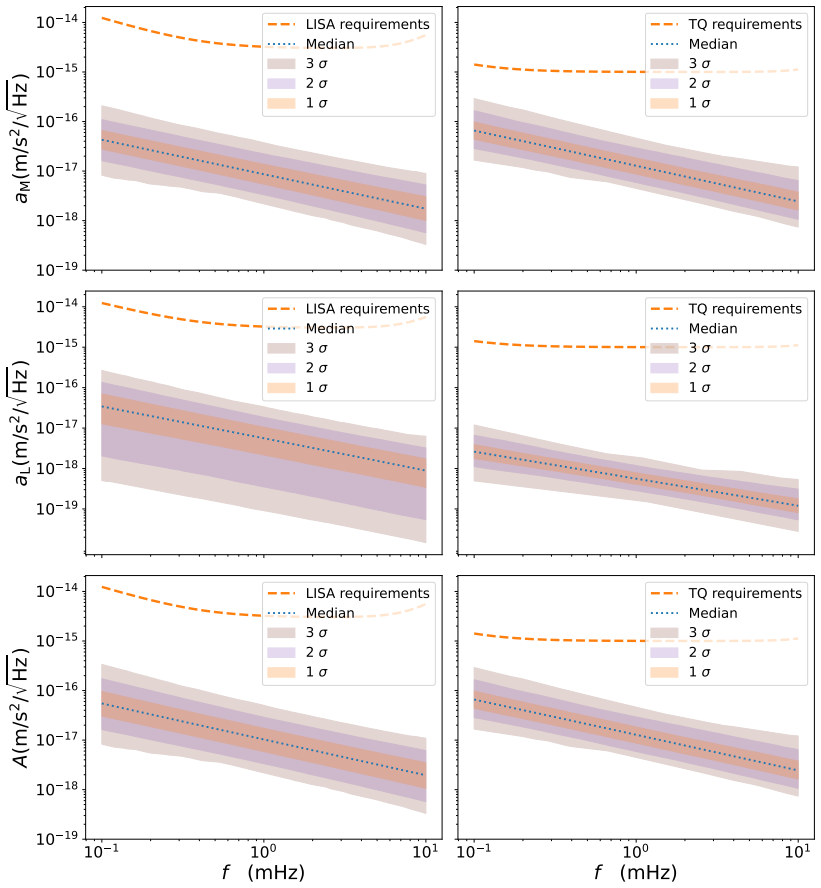
The central claim is that, with the currently assumed test-mass parameters (magnetic susceptibility 2.5 × $10^{-5}$, shielding factor 10, charge 1.6 × $10^{-12}$ C, spacecraft field 1 × $10^{-6}$ T), the space magnetic field is not a limiting acceleration noise source for LISA: the median total magnetic acceleration noise A = $\sqrt$($a_M^{2}$ + $a_L^{2}$) at 1 mHz is 1.208 × $10^{-17}$ m $s^{-2}$ $Hz^{-1}$/2, which is a factor of about 270 below the LISA requirement. Across the full 25-year record, even the 3σ upper bound of the daily ASDs remains below the requirement curve from 0.1 to 10 mHz, and the probability that the noise exceeds 1% of the requirement at 1 mHz is about 1.23%. For TianQin the median total noise is 1.412 × $10^{-17}$ m $s^{-2}$ $Hz^{-1}$/2, also below its requirement; the paper therefore updates the TianQin magnetic-noise estimate and provides a design parameter map of χ and ξ for both missions, showing that TianQin requires a smaller susceptibility or stronger shielding to keep magnetic acceleration below 10% of its requirement.
Load-bearing premise
The paper assumes that 60-second OMNI interplanetary magnetic field measurements taken near Earth (at L1) represent the magnetic field that LISA will actually encounter in its heliocentric orbit, and it updates TianQin's result without stating which magnetic field data or model that update uses.
Editorial extensions
If this is right
- For LISA, the interplanetary magnetic field contributes a median acceleration noise of about 1.2 × 10^-17 m s^-2 Hz^-1/2 at 1 mHz, roughly two orders of magnitude below the mission requirement, so magnetic field alone does not limit the mission under the assumed parameters.
- Even at the 3σ upper bound of the 25-year daily ASD distribution, the magnetic acceleration noise stays below the LISA requirement across 0.1–10 mHz, and the occurrence probability of exceeding 1% of the requirement at 1 mHz is about 1.23%.
- TianQin's magnetic acceleration noise is comparable in total (median 1.4 × 10^-17 m s^-2 Hz^-1/2 at 1 mHz) but sits closer to its requirement; with χ = 10^-5 and no shielding (ξ = 1), TianQin's magnetic moment noise exceeds 10% of its requirement.
- The χ–ξ design maps give a quantitative trade-off: for a chosen magnetic acceleration allowance (e.g., 0.1%, 1%, 10% of the requirement at 1 mHz), the required shielding factor ξ can be read off for any achievable susceptibility χ, and TianQin consistently requires a more stringent combination than LISA.
- The same statistical method and OMNI-based approach are directly applicable to other heliocentric observatories such as Taiji.
Reading between the lines
- The analysis assumes OMNI data at L1 are representative of LISA's orbit 50 million km behind Earth; if in-situ measurements from a trailing heliocentric probe showed systematically stronger fields, the margins would shrink. Directly measuring the interplanetary field along LISA's orbit would be the cleanest test of this assumption.
- The paper's use of A = sqrt(a_M^2 + a_L^2) as total noise implicitly treats the two forces as uncorrelated and uses the 'largest possible' combined ASD; a more detailed treatment could reduce or alter the total if the two noise sources share a common solar-wind driver.
- The daily ASD statistics across two solar cycles could be extended to forecast magnetic noise over LISA's actual mission lifetime, using solar cycle phase as a predictor, since the noise is visibly modulated by solar activity.
- The χ–ξ map is built on the median a_M at 1 mHz; using the 3σ or worst-day baseline would produce a more conservative (and likely more stringent) design region for both missions.
Editorial analysis
A structured set of objections, weighed in public.
Referee Report
Summary. The manuscript estimates the acceleration noise on the LISA test masses produced by the interplanetary magnetic field, using 60-second OMNI magnetic-field data from 1998 to 2022 (25 years, more than two solar cycles). It applies a magnetic-moment force model and a Lorentz force model, computes daily amplitude spectral densities, and reports median values at 1 mHz of about 9.69e-18 m/s^2/Hz^1/2 for the magnetic-moment term, 6.56e-18 for the Lorentz term, and 1.21e-17 for their quadrature sum. These values are below the LISA acceleration-noise requirement by more than two orders of magnitude. The same calculation is said to be updated for TianQin, yielding comparable total noise that is also below the TianQin requirement. Based on the 1 mHz statistics, the authors provide chi-xi design-parameter maps for both missions and conclude that TianQin requires more stringent test-mass magnetic parameters than LISA.
Significance. If the quantitative results are correct, the paper makes a useful contribution by showing, with a long statistical baseline, that the interplanetary magnetic field is not a limiting acceleration-noise source for a heliocentric detector such as LISA under the assumed test-mass parameters. The use of 25 years of OMNI data is a genuine strength, as is the explicit comparison with the TianQin requirement and the presentation of design margins in the chi-xi plane. The central conclusion is consistent with earlier LISA Pathfinder results and with prior TianQin modeling work. However, the numerical reproducibility of the reported medians depends on an input that is not stated consistently in the manuscript, and the TianQin comparison lacks a specification of the magnetic-field data or model used. These issues are load-bearing for the headline numbers and for the chi-xi maps, so the paper needs revision before the results can be accepted.
major comments (3)
- [Methods, Eq. (1) and parameter list in Results] The reported LISA median aM = 9.686e-18 m/s^2/Hz^1/2 at 1 mHz is not derivable from Eq. (1) with the gradient value stated in Methods. Using the stated LISA parameters, the prefactor 2*chi*V/(m*xi*mu0) is about 1.98e-4; with Bsp = 10 nT and the stated gradient "on the order of 1 nT m^-1 Hz^-1/2", Eq. (1) gives roughly 2e-21 m/s^2, about five orders of magnitude below the reported median. Reproducing the reported value requires a static spacecraft-field gradient of about 4 microT/m, which is consistent with the dipole estimate 3*Bsc/rsc from Bsc = 1 microT and rsc = 0.75 m, but this value is not stated anywhere. Please specify exactly which gradient (static spacecraft-field gradient versus spacecraft-field fluctuation) is used in Eq. (1), give its numerical value and its units, and verify that the reported medians, the LISA/TianQin comparison, and the chi-xi maps all follow from the stated inputs.
- [Results, Figure 4 and TQ comparison] The manuscript does not state what magnetic-field data or model was used to compute the TianQin results shown in the right panels of Figure 4. The TianQin orbit passes through the Earth's magnetosphere and magnetosheath, where the field differs substantially from the solar-wind field at L1 measured by OMNI. If OMNI data were used for TianQin as well, the comparison would not represent the TianQin environment; if a magnetosphere model or another data set was used, that source must be identified with its time coverage and resolution. Please clarify this point because the TianQin medians and the conclusion that TianQin has more stringent chi-xi requirements depend on it.
- [Methods, text following Eq. (6)] The Methods text states that aM1 is on the order of 10^-15 m/s^2, while later in the same paragraph it states that "aM is on the order of 10^-17 m/s^2" after the DC residual-moment term is dropped. This apparent contradiction should be resolved explicitly. If the 10^-15 value refers to the DC term (Mr * grad Bsc) and the 10^-17 value refers to the AC term retained in Eq. (1), the distinction should be stated clearly, together with the corresponding gradient values used for each term.
minor comments (5)
- [Results, text near Figure 4] The units of the median amplitudes are written as "m s2" in the text reporting 9.686e-18, 6.560e-18, and 1.208e-17; these should be m s^-2 Hz^-1/2.
- [Results, Figure 5 and text describing CDF] The sentence on occurrence probabilities is unclear: "the occurrence rate of the magnetic acceleration noise exceeding 8% for LISA's acceleration requirement is very rare, which is less than 8% for the sensitivity frequency range of LISA." The threshold and the probability should be stated separately and consistently.
- [Results, data sampling] The OMNI data have a 60-second time resolution, giving a Nyquist frequency of about 8.33 mHz, yet the analysis and requirement comparison extend to 10 mHz and report R8mHz. Please state how the 8 mHz values are affected by the Nyquist limit and by any smoothing or interpolation used before computing the ASDs.
- [General notation] The symbols chi_M and xi_M are used interchangeably with chi_m and xi_m in several places; please unify the notation.
- [Abstract and Discussion] There are a few typographical errors, including "magntiec" in Methods and "abouy" in Methods; these should be corrected in a final proofreading pass.
Circularity Check
No significant circularity: the LISA/TQ acceleration numbers are direct functions of external OMNI magnetic-field data and stated test-mass parameters, not fitted to the claimed noise levels.
full rationale
The paper's central estimates are not circular. Equation (1) maps 25 years of external OMNI interplanetary magnetic-field data, together with independently specified test-mass parameters (mass, susceptibility, volume, shielding factor, residual moment, and GRS charge), into aM and aL time series; the reported medians and ASDs are summary statistics of that direct mapping, not parameters fitted to reproduce the claimed noise. The magnetic-moment and Lorentz-force formulas are standard and are re-derived in the Methods from F = ∇(M·B) and the residual/induced moment decomposition, so the citations to the authors' prior works [13,17,26] are supporting pointers rather than load-bearing uniqueness arguments. Similarly, the χ–ξ maps are just Equation (1) rescaled relative to the median baseline at 1 mHz; the paper presents them as design-space contours, not as independent predictions. There are correctness concerns outside the circularity rubric: the Methods value ∇Bsc ≈ 1 nT/m appears numerically inconsistent with the reported 10^-17 m s^-2 Hz^-1/2 median, and the TianQin magnetic-field input is not explicitly specified. But an internal arithmetic tension or an omitted model choice is not circularity, because no reduction of the output to a fitted input or to a self-citation chain is exhibited in the text. Overall the circularity burden is low.
Assumptions & free parameters
free parameters (5)
- Magnetic susceptibility chi_m =
LISA: 2.5e-5; TianQin: 1e-5
- Magnetic shielding factor xi_m =
10 for both LISA and TianQin
- Test mass charge q =
1.6e-12 C for both detectors
- Spacecraft magnetic field gradient grad_Bsc at test mass =
about 1 nT/m/sqrt(Hz) at 1 mHz
- Effective Lorentz shielding factor eta =
not stated (implicitly 1)
assumptions (6)
- standard math Magnetic force on a dipole in a field gradient is F = grad(M dot B), and the Lorentz force on a charge is q v x B.
- domain assumption OMNI L1 60-s interplanetary magnetic field measurements represent the ambient field at LISA's heliocentric orbit, and can drive the TianQin update.
- domain assumption The spacecraft magnetic field gradient grad_Bsc at the test mass is a fixed spectral value of about 1 nT/m/sqrt(Hz) and does not fluctuate significantly.
- domain assumption 60-s sampling supports ASD estimates up to 10 mHz.
- domain assumption aM1 is the dominant magnetic acceleration term; aM5 and other terms can be neglected.
- ad hoc to paper Total magnetic acceleration noise is represented by A = sqrt(aM^2 + aL^2), called the largest possible estimate.
Cite this review
Pith. "Pith review of Acceleration noise due to Space Magnetic Field for Heliocentric Gravitational Wave Detector." pith.science (2026). https://pith.science/paper/TILOPQPJ
@misc{pith2026250210142,
  author       = {Pith},
  title        = {Pith review of: Acceleration noise due to Space Magnetic Field for Heliocentric Gravitational Wave Detector},
  year         = {2026},
  howpublished = {\url{https://pith.science/paper/TILOPQPJ}},
  note         = {Machine review of arXiv:2502.10142}
}
abstract
The space-borne gravitational wave observatory is to detect low-frequency gravitational wave signals in the range of 0.1 mHz to 100 mHz. The inertial sensors of space gravitational wave require very high accuracy for acceleration noise, and the interaction of the space magnetic field with the test mass can generate magnetic moment forces and Lorentz forces, which lead to acceleration noise. Here, we obtain space magnetic field data from OMNI during 25 years from 1998 to 2022. And accordingly, we calculate the acceleration noise of space magnetic field of a heliocentric gravitational wave observatory, LISA, in more than 2 solar activity cycles. Then, we obtain the amplitude spectral densities of the acceleration noise for each day of the 25 years. We find that the median of the space magnetic field acceleration noise of LISA at 1 mHz is about $1 \times \rm 10^{-17}~m s^{-2}~Hz^{-1/2}$. We compare the space magnetic field acceleration noise of LISA and a geocentric gravitational wave observatory, TianQin, and find that the acceleration noise of the space magnetic field is of comparable magnitude for TianQin and LISA, and neither of them exceeds the respective acceleration noise requirements. Based on the statistical result of space magnetic field acceleration noise in more than 2 solar cycles, we give the $\chi$--$\xi$ parameters map of the TM for LISA and TianQin, and find that TianQin has a more stringent requirement of the parameters design than that of LISA.
Figures


Figures from the paper (3 more)


Reference graph
Works this paper leans on
-
[1]
Abbott, B. et al. Observation of gravitational waves from a binary black hole merger. Phys. Rev. Lett. 116, DOI: 10.1103/physrevlett.116.061102 (2016)
-
[2]
Acernese, F. et al. Advanced Virgo: a second-generation interferometric gravitational wave detector. Class. Quantum Gravity 32, 024001, DOI: 10.1088/0264-9381/32/2/024001 (2015). 1408.3978
arXiv 2015
-
[3]
Detector configuration of kagra–the japanese cryogenic gravitational-wave detector
Somiya, K. Detector configuration of kagra–the japanese cryogenic gravitational-wave detector. Class. Quantum Gravity 29, 124007, DOI: 10.1088/0264-9381/29/12/124007 (2012)
-
[4]
Abbott, B. P. et al. Gwtc-1: A gravitational-wave transient catalog of compact binary mergers observed by ligo and virgo during the first and second observing runs. Phys. Rev. X 9, 031040, DOI: 10.1103/PhysRevX.9.031040 (2019)
-
[5]
Abbott, R. et al. Gwtc-2: Compact binary coalescences observed by ligo and virgo during the first half of the third observing run. Phys. Rev. X 11, 021053, DOI: 10.1103/PhysRevX.11.021053 (2021)
-
[6]
Akutsu, T. et al. Kagra: 2.5 generation interferometric gravitational wave detector. Nat. Astron. 3, 35–40, DOI: 10.1038/s41550-018-0658-y (2019)
-
[7]
Kuroda, K., Ni, W.-T. & Pan, W.-P. Gravitational waves: Classification, methods of detection, sensitivities and sources.Int. J. Mod. Phys. D 24, 1530031–129, DOI: 10.1142/S0218271815300311 (2015). 1511.00231
arXiv 2015
-
[8]
Amaro-Seoane, P. et al. Laser interferometer space antenna (2017). 1702.00786
arXiv 2017
Show all 47 references
-
[9]
& Tilley, S
Tinto, M., DeBra, D., Buchman, S. & Tilley, S. glisa: geosynchronous laser interferometer space antenna concepts with off-the-shelf satellites. Rev. Sci. Instruments 86, DOI: 10.1063/1.4904862 (2015)
2015 doi
-
[10]
Gong, X. et al. Descope of the alia mission. J. Physics: Conf. Ser. 610, 012011, DOI: 10.1088/1742-6596/610/1/012011 (2015)
2015 doi
-
[11]
Luo, J. et al. Tianqin: a space-borne gravitational wave detector. Class. Quantum Gravity 33, 035010, DOI: 10.1088/ 0264-9381/33/3/035010 (2016)
2016
-
[12]
Kawamura, S. et al. The japanese space gravitational wave antenna: Decigo. Class. Quantum Gravity 28, 094011, DOI: 10.1088/0264-9381/28/9/094011 (2011)
2011 doi
-
[13]
Su, W. et al. Analyses of Laser Propagation Noises for TianQin Gravitational Wave Observatory Based on the Global Magnetosphere MHD Simulations. The Astrophys. J. 914, 139, DOI: 10.3847/1538-4357/abfc49 (2021). 2102.10574
2021 arXiv
-
[14]
Sun, Z. et al. Analysis of the calculation method and evaluation of the magnetic acceleration noise of space inertial sensor. Results Phys. 53, 106955, DOI: 10.1016/j.rinp.2023.106955 (2023)
2023
-
[15]
H., Wen, Q
Low, K. H., Wen, Q. & Wang, Z. Magnetic field dynamics and noise analysis for space-based GW detector in far-earth orbits: A hybrid modeling approach. Acta Astronaut. 224, 99–111, DOI: 10.1016/j.actaastro.2024.08.003 (2024)
2024 doi
-
[16]
Armano, M. et al. Disentangling the magnetic force noise contribution in LISA Pathfinder. In Journal of Physics Conference Series, vol. 610 of Journal of Physics Conference Series, 012024, DOI: 10.1088/1742-6596/610/1/012024 (IOP, 2015). 9/11
-
[17]
Su, W. et al. Analyses of residual accelerations for TianQin based on the global MHD simulation. Class. Quantum Gravity 37, 185017, DOI: 10.1088/1361-6382/aba181 (2020). 2004.00254
2020 arXiv
-
[18]
I., Slutsky, J
Jennrich, O., Luetzgendorf, N., Thorpe, J. I., Slutsky, J. & Cutler, C. Sensitivity limits of space-based interferometric gravitational wave observatories from the solar wind. Phys. Rev. D 104, 062003, DOI: 10.1103/PhysRevD.104.062003 (2021). 2107.03138
2021 arXiv
-
[19]
Han, R. et al. Effect of solar proton events on test mass for gravitational wave detection in the 24th solar cycle.Sci. Reports 13, 9932, DOI: 10.1038/s41598-023-37005-3 (2023)
2023 doi
-
[20]
Gu, W. et al. Test mass charge estimation for the space inertial sensor with extended Kalman filter. Meas. Sci. Technol. 35, 055020, DOI: 10.1088/1361-6501/ad28ae (2024)
2024 doi
-
[21]
López Zaragoza, J. P. Magnetically induced forces during LISA Pathfinder in-flight operations. Ph.D. thesis, Barcelona, Autonoma U. (2020)
2020
-
[22]
M., Piotrzkowski, B., Bolen, B., Cavaglià, M
Frank, B. M., Piotrzkowski, B., Bolen, B., Cavaglià, M. & Larson, S. L. Modeling spurious forces on the LISA spacecraft across a full solar cycle. Class. Quantum Gravity 37, 175007, DOI: 10.1088/1361-6382/ab9bba (2020)
2020 doi
-
[23]
Armano, M. et al. Spacecraft and interplanetary contributions to the magnetic environment on-board LISA Pathfinder. Mon. Notices Royal Astron. Soc. 494, 3014–3027, DOI: 10.1093/mnras/staa830 (2020). 2005.03423
2020 arXiv
-
[24]
Armano, M. et al. Beyond the required lisa free-fall performance: New lisa pathfinder results down to 20 µHz. Phys. Rev. Lett. 120, 061101, DOI: 10.1103/PhysRevLett.120.061101 (2018)
2018 doi
-
[25]
& Cai, Z
Shi, X. & Cai, Z. Testing, modeling and estimation of Taiji-1’s in-orbit magnetic parameters. Int. J. Mod. Phys. A 36, 2140023–3027, DOI: 10.1142/S0217751X21400236 (2021)
2021 doi
-
[26]
Su, W. et al. Evaluating residual acceleration noise for the TianQin gravitational waves observatory with an empirical magnetic field model. Phys. Rev. D 108, 103030, DOI: 10.1103/PhysRevD.108.103030 (2023). 2310.10043
2023 arXiv
-
[27]
Xu, J.-H. et al. Measuring ac Magnetic Susceptibility at Low Frequencies with a Torsion Pendulum for Gravitational-Wave Detection. Phys. Rev. Appl. 18, 044010, DOI: 10.1103/PhysRevApplied.18.044010 (2022)
2022 doi
-
[28]
Investigation of charge management using UV LED device with a torsion pendulum for TianQin
Yang, F.et al. Investigation of charge management using UV LED device with a torsion pendulum for TianQin. Class. Quantum Gravity 37, 115005, DOI: 10.1088/1361-6382/ab8489 (2020)
2020 doi
-
[30]
Lou, A. et al. Theoretical calculations and experimental measurements on the two-component Au-Pt alloys with ultralow magnetic susceptibility. Phys. Rev. Appl. 19, 034080, DOI: 10.1103/PhysRevApplied.19.034080 (2023)
2023 doi
-
[31]
Schumaker, B. L. Disturbance reduction requirements for LISA. Class. Quantum Gravity 20, S239–S253, DOI: 10.1088/ 0264-9381/20/10/327 (2003)
2003
-
[32]
Magnetic diagnostics algorithms for LISA Pathfinder: System Identification and data analysis
Díaz-Aguiló, M. Magnetic diagnostics algorithms for LISA Pathfinder: System Identification and data analysis. Ph.D. thesis, Technical University of Catalona, Spain (2011)
2011
- [33]
-
[34]
Poopakun, K. et al. Solar Magnetic Polarity Effect on Neutron Monitor Count Rates: Comparing Latitude Surveys and Antarctic Stations. The Astrophys. J. 958, 80, DOI: 10.3847/1538-4357/ad02f1 (2023). 2310.14460
2023 arXiv
-
[35]
King, J. H. & Papitashvili, N. E. Solar wind spatial scales in and comparisons of hourly Wind and ACE plasma and magnetic field data. J. Geophys. Res. (Space Physics) 110, A02104, DOI: 10.1029/2004JA010649 (2005)
2005 doi
-
[36]
Ogilvie, K. W. et al. SWE, A Comprehensive Plasma Instrument for the Wind Spacecraft. Space Sci. Rev. 71, 55–77, DOI: 10.1007/BF00751326 (1995)
1995 doi
-
[37]
& Golay, M
Savitzky, A. & Golay, M. J. E. Smoothing and differentiation of data by simplified least squares procedures. Anal. Chem. 36, 1627–1639, DOI: 10.1021/ac60214a047 (1964)
1964 doi
-
[38]
Wang, M. et al. The Influence of IMF By on the Bow Shock: Observation Result. J. Geophys. Res. (Space Physics) 123, 1915–1926, DOI: 10.1002/2017JA024750 (2018)
2018 doi
-
[39]
Y .et al
Lu, J. Y .et al. Energy Transfer Across the Magnetopause Under Radial IMF Conditions. The Astrophys. J. 920, 52, DOI: 10.3847/1538-4357/ac15f4 (2021). 10/11
2021 doi
-
[40]
Yue, C. et al. A review on DFACS (II): Modeling and analysis of disturbances and noises. Chin. J. Aeronaut. 37, 120–147, DOI: 10.1016/j.cja.2024.02.013 (2024)
2024 doi
-
[41]
Hanson, J. et al. St-7 gravitational reference sensor: analysis of magnetic noise sources. Class. Quantum Gravity 20, S109 – S116 (2003)
2003
-
[42]
Yin, H. et al. Measurements of Magnetic Properties of Kilogram-Level Test Masses for Gravitational-Wave Detection Using a Torsion Pendulum. Phys. Rev. Appl. 15, 014008, DOI: 10.1103/PhysRevApplied.15.014008 (2021)
2021 doi
-
[43]
J., Mueller, G., Conklin, J
Sumner, T. J., Mueller, G., Conklin, J. W., Wass, P. J. & Hollington, D. Charge induced acceleration noise in the LISA gravitational reference sensor. Class. Quantum Gravity 37, 045010, DOI: 10.1088/1361-6382/ab5f6e (2020). 1909.12608
2020 arXiv
-
[44]
& King, J
Papitashvili, N. & King, J. H. Solar Wind Spatial Scales in, and Comparisons of, Hourly Wind and ACE IMF and Plasma Data. In AGU Spring Meeting Abstracts, vol. 2004, SH41A–07 (2004)
2004
-
[45]
Stebbins, R. T. et al. Current error estimates for LISA spurious accelerations. Class. Quantum Gravity 21, S653–S660, DOI: 10.1088/0264-9381/21/5/039 (2004)
2004 doi
-
[46]
Antonucci, F. et al. From laboratory experiments to LISA Pathfinder: achieving LISA geodesic motion. Class. Quantum Gravity 28, 094002, DOI: 10.1088/0264-9381/28/9/094002 (2011). 1012.5968
2011 arXiv
-
[47]
J., Araújo, H
Wass, P. J., Araújo, H. M., Shaul, D. N. A. & Sumner, T. J. Test-mass charging simulations for the LISA Pathfinder mission. Class. Quantum Gravity 22, S311–S317, DOI: 10.1088/0264-9381/22/10/023 (2005)
2005 doi
-
[48]
Rubbo, L. J. Gravitational wave astronomy using spaceborne detectors. Ph.D. thesis, Montana State University System (2004). Acknowledgements S.W. is supported by the National Key R&D Program of China (No. 2020YFC2201200), NSFC (grant No. 12473060 and 122261131504). Author cont...
2004
Reviewed August 7, 2026 · model on record in the stance chip above.
Discussion (0). Continue with ORCID to comment.