REVIEW 4 major objections 5 minor 1 cited by
A primordial radius valley as a consequence of planet formation
T0 review · 4 major / 5 minor · reviewed 2026-08-07 · deepseek-v4-flash
Pith's one-line read This paper argues that the observed radius valley around 1.5–2 Earth radii can be produced by planet formation alone, with no atmospheric mass loss required: only cores reaching the pebble isolation mass accrete enough gas to be inflated…
desk verdict Serious population-synthesis case for a primordial radius valley, but the no-boil-off assumption is load-bearing and untested. read the letter →
The pith
A machine-rendered reading of the paper's core claim, the machinery that carries it, and where it could break.
The reading
What carries the argument
The switch is the pebble isolation mass $M_{\rm iso}$, the core mass at which a planet's perturbation of the disc halts pebble accretion and lets the planet cool. Below this mass, the atmosphere is held thin by pebble-accretion heating; above it, Kelvin-Helmholtz contraction drives gas accretion. To follow what happens after the disc disappears, the paper builds an analytical contraction model based on a convective envelope with an effective Bondi radius, solving for the luminosity and atmospheric energy as functions of the radiative–convective boundary height, then maps that height to a transit radius.
What would settle it
Run the same population with a boil-off prescription, for example by removing the disc's outer pressure boundary at dispersal and letting the atmosphere expand to the Bondi radius, and check whether the gap survives; if most close-in planets above the isolation mass lose their atmospheres within a few million years and the valley vanishes or shifts below about 1.5 Earth radii, the claim that contraction alone can create the primordial valley is refuted.
Extended reading notes
Core claim
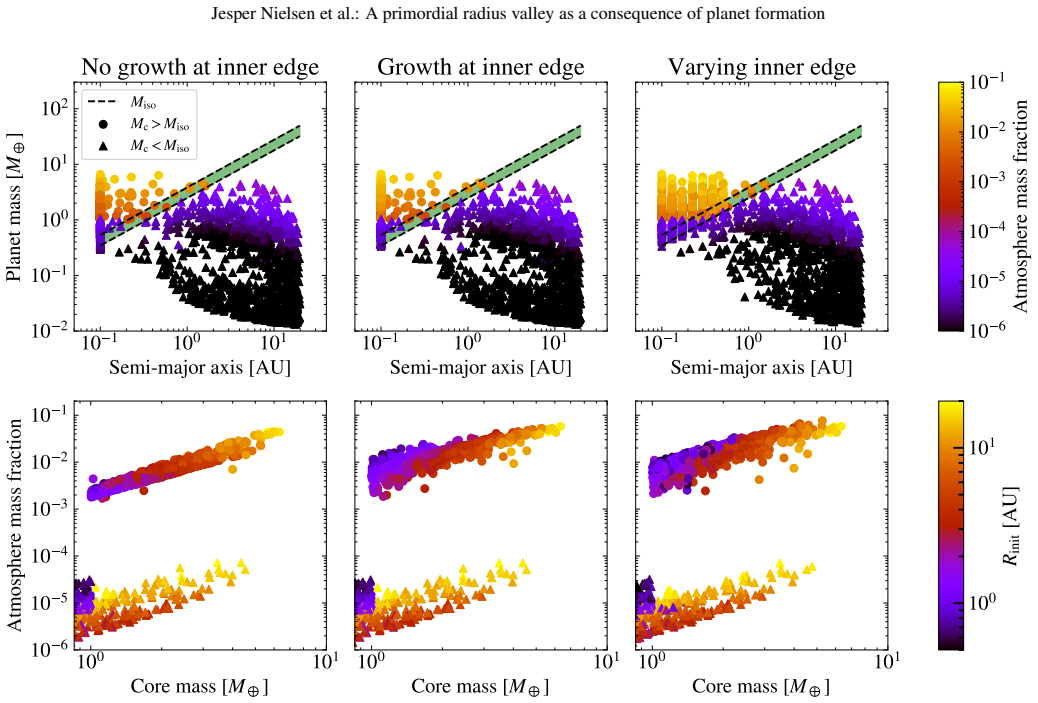
The central claim is that the radius valley is primordial in the sense that it is set during the formation of planetary cores, and no mass loss after disc dispersal is needed to produce the gap. Planets below the pebble isolation mass never accrete more than about $10^{-5}$ of their mass as atmosphere and remain bare cores, while planets that reach the isolation mass accrete atmospheres of roughly 0.1–10% of the core mass and are inflated to radii above the valley. The paper further predicts that the valley's location for the intrinsic population tracks the pebble isolation mass and rises with orbital period, while for close-in planets ($P<100$ days) the fitted slope reverses, and that the valley gradually fills in for wider orbits.
Load-bearing premise
The load-bearing premise is that after the protoplanetary disc disperses, no atmospheric mass is lost: the paper assumes contraction outruns any expansion from stellar XUV heating or the planet's own thermal energy, and it omits boil-off, the rapid loss triggered by the sudden removal of disc pressure; if boil-off strips a substantial part of the accreted gas, the inflated population shrinks and the valley moves or disappears.
Editorial extensions
If this is right
- Close-in planets below the valley should be predominantly rocky and nearly atmosphere-free, while those above should host H/He atmospheres of a few percent by mass.
- The radius gap for the full planet population should rise with orbital period as $P^{0.1-0.17}$, whereas for $P<100$ days the slope should steepen and reverse.
- The valley should appear within about a gigayear after disc dispersal and persist for at least 3 Gyr even with no mass loss.
- Surveying planets with periods beyond 100 days should reveal the valley progressively filled in by bare, water-rich cores of a few Earth masses.
Reading between the lines
- If the valley is a formation signature, its location directly encodes the pebble isolation mass, so radius-valley surveys could be inverted to measure disc scale height and turbulence at the time of planet formation—an application the paper does not develop.
- Mass-loss and formation are not mutually exclusive: adding photoevaporation in the paper's own test partially fills the valley, so a realistic population may show a deeper or shifted gap depending on which process dominates at a given stellar mass and age.
- A discriminating observation would be atmospheric age dating or mean-molecular-weight measurements of planets just above the valley: formation-only models predict pristine accreted H/He on young planets, while mass-loss models predict depletion signatures.
- The predicted filled valley at long periods could be tested with PLATO or Roman transit samples; a valley that remains deep beyond 100 days would disfavour the primordial interpretation.
Editorial analysis
A structured set of objections, weighed in public.
Referee Report
Summary. This paper presents a population synthesis of close-in planets formed by pebble accretion, in which gas accretion begins only after a core reaches the pebble isolation mass, and the accreted H/He atmosphere contracts after the disc disperses with no mass loss. The model produces a radius valley around 1.5-2 R⊕: planets below the isolation mass remain bare rocky cores below the valley, while planets that reach it accrete a few-percent atmosphere and are inflated above it. The authors show that this dichotomy appears in three migration prescriptions, derive slope fits for the full and P<100 d populations, and report that the valley is mostly a close-in feature that becomes filled at wider orbits. They also explore variations of the fragmentation velocity, alpha, opacity, photoevaporation, and steam atmospheres.
Significance. If the result holds, the paper makes an important conceptual point: the radius valley need not be carved by mass loss, but can arise from the threshold behavior of gas accretion set by the pebble isolation mass. The model is transparently documented, uses the analytic Piso-Youdin framework consistently, and is tested against several parameter variations; the authors are also explicit about what is and is not included. The prediction that the valley is a close-in phenomenon and becomes filled on wider orbits is falsifiable by PLATO/Roman transit surveys. Because the full-population slope essentially recovers the adopted pebble isolation mass scaling, the independent predictive content is concentrated in the close-in slope and composition split; those predictions should be emphasized. The main caveat is that the primordial interpretation depends on atmosphere survival immediately after disc dispersal (boil-off), which the paper explicitly omits.
major comments (4)
- [Sect. 4 (first paragraph) and Sect. 6.1] The central claim that the valley is primordial requires that the atmospheres accreted above the pebble isolation mass survive the loss of pressure support when the disc dissipates. The paper omits boil-off and replaces it with the assumption that contraction is faster than expansion from internal or XUV heating; it then acknowledges in Sect. 6.1 that boil-off can remove up to 90% of an atmosphere (citing Rogers et al. 2024) and would mimic photoevaporation. Appendix F tests only XUV photoevaporation, not the immediate Bondi-regime outflow that acts on the thermal energy of the atmosphere. The low-core-mass (1-2 M⊕), few-percent-atmosphere planets that populate the large-radius side of the valley are precisely the planets for which boil-off is most efficient, so even partial stripping would shrink that population and move stripped cores into or below the valley. A quantitative boil-off treatment, or at least a physically grounded bound on the mass lost before contraction outruns the outflow, is needed before the 'primordial valley' conclusion is established.
- [Sect. 4.1, Eqs. (19)-(23), Fig. 6] The post-dissipation contraction model replaces the enclosed mass m(r) with the total planet mass Mpl in the effective Bondi radius and energy integrals. The authors correctly note that this overestimates self-gravity and luminosity, and Fig. 6 shows that the overestimate is largest precisely at the high atmosphere mass fractions that define the inflated side of the valley. Because L = -dE/dt sets the contraction rate, the analytic model will make the large-radius planets shrink faster than the numerical structure equations would; this can artificially shift the inflated population toward (or into) the valley. The validation in Fig. 6 is carried out for the embedded, disc-boundary case and for one core mass; it does not quantify the effect on the final 3 Gyr radius distribution. A comparison of the analytical contraction model with the numerical model, or a corrected self-gravity treatment, for representative post-dissipation configurations is required to establish that the valley depth and location are not artifacts of this approximation.
- [Sect. 5.3, paragraph after Fig. 11] The reported full-population gap slopes, Rgap ∝ P^0.17, P^0.16, and P^0.11, are, as the authors explicitly state, essentially the radius of a bare core at the pebble isolation mass, which scales as P^0.19 for the adopted Miso formula and a fixed density. This means the full-population slope is a consistency check of the input Miso prescription rather than an independent prediction of the model. The comparison with observed slopes is therefore only meaningful for the P<100 d subsample, where the slope reverses and is set by the contraction model. The paper should be reframed accordingly, and the full-population slope should not be presented as support for the model without noting this relation.
- [Sect. 5, 'three sets of simulations', and Sect. 5.2] The inner-edge treatment is chosen ad hoc: gas accretion and migration are stopped at 0.1 AU in two models, and in the third each planet is randomly assigned one of seven 3:2-resonant inner edges without modeling the multi-planet dynamics that would produce such a chain. The resulting population depends strongly on this choice: the varying-inner-edge model produces an excess of 3-4 R⊕ planets that the authors themselves note is not seen in observations, and this is also the model whose close-in slope they compare to observations. Since the main observational comparison is made with a model whose stopping condition is not derived from a formation mechanism, the slope agreement is not a robust test of the theory. The inner-edge distribution should either be modeled from N-body or resonant-migration simulations, or varied systematically to show that the slope comparison is robust to the prescription.
minor comments (5)
- [Sect. 2, after Eq. (1)] There is a duplicated article: 'The the disc scale height is given by H = cs/Ω'. This should read 'The disc scale height...'.
- [Fig. C.1 caption] The caption refers to 'the top row in Fig. C', but the figure being compared is Fig. 7; the cross-reference should be corrected.
- [Sect. 6.4] The sentence 'The details of the model are described in H' should read 'described in Appendix H'.
- [Sect. 2, paragraph on alpha choice] The sentence 'We choose to adopt a value of α = 0.01, which have been needed in order to match...' has a subject-verb agreement error; it should be 'which has been needed'.
- [Sect. 6.1, last paragraph] The spelling 'boil-o ff' should be 'boil-off' throughout, and the same applies to 'di fferent' in several places; a final proofreading pass is needed.
Circularity Check
No significant circularity: the valley location is set by an external pebble-isolation-mass criterion rather than fitted to observations, and the paper explicitly labels the intrinsic slope as a recovery of that input; the close-in slope reversal is an independent model output.
full rationale
The derivation is self-contained in the relevant sense. The valley location is set by the pebble isolation mass Miso(P) from Bitsch et al. (2018), Eq. (1), which is adopted a priori from external hydrodynamical simulations and is not fitted to the observed radius valley. The synthetic core-mass distribution is produced by the pebble accretion model of Nielsen et al. (2023), and the atmosphere accretion and contraction calculations are explicit (Eqs. 10-29). The intrinsic-population gap slope indeed reduces to the Miso bare-core scaling (P^0.19), but the paper states this openly in Sect. 5.3: "we essentially recover the pebble isolation mass as the size of a bare planet core... will scale with orbital period as P^0.19." This is a transparent consequence of an input, not a disguised prediction. The close-in slope reversal and the gradual filling of the valley at wide orbits are genuine outputs of the contraction model, and no parameter is fitted to the observed valley location or slope. The only notable unmodeled process, boil-off, is explicitly acknowledged in Sect. 4 and Sect. 6.1 as an omission and discussed as a physical limitation; an assumption about an external process is not a circular reduction of outputs to inputs. Self-citations such as Nielsen et al. (2023) and the overlapping authorship of Bitsch et al. (2018) supply model ingredients, but they do not smuggle in the target result or forbid alternatives through a uniqueness claim. Therefore no load-bearing circular step was identified.
Assumptions & free parameters
free parameters (8)
- Viscous alpha =
0.01
- Turbulence alpha_t =
1e-4
- Pebble fragmentation velocity =
2 m/s
- Initial gas accretion rate onto star =
1e-7 M_sun/yr
- Initial disc gas mass =
0.1 M_sun
- Injection time range =
1 kyr to 1 Myr, uniform
- Injection location range =
0.5 to 20 AU, log-uniform
- Transit pressure =
20 mbar
assumptions (9)
- domain assumption The atmosphere is spherically symmetric, in hydrostatic equilibrium, and in pressure balance with the disc midplane.
- domain assumption The gas is an ideal gas with P = ρRT.
- domain assumption The atmosphere has an inner convective layer and an outer radiative layer, with the radiative-convective boundary where ∇rad = ∇ad.
- ad hoc to paper After disc dissipation, the atmosphere contracts without mass loss; contraction is faster than expansion from XUV or internal thermal energy.
- domain assumption The core is supercritical, convective, and nearly isothermal, so its thermal energy does not affect the contraction timescale.
- domain assumption Planets stop accreting solids once they reach the pebble isolation mass, and thereafter only accrete gas.
- domain assumption The pebble isolation mass formula of Bitsch et al. (2018), Eq. (1), sets the threshold for gas accretion.
- ad hoc to paper The atmospheric energy integral replaces the enclosed mass m(r) with the total planet mass Mpl to make the equations analytically tractable.
- ad hoc to paper The transit radius is approximated as RRCB + ΔRtr with a constant transit pressure of 20 mbar.
Cite this review
Pith. "Pith review of A primordial radius valley as a consequence of planet formation." pith.science (2026). https://pith.science/paper/G7RHBHRN
@misc{pith2026250210186,
  author       = {Pith},
  title        = {Pith review of: A primordial radius valley as a consequence of planet formation},
  year         = {2026},
  howpublished = {\url{https://pith.science/paper/G7RHBHRN}},
  note         = {Machine review of arXiv:2502.10186}
}
abstract
The radius distribution of close-in planets has been observed to have a bimodal distribution with a dearth of planets around ~1.5-2.0 $R_\oplus$ commonly referred to as the ''radius valley''. The origin of the valley is normally attributed to mass-loss process such as photoevaporation or core-powered mass loss. Recent work, however, has suggested that the radius valley may instead arise as a consequence of gas accretion by low-mass planets. In this work we therefore aim to investigate the formation of a primordial radius valley from the formation of planet cores through pebble accretion up until the dissipation of the protoplanetary disc and subsequent contraction of accreted atmospheres. The goal of this work is to explore the conditions for forming a primordial radius valley from first principles of planet formation theory, rather than attempting to explain the detailed structure of the observed valley. We use an analytical model with minimal assumptions to estimate the contraction rate of atmospheres and, indeed, find the formation of a primordial radius valley. The planets smaller than the valley did not reach the pebble isolation mass, which is required for the planets to cool down sufficiently to be able to accrete a significant amount of gas. We also estimate the slopes of the radius gap as a function of orbital period for the intrinsic population as well as for planets with orbital periods <100 days. For the intrinsic population, the radius gap follows the pebble isolation mass and increases with increasing orbital period, while for close-in planets the direction of the slope reverses and decreases with increasing orbital period. We find that planets smaller than the radius valley are predominantly rocky while the population of planets larger than the valley consists of a mixture of rocky and water-rich planets.
Figures


Figures from the paper (10 more)




Forward citations
Cited by 1 Pith paper
-
The Influence of Dust Composition on Accretion Outbursts
Using 1D simulations with dust evaporation and condensation, the paper shows that dead-zone accretion outbursts vaporize dust out to about 0.5 au and that higher dust sublimation temperatures produce stronger but less...
Reference graph
Works this paper leans on
-
[1]
, " * write output.state after.block = add.period write newline
ENTRY address archiveprefix author booktitle chapter edition editor howpublished institution eprint journal key month note number organization pages publisher school series title type volume year label extra.label sort.label short.list INTEGERS output.state before.all mid.sentence after.sentence after.block FUNCTION init.state.consts #0 'before.all := #1 ...
-
[2]
write newline
" write newline "" before.all 'output.state := FUNCTION n.dashify 't := "" t empty not t #1 #1 substring "-" = t #1 #2 substring "--" = not "--" * t #2 global.max substring 't := t #1 #1 substring "-" = "-" * t #2 global.max substring 't := while if t #1 #1 substring * t #2 global.max substring 't := if while FUNCTION word.in bbl.in " " * FUNCTION format....
-
[3]
2013, , 774, 57
Bae , J., Hartmann , L., Zhu , Z., & Gammie , C. 2013, , 774, 57
2013
-
[4]
B., & Karki, B
Bajgain, S., Ghosh, D. B., & Karki, B. B. 2015, Nature Communications, 6, 8578, publisher: Nature Publishing Group
2015
-
[5]
2015, , 577, A42
Baraffe , I., Homeier , D., Allard , F., & Chabrier , G. 2015, , 577, A42
2015
-
[6]
& Morbidelli , A
Batygin , K. & Morbidelli , A. 2023, Nature Astronomy, 7, 330
2023
-
[7]
Bell , K. R. & Lin , D. N. C. 1994, , 427, 987
1994
-
[8]
A., Huber , D., Gaidos , E., van Saders , J
Berger , T. A., Huber , D., Gaidos , E., van Saders , J. L., & Weiss , L. M. 2020 a , , 160, 108
2020
Show all 115 references
-
[9]
A., Huber , D., van Saders , J
Berger , T. A., Huber , D., van Saders , J. L., et al. 2020 b , , 159, 280
2020
-
[10]
A., Schlieder , J
Berger , T. A., Schlieder , J. E., Huber , D., & Barclay , T. 2023, arXiv e-prints, arXiv:2302.00009
2023 arXiv
-
[11]
2015, , 575, A28
Bitsch , B., Johansen , A., Lambrechts , M., & Morbidelli , A. 2015, , 575, A28
2015
-
[12]
2018, , 612, A30
Bitsch , B., Morbidelli , A., Johansen , A., et al. 2018, , 612, A30
2018
-
[13]
J., Koch , D., Basri , G., et al
Borucki , W. J., Koch , D., Basri , G., et al. 2010, Science, 327, 977
2010
-
[14]
2024, Nature Astronomy, 8, 463
Burn , R., Mordasini , C., Mishra , L., et al. 2024, Nature Astronomy, 8, 463
2024
-
[15]
B., Sudarsky , D., & Fortney , J
Burrows , A., Hubeny , I., Hubbard , W. B., Sudarsky , D., & Fortney , J. J. 2004, , 610, L53
2004
-
[16]
L., Zink , J
Christiansen , J. L., Zink , J. K., Hardegree-Ullman , K. K., et al. 2023, , 166, 248
2023
-
[17]
& Menou , K
Cloutier , R. & Menou , K. 2020, , 159, 211
2020
-
[18]
Connolly, J. A. D. 2009, Geochemistry, Geophysics, Geosystems, 10
2009
-
[19]
& Lichtenberg, T
Dorn, C. & Lichtenberg, T. 2021, The Astrophysical Journal Letters, 922, L4
2021
-
[20]
L., & Alibert, Y
Dorn, C., Mosegaard, K., Grimm, S. L., & Alibert, Y. 2018, The Astrophysical Journal, 865, 20, arXiv:1808.01803 [astro-ph]
2018 arXiv
-
[21]
2017, Astronomy & Astrophysics, 597, A37, arXiv:1609.03908 [astro-ph]
Dorn, C., Venturini, J., Khan, A., et al. 2017, Astronomy & Astrophysics, 597, A37, arXiv:1609.03908 [astro-ph]
2017 arXiv
-
[22]
2023, in Astronomical Society of the Pacific Conference Series, Vol
Dr a \.z kowska , J., Bitsch , B., Lambrechts , M., et al. 2023, in Astronomical Society of the Pacific Conference Series, Vol. 534, Protostars and Planets VII, ed. S. Inutsuka , Y. Aikawa , T. Muto , K. Tomida , & M. Tamura , 717
2023
-
[23]
M., & Birnstiel , T
Dr a \.z kowska , J., Stammler , S. M., & Birnstiel , T. 2021, , 647, A15
2021
-
[24]
C., Lissauer , J
Fabrycky , D. C., Lissauer , J. J., Ragozzine , D., et al. 2014, , 790, 146
2014
-
[25]
2018, Computer Physics Communications, 227, 117
Faik, S., Tauschwitz, A., & Iosilevskiy, I. 2018, Computer Physics Communications, 227, 117
2018
-
[26]
A., Campbell, A
Fischer, R. A., Campbell, A. J., Shofner, G. A., et al. 2011, Earth and Planetary Science Letters, 304, 496
2011
-
[27]
Fulton , B. J. & Petigura , E. A. 2018, , 156, 264
2018
-
[28]
J., Petigura , E
Fulton , B. J., Petigura , E. A., Howard , A. W., et al. 2017, , 154, 109
2017
-
[29]
Gaia Collaboration , Prusti , T., de Bruijne , J. H. J., et al. 2016, , 595, A1
2016
-
[30]
Gaia Collaboration , Vallenari , A., Brown , A. G. A., et al. 2023, , 674, A1
2023
-
[31]
E., & Sari , R
Ginzburg , S., Schlichting , H. E., & Sari , R. 2016, , 825, 29
2016
-
[32]
E., & Sari , R
Ginzburg , S., Schlichting , H. E., & Sari , R. 2018, , 476, 759
2018
-
[33]
& Tremaine , S
Goldreich , P. & Tremaine , S. 1980, , 241, 425
1980
-
[34]
& Blum , J
Gundlach , B. & Blum , J. 2015, , 798, 34
2015
-
[35]
Gupta , A., Nicholson , L., & Schlichting , H. E. 2022, , 516, 4585
2022
-
[36]
& Schlichting , H
Gupta , A. & Schlichting , H. E. 2019, , 487, 24
2019
-
[37]
& Schlichting , H
Gupta , A. & Schlichting , H. E. 2020, , 493, 792
2020
-
[38]
& Schlichting , H
Gupta , A. & Schlichting , H. E. 2021, , 504, 4634
2021
-
[39]
2024, , 682, A43
Gurrutxaga , N., Johansen , A., Lambrechts , M., & Appelgren , J. 2024, , 682, A43
2024
-
[40]
2018, Icarus, 313, 61
Hakim, K., Rivoldini, A., Van Hoolst, T., et al. 2018, Icarus, 313, 61
2018
-
[41]
2020, Astronomy & Astrophysics, 643, A105, arXiv:2009.10098 [astro-ph]
Haldemann, J., Alibert, Y., Mordasini, C., & Benz, W. 2020, Astronomy & Astrophysics, 643, A105, arXiv:2009.10098 [astro-ph]
2020 arXiv
-
[42]
Hamer , J. H. & Schlaufman , K. C. 2024, , 167, 55
2024
-
[43]
1998, , 495, 385
Hartmann , L., Calvet , N., Gullbring , E., & D'Alessio , P. 1998, , 495, 385
1998
-
[44]
J., Stixrude, L., Fei, Y., & Mao, H
Hemley, R. J., Stixrude, L., Fei, Y., & Mao, H. K. 1992, in High- Pressure Research : Application to Earth and Planetary Sciences (American Geophysical Union (AGU)), 183--189, \_eprint: https://onlinelibrary.wiley.com/doi/pdf/10.1029/GM067p0183
1992 doi
-
[45]
Ho , C. S. K., Rogers , J. G., Van Eylen , V., Owen , J. E., & Schlichting , H. E. 2024, arXiv e-prints, arXiv:2401.12378
2024 arXiv
-
[46]
Ho , C. S. K. & Van Eylen , V. 2023, , 519, 4056
2023
-
[47]
2016, , 591, A72
Ida , S., Guillot , T., & Morbidelli , A. 2016, , 591, A72
2016
-
[48]
D., & Tanigawa , T
Ida , S., Tanaka , H., Johansen , A., Kanagawa , K. D., & Tanigawa , T. 2018, , 864, 77
2018
-
[49]
2000, , 537, 1013
Ikoma , M., Nakazawa , K., & Emori , H. 2000, , 537, 1013
2000
-
[50]
N., et al
Izidoro , A., Bitsch , B., Raymond , S. N., et al. 2021, , 650, A152
2021
-
[51]
N., et al
Izidoro , A., Ogihara , M., Raymond , S. N., et al. 2017, , 470, 1750
2017
-
[52]
E., Isella , A., et al
Izidoro , A., Schlichting , H. E., Isella , A., et al. 2022, , 939, L19
2022
-
[53]
P., Davis , T
Jackson , A. P., Davis , T. A., & Wheatley , P. J. 2012, , 422, 2024
2012
-
[54]
2019, , 622, A202
Johansen , A., Ida , S., & Brasser , R. 2019, , 622, A202
2019
-
[55]
2021, Science Advances, 7, eabc0444
Johansen , A., Ronnet , T., Bizzarro , M., et al. 2021, Science Advances, 7, eabc0444
2021
-
[56]
P., Bartel , M., & G \"u del , M
Johnstone , C. P., Bartel , M., & G \"u del , M. 2021, , 649, A96
2021
-
[57]
C., & Johansen , A
Kajtazi , K., Petit , A. C., & Johansen , A. 2023, , 669, A44
2023
-
[58]
D., Tanaka , H., & Szuszkiewicz , E
Kanagawa , K. D., Tanaka , H., & Szuszkiewicz , E. 2018, , 861, 140
2018
-
[59]
F., Spiegelman, M., & Langmuir, C
Katz, R. F., Spiegelman, M., & Langmuir, C. H. 2003, Geochemistry, Geophysics, Geosystems, 4, 2002GC000433
2003
-
[60]
2021, , 910, 51
Komaki , A., Nakatani , R., & Yoshida , N. 2021, , 910, 51
2021
-
[61]
2014, , 572, A35
Lambrechts , M., Johansen , A., & Morbidelli , A. 2014, , 572, A35
2014
-
[62]
& Lega , E
Lambrechts , M. & Lega , E. 2017, , 606, A146
2017
-
[63]
P., Crida , A., & Morbidelli , A
Lambrechts , M., Lega , E., Nelson , R. P., Crida , A., & Morbidelli , A. 2019 a , , 630, A82
2019
-
[64]
A., et al
Lambrechts , M., Morbidelli , A., Jacobson , S. A., et al. 2019 b , , 627, A83
2019
-
[65]
Lau , T. C. H., Dr a \.z kowska , J., Stammler , S. M., Birnstiel , T., & Dullemond , C. P. 2022, , 668, A170
2022
-
[66]
Lee , E. J. & Chiang , E. 2015, , 811, 41
2015
-
[67]
J., Chiang , E., & Ormel , C
Lee , E. J., Chiang , E., & Ormel , C. W. 2014, , 797, 95
2014
-
[68]
Lee , E. J. & Connors , N. J. 2021, , 908, 32
2021
-
[69]
J., Karalis , A., & Thorngren , D
Lee , E. J., Karalis , A., & Thorngren , D. P. 2022, , 941, 186
2022
-
[70]
2023, in Astronomical Society of the Pacific Conference Series, Vol
Lesur , G., Flock , M., Ercolano , B., et al. 2023, in Astronomical Society of the Pacific Conference Series, Vol. 534, Protostars and Planets VII, ed. S. Inutsuka , Y. Aikawa , T. Muto , K. Tomida , & M. Tamura , 465
2023
-
[71]
2019, , 632, A7
Liu , B., Lambrechts , M., Johansen , A., & Liu , F. 2019, , 632, A7
2019
-
[72]
Liu , S.-F., Hori , Y., Lin , D. N. C., & Asphaug , E. 2015, , 812, 164
2015
-
[73]
Lopez , E. D. & Fortney , J. J. 2013, , 776, 2
2013
-
[74]
Lopez , E. D. & Fortney , J. J. 2014, , 792, 1
2014
-
[75]
D., Fortney , J
Lopez , E. D., Fortney , J. J., & Miller , N. 2012, , 761, 59
2012
-
[76]
Lopez , E. D. & Rice , K. 2018, , 479, 5303
2018
-
[77]
Loyd , R. O. P., Shkolnik , E. L., Schneider , A. C., et al. 2020, , 890, 23
2020
-
[78]
2024, Majority of water hides deep in the interiors of exoplanets, arXiv:2401.16394 [astro-ph]
Luo, H., Dorn, C., & Deng, J. 2024, Majority of water hides deep in the interiors of exoplanets, arXiv:2401.16394 [astro-ph]
2024 arXiv
-
[79]
2022, , 661, A140
Magg , E., Bergemann , M., Serenelli , A., et al. 2022, , 661, A140
2022
-
[80]
& Korenaga , J
Modirrousta-Galian , D. & Korenaga , J. 2024, arXiv e-prints, arXiv:2402.06933
2024 arXiv
-
[81]
2020, , 638, A52
Mordasini , C. 2020, , 638, A52
2020
-
[82]
2019, Physical Review B, 99, 064110, publisher: American Physical Society
Musella, R., Mazevet, S., & Guyot, F. 2019, Physical Review B, 99, 064110, publisher: American Physical Society
2019
-
[83]
& Wurm , G
Musiolik , G. & Wurm , G. 2019, , 873, 58
2019
-
[84]
J., Davies , M
Mustill , A. J., Davies , M. B., & Johansen , A. 2017, , 468, 3000
2017
-
[85]
Najita , J. R. & Bergin , E. A. 2018, , 864, 168
2018
-
[86]
R., Bergemann , M., Eitner , P., & Johansen , A
Nielsen , J., Gent , M. R., Bergemann , M., Eitner , P., & Johansen , A. 2023, , 678, A74
2023
-
[87]
J., Schiller , M., Makhatadze , G
Onyett , I. J., Schiller , M., Makhatadze , G. V., et al. 2023, , 619, 539
2023
-
[88]
E., Clarke , C
Owen , J. E., Clarke , C. J., & Ercolano , B. 2012, , 422, 1880
2012
-
[89]
Owen , J. E. & Schlichting , H. E. 2024, , 528, 1615
2024
-
[90]
Owen , J. E. & Wu , Y. 2013, , 775, 105
2013
-
[91]
Owen , J. E. & Wu , Y. 2016, , 817, 107
2016
-
[92]
Owen , J. E. & Wu , Y. 2017, , 847, 29
2017
-
[93]
2024, , 682, A89
Pan , M., Liu , B., Johansen , A., et al. 2024, , 682, A89
2024
-
[94]
Peale , S. J. 1976, , 14, 215
1976
-
[95]
A., Rogers , J
Petigura , E. A., Rogers , J. G., Isaacson , H., et al. 2022, , 163, 179
2022
-
[96]
Piso , A.-M. A. & Youdin , A. N. 2014, , 786, 21
2014
-
[97]
A., Youdin , A
Piso , A.-M. A., Youdin , A. N., & Murray-Clay , R. A. 2015, , 800, 82
2015
-
[98]
2014, Experimental Astronomy, 38, 249
Rauer , H., Catala , C., Aerts , C., et al. 2014, Experimental Astronomy, 38, 249
2014
-
[99]
G., Gupta , A., Owen , J
Rogers , J. G., Gupta , A., Owen , J. E., & Schlichting , H. E. 2021, , 508, 5886
2021
-
[100]
Rogers , J. G. & Owen , J. E. 2021, , 503, 1526
2021
-
[101]
G., Owen , J
Rogers , J. G., Owen , J. E., & Schlichting , H. E. 2024, , 529, 2716
2024
-
[102]
Rogers , L. A. 2015, , 801, 41
2015
-
[103]
Rosotti , G. P. 2023, , 96, 101674
2023
-
[104]
M., Reg \'a ly , Z., & Lyra , W
S \'a ndor , Z., Guilera , O. M., Reg \'a ly , Z., & Lyra , W. 2024, arXiv e-prints, arXiv:2402.11584
2024 arXiv
-
[105]
Schneider , A. D. & Bitsch , B. 2021, , 654, A71
2021
-
[106]
Shkolnik , E. L. & Barman , T. S. 2014, , 148, 64
2014
-
[107]
2015, arXiv e-prints, arXiv:1503.03757
Spergel , D., Gehrels , N., Baltay , C., et al. 2015, arXiv e-prints, arXiv:1503.03757
2015 arXiv
-
[108]
2014, Philosophical Transactions of the Royal Society A: Mathematical, Physical and Engineering Sciences, 372, 20130076
Stixrude, L. 2014, Philosophical Transactions of the Royal Society A: Mathematical, Physical and Engineering Sciences, 372, 20130076
2014
-
[109]
& Lithgow-Bertelloni, C
Stixrude, L. & Lithgow-Bertelloni, C. 2022, Geophysical Journal International, 228, 1119
2022
-
[110]
Tanaka , H., Takeuchi , T., & Ward , W. R. 2002, , 565, 1257
2002
-
[111]
D., Hogerheijde , M
Trapman , L., Rosotti , G., Bosman , A. D., Hogerheijde , M. R., & van Dishoeck , E. F. 2020, , 640, A5
2020
-
[112]
S., et al
Van Eylen , V., Agentoft , C., Lundkvist , M. S., et al. 2018, , 479, 4786
2018
-
[113]
M., Haldemann , J., Ronco , M
Venturini , J., Guilera , O. M., Haldemann , J., Ronco , M. P., & Mordasini , C. 2020, , 643, L1
2020
-
[114]
& Lopez , E
Wolfgang , A. & Lopez , E. 2015, , 806, 183
2015
-
[115]
B., Sasselov , D
Zeng , L., Jacobsen , S. B., Sasselov , D. D., et al. 2019, Proceedings of the National Academy of Science, 116, 9723
2019
Reviewed August 7, 2026 · model on record in the stance chip above.
Discussion (0). Continue with ORCID to comment.