REVIEW 3 major objections 6 minor 39 references
GREENY: A Full-F 2D Gyrofluid Reconnection Code
T0 review · 3 major / 6 minor · reviewed 2026-08-07 · deepseek-v4-flash
Pith's one-line read GREENY is a 2D gyrofluid reconnection code that correctly simulates collisionless magnetic reconnection with finite Larmor radius effects, verified by solver-convergence and conservation tests.
desk verdict A solid, clearly written code paper with genuine verification for the δF-like regime, but the advertised full-F Ampère capability is not actually tested and the conclusion overstates what is proven. read the letter →
The pith
A machine-rendered reading of the paper's core claim, the machinery that carries it, and where it could break.
The reading
What carries the argument
The central machinery is the closed system of gyrofluid equations, with finite Larmor radius effects encoded in Padé gyroaveraging and screening operators such as $\Gamma_{0,i}=1/(1-\tau_i\mu_i\Delta_\perp)$ and $\Gamma_{1,i}=1/(1-\tau_i\mu_i\Delta_\perp/2)$ for ions, while electron FLR is neglected. The evolution equations for electron density, ion gyrocenter density, and the parallel velocities are closed by the polarisation equation and by Ampère's law $-(1/\beta)\Delta_\perp A_\parallel = -n_e u_e + \Gamma_1(N_i U_i)$. For the polarisation equation the code implements the non-Oberbeck-Boussinesq arbitrary-wavelength limit as well as the Oberbeck-Boussinesq and long-wavelength limits. Ampère's law is inverted either spectrally in the δF limit or by a successive over-relaxation scheme in the full-F case, with the spectral and iterative polarisation solvers converging as $h^4$ and the SOR solver as $h^2$ in the presented benchmarks.
What would settle it
Run a full-F Harris-sheet or island simulation with a density perturbation amplitude comparable to the background density, and compare the parallel vector potential obtained from the SOR solver against a spectral inversion with a proper deconvolution algorithm. If the two disagree beyond the stated convergence tolerances in the reconnection zone, the claim that GREENY is full-F for arbitrary density amplitudes would be refuted; agreement would extend the verification to the previously untested regime.
Extended reading notes
Core claim
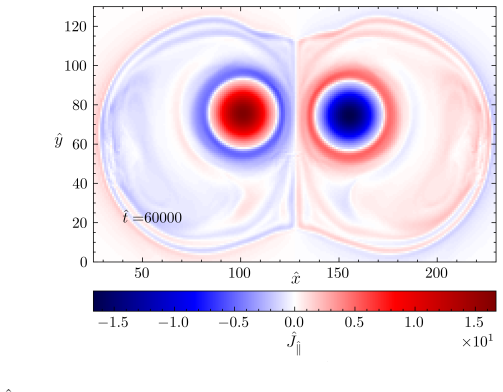
The paper's central discovery is that a full-F gyrofluid collisionless reconnection model can be implemented with self-consistent electromagnetic fluctuations by closing the equations with the quasi-neutrality polarisation equation and Ampère's law, using Padé gyroaveraging operators to represent finite Larmor radius effects. The verification program shows the elliptic solvers converge as expected (SOR second order, spectral fourth order), the total energy balance including the hyperviscous sink is tracked, and particle number and parallel canonical momentum are conserved. Qualitatively, the code reproduces earlier gyrofluid results: the reconnection zone elongates from X-shaped at larger β to Y-shaped at small β, warm ions produce two plasmoids in an ion-current-driven case, and co-rotating magnetic vortices are prevented from merging by the surrounding vorticity layer.
Load-bearing premise
The load-bearing premise is that the full-F inversion of Ampère's law is accurate at large density amplitudes: the solver that allows arbitrary amplitudes omits part of the gyroaveraging operator, and the solver that keeps all gyroaveraging is only valid for small density perturbations, while the paper's test cases stay in the small-perturbation regime.
Editorial extensions
If this is right
- With verified solvers, GREENY offers a direct comparison of full-F versus δF dynamics and of arbitrary-wavelength, Oberbeck-Boussinesq, and long-wavelength polarisation closures in the same reconnection problem.
- The simulations show that the reconnection zone changes from an elongated Y-shape at low β to an X-shape at higher β, and that resolving the $\rho_s$-scale fine structures of the non-Oberbeck-Boussinesq closure demands high resolution.
- The hyperviscosity parameter $\nu$ cannot be set by a general rule: in the studied Harris-sheet cases it changes the transient island-merging phase and the onset of the main reconnection event, so every simulation needs individual convergence checks.
- Conservation of total energy, particle number, and parallel canonical momentum holds to reasonable accuracy with small hyperviscosity, providing a baseline for future physical runs.
- The code reproduces known drift-wave-driven vortex behaviour and the delay of magnetic vortex merging by the surrounding vorticity field, independent of purely magnetic attraction.
Reading between the lines
- If the full-F Ampère inversion gap is closed, for example by a deconvolution algorithm or a fully gyroaverage-aware iterative solver, GREENY could be pushed into a regime of genuinely large-density-amplitude reconnection, which is where the full-F label would carry real weight.
- The erratic role of subgrid hyperviscosity suggests that similar gyrofluid reconnection codes may have hyperviscosity-dependent reconnection-rate histories, so published rates should be accompanied by explicit $\nu$ scans.
- A direct extension to three dimensions would test whether the two-dimensional conclusions about Y-shaped and X-shaped reconnection zones and plasmoid formation survive coupling along the guide field.
- The code's modular solver choices make it a natural testbed for quantifying the error of the Oberbeck-Boussinesq and long-wavelength closures against the arbitrary-wavelength model for reconnection observables such as the reconnection rate and island sizes.
Editorial analysis
A structured set of objections, weighed in public.
Referee Report
Summary. This paper presents GREENY, a two-dimensional gyrofluid code for collisionless magnetic reconnection, implementing both full-F and delta-F models with finite Larmor radius effects. The authors describe the model equations, the numerical methods for solving the polarisation equation and Ampère's law, and report verification tests: manufactured-solution convergence studies for the elliptic solvers, conservation of energy, particle number, and parallel momentum, and example Harris-sheet and vortex-interaction simulations. The central claim is that GREENY correctly solves the implemented gyrofluid models and passes relevant verification tests.
Significance. GREENY addresses a useful niche: a lightweight 2D gyrofluid reconnection code with multiple model options and open-source availability under an MIT license, with a repository link provided. The verification strategy is commendable in that the elliptic solvers are tested against analytic manufactured solutions, with observed convergence orders matching discretization expectations, and the conservation laws are checked in a realistic reconnection setup. The ability to compare full-F, delta-F, and Oberbeck-Boussinesq variants in one framework is valuable for future gyrofluid reconnection studies. However, the significance of the 'Full-F' claim is currently weakened because the full-F Ampère law solver is not exercised in the large-amplitude regime and the conservation-law evidence is only qualitative.
major comments (3)
- [Section 3.1, Eq. (27), Algorithm 1] The Full-F treatment of Ampère's law is not consistently full-F. The SOR branch (ifullf = -1) of Algorithm 1 replaces the gyroaveraging operators Gamma_1 by the identity in the density-dependent terms Gamma_1(N_i Gamma_1 A_parallel) and Gamma_1(N_i A*_parallel,i), while the spectral branch retains all FLR terms but is valid only for density perturbations delta n/N_0 << 1, as the text states. The verification cases in Section 5.1 (Harris-sheet) use small density fluctuations, so they do not exercise the regime in which the SOR approximation deviates from the full operator. The polarisation equation, by contrast, is solved with the full arbitrary-wavelength NOB closure, so the code is not uniformly full-F across the two elliptic closures. The conclusion (Section 6) that GREENY 'was presented and proven to pass relevant verification tests' is therefore supported for the delta-F-like regime only, not for the advertised large-amplitude Full-F capability. I recommend adding tests with large density perturbations that exercise the full nonlinear operator, or revising the title and claims and explicitly documenting the SOR approximation as an additional model variant.
- [Section 3.2, Figures 4 and 5] The conservation-law tests are reported qualitatively. The text states that particle number (Eq. 40) and total parallel canonical momentum (Eq. 41) are conserved 'to a reasonable degree', but no quantitative error is given, and there is no demonstration that the conservation errors converge with resolution or time-step. Since the conclusion claims that the code passes conservation-law verification, I would expect relative deviations such as |Delta M|/M and |Delta P_parallel|/|P_parallel| (or their time trends) and a resolution study. This is particularly important because the energy balance (Eq. 18) includes the hyperviscous dissipation term (Eq. 38), and the figure alone does not show that the implemented discrete energy balance is satisfied to the advertised accuracy.
- [Section 3.1, Figure 2] The manufactured-solution tests for the Ampère solvers do not test the full-F operator. The spectral test uses f(x) = const., which corresponds to a constant density background and hence the delta-F limit; the SOR test uses a spatially varying f(x) but, as stated in the text and in Algorithm 1, the SOR solver ignores the Gamma_1 terms in the full-F densities. Thus the convergence orders shown (h^2 for SOR, h^4 for FFT) verify the discretization of a simplified operator, not the correctness of the full-F Ampère equation (Eq. 27). I suggest manufacturing solutions for the full operator, with non-constant gyrocenter densities and including the Gamma_1 factors, and clearly stating which equation is solved in each branch.
minor comments (6)
- [Section 3.1] The sentence 'Hence GREENY treats the Full-F RHS with constant densities' is confusing; please clarify whether this applies only to the spectral solver and what 'constant densities' means in the Full-F context.
- [Section 4] The heading 'Inital conditions' is misspelled and should read 'Initial conditions'.
- [Throughout] The paper inconsistently spells 'Amperè' (e.g., in Section 3.1 and the Figure 2 caption) and 'Ampère'; please standardize to 'Ampère'.
- [Figures 2 and 3] The text refers to a 'log-lin plot' for the error scalings, but the axes in the figures appear logarithmic on both axes; please correct the description.
- [References] Reference [6] lists 'doi:https://doi.org/10.1103/PhysRevLett.40.1500', which appears to be an incorrect DOI (the cited article is presumably Uzdensky et al., PRL 2010); please verify and correct.
- [Program Summary] The supplementary material (Granalysis, vortex_experiments.pdf, gyromod_derivation.pdf) is listed but not referenced or described in the main text; please add a brief mention or link so readers know what these files contain.
Circularity Check
No significant circularity: solver tests, conservation checks, and model-closure citations are independent; the full-F limitations are acknowledged approximations, not circular reductions.
full rationale
GREENY's derivation chain is self-contained at the level of what is claimed. The solver verification tests in Sec. 3.1 compare against analytic manufactured solutions (Eqs. 30-32 for Ampère's law and Eqs. 34-37 for the polarisation equation), so the reported convergence orders (SOR ~ h^2, FFT/PCG/Teague ~ h^4) are measured against inputs that do not contain the code's own output. The conservation checks in Sec. 3.2 integrate the physically defined energy balance Eq. 18 including the explicitly time-integrated hyperviscous sink Eq. 38, and monitor particle number Eq. 40 and parallel canonical momentum Eq. 41; these are diagnostics of the implemented equations, not renames of fitted data. The model closures (Padé gyroaverage operators Eqs. 4-5, polarisation closures) are cited to earlier work [27,28]; those citations are parameter-free stated assumptions that do not smuggle in the numerical verification result. The vortex-interaction comparison [37] is a same-group benchmark, but it is used as an illustrative validation example, not as the load-bearing proof of correctness. The paper explicitly acknowledges the full-F limitation in Sec. 3.1: the SOR Ampère solver 'ignores the Γ1 in both, Γ1(NiΓ1) and Γ1(Ni A*∥,i)' and the spectral solver 'is only valid for perturbations in the densities ... small', and the test cases 'displayed rather small density fluctuations.' This is a limitation on the advertised full-F/large-amplitude capability, not a circular step: no quantity is defined in terms of the quantity it is used to predict, and no parameter is fitted to a subset and then reported as a prediction. Consequently no circularity is found.
Assumptions & free parameters
free parameters (1)
- hyperviscosity coefficient ν =
scanned 10^-12 to 10^-6; suggested 10^-7 to 10^-9
assumptions (5)
- domain assumption Full-F gyrofluid model of Madsen (2013) is an accurate closure of gyrokinetics for the target regimes.
- domain assumption Padé approximations for gyroaveraging operators Γ0 and Γ1 are valid.
- domain assumption Constant gyro radius ρ_s and background magnetic field B0 (partial Oberbeck-Boussinesq approximation).
- domain assumption Electron gyrocenter density can be replaced by particle density and electron FLR effects neglected.
- domain assumption Isothermal equations with no heat flux closure.
Cite this review
Pith. "Pith review of GREENY: A Full-F 2D Gyrofluid Reconnection Code." pith.science (2026). https://pith.science/paper/QSGHX6OH
@misc{pith2026250210219,
  author       = {Pith},
  title        = {Pith review of: GREENY: A Full-F 2D Gyrofluid Reconnection Code},
  year         = {2026},
  howpublished = {\url{https://pith.science/paper/QSGHX6OH}},
  note         = {Machine review of arXiv:2502.10219}
}
read the original abstract
We present the 2D gyrofluid magnetic reconnection code GREENY (Gyrofluid Reconnection with Extended Electromagnetic Nonlinearity). After a brief introduction to gyrofluids, magnetic reconnection, and the implemented models, we discuss the numerical framework and the algorithmic treatment of the quasi-neutrality condition and Amper\`e's law. Next, we present solver tests, conservation laws, and the influence of artificial subgrid dissipation on Harris-sheet magnetic reconnection. Finally, we show different applications, initial conditions and present example simulations.
Figures


Figures from the paper (7 more)


Reference graph
Works this paper leans on
-
[1]
A. H. Boozer, Why fast magnetic reconnection is so prevalent, Journal of Plasma Physics 84, cambridge University Press (2018).doi:http://doi.org/10.1017/S0022377818000028. 15
-
[2]
E. N. Parker, Acceleration of cosmic rays in solar flares, Phys. Rev. 107 (1957) 830–836.doi:10.1103/ PhysRev.107.830. URL https://link.aps.org/doi/10.1103/PhysRev.107.830
-
[3]
E. N. Parker, Sweet’s mechanism for merging magnetic fields in conducting fluids, Journal of Geophysical Research 62 (1957) 509–520, wiley
work page 1957
-
[4]
H. E. Petschek, AAS/NASA Symposium on the Physics of Solar Flares 2372 (1964) 425, (NASA, Wash- ington, DC,
work page 1964
-
[5]
Sweet, Electromagnetic phenomena in cosmical physics, in: IAU Symp
P. Sweet, Electromagnetic phenomena in cosmical physics, in: IAU Symp. 6, Vol. 123, Kluwer Academic Publishers, 1958
work page 1958
-
[6]
D. Uzdensky, N. F. Loureiro, A. A. Schekochihin, Fast magnetic reconnection in the plasmoid-dominated regime, PHYSICAL REVIEW LETTERS 105 (2010).doi:https://doi.org/10.1103/PhysRevLett. 40.1500
-
[7]
Introduction to Magnetic Reconnection
A. Jafari, E. Vishniac, Introduction to magnetic reconnection, arXiv:1805.01347v3 (2018).doi:https: //doi.org/10.48550/arXiv.1805.01347
work page Pith review arXiv doi:10.48550/arxiv.1805.01347 2018
-
[9]
E. G. Zweibel, M. Yamada, Perspectives on magnetic reconnection, Proc. R. Soc. A 472, royal Society Publishing (2016). doi:https://doi.org/10.1098/rspa.2016.0479
arXiv 2016
Show all 39 references
-
[10]
Gonzales, E
W. Gonzales, E. Parker, Magnetic Reconnection - Concepts and Applications, Vol. 26, Springer, 2016. doi:https://doi.org/10.1007/978-3-319-26432-5
2016 doi
-
[11]
Letsch, H
A. Letsch, H. Zohm, F. Ryter, W. Suttrop, A. Gude, F. Porcelli, C. Angioni, I. Furno, Incomplete reconnection in sawtooth crashes in asdex upgrade, Nuclear Fusion 42, iOP Publishing (2002)
2002
-
[12]
Agullo, M
O. Agullo, M. Muraglia, S. Benkadda, A. Poyè, N. Dubuit, X. Garbet, A. Sen, Nonlinear dynamics of turbulence driven magnetic islands. ii. numerical simulations, Phys. Plasmas 24 (2017).doi:http: //doi.org/10.1063/1.4981230
2017 doi
-
[13]
Sauter, R
O. Sauter, R. LaHaye, Z. Chang, D. A. Gates, Y. Kamada, H. Zohm, A. Bondeson, D. Boucher, J. Callen, M. Chu, T. Gianakon, O. Gruber, R. Harvey, C. Hegna, L. Lao, D. Monticello, F. Perkins, A. Pletzer, A. Reiman, R. Yoshino, Beta limits in long-pulse tokamak discharges, Physics...
1997 doi
-
[14]
Fitzpatrick, F
R. Fitzpatrick, F. L. Waelbroeck, Drift-tearing magnetic islands in tokamak plasmas, Phys. Plasmas 15 (2008). doi:https://doi.org/10.1063/1.2829757
2008 doi
-
[15]
P. H. Rutherford, Nonlinear growth of the tearing mode, The Physics of Fluids 16 (1973).doi:https: //doi.org/10.1063/1.1694232
1973 doi
-
[16]
Granier, R
C. Granier, R. Numata, D. Borgogno, E. Tassi, D. Grasso, Investigation of the collisionless plasmoid instability based on gyrofluid and gyrokinetic integrated approach, J. Plasma Phys. 89 (2023).doi: https://doi.org/10.1017/S0022377823000570
2023 doi
-
[17]
Borgogno, D
D. Borgogno, D. Grasso, B. Achilli, M. Romé, L. Comisso, Coexistence of plasmoid and kelvin–helmholtz instabilities in collisionless plasma turbulence, The Astrophysical Journal 929 (2022).doi:http://doi. org/10.3847/1538-4357/ac582f
2022 doi
-
[18]
Comisso, M
L. Comisso, M. Lingam, Y.-M-Huang, A. Bhatacharjee, General theory of the plasmoid instability, Phys. of Plasmas 23 (2016).doi:https://doi.org/10.1063/1.4964481
2016 doi
-
[19]
Ottavini, F
M. Ottavini, F. Porcelli, Nonlinear collisionless magnetic reconnection, Phys. Rev. Lett. 71 (1993). doi:https://doi.org/10.1103/PhysRevLett.71.3802
1993 doi
-
[20]
Grasso, F
D. Grasso, F. Califano, F. Pegoraro, F. Porcelli, Ion larmor radius effects in collisionless reconnection, Plasma Phys. Rep. (2000) 512–518doi:https://doi.org/10.1134/1.952886. 16
2000 doi
-
[21]
Comisso, D
L. Comisso, D. Grasso, F. L. Waelbroeck, D. Borgogno, Gyro-induced acceleration of magnetic recon- nection, Phys. Plasmas 60 (2013).doi:https://doi.org/10.1063/1.4821840
2013 doi
-
[22]
Biancalani, B
A. Biancalani, B. Scott, Observation of explosive collisionless reconnection in 3d nonlinear gyrofluid simulations, EPL 97 (2012).doi:https://doi.org/10.1209/0295-5075/97/15005
2012 doi
-
[23]
Kendl, Tiff: Gyrofluid turbulence in full-f and full-k, Computer Physics Communications 294 (2023)
A. Kendl, Tiff: Gyrofluid turbulence in full-f and full-k, Computer Physics Communications 294 (2023). doi:https://doi.org/10.1016/j.cpc.2023.108953
2023
-
[24]
M. Held, M. Wiesenberger, A. Kendl, The collisional drift wave instability in steep density gradient regimes, Nucl. Fusion 59 (2019).doi:https://doi.org/10.1088/1741-4326/aaf6cc
2019 doi
-
[25]
Madsen, Full-f gyrofluid model, Phys
J. Madsen, Full-f gyrofluid model, Phys. Plasmas 20 (2013). doi:https://doi.org/10.1063/1. 4813241
2013 doi
-
[26]
Scott, Turbulence and Instabilities in Magnetised Plasmas: Volume Two, IOP Publishing, 2021
B. Scott, Turbulence and Instabilities in Magnetised Plasmas: Volume Two, IOP Publishing, 2021. doi:https://doi.org/10.1088/978-0-7503-3855-4
2021 doi
-
[27]
M. Held, M. Wiesenberger, Beyond the oberbeck–boussinesq and long wavelength approximation, Nucl. Fusion 63 (2022).doi:https://doi.org/10.1088/1741-4326/aca9e0
2022 doi
-
[28]
M. Held, M. Wiesenberger, A. Kendl, Padé-based arbitrary wavelength polarization closures for full-f gyro-kinetic and -fluid models, Nucl. Fusion 60 (2020).doi:https://doi.org/10.1088/1741-4326/ ab7a68
2020 doi
-
[29]
Teague, Deterministic phase retrieval: A green’s function solution, J
M. Teague, Deterministic phase retrieval: A green’s function solution, J. Opt. Soc. Am. 73 (1983). doi:https://doi.org/10.1364/JOSA.73.001434
1983 doi
-
[30]
Fisicaro, L
G. Fisicaro, L. Genovese, O. Andreussi, N. Marzari, S. Goedecker, A generalized poisson and poisson- boltzmann solver for electrostatic environments, J. Chem. Phys. 144 (2016).doi:https://doi.org/ 10.1063/1.4939125
2016 doi
-
[31]
G. E. Karniadakis, M. Israeli, S. A. Orszag, High-order splitting methods for the incompressible navier- stokes equations, Journal of Computational Physics 97 (2) (1991) 414–443.doi:https://doi.org/10. 1016/0021-9991(91)90007-8. URL https://www.sciencedirect.com/science/articl...
1991
-
[32]
A. Arakawa, Computational design for long-term numerical integration of the equations of fluid motion: Two-dimensional incompressible flow, Journal of Computational Physics 1, 1 (1966).doi:https://doi. org/10.1016/0021-9991(66)90015-5
1966 doi
-
[33]
Program Generation, Optimization, and Platform Adaptation
M. Frigo, S. G. Johnson, The design and implementation of FFTW3, Proceedings of the IEEE 93 (2) (2005) 216–231, special issue on “Program Generation, Optimization, and Platform Adaptation”
2005
-
[34]
Grander, F
F. Grander, F. Locker, A. Kendl, Hysteresis in the gyrofluid resistive drift wave turbulence to zonal flow transition, Phys. Plasmas 32 (2024).doi:https://doi.org/10.1063/5.0202720
2024 doi
-
[35]
Scott, Turbulence and Instabilities in Magnetised Plasmas: Volume One, IOP Publishing, 2021
B. Scott, Turbulence and Instabilities in Magnetised Plasmas: Volume One, IOP Publishing, 2021. doi:https://doi.org/10.1088/978-0-7503-2504-2
2021 doi
-
[36]
Scott, J
B. Scott, J. Smirnov, Energetic consistency and momentum conservation in the gyrokinetic description of tokamak plasmas, Physics of Plasmas 17 (2010).doi:https://doi.org/10.1063/1.3507920
2010 doi
-
[37]
Kendl, Gyrofluid vortex interaction, Plasma Phys
A. Kendl, Gyrofluid vortex interaction, Plasma Phys. Control. Fusion 60 (2018).doi:https://doi. org/10.1088/1361-6587/aa9f94
2018 doi
-
[38]
Stanier, A
A. Stanier, A. N. Simakov, L. Chacón, W. Daughton, Fluid vs. kinetic magnetic reconnection with strong guide fields, Phys. Plasmas 22 (2015).doi:https://doi.org/10.1063/1.4932330
2015 doi
-
[39]
Stürz, Numerical study of gyrofluid magnetic reconnection, Msc thesis, University of Innsbruck, Innsbruck, available athttps://ulb-dok.uibk.ac.at/ (April 2024)
A. Stürz, Numerical study of gyrofluid magnetic reconnection, Msc thesis, University of Innsbruck, Innsbruck, available athttps://ulb-dok.uibk.ac.at/ (April 2024)
2024
- [40]
Reviewed August 7, 2026 · model on record in the stance chip above.
Discussion (0). Continue with ORCID to comment.