REVIEW 3 major objections 5 minor 1 cited by
Machine learning the vanishing order of rational L-functions
T0 review · 3 major / 5 minor · reviewed 2026-08-07 · deepseek-v4-flash
Pith's one-line read The paper claims that the order of vanishing of a rational L-function at its central point can be predicted from finitely many normalized Dirichlet coefficients, with a linear classifier reaching 95.9% accuracy and neural networks…
desk verdict Large-scale but under-benchmarked ML study of vanishing orders; transfer learning is the new part, but missing conductor baselines and scope overclaims keep it from a clean accept. read the letter →
The pith
A machine-rendered reading of the paper's core claim, the machinery that carries it, and where it could break.
The reading
What carries the argument
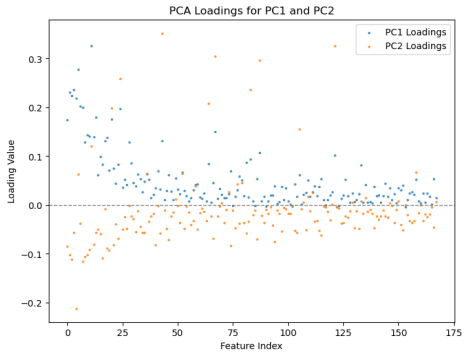
The carrying object is the coefficient vector $v(L)\in\mathbb{R}^{168}$ formed by the normalized Dirichlet coefficients $\bar a_p = a_p/(d p^{w/2})$ for primes $p<1000$, which puts every feature in $[-1,1]$ through the Hasse bound. The paper runs three mechanisms on this point cloud: PCA diagonalizes the covariance matrix to find linear projections that separate classes; LDA finds the linear discriminant that best separates the four vanishing orders; and a 1D CNN with three convolutional layers learns a nonlinear classifier. The normalization is load-bearing: it removes the dependence on degree and weight so that functions of different origins live in the same feature space, and averaging these coefficients by vanishing order produces the murmuration-like curves that motivate the supervised approach.
What would settle it
Permute the vanishing-order labels in the training portion of the dataset and retrain the LDA with the same features and hyperparameters; if validation accuracy on the unpermuted test set does not fall to chance, the reported 95.9% stems from label leakage rather than genuine learnability.
Extended reading notes
Core claim
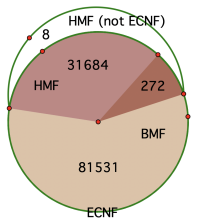
The paper's central claim is that the vanishing order $r$ at the central point of a rational L-function is encoded in the normalized Dirichlet coefficient vector $v(L)=(a_p/(d p^{w/2}))_{p<1000}$, in the following sense: on the sub-dataset PRAT$^\star$ of 176,156 primitive rational L-functions (degree 4, motivic weight 1, mostly elliptic curves over number fields and genus-2 curves over $\mathbb{Q}$), LDA predicts $r\in\{0,1,2,3\}$ with 95.9% held-out accuracy and explained variance 0.982, and a CNN trained on the raw coefficient vector reaches over 95% accuracy on each subfamily (ECNF, BMF, HMF, G2Q). Additionally, PCA projections show visible clustering by $r$, and a CNN trained on only the first two principal components reaches about 91% accuracy. The paper interprets these accuracies as evidence that the order of vanishing is a learnable function of finitely many coefficients, not that the models have identified the underlying arithmetic mechanism.
Load-bearing premise
The paper assumes the vanishing-order labels in the dataset are exact and that every coefficient is correctly normalized; if any label is wrong or mis-scaled, the reported accuracies measure the noise in the labels, not learnability of the true invariant.
Editorial extensions
If this is right
- If the result is correct, the order of vanishing is, for this class of L-functions, a function of the first 168 prime coefficients; no further analytic information is needed for accurate classification.
- The 95.9% LDA accuracy implies the class separation is nearly linear in the normalized coefficient space, suggesting a single linear combination of coefficients carries most of the signal.
- The transfer-learning result (train on one subfamily, test on another above 90%) implies that the coefficient–vanishing-order relationship is shared across ECNF and G2Q, not an artifact of one family.
- Murmuration-like averages provide a quantitative counterpart to Mestre–Nagao sums: larger vanishing orders correspond to systematically smaller average coefficients across conductors.
Reading between the lines
- One step the paper leaves open is whether the same protocol holds on larger conductor ranges or on the excluded degree-2 families; a failure there would mark a boundary of the learnability phenomenon.
- If the linear discriminant is stable across random splits, it could be extracted as an explicit linear form; comparing its weights to the Mestre–Nagao logarithmic weights might reveal the number-theoretic mechanism, a step the paper leaves open.
- Because the dataset is restricted to root analytic conductor below 4, the high accuracy may reflect a restricted range; on wider conductor ranges the signal could degrade, and the paper does not test this.
- A practical extension is to use the classifier as a rapid pre-screen for vanishing order before exact computation, but only after a label-permutation falsifier is passed.
Editorial analysis
A structured set of objections, weighed in public.
Referee Report
Summary. The paper studies the order of vanishing at the central point for rational L-functions from a data-scientific viewpoint. Using the RAT/PRAT datasets extracted from LMFDB, the authors represent each L-function by the vector of 168 normalized Dirichlet coefficients at primes less than 1000. Restricting to the dataset PRAT* (primitive, degree 4, motivic weight 1, vanishing order <= 3), they compute PCA projections, run LDA, and train CNNs to predict the vanishing order. The main reported results are 95.9% held-out LDA accuracy on PRAT*, CNN accuracies above 95% on sub-datasets, and transfer learning between ECNF and G2Q with accuracies above 90%.
Significance. If the reported accuracies genuinely reflect information carried by the Dirichlet coefficients, the paper would provide a substantial data-driven contribution to understanding vanishing orders in a large, heterogeneous family of L-functions. The construction of the RAT/PRAT datasets, with a public DOI, is itself a useful resource, and the transfer-learning observations are interesting. However, the central claim is currently not fully established: the feature vector may encode the conductor N of the L-function, and the paper does not provide the conductor-only baseline needed to separate the coefficient signal from a conductor/type proxy. The post hoc restriction to PRAT* also makes the abstract's 'rational L-functions' claim broader than the evidence. The PCA-based experiment additionally suffers from fitting principal components on the full dataset before splitting.
major comments (3)
- [§3.3, Table 3.1; §3.4, Table 3.3] The claim that the normalized Dirichlet coefficient vector v(L) carries the vanishing order is not yet established, because the features may encode the conductor N. Every L-function in PRAT* has root analytic conductor < 4, and for degree 4 this gives N < 256; for each prime p dividing N, the local Euler factor is represented among the 168 feature coordinates, so the feature vector contains strong local information at exactly the primes where the conductor is supported. The manuscript reports no distribution of r by conductor, no conductor-only classifier (e.g., logistic regression on N or log N, or majority class per N), and no accuracy stratified by conductor intervals. A conductor-only baseline is essential: if such a baseline approaches 95%, the reported LDA/CNN accuracy and the ECNF-to-G2Q transfer would be explained by a shared conductor/type correlation rather than by a subtler coefficient signal, which would materially change the contribution.
- [§2.3, §3.1, abstract] The abstract advertises 'rational L-functions' broadly, but all supervised experiments are performed on PRAT*, a subset selected after inspecting the data: primitive, degree 4, motivic weight 1, vanishing order <= 3, and root analytic conductor < 4. This selection is reasonable, but it means the reported accuracies do not cover ECQ, CMF, DIR, or Artin L-functions; Appendix A explicitly treats those as outside the main dataset. The paper should either temper the abstract and concluding claims to the actual class studied, or provide additional experiments on the remaining part of PRAT<=3. As written, the presentation overstates the scope of the empirical evidence.
- [§3.4, Figure 3.2, Table 3.2] The PCA used for the principal-component CNN is computed on the full pointcloud D before the train/test split (as described at the end of §3.2 and used in §3.4), so the test set contributes to the principal axes. The 91% test accuracies in Table 3.2 may therefore be optimistically biased. The PCA should be fit on the training split only, and its weights then applied to the validation/test split, before these numbers are reported. This issue does not affect the v(L)-based results in Tables 3.1 and 3.3, which use the raw feature vector directly, but it does affect the specific PCA-based claim.
minor comments (5)
- [Equations (2.1) and (3.1)] The notation overloads a_p: in (2.1) the normalized coefficient is called eap, while in (3.1) the same symbol a_p is reused for the further normalized coefficient. Distinct symbols would avoid confusion.
- [Table 3.1] The column 'Explained Variance' is not defined for LDA; the manuscript should state whether it is the ratio of between-class to total scatter eigenvalues or another quantity, since the reported value 0.982 is used to support the accuracy claim.
- [References] References [Poz24a] and [Poz24b] appear to refer to the same arXiv paper; the duplicate should be removed or consolidated.
- [§3.4, Figure 3.5] The transfer-learning curves in Figure 3.5 lack axis labels and a precise statement of which epochs and accuracies are shown; adding these would make the transfer claim easier to verify.
- [§3.3, §3.4] All accuracy numbers are point estimates without confidence intervals, repeated seeds, or standard deviations; given the class imbalance (e.g., vanishing order 3 has only 2,837 examples in PRAT*), error bars would substantially strengthen the quantitative claims.
Circularity Check
No significant circularity: the vanishing-order predictions are evaluated on held-out data and do not reduce to the fitted inputs or to the labels by definition.
full rationale
The central claim is an empirical supervised-learning statement: the feature vector v(L) is built from normalized Dirichlet coefficients (Eq. 3.2), and the target r is the vanishing order supplied by the external LMFDB data described in Section 2.2. LDA and CNN accuracies (Tables 3.1 and 3.3) are reported on 20% held-out validation/test splits after an 80:20 stratified split, so the numbers are not training accuracy and are not equal by construction to a fitted parameter. No equation in the paper defines r in terms of a_p; Eq. (3.1) is merely a rescaling of the input features, and for PRAT* it reduces to the fixed divisor 4*sqrt(p), so there is no self-definitional identity between target and features. The citations to [CL25] and earlier murmuration work are data attribution and background, not load-bearing derivation: [CL25] is an externally deposited Zenodo/LMFDB-derived dataset, and the labels are independently computable invariants. Section 4 explicitly asks to what extent classifier accuracy depends on the conductor range, which flags a possible confounding variable, but a conductor-proxy concern is a robustness and validity issue, not circularity, because the reported predictions do not reduce to the conductor by construction. The absence of code is a reproducibility concern, not a circularity concern. No fitted parameter is renamed as a prediction, and no uniqueness theorem or ansatz is imported from the authors' prior work to force the choice of model. The derivation chain is therefore self-contained with respect to circularity.
Assumptions & free parameters
free parameters (4)
- PCA principal components (weights w_p in Eq. 3.3) =
eigenvectors of covariance matrix fitted on D
- LDA discriminant coefficients =
fitted on the 80% training split
- CNN hyperparameters =
3 conv layers (16/32/64 channels, kernel 3), 2 FC layers (128), dropout 0.5, Adam lr 0.001, batch 3000
- Root analytic conductor cutoff =
4
assumptions (5)
- standard math Selberg-type axiomatisation: each L-function has an Euler product and functional equation
- standard math Hasse and Weil bounds |a_p| <= d p^{w/2}
- domain assumption LMFDB vanishing order r is the true analytic order
- domain assumption Truncation at primes below 1000 preserves the signal
- domain assumption Stratified 80:20 split is representative
Cite this review
Pith. "Pith review of Machine learning the vanishing order of rational L-functions." pith.science (2026). https://pith.science/paper/IPBS6IWR
@misc{pith2026250210360,
  author       = {Pith},
  title        = {Pith review of: Machine learning the vanishing order of rational L-functions},
  year         = {2026},
  howpublished = {\url{https://pith.science/paper/IPBS6IWR}},
  note         = {Machine review of arXiv:2502.10360}
}
abstract
In this paper, we study the vanishing order of rational $L$-functions from a data scientific perspective. Each $L$-function is represented in our data by finitely many Dirichlet coefficients, the normalisation of which depends on the context. We observe murmuration-like patterns in averages across our dataset, find that PCA clusters rational $L$-functions by their vanishing order, and record that LDA and neural networks may accurately predict this quantity.
Figures


Figures from the paper (8 more)





Forward citations
Cited by 1 Pith paper
-
Improving elliptic curve rank classification using multi-value and learned Mestre-Nagao sums
Multi-value Mestre-Nagao sums and learned weighted sums raise elliptic curve rank classification accuracy over a single-sum baseline, with best Matthews correlation coefficient 0.856 versus 0.712.
Reference graph
Works this paper leans on
-
[1]
Machine-learning of the class number of real quadratic fields
Malik Amir, Yang-Hui He, Kyu-Hwan Lee, Thomas Oliver, and Eldar Sultanow. Machine-learning of the class number of real quadratic fields. International Journal of Data Science in the Mathematical Sciences , (1(2)):107--134, 2023
work page 2023
-
[2]
Best, Jonathan Bober, Andrew R
Alex J. Best, Jonathan Bober, Andrew R. Booker, Edgar Costa, John E. Cremona, Maarten Derickx, Min Lee, David Lowry-Duda, David Roe, Andrew V. Sutherland, and John Voight. Computing classical modular forms. In Arithmetic geometry, number theory, and computation , Simons Symp., pages 131--213. Springer, Cham, [2021] 2021
work page 2021
-
[3]
Andrew Ohana, Ashwath Rabindranath, Paul Sharaba, and William Stein
Jonathan Bober, Alyson Deines, Ariah Klages-Mundt, Benjamin LeVeque, R. Andrew Ohana, Ashwath Rabindranath, Paul Sharaba, and William Stein. A database of elliptic curves over Q( 5) : a first report. 1:145--166, 2013
work page 2013
-
[5]
Booker, Jeroen Sijsling, Andrew V
Andrew R. Booker, Jeroen Sijsling, Andrew V. Sutherland, John Voight, and Dan Yasaki. A database of genus-2 curves over the rational numbers. LMS J. Comput. Math. , 19:235--254, 2016
work page 2016
-
[6]
Rational L -functions in LMFDB with root analytic conductor less than 4
Edgar Costa and The LMFDB Collaboration . Rational L -functions in LMFDB with root analytic conductor less than 4. https://doi.org/10.5281/zenodo.14774042, 2025
-
[7]
J. E. Cremona and Filip Najman. Q -curves over odd degree number fields. Res. Number Theory , 7(4):Paper No. 62, 30, 2021
work page 2021
-
[8]
J. E. Cremona. Modular symbols . PhD thesis, University of Oxford, 1981
work page 1981
-
[9]
Jonh E. Cremona. Hyperbolic tessellations, modular symbols, and elliptic curves over complex quadratic fields. Compositio Math. , 51(3):275--324, 1984
work page 1984
Show all 35 references
-
[10]
J. E. Cremona. Algorithms for modular elliptic curves . Cambridge University Press, Cambridge, 1992
1992
-
[11]
A database of H ilbert modular forms
Steve Donnelly and John Voight. A database of H ilbert modular forms. In Arithmetic geometry, number theory, and computation , Simons Symp., pages 365--373. Springer, Cham, [2021] 2021
2021
-
[12]
Machine-learning number fields
Yang-Hui He, Kyu-Hwan Lee, and Thomas Oliver. Machine-learning number fields. Math. Comput. Geom. Data , 2(1):49--66, 2022
2022
-
[13]
Machine-learning the S ato- T ate conjecture
Yang-Hui He, Kyu-Hwan Lee, and Thomas Oliver. Machine-learning the S ato- T ate conjecture. J. Symbolic Comput. , 111:61--72, 2022
2022
-
[14]
Machine learning invariants of arithmetic curves
Yang-Hui He, Kyu-Hwan Lee, and Thomas Oliver. Machine learning invariants of arithmetic curves. J. Symbolic Comput. , 115:478--491, 2023
2023
-
[15]
Murmurations of elliptic curves
Yang-Hui He, Kyu-Hwan Lee, Thomas Oliver, and Alexey Pozdnyakov. Murmurations of elliptic curves. Experimental Mathematics , pages 1--13, 2024
2024
-
[16]
Jones and David P
John W. Jones and David P. Roberts. Artin L -functions of small conductor. Res. Number Theory , 3:Paper No. 16, 33, 2017
2017
-
[17]
Ranks of elliptic curves and deep neural networks
Matija Kazalicki and Domagoj Vlah. Ranks of elliptic curves and deep neural networks. Res. Number Theory , 9(3):Paper No. 53, 21, 2023
2023
-
[18]
UpSet : visualization of intersecting sets
Alexander Lex, Nils Gehlenborg, Hendrik Strobelt, Romain Vuillemot, and Hanspeter Pfister. UpSet : visualization of intersecting sets. IEEE transactions on visualization and computer graphics , 20(12):1983--1992, 2014
1983
-
[19]
The L -functions and modular forms database
The LMFDB Collaboration . The L -functions and modular forms database. https://www.lmfdb.org, 2024. [Online; accessed 27 November 2024]
2024
-
[20]
Murmurations of D irichlet C haracters
Kyu-Hwan Lee, Thomas Oliver, and Alexey Pozdnyakov. Murmurations of D irichlet C haracters. Int. Math. Res. Not. IMRN , (1):rnae277, 2025
2025
-
[21]
Machine learning for number theory: unsupervised learning with L -functions
Thomas Oliver. Machine learning for number theory: unsupervised learning with L -functions. In Mathematical software--- ICMS 2024 , volume 14749 of Lecture Notes in Comput. Sci. , pages 196--203. Springer, Cham, [2024] 2024
2024
-
[23]
Letter to sutherland and zubrilina
Peter Sarnak. Letter to sutherland and zubrilina. https://publications.ias.edu/sarnak/paper/2726, 2023
2023
-
[24]
Old and new conjectures and results about a class of D irichlet series
Atle Selberg. Old and new conjectures and results about a class of D irichlet series. In Proceedings of the A malfi C onference on A nalytic N umber T heory ( M aiori, 1989) , pages 367--385. Univ. Salerno, Salerno, 1992
1989
-
[25]
Letter from sutherland to rubinstein and sarnak
Andrew Sutherland. Letter from sutherland to rubinstein and sarnak. https://math.mit.edu/ drew/RubinsteinSarnakLetter.pdf, August 2022
2022
-
[26]
Modular forms and elliptic curves over imaginary quadratic number fields
Elise Whitley. Modular forms and elliptic curves over imaginary quadratic number fields . PhD thesis, University of Exeter, 1990
1990
-
[27]
Amir, Y.-H
M. Amir, Y.-H. He, K.-H. Lee, T. Oliver, and E. Sultanow, Machine learning class numbers of real quadratic fields , International Journal of data science in the mathematical sciences 1(2) (2023), 107--134
2023
-
[28]
Bujanović, M
Z. Bujanović, M. Kazalicki, L. Novak Murmurations of Mestre--Nagao sums , arXiv:2403.17626
-
[29]
He, K.-H
Y.-H. He, K.-H. Lee, and T. Oliver, Machine-learning the Sato--Tate conjecture , J. Symb. Comput. 111 (2022), 61--72
2022
-
[30]
, Machine-learning Number Fields , Mathematics, Computation and Geometry of Data 2(1) (2022), 49--66
2022
-
[31]
, Machine learning invariants of arithmetic curves , J. Symb. Comput. 115 , (2023), 478--491
2023
-
[32]
He, K.-H
Y.-H. He, K.-H. Lee, T. Oliver, and A. Pozdnyakov, Murmurations of elliptic curves , Experimental Mathematics (2024), 1--13
2024
-
[33]
Oliver, Machine Learning for Number Theory: Unsupervised Learning with L-Functions , International Congress on Mathematical Software (2024), 196--203
T. Oliver, Machine Learning for Number Theory: Unsupervised Learning with L-Functions , International Congress on Mathematical Software (2024), 196--203
2024
-
[34]
Selberg Old and new conjectures and results about a class of Dirichlet series , Proceedings of the Amalfi Conference on Analytic Number Theory (Maiori, 1989), Salerno: Univ
A. Selberg Old and new conjectures and results about a class of Dirichlet series , Proceedings of the Amalfi Conference on Analytic Number Theory (Maiori, 1989), Salerno: Univ. Salerno, pp. 367–385, Reprinted in Collected Papers, vol 2, Springer-Verlag, Berlin (1991)
1991
-
[35]
Kazalicki and D
M. Kazalicki and D. Vlah, ``Ranks of elliptic curves and deep neural networks,'' Res. Number Theory, vol. 9, no. 3, Paper No. 53, 21 pp., 2023. DOI: 10.1007/s40993-023-00462-w https://doi.org/10.1007/s40993-023-00462-w
2023 doi
-
[36]
The LMFDB Collaboration, The L-functions and modular forms database , Available at https://www.lmfdb.org , 2024, [Online; accessed 23 October 2024]
2024
-
[37]
Pozdnyakov Predicting root numbers with neural networks , arXiv:2403.14631
A. Pozdnyakov Predicting root numbers with neural networks , arXiv:2403.14631
Reviewed August 7, 2026 · model on record in the stance chip above.
Discussion (0). Sign in to comment.