Influence Strength Estimation in Hyperbolic Space for Social Influence Maximization
Pith reviewed 2026-05-23 02:31 UTC · model grok-4.3
The pith
Hyperbolic embeddings learn user influence strength directly from propagation data without assuming a diffusion model.
A machine-rendered reading of the paper's core claim, the machinery that carries it, and where it could break.
Core claim
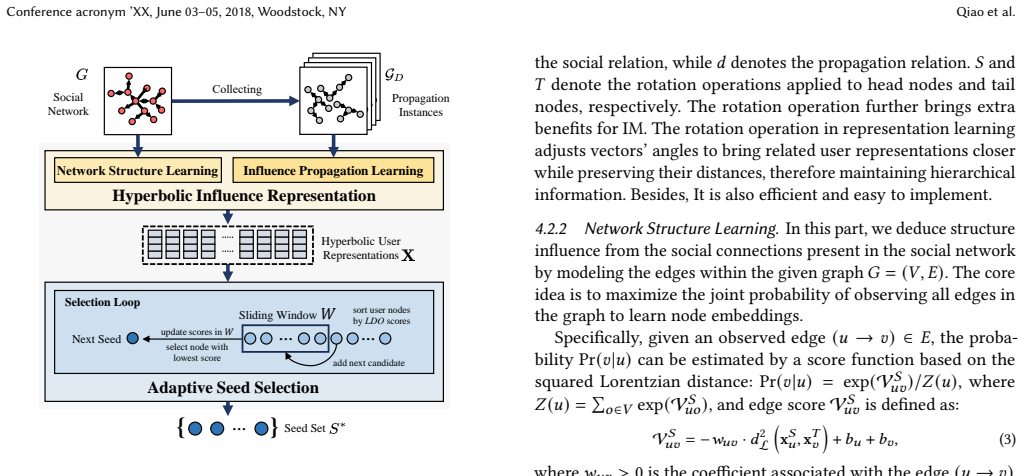
HIM consists of a hyperbolic influence representation module that encodes influence spread patterns from network structure and historical influence activations into expressive hyperbolic user representations, where the influence magnitude of users can be reflected through the geometric properties of hyperbolic space with highly influential users tending to cluster near the space origin, together with a novel adaptive seed selection module developed to flexibly and effectively select seed users using the positional information of learned user representations.
What carries the argument
Hyperbolic influence representation module that maps propagation data into hyperbolic embeddings so that influence magnitude appears as geometric clustering near the origin.
If this is right
- The method works on networks where the diffusion model parameters are unknown.
- Influence magnitude becomes directly readable from embedding position without additional simulation.
- Adaptive selection based on hyperbolic position yields higher spread than fixed-model baselines.
- The approach scales to large real-world networks while remaining diffusion-model agnostic.
Where Pith is reading between the lines
- If the origin-clustering property holds, the same hyperbolic encoder could be reused for related tasks such as link prediction or community detection that also involve hierarchy.
- Testing the method on synthetic networks with explicitly planted hierarchies would isolate whether the geometric signal is the decisive factor.
- Dynamic networks where influence evolves could be handled by updating the hyperbolic embeddings incrementally rather than retraining from scratch.
Load-bearing premise
That the hierarchical features of social influence are faithfully captured by hyperbolic geometry and cannot be captured by Euclidean geometry.
What would settle it
On the same five datasets, replace the hyperbolic module with a Euclidean counterpart and measure whether seed sets achieve equal or higher spread under the unknown diffusion setting.
Figures


read the original abstract
The Influence Maximization (IM) problem aims to find a small set of influential users to maximize their influence spread in a social network. Traditional methods rely on fixed diffusion models with known parameters, limiting their generalization to real-world scenarios. In contrast, graph representation learning-based methods have gained wide attention for overcoming this limitation by learning user representations to capture influence characteristics. However, existing studies are built on Euclidean space, which fails to effectively capture the latent hierarchical features of social influence distribution. As a result, users' influence spread cannot be effectively measured through the learned representations. To alleviate these limitations, we propose HIM, a novel diffusion model agnostic method that leverages hyperbolic representation learning to estimate users' potential influence spread from social propagation data. HIM consists of two key components. First, a hyperbolic influence representation module encodes influence spread patterns from network structure and historical influence activations into expressive hyperbolic user representations. Hence, the influence magnitude of users can be reflected through the geometric properties of hyperbolic space, where highly influential users tend to cluster near the space origin. Second, a novel adaptive seed selection module is developed to flexibly and effectively select seed users using the positional information of learned user representations. Extensive experiments on five network datasets demonstrate the superior effectiveness and efficiency of our method for the IM problem with unknown diffusion model parameters, highlighting its potential for large-scale real-world social networks.
Editorial analysis
A structured set of objections, weighed in public.
Referee Report
Summary. The paper proposes HIM, a diffusion-model-agnostic approach to influence maximization that learns hyperbolic user embeddings from network structure and historical propagation data. It claims that the resulting geometry encodes influence magnitude (high-influence users cluster near the origin), enabling an adaptive seed-selection module that uses only positional information. Experiments on five datasets are reported to demonstrate superior effectiveness and efficiency compared with existing methods.
Significance. If the geometric correlation between hyperbolic norm and influence spread can be shown to emerge reliably from standard representation-learning objectives, the method would supply a concrete way to estimate spread without committing to a particular diffusion model or its parameters, addressing a recognized limitation of both classical IM algorithms and Euclidean embedding baselines.
major comments (2)
- [Abstract / §3] Abstract / Hyperbolic influence representation module: the assertion that 'highly influential users tend to cluster near the space origin' is stated as a direct consequence of the embedding procedure, yet no loss term, hyperbolic-norm regularizer, or derivation is supplied that would enforce or guarantee this property. Without such a mechanism the adaptive seed-selection module reduces to using arbitrary positional features whose relation to actual spread is unestablished.
- [Experiments] Experiments section: the abstract states superior performance on five datasets, but the provided description supplies neither quantitative metrics, baseline comparisons, nor error bars. If these results exist in the full manuscript they must be reported with statistical tests; otherwise the central empirical claim cannot be evaluated.
minor comments (2)
- [§3] Notation for the hyperbolic distance and the origin-centered norm should be defined explicitly before the claim about clustering is made.
- [§3] The manuscript should clarify whether the hyperbolic representation module is trained solely on the observed activation sequences or also incorporates the underlying graph adjacency; the current description leaves this ambiguous.
Simulated Author's Rebuttal
We thank the referee for the constructive feedback on our manuscript. We respond to each major comment below, indicating where revisions will be made.
read point-by-point responses
-
Referee: [Abstract / §3] Abstract / Hyperbolic influence representation module: the assertion that 'highly influential users tend to cluster near the space origin' is stated as a direct consequence of the embedding procedure, yet no loss term, hyperbolic-norm regularizer, or derivation is supplied that would enforce or guarantee this property. Without such a mechanism the adaptive seed-selection module reduces to using arbitrary positional features whose relation to actual spread is unestablished.
Authors: We acknowledge the point. The manuscript presents the clustering as an observed geometric property that arises when hyperbolic embeddings are learned from propagation data, capitalizing on hyperbolic geometry's suitability for hierarchical structures. However, no explicit loss term or derivation is supplied to guarantee the property. In revision we will expand §3 with additional analysis explaining the emergence of this behavior from the training objective and will include supporting empirical checks. revision: partial
-
Referee: [Experiments] Experiments section: the abstract states superior performance on five datasets, but the provided description supplies neither quantitative metrics, baseline comparisons, nor error bars. If these results exist in the full manuscript they must be reported with statistical tests; otherwise the central empirical claim cannot be evaluated.
Authors: The full manuscript reports quantitative results, baseline comparisons, and evaluations across the five datasets in the Experiments section. To strengthen the presentation we will add error bars and the results of statistical significance tests in the revised version. revision: yes
Circularity Check
No circularity detected; derivation self-contained with no reductions to inputs by construction
full rationale
The provided abstract and description contain no equations, fitting procedures, or self-citations. The central claim that hyperbolic geometry reflects influence magnitude via clustering near the origin is presented as an emergent property of the representation module without any shown loss term, norm constraint, or derivation that reduces the estimate to a fitted parameter or prior result by construction. No load-bearing step matches the enumerated circularity patterns, as the method is described at a high level without visible self-referential definitions or imported uniqueness theorems. The derivation chain remains independent of its inputs.
Axiom & Free-Parameter Ledger
axioms (1)
- domain assumption Hyperbolic space captures latent hierarchical features of social influence distribution better than Euclidean space, allowing influence magnitude to be read from geometric position near the origin.
Lean theorems connected to this paper
-
IndisputableMonolith/Foundation/AlexanderDuality.lean; Cost/FunctionalEquation.lean (Jcost, cosh-cost)reality_from_one_distinction; dAlembert_cosh_solution_aczel; alexander_duality_circle_linking echoes?
echoesECHOES: this paper passage has the same mathematical shape or conceptual pattern as the Recognition theorem, but is not a direct formal dependency.
highly influential users tend to cluster near the space origin... proactive influence regularization term: I_GD = sum α_u log σ(d²_L(x_u, o_L))... LDO_u = d²_L(x_u, o_L)... user nodes with smaller LDO values are more likely to be influential
What do these tags mean?
- matches
- The paper's claim is directly supported by a theorem in the formal canon.
- supports
- The theorem supports part of the paper's argument, but the paper may add assumptions or extra steps.
- extends
- The paper goes beyond the formal theorem; the theorem is a base layer rather than the whole result.
- uses
- The paper appears to rely on the theorem as machinery.
- contradicts
- The paper's claim conflicts with a theorem or certificate in the canon.
- unclear
- Pith found a possible connection, but the passage is too broad, indirect, or ambiguous to say the theorem truly supports the claim.
Reference graph
Works this paper leans on
-
[1]
Linda JS Allen. 1994. Some Discrete-Time SI, SIR, and SIS Epidemic Models. Mathematical biosciences (1994)
work page 1994
-
[2]
Albert-László Barabási and Réka Albert. 1999. Emergence of Scaling in Random Networks. Science (1999)
work page 1999
-
[3]
Ceren Budak, Divyakant Agrawal, and Amr El Abbadi. 2011. Limiting the Spread of Misinformation in Social Networks. In WWW
work page 2011
-
[4]
Ines Chami, Albert Gu, Vaggos Chatziafratis, and Christopher Ré. 2020. From Trees to Continuous Embeddings and Back: Hyperbolic Hierarchical Clustering. In NeurIPS
work page 2020
-
[5]
Ines Chami, Adva Wolf, Da-Cheng Juan, Frederic Sala, Sujith Ravi, and Christo- pher Ré. 2020. Low-Dimensional Hyperbolic Knowledge Graph Embeddings. In ACL
work page 2020
-
[6]
Ines Chami, Zhitao Ying, Christopher Ré, and Jure Leskovec. 2019. Hyperbolic Graph Convolutional Neural Networks. In NeurIPS
work page 2019
-
[7]
Tiantian Chen, Siwen Yan, Jianxiong Guo, and Weili Wu. 2023. ToupleGDD: A Fine-Designed Solution of Influence Maximization by Deep Reinforcement Learning. TCSS (2023)
work page 2023
-
[8]
Wei Chen, Chi Wang, and Yajun Wang. 2010. Scalable Influence Maximization for Prevalent Viral Marketing in Large-Scale Social Networks. In KDD
work page 2010
-
[9]
Wei Chen, Yajun Wang, and Siyu Yang. 2009. Efficient Influence Maximization in Social Networks. In KDD
work page 2009
-
[10]
Wei Chen, Yifei Yuan, and Li Zhang. 2010. Scalable Influence Maximization in Social Networks Under the Linear Threshold Model. In ICDM
work page 2010
-
[11]
Xiaolong Chen, Yifan Song, and Jing Tang. 2024. Link Recommendation to Augment Influence Diffusion with Provable Guarantees. In WWW
work page 2024
-
[12]
Tanmoy Chowdhury, Chen Ling, Junji Jiang, Junxiang Wang, My T Thai, and Liang Zhao. 2024. Deep Graph Representation Learning for Influence Maximiza- tion with Accelerated Inference. Neural Networks (2024)
work page 2024
-
[13]
Nan Du, Yingyu Liang, Maria Balcan, and Le Song. 2014. Influence Function Learning in Information Diffusion Networks. In ICML
work page 2014
-
[14]
Shanshan Feng, Lisi Chen, Kaiqi Zhao, Wei Wei, Xuemeng Song, Shuo Shang, Panos Kalnis, and Ling Shao. 2022. ROLE: Rotated Lorentzian Graph Embedding Model for Asymmetric Proximity. TKDE (2022)
work page 2022
-
[15]
Shanshan Feng, Kaiqi Zhao, Lanting Fang, Kaiyu Feng, Wei Wei, Xutao Li, and Ling Shao. 2022. H-Diffu: Hyperbolic Representations for Information Diffusion Prediction. TKDE (2022)
work page 2022
-
[16]
Yuting Feng, Vincent YF Tan, and Bogdan Cautis. 2024. Influence Maximization via Graph Neural Bandits. In KDD. 771–781
work page 2024
-
[17]
Xingcheng Fu, Yuecen Wei, Qingyun Sun, Haonan Yuan, Jia Wu, Hao Peng, and Jianxin Li. 2023. Hyperbolic Geometric Graph Representation Learning for Hierarchy-imbalance Node Classification. In WWW
work page 2023
-
[18]
Octavian Ganea, Gary Bécigneul, and Thomas Hofmann. 2018. Hyperbolic Neural Networks. In NeurIPS
work page 2018
-
[19]
Amit Goyal, Wei Lu, and Laks VS Lakshmanan. 2011. SimPath: An Efficient Algorithm for Influence Maximization Under the Linear Threshold Model. In ICDM
work page 2011
-
[20]
Aditya Grover and Jure Leskovec. 2016. node2vec: Scalable Feature Learning for Networks. In KDD
work page 2016
-
[21]
Caglar Gulcehre, Misha Denil, Mateusz Malinowski, Ali Razavi, Razvan Pascanu, Karl Moritz Hermann, Peter Battaglia, Victor Bapst, David Raposo, Adam Santoro, et al. 2018. Hyperbolic Attention Networks. In ICLR
work page 2018
-
[22]
Qintian Guo, Sibo Wang, Zhewei Wei, and Ming Chen. 2020. Influence Maximiza- tion Revisited: Efficient Reverse Reachable Set Generation with Bound Tightened. In SIGMOD
work page 2020
-
[23]
Asela Hevapathige, Qing Wang, and Ahad N Zehmakan. 2025. DeepSN: A Sheaf Neural Framework for Influence Maximization. In AAAI
work page 2025
-
[24]
Keke Huang, Ruize Gao, Bogdan Cautis, and Xiaokui Xiao. 2024. Scalable Continuous-time Diffusion Framework for Network Inference and Influence Estimation. In WWW
work page 2024
-
[25]
David Kempe, Jon Kleinberg, and Éva Tardos. 2003. Maximizing the Spread of Influence Through a Social Network. In KDD
work page 2003
-
[26]
Sanjay Kumar, Abhishek Mallik, Anavi Khetarpal, and BS Panda. 2022. Influence Maximization in Social Networks Using Graph Embedding and Graph Neural Network. Information Sciences (2022)
work page 2022
-
[27]
Jure Leskovec, Andreas Krause, Carlos Guestrin, Christos Faloutsos, Jeanne VanBriesen, and Natalie Glance. 2007. Cost-effective Outbreak Detection in Networks. In KDD
work page 2007
-
[28]
Hui Li, Mengting Xu, Sourav S Bhowmick, Joty Shafiq Rayhan, Changsheng Sun, and Jiangtao Cui. 2022. PIANO: Influence Maximization Meets Deep Reinforce- ment Learning. TCSS (2022)
work page 2022
-
[29]
Hui Li, Susu Yang, Mengting Xu, Sourav S Bhowmick, and Jiangtao Cui
-
[30]
arXiv preprint arXiv:2309.04668 (2023)
Influence Maximization in Social Networks: A Survey. arXiv preprint arXiv:2309.04668 (2023)
-
[31]
Yuchen Li, Ju Fan, Yanhao Wang, and Kian-Lee Tan. 2018. Influence Maximization on Social Graphs: A Survey. TKDE (2018)
work page 2018
-
[32]
Yandi Li, Haobo Gao, Yunxuan Gao, Jianxiong Guo, and Weili Wu. 2023. A Survey on Influence Maximization: From an ML-based Combinatorial Optimization.ACM Transactions on Knowledge Discovery from Data (2023)
work page 2023
-
[33]
Chen Ling, Junji Jiang, Junxiang Wang, My Thai, Lukas Xue, James Song, Meikang Qiu, and Liang Zhao. 2023. Deep Graph Representation Learning and Optimiza- tion for Influence Maximization. In ICML
work page 2023
-
[34]
Qi Liu, Maximilian Nickel, and Douwe Kiela. 2019. Hyperbolic Graph Neural Networks. In NeurIPS
work page 2019
-
[35]
Tomas Mikolov, Ilya Sutskever, Kai Chen, Greg S Corrado, and Jeff Dean. 2013. Distributed Representations of Words and Phrases and Their Compositionality. (2013). Conference acronym ’XX, June 03–05, 2018, Woodstock, NY Qiao et al
work page 2013
-
[36]
Nicola Neophytou, Afaf Taïk, and Golnoosh Farnadi. 2024. Promoting Fair Vaccination Strategies through Influence Maximization: A Case Study on COVID- 19 Spread. In AAAI
work page 2024
-
[37]
Hung T Nguyen, My T Thai, and Thang N Dinh. 2016. Stop-and-Stare: Optimal Sampling Algorithms for Viral Marketing in Billion-Scale Networks. InSIGMOD
work page 2016
-
[38]
Maximillian Nickel and Douwe Kiela. 2017. Poincaré Embeddings for Learning Hierarchical Representations. In NeurIPS
work page 2017
-
[39]
Maximillian Nickel and Douwe Kiela. 2018. Learning Continuous Hierarchies in the Lorentz Model of Hyperbolic Geometry. In ICML
work page 2018
-
[40]
George Panagopoulos, Fragkiskos D Malliaros, and Michalis Vazirgiannis. 2022. Multi-task Learning for Influence Estimation and Maximization. TKDE (2022)
work page 2022
-
[41]
George Panagopoulos, Nikolaos Tziortziotis, Michalis Vazirgiannis, Jun Pang, and Fragkiskos D Malliaros. 2024. Learning Graph Representations for Influence Maximization. Social Network Analysis and Mining (2024)
work page 2024
-
[42]
Wei Peng, Tuomas Varanka, Abdelrahman Mostafa, Henglin Shi, and Guoying Zhao. 2021. Hyperbolic Deep Neural Networks: A Survey. TPAMI 44, 12 (2021), 10023–10044
work page 2021
-
[43]
Hongliang Qiao, Shanshan Feng, Xutao Li, Huiwei Lin, Han Hu, Wei Wei, and Yunming Ye. 2023. RotDiff: A Hyperbolic Rotation Representation Model for Information Diffusion Prediction. In CIKM
work page 2023
-
[44]
Zitai Qiu, Congbo Ma, Jia Wu, and Jian Yang. 2024. An Efficient Automatic Meta-Path Selection for Social Event Detection via Hyperbolic Space. In WWW
work page 2024
-
[45]
Leonardo FR Ribeiro, Pedro HP Saverese, and Daniel R Figueiredo. 2017. struc2vec: Learning Node Representations from Structural Identity. In KDD
work page 2017
-
[46]
Ryan A. Rossi and Nesreen K. Ahmed. 2015. The Network Data Repository with Interactive Graph Analytics and Visualization. In AAAI
work page 2015
- [47]
-
[48]
Xiaobin Rui, Zhixiao Wang, Jiayu Zhao, Lichao Sun, and Wei Chen. 2024. Scalable Fair Influence Maximization. In NeurIPS
work page 2024
-
[49]
Frederic Sala, Chris De Sa, Albert Gu, and Christopher Ré. 2018. Representation Tradeoffs for Hyperbolic Embeddings. In ICML
work page 2018
-
[50]
Rik Sarkar. 2011. Low Distortion Delaunay Embedding of Trees in Hyperbolic Plane. In International Symposium on Graph Drawing
work page 2011
-
[51]
Karishma Sharma, Xinran He, Sungyong Seo, and Yan Liu. 2021. Network Infer- ence from a Mixture of Diffusion Models for Fake News Mitigation. In ICWSM
work page 2021
-
[52]
Mingyang Song, Yi Feng, and Liping Jing. 2023. HISum: Hyperbolic Interaction Model for Extractive Multi-Document Summarization. In WWW
work page 2023
-
[53]
Jianing Sun, Zhaoyue Cheng, Saba Zuberi, Felipe Pérez, and Maksims Volkovs
-
[54]
HGCF: Hyperbolic Graph Convolution Networks for Collaborative Filtering. In WWW
-
[55]
Zhiqing Sun, Zhi-Hong Deng, Jian-Yun Nie, and Jian Tang. 2019. RotatE: Knowl- edge Graph Embedding by Relational Rotation in Complex Space. In ICLR
work page 2019
-
[56]
Jianxin Tang, Shihui Song, Qian Du, Yabing Yao, and Jitao Qu. 2024. Graph Con- volutional Networks with the Self-Attention Mechanism for Adaptive Influence Maximization in Social Networks. Complex & Intelligent Systems (2024)
work page 2024
-
[57]
Shaojie Tang. 2018. When Social Advertising Meets Viral Marketing: Sequencing Social Advertisements for Influence Maximization. In AAAI
work page 2018
-
[58]
Youze Tang, Yanchen Shi, and Xiaokui Xiao. 2015. Influence Maximization in Near-linear Time: A Martingale Approach. In SIGMOD
work page 2015
-
[59]
Kevin Verbeek and Subhash Suri. 2014. Metric Embedding, Hyperbolic Space, and Social Networks. In SOCG
work page 2014
-
[60]
Jihu Wang, Yuliang Shi, Han Yu, Xinjun Wang, Zhongmin Yan, and Fanyu Kong
- [61]
-
[62]
Shicheng Wang, Shu Guo, Lihong Wang, Tingwen Liu, and Hongbo Xu. 2023. HDNR: A Hyperbolic-Based Debiased Approach for Personalized News Recom- mendation. In SIGIR
work page 2023
-
[63]
Xiao Wang, Yiding Zhang, and Chuan Shi. 2019. Hyperbolic Heterogeneous Information Network Embedding. In AAAI
work page 2019
-
[64]
Xiaoyang Wang, Ying Zhang, Wenjie Zhang, Xuemin Lin, and Chen Chen. 2016. Bring Order into the Samples: A Novel Scalable Method for Influence Maximiza- tion. TKDE (2016)
work page 2016
-
[65]
Yu Wang, Gao Cong, Guojie Song, and Kunqing Xie. 2010. Community-based Greedy Algorithm for Mining Top-k Influential Nodes in Mobile Social Networks. In KDD
work page 2010
-
[66]
Jingyun Xu and Yi Cai. 2023. Decoupled Hyperbolic Graph Attention Network for Cross-domain Named Entity Recognition. In SIGIR
work page 2023
-
[67]
Jaewon Yang and Jure Leskovec. 2012. Defining and Evaluating Network Com- munities Based on Ground-Truth. In Proceedings of the ACM SIGKDD Workshop on Mining Data Semantics
work page 2012
-
[68]
Menglin Yang, Zhihao Li, Min Zhou, Jiahong Liu, and Irwin King. 2022. HICF: Hyperbolic Informative Collaborative Filtering. In KDD
work page 2022
-
[69]
Menglin Yang, Min Zhou, Rex Ying, Yankai Chen, and Irwin King. 2023. Hyper- bolic Representation Learning: Revisiting and Advancing. In ICML
work page 2023
-
[70]
Ahmad Zareie and Rizos Sakellariou. 2023. Influence Maximization in Social Networks: A Survey of Behaviour-aware Methods. Social Network Analysis and Mining (2023)
work page 2023
-
[71]
Cai Zhang, Weimin Li, Dingmei Wei, Yanxia Liu, and Zheng Li. 2022. Network Dynamic GCN Influence Maximization Algorithm with Leader Fake Labeling Mechanism. TCSS (2022). A TIME COMPLEXITY ANALYSIS OF HIM The time complexity of HIM primarily consists of the training time of the hyperbolic influence representation module and the selection time of the adapti...
work page 2022
discussion (0)
Sign in with ORCID, Apple, or X to comment. Anyone can read and Pith papers without signing in.