Reaction-diffusion dynamics of the weakly dissipative Fermi gas
Pith reviewed 2026-05-23 02:42 UTC · model grok-4.3
The pith
Weakly dissipative continuum Fermi gas exhibits algebraic density decay and mean-field directed percolation transition like lattice systems.
A machine-rendered reading of the paper's core claim, the machinery that carries it, and where it could break.
Core claim
For the one-dimensional Fermi gas with dissipative reactions in the weakly dissipative regime, the density shows asymptotic algebraic decay for 2A→∅, 3A→∅, and A+A→A processes, similar to lattice problems, with exponents unaffected by initial temperature. A second-order absorbing-state phase transition in the mean-field directed percolation universality class emerges from competition between branching A→A+A and decay processes.
What carries the argument
The time-dependent generalized Gibbs ensemble method applied to the quantum master equation for the continuum Fermi gas, capturing the reaction-limited regime of weak dissipation.
If this is right
- The density decay accelerates with higher initial temperature but retains the same algebraic exponents.
- Emergent critical behavior from lattice systems is present in continuum space.
- The phase transition belongs to the mean-field directed percolation class.
- Such features may be probed using ultra-cold atomic physics.
Where Pith is reading between the lines
- This could imply that continuum models are sufficient for studying reaction-diffusion criticality without needing lattice discreteness.
- Experiments with ultra-cold fermions might directly test these predictions by tuning dissipation strength.
- The universality suggests similar behavior in higher dimensions or other particle statistics.
Load-bearing premise
The time-dependent generalized Gibbs ensemble method accurately derives the dynamics of the continuum Fermi gas in the weakly dissipative regime.
What would settle it
An experiment measuring the long-time density decay exponent in a one-dimensional ultra-cold Fermi gas under controlled two-body annihilation and finding it differs from the lattice-predicted algebraic form.
Figures




read the original abstract
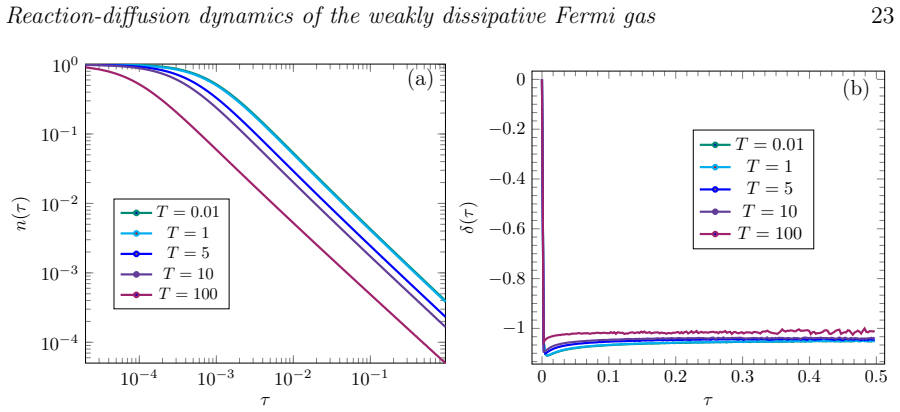
We study the one-dimensional Fermi gas subject to dissipative reactions. The dynamics is governed by the quantum master equation, where the Hamiltonian describes coherent motion of the particles, while dissipation accounts for irreversible reactions. For lattice one-dimensional fermionic systems, emergent critical behavior has been found in the dynamics in the reaction-limited regime of weak dissipation. Here, we address the question whether such features are present also in a gas in continuum space. We do this in the weakly dissipative regime by applying the time-dependent generalized Gibbs ensemble method. We show that for two body $2A\to \emptyset$ and three $3A\to \emptyset$ body annihilation, as well as for coagulation $A+A\to A$, the density features an asymptotic algebraic decay in time akin to the lattice problem. In all the cases, we find that upon increasing the temperature of the initial state the density decay accelerates, but the asymptotic algebraic decay exponents are not affected. We eventually consider the competition between branching $A\to A+A$ and the decay processes $A\to \emptyset$ and $2A\to \emptyset$. We find a second-order absorbing-state phase transition in the mean-field directed percolation universality class. This analysis shows that emergent behavior observed in lattice quantum reaction-diffusion systems is present also in continuum space, where it may be probed using ultra-cold atomic physics.
Editorial analysis
A structured set of objections, weighed in public.
Referee Report
Summary. The manuscript applies the time-dependent generalized Gibbs ensemble (tGGE) method to the one-dimensional continuum Fermi gas in the weak-dissipation regime governed by a quantum master equation. For the reactions 2A→∅, 3A→∅ and A+A→A it reports algebraic long-time density decay with the same exponents as the corresponding lattice problems; initial temperature only rescales the prefactor. For the branching-decay competition A→A+A versus A→∅ and 2A→∅ it identifies a second-order absorbing-state transition belonging to the mean-field directed-percolation universality class.
Significance. If the tGGE mapping is justified, the work establishes that the emergent algebraic decays and mean-field DP transition previously seen on lattices survive in continuum space, thereby strengthening the case for experimental probes with ultra-cold atoms. The temperature independence of the exponents is a clear, falsifiable prediction.
major comments (2)
- [Method and tGGE application] The central claim rests on the validity of the tGGE reduction for the continuum dispersion; the manuscript does not supply an explicit derivation showing that the continuous kinetic term does not generate additional relevant operators beyond those retained in the lattice tGGE (see the paragraph following Eq. (3) and the rate-equation section).
- [Branching-decay competition] The assertion that the branching-decay transition lies in the mean-field DP class is stated without a supporting calculation of the critical exponents or the scaling function; a direct comparison to the mean-field rate equations or a finite-size scaling analysis is required to substantiate the universality-class assignment.
minor comments (2)
- [Abstract] The abstract states that the algebraic exponents are 'akin to the lattice problem' but does not quote the numerical values obtained for the continuum case, making immediate comparison difficult.
- [Model definition] Notation for the reaction rates (e.g., the symbols used for the two-body and three-body annihilation strengths) is introduced without a consolidated table; a short table would improve readability.
Simulated Author's Rebuttal
We thank the referee for the constructive report and positive assessment of the work. We address each major comment below and will revise the manuscript to incorporate the requested clarifications.
read point-by-point responses
-
Referee: [Method and tGGE application] The central claim rests on the validity of the tGGE reduction for the continuum dispersion; the manuscript does not supply an explicit derivation showing that the continuous kinetic term does not generate additional relevant operators beyond those retained in the lattice tGGE (see the paragraph following Eq. (3) and the rate-equation section).
Authors: We acknowledge the need for a more explicit justification. In the revised manuscript we will expand the discussion immediately after Eq. (3) to derive that the quadratic continuum dispersion, when integrated against the local reaction kernels in the weak-dissipation limit, produces no additional relevant operators beyond those already retained in the lattice tGGE. The resulting effective rate equations therefore retain the same structure, with the continuous kinetic term only renormalizing the diffusion constant without altering the scaling of the reaction terms. revision: yes
-
Referee: [Branching-decay competition] The assertion that the branching-decay transition lies in the mean-field DP class is stated without a supporting calculation of the critical exponents or the scaling function; a direct comparison to the mean-field rate equations or a finite-size scaling analysis is required to substantiate the universality-class assignment.
Authors: We agree that an explicit comparison is required. In the revision we will add a direct comparison of the tGGE steady-state and relaxation data to the mean-field rate equations for the branching-decay process. This will demonstrate that the order-parameter exponent, the density decay exponent at criticality, and the scaling function near the transition coincide with the known mean-field directed-percolation values, thereby substantiating the universality-class assignment without invoking finite-size scaling. revision: yes
Circularity Check
No significant circularity detected
full rationale
The derivation applies the established time-dependent generalized Gibbs ensemble (tGGE) method to the weakly dissipative continuum Fermi gas, yielding algebraic decay for 2A→∅, 3A→∅, A+A→A and a mean-field DP transition for branching-decay competition. These outcomes follow from the method's application to the new continuum setting rather than from self-definition, fitted inputs renamed as predictions, or load-bearing self-citations. The abstract and description indicate the approach is restricted to the weak-dissipation regime where tGGE is designed to operate, with temperature only rescaling prefactors; no equation reduces to its input by construction and the central claims retain independent content from the lattice comparisons.
Axiom & Free-Parameter Ledger
axioms (1)
- domain assumption The time-dependent generalized Gibbs ensemble method applies to the weakly dissipative regime of the continuum one-dimensional Fermi gas.
Forward citations
Cited by 1 Pith paper
-
Is Lindblad for me?
A review that contrasts common assumptions about the Lindblad equation with refined expectations drawn from examples, culminating in a checklist for assessing its breakdown.
Reference graph
Works this paper leans on
-
[1]
Kogut J B 1979 Rev. Mod. Phys. 51(4) 659–713 URL https://link.aps.org/doi/10.1103/ RevModPhys.51.659
work page 1979
- [2]
-
[3]
Cardy J 1996 Scaling and renormalization in statistical physics vol 5 (Cam- bridge university press) URL https://www.cambridge.org/core/books/ scaling-and-renormalization-in-statistical-physics
work page 1996
-
[4]
Huang K 2008 Statistical mechanics (John Wiley & Sons)
work page 2008
-
[5]
Privman V 1997 Nonequilibrium statistical mechanics in one dimen- sion (Cambridge University Press) URL https://www.cambridge.org/ core/books/nonequilibrium-statistical-mechanics-in-one-dimension/ 3E21FA0936348F96D4F92849C86076BB
work page 1997
-
[6]
Hinrichsen H 2000 Adv. Phys. 49 815–958 URL https://www.tandfonline.com/doi/abs/10. 1080/00018730050198152
work page 2000
-
[7]
Henkel M, Hinrichsen H, L¨ ubeck S and Pleimling M 2008 Non-equilibrium phase transitions vol 1 (Springer) URL https://link.springer.com/book/10.1007/978-1-4020-8765-3? noAccess=true
-
[8]
Tauber U C 2002 arXiv:cond-mat/0205327 URL https://arxiv.org/abs/cond-mat/0205327 Reaction-diffusion dynamics of the weakly dissipative Fermi gas 34
work page internal anchor Pith review Pith/arXiv arXiv 2002
-
[9]
T¨ auber U C, Howard M and Vollmayr-Lee B P 2005 J. Phys. A: Math. Gen. 38 R79 URL https://iopscience.iop.org/article/10.1088/0305-4470/38/17/R01/meta
- [10]
-
[11]
Toussaint D and Wilczek F 1983 J. Chem. Phys. 78 2642–2647
work page 1983
-
[12]
R´ acz Z 1985 Phys. Rev. Lett. 55(17) 1707–1710 URL https://link.aps.org/doi/10.1103/ PhysRevLett.55.1707
work page 1985
-
[13]
Spouge J L 1988 Phys. Rev. Lett. 60(10) 871–874 URL https://link.aps.org/doi/10.1103/ PhysRevLett.60.871
work page 1988
-
[14]
Torney D C and McConnell H M 1983 J. Phys. Chem. 87 1941–1951
work page 1983
-
[15]
Privman V 1994 Phys. Rev. E 50(1) 50–53 URL https://link.aps.org/doi/10.1103/ PhysRevE.50.50
work page 1994
-
[17]
Lee B P 1994 J. Phys. A: Math. Gen. 27 2633 URL https://dx.doi.org/10.1088/0305-4470/ 27/8/004
-
[18]
Cardy J 1996 arXiv:cond-mat/9607163 URL https://arxiv.org/abs/cond-mat/9607163
work page internal anchor Pith review Pith/arXiv arXiv 1996
-
[19]
Kang K and Redner S 1984 Phys. Rev. Lett. 52(12) 955–958 URL https://link.aps.org/doi/ 10.1103/PhysRevLett.52.955
-
[20]
Kang K and Redner S 1985 Phys. Rev. A 32(1) 435–447 URL https://link.aps.org/doi/10. 1103/PhysRevA.32.435
work page 1985
-
[21]
Kang K and Redner S 1984 Phys. Rev. A 30(5) 2833–2836 URL https://link.aps.org/doi/ 10.1103/PhysRevA.30.2833
-
[22]
Henkel M and Hinrichsen H 2004 J. Phys. A: Math. Gen. 37 R117 URL https://dx.doi.org/ 10.1088/0305-4470/37/28/R01
-
[23]
Syassen N, Bauer D M, Lettner M, Volz T, Dietze D, Garc´ ıa-Ripoll J J, Cirac J I, Rempe G and D¨ urr S 2008Science 320 1329–1331 URL https://www.science.org/doi/abs/10.1126/ science.1155309
-
[24]
S¨ oding J, Gu´ ery-Odelin D, Desbiolles P, Chevy F, Inamori H and Dalibard J 1999Appl. Phys. B 69 257–261 URL https://link.springer.com/article/10.1007/s003400050805
-
[25]
Tolra B L, O’Hara K M, Huckans J H, Phillips W D, Rolston S L and Porto J V 2004 Phys. Rev. Lett. 92(19) 190401 URL https://link.aps.org/doi/10.1103/PhysRevLett.92.190401
-
[26]
Kinoshita T, Wenger T and Weiss D S 2005 Phys. Rev. Lett. 95(19) 190406 URL https: //link.aps.org/doi/10.1103/PhysRevLett.95.190406
-
[27]
Yamaguchi A, Uetake S, Hashimoto D, Doyle J M and Takahashi Y 2008 Phys. Rev. Lett. 101(23) 233002 URL https://link.aps.org/doi/10.1103/PhysRevLett.101.233002
-
[28]
Traverso A, Chakraborty R, Martinez de Escobar Y N, Mickelson P G, Nagel S B, Yan M and Killian T C 2009 Phys. Rev. A 79(6) 060702 URL https://link.aps.org/doi/10.1103/ PhysRevA.79.060702
work page 2009
-
[29]
Burrows K A, Perrin H and Garraway B M 2017 Phys. Rev. A 96(2) 023429 URL https: //link.aps.org/doi/10.1103/PhysRevA.96.023429
-
[30]
8(4) 60 URL https://scipost.org/10.21468/ SciPostPhys.8.4.060
Bouchoule I and Schemmer M 2020 SciPost Phys. 8(4) 60 URL https://scipost.org/10.21468/ SciPostPhys.8.4.060
work page 2020
-
[31]
Honda K, Taie S, Takasu Y, Nishizawa N, Nakagawa M and Takahashi Y 2023 Phys. Rev. Lett. 130(6) 063001 URL https://link.aps.org/doi/10.1103/PhysRevLett.130.063001
-
[32]
Yan B, Moses S A, Gadway B, Covey J P, Hazzard K R, Rey A M, Jin D S and Ye J 2013 Nature 501 521–525 URL https://www.nature.com/articles/nature12483
work page 2013
-
[33]
Zhu B, Gadway B, Foss-Feig M, Schachenmayer J, Wall M L, Hazzard K R A, Yan B, Moses S A, Covey J P, Jin D S, Ye J, Holland M and Rey A M 2014 Phys. Rev. Lett. 112(7) 070404 URL https://link.aps.org/doi/10.1103/PhysRevLett.112.070404 Reaction-diffusion dynamics of the weakly dissipative Fermi gas 35
-
[34]
Sponselee K, Freystatzky L, Abeln B, Diem M, Hundt B, Kochanke A, Ponath T, Santra B, Mathey L, Sengstock K et al. 2018 Quantum Sci. Technol. 4 014002 URL https://iopscience.iop. org/article/10.1088/2058-9565/aadccd
-
[35]
Diehl S, Micheli A, Kantian A, Kraus B, B¨ uchler H and Zoller P 2008 Nat. Phys. 4 878–883
work page 2008
-
[36]
Diehl S, Rico E, Baranov M A and Zoller P 2011 Nat. Phys. 7 971–977
work page 2011
-
[37]
Tomadin A, Diehl S and Zoller P 2011 Phys. Rev. A 83(1) 013611 URL https://link.aps.org/ doi/10.1103/PhysRevA.83.013611
-
[38]
Carollo F, Gnann M, Perfetto G and Lesanovsky I 2022 Phys. Rev. B 106(9) 094315 URL https://link.aps.org/doi/10.1103/PhysRevB.106.094315
-
[39]
Lesanovsky I and Garrahan J P 2013 Phys. Rev. Lett. 111(21) 215305 URL https://link.aps. org/doi/10.1103/PhysRevLett.111.215305
-
[40]
Olmos B, Lesanovsky I and Garrahan J P 2014 Phys. Rev. E 90(4) 042147 URL https: //link.aps.org/doi/10.1103/PhysRevE.90.042147
-
[41]
Marcuzzi M, Buchhold M, Diehl S and Lesanovsky I 2016 Phys. Rev. Lett. 116(24) 245701 URL https://link.aps.org/doi/10.1103/PhysRevLett.116.245701
-
[42]
Gillman E, Carollo F and Lesanovsky I 2020 Phys. Rev. Lett. 125(10) 100403 URL https: //link.aps.org/doi/10.1103/PhysRevLett.125.100403
-
[43]
Gorini V, Kossakowski A and Sudarshan E C G 1976 J. Math. Phys. 17 821–825
work page 1976
-
[44]
Lindblad G 1976 Commun. Math. Phys. 48 119–130 URL https://link.springer.com/article/ 10.1007/BF01608499#citeas
-
[45]
van Horssen M and Garrahan J P 2015 Phys. Rev. E 91(3) 032132 URL https://link.aps.org/ doi/10.1103/PhysRevE.91.032132
-
[46]
Carollo F, Gillman E, Weimer H and Lesanovsky I 2019 Phys. Rev. Lett. 123 100604
work page 2019
-
[47]
Gillman E, Carollo F and Lesanovsky I 2019 New J. Phys. 21 093064
work page 2019
-
[48]
Jo M, Lee J, Choi K and Kahng B 2021 Phys. Rev. Res. 3(1) 013238 URL https://link.aps. org/doi/10.1103/PhysRevResearch.3.013238
-
[49]
Carollo F and Lesanovsky I 2022 Phys. Rev. Lett. 128 040603 URL https://journals.aps.org/ prl/abstract/10.1103/PhysRevLett.128.040603
-
[50]
Lange F, Lenarˇ ciˇ c Z and Rosch A 2018Phys. Rev. B 97(16) 165138 URL https://link.aps. org/doi/10.1103/PhysRevB.97.165138
-
[51]
Mallayya K, Rigol M and De Roeck W 2019 Phys. Rev. X 9(2) 021027 URL https://link.aps. org/doi/10.1103/PhysRevX.9.021027
-
[52]
Lange F, Lenarˇ ciˇ c Z and Rosch A 2017Nat. Commun. 8 1–8 URL https://www.nature.com/ articles/ncomms15767
-
[53]
Lenarˇ ciˇ c Z, Lange F and Rosch A 2018Phys. Rev. B 97(2) 024302 URL https://link.aps.org/ doi/10.1103/PhysRevB.97.024302
-
[54]
Ulˇ cakar I and Lenarˇ ciˇ c Z 2024Phys. Rev. Lett. 132(23) 230402 URL https://link.aps.org/ doi/10.1103/PhysRevLett.132.230402
- [55]
-
[56]
Vidmar L and Rigol M 2016 J. Stat. Mech.: Theory Exp. 2016 064007 URL https://iopscience. iop.org/article/10.1088/1742-5468/2016/06/064007
-
[57]
Essler F H and Fagotti M 2016 J. Stat. Mech.: Theory Exp. 2016 064002 URL https: //iopscience.iop.org/article/10.1088/1742-5468/2016/06/064002
-
[58]
Riggio F, Rosso L, Karevski D and Dubail J 2024 Phys. Rev. A 109(2) 023311 URL https: //link.aps.org/doi/10.1103/PhysRevA.109.023311
- [59]
- [60]
-
[61]
9(4) 44 URL https://scipost.org/10
Bouchoule I, Doyon B and Dubail J 2020 SciPost Phys. 9(4) 44 URL https://scipost.org/10. 21468/SciPostPhys.9.4.044
work page 2020
-
[62]
Rowlands S, Lesanovsky I and Perfetto G 2024 New J. Phys. 26 043010 URL https:// Reaction-diffusion dynamics of the weakly dissipative Fermi gas 36 iopscience.iop.org/article/10.1088/1367-2630/ad397a/meta
-
[63]
Rossini D, Ghermaoui A, Aguilera M B, Vatr´ e R, Bouganne R, Beugnon J, Gerbier F and Mazza L 2021 Phys. Rev. A 103(6) L060201 URL https://link.aps.org/doi/10.1103/PhysRevA. 103.L060201
-
[64]
Rosso L, Biella A, De Nardis J and Mazza L 2023 Phys. Rev. A 107(1) 013303 URL https: //link.aps.org/doi/10.1103/PhysRevA.107.013303
-
[65]
Perfetto G, Carollo F, Garrahan J P and Lesanovsky I 2023 Phys. Rev. Lett. 130(21) 210402 URL https://link.aps.org/doi/10.1103/PhysRevLett.130.210402
-
[66]
Perfetto G, Carollo F, Garrahan J P and Lesanovsky I 2023 Phys. Rev. E 108(6) 064104 URL https://link.aps.org/doi/10.1103/PhysRevE.108.064104
-
[67]
Huang C H, Giamarchi T and Cazalilla M A 2023 Phys. Rev. Res. 5(4) 043192 URL https: //link.aps.org/doi/10.1103/PhysRevResearch.5.043192
-
[68]
12(1) 44 URL https://scipost.org/10
Rosso L, Biella A and Mazza L 2022 SciPost Phys. 12(1) 44 URL https://scipost.org/10. 21468/SciPostPhys.12.1.044
work page 2022
-
[69]
Gerbino F, Lesanovsky I and Perfetto G 2024 Phys. Rev. B 109(22) L220304 URL https: //link.aps.org/doi/10.1103/PhysRevB.109.L220304
- [70]
-
[71]
Maki J, Rosso L, Mazza L and Biella A 2024 Phys. Rev. A 110(4) 043315 URL https: //link.aps.org/doi/10.1103/PhysRevA.110.043315
-
[72]
Garc´ ıa-Ripoll J J, D¨ urr S, Syassen N, Bauer D M, Lettner M, Rempe G and Cirac J I 2009 New J. Phys. 11 013053 URL https://iopscience.iop.org/article/10.1088/1367-2630/11/1/ 013053
-
[73]
Doyon B 2020 SciPost Phys. Lect. Notes 18 URL https://scipost.org/10.21468/ SciPostPhysLectNotes.18
work page 2020
-
[74]
NIST Digital Library of Mathematical Functions https://dlmf.nist.gov/, Release 1.1.12 of 2023-12-15 f. W. J. Olver, A. B. Olde Daalhuis, D. W. Lozier, B. I. Schneider, R. F. Boisvert, C. W. Clark, B. R. Miller, B. V. Saunders, H. S. Cohl, and M. A. McClain, eds. URL https://dlmf.nist.gov/
work page 2023
-
[75]
March´ e A, Yoshida H, Nardin A, Katsura H and Mazza L 2024Phys. Rev. A 110(3) 033321 URL https://link.aps.org/doi/10.1103/PhysRevA.110.033321
-
[76]
Henkel M, Orlandini E and Schutz G 1995 J. Phys. A: Math. Gen. 28 6335 URL https: //iopscience.iop.org/article/10.1088/0305-4470/28/22/010/meta
-
[77]
Henkel M, Orlandini E and Santos J 1997 Ann. Phys. 259 163–231 URL https://www. sciencedirect.com/science/article/pii/S0003491697957122
work page 1997
-
[78]
Krebs K, Pfannm¨ uller M P, Wehefritz B and Hinrichsen H 1995J. Stat. Phys. 78 1429–1470 URL https://link.springer.com/article/10.1007/BF02180138
-
[79]
F¨ urst M L, Lukkarinen J, Mei P and Spohn H 2013 J. Phys. A: Math. 46 485002 URL https://dx.doi.org/10.1088/1751-8113/46/48/485002
-
[80]
F¨ urst M L R, Mendl C B and Spohn H 2013 Phys. Rev. E 88(1) 012108 URL https://link. aps.org/doi/10.1103/PhysRevE.88.012108
-
[81]
Zechmann P, Bastianello A and Knap M 2022 Phys. Rev. B 106(7) 075115 URL https: //link.aps.org/doi/10.1103/PhysRevB.106.075115
discussion (0)
Sign in with ORCID, Apple, or X to comment. Anyone can read and Pith papers without signing in.