Global-Decision-Focused Neural ODEs for Proactive Grid Resilience Management
Pith reviewed 2026-05-23 02:05 UTC · model grok-4.3
The pith
A global-decision-focused neural ODE embeds the full optimization objective into outage modeling to produce spatially and temporally coherent resilience decisions.
A machine-rendered reading of the paper's core claim, the machinery that carries it, and where it could break.
Core claim
The central claim is that the global-decision-focused neural ODE captures outage dynamics while simultaneously optimizing resilience strategies in a decision-aware manner, thereby ensuring spatially and temporally coherent decision-making that improves both predictive accuracy and operational efficiency compared with conventional predict-then-optimize pipelines.
What carries the argument
The global-decision-focused (GDF) neural ODE, which incorporates the global optimization objective directly into the model's training dynamics to enforce coherence between predictions and interventions.
If this is right
- Outage predictions become consistent with the downstream global optimization of interventions.
- Resource allocation decisions gain spatial and temporal coherence across the grid.
- Both predictive accuracy and operational efficiency improve on synthetic and real datasets.
- The framework enables proactive rather than reactive resilience management under extreme hazards.
Where Pith is reading between the lines
- The same decision-focused dynamics could be tested on other networked systems such as transportation or water distribution that face similar prediction-optimization gaps.
- Real-time sensor streams could be added to the ODE to update interventions while an event unfolds.
- The approach might reduce the frequency of manual reconciliation steps currently used in grid control rooms.
Load-bearing premise
Embedding the global optimization objective directly inside the neural ODE training produces coherent decisions without introducing instability or requiring post-hoc adjustments that break the alignment.
What would settle it
Demonstrating that the GDF model outputs still require separate post-processing to achieve spatial-temporal coherence, or that its resilience performance is no better than standard two-stage methods on held-out real-world outage records, would falsify the central claim.
Figures


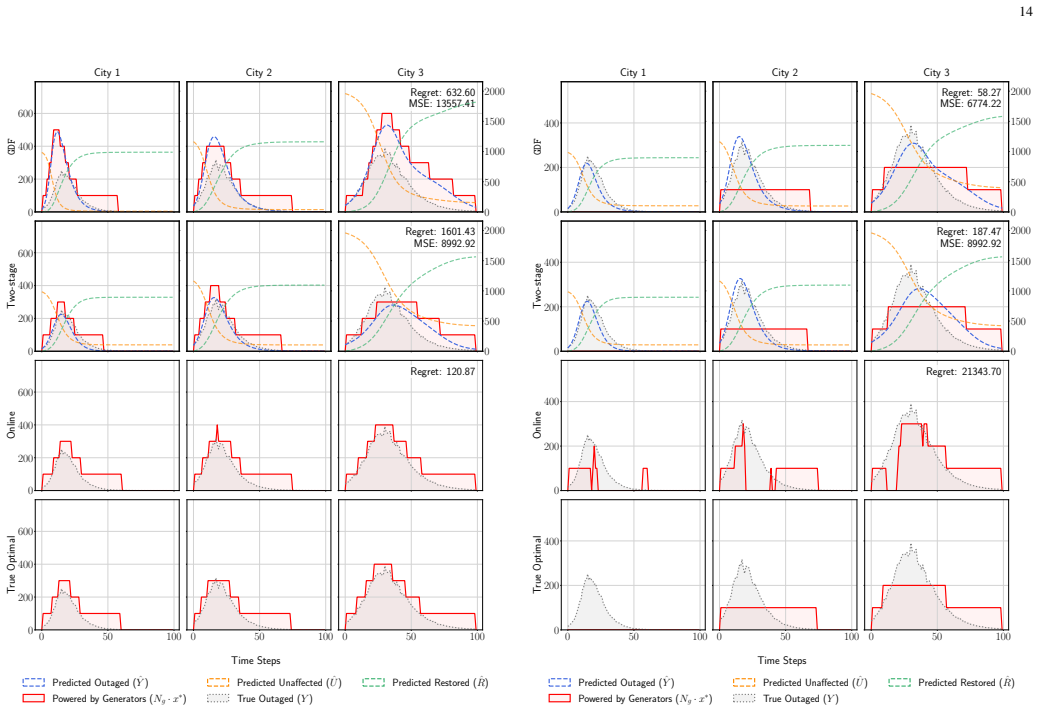


read the original abstract
Extreme hazard events such as wildfires and hurricanes increasingly threaten power systems, causing widespread outages and disrupting critical services. Recently, predict-then-optimize approaches have gained traction in grid operations, where system functionality forecasts are first generated and then used as inputs for downstream decision-making. However, this two-stage method often results in a misalignment between prediction and optimization objectives, leading to suboptimal resource allocation. To address this, we propose predict-all-then-optimize-globally (PATOG), a framework that integrates outage prediction with globally optimized interventions. At its core, our global-decision-focused (GDF) neural ODE model captures outage dynamics while optimizing resilience strategies in a decision-aware manner. Unlike conventional methods, our approach ensures spatially and temporally coherent decision-making, improving both predictive accuracy and operational efficiency. Experiments on synthetic and real-world datasets demonstrate significant improvements in outage prediction consistency and grid resilience.
Editorial analysis
A structured set of objections, weighed in public.
Referee Report
Summary. The manuscript proposes a predict-all-then-optimize-globally (PATOG) framework whose core is a global-decision-focused (GDF) neural ODE that jointly models outage dynamics and optimizes resilience interventions in a decision-aware manner. It claims that embedding the global optimization objective inside the neural ODE training produces spatially and temporally coherent decisions, outperforming conventional predict-then-optimize pipelines on both synthetic and real-world power-grid datasets.
Significance. If the central claim were substantiated, the work would address a recognized misalignment between forecasting and operational optimization in critical-infrastructure resilience. However, the supplied manuscript contains no equations, no description of the loss formulation, no training procedure, no baselines, and no quantitative results, rendering any assessment of significance impossible at present.
major comments (2)
- [Abstract] Abstract: the assertion of 'significant improvements in outage prediction consistency and grid resilience' is unsupported by any numerical results, baseline comparisons, or experimental protocol; without these the central claim that decision-aware training yields coherent decisions cannot be evaluated.
- [Abstract] Abstract: the manuscript states that the GDF neural ODE 'captures outage dynamics while optimizing resilience strategies in a decision-aware manner' yet supplies neither the form of the embedded global objective nor any analysis of gradient stability or convergence in the high-dimensional spatiotemporal setting; this leaves the key assumption that embedding the optimization objective produces stable, aligned decisions unexamined.
Simulated Author's Rebuttal
We thank the referee for their comments on our manuscript. The points raised highlight important omissions in the current draft, and we will revise accordingly to provide the necessary technical details and experimental evidence.
read point-by-point responses
-
Referee: [Abstract] Abstract: the assertion of 'significant improvements in outage prediction consistency and grid resilience' is unsupported by any numerical results, baseline comparisons, or experimental protocol; without these the central claim that decision-aware training yields coherent decisions cannot be evaluated.
Authors: We agree with this observation. The submitted manuscript does not contain the numerical results or experimental details to support the abstract claims. We will revise the manuscript to include a comprehensive experiments section with quantitative results from synthetic and real-world datasets, baseline comparisons, and the experimental protocol. revision: yes
-
Referee: [Abstract] Abstract: the manuscript states that the GDF neural ODE 'captures outage dynamics while optimizing resilience strategies in a decision-aware manner' yet supplies neither the form of the embedded global objective nor any analysis of gradient stability or convergence in the high-dimensional spatiotemporal setting; this leaves the key assumption that embedding the optimization objective produces stable, aligned decisions unexamined.
Authors: This is a valid criticism. The current manuscript lacks the equations for the embedded global objective and any analysis of gradient stability or convergence. In the revision, we will add the full mathematical formulation of the GDF neural ODE, the loss function that incorporates the global optimization, the training procedure, and discussion or analysis of gradient behavior in the high-dimensional setting. revision: yes
Circularity Check
No derivation chain or equations visible; no circularity detected
full rationale
The abstract and provided text describe the PATOG framework and GDF neural ODE at a high conceptual level, claiming integration of outage prediction with global optimization to avoid misalignment. No equations, derivation steps, fitted parameters, or self-citations are quoted or shown. Without any visible mathematical structure or load-bearing claims that reduce to inputs by construction, the derivation cannot be walked and is treated as self-contained per the rules.
Axiom & Free-Parameter Ledger
Lean theorems connected to this paper
-
IndisputableMonolith/Cost/FunctionalEquation.leanwashburn_uniqueness_aczel unclear?
unclearRelation between the paper passage and the cited Recognition theorem.
GDF Neural ODE model jointly captures outage dynamics and optimizes global resilience decisions... ℓ_GDF(θ) := regret + λ·MSE
-
IndisputableMonolith/Foundation/RealityFromDistinction.leanreality_from_one_distinction unclear?
unclearRelation between the paper passage and the cited Recognition theorem.
Neural ODEs... dS_k(t)/dt = f_θ(S_k(t), z_k) with SIR compartments
What do these tags mean?
- matches
- The paper's claim is directly supported by a theorem in the formal canon.
- supports
- The theorem supports part of the paper's argument, but the paper may add assumptions or extra steps.
- extends
- The paper goes beyond the formal theorem; the theorem is a base layer rather than the whole result.
- uses
- The paper appears to rely on the theorem as machinery.
- contradicts
- The paper's claim conflicts with a theorem or certificate in the canon.
- unclear
- Pith found a possible connection, but the passage is too broad, indirect, or ambiguous to say the theorem truly supports the claim.
Reference graph
Works this paper leans on
-
[1]
Changes in impacts of climate extremes: human systems and ecosystems,
J. Handmer, Y . Honda, Z. W. Kundzewicz, N. Arnell, G. Benito, J. Hat- field, I. F. Mohamed, P. Peduzzi, S. Wu, B. Sherstyukovet al., “Changes in impacts of climate extremes: human systems and ecosystems,” in Managing the risks of extreme events and disasters to advance climate change adaptation special report of the intergovernmental panel on climate cha...
work page 2012
-
[2]
Blackout: Extreme weather climate change and power outages,
A. Kenward and U. Raja, “Blackout: Extreme weather climate change and power outages,”Climate central, vol. 10, pp. 1–23, 2014
work page 2014
-
[3]
Over 1.3 million florida customers without power due to hur- ricane milton,
Reuters, “Over 1.3 million florida customers without power due to hur- ricane milton,”Reuters, October 2024, accessed: 2025-02-15. [Online]. Available: https://www.reuters.com/business/energy/over-13-million- florida-customers-without-power-due-hurricane-milton-2024-10-10/
work page 2024
-
[4]
Californian utility socal edison shuts power to over 114,000 customers due to wildfire,
——, “Californian utility socal edison shuts power to over 114,000 customers due to wildfire,”Reuters, January 2025, accessed: 2025-02-15. [Online]. Avail- able: https://www.reuters.com/business/energy/californian-utility-socal- edison-shuts-power-over-114000-customers-due-wildfire-2025-01-08/
work page 2025
-
[5]
Majlie de Puy Kamp, Curt Devine, Casey Tolan, Blake Ellis, Melanie Hicken, Rob Kuznia, Scott Glover, Yahya Abou-Ghazala, Audrey Ash, and Nelli Black, “No ‘water system in the world’ could have handled the LA fires. How the region could have minimized the damage,”CNN, 2025, [Online; accessed 14-February-2025]. [Online]. Available: https://www.cnn.com/2025/...
work page 2025
-
[6]
2019 California power shutoffs — Wikipedia, The Free Encyclopedia,
Wikipedia contributors, “2019 California power shutoffs — Wikipedia, The Free Encyclopedia,” 2019, [Online; accessed 14- February-2025]. [Online]. Available: https://en.wikipedia.org/wiki/ 2019 California power shutoffs
work page 2019
-
[7]
Entergy Texas invests $137 million in grid improvements to withstand extreme weather,
Houston Chronicle Staff, “Entergy Texas invests $137 million in grid improvements to withstand extreme weather,”Houston Chronicle, 2025, [Online; accessed 14-February-2025]. [Online]. Available: https://www.houstonchronicle.com/business/energy/article/ entergy-grid-improvements-extreme-weather-20034162.php
work page 2025
-
[8]
A. N. Elmachtoub and P. Grigas, “Smart “Predict, then Optimize”,” Management Science, vol. 68, no. 1, pp. 9–26, Jan. 2022, publisher: INFORMS. [Online]. Available: https://pubsonline.informs.org/doi/ 10.1287/mnsc.2020.3922
-
[9]
Decision-Focused Learning: Foundations, State of the Art, Benchmark and Future Opportunities,
J. Mandi, J. Kotary, S. Berden, M. Mulamba, V . Bucarey, T. Guns, and F. Fioretto, “Decision-Focused Learning: Foundations, State of the Art, Benchmark and Future Opportunities,”Journal of Artificial Intelligence Research, vol. 80, pp. 1623–1701, Aug. 2024. [Online]. Available: https://www.jair.org/index.php/jair/article/view/15320 11
work page 2024
-
[10]
Causal decision making and causal effect estimation are not the same. . . and why it matters,
C. Fern ´andez-Lor´ıa and F. Provost, “Causal decision making and causal effect estimation are not the same. . . and why it matters,”INFORMS Journal on Data Science, vol. 1, no. 1, pp. 4–16, 2022
work page 2022
-
[11]
Advancing coherent power grid partitioning: A review embracing machine and deep learning,
M. Massaoudi, M. Ez Eddin, A. Ghrayeb, H. Abu-Rub, and S. S. Refaat, “Advancing coherent power grid partitioning: A review embracing machine and deep learning,”IEEE Open Access Journal of Power and Energy, vol. 12, pp. 59–75, 2025
work page 2025
-
[12]
W. Guo, Z. Xu, Z. Zhou, J. Liu, J. Wu, H. Zhao, and X. Guan, “Integrating end-to-end prediction-with-optimization for distributed hy- drogen energy system scheduling*,” in2024 IEEE 20th International Conference on Automation Science and Engineering (CASE), 2024, pp. 2774–2779
work page 2024
-
[13]
“Massachusetts power outages,” Massachusetts Emergency Management Agency, Massachusetts, USA, Tech. Rep., 2020
work page 2020
-
[14]
High-resolution rapid refresh (HRRR) model,
National Oceanic and Atmospheric Administration, “High-resolution rapid refresh (HRRR) model,” https://rapidrefresh.noaa.gov/hrrr/, 2024, accessed: 2024-11-11
work page 2024
-
[15]
American community survey 1-year estimates, data profiles: Massachusetts,
U.S. Census Bureau, “American community survey 1-year estimates, data profiles: Massachusetts,” 2017, accessed: 2025-02-23. [Online]. Available: https://www.census.gov/acs/www/data/data-tables-and-tools/ data-profiles/2017/
work page 2017
-
[16]
R. Deshmukh and A. Kalage, “Optimal placement and sizing of dis- tributed generator in distribution system using artificial bee colony algorithm,” in2018 IEEE Global Conference on Wireless Computing and Networking (GCWCN), 2018, pp. 178–181
work page 2018
-
[17]
H. Qin, A. Moriakin, G. Xu, and J. Li, “The generator distribution problem for base stations during emergency power outage: A branch-and-price-and-cut approach,”European Journal of Operational Research, vol. 318, no. 3, pp. 752–767, 2024. [Online]. Available: https://www.sciencedirect.com/science/article/pii/S0377221724004351
work page 2024
-
[18]
Distributed generators optimal placement and sizing in power systems,
N. A. Ahmed and M. F. AlHajri, “Distributed generators optimal placement and sizing in power systems,” in2019 IEEE 6th Interna- tional Conference on Engineering Technologies and Applied Sciences (ICETAS), 2019, pp. 1–5
work page 2019
-
[19]
Network reinforcement for grid resiliency under extreme events,
J. Qiu, L. J. Reedman, Z. Y . Dong, K. Meng, H. Tian, and J. Zhao, “Network reinforcement for grid resiliency under extreme events,” in 2017 IEEE Power & Energy Society General Meeting, 2017, pp. 1–5
work page 2017
-
[20]
S. Bu, F. R. Yu, P. X. Liu, and P. Zhang, “Distributed scheduling in smart grid communications with dynamic power demands and intermittent renewable energy resources,” in2011 IEEE International Conference on Communications Workshops (ICC), 2011, pp. 1–5
work page 2011
-
[21]
Dynamic and aggressive scheduling techniques for power-aware real-time systems,
H. Aydin, R. Melhem, D. Mosse, and P. Mejia-Alvarez, “Dynamic and aggressive scheduling techniques for power-aware real-time systems,” inProceedings 22nd IEEE Real-Time Systems Symposium (RTSS 2001) (Cat. No.01PR1420), 2001, pp. 95–105
work page 2001
-
[22]
Proactive management of the future grid,
J. Giri, “Proactive management of the future grid,”IEEE Power and Energy Technology Systems Journal, vol. 2, no. 2, pp. 43–52, 2015
work page 2015
-
[23]
Impact of forecasting errors on microgrid optimal power management,
M. Maca ˇs, S. Orlando, S. Costea, P. Nov ´ak, O. Chumak, P. Kadera, and P. Kopejtko, “Impact of forecasting errors on microgrid optimal power management,” in2020 IEEE International Conference on Environment and Electrical Engineering and 2020 IEEE Industrial and Commercial Power Systems Europe (EEEIC / I&CPS Europe), 2020, pp. 1–6
work page 2020
-
[24]
Machine learning based power grid outage prediction in response to extreme events,
R. Eskandarpour and A. Khodaei, “Machine learning based power grid outage prediction in response to extreme events,”IEEE Transactions on Power Systems, vol. 32, no. 4, pp. 3315–3316, 2017
work page 2017
-
[25]
Recurrent neural goodness- of-fit test for time series,
A. Zhang, W. Zhou, L. Xie, and S. Zhu, “Recurrent neural goodness- of-fit test for time series,”arXiv preprint arXiv:2410.13986, 2024
-
[26]
Neural ordinary differential equations,
R. T. Q. Chen, Y . Rubanova, J. Bettencourt, and D. Duvenaud, “Neural ordinary differential equations,” inProceedings of the 32nd International Conference on Neural Information Processing Systems, ser. NIPS’18. Red Hook, NY , USA: Curran Associates Inc., 2018, p. 6572–6583
work page 2018
-
[27]
Power grid disturbance prediction and analysis method based on SIR model,
C. Qian and A. Wang, “Power grid disturbance prediction and analysis method based on SIR model,” in2021 IEEE 4th Student Conference on Electric Machines and Systems (SCEMS), 2021, pp. 1–5
work page 2021
-
[28]
OptNet: Differentiable optimization as a layer in neural networks,
B. Amos and J. Z. Kolter, “OptNet: Differentiable optimization as a layer in neural networks,” inProceedings of the 34th International Conference on Machine Learning, ser. Proceedings of Machine Learning Research, vol. 70. PMLR, 2017, pp. 136–145
work page 2017
-
[29]
S. Gould, R. Hartley, and D. Campbell, “Deep declarative networks,” IEEE Transactions on Pattern Analysis and Machine Intelligence, vol. 44, no. 8, pp. 3988–4004, 2021
work page 2021
-
[30]
Backpropagation of unrolled solvers with folded optimization,
J. Kotary, M. H. Dinh, and F. Fioretto, “Backpropagation of unrolled solvers with folded optimization,”arXiv preprint arXiv:2301.12047, 2023
-
[31]
End to end learning and optimization on graphs,
B. Wilder, E. Ewing, B. Dilkina, and M. Tambe, “End to end learning and optimization on graphs,”Advances in Neural Information Processing Systems, vol. 32, 2019
work page 2019
-
[32]
Differentiation of blackbox combinatorial solvers,
M. Vlastelica, A. Paulus, V . Musil, G. Martius, and M. Rol ´ınek, “Differentiation of blackbox combinatorial solvers,”arXiv preprint arXiv:1912.02175, 2019
-
[33]
Learning with differentiable pertubed optimizers,
Q. Berthet, M. Blondel, O. Teboul, M. Cuturi, J.-P. Vert, and F. Bach, “Learning with differentiable pertubed optimizers,”Advances in neural information processing systems, vol. 33, pp. 9508–9519, 2020
work page 2020
-
[34]
Learning to solve differential equation constrained optimization problems,
V . D. Vito, M. Mohammadian, K. Baker, and F. Fioretto, “Learning to solve differential equation constrained optimization problems,” in International Conference on Learning Representations, vol. 13, 2025
work page 2025
-
[35]
Branch-and-price for prescriptive contagion analytics,
A. Jacquillat, M. L. Li, M. Ram ´e, and K. Wang, “Branch-and-price for prescriptive contagion analytics,”Operations Research, vol. Ahead of Print, 2024. [Online]. Available: https://doi.org/10.1287/opre.2023.0308
-
[36]
Smart predict-and-optimize for hard combinatorial optimization problems,
J. Mandi, P. J. Stuckey, T. Gunset al., “Smart predict-and-optimize for hard combinatorial optimization problems,” inProceedings of the AAAI Conference on Artificial Intelligence, vol. 34, no. 02, 2020, pp. 1603– 1610
work page 2020
-
[37]
Melding the data-decisions pipeline: Decision-focused learning for combinatorial optimization,
B. Wilder, B. Dilkina, and M. Tambe, “Melding the data-decisions pipeline: Decision-focused learning for combinatorial optimization,” in Proceedings of the AAAI Conference on Artificial Intelligence, vol. 33, no. 01, 2019, pp. 1658–1665
work page 2019
-
[38]
Gen-dfl: Decision-focused generative learning for robust decision making,
P. Z. Wang, J. Liang, S. Chen, F. Fioretto, and S. Zhu, “Gen-dfl: Decision-focused generative learning for robust decision making,” 2025. [Online]. Available: https://arxiv.org/abs/2502.05468
-
[39]
Differentiable convex optimization layers,
A. Agrawal, B. Amos, S. Barratt, S. Boyd, S. Diamond, and Z. Kolter, “Differentiable convex optimization layers,” inAdvances in Neural Information Processing Systems, 2019
work page 2019
-
[40]
Distributionally robust weighted k-nearest neighbors,
S. Zhu, L. Xie, M. Zhang, R. Gao, and Y . Xie, “Distributionally robust weighted k-nearest neighbors,”Advances in Neural Information Processing Systems, vol. 35, pp. 29 088–29 100, 2022
work page 2022
-
[41]
Uncertainty-aware robust learning on noisy graphs,
S. Chen, K. Ding, and S. Zhu, “Uncertainty-aware robust learning on noisy graphs,” inICASSP 2025 - 2025 IEEE International Conference on Acoustics, Speech and Signal Processing (ICASSP), 2025, pp. 1–5
work page 2025
-
[42]
End-to-end constrained optimization learning: A survey,
J. Kotary, F. Fioretto, P. Van Hentenryck, and B. Wilder, “End-to-end constrained optimization learning: A survey,” inProceedings of the Thirtieth International Joint Conference on Artificial Intelligence, IJCAI-21, 2021, pp. 4475–4482. [Online]. Available: https://doi.org/ 10.24963/ijcai.2021/610
-
[43]
Quantifying grid resilience against extreme weather using large-scale customer power outage data,
S. Zhu, R. Yao, Y . Xie, F. Qiu, Y . L. Qiu, and X. Wu, “Quantifying grid resilience against extreme weather using large-scale customer power outage data,”INFORMS Journal on Data Science, vol. 0, no. 0, p. null, 0. [Online]. Available: https://doi.org/10.1287/ijds.2023.0017
-
[44]
Dynamical analysis of power system cascading failures caused by cyber attacks,
V . S. Rajkumar, A. S ¸tefanov, J. L. Rueda Torres, and P. Palensky, “Dynamical analysis of power system cascading failures caused by cyber attacks,”IEEE Transactions on Industrial Informatics, vol. 20, no. 6, pp. 8807–8817, 2024
work page 2024
-
[45]
Neural ordinary differential equations for modeling epidemic spreading,
C. Kosma, G. Nikolentzos, G. Panagopoulos, J.-M. Steyaert, and M. Vazirgiannis, “Neural ordinary differential equations for modeling epidemic spreading,”Transactions on Machine Learning Research, 2023
work page 2023
-
[46]
Gurobi Optimizer Reference Manual,
Gurobi Optimization, LLC, “Gurobi Optimizer Reference Manual,”
- [47]
-
[48]
Value of lost load: How much is supply security worth?
A. Ratha, E. Iggland, and G. Andersson, “Value of lost load: How much is supply security worth?” in2013 IEEE Power & Energy Society General Meeting, 2013, pp. 1–5
work page 2013
-
[49]
Wikipedia contributors, “March 11–15, 2018 nor’easter,” 2023, [Online; accessed 23-February-2025]. [Online]. Available: https:// en.wikipedia.org/wiki/March 11%E2%80%9315, 2018 nor%27easter
work page 2018
-
[50]
Utilities bury transmission lines,
P. Fairley, “Utilities bury transmission lines,”IEEE Spectrum, vol. 55, no. 2, pp. 9–10, 2018
work page 2018
-
[51]
Power systems resilience assessment: Hardening and smart operational enhancement strategies,
M. Panteli, D. N. Trakas, P. Mancarella, and N. D. Hatziargyriou, “Power systems resilience assessment: Hardening and smart operational enhancement strategies,”Proceedings of the IEEE, vol. 105, no. 7, pp. 1202–1213, 2017
work page 2017
-
[52]
N. Abi-Samra, L. Willis, and M. Moon,Hardening the System, 2013. [Online]. Available: https://www.tdworld.com/vegetation-management/ article/20962556/hardening-the-system
-
[53]
D. Shea,Hardening the Grid: How States Are Working to Establish a Resilient and Reliable Electric System, 2018, available online: urlhttps://www.ncsl.org/research/energy/hardening-the-grid-how-states- are-working-to-establish-a-resilient-and-reliable-electric-system.aspx [Accessed: February 14, 2025]
work page 2018
-
[54]
Massively digitized power grid: Opportunities and challenges of use-inspired ai,
L. Xie, X. Zheng, Y . Sun, T. Huang, and T. Bruton, “Massively digitized power grid: Opportunities and challenges of use-inspired ai,” Proceedings of the IEEE, vol. 111, no. 7, pp. 762–787, 2023. [54]IEEE Guide for Electric Power Distribution Reliability Indices, IEEE Std. IEEE Std 1366-2022 (Revision of IEEE Std 1366-2012), 2022. 12
work page 2023
-
[55]
Learning repre- sentations by back-propagating errors,
D. E. Rumelhart, G. E. Hinton, and R. J. Williams, “Learning repre- sentations by back-propagating errors,”Nature, vol. 323, no. 6088, pp. 533–536, 1986
work page 1986
-
[56]
S. Hochreiter and J. Schmidhuber, “Long short-term memory,”Neural Computation, vol. 9, no. 8, pp. 1735–1780, 1997
work page 1997
-
[57]
Wildfire risk mitiga- tion: A paradigm shift in power systems planning and operation,
J. W. Muhs, M. Parvania, and M. Shahidehpour, “Wildfire risk mitiga- tion: A paradigm shift in power systems planning and operation,”IEEE Open Access Journal of Power and Energy, vol. 7, pp. 366–375, 2020
work page 2020
-
[58]
The use of trenchless technologies for transmission and distribution projects,
S. Kramer, T. Rodenbaugh, and M. Conroy, “The use of trenchless technologies for transmission and distribution projects,” inProceedings of IEEE/PES Transmission and Distribution Conference, 1994, pp. 302– 308
work page 1994
-
[59]
IEEE guide for electric power distribution reliability indices,
“IEEE guide for electric power distribution reliability indices,”IEEE Std 1366-2022 (Revision of IEEE Std 1366-2012), pp. 1–44, 2022. APPENDIX A. Ablation Study onλ To evaluate the impact of the prediction error weightλ in (6) on balancing prediction accuracy and decision quality, we conducted an ablation study with variousλvalues on synthetic dataset. Re...
work page 2022
-
[60]
[37] evaluated their approach on LP relaxations of MIPs
demonstrated their method directly on MIPs, and Wilder et al. [37] evaluated their approach on LP relaxations of MIPs. Building on these works, we extend DFL to spatio-temporal decision-making for power grid resilience management. Our approach employs quadratic relaxations to enable gradient backpropagation through MIPs [37], thereby integrating a spatio-...
discussion (0)
Sign in with ORCID, Apple, or X to comment. Anyone can read and Pith papers without signing in.