Spin waves in the bilayer van der Waals magnet CrSBr
Pith reviewed 2026-05-23 02:17 UTC · model grok-4.3
The pith
Spin wave frequencies and precession amplitudes in CrSBr monolayers and bilayers can be expressed analytically and tuned by in-plane magnetic fields.
A machine-rendered reading of the paper's core claim, the machinery that carries it, and where it could break.
Core claim
We derive analytical expressions for the spin wave frequencies and precession amplitudes in monolayer and antiferromagnetically coupled bilayer CrSBr under in-plane external magnetic fields. The analysis covers the antiferromagnetic, ferromagnetic, and canted phases, demonstrating that the spin wave frequencies in all phases are tunable by the applied magnetic field.
What carries the argument
Analytical expressions derived from the model incorporating intra- and interlayer exchange interactions, triaxial anisotropy, and intralayer dynamic dipolar fields, which determine the magnetization dynamics in different magnetic phases.
If this is right
- Frequencies are tunable by the applied magnetic field in antiferromagnetic, ferromagnetic, and canted phases.
- The roles of exchange interactions, anisotropy, and dipolar fields in controlling dynamics are identified.
- Expressions apply to both monolayer and bilayer systems.
Where Pith is reading between the lines
- These analytical results could simplify the design of spintronic devices based on van der Waals magnets.
- Comparison with experiments would validate the model's completeness.
- Extension to out-of-plane fields or other materials might follow similar derivations.
Load-bearing premise
The model assumes that intra- and interlayer exchange interactions, triaxial anisotropy, and intralayer dynamic dipolar fields are sufficient to capture the magnetization dynamics without additional terms.
What would settle it
Measuring the spin wave frequencies as a function of applied magnetic field in CrSBr samples and comparing them to the predicted analytical expressions; mismatch in any phase would falsify the tunability claim or the model sufficiency.
Figures


read the original abstract
We derive analytical expressions for the spin wave frequencies and precession amplitudes in monolayer and antiferromagnetically coupled bilayer CrSBr under in-plane external magnetic fields. The analysis covers the antiferromagnetic, ferromagnetic, and canted phases, demonstrating that the spin wave frequencies in all phases are tunable by the applied magnetic field. We discuss the roles of intra- and interlayer exchange interactions, triaxial anisotropy, and intralayer dynamic dipolar fields in controlling the magnetization dynamics.
Editorial analysis
A structured set of objections, weighed in public.
Referee Report
Summary. The manuscript derives analytical expressions for spin-wave frequencies and precession amplitudes in monolayer and antiferromagnetically coupled bilayer CrSBr under in-plane external magnetic fields. It covers the antiferromagnetic, ferromagnetic, and canted phases and shows that the frequencies in all phases are tunable by the applied field, while discussing the contributions of intra- and interlayer exchange, triaxial anisotropy, and intralayer dynamic dipolar fields.
Significance. If the derivations hold, the work supplies explicit analytical forms that make the field dependence of spin-wave modes transparent and directly usable for experiment design in van der Waals magnets. The inclusion of dynamic dipolar fields alongside triaxial anisotropy is a constructive modeling choice that strengthens the predictive reach without introducing free parameters beyond the standard Hamiltonian terms.
minor comments (3)
- [§3.2] §3.2, Eq. (12): the linearization step around the canted equilibrium would benefit from an explicit statement of the small-angle approximation used for the dynamic dipolar term to confirm it remains consistent with the intralayer-only treatment.
- [Figure 4] Figure 4: the plotted frequency branches for the bilayer AFM phase would be clearer if the analytical curves were overlaid on any numerical validation data shown in the same panel.
- The notation for the triaxial anisotropy constants (K_x, K_y, K_z) is introduced without a dedicated table of numerical values adopted for CrSBr; adding this would aid reproducibility.
Simulated Author's Rebuttal
We thank the referee for the positive summary and significance assessment of our manuscript, as well as the recommendation for minor revision. No major comments were provided in the report.
Circularity Check
No significant circularity detected
full rationale
The paper's central claim consists of analytical derivations of spin-wave frequencies and amplitudes obtained by minimizing the energy functional (intra-/interlayer exchange + triaxial anisotropy + intralayer dynamic dipoles) to locate equilibrium configurations and then linearizing the Landau-Lifshitz equations about those states. This procedure is self-contained within the standard micromagnetic framework; no fitted parameters are renamed as predictions, no load-bearing uniqueness theorem is imported via self-citation, and the tunability result follows directly from the explicit algebra rather than by construction from the inputs. The derivation therefore stands on independent content.
Axiom & Free-Parameter Ledger
Lean theorems connected to this paper
-
IndisputableMonolith/Cost/FunctionalEquation.leanwashburn_uniqueness_aczel unclear?
unclearRelation between the paper passage and the cited Recognition theorem.
We derive analytical expressions for the spin wave frequencies and precession amplitudes... from the linearized Landau-Lifshitz equation... Hamiltonian HA = −∑ γℏ B0·Sj,A −∑ Jσ Sj,A·Sj+σ,A −∑ [Dx Sx² + Dy Sy² + Dz Sz²]
-
IndisputableMonolith/Foundation/DimensionForcing.leanalexander_duality_circle_linking unclear?
unclearRelation between the paper passage and the cited Recognition theorem.
ω∓ = γ/2π √(AB) with A,B containing α1−β1, μ0Ms f(k), etc.; Bsat = 2(Dz−Dx)
What do these tags mean?
- matches
- The paper's claim is directly supported by a theorem in the formal canon.
- supports
- The theorem supports part of the paper's argument, but the paper may add assumptions or extra steps.
- extends
- The paper goes beyond the formal theorem; the theorem is a base layer rather than the whole result.
- uses
- The paper appears to rely on the theorem as machinery.
- contradicts
- The paper's claim conflicts with a theorem or certificate in the canon.
- unclear
- Pith found a possible connection, but the passage is too broad, indirect, or ambiguous to say the theorem truly supports the claim.
Forward citations
Cited by 1 Pith paper
-
Dipolar-exchange spin waves in thin bilayers
Derives the dipolar-exchange spin wave dispersion relation for thin ferromagnetic bilayers and analyzes nonreciprocity of propagating stray fields as a function of relative magnetization orientations in the continuum limit.
Reference graph
Works this paper leans on
-
[1]
but are assumed here to be equal. This simplifies the analytical treatment since the unit cell contains ef- fectively only one chromium spin. The Brillouin zone is then twice as large without optical intralayer modes. We discuss this approximation in Appendix A for the mono- layer and Appendix B for the bilayer. Parameter values for CrSBr vary across the ...
work page 2023
-
[2]
Ferromagnetic Phase - Easy Axis External Field The eigenvalue matrix in the basis of m(1) x m(2) x m(1) y m(2) y , . (A4) for an external field along the (positive) easy axis reads 0 0 iA(1) −iA1 0 0 −iA1 iA(2) −iB(1) iB1 0 0 iB1 −iB(2) 0 0 , (A5) where A(1) = B0 + 2(Dz − Dy) + [α(1) 1 − β(1) 1 ] + α2 + µ0Msf(k), A(2) = B0 + 2(Dz −...
-
[3]
Canted Phase - Intermediate Axis External Field The eigenvalue matrix for the canted and saturated (θ = θ/2 phases reads 0 0 iC (1) −iC1 0 0 −iC1 iC (2) −iD(1) iD1 0 0 iD1 −iD(2) 0 0 , (A7) where C (1) = B0 sin(θ) + 2(Dx sin2(θ) + Dz cos2(θ) − Dy) + [α(1) 1 − β(1) 1 ] + α2 + µ0Msf(k), C (2) = B0 sin(θ) + 2(Dx sin2(θ) + Dz cos2(θ) − Dy) + [α(2) ...
-
[4]
Antiferromagnetic and ferromagnetic phase In the basis m(1) x,A m(1) x,B m(2) x,A m(2) x,B m(1) y,A m(1) y,B m(2) y,A m(2) y,B . (B1) the dynamical LL matrix for the AFM phase reads 0 0 0 0 iE(1) 1 −iJ⊥ −iE 0 0 0 0 0 iJ⊥ −iE(1) 2 0 iE 0 0 0 0 −iE 0 iE(2) 1 −iJ⊥ 0 0 0 0 0 iE iJ ⊥ −iE(2) 2 −iF (1) 1 iJ⊥ iF 0...
-
[5]
Canted Phase When applying an external magnetic field along the intermediate axis, we expand the non-collinear phases in the basis m(1) α,A m(1) α,B m(2) α,A m(2) α,B m(1) β,A m(1) β,B m(2) β,A m(2) β,B . (B6) For both canted and saturated ( θ = θ/2) spin textures 0 0 0 0 iI (1)−iJ⊥−iI1 0 0 0 0 0 −iJ⊥iI (1)...
-
[6]
Monolayer - Canted Phase The canted phase in the monolayer is described in the basis of [ˆeA α , ˆeA β , ˆeA γ ] with transformations ˆx = ˆeA α cos θ + ˆeA γ sin θ, ˆy = ˆeA β , ˆz = − sin(θ)ˆeA α + cos(θ)ˆeA γ , (C1) as illustrated in FIG. 5. FIG. 5: Canted orientation of magnetic moments in the monolayer when ⃗BExt ∥ ˆx, including unit vectors in the r...
-
[7]
Bilayer - Canted Phase The canted phase in the bilayer is described in the bases of [ˆeA α , ˆeA β , ˆeA γ ] and [ˆeB α , ˆeB β , ˆeB γ ] with transformations ˆx = cos(θ)ˆeA α + sin(θ)ˆeA γ , ˆy = ˆeA β , ˆz = − sin(θ)ˆeA α + cos(θ)ˆeA γ , (C2) and ˆx = − cos(θ)ˆeB α + sin(θ)ˆeB γ , ˆy = ˆeB β , ˆz = − sin(θ)ˆeB α − cos(θ)ˆeB γ , (C3) as illustrated in FI...
-
[8]
Spin-flip Transition A “spin-flip” transition occurs at external fields B0 = Bcrit f lip along the easy axis ( z) as illustrated in FIG. 7. It should not be confused with the spin-flop transition in materials with stronger interlayer exchange coupling. FIG. 7: Spin-flip phase transition in the bilayer
-
[9]
The magnetic moments are parallel to the intermediate axis for higher fields as illustrated in FIG
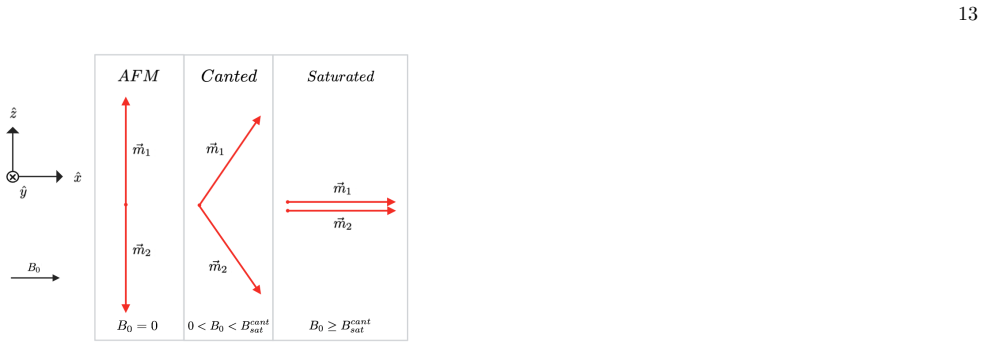
Canted Phase Transition The continuous canting transition occurs for exter- nal fields oriented along the intermediate axis ( x) in the bilayer (monolayer) for any field B < B 0 < B cant sat (0 < B 0 < B sat). The magnetic moments are parallel to the intermediate axis for higher fields as illustrated in FIG. 8. 13 FIG. 8: Canted phase transition in the bilayer
-
[10]
B. Huang, G. Clark, E. Navarro-Moratalla, D. R. Klein, R. Cheng, K. L. Seyler, D. Zhong, E. Schmidgall, M. A. McGuire, D. H. Cobden, W. Yao, D. Xiao, P. Jarillo- Herrero, and X. Xu, Layer-dependent ferromagnetism in a van der waals crystal down to the monolayer limit, Nature 546, 270–273 (2017)
work page 2017
-
[11]
C. Gong, L. Li, Z. Li, H. Ji, A. Stern, Y. Xia, T. Cao, W. Bao, C. Wang, Y. Wang, Z. Qiu, R. Cava, S. Louie, J. Xia, and X. Zhang, Discovery of intrinsic ferromag- netism in 2d van der waals crystals, Nature 546, 265 (2017)
work page 2017
- [12]
-
[13]
A. Mahmoud, F. Ciubotaru, F. Vanderveken, A. Chu- mak, S. Hamdioui, C. Adelmann, and S. Cotofana, In- troduction to spin wave computing, Journal of Applied Physics 128, 161101 (2020)
work page 2020
-
[14]
Y. Deng, Y. Yu, Y. Song, J. Zhang, N. Wang, Y. Wu, J. Zhu, J. Wang, X. Chen, and Y. Zhang, Gate-tunable room-temperature ferromagnetism in two-dimensional fe3gete2, Nature 563, 94 (2018)
work page 2018
-
[15]
M. Bonilla, S. Kolekar, Y. Ma, H. Coy Diaz, V. Sankar, R. Das, T. Eggers, H. Rodriguez Gutierrez, M.-H. Phan, and M. Batzill, Strong room-temperature ferro- magnetism in vse2 monolayers on van der waals sub- strates, Nature Nanotechnology 13, 289 (2018)
work page 2018
- [16]
-
[17]
M. Gibertini, M. Koperski, A. Morpurgo, and K. Novoselov, Magnetic 2d materials and heterostruc- tures, Nature Nanotechnology 14, 408 (2019)
work page 2019
- [18]
- [19]
-
[20]
T. Li, S. Jiang, N. Sivadas, Z. Wang, Y. Xu, D. We- ber, J. Goldberger, K. Watanabe, T. Taniguchi, C. Fen- nie, K. Mak, and J. Shan, Pressure-controlled interlayer magnetism in atomically thin cri3, Nature Materials 18, 1303–1308 (2019)
work page 2019
-
[21]
Z. Lin, M. Lohmann, Z. A. Ali, C. Tang, J. Li, W. Xing, J. Zhong, S. Jia, W. Han, S. Coh, W. Beyermann, and J. Shi, Pressure-induced spin reorientation transi- tion in layered ferromagnetic insulator cr 2ge2te6, Phys. Rev. Mater. 2, 051004 (2018)
work page 2018
-
[22]
D. Esteras, A. Rybakov, A. Ruiz, and J. J. Baldov´ ı, Magnon straintronics in the 2d van der waals ferromagnet crsbr from first-principles, Nano Lett. 22, 8771 (2022)
work page 2022
-
[23]
M. ˇSiˇ skins, M. Lee, S. Ma˜ nas-Valero, E. Coronado, Y. Blanter, H. van der Zant, and P. Steeneken, Magnetic and electronic phase transitions probed by nanomechani- cal resonators, Nature Communications 11, 2698 (2020)
work page 2020
-
[24]
R. Roy Chowdhury, C. Patra, S. DuttaGupta, S. Satheesh, S. Dan, S. Fukami, and R. P. Singh, Modi- fication of unconventional hall effect with doping at the nonmagnetic site in a two-dimensional van der waals fer- romagnet, Phys. Rev. Mater. 6, 014002 (2022)
work page 2022
-
[25]
L. Lin, Q. Zhou, Y. Li, S. Yuan, Q. Chen, S. Dong, and J. Wang, Surface vacancy-induced switchable electric polarization and enhanced ferromagnetism in monolayer metal trihalides, Nano letters 18, 2943–2949 (2018)
work page 2018
-
[26]
Y. Guo, Y. Zhang, S. Yuan, B. Wang, and J. Wang, Chromium sulfide halide monolayers: Intrinsic ferromag- netic semiconductors with large spin polarization and high carrier mobility, Nanoscale 10, 18036 (2018)
work page 2018
- [27]
-
[28]
R. Duine, K.-J. Lee, S. Parkin, and M. Stiles, Synthetic antiferromagnetic spintronics, Nature Physics 14, 217 (2018)
work page 2018
-
[29]
C. Gong and X. Zhang, Two-dimensional magnetic crys- tals and emergent heterostructure devices, Science 363, 4450 (2019)
work page 2019
- [30]
-
[31]
K. Yang, G. Wang, L. Liu, D. Lu, and H. Wu, Tri- axial magnetic anisotropy in the two-dimensional ferro- magnetic semiconductor crsbr, Physical Review B 104 14 (2021)
work page 2021
-
[32]
C. W. Cho, A. Pawbake, N. Aubergier, A. L. Barra, K. Mosina, Z. Sofer, M. E. Zhitomirsky, C. Faugeras, and B. A. Piot, Microscopic parameters of the van der waals crsbr antiferromagnet from microwave absorption experiments, Phys. Rev. B 107, 094403 (2023)
work page 2023
-
[33]
T. Cham, S. Karimeddiny, A. Dismukes, X. Roy, D. Ralph, and Y. K. Luo, Anisotropic gigahertz anti- ferromagnetic resonances of the easy-axis van der waals antiferromagnet crsbr, Nano Letters 22, 6716 (2022)
work page 2022
-
[34]
Z. Guo, H. Jiang, L. Jin, X. Zhang, Y. Liu, and X. Wang, Second-order topological insulator in ferro- magnetic monolayer and antiferromagnetic bilayer crsbr, Small Science 4, 2300356 (2024)
work page 2024
- [35]
-
[36]
K. Lee, A. H. Dismukes, E. J. Telford, R. A. Wiscons, J. Wang, X. Xu, C. P. Nuckolls, C. R. Dean, X. Roy, and X. Zhu, Magnetic order and symmetry in the 2d semiconductor crsbr., Nano letters 8, 3511 (2020)
work page 2020
-
[37]
F. Moro, S. Ke, A. Aguila, A. S¨ oll, Z. Sofer, Q. Wu, M. Yue, L. Li, X. Liu, and M. Fanciulli, Revealing 2d magnetism in a bulk crsbr single crystal by electron spin resonance, Advanced Functional Materials 32, 2207044 (2022)
work page 2022
-
[38]
K. Yang, G. Wang, L. Liu, D. Lu, and H. Wu, Tri- axial magnetic anisotropy in the two-dimensional ferro- magnetic semiconductor crsbr, Physical Review B 104, 144416 (2021)
work page 2021
-
[39]
A. Rudenko, M. R¨ osner, and M. Katsnelson, Dielectric tunability of magnetic properties in orthorhombic ferro- magnetic monolayer crsbr, npj Computational Materials 9, 83 (2023)
work page 2023
-
[40]
B. Wang, Y. Wu, Y. Bai, P. Shi, G. Zhang, Y. Zhang, and C. Liu, Origin and regulation of triaxial magnetic anisotropy in the ferromagnetic semiconductor crsbr monolayer, Nanoscale 15, 13402 (2023)
work page 2023
-
[41]
C. Boix-Constant, S. Jenkins, R. Rama-Eiroa, E. J. G. Santos, S. Ma˜ nas-Valero, and E. Coronado, Multistep magnetization switching in orthogonally twisted fer- romagnetic monolayers, Nature Materials 23, 212–218 (2023)
work page 2023
- [42]
-
[43]
S. Rezende, A. Azevedo, and R. Rodr´ ıguez-Su´ arez, In- troduction to antiferromagnetic magnons, Journal of Ap- plied Physics 126, 151101 (2019)
work page 2019
-
[44]
D. Stancil and A. Prabhakar, Spin Waves: Theory and Applications (2009)
work page 2009
-
[45]
R. L. Stamps, Spin configurations and spin-wave excita- tions in exchange-coupled bilayers, Phys. Rev. B 49, 339 (1994)
work page 1994
-
[46]
R. den Teuling, R. Das, A. V. Bondarenko, G. E. W. Bauer, Y. M. Blanter, and E. V. Tartakovskaya, Dipolar interactions in thin bilayers, in preparation
- [47]
-
[48]
E. V. Tartakovskaya, M. Pardavi-Horvath, and R. D. McMichael, Spin-wave localization in tangentially mag- netized films, Phys. Rev. B 93, 214436 (2016)
work page 2016
-
[49]
J. Harms and R. Duine, Theory of the dipole-exchange spin wave spectrum in ferromagnetic films with in-plane magnetization revisited, Journal of Magnetism and Mag- netic Materials 557, 169426 (2022)
work page 2022
- [50]
-
[51]
F. B. Anderson and H. B. Callen, Statistical mechanics and field-induced phase transitions of the heisenberg an- tiferromagnet, Phys. Rev. 136, A1068 (1964)
work page 1964
-
[52]
Kittel, Theory of antiferromagnetic resonance, Phys
C. Kittel, Theory of antiferromagnetic resonance, Phys. Rev. 82, 565 (1951)
work page 1951
-
[53]
J. G¨ uckelhorn, A. Kamra, T. Wimmer, M. Opel, S. Gepr¨ ags, R. Gross, H. Huebl, and M. Althammer, In- fluence of low-energy magnons on magnon hanle experi- ments in easy-plane antiferromagnets, Phys. Rev. B 105, 094440 (2022)
work page 2022
discussion (0)
Sign in with ORCID, Apple, or X to comment. Anyone can read and Pith papers without signing in.