REVIEW 4 major objections 6 minor 9 references
Unidentified Aerial Phenomena. Characterization of Dark UAPs
T0 review · 4 major / 6 minor · reviewed 2026-08-07 · deepseek-v4-flash
Pith's one-line read Dark UAPs are real 3-to-6-kilometer objects flying at Mach 2.5 or faster, this paper argues.
desk verdict New UAP footage and some real photometry, but the kilometer-size/Mach-2.5 conclusion rests on an unvalidated contrast-to-distance model. read the letter →
The pith
A machine-rendered reading of the paper's core claim, the machinery that carries it, and where it could break.
The reading
What carries the argument
The machinery is colorimetric flux comparison. For daytime objects the authors compare reflected sunlight from the object ($I_{obj}=F_{\rm sun}\,r^2/R^2\,\alpha$) with scattered daylight from the sky ($I_{sky}=F_{\rm sky}\,\Omega$) to derive the object size $r$ and albedo $\alpha$ once the distance $R$ is determined by parallax. For the Moon video the same comparison is made between the object and the lunar surface using the Moon's known albedo. For the night drone video the distance comes from a contrast map: the residual intensity along the line of sight is assumed to scale with geometric distance through a homogeneous 10-km atmosphere via $S = (10/\sin h)\,r$. Synchronized two-station parallax with millisecond timing is the anchor method that gives absolute distance and velocity.
What would settle it
Point the same DJI Mavic 3T at an object of known size and range, such as a large ground target or a tracked aircraft at measured distances, and compare the resulting residual-intensity curve with the paper's graph; a mismatch between true and predicted distances would falsify the contrast-to-distance relation and with it the 88-km distance, 8-km altitude, 6-km size, and Mach 2.5 speed claimed for the combat-zone object.
Extended reading notes
Core claim
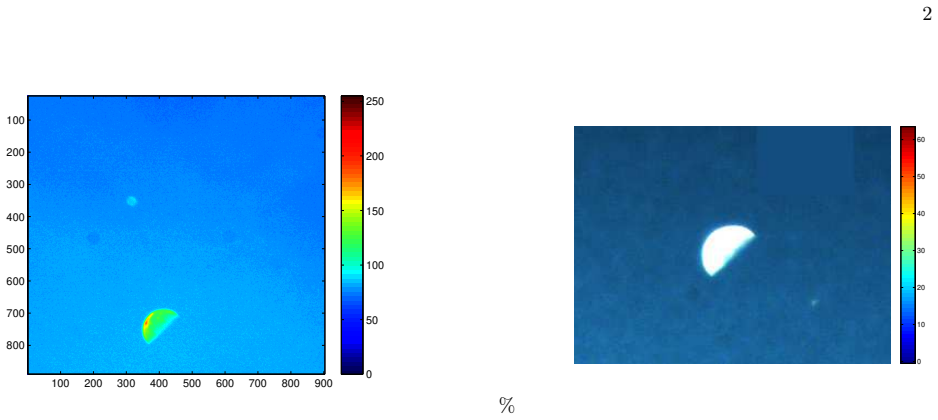
The central discovery is that dark UAPs, visible only as low-contrast shadows, can be characterized quantitatively. Over Kyiv, a parallax of 0.0464 rad places the object at 2600 km distance and 1130 km altitude, moving at 78 km/s, with a size of about 3 km and an albedo of 0.037. For the Moon video, colorimetry comparing the object to the lunar surface gives an albedo near 0.025 and sizes between 3.0 and 6.8 km. For the drone video, a contrast map against a homogeneous 10-km atmosphere places the object 88 km away, 8 km high, about 6 km wide, and moving at 806 m/s. The paper holds that all three cases agree within the measurement errors and that the objects behave like completely black bodies.
Load-bearing premise
Everything about the warzone object — its altitude, size, and Mach 2.5 speed — rests on an uncalibrated assumption that residual pixel intensity on a thermal contrast map is linearly proportional to geometric distance through a uniform 10-km atmosphere; if that relation is wrong, that entire case collapses.
Editorial extensions
If this is right
- If the three cases describe one population, night-time infrared imaging becomes the reliable detection channel for dark UAPs, since visible-light observation works only in daylight.
- Kilometer-scale objects flying at Mach 2.5 at 8 km altitude would be detectable by existing air-defense radar and would represent a physical presence in controlled airspace.
- The 78 km/s object at 1130 km altitude is far faster than any known satellite or meteor interpretation for that event, so its confirmation would challenge conventional near-Earth object models.
- A network of two synchronized wide-field cameras on a 120-km baseline could, in principle, map such objects at ranges beyond 1000 km, as the Kyiv case demonstrates.
Reading between the lines
- The uncalibrated contrast-to-distance relation is directly testable: pointing the same thermal drone camera at aircraft of known range would validate or falsify the 88-km and 75-km distances that carry the combat-zone analysis.
- The Moon-case photometry assumes that YouTube-compressed video pixels preserve relative intensities; recovering the original video stream would test whether the 0.025 albedo estimate is stable.
- If dark UAPs are a real class, archival all-sky surveys and weather-satellite imagery could be searched for large, slow apparent transits with low visible contrast and strong thermal signatures, a search the paper does not perform.
- The consistency of the three cases could also be checked by looking for the claimed 6-by-1.5-km shape in other drone or aircraft infrared videos recorded at low elevation angles.
Editorial analysis
A structured set of objections, weighed in public.
Referee Report
Summary. The paper reports three opportunistic observations of objects it calls 'dark UAPs': a two-station daytime observation over Kyiv, a YouTube video showing objects near the Moon, and a drone thermal video from a combat zone in Ukraine. From these it derives distances, sizes, albedos, and velocities, and concludes that dark UAPs are kilometer-scale objects (about 3 to 6 km), have albedo below about 3%, and move at speeds from about Mach 2.5 up to 78 km/s. The paper further claims that the same object type was observed in all three cases, with identical characteristics.
Significance. If the claims were correct, they would imply the existence of structured, kilometer-sized, extremely low-albedo objects at altitudes from 8 km to more than 1000 km, moving at transatmospheric speeds. The paper deserves credit for attempting quantitative estimates, for using a two-station parallax approach with millisecond synchronization, and for presenting explicit formulas for size and albedo. However, the central physical conversions are asserted rather than demonstrated: the drone case uses an uncalibrated contrast-to-range relation, the Moon case treats a compressed YouTube video as photometric data, and the parallax case carries no error budget. No raw data, calibration files, or analysis code are provided. Given the extraordinary nature of the claims, the evidence presented is far below the standard needed to support them.
major comments (4)
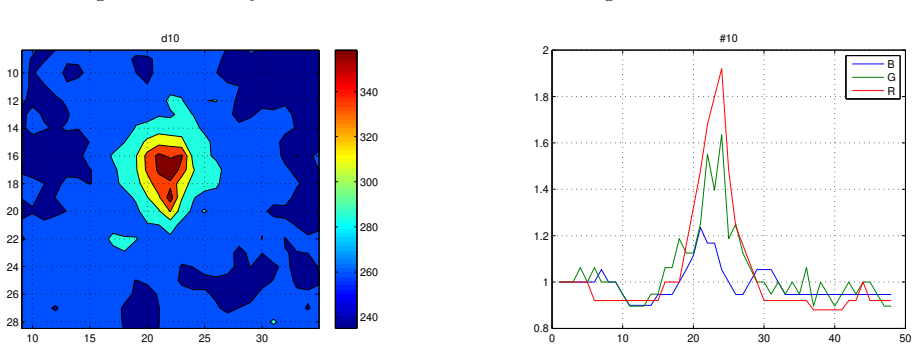
- [Section 4.1] The distance model S = 10/sin(h) * r is asserted without calibration or a forward model. In the 8-14 micron thermal band, the residual intensity on a contrast map depends on the object's temperature and emissivity, atmospheric emission and absorption along the line of sight, aerosol scattering, and the detector's spectral response; it is not simply proportional to geometric path length through a homogeneous 10 km atmosphere. The cited 'error of no more than 6%' refers to the homogeneous-atmosphere approximation for a known optical depth, not to the validity of the r-to-distance proportionality. Because the derived 88 km and 75 km distances set the object's 8 km altitude, 6 km width, and roughly 800 m/s velocity, this unsupported mapping is load-bearing.
- [Section 3] The Moon case treats pixel values from a compressed, re-encoded YouTube video as calibrated photometry. The albedo alpha_obj = 0.025 is obtained from RGB intensity ratios between the Endymion crater and an object, with no flat-fielding, linearity check, compression-artifact analysis, or uncertainty estimate. Likewise, the pixel scale derived from Endymion crater is applied to objects assumed to be at the Moon's distance without an independent astrometric reduction. The statement that 'a paper was recently published that attempts to prove the original video is a fake' is not accompanied by a citation or a rebuttal. This case cannot independently support the claimed albedo or size.
- [Section 2] The parallax measurement for the Kyiv object is reported without an error budget. The distance of 2600 km, altitude of 1130 km, and linear velocity of 78 km/s follow from a single parallax angle of 0.0464 rad and an angular velocity, with no plate solution, no treatment of timing or refraction errors, and no cross-check from the second station's independent trajectory. The object's size estimate of 3 +/- 0.4 km is based on a 7 +/- 1 pixel extent against a 2 x 2 pixel PSF, which is only marginally resolved; the quoted uncertainty does not include PSF-subtraction or deconvolution errors. The albedo estimate from Eq. (5) inherits these unquantified errors and further assumes reflected sunlight.
- [Section 5] The Discussion's central claim that the Moon and drone objects have 'identical characteristics' is internally inconsistent. The drone case yields about 6 km width and Mach 2.5 at about 8 km altitude above Earth, whereas the Moon case object is 6.8 x 3.5 km, travels at about 31 miles per second (roughly 50 km/s), and its 8.7 km altitude is above the lunar surface, not above Earth. These are not the same quantitative characteristics, and no physical argument is given for why objects near Earth's surface, in near-Moon space, and at 1130 km altitude should belong to one population. The cross-case claim therefore does not follow from the presented measurements.
minor comments (6)
- [Section 2.1] Equation (1) uses r for the object's size, while Section 4.1 uses r for residual intensity; this notation collision makes the distance formula S = 10/sin(h) * r confusing.
- [Section 3.1] The color transformations in Eqs. (6) and (7) are taken from an external arXiv paper without stating whether they are valid for the camera and video pipeline used by Carlotto, and the resulting (B-V)_J and (V-R)_J values have no uncertainties.
- [General] The paper states that the authors analyzed the Carlotto video but provides no link to the original file, no calibration frames, no timestamp metadata, and no analysis code; raw data and code should be made available if these claims are to be checked.
- [Section 2] The sentence 'Practice shows that fireflies are visible only in the daytime sky' appears to be a typo or an unclear translation; as written it is confusing.
- [Figures 11 and 12] The axes of Figures 11 and 12 lack units, and 'residual intensity' is not defined in the text; it is unclear whether this quantity is a normalized pixel value, a contrast, or a radiance ratio.
- [Section 4.2] The comparison of the object to Laputa in Gulliver's Travels is literary rather than scientific and should be removed from a research paper.
Circularity Check
No significant circularity: the derivation chain uses independent parallax, lunar-calibrated photometry, and a stated (if unvalidated) atmospheric contrast model; no equation reduces to its own input.
full rationale
Walking the paper's derivation chain, the quantitative claims do not reduce to their inputs. For the Kyiv case, the distance is obtained from a two-station parallax with millisecond synchronization, the angular size is pixel-resolved against the PSF, and Eq. (5) derives albedo from the measured contrast ratio, the sky brightness, and the geometric distance/size ratio, with the geometric ratio coming from the independent parallax and angular-size measurements. For the Moon case, the albedo is derived from a contrast ratio against the known lunar albedo (0.067) and sizes are calibrated with the Endymion crater, an external image benchmark; the color transformation is checked against published lunar (B−V) values. For the drone case, the distance is obtained from the explicitly stated homogeneous-atmosphere model S = 10/sin(h)·r, with the 6% error estimate quoted from Allen [1]; the coefficient is an assumed atmospheric scale height, not a parameter fitted to the target size or velocity. The statement that the drone object 'does not emit' is an interpretive premise used to justify the contrast-to-distance mapping, not a quantity derived from that mapping, so the later black-body language is an unsupported generalization rather than a circular derivation. Reference [9] is a self-citation to the authors' prior UAP classification, but it is not load-bearing: none of the sizes, velocities, altitudes, or albedos depend on values imported from [9]. The main validity threat is that the contrast-to-range relation and the compressed video photometry are uncalibrated and lack an error budget; that is an input-validation and correctness-risk issue, not circularity by construction.
Assumptions & free parameters
free parameters (3)
- Homogeneous atmosphere scale height H =
10 km
- Sky/object brightness contrast beta (Kiev case) =
2
- Moon/object brightness contrast beta (Moon case) =
2.65
assumptions (4)
- domain assumption Objects reflect sunlight as diffuse, uniformly bright surfaces with a single albedo, and the sky background is given by Allen's tabulated values
- ad hoc to paper The YouTube video of the Moon (Carlotto) shows real physical objects transiting the lunar surface and its pixel values are usable as photometry
- ad hoc to paper Thermal infrared contrast in the 8-14 micrometer drone image is dominated by atmospheric scattering, and residual intensity decreases linearly with distance through a homogeneous 10 km atmosphere
- domain assumption The distance and velocity from parallax are correct despite lack of detailed astrometric reduction
Cite this review
Pith. "Pith review of Unidentified Aerial Phenomena. Characterization of Dark UAPs." pith.science (2026). https://pith.science/paper/UB3EOPOW
@misc{pith2026250305627,
  author       = {Pith},
  title        = {Pith review of: Unidentified Aerial Phenomena. Characterization of Dark UAPs},
  year         = {2026},
  howpublished = {\url{https://pith.science/paper/UB3EOPOW}},
  note         = {Machine review of arXiv:2503.05627}
}
read the original abstract
We use high-tech observations of Unidentified Aerial Phenomena (UAP) class objects to evaluate their characteristics. We present data in three cases. (1) Multi-side daytime observations of UAPs over Kiev. (2) Night observations of a group of objects in the vicinity of the Moon. (3) UAP observations in the combat zone in Ukraine. Dark UAPs in the visible wavelength range are observed only during the day. At night they can only be seen in the infrared wavelength range. We note large sizes of UAPs, from three to six kilometers.They exhibit large velocities, from 2.5 Mach and much larger. They have low albedo, from three percent and below, that is, they actually exhibit features of a completely black body.
Figures

Figures from the paper (3 more)


Reference graph
Works this paper leans on
-
[1]
W., 1963, Astrophysical Quantities, 2d ed., Lon don, Athlone Press
Allen C. W., 1963, Astrophysical Quantities, 2d ed., Lon don, Athlone Press
work page 1963
-
[2]
Carlotto, https://www.youtube.com/watch?v=ScBx 2EwSuDo 6 7
M.J. Carlotto, https://www.youtube.com/watch?v=ScBx 2EwSuDo 6 7
-
[3]
Carlotto, 1995, Journal of Scientijc Exploration, Vol
M.J. Carlotto, 1995, Journal of Scientijc Exploration, Vol. 9, No. 1 , pp. 45-63
work page 1995
-
[4]
https://www.instagram.com/reel/C3vGfLDr-HB/?igsh= MWZweDV3c3BqczE5Ng
-
[5]
https://alpha-photonics.com/en/produkte/dji-mavi c-3-thermal-en/
- [6]
-
[7]
Thejll P., Flynn C., Gleisner H., et al., 2014, A&A, 563, A 38
work page 2014
-
[8]
Zagury F., 2012, The Color of the Sky, Atmospheric and Cli mate Sciences, 2012, 2, 510-517
work page 2012
Reviewed August 7, 2026 · model on record in the stance chip above.
Discussion (0). Continue with ORCID to comment.