NullFace: Training-Free Localized Face Anonymization
Pith reviewed 2026-05-23 00:12 UTC · model grok-4.3
The pith
A pre-trained diffusion model can anonymize faces by inverting the image then denoising with altered identity embeddings, without any training.
A machine-rendered reading of the paper's core claim, the machinery that carries it, and where it could break.
Core claim
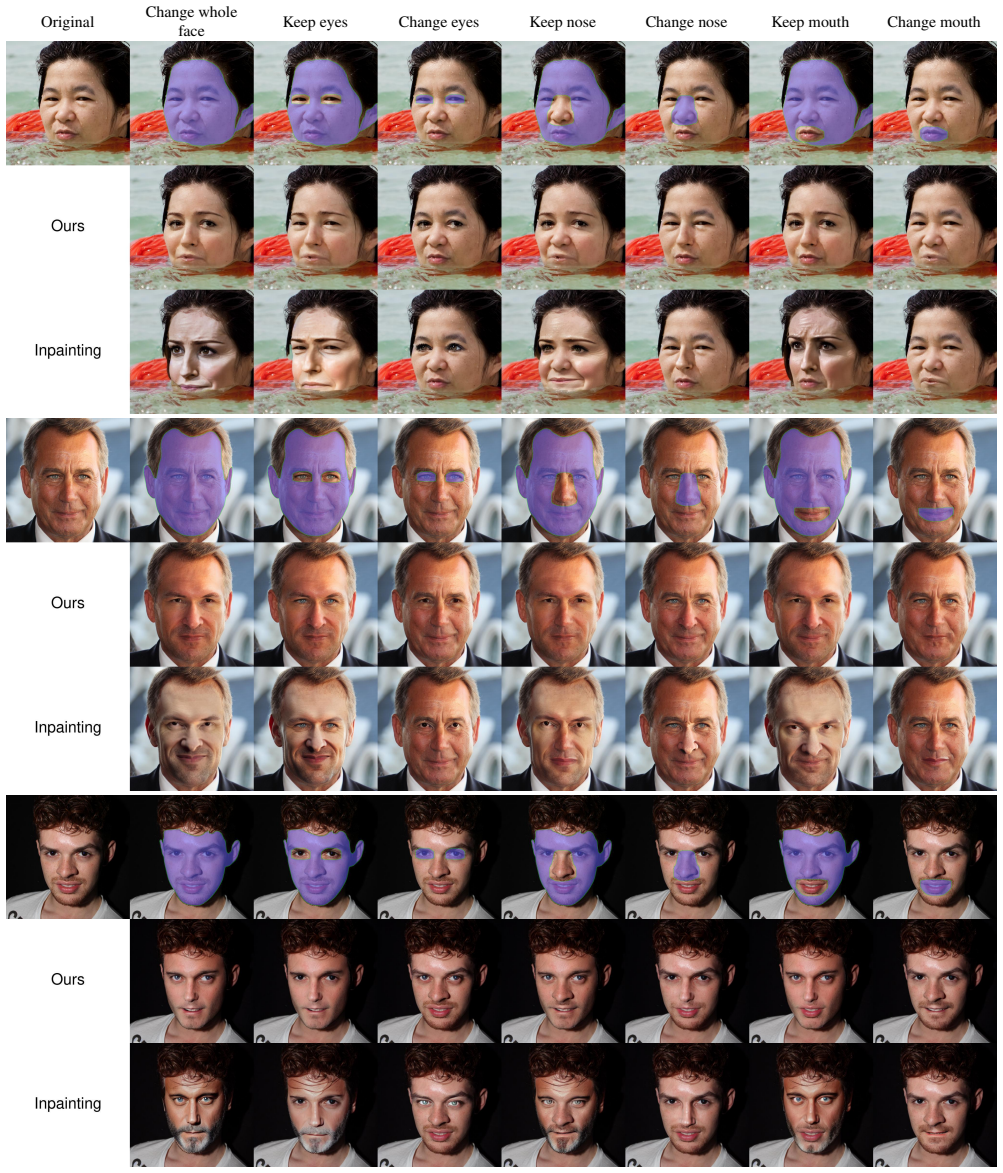
The paper claims that face anonymization reduces to inverting an input image to obtain its initial noise map and then running the diffusion denoising process conditioned on a modified identity embedding; the resulting output face is distinct from the source identity, non-identity attributes are retained, and the same pipeline supports localized control by applying the identity change only inside user-specified masks.
What carries the argument
The identity-conditioned diffusion denoising step performed after inversion, in which only the identity embedding is replaced while the rest of the conditioning remains fixed.
If this is right
- Anonymization becomes possible on any device that can run the base diffusion model, with no extra training data or compute required.
- Users gain direct control over which facial areas stay recognizable and which are altered.
- Image utility for downstream tasks such as expression analysis or pose estimation is expected to stay higher than with global distortion methods.
- The same inversion-plus-modified-embedding pattern can be applied to new diffusion backbones without retraining the anonymizer itself.
Where Pith is reading between the lines
- The approach could be tested on video sequences by applying the inversion and denoising frame-by-frame to check temporal consistency.
- If the separation between identity and other attributes holds, the method might generalize to anonymizing other object categories the diffusion model understands.
- Real-world deployment would still require checking whether the inversion step itself leaks identity cues that survive the later denoising.
Load-bearing premise
Changing only the identity embedding inside a pre-trained diffusion model is enough to remove identity information while leaving all other visual attributes untouched.
What would settle it
If face-recognition systems applied to the output images still match the original identities at rates well above chance, or if attribute-classification accuracy drops sharply on the anonymized outputs, the separation claim would be refuted.
Figures




read the original abstract
Privacy concerns around ever increasing number of cameras are increasing in today's digital age. Although existing anonymization methods are able to obscure identity information, they often struggle to preserve the utility of the images. In this work, we introduce a training-free method for face anonymization that preserves key non-identity-related attributes. Our approach utilizes a pre-trained text-to-image diffusion model without requiring optimization or training. It begins by inverting the input image to recover its initial noise. The noise is then denoised through an identity-conditioned diffusion process, where modified identity embeddings ensure the anonymized face is distinct from the original identity. Our approach also supports localized anonymization, giving users control over which facial regions are anonymized or kept intact. Comprehensive evaluations against state-of-the-art methods show our approach excels in anonymization, attribute preservation, and image quality. Its flexibility, robustness, and practicality make it well-suited for real-world applications. Code and data can be found at https://github.com/hanweikung/nullface .
Editorial analysis
A structured set of objections, weighed in public.
Referee Report
Summary. The paper introduces NullFace, a training-free method for localized face anonymization that leverages a pre-trained text-to-image diffusion model. The approach inverts an input image to recover initial noise, then performs denoising conditioned on modified identity embeddings to produce an anonymized output distinct from the original identity while aiming to preserve non-identity attributes; it additionally supports user-controlled localized anonymization of specific facial regions. Comprehensive evaluations are claimed to show superiority over state-of-the-art methods in anonymization effectiveness, attribute preservation, and image quality, with code and data released.
Significance. If the central claims hold, the work provides a practical, optimization-free alternative for face anonymization that balances privacy with utility and offers localized control, which would be valuable for real-world privacy applications in computer vision. The release of code and data is a clear strength that supports reproducibility.
major comments (2)
- [Abstract and method description] Abstract and method description: The central claim that modifying only the identity embedding during the post-inversion denoising stage isolates identity without altering non-identity attributes (pose, expression, lighting, background) lacks any derivation, targeted ablation, or analysis demonstrating the required factorization in the pre-trained diffusion model's text embedding space. Standard latent diffusion models do not guarantee such disentanglement, and this assumption is load-bearing for the attribute-preservation guarantee.
- [Evaluation claims] Evaluation claims: The assertion of comprehensive evaluations demonstrating superiority in anonymization, attribute preservation, and image quality is load-bearing for the contribution, yet the manuscript provides no referenced details on metrics, baselines, statistical significance, or failure-case analysis that would allow verification of robustness against post-hoc choices or entanglement effects.
minor comments (1)
- [Abstract] The abstract states 'Code and data can be found at https://github.com/hanweikung/nullface' but does not specify the exact release contents or license in the main text.
Simulated Author's Rebuttal
We thank the referee for the detailed and constructive review. We address each major comment below and commit to revisions that strengthen the presentation of the method's assumptions and evaluation details.
read point-by-point responses
-
Referee: [Abstract and method description] Abstract and method description: The central claim that modifying only the identity embedding during the post-inversion denoising stage isolates identity without altering non-identity attributes (pose, expression, lighting, background) lacks any derivation, targeted ablation, or analysis demonstrating the required factorization in the pre-trained diffusion model's text embedding space. Standard latent diffusion models do not guarantee such disentanglement, and this assumption is load-bearing for the attribute-preservation guarantee.
Authors: We agree that the manuscript does not include a formal derivation or targeted ablations demonstrating factorization in the text embedding space. The approach is motivated by empirical behavior observed when editing identity tokens in pre-trained diffusion models, consistent with prior prompt-based editing literature. To address the concern, we will add a new analysis subsection with quantitative ablations measuring the effect of identity embedding changes on non-identity attributes (pose via head orientation error, expression via classifier accuracy, lighting via histogram metrics) while holding other conditioning fixed. revision: yes
-
Referee: [Evaluation claims] Evaluation claims: The assertion of comprehensive evaluations demonstrating superiority in anonymization, attribute preservation, and image quality is load-bearing for the contribution, yet the manuscript provides no referenced details on metrics, baselines, statistical significance, or failure-case analysis that would allow verification of robustness against post-hoc choices or entanglement effects.
Authors: The Experiments section of the manuscript specifies the evaluation protocol, including concrete metrics for anonymization effectiveness, attribute preservation, and perceptual quality, along with the full set of baselines and qualitative comparisons. We acknowledge that explicit cross-references, statistical significance reporting, and dedicated failure-case discussion can be strengthened for verifiability. We will revise the section to add these elements, including p-values where applicable and an expanded failure-case subsection. revision: yes
Circularity Check
No circularity: method is training-free with no internal derivations or fitted predictions
full rationale
The paper describes a training-free pipeline that inverts an input image to noise and denoises it using a pre-trained text-to-image diffusion model with a modified identity embedding. No equations, parameter fits, or derivations appear in the provided text. Claims rest on the external pre-trained model's behavior and empirical evaluations, not on quantities defined or fitted inside the paper itself. No self-citation chains or ansatzes reduce the central claims to the inputs by construction. This is the common case of a self-contained empirical method description.
Axiom & Free-Parameter Ledger
axioms (1)
- domain assumption Pre-trained diffusion model separates identity from other attributes via embedding modification alone
Reference graph
Works this paper leans on
-
[1]
https://www.ppc.go.jp/files/pdf/ APPI_english.pdf
Amended Act on the Protection of Personal Information (APPI). https://www.ppc.go.jp/files/pdf/ APPI_english.pdf. 1 8
-
[2]
https:// www.oag.ca.gov/privacy/ccpa/
California Consumer Privacy Act (CCPA). https:// www.oag.ca.gov/privacy/ccpa/. 1
-
[3]
General Data Protection Regulation (GDPR) Compliance Guidelines. https://gdpr.eu/. 1
-
[4]
L2cs-net: Fine-grained gaze estimation in unconstrained environments
Ahmed A Abdelrahman, Thorsten Hempel, Aly Khalifa, Ay- oub Al-Hamadi, and Laslo Dinges. L2cs-net: Fine-grained gaze estimation in unconstrained environments. In 2023 8th International Conference on Frontiers of Signal Processing (ICFSP), pages 98–102. IEEE, 2023. 7
work page 2023
-
[5]
Eye tracking of attention in the affective disorders: A meta-analytic review and synthesis
Thomas Armstrong and Bunmi O Olatunji. Eye tracking of attention in the affective disorders: A meta-analytic review and synthesis. Clinical psychology review, 32(8):704–723,
-
[6]
Attribute-preserving face dataset anonymization via latent code optimization
Simone Barattin, Christos Tzelepis, Ioannis Patras, and Nicu Sebe. Attribute-preserving face dataset anonymization via latent code optimization. In Proceedings of the IEEE/CVF Conference on Computer Vision and Pattern Recognition , pages 8001–8010, 2023. 2, 6, 7, 8, 9
work page 2023
-
[7]
Eye track- ing in user experience design
Jennifer Romano Bergstrom and Andrew Schall. Eye track- ing in user experience design. Elsevier, 2014. 8
work page 2014
-
[8]
A morphable model for the synthesis of 3d faces
V olker Blanz and Thomas Vetter. A morphable model for the synthesis of 3d faces. In Seminal Graphics Papers: Pushing the Boundaries, Volume 2 , pages 157–164. Association for Computing Machinery, 2023. 7
work page 2023
-
[9]
Ledits++: Limitless image editing using text-to-image models
Manuel Brack, Felix Friedrich, Katharia Kornmeier, Linoy Tsaban, Patrick Schramowski, Kristian Kersting, and Apolin´ario Passos. Ledits++: Limitless image editing using text-to-image models. In Proceedings of the IEEE/CVF Con- ference on Computer Vision and Pattern Recognition, pages 8861–8870, 2024. 3
work page 2024
-
[10]
Face de-identification: State-of-the-art methods and comparative studies
Jingyi Cao, Xiangyi Chen, Bo Liu, Ming Ding, Rong Xie, Li Song, Zhu Li, and Wenjun Zhang. Face de-identification: State-of-the-art methods and comparative studies. arXiv preprint arXiv:2411.09863, 2024. 1
-
[11]
My face my choice: Privacy enhancing deepfakes for social me- dia anonymization
Umur A Ciftci, Gokturk Yuksek, and Ilke Demir. My face my choice: Privacy enhancing deepfakes for social me- dia anonymization. In Proceedings of the IEEE/CVF Win- ter Conference on Applications of Computer Vision , pages 1369–1379, 2023. 2
work page 2023
-
[12]
Idadapter: Learn- ing mixed features for tuning-free personalization of text-to- image models
Siying Cui, Jia Guo, Xiang An, Jiankang Deng, Yongle Zhao, Xinyu Wei, and Ziyong Feng. Idadapter: Learn- ing mixed features for tuning-free personalization of text-to- image models. In Proceedings of the IEEE/CVF Conference on Computer Vision and Pattern Recognition , pages 950– 959, 2024. 4
work page 2024
-
[13]
Graph-based generative face anonymisa- tion with pose preservation
Nicola Dall’Asen, Yiming Wang, Hao Tang, Luca Zanella, and Elisa Ricci. Graph-based generative face anonymisa- tion with pose preservation. In International Conference on Image Analysis and Processing , pages 503–515. Springer,
-
[14]
Geraldine Dawson, Sara Jane Webb, and James McPartland. Understanding the nature of face processing impairment in autism: insights from behavioral and electrophysiological studies. Developmental neuropsychology, 27(3):403–424,
-
[15]
Arcface: Additive angular margin loss for deep face recognition
Jiankang Deng, Jia Guo, Niannan Xue, and Stefanos Zafeiriou. Arcface: Additive angular margin loss for deep face recognition. In Proceedings of the IEEE/CVF con- ference on computer vision and pattern recognition , pages 4690–4699, 2019. 4, 5
work page 2019
-
[16]
Turboedit: Text-based image editing using few-step diffusion models
Gilad Deutch, Rinon Gal, Daniel Garibi, Or Patashnik, and Daniel Cohen-Or. Turboedit: Text-based image editing using few-step diffusion models. arXiv preprint arXiv:2408.00735, 2024. 3
-
[17]
Privategaze: Preserving user privacy in black-box mobile gaze tracking services
Lingyu Du, Jinyuan Jia, Xucong Zhang, and Guohao Lan. Privategaze: Preserving user privacy in black-box mobile gaze tracking services. Proceedings of the ACM on Interac- tive, Mobile, Wearable and Ubiquitous Technologies , 8(3): 1–28, 2024. 8
work page 2024
-
[18]
Scaling recti- fied flow transformers for high-resolution image synthesis
Patrick Esser, Sumith Kulal, Andreas Blattmann, Rahim Entezari, Jonas M ¨uller, Harry Saini, Yam Levi, Dominik Lorenz, Axel Sauer, Frederic Boesel, et al. Scaling recti- fied flow transformers for high-resolution image synthesis. In Forty-first International Conference on Machine Learn- ing, 2024. 8
work page 2024
-
[19]
An Image is Worth One Word: Personalizing Text-to-Image Generation using Textual Inversion
Rinon Gal, Yuval Alaluf, Yuval Atzmon, Or Patash- nik, Amit H Bermano, Gal Chechik, and Daniel Cohen- Or. An image is worth one word: Personalizing text-to- image generation using textual inversion. arXiv preprint arXiv:2208.01618, 2022. 3
work page internal anchor Pith review Pith/arXiv arXiv 2022
-
[20]
Ian Goodfellow, Jean Pouget-Abadie, Mehdi Mirza, Bing Xu, David Warde-Farley, Sherjil Ozair, Aaron Courville, and Yoshua Bengio. Generative adversarial nets. Advances in neural information processing systems, 27, 2014. 1, 2
work page 2014
-
[21]
Password-conditioned anonymization and deanonymization with face identity transformers
Xiuye Gu, Weixin Luo, Michael S Ryoo, and Yong Jae Lee. Password-conditioned anonymization and deanonymization with face identity transformers. In European conference on computer vision, pages 727–743. Springer, 2020. 2
work page 2020
-
[22]
Pulid: Pure and lightning id customization via contrastive alignment
Zinan Guo, Yanze Wu, Zhuowei Chen, Lang Chen, Peng Zhang, and Qian He. Pulid: Pure and lightning id customization via contrastive alignment. arXiv preprint arXiv:2404.16022, 2024. 3, 4
-
[23]
Viewer experience of obscuring scene elements in photos to enhance privacy
Rakibul Hasan, Eman Hassan, Yifang Li, Kelly Caine, David J Crandall, Roberto Hoyle, and Apu Kapadia. Viewer experience of obscuring scene elements in photos to enhance privacy. In Proceedings of the 2018 CHI Conference on Hu- man Factors in Computing Systems, pages 1–13, 2018. 1
work page 2018
-
[24]
Diff-privacy: Diffusion-based face privacy pro- tection
Xiao He, Mingrui Zhu, Dongxin Chen, Nannan Wang, and Xinbo Gao. Diff-privacy: Diffusion-based face privacy pro- tection. IEEE Transactions on Circuits and Systems for Video Technology, 2024. 2
work page 2024
-
[25]
Vera: Versatile anonymization fit for clinical facial images
Majed El Helou, Doruk Cetin, Petar Stamenkovic, and Fabio Zund. Vera: Versatile anonymization fit for clinical facial images. arXiv preprint arXiv:2312.02124, 2023. 2
-
[26]
Prompt-to-Prompt Image Editing with Cross Attention Control
Amir Hertz, Ron Mokady, Jay Tenenbaum, Kfir Aberman, Yael Pritch, and Daniel Cohen-Or. Prompt-to-prompt im- age editing with cross attention control. arXiv preprint arXiv:2208.01626, 2022. 2
work page internal anchor Pith review Pith/arXiv arXiv 2022
-
[27]
Gans trained by a two time-scale update rule converge to a local nash equilib- rium
Martin Heusel, Hubert Ramsauer, Thomas Unterthiner, Bernhard Nessler, and Sepp Hochreiter. Gans trained by a two time-scale update rule converge to a local nash equilib- rium. Advances in neural information processing systems , 30, 2017. 7
work page 2017
-
[28]
Classifier-Free Diffusion Guidance
Jonathan Ho and Tim Salimans. Classifier-free diffusion guidance. arXiv preprint arXiv:2207.12598, 2022. 3, 4 9
work page internal anchor Pith review Pith/arXiv arXiv 2022
-
[29]
Denoising dif- fusion probabilistic models
Jonathan Ho, Ajay Jain, and Pieter Abbeel. Denoising dif- fusion probabilistic models. Advances in neural information processing systems, 33:6840–6851, 2020. 2
work page 2020
-
[30]
An edit friendly ddpm noise space: Inversion and manipulations
Inbar Huberman-Spiegelglas, Vladimir Kulikov, and Tomer Michaeli. An edit friendly ddpm noise space: Inversion and manipulations. In Proceedings of the IEEE/CVF Conference on Computer Vision and Pattern Recognition, pages 12469– 12478, 2024. 2, 3, 4, 5
work page 2024
-
[31]
Deepprivacy2: To- wards realistic full-body anonymization
H ˚akon Hukkel ˚as and Frank Lindseth. Deepprivacy2: To- wards realistic full-body anonymization. In Proceedings of the IEEE/CVF Winter Conference on Applications of Com- puter Vision, pages 1329–1338, 2023. 2, 6, 7, 8, 9, 10, 11, 12
work page 2023
-
[32]
Deepprivacy: A generative adversarial network for face anonymization
H ˚akon Hukkel ˚as, Rudolf Mester, and Frank Lindseth. Deepprivacy: A generative adversarial network for face anonymization. In International symposium on visual com- puting, pages 565–578. Springer, 2019. 2, 3, 4
work page 2019
-
[33]
Biometrics: a tool for information security
Anil K Jain, Arun Ross, and Sharath Pankanti. Biometrics: a tool for information security. IEEE transactions on infor- mation forensics and security, 1(2):125–143, 2006. 1
work page 2006
-
[34]
Secure, privacy-preserving and feder- ated machine learning in medical imaging
Georgios A Kaissis, Marcus R Makowski, Daniel R ¨uckert, and Rickmer F Braren. Secure, privacy-preserving and feder- ated machine learning in medical imaging. Nature Machine Intelligence, 2(6):305–311, 2020. 2
work page 2020
-
[35]
Progressive Growing of GANs for Improved Quality, Stability, and Variation
Tero Karras, Timo Aila, Samuli Laine, and Jaakko Lehtinen. Progressive growing of gans for improved quality, stability, and variation. arXiv preprint arXiv:1710.10196, 2017. 6, 7, 8, 1, 2, 3, 4, 9
work page internal anchor Pith review Pith/arXiv arXiv 2017
-
[36]
A style-based generator architecture for generative adversarial networks
Tero Karras, Samuli Laine, and Timo Aila. A style-based generator architecture for generative adversarial networks. In Proceedings of the IEEE/CVF conference on computer vi- sion and pattern recognition, pages 4401–4410, 2019. 6, 7, 8, 1, 2, 5, 10, 11, 12
work page 2019
-
[37]
Analyzing and improv- ing the image quality of stylegan
Tero Karras, Samuli Laine, Miika Aittala, Janne Hellsten, Jaakko Lehtinen, and Timo Aila. Analyzing and improv- ing the image quality of stylegan. In Proceedings of the IEEE/CVF conference on computer vision and pattern recognition, pages 8110–8119, 2020. 2
work page 2020
-
[38]
Musiq: Multi-scale image quality transformer
Junjie Ke, Qifei Wang, Yilin Wang, Peyman Milanfar, and Feng Yang. Musiq: Multi-scale image quality transformer. In Proceedings of the IEEE/CVF international conference on computer vision, pages 5148–5157, 2021. 7
work page 2021
-
[39]
Adaface: Quality adaptive margin for face recognition
Minchul Kim, Anil K Jain, and Xiaoming Liu. Adaface: Quality adaptive margin for face recognition. InProceedings of the IEEE/CVF conference on computer vision and pattern recognition, pages 18750–18759, 2022. 7, 1
work page 2022
-
[40]
Ldfa: Latent diffusion face anonymiza- tion for self-driving applications
Marvin Klemp, Kevin R ¨osch, Royden Wagner, Jannik Quehl, and Martin Lauer. Ldfa: Latent diffusion face anonymiza- tion for self-driving applications. In Proceedings of the IEEE/CVF Conference on Computer Vision and Pattern Recognition, pages 3199–3205, 2023. 2, 3, 6, 7, 8, 9, 10, 11, 12
work page 2023
-
[41]
Facial identity anonymization via intrin- sic and extrinsic attention distraction
Zhenzhong Kuang, Xiaochen Yang, Yingjie Shen, Chao Hu, and Jun Yu. Facial identity anonymization via intrin- sic and extrinsic attention distraction. In Proceedings of the IEEE/CVF Conference on Computer Vision and Pattern Recognition, pages 12406–12415, 2024. 3
work page 2024
-
[42]
Facial emotion analysis using deep convolution neural net- work
GA Rajesh Kumar, Ravi Kant Kumar, and Goutam Sanyal. Facial emotion analysis using deep convolution neural net- work. In 2017 International Conference on Signal Pro- cessing and Communication (ICSPC), pages 369–374. IEEE,
work page 2017
-
[43]
Face anonymization made simple
Han-Wei Kung, Tuomas Varanka, Sanjay Saha, Terence Sim, and Nicu Sebe. Face anonymization made simple. arXiv preprint arXiv:2411.00762, 2024. 2, 6, 7, 8, 9, 10, 11, 12
-
[44]
Face transplant: long-term follow- up and results of a prospective open study
Laurent Lantieri, Philippe Grimbert, Nicolas Ortonne, Car- oline Suberbielle, Dominique Bories, Salvador Gil-Vernet, C´edric Lemogne, Frank Bellivier, Jean Pascal Lefaucheur, Nathaniel Schaffer, et al. Face transplant: long-term follow- up and results of a prospective open study. The Lancet, 388 (10052):1398–1407, 2016. 8
work page 2016
-
[45]
Riddle: Reversible and diversified de-identification with latent encryptor
Dongze Li, Wei Wang, Kang Zhao, Jing Dong, and Tie- niu Tan. Riddle: Reversible and diversified de-identification with latent encryptor. In Proceedings of the IEEE/CVF con- ference on computer vision and pattern recognition , pages 8093–8102, 2023. 2, 6, 7, 8, 10, 11, 12
work page 2023
-
[46]
Styleface: Towards identity-disentangled face generation on megapixels
Yuchen Luo, Junwei Zhu, Keke He, Wenqing Chu, Ying Tai, Chengjie Wang, and Junchi Yan. Styleface: Towards identity-disentangled face generation on megapixels. In European conference on computer vision , pages 297–312. Springer, 2022. 2
work page 2022
-
[47]
Jian Ma, Junhao Liang, Chen Chen, and Haonan Lu. Subject- diffusion: Open domain personalized text-to-image genera- tion without test-time fine-tuning. In ACM SIGGRAPH 2024 Conference Papers, pages 1–12, 2024. 4
work page 2024
-
[48]
Cia- gan: Conditional identity anonymization generative adver- sarial networks
Maxim Maximov, Ismail Elezi, and Laura Leal-Taix ´e. Cia- gan: Conditional identity anonymization generative adver- sarial networks. In Proceedings of the IEEE/CVF conference on computer vision and pattern recognition , pages 5447– 5456, 2020. 2, 3, 4
work page 2020
-
[49]
BN Mayanja, FSK Kambugu, SM Mbulaiteye, and JAG Whitworth. Chronic facial crusts. The Lancet, 360(9349): 1940, 2002. 8
work page 1940
-
[50]
Bla ˇz Meden, Peter Rot, Philipp Terh ¨orst, Naser Damer, Ar- jan Kuijper, Walter J Scheirer, Arun Ross, Peter Peer, and Vitomir ˇStruc. Privacy–enhancing face biometrics: A com- prehensive survey.IEEE Transactions on Information Foren- sics and Security, 16:4147–4183, 2021. 1
work page 2021
-
[51]
SDEdit: Guided Image Synthesis and Editing with Stochastic Differential Equations
Chenlin Meng, Yutong He, Yang Song, Jiaming Song, Jia- jun Wu, Jun-Yan Zhu, and Stefano Ermon. Sdedit: Guided image synthesis and editing with stochastic differential equa- tions. arXiv preprint arXiv:2108.01073, 2021. 2
work page internal anchor Pith review Pith/arXiv arXiv 2021
-
[52]
Null-text inversion for editing real im- ages using guided diffusion models
Ron Mokady, Amir Hertz, Kfir Aberman, Yael Pritch, and Daniel Cohen-Or. Null-text inversion for editing real im- ages using guided diffusion models. In Proceedings of the IEEE/CVF Conference on Computer Vision and Pattern Recognition, pages 6038–6047, 2023. 3
work page 2023
-
[53]
Medical progress: The tuber- ous sclerosis complex
KL Nathanson and EP Henske. Medical progress: The tuber- ous sclerosis complex. N Engl J Med, 355:1345–1356, 2006. 8
work page 2006
-
[54]
GLIDE: Towards Photorealistic Image Generation and Editing with Text-Guided Diffusion Models
Alex Nichol, Prafulla Dhariwal, Aditya Ramesh, Pranav Shyam, Pamela Mishkin, Bob McGrew, Ilya Sutskever, and Mark Chen. Glide: Towards photorealistic image generation and editing with text-guided diffusion models.arXiv preprint arXiv:2112.10741, 2021. 2 10
work page internal anchor Pith review Pith/arXiv arXiv 2021
-
[55]
Eye- tracking in adult depression: protocol for a systematic review and meta-analysis
Blake Noyes, Aleks Biorac, Gustavo Vazquez, Sarosh Khalid-Khan, Douglas Munoz, and Linda Booij. Eye- tracking in adult depression: protocol for a systematic review and meta-analysis. BMJ open, 13(6):e069256, 2023. 8
work page 2023
-
[56]
Zero-shot text-to-image generation
Aditya Ramesh, Mikhail Pavlov, Gabriel Goh, Scott Gray, Chelsea V oss, Alec Radford, Mark Chen, and Ilya Sutskever. Zero-shot text-to-image generation. In International confer- ence on machine learning, pages 8821–8831. Pmlr, 2021. 2
work page 2021
-
[57]
Hierarchical Text-Conditional Image Generation with CLIP Latents
Aditya Ramesh, Prafulla Dhariwal, Alex Nichol, Casey Chu, and Mark Chen. Hierarchical text-conditional image gener- ation with clip latents. arXiv preprint arXiv:2204.06125, 1 (2):3, 2022
work page internal anchor Pith review Pith/arXiv arXiv 2022
-
[58]
High-resolution image synthesis with latent diffusion models
Robin Rombach, Andreas Blattmann, Dominik Lorenz, Patrick Esser, and Bj ¨orn Ommer. High-resolution image synthesis with latent diffusion models. In Proceedings of the IEEE/CVF conference on computer vision and pattern recognition, pages 10684–10695, 2022. 1, 2, 4, 5, 8, 3, 6
work page 2022
-
[59]
Fiva: Facial image and video anonymization and anonymization defense
Felix Rosberg, Eren Erdal Aksoy, Cristofer Englund, and Fernando Alonso-Fernandez. Fiva: Facial image and video anonymization and anonymization defense. In Proceedings of the IEEE/CVF International Conference on Computer Vi- sion, pages 362–371, 2023. 2, 5
work page 2023
-
[60]
Emily Claire Rudd, Austin Kulasekararaj, and Tanya N Basu. Facial lymphoedema, viral warts, and myelodysplastic syn- drome: the protean condition of gata2 deficiency. The Lancet, 400(10347):236, 2022. 8
work page 2022
-
[61]
Fine- grained head pose estimation without keypoints
Nataniel Ruiz, Eunji Chong, and James M Rehg. Fine- grained head pose estimation without keypoints. InProceed- ings of the IEEE conference on computer vision and pattern recognition workshops, pages 2074–2083, 2018. 7
work page 2074
-
[62]
Dreambooth: Fine tuning text-to-image diffusion models for subject-driven generation
Nataniel Ruiz, Yuanzhen Li, Varun Jampani, Yael Pritch, Michael Rubinstein, and Kfir Aberman. Dreambooth: Fine tuning text-to-image diffusion models for subject-driven generation. In Proceedings of the IEEE/CVF conference on computer vision and pattern recognition , pages 22500– 22510, 2023. 3
work page 2023
-
[63]
Photorealistic text-to-image diffusion models with deep language understanding
Chitwan Saharia, William Chan, Saurabh Saxena, Lala Li, Jay Whang, Emily L Denton, Kamyar Ghasemipour, Raphael Gontijo Lopes, Burcu Karagol Ayan, Tim Salimans, et al. Photorealistic text-to-image diffusion models with deep language understanding. Advances in neural information processing systems, 35:36479–36494, 2022. 2
work page 2022
-
[64]
Adversarial diffusion distillation
Axel Sauer, Dominik Lorenz, Andreas Blattmann, and Robin Rombach. Adversarial diffusion distillation. In European Conference on Computer Vision , pages 87–103. Springer,
-
[65]
Facenet: A unified embedding for face recognition and clus- tering
Florian Schroff, Dmitry Kalenichenko, and James Philbin. Facenet: A unified embedding for face recognition and clus- tering. In Proceedings of the IEEE conference on computer vision and pattern recognition, pages 815–823, 2015. 5, 6
work page 2015
-
[66]
Eye-tracking performance and engagement of attention
Charles Shagass, Richard A Roemer, and Marco Amadeo. Eye-tracking performance and engagement of attention. Archives of General Psychiatry, 33(1):121–125, 1976. 8
work page 1976
-
[67]
Iddiffuse: Dual-conditional diffusion model for enhanced fa- cial image anonymization
Muhammad Shaheryar, Jong Taek Lee, and Soon Ki Jung. Iddiffuse: Dual-conditional diffusion model for enhanced fa- cial image anonymization. In Proceedings of the Asian Con- ference on Computer Vision, pages 4017–4033, 2024. 2
work page 2024
-
[68]
Denoising Diffusion Implicit Models
Jiaming Song, Chenlin Meng, and Stefano Ermon. Denoising diffusion implicit models. arXiv preprint arXiv:2010.02502, 2020. 2, 3
work page internal anchor Pith review Pith/arXiv arXiv 2010
-
[69]
Natural and effective obfus- cation by head inpainting
Qianru Sun, Liqian Ma, Seong Joon Oh, Luc Van Gool, Bernt Schiele, and Mario Fritz. Natural and effective obfus- cation by head inpainting. In Proceedings of the IEEE con- ference on computer vision and pattern recognition , pages 5050–5059, 2018. 2, 3
work page 2018
-
[70]
A hybrid model for identity obfuscation by face replacement
Qianru Sun, Ayush Tewari, Weipeng Xu, Mario Fritz, Chris- tian Theobalt, and Bernt Schiele. A hybrid model for identity obfuscation by face replacement. In Proceedings of the Eu- ropean conference on computer vision (ECCV) , pages 553– 569, 2018. 2, 3
work page 2018
-
[71]
Designing an encoder for stylegan image manipulation
Omer Tov, Yuval Alaluf, Yotam Nitzan, Or Patashnik, and Daniel Cohen-Or. Designing an encoder for stylegan image manipulation. ACM Transactions on Graphics (TOG), 40(4): 1–14, 2021. 2
work page 2021
-
[72]
Siamese-rppg network: Remote photoplethys- mography signal estimation from face videos
Yun-Yun Tsou, Yi-An Lee, Chiou-Ting Hsu, and Shang- Hung Chang. Siamese-rppg network: Remote photoplethys- mography signal estimation from face videos. In Proceed- ings of the 35th annual ACM symposium on applied comput- ing, pages 2066–2073, 2020. 2
work page 2066
-
[73]
Plug-and-play diffusion features for text-driven image-to-image translation
Narek Tumanyan, Michal Geyer, Shai Bagon, and Tali Dekel. Plug-and-play diffusion features for text-driven image-to-image translation. InProceedings of the IEEE/CVF Conference on Computer Vision and Pattern Recognition , pages 1921–1930, 2023. 3
work page 1921
-
[74]
InstantID: Zero-shot Identity-Preserving Generation in Seconds
Qixun Wang, Xu Bai, Haofan Wang, Zekui Qin, Anthony Chen, Huaxia Li, Xu Tang, and Yao Hu. Instantid: Zero-shot identity-preserving generation in seconds. arXiv preprint arXiv:2401.07519, 2024. 3
work page internal anchor Pith review Pith/arXiv arXiv 2024
-
[75]
Yunqian Wen, Bo Liu, Jingyi Cao, Rong Xie, and Li Song. Divide and conquer: a two-step method for high quality face de-identification with model explainability. In Proceedings of the IEEE/CVF International Conference on Computer Vi- sion, pages 5148–5157, 2023. 2
work page 2023
-
[76]
Haoxin Yang, Xuemiao Xu, Cheng Xu, Huaidong Zhang, Jing Qin, Yi Wang, Pheng-Ann Heng, and Shengfeng He. G 2 face: High-fidelity reversible face anonymization via gen- erative and geometric priors.IEEE Transactions on Informa- tion Forensics and Security, 2024. 2
work page 2024
-
[77]
IP-Adapter: Text Compatible Image Prompt Adapter for Text-to-Image Diffusion Models
Hu Ye, Jun Zhang, Sibo Liu, Xiao Han, and Wei Yang. Ip- adapter: Text compatible image prompt adapter for text-to- image diffusion models. arXiv preprint arXiv:2308.06721,
work page internal anchor Pith review Pith/arXiv arXiv
-
[78]
Autologous tissue repair and total face restoration
Tao Zan, Wenjin Wang, Haizhou Li, Caiyue Liu, Hainan Zhu, Yun Xie, Shuangbai Zhou, Yashan Gao, Xin Huang, Shuchen Gu, et al. Autologous tissue repair and total face restoration. JAMA Otolaryngology–Head & Neck Surgery , 150(8):695–703, 2024. 8
work page 2024
-
[79]
A3gan: Attribute-aware anonymiza- tion networks for face de-identification
Liming Zhai, Qing Guo, Xiaofei Xie, Lei Ma, Yi Estelle Wang, and Yang Liu. A3gan: Attribute-aware anonymiza- tion networks for face de-identification. In Proceedings of the 30th ACM international conference on multimedia, pages 5303–5313, 2022. 2
work page 2022
-
[80]
Facersa: Rsa-aware fa- cial identity cryptography framework
Zhongyi Zhang, Tianyi Wei, Wenbo Zhou, Hanqing Zhao, Weiming Zhang, and Nenghai Yu. Facersa: Rsa-aware fa- cial identity cryptography framework. In Proceedings of 11 the AAAI Conference on Artificial Intelligence, pages 7423– 7431, 2024. 2 12 NullFace: Training-Free Localized Face Anonymization Supplementary Material
work page 2024
discussion (0)
Sign in with ORCID, Apple, or X to comment. Anyone can read and Pith papers without signing in.