Patch-Wise Hypergraph Contrastive Learning with Dual Normal Distribution Weighting for Multi-Domain Stain Transfer
Pith reviewed 2026-05-22 23:50 UTC · model grok-4.3
The pith
Hypergraph modeling of patches with dual Gaussian weighting preserves higher-order topology in stain transfer.
A machine-rendered reading of the paper's core claim, the machinery that carries it, and where it could break.
Core claim
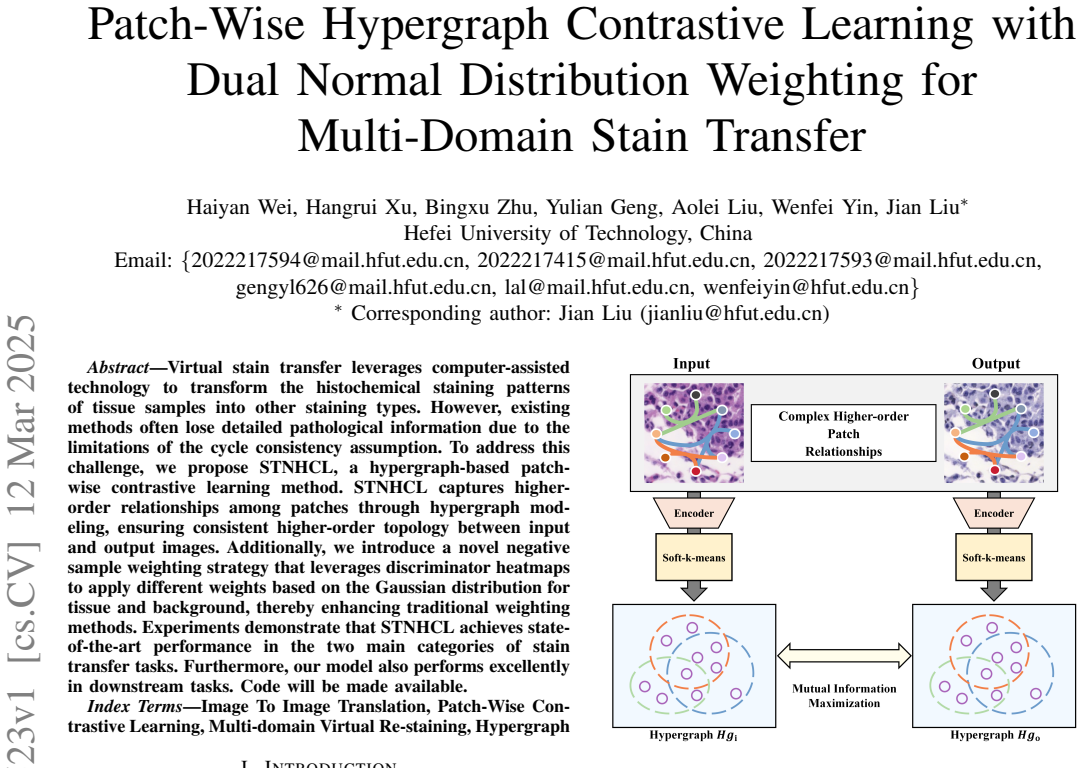
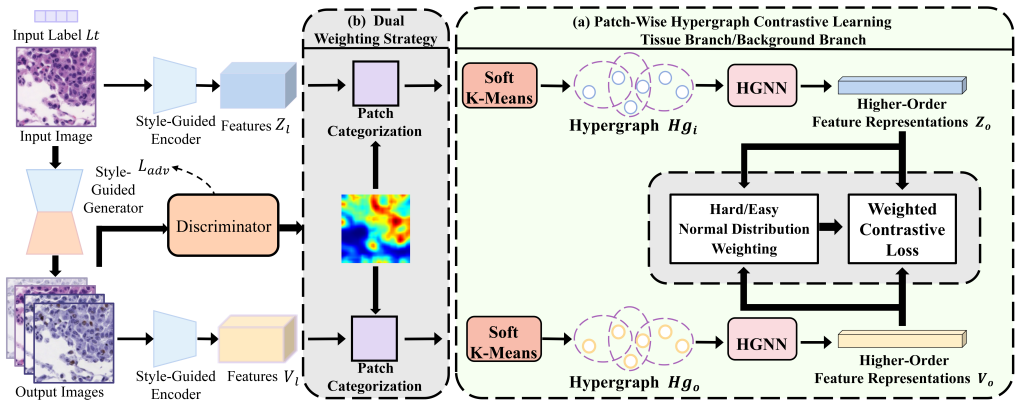
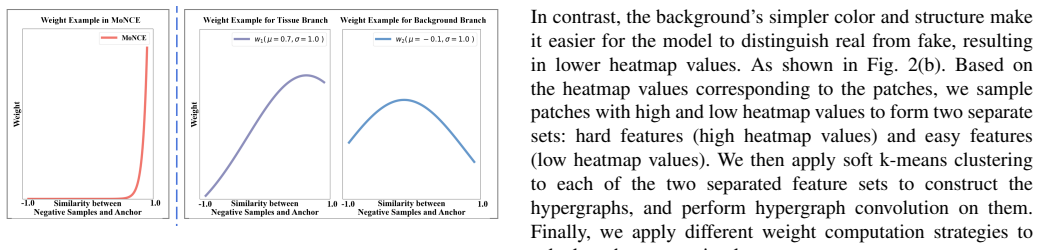
STNHCL captures higher-order relationships among patches through hypergraph modeling, ensuring consistent higher-order topology between input and output images. It also introduces a novel negative sample weighting strategy that leverages discriminator heatmaps to apply different weights based on the Gaussian distribution for tissue and background.
What carries the argument
Hypergraph-based patch-wise contrastive learning combined with dual normal distribution weighting of negative samples from discriminator heatmaps
If this is right
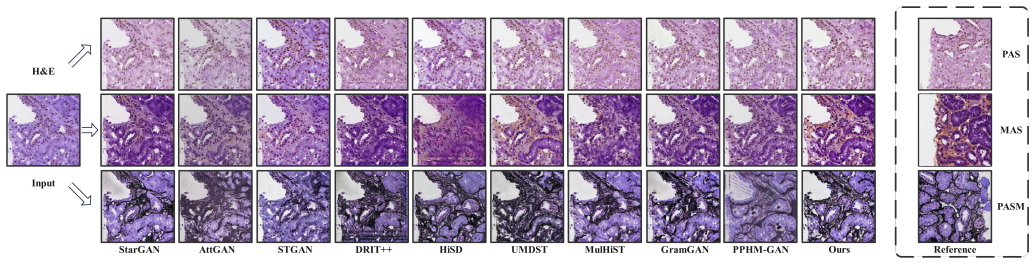
- State-of-the-art performance on the two main categories of stain transfer tasks.
- Strong results on downstream tasks that use the transferred images.
- Reduced loss of detailed pathological information relative to cycle-consistency approaches.
- Improved handling of multi-domain stain transfer through the combined hypergraph and weighting design.
Where Pith is reading between the lines
- The same hypergraph construction could be tested on other medical image-to-image tasks where structural consistency across domains matters.
- The dual weighting idea may transfer to contrastive frameworks outside pathology that must separate foreground from background negatives.
- Integration with generative models that already use patch relations could be explored to further reduce detail loss.
Load-bearing premise
That hypergraph modeling of patches will ensure consistent higher-order topology between input and output images, thereby preserving detailed pathological information better than cycle-consistency-based methods.
What would settle it
A quantitative comparison of preserved pathological structures, such as nuclei boundaries or glandular architecture, measured by segmentation accuracy or edge fidelity on images translated by STNHCL versus cycle-consistency baselines.
Figures
read the original abstract
Virtual stain transfer leverages computer-assisted technology to transform the histochemical staining patterns of tissue samples into other staining types. However, existing methods often lose detailed pathological information due to the limitations of the cycle consistency assumption. To address this challenge, we propose STNHCL, a hypergraph-based patch-wise contrastive learning method. STNHCL captures higher-order relationships among patches through hypergraph modeling, ensuring consistent higher-order topology between input and output images. Additionally, we introduce a novel negative sample weighting strategy that leverages discriminator heatmaps to apply different weights based on the Gaussian distribution for tissue and background, thereby enhancing traditional weighting methods. Experiments demonstrate that STNHCL achieves state-of-the-art performance in the two main categories of stain transfer tasks. Furthermore, our model also performs excellently in downstream tasks. Code is available at https://github.com/Whywwwzzzg/STNHCL
Editorial analysis
A structured set of objections, weighed in public.
Referee Report
Summary. The manuscript proposes STNHCL, a patch-wise hypergraph contrastive learning framework for multi-domain virtual stain transfer in histopathology images. It models higher-order relationships among patches via hypergraphs to enforce consistent topology between input and output (addressing limitations of cycle-consistency assumptions), introduces a dual normal distribution weighting scheme derived from discriminator heatmaps to differentiate tissue and background, and reports state-of-the-art performance on stain transfer tasks plus strong downstream task results, with code released.
Significance. If the empirical claims are substantiated, the work could advance stain transfer by demonstrating that hypergraph-based higher-order modeling better preserves pathological detail than pairwise or cycle-based alternatives, with the weighting strategy offering a practical improvement for imbalanced regions. Releasing code aids reproducibility.
major comments (1)
- [Abstract and §3 (Method)] The central mechanistic claim—that hypergraph modeling of patches ensures consistent higher-order topology between input and output images, thereby outperforming cycle-consistency methods—is load-bearing but unsupported by direct evidence. No quantitative validation (e.g., hypergraph Laplacian distance, persistent homology, or topology metrics between input/output patch graphs) or ablation isolating the hypergraph component against a pairwise-graph baseline is described, leaving open the possibility that observed gains derive solely from the contrastive loss or weighting scheme.
minor comments (1)
- [Abstract] The abstract's phrasing 'performs excellently in downstream tasks' is imprecise; specific metrics, datasets, and comparisons should be stated explicitly.
Simulated Author's Rebuttal
We thank the referee for the constructive feedback on our manuscript. We address the major comment point-by-point below and commit to revisions that strengthen the empirical support for our central claims.
read point-by-point responses
-
Referee: [Abstract and §3 (Method)] The central mechanistic claim—that hypergraph modeling of patches ensures consistent higher-order topology between input and output images, thereby outperforming cycle-consistency methods—is load-bearing but unsupported by direct evidence. No quantitative validation (e.g., hypergraph Laplacian distance, persistent homology, or topology metrics between input/output patch graphs) or ablation isolating the hypergraph component against a pairwise-graph baseline is described, leaving open the possibility that observed gains derive solely from the contrastive loss or weighting scheme.
Authors: We agree that the manuscript would benefit from explicit quantitative validation of the topology-preservation claim. While the hypergraph contrastive loss is designed to enforce higher-order consistency (via hyperedge-based negative sampling across patches), and the reported gains over cycle-consistency baselines are consistent with this mechanism, we did not include direct topology metrics or a pairwise-graph ablation. In the revision we will add: (1) an ablation replacing the hypergraph module with a standard pairwise graph contrastive baseline while keeping all other components fixed, and (2) quantitative topology metrics (hypergraph Laplacian distance and a simple persistent-homology-inspired measure on patch connectivity) computed between input and generated images. These additions will isolate the contribution of the hypergraph component. revision: yes
Circularity Check
No circularity; empirical method with no self-referential derivations
full rationale
The paper presents an empirical architecture (hypergraph contrastive learning plus dual Gaussian weighting) whose performance claims rest on experimental results rather than any closed mathematical derivation. No equations, uniqueness theorems, or self-citations are invoked to force the central claims; the topology-preservation argument is stated as a modeling assumption whose validity is left to downstream metrics. This is the normal case of a self-contained empirical contribution.
Axiom & Free-Parameter Ledger
Reference graph
Works this paper leans on
-
[1]
Deep learning-enabled virtual histological staining of biological samples,
Bijie Bai, Xilin Yang, Yuzhu Li, Yijie Zhang, Nir Pillar, and Aydogan Ozcan, “Deep learning-enabled virtual histological staining of biological samples,” Light: Science & Applications , vol. 12, no. 1, pp. 57, 2023
work page 2023
-
[2]
Kaiming He, Georgia Gkioxari, Piotr Doll ´ar, and Ross Girshick, “Mask r-cnn,” in Proceedings of the IEEE international conference on computer vision, 2017, pp. 2961–2969
work page 2017
-
[3]
Ying-Chih Lo, I-Fang Chung, Shin-Ning Guo, Mei-Chin Wen, and Chia- Feng Juang, “Cycle-consistent gan-based stain translation of renal pathology images with glomerulus detection application,” Applied Soft Computing, vol. 98, pp. 106822, 2021
work page 2021
-
[4]
Unpaired multi-domain stain transfer for kidney histopathological images,
Yiyang Lin, Bowei Zeng, et al., “Unpaired multi-domain stain transfer for kidney histopathological images,” in Proceedings of the AAAI Conference on Artificial Intelligence , 2022, vol. 36, pp. 1630–1637
work page 2022
-
[5]
Masataka Kawai, Toru Odate, Kazunari Kasai, Tomohiro Inoue, Kunio Mochizuki, et al., “Virtual multi-staining in a single-section view for renal pathology using generative adversarial networks,” Computers in Biology and Medicine , vol. 182, pp. 109149, 2024
work page 2024
-
[6]
Unsupervised multi-domain progressive stain transfer guided by style encoding dictionary,
Xianchao Guan, Yifeng Wang, Yiyang Lin, Xi Li, and Yongbing Zhang, “Unsupervised multi-domain progressive stain transfer guided by style encoding dictionary,” IEEE Transactions on Image Processing , 2024
work page 2024
-
[7]
Unpaired image-to-image translation using cycle-consistent adversarial networks,
Jun-Yan Zhu, Taesung Park, Phillip Isola, and Alexei A Efros, “Unpaired image-to-image translation using cycle-consistent adversarial networks,” in Proceedings of the IEEE international conference on computer vision, 2017, pp. 2223–2232
work page 2017
-
[8]
Con- trastive learning for unpaired image-to-image translation,
Taesung Park, Alexei A Efros, Richard Zhang, and Jun-Yan Zhu, “Con- trastive learning for unpaired image-to-image translation,” in Computer Vision–ECCV 2020: 16th European Conference, Glasgow, UK, August 23–28, 2020, Proceedings, Part IX 16 . Springer, 2020, pp. 319–345
work page 2020
-
[9]
Modulated contrast for versatile image synthesis,
Fangneng Zhan, Jiahui Zhang, Yingchen Yu, Rongliang Wu, and Shijian Lu, “Modulated contrast for versatile image synthesis,” in Proceedings of the IEEE/CVF Conference on Computer Vision and Pattern Recogni- tion, 2022, pp. 18280–18290
work page 2022
-
[10]
Qs-attn: Query-selected attention for contrastive learning in i2i translation,
Xueqi Hu, Xinyue Zhou, Qiusheng Huang, Zhengyi Shi, Li Sun, and Qingli Li, “Qs-attn: Query-selected attention for contrastive learning in i2i translation,” in Proceedings of the IEEE/CVF Conference on Computer Vision and Pattern Recognition , 2022, pp. 18291–18300
work page 2022
-
[11]
Patch-wise graph contrastive learning for image translation,
Chanyong Jung, Gihyun Kwon, and Jong Chul Ye, “Patch-wise graph contrastive learning for image translation,” in Proceedings of the AAAI Conference on Artificial Intelligence , 2024, vol. 38, pp. 13013–13021
work page 2024
-
[12]
Vision hgnn: An image is more than a graph of nodes,
Yan Han, Peihao Wang, Souvik Kundu, Ying Ding, and Zhangyang Wang, “Vision hgnn: An image is more than a graph of nodes,” in Proceedings of the IEEE/CVF International Conference on Computer Vision, 2023, pp. 19878–19888
work page 2023
-
[13]
3-d object retrieval and recognition with hypergraph analysis,
Yue Gao, Meng Wang, Dacheng Tao, Rongrong Ji, and Qionghai Dai, “3-d object retrieval and recognition with hypergraph analysis,” IEEE transactions on image processing , vol. 21, no. 9, pp. 4290–4303, 2012
work page 2012
-
[14]
] video object segmentation by hypergraph cut,
Yuchi Huang, Qingshan Liu, and Dimitris Metaxas, “] video object segmentation by hypergraph cut,” in 2009 IEEE conference on computer vision and pattern recognition . IEEE, 2009, pp. 1738–1745
work page 2009
-
[15]
Hypergraph transformer for skeleton-based action recognition,
Yuxuan Zhou, Zhi-Qi Cheng, Chao Li, Yanwen Fang, Yifeng Geng, et al., “Hypergraph transformer for skeleton-based action recognition,” arXiv preprint arXiv:2211.09590 , 2022
-
[16]
Recon- structing groups of people with hypergraph relational reasoning,
Buzhen Huang, Jingyi Ju, Zhihao Li, and Yangang Wang, “Recon- structing groups of people with hypergraph relational reasoning,” in Proceedings of the IEEE/CVF International Conference on Computer Vision, 2023, pp. 14873–14883
work page 2023
-
[17]
Are all negatives created equal in contrastive instance discrimination?,
Tiffany Tianhui Cai, Jonathan Frankle, David J Schwab, and Ari S Morcos, “Are all negatives created equal in contrastive instance discrimination?,” arXiv preprint arXiv:2010.06682 , 2020
-
[18]
Understanding con- trastive learning via distributionally robust optimization,
Junkang Wu, Jiawei Chen, Jiancan Wu, et al., “Understanding con- trastive learning via distributionally robust optimization,” Advances in Neural Information Processing Systems , vol. 36, 2024
work page 2024
-
[19]
Re- thinking the paradigm of content constraints in unpaired image-to- image translation,
Xiuding Cai, Yaoyao Zhu, Dong Miao, Linjie Fu, and Yu Yao, “Re- thinking the paradigm of content constraints in unpaired image-to- image translation,” in Proceedings of the AAAI Conference on Artificial Intelligence, 2024, vol. 38, pp. 891–899
work page 2024
-
[20]
Anhir: automatic non-rigid histological image registration challenge,
Ji ˇr´ı Borovec, Jan Kybic, Ignacio Arganda-Carreras, et al., “Anhir: automatic non-rigid histological image registration challenge,” IEEE transactions on medical imaging , vol. 39, no. 10, pp. 3042–3052, 2020
work page 2020
-
[21]
Star- gan: Unified generative adversarial networks for multi-domain image-to- image translation,
Yunjey Choi, Minje Choi, Munyoung Kim, Jung-Woo Ha, et al., “Star- gan: Unified generative adversarial networks for multi-domain image-to- image translation,” in Proceedings of the IEEE conference on computer vision and pattern recognition , 2018, pp. 8789–8797
work page 2018
-
[22]
Attgan: Facial attribute editing by only changing what you want,
Zhenliang He, Wangmeng Zuo, Meina Kan, Shiguang Shan, and Xilin Chen, “Attgan: Facial attribute editing by only changing what you want,” IEEE transactions on image processing, vol. 28, no. 11, pp. 5464–5478, 2019
work page 2019
-
[23]
Stgan: A unified selective transfer network for arbitrary image attribute editing,
Ming Liu, Yukang Ding, Min Xia, Xiao Liu, Errui Ding, et al., “Stgan: A unified selective transfer network for arbitrary image attribute editing,” in Proceedings of the IEEE/CVF conference on computer vision and pattern recognition, 2019, pp. 3673–3682
work page 2019
-
[24]
Drit++: Diverse image- to-image translation via disentangled representations,
Hsin-Ying Lee, Hung-Yu Tseng, Qi Mao, et al., “Drit++: Diverse image- to-image translation via disentangled representations,” International Journal of Computer Vision , vol. 128, no. 10-11, pp. 2402–2417, 2020
work page 2020
-
[25]
Image-to-image translation via hierarchical style disentanglement,
Xinyang Li, Shengchuan Zhang, Jie Hu, Liujuan Cao, Xiaopeng Hong, Xudong Mao, et al., “Image-to-image translation via hierarchical style disentanglement,” in Proceedings of the IEEE/CVF conference on computer vision and pattern recognition , 2021, pp. 8639–8648
work page 2021
-
[26]
Lulin Shi, Yan Zhang, Ivy HM Wong, Claudia TK Lo, and Terence TW Wong, “Mulhist: Multiple histological staining for thick biological samples via unsupervised image-to-image translation,” in International Conference on Medical Image Computing and Computer-Assisted Inter- vention. Springer, 2023, pp. 735–744
work page 2023
discussion (0)
Sign in with ORCID, Apple, or X to comment. Anyone can read and Pith papers without signing in.