Dirac node pinning from Dzyaloshinskii-Moriya interactions in a Kagome spin liquid
Pith reviewed 2026-05-22 23:43 UTC · model grok-4.3
The pith
Dzyaloshinskii-Moriya interactions create and pin Dirac nodes in Kagome spin liquid spinon spectrum via band closing and flux coupling.
A machine-rendered reading of the paper's core claim, the machinery that carries it, and where it could break.
Core claim
DM interactions induce a band closing phase transition in the spinon spectrum. There is a change in the Chern number when the bands are inverted. Together with the DM-generated internal gauge flux, the coupling to the spinon orbital magnetization counteracts the band reopening. This interplay energetically pins the Dirac nodes over a range of parameters, resulting in a pinning mechanism distinct from the usual one from symmetry protection.
What carries the argument
Dzyaloshinskii-Moriya interactions that generate internal gauge flux and couple to spinon orbital magnetization, pinning Dirac nodes after inducing a Chern-number-changing band inversion in the 2π/3 flux state.
If this is right
- Dirac nodes appear in the spinon spectrum after the DM-induced band closing transition.
- The Chern number of the bands changes sign or value during the inversion.
- The nodes stay pinned for a finite range of DM interaction strengths due to the counteracting effects.
- The mechanism applies specifically to the 2π/3 flux configuration without symmetry protection.
Where Pith is reading between the lines
- Similar DM-driven pinning could stabilize nodes in other spin liquid models on different lattices.
- External magnetic fields might modulate the orbital magnetization coupling to adjust the pinning range.
- Variational Monte Carlo methods could be used to explore this in related systems with varying flux states.
Load-bearing premise
The relevant spinon state is the 2π/3 flux configuration which triples the unit cell and has no symmetry protection for Dirac nodes.
What would settle it
A calculation showing that DM interactions always reopen a gap after band closing without pinning, or an experiment finding gapped spinons in YCOB despite significant DM interactions, would falsify the mechanism.
Figures




read the original abstract
Recent experiments on the Kagome spin liquid candidate YCOB suggest the presence of Dirac fermionic spinons near the magnetization plateau at 1/9. Theories suggest that the spinons are charge neutral spin-$1/2$ excitations, in a $2\pi/3$ flux which triples the unit cell. Generally a gap is expected, and there is no symmetry protection for the Dirac nodes in this system. The question arises as to what causes the nodes and stabilizes them. In this work, we propose a node-creation and node-pinning mechanism driven by the Dzyaloshinskii-Moriya (DM) interactions. Employing Gutzwiller-projected variational Monte Carlo calculations, we demonstrate that DM interactions induce a band closing phase transition in the spinon spectrum. There is a change in the Chern number when the bands are inverted. Together with the DM-generated internal gauge flux, the coupling to the spinon orbital magnetization counteracts the band reopening. This interplay energetically pins the Dirac nodes over a range of parameters, resulting in a pinning mechanism distinct from the usual one from symmetry protection.
Editorial analysis
A structured set of objections, weighed in public.
Referee Report
Summary. The manuscript claims that Dzyaloshinskii-Moriya (DM) interactions drive a band-closing phase transition in the spinon spectrum of a 2π/3-flux Kagome spin liquid (tripling the unit cell), accompanied by a Chern-number change upon band inversion; the resulting DM-generated internal gauge flux then couples to the spinon orbital magnetization to counteract band reopening, energetically pinning the Dirac nodes over a parameter range. This pinning is presented as distinct from symmetry protection and is supported by Gutzwiller-projected variational Monte Carlo (VMC) calculations. The setup assumes the 2π/3 flux state is relevant and lacks symmetry protection for the nodes.
Significance. If the VMC results and the orbital-magnetization coupling mechanism hold, the work supplies a concrete, non-symmetry-based route to stabilizing Dirac spinons in a Kagome spin liquid, directly relevant to the 1/9-plateau observations in YCOB. The standard VMC methodology is a strength, but the interpretive pinning step would benefit from explicit falsifiable predictions or parameter scans that could be tested experimentally.
major comments (2)
- [Abstract] Abstract and introduction: the central claim presupposes that the 2π/3 flux state (which triples the unit cell) has no symmetry protection for Dirac nodes and generally expects a gap, making DM necessary for node creation and pinning. The manuscript reports VMC results exclusively inside this fixed-flux ansatz; it does not demonstrate that this sector is the variational minimum or that residual lattice/projective symmetries cannot protect nodes, which is load-bearing for the assertion that DM interactions are required.
- [Methods (VMC section)] The band-closing transition and subsequent pinning via gauge-flux plus orbital-magnetization coupling are presented as outputs of the VMC. Without access to the full methods, error analysis, flux-sector energy comparisons, or the explicit form of the orbital-magnetization term, it is not possible to assess whether the pinning is robust or an artifact of the fixed ansatz.
minor comments (1)
- [Abstract] The abstract states 'theories suggest' the 2π/3 flux without citing the specific prior works; explicit references should be added for traceability.
Simulated Author's Rebuttal
We thank the referee for their detailed reading and constructive feedback. We address the major comments point-by-point below, clarifying the scope of our work within the experimentally motivated 2π/3 flux ansatz while agreeing to strengthen the presentation of methods and assumptions.
read point-by-point responses
-
Referee: [Abstract] Abstract and introduction: the central claim presupposes that the 2π/3 flux state (which triples the unit cell) has no symmetry protection for Dirac nodes and generally expects a gap, making DM necessary for node creation and pinning. The manuscript reports VMC results exclusively inside this fixed-flux ansatz; it does not demonstrate that this sector is the variational minimum or that residual lattice/projective symmetries cannot protect nodes, which is load-bearing for the assertion that DM interactions are required.
Authors: We agree that our calculations are performed within the fixed 2π/3 flux sector, as motivated by experimental indications in YCOB and prior theoretical proposals for the spinon spectrum. The manuscript does not perform a global variational minimization over flux sectors, nor does it claim that the 2π/3 state is the absolute ground state; instead, we demonstrate a concrete DM-driven node-creation and pinning mechanism inside this ansatz. The statement of no symmetry protection follows from the projective symmetry group analysis for the 2π/3 flux state (as referenced in the introduction). We will revise the abstract and introduction to more explicitly state the fixed-ansatz scope and cite the relevant symmetry analysis, making clear that the mechanism is proposed within this sector rather than as a universal requirement. revision: yes
-
Referee: [Methods (VMC section)] The band-closing transition and subsequent pinning via gauge-flux plus orbital-magnetization coupling are presented as outputs of the VMC. Without access to the full methods, error analysis, flux-sector energy comparisons, or the explicit form of the orbital-magnetization term, it is not possible to assess whether the pinning is robust or an artifact of the fixed ansatz.
Authors: The VMC implementation follows standard Gutzwiller-projected variational Monte Carlo procedures for spinon wavefunctions. The orbital-magnetization coupling arises from the interaction between the DM-generated internal gauge flux and the spinon orbital response, which is incorporated into the variational energy. We acknowledge that additional technical details would aid assessment. In the revised manuscript we will expand the methods section to include the explicit form of the orbital-magnetization term, statistical error analysis from the Monte Carlo sampling, and convergence checks. Flux-sector energy comparisons lie outside the present scope, as the work focuses on the mechanism inside the fixed ansatz; we will add a clarifying sentence to this effect. revision: yes
Circularity Check
No circularity: pinning mechanism is numerical output of VMC, not input or self-referential definition
full rationale
The paper's central result (DM-induced band closing, Chern change, and node pinning via gauge flux + orbital magnetization coupling) is obtained from Gutzwiller-projected variational Monte Carlo calculations inside a fixed 2π/3 flux ansatz. This is an independent computational output rather than a quantity that reduces by the paper's own equations to a fitted parameter or prior self-citation. The statement that 'generally a gap is expected, and there is no symmetry protection' is presented as background from external theories, not derived or assumed circularly within the derivation chain. No self-definitional steps, fitted-input predictions, or load-bearing self-citations appear in the abstract or described method. The derivation is therefore self-contained against the VMC benchmark.
Axiom & Free-Parameter Ledger
axioms (1)
- domain assumption The spinons realize a 2π/3 flux state that triples the unit cell with no symmetry protection for Dirac nodes
Lean theorems connected to this paper
-
IndisputableMonolith/Foundation/AlexanderDuality.leanalexander_duality_circle_linking unclear?
unclearRelation between the paper passage and the cited Recognition theorem.
Theories suggest that the spinons are charge neutral spin-1/2 excitations, in a 2π/3 flux which triples the unit cell. Generally a gap is expected, and there is no symmetry protection for the Dirac nodes in this system.
-
IndisputableMonolith/Cost/FunctionalEquation.leanwashburn_uniqueness_aczel unclear?
unclearRelation between the paper passage and the cited Recognition theorem.
DM interactions induce a band closing phase transition in the spinon spectrum. There is a change in the Chern number when the bands are inverted.
What do these tags mean?
- matches
- The paper's claim is directly supported by a theorem in the formal canon.
- supports
- The theorem supports part of the paper's argument, but the paper may add assumptions or extra steps.
- extends
- The paper goes beyond the formal theorem; the theorem is a base layer rather than the whole result.
- uses
- The paper appears to rely on the theorem as machinery.
- contradicts
- The paper's claim conflicts with a theorem or certificate in the canon.
- unclear
- Pith found a possible connection, but the passage is too broad, indirect, or ambiguous to say the theorem truly supports the claim.
Reference graph
Works this paper leans on
-
[1]
1(b), we see that there is a linear increase in M versus D for D > D c
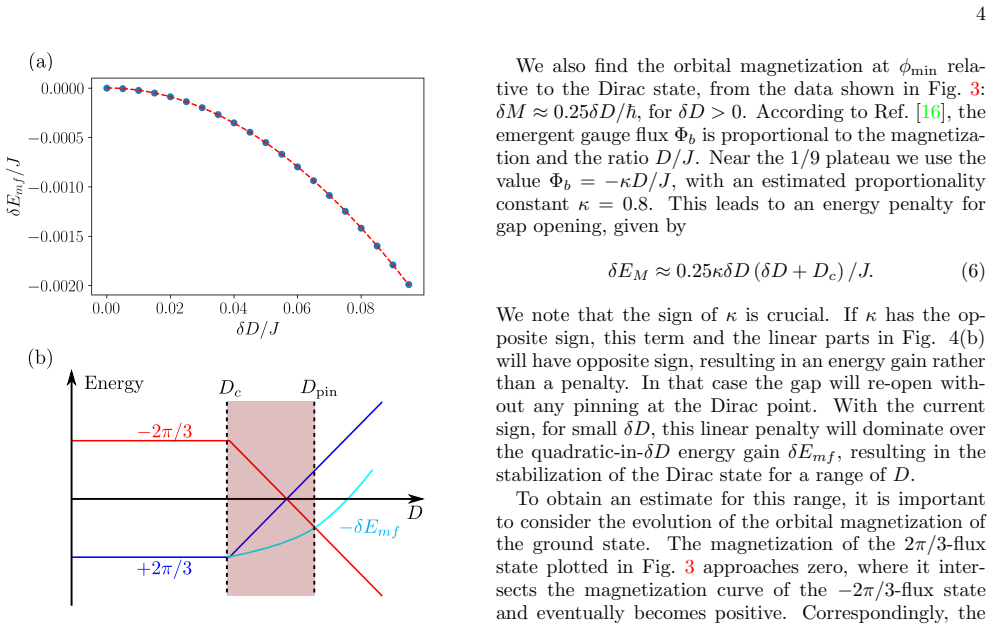
From the inset of Fig. 1(b), we see that there is a linear increase in M versus D for D > D c. The energy contribution, due to the orbital magnetism, per unit cell can be expressed as EM = −ℏMΦb, where Φb is the flux of b through a unit cell. Since the b-field generated by DM interactions was shown to be opposite to the applied magnetic field [16], and th...
-
[2]
L. Savary and L. Balents, Quantum spin liquids: a re- view, Reports on Progress in Physics 80, 016502 (2016)
work page 2016
-
[3]
Y. Zhou, K. Kanoda, and T.-K. Ng, Quantum spin liquid states, Rev. Mod. Phys. 89, 025003 (2017)
work page 2017
-
[4]
C. Broholm, R. J. Cava, S. Kivelson, D. Nocera, M. Nor- man, and T. Senthil, Quantum spin liquids, Science 367, eaay0668 (2020)
work page 2020
-
[5]
T.-H. Han, J. S. Helton, S. Chu, D. G. Nocera, J. A. Rodriguez-Rivera, C. Broholm, and Y. S. Lee, Fraction- alized excitations in the spin-liquid state of a kagome- lattice antiferromagnet, Nature 492, 406 (2012)
work page 2012
-
[6]
D. V. Pilon, C. H. Lui, T. H. Han, D. Shrekenhamer, A. J. Frenzel, W. J. Padilla, Y. S. Lee, and N. Gedik, Spin- induced optical conductivity in the spin-liquid candidate herbertsmithite, Phys. Rev. Lett. 111, 127401 (2013)
work page 2013
-
[7]
M. Fu, T. Imai, T.-H. Han, and Y. S. Lee, Evidence for a gapped spin-liquid ground state in a kagome heisenberg antiferromagnet, Science 350, 655 (2015)
work page 2015
- [8]
-
[9]
G. Zheng, D. Zhang, Y. Zhu, K.-W. Chen, A. Chan, K. Jenkins, B. Kang, Z. Zeng, A. Xu, D. Ratkovski, J. Blawat, A. Bangura, J. Singleton, P. A. Lee, S. Li, and L. Li, Thermodynamic evidence of fermionic behavior in the vicinity of one-ninth plateau in a kagome antiferro- magnet (2024), arXiv:2409.05600 [cond-mat.str-el]
-
[10]
S. Jeon, D. Wulferding, Y. Choi, S. Lee, K. Nam, K. H. Kim, M. Lee, T.-H. Jang, J.-H. Park, S. Lee, et al., One- ninth magnetization plateau stabilized by spin entangle- ment in a kagome antiferromagnet, Nature Physics 20, 435 (2024)
work page 2024
-
[11]
S. Suetsugu, T. Asaba, Y. Kasahara, Y. Kohsaka, K. Tot- suka, B. Li, Y. Zhao, Y. Li, M. Tokunaga, and Y. Mat- suda, Emergent spin-gapped magnetization plateaus in a spin-1/2 perfect kagome antiferromagnet, Phys. Rev. Lett. 132, 226701 (2024)
work page 2024
-
[12]
S. Nishimoto, N. Shibata, and C. Hotta, Controlling frus- trated liquids and solids with an applied field in a kagome heisenberg antiferromagnet, Nature communications 4, 2287 (2013)
work page 2013
- [13]
-
[14]
D.-z. Fang, N. Xi, S.-J. Ran, and G. Su, Nature of the 1/9-magnetization plateau in the spin-1/2 kagome heisenberg antiferromagnet, Phys. Rev. B 107, L220401 (2023)
work page 2023
- [15]
-
[16]
O. I. Motrunich, Orbital magnetic field effects in spin liq- uid with spinon fermi sea: Possible application to kappa- (et) 2 cu 2 (cn) 3, Physical Review B—Condensed Matter and Materials Physics 73, 155115 (2006)
work page 2006
-
[17]
B. Kang and P. A. Lee, Generation of gauge mag- netic fields in a kagome spin liquid candidate using the dzyaloshinskii-moriya interaction, Phys. Rev. B 109, L201104 (2024)
work page 2024
-
[18]
D. Xiao, J. Shi, and Q. Niu, Berry phase correction to electron density of states in solids, Phys. Rev. Lett. 95, 137204 (2005)
work page 2005
-
[19]
D. Ceresoli, T. Thonhauser, D. Vanderbilt, and R. Resta, Orbital magnetization in crystalline solids: Multi-band insulators, chern insulators, and metals, Phys. Rev. B 74, 024408 (2006)
work page 2006
- [20]
-
[21]
Gros, Physics of projected wavefunctions, Annals of Physics 189, 53 (1989)
C. Gros, Physics of projected wavefunctions, Annals of Physics 189, 53 (1989)
work page 1989
- [22]
-
[23]
A. L. Sharpe, E. J. Fox, A. W. Barnard, J. Finney, K. Watanabe, T. Taniguchi, M. Kastner, and D. Goldhaber-Gordon, Emergent ferromagnetism near three-quarters filling in twisted bilayer graphene, Science 365, 605 (2019)
work page 2019
- [24]
-
[25]
T. Han, Z. Lu, G. Scuri, J. Sung, J. Wang, T. Han, K. Watanabe, T. Taniguchi, H. Park, and L. Ju, Cor- related insulator and chern insulators in pentalayer rhombohedral-stacked graphene, Nature Nanotechnology 19, 181 (2024)
work page 2024
-
[26]
G. Chen, A. L. Sharpe, E. J. Fox, Y.-H. Zhang, S. Wang, L. Jiang, B. Lyu, H. Li, K. Watanabe, T. Taniguchi, et al., Tunable correlated chern insulator and ferromag- netism in a moire superlattice, Nature 579, 56 (2020)
work page 2020
-
[27]
M. Koshino and T. Ando, Anomalous orbital magnetism in dirac-electron systems: Role of pseudospin paramag- netism, Phys. Rev. B 81, 195431 (2010)
work page 2010
-
[28]
Z. Dong and L. Levitov, Chiral stoner magnetism in dirac bands, Phys. Rev. B 110, 104420 (2024)
work page 2024
-
[29]
B. A. Bernevig, Topological insula- tors and topological superconductors, in Topological Insulators and Topological Superconductors (Princeton university press, 2013). 7 Appendix A: Additional numerical results 2.0 2.5 3.0 φ1 2.0 2.2 2.4 2.6 2.8 3.0 φ2 −3.675 −3.650 −3.625 −3.600 −3.575 −3.550 Heisenberg (a) Heisenberg term ( J = 1). 2.0 2.5 3.0 φ1 2.0 2....
work page 2013
discussion (0)
Sign in with ORCID, Apple, or X to comment. Anyone can read and Pith papers without signing in.