A Profit Sharing Mechanism for Coordinated Power Traffic System
Pith reviewed 2026-05-25 08:26 UTC · model grok-4.3
The pith
A profit-sharing mechanism lets the DNO reach its minimum total operation cost by incentivizing the TNO to adjust EV charging loads.
A machine-rendered reading of the paper's core claim, the machinery that carries it, and where it could break.
Core claim
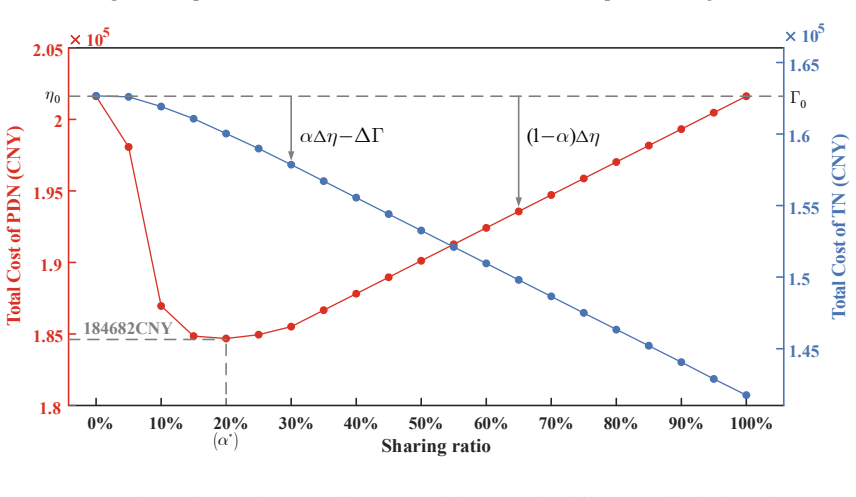
The scheduling process is divided into prescheduling, where the TNO ignores the PDN and the DNO records its original cost, and rescheduling, where the DNO shares part of the saved cost to motivate the TNO to reallocate charging loads favorably for the PDN. This two-stage interaction is captured by single-level models for each stage and a bilevel model that finds the sharing ratio at which the DNO's total cost reaches its lowest value while the TNO still benefits.
What carries the argument
The bilevel model that treats the DNO's choice of profit-sharing ratio as the upper level and the TNO's response of reallocating traffic flow and charging load as the lower level.
If this is right
- At the identified optimal sharing ratio the DNO's total scheduling cost reaches its lowest value.
- The TNO receives a positive share of the saved cost and therefore also benefits.
- The mechanism produces an incentive-compatible outcome in which the TNO voluntarily adjusts charging to reduce PDN imbalance.
- The two-stage process can be solved by converting the bilevel interaction into equivalent single-level problems.
Where Pith is reading between the lines
- The same profit-sharing logic could be applied to other infrastructure pairs that exhibit load shifting opportunities, such as gas and electricity networks.
- If EV arrival times or battery states contain significant uncertainty, the optimal ratio may need periodic recalibration rather than a single fixed value.
- The approach assumes perfect information between operators; relaxing that assumption would require testing whether the identified ratio remains stable under partial information.
Load-bearing premise
The bilevel model correctly predicts how the TNO will change its charging schedule for any given profit share, without unmodeled strategic behavior or external uncertainties.
What would settle it
Simulate the rescheduling stage at the reported optimal sharing ratio and check whether the realized DNO cost equals the predicted minimum or whether the TNO's actual allocation deviates from the model's prediction.
Figures



read the original abstract
The transportation network operator (TNO) and the power distribution network operator (DNO) act non cooperatively during the scheduling process. Under the TNOs management, the distribution of charging load may exacerbate the local supply-demand imbalance in the power distribution network (PDN), which negatively impacts the secure and economic operation of the PDN. This paper proposes a profit sharing mechanism based on the principle of incentive compatibility for coordinating the transportation network (TN) and the PDN to minimize the total operation cost of the PDN. In this mechanism, the scheduling process of the power transportation system is divided into two stages. At the prescheduling stage, the TNO allocates traffic flow and charging load without considering the operation of the PDN, after which the DNO schedules and obtains the original cost. At the rescheduling stage, the DNO shares part of the saved dispatch cost to motivate the TNO to reallocate the EVs charging, which is more beneficial to the operation of the PDN. This two-stage process is then simulated by two single level models and a bilevel model. Finally, the optimal sharing ratio is identified, at which the total scheduling cost of the DNO can decrease to the lowest point when gaming with the TNO. The efficiency of the proposed mechanism is simulated via a coupled network with 12 traffic nodes and 18 electric buses. Numerical results demonstrate that the DNO can achieve the minimum total cost. Simultaneously, the TNO can also benefit from the proposed profit-sharing mechanism.
Editorial analysis
A structured set of objections, weighed in public.
Referee Report
Summary. The manuscript proposes a profit-sharing mechanism based on incentive compatibility to coordinate the non-cooperative TNO and DNO in EV charging scheduling. The process is split into prescheduling (TNO allocates traffic/charging without PDN consideration, DNO computes original cost) and rescheduling (DNO offers a share of saved cost via a bilevel model to induce TNO reallocation of EVs), with the optimal sharing ratio identified to minimize DNO total cost; both parties benefit. This is simulated via two single-level models and one bilevel model, with numerical validation on a 12-node/18-bus coupled network showing the DNO achieves minimum cost.
Significance. If the bilevel formulation correctly captures TNO incentives and the identified ratio produces the claimed global minimum DNO dispatch cost without unmodeled deviations, the mechanism offers a practical incentive-compatible approach for reducing PDN operational costs from uncoordinated TN scheduling. The coupled-network simulation provides a concrete test case for integrated power-transport systems with EVs.
major comments (2)
- [Abstract and bilevel model description] Abstract and rescheduling-stage bilevel model: the central claim that the optimal sharing ratio produces the 'lowest point' for DNO total cost requires that the lower-level TNO problem yields a unique response most favorable to the DNO leader. The manuscript does not address potential multiple optima in the follower problem or selection rules, which directly undermines the guarantee of achieving the absolute minimum dispatch cost.
- [Numerical results section] Numerical results on 12-node/18-bus network: the simulations are presented as demonstrating the minimum cost outcome, yet the text provides no verification that the bilevel solution corresponds to the true minimum (e.g., via comparison to exhaustive search or alternative formulations), no error analysis, and no discussion of post-agreement TNO deviations, all of which are load-bearing for the claim that DNO achieves the minimum total cost.
minor comments (2)
- The distinction between the two single-level models and the bilevel model could be clarified with explicit equation references or a flowchart to improve readability of the two-stage process.
- Notation for the sharing ratio and cost functions should be defined consistently at first use to avoid ambiguity when comparing prescheduling and rescheduling costs.
Simulated Author's Rebuttal
Thank you for the constructive comments on our manuscript. We address each major comment below, proposing revisions to strengthen the presentation of our bilevel model and numerical results.
read point-by-point responses
-
Referee: [Abstract and bilevel model description] Abstract and rescheduling-stage bilevel model: the central claim that the optimal sharing ratio produces the 'lowest point' for DNO total cost requires that the lower-level TNO problem yields a unique response most favorable to the DNO leader. The manuscript does not address potential multiple optima in the follower problem or selection rules, which directly undermines the guarantee of achieving the absolute minimum dispatch cost.
Authors: We thank the referee for highlighting this important aspect of bilevel optimization. The manuscript implicitly assumes that the lower-level TNO problem has a unique optimal solution for the given sharing ratio, as is standard in many applied bilevel models unless otherwise specified. In the numerical experiments, the solver returned a unique solution. To make this explicit and address potential multiple optima, we will revise the description of the bilevel model to state that we adopt the optimistic assumption where the leader (DNO) anticipates the follower's response that is most favorable to the leader if multiple optima exist. This clarification will be added to the abstract and model section. revision: yes
-
Referee: [Numerical results section] Numerical results on 12-node/18-bus network: the simulations are presented as demonstrating the minimum cost outcome, yet the text provides no verification that the bilevel solution corresponds to the true minimum (e.g., via comparison to exhaustive search or alternative formulations), no error analysis, and no discussion of post-agreement TNO deviations, all of which are load-bearing for the claim that DNO achieves the minimum total cost.
Authors: We agree that the numerical section would benefit from additional details on verification. The bilevel problem is solved using a commercial solver, and the solution is the global optimum under the model's assumptions for this instance size. While an exhaustive search was not conducted, we will add a sentence confirming that the reported cost is the minimum obtained from the optimization. No error analysis is provided because the model is deterministic with no stochastic elements. For post-agreement TNO deviations, since the sharing ratio is chosen to make the TNO's optimal response align with DNO's interest via incentive compatibility, rational deviation is not expected; we will include a short discussion on this in the revised numerical results section. revision: partial
Circularity Check
No significant circularity detected.
full rationale
The paper constructs explicit single-level and bilevel optimization models to simulate a two-stage scheduling process and identify a profit-sharing ratio. The reported minimum DNO cost is the direct output of solving the bilevel program whose objective is defined to minimize that cost; this is the intended function of the model rather than a reduction of an independent prediction to its inputs. No equations or claims in the provided text exhibit self-definition, fitted parameters renamed as predictions, or load-bearing self-citations that collapse the central result. The numerical demonstration follows from the model as stated, with no first-principles derivation asserted that would require external verification beyond the simulation itself.
Axiom & Free-Parameter Ledger
free parameters (1)
- sharing ratio
axioms (2)
- domain assumption TNO and DNO act non-cooperatively during the scheduling process
- domain assumption The scheduling process can be divided into prescheduling and rescheduling stages that are simulated by single-level and bilevel models
Reference graph
Works this paper leans on
-
[1]
M. Singh, I. Kar and P. Kumar, "Influence of EV on grid power quality and optimizing the charging schedule to mitigate voltage imbalance and reduce power loss," Proceedin gs of 14th International Power Electronics and Motion Control Conference EPE-PEMC 2010, Ohrid, Macedonia, 2010
work page 2010
-
[2]
Impact of electric vehicles onpower distribution networks
GA Putrus, Pasist Suwanapingkarl, David Johnston, EC Bentley, and Mahinsasa Narayana. Impact of electric vehicles onpower distribution networks. In 2009 IEEE Vehicle Power and Propulsion Conference, pages 827–
work page 2009
-
[3]
Assessment of the Impact of Plug-in Electric Vehicles on Distribution Networks,
L. Pieltain Fernández, T. Gomez San Roman, R. Cossent, C. Mateo Domingo and P. Frías, "Assessment of the Impact of Plug-in Electric Vehicles on Distribution Networks," IEEE Trans. Power Systems, vol. 26, no. 1, pp. 206-213, Feb. 2011
work page 2011
-
[4]
S. Acha, T. C. Green and N. Shah, "Effects of optimised plug-in hybrid vehicle charging strategies on electric distribution network losses," IEEE PES T&D 2010, New Orleans, LA, USA, 2010, pp. 1-6
work page 2010
-
[5]
W. Gan et al., "Multi-network coordinated hydrogen supply infra structure planning for the integration of hydrogen vehicles and renewable energy," IEEE Trans. Industry Applications, vol. 58, no. 2, pp. 2875-2886, March-April 2022
work page 2022
-
[6]
Y. S h e ff i , Urban Transportation Networks: Equilibrium Analysis With Mathematical Programming Methods. Englewood Cliffs, NJ, USA: Prentice-Hall, 1985
work page 1985
-
[7]
Network equilibrium of coup led transportation and power distribution systems,
W. Wei, L. Wu, J. Wang and S. Mei, "Network equilibrium of coup led transportation and power distribution systems," IEEE Trans. Smart Grid, vol. 9, no. 6, pp. 6764-6779, Nov. 2018
work page 2018
-
[8]
W. Gan et al., "A tri-level planning approach to resilient expansion and hardening of coupled power distribution and transportation systems," IEEE Trans. Power Systems, vol. 37, no. 2, pp. 1495-1507, March 2022
work page 2022
-
[9]
M. Yan, M. Shahidehpour, A. Paaso, L. Zhang, A. Alabdulwahab an d A. Abusorrah, "Distribution system resilience in ice storms by optimal routing of mobile devices o n congested roads," IEEE Trans. Smart Grid, vol. 12, no. 2, pp. 1314-1328, March 2021
work page 2021
-
[10]
H. Wang et al., "Stochastic optimization of coupled power distribution-urban transportation network operations with autonomous mobility on demand systems," IEEE Trans. Smart Grid, vol. 15, no. 3, pp. 3040-3053, May 2024
work page 2024
-
[11]
DCOPF-based LMP simulation: algorithm, comparison with ACOPF, and sensitivity,
F. Li and R. Bo, "DCOPF-based LMP simulation: algorithm, comparison with ACOPF, and sensitivity," IEEE Trans. Power Systems, vol. 22, no. 4, pp. 1475-1485, Nov. 2007
work page 2007
-
[12]
Optimal tr affic-power flow in urban electrified transportation networks,
W. Wei, S. Mei, L. Wu, M. Shahidehpour and Y . Fang, "Optimal tr affic-power flow in urban electrified transportation networks," IEEE Trans. Smart Grid, vol. 8, no. 1, pp. 84-95, Jan. 2017
work page 2017
-
[13]
Y . Cui, Z. Hu and X. Duan, "Optimal pricing of public electric vehicle charging stations considering operations of coupled transportation and power systems," IEEE Trans. Smart Grid , vol. 12, no. 4, pp. 3278-3288, July 2021
work page 2021
-
[14]
Coordinating urban power-traffic networks: a subsidy-based Nash–Stackelberg– Nash game model,
S. Lv, S. Chen and Z. Wei, "Coordinating urban power-traffic networks: a subsidy-based Nash–Stackelberg– Nash game model," IEEE Trans. Industrial Informatics, vol. 19, no. 2, pp. 1778-1790, Feb. 2023
work page 2023
-
[15]
K. Li, C. Shao, M. Shahidehpour and X. Wang, "A capacity-based regulation method for coordinating electric vehicle charging flows in coupled distribution and transportation networks," IEEE Trans. Smart Grid, vol. 15, no. 3, pp. 3066-3079, May 2024
work page 2024
-
[16]
W. Gan, J. Wen, M. Yan, Y . Zhou and W. Yao, "Enhancing resilien ce with electric vehicles charging redispatching and vehicle-to-grid in traffic-electric networks," IEEE Trans. Industry Applications, vol. 60, no. 1, pp. 953-965, Jan.-Feb. 2024
work page 2024
-
[17]
Mechanism Design: A Linear Programming Approach
V ohra RV . Mechanism Design: A Linear Programming Approach . Econometric Society Monographs. Cambridge University Press; 2011:1-6
work page 2011
-
[18]
T. A. Manual, Bureau of Public Roads, U.S. Dept. Commisson, Washington, DC, USA, 1964
work page 1964
-
[19]
A flow travel time relationship for use in transportation planning,
K. Davidson, “A flow travel time relationship for use in transportation planning,” in Proc. 3rd Aust. Road Res. Board (ARRB) Conf., vol. 3, 1966, pp. 183–194
work page 1966
-
[20]
Optimal pricing to manage electric vehicles in coupled power and transportation networks,
M. Alizadeh, H. -T. Wai, M. Chowdhury, A. Goldsmith, A. Scaglione and T. Javidi, "Optimal pricing to manage electric vehicles in coupled power and transportation networks," IEEE Trans. Control of Network Systems, vol. 4, no. 4, pp. 863-875, Dec. 2017
work page 2017
discussion (0)
Sign in with ORCID, Apple, or X to comment. Anyone can read and Pith papers without signing in.