Doubly robust identification of treatment effects from multiple environments
Pith reviewed 2026-05-22 23:35 UTC · model grok-4.3
The pith
RAMEN identifies treatment effects from multiple data sources without the causal graph by using double robustness from invariance.
A machine-rendered reading of the paper's core claim, the machinery that carries it, and where it could break.
Core claim
RAMEN achieves doubly robust identification of treatment effects from multiple environments: the treatment effect is identifiable whenever the causal parents of the treatment or those of the outcome are observed, and the node whose parents are observed satisfies an invariance assumption.
What carries the argument
Doubly robust identification that exploits observed causal parents of the treatment or outcome satisfying an invariance assumption across heterogeneous data sources.
If this is right
- The treatment effect remains identifiable even if only the parents of the treatment satisfy the conditions.
- The treatment effect remains identifiable even if only the parents of the outcome satisfy the conditions.
- No knowledge or recovery of the full causal graph is required for valid estimation.
- The method applies directly to observational datasets in medicine and social sciences where post-treatment or unobserved variables may be present.
Where Pith is reading between the lines
- The same invariance logic might extend to partial identification when some but not all relevant parents are observed.
- Adding more environments could tighten bounds or relax the required heterogeneity level.
- The approach could be tested by constructing synthetic environments with controlled invariance violations.
Load-bearing premise
The multiple data sources must exhibit sufficient heterogeneity and the invariance assumption must hold for the observed parents node.
What would settle it
A collection of environments where the invariance assumption holds for the relevant parents node yet RAMEN's estimate differs from the true effect recovered by a randomized experiment on the same variables.
Figures
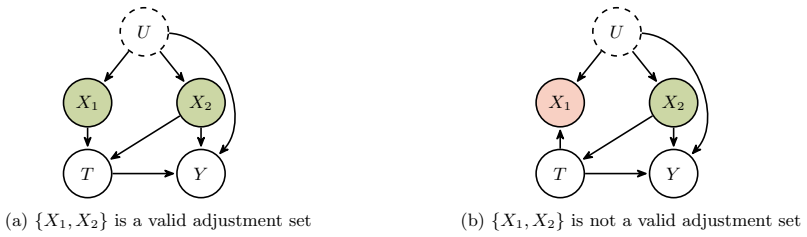


read the original abstract
Practical and ethical constraints often require the use of observational data for causal inference, particularly in medicine and social sciences. Yet, observational datasets are prone to confounding, potentially compromising the validity of causal conclusions. While it is possible to correct for biases if the underlying causal graph is known, this is rarely a feasible ask in practical scenarios. A common strategy is to adjust for all available covariates, yet this approach can yield biased treatment effect estimates, especially when post-treatment or unobserved variables are present. We propose RAMEN, an algorithm that produces unbiased treatment effect estimates by leveraging the heterogeneity of multiple data sources without the need to know or learn the underlying causal graph. Notably, RAMEN achieves doubly robust identification: it can identify the treatment effect whenever the causal parents of the treatment or those of the outcome are observed, and the node whose parents are observed satisfies an invariance assumption. Empirical evaluations on synthetic and real-world datasets show that our approach outperforms existing methods.
Editorial analysis
A structured set of objections, weighed in public.
Referee Report
Summary. The paper introduces RAMEN, an algorithm that produces unbiased treatment effect estimates from multiple observational data sources by exploiting heterogeneity across environments, without requiring knowledge or learning of the underlying causal graph. It claims a doubly robust identification result: the average treatment effect is identified whenever the causal parents of the treatment or of the outcome are observed and the node with observed parents satisfies an invariance assumption. The approach is evaluated empirically on synthetic and real-world datasets, where it outperforms existing methods.
Significance. If the doubly robust identification result holds under the stated conditions on invariance and heterogeneity, the work would offer a practically useful advance in causal inference. It enables graph-free estimation from multi-environment observational data, which is common in medicine and social sciences, while providing robustness to misspecification of either the treatment or outcome mechanism. The empirical outperformance on both synthetic and real data strengthens the case for its utility.
minor comments (1)
- [Abstract] Abstract, final sentence of contribution description: the invariance assumption and the precise heterogeneity conditions across environments are referenced but not defined; a one-sentence clarification of these would improve readability without altering the central claim.
Simulated Author's Rebuttal
We thank the referee for their positive summary of our work on RAMEN and for recommending minor revision. The recognition of the practical utility of the doubly robust identification result from multi-environment data without requiring the causal graph is appreciated. No major comments were provided in the report.
Circularity Check
No significant circularity detected
full rationale
The abstract presents RAMEN as achieving doubly robust identification of treatment effects from multiple environments under an invariance assumption on observed causal parents, without any displayed equations, fitted parameters, or derivation steps that reduce the claimed result to its own inputs by construction. No self-definitional loops, fitted-input predictions, or load-bearing self-citations are visible in the supplied text. The central claim is framed as relying on external heterogeneity across data sources and the stated invariance condition, rendering the derivation self-contained on the given information.
Axiom & Free-Parameter Ledger
axioms (2)
- domain assumption Invariance assumption holds for the node whose parents are observed
- domain assumption Multiple data sources exhibit heterogeneity sufficient for identification
invented entities (1)
-
RAMEN algorithm
no independent evidence
Reference graph
Works this paper leans on
-
[1]
Explaining causal findings without bias: detecting and assessing direct effects
Avidit Acharya, Matthew Blackwell, and Maya Sen. Explaining causal findings without bias: detecting and assessing direct effects. American Political Science Review, 110(3):512–529, 2016
work page 2016
-
[2]
Douglas Almond, Kenneth Chay, and David Lee. The costs of low birth weight. The Quarterly Journal of Economics, 120(3):1031–1083, 2005
work page 2005
-
[3]
Martin Arjovsky, L´ eon Bottou, Ishaan Gulrajani, and David Lopez-Paz. Invariant risk minimization. arXiv preprint arXiv:1907.02893 , 2019
work page internal anchor Pith review Pith/arXiv arXiv 1907
-
[4]
Doubly robust identification for causal panel data models
Dmitry Arkhangelsky and Guido Imbens. Doubly robust identification for causal panel data models. The Econometrics Journal , 25(3):649–674, 2022
work page 2022
-
[5]
Peter Austin. An introduction to propensity score methods for reducing the effects of confounding in observational studies. Multivariate Behavioral Research, 46(3):399–424, 2011
work page 2011
-
[6]
Half-trek criterion for identifiability of latent variable models
Rina Foygel Barber, Mathias Drton, Nils Sturma, and Luca Weihs. Half-trek criterion for identifiability of latent variable models. The Annals of Statistics , 50(6):3174–3196, 2022
work page 2022
-
[7]
Reuben Baron and David Kenny. The moderator–mediator variable distinction in social psychologi- cal research: Conceptual, strategic, and statistical considerations. Journal of Personality and Social Psychology, 51(6):1173, 1986
work page 1986
-
[8]
Efficient semiparametric estimation of multi-valued treatment effects under ignora- bility
Matias Cattaneo. Efficient semiparametric estimation of multi-valued treatment effects under ignora- bility. Journal of Econometrics , 155(2):138–154, 2010
work page 2010
-
[9]
Causal query in observational data with hidden variables
Debo Cheng, Jiuyong Li, Lin Liu, Jixue Liu, Kui Yu, and Thuc Duy Le. Causal query in observational data with hidden variables. European Conference on Artificial Intelligence, 2020
work page 2020
-
[10]
Toward unique and unbiased causal effect estimation from data with hidden variables
Debo Cheng, Jiuyong Li, Lin Liu, Kui Yu, Thuc Duy Le, and Jixue Liu. Toward unique and unbiased causal effect estimation from data with hidden variables. IEEE Transactions on Neural Networks and Learning Systems, 34(9):6108–6120, 2022
work page 2022
-
[11]
Local search for efficient causal effect estimation
Debo Cheng, Jiuyong Li, Lin Liu, Jiji Zhang, Jixue Liu, and Thuc Duy Le. Local search for efficient causal effect estimation. IEEE Transactions on Knowledge and Data Engineering , 2022
work page 2022
-
[12]
Data-driven causal effect estimation based on graphical causal modelling: A survey
Debo Cheng, Jiuyong Li, Lin Liu, Jixue Liu, and Thuc Duy Le. Data-driven causal effect estimation based on graphical causal modelling: A survey. ACM Computing Surveys , 56(5):1–37, 2024
work page 2024
-
[13]
Double/debiased machine learning for treatment and structural parameters
Victor Chernozhukov, Denis Chetverikov, Mert Demirer, Esther Duflo, Christian Hansen, Whitney Newey, and James Robins. Double/debiased machine learning for treatment and structural parameters. The Econometrics Journal , 21(1):C1–C68, 2018. 12
work page 2018
-
[14]
Hidden yet quantifi- able: A lower bound for confounding strength using randomized trials
Piersilvio De Bartolomeis, Javier Abad, Konstantin Donhauser, and Fanny Yang. Hidden yet quantifi- able: A lower bound for confounding strength using randomized trials. International Conference on Artificial Intelligence and Statistics , 2024
work page 2024
-
[15]
Detecting critical treatment effect bias in small subgroups
Piersilvio De Bartolomeis, Javier Abad, Konstantin Donhauser, and Fanny Yang. Detecting critical treatment effect bias in small subgroups. Uncertainty in Artificial Intelligence , 2024
work page 2024
-
[16]
Covariate selection for the nonpara- metric estimation of an average treatment effect
Xavier De Luna, Ingeborg Waernbaum, and Thomas Richardson. Covariate selection for the nonpara- metric estimation of an average treatment effect. Biometrika, 98(4):861–875, 2011
work page 2011
-
[17]
Benchmarking observational studies with experimental data under right-censoring
Ilker Demirel, Edward De Brouwer, Zeshan Hussain, Michael Oberst, Anthony Philippakis, and David Sontag. Benchmarking observational studies with experimental data under right-censoring. arXiv preprint arXiv:2402.15137, 2024
-
[18]
Npci: Non-parametrics for causal inference
Vincent Dorie. Npci: Non-parametrics for causal inference. 2016. URL https://github.com/vdorie/ npci
work page 2016
-
[19]
Global identifiability of linear structural equation models
Mathias Drton, Rina Foygel, and Seth Sullivant. Global identifiability of linear structural equation models. The Annals of Statistics , 39(2):865–886, 2011
work page 2011
-
[20]
Data-driven covariate selection for nonparametric esti- mation of causal effects
Doris Entner, Patrik Hoyer, and Peter Spirtes. Data-driven covariate selection for nonparametric esti- mation of causal effects. International Conference on Artificial Intelligence and Statistics , 2013
work page 2013
-
[21]
IDA with background knowledge.Uncertainty in Artificial Intelligence, 2020
Zhuangyan Fang and Yangbo He. IDA with background knowledge.Uncertainty in Artificial Intelligence, 2020
work page 2020
-
[22]
Half-trek criterion for generic identifiability of linear structural equation models
Rina Foygel, Jan Draisma, and Mathias Drton. Half-trek criterion for generic identifiability of linear structural equation models. The Annals of Statistics , pages 1682–1713, 2012
work page 2012
-
[23]
Learning causal structures using regression invariance
AmirEmad Ghassami, Saber Salehkaleybar, Negar Kiyavash, and Kun Zhang. Learning causal structures using regression invariance. Advances in Neural Information Processing Systems , 2017
work page 2017
-
[24]
Arthur Gretton, Karsten Borgwardt, Malte Rasch, Bernhard Sch¨ olkopf, and Alexander Smola. A kernel two-sample test. The Journal of Machine Learning Research , 13(1):723–773, 2012
work page 2012
-
[25]
arXiv preprint arXiv:2405.04715
Yihong Gu, Cong Fang, Peter B¨ uhlmann, and Jianqing Fan. Causality pursuit from heterogeneous environments via neural adversarial invariance learning. arXiv preprint arXiv:2405.04715 , 2024
-
[26]
Differentiable causal backdoor dis- covery
Limor Gultchin, Matt Kusner, Varun Kanade, and Ricardo Silva. Differentiable causal backdoor dis- covery. International Conference on Artificial Intelligence and Statistics , 2020
work page 2020
-
[27]
Confounder selection: Objectives and ap- proaches
Richard Guo, Anton Rask Lundborg, and Qingyuan Zhao. Confounder selection: Objectives and ap- proaches. arXiv preprint arXiv:2208.13871 , 2022
-
[28]
Variable elimination, graph reduction and the efficient g-formula
Richard Guo, Emilija Perkovi´ c, and Andrea Rotnitzky. Variable elimination, graph reduction and the efficient g-formula. Biometrika, 110(3):739–761, 2023
work page 2023
-
[29]
Zijian Guo, Hyunseung Kang, Tony Cai, and Dylan Small. Confidence intervals for causal effects with invalid instruments by using two-stage hard thresholding with voting. Journal of the Royal Statistical Society Series B: Statistical Methodology , 80(4):793–815, 2018
work page 2018
-
[30]
Functional restriction and efficiency in causal inference
Jinyong Hahn. Functional restriction and efficiency in causal inference. The Review of Economics and Statistics, 86(1):73–76, 2004
work page 2004
-
[31]
Valid causal inference with (some) invalid instruments
Jason Hartford, Victor Veitch, Dhanya Sridhar, and Kevin Leyton-Brown. Valid causal inference with (some) invalid instruments. International Conference on Machine Learning , 2021. 13
work page 2021
-
[32]
Robust inference in summary data mendelian randomization via the zero modal pleiotropy assumption
Fernando Pires Hartwig, George Davey Smith, and Jack Bowden. Robust inference in summary data mendelian randomization via the zero modal pleiotropy assumption. International Journal of Epidemi- ology, 46(6):1985–1998, 2017
work page 1985
-
[33]
Invariant causal prediction for nonlinear models
Christina Heinze-Deml, Jonas Peters, and Nicolai Meinshausen. Invariant causal prediction for nonlinear models. Journal of Causal Inference , 6(2):20170016, 2018
work page 2018
-
[34]
Graphical criteria for efficient total effect estimation via adjustment in causal linear models
Leonard Henckel, Emilija Perkovi´ c, and Marloes Maathuis. Graphical criteria for efficient total effect estimation via adjustment in causal linear models. Journal of the Royal Statistical Society Series B: Statistical Methodology, 84(2):579–599, 2022
work page 2022
- [35]
-
[36]
Bayesian nonparametric modeling for causal inference
Jennifer Hill. Bayesian nonparametric modeling for causal inference. Journal of Computational and Graphical Statistics, 20(1):217–240, 2011
work page 2011
-
[37]
Causal discovery from heterogeneous/nonstationary data
Biwei Huang, Kun Zhang, Jiji Zhang, Joseph Ramsey, Ruben Sanchez-Romero, Clark Glymour, and Bernhard Sch¨ olkopf. Causal discovery from heterogeneous/nonstationary data. Journal of Machine Learning Research, 21(89):1–53, 2020
work page 2020
-
[38]
Falsification before extrapolation in causal effect estimation
Zeshan Hussain, Michael Oberst, Ming-Chieh Shih, and David Sontag. Falsification before extrapolation in causal effect estimation. Advances in Neural Information Processing Systems , 35, 2022
work page 2022
-
[39]
Zeshan Hussain, Ming-Chieh Shih, Michael Oberst, Ilker Demirel, and David Sontag. Falsification of internal and external validity in observational studies via conditional moment restrictions. International Conference on Artificial Intelligence and Statistics , 2023
work page 2023
-
[40]
Do-calculus when the true graph is unknown
Antti Hyttinen, Frederick Eberhardt, and Matti J¨ arvisalo. Do-calculus when the true graph is unknown. Uncertainty in Artificial Intelligence , 2015
work page 2015
-
[41]
Kosuke Imai, Luke Keele, Dustin Tingley, and Teppei Yamamoto. Unpacking the black box of causality: Learning about causal mechanisms from experimental and observational studies. American Political Science Review, 105(4):765–789, 2011
work page 2011
-
[42]
Categorical reparameterization with gumbel-softmax
Eric Jang, Shixiang Gu, and Ben Poole. Categorical reparameterization with gumbel-softmax. Inter- national Conference on Learning Representations, 2017
work page 2017
-
[43]
Hyunseung Kang, Anru Zhang, Tony Cai, and Dylan Small. Instrumental variables estimation with some invalid instruments and its application to mendelian randomization. Journal of the American Statistical Association, 111(513):132–144, 2016
work page 2016
-
[44]
Joseph Kang and Joseph Schafer. Demystifying double robustness: a comparison of alternative strategies for estimating a population mean from incomplete data. Statistical Science, pages 523–539, 2007
work page 2007
-
[45]
Detecting hidden confounding in observational data using multiple environments
Rickard Karlsson and Jesse Krijthe. Detecting hidden confounding in observational data using multiple environments. Advances in Neural Information Processing Systems , 37, 2023
work page 2023
-
[46]
Dimension-agnostic inference using cross U-statistics
Ilmun Kim and Aaditya Ramdas. Dimension-agnostic inference using cross U-statistics. Bernoulli, 30 (1):683–711, 2024
work page 2024
-
[47]
A hard unsolved problem? Post-treatment bias in big social science questions
Gary King. A hard unsolved problem? Post-treatment bias in big social science questions. Hard Problems in Social Science Symposium , 2010
work page 2010
-
[48]
Ivy: Instrumental variable synthesis for causal inference
Zhaobin Kuang, Frederic Sala, Nimit Sohoni, Sen Wu, Aldo C´ ordova-Palomera, Jared Dunnmon, James Priest, and Christopher R´ e. Ivy: Instrumental variable synthesis for causal inference. International Conference on Artificial Intelligence and Statistics , 2020. 14
work page 2020
-
[49]
A generalized back-door criterion
Marloes Maathuis and Diego Colombo. A generalized back-door criterion. The Annals of Statistics , 43 (3):1060–1088, 2015
work page 2015
-
[50]
Estimating high-dimensional intervention effects from observational data
Marloes Maathuis, Markus Kalisch, and Peter B¨ uhlmann. Estimating high-dimensional intervention effects from observational data. The Annals of Statistics , 37(6A):3133–3164, 2009
work page 2009
-
[51]
The concrete distribution: A continuous relaxation of discrete random variables
Chris Maddison, Andriy Mnih, and Yee Whye Teh. The concrete distribution: A continuous relaxation of discrete random variables. International Conference on Learning Representations, 2017
work page 2017
-
[52]
Estimating bounds on causal effects in high-dimensional and possibly confounded systems
Daniel Malinsky and Peter Spirtes. Estimating bounds on causal effects in high-dimensional and possibly confounded systems. International Journal of Approximate Reasoning , 88:371–384, 2017
work page 2017
-
[53]
Identifying confounding from causal mechanism shifts
Sarah Mameche, Jilles Vreeken, and David Kaltenpoth. Identifying confounding from causal mechanism shifts. In International Conference on Artificial Intelligence and Statistics , 2024
work page 2024
-
[54]
Maternal cigarette smoking and perinatal mortality
Mary Meyer and George Comstock. Maternal cigarette smoking and perinatal mortality. American Journal of Epidemiology , 96(1):1–10, 1972
work page 1972
-
[55]
Jacob Montgomery, Brendan Nyhan, and Michelle Torres. How conditioning on posttreatment variables can ruin your experiment and what to do about it.American Journal of Political Science, 62(3):760–775, 2018
work page 2018
-
[56]
A double machine learning approach to combining experimental and observational data
Marco Morucci, Vittorio Orlandi, Harsh Parikh, Sudeepa Roy, Cynthia Rudin, and Alexander Volfovsky. A double machine learning approach to combining experimental and observational data. arXiv preprint arXiv:2307.01449, 2023
-
[57]
Causal diagrams for empirical research
Judea Pearl. Causal diagrams for empirical research. Biometrika, 82(4):669–688, 1995
work page 1995
-
[58]
Judea Pearl. Direct and indirect effects. Probabilistic and causal inference: the works of Judea Pearl , pages 373–392, 2022
work page 2022
-
[59]
Interpreting and using CPDAGs with back- ground knowledge
Emilija Perkovi´ c, Markus Kalisch, and Marloes Maathuis. Interpreting and using CPDAGs with back- ground knowledge. Uncertainty in Artificial Intelligence , 2017
work page 2017
-
[60]
Emilija Perkovi´ c, Johannes Textor, Markus Kalisch, and Marloes Maathuis. Complete graphical charac- terization and construction of adjustment sets in Markov equivalence classes of ancestral graphs.Journal of Machine Learning Research, 18(220):1–62, 2018
work page 2018
-
[61]
Causal inference by using invariant prediction: identification and confidence intervals
Jonas Peters, Peter B¨ uhlmann, and Nicolai Meinshausen. Causal inference by using invariant prediction: identification and confidence intervals. Journal of the Royal Statistical Society Series B: Statistical Methodology, 78(5):947–1012, 2016
work page 2016
-
[62]
Elements of causal inference: foundations and learning algorithms
Jonas Peters, Dominik Janzing, and Bernhard Sch¨ olkopf. Elements of causal inference: foundations and learning algorithms. The MIT Press , 2017
work page 2017
-
[63]
Invariant causal prediction for sequential data
Niklas Pfister, Peter B¨ uhlmann, and Jonas Peters. Invariant causal prediction for sequential data. Journal of the American Statistical Association , 2019
work page 2019
-
[64]
Stabilizing variable selection and regression
Niklas Pfister, Evan Williams, Jonas Peters, Ruedi Aebersold, and Peter B¨ uhlmann. Stabilizing variable selection and regression. The Annals of Applied Statistics , 15(3):1220–1246, 2021
work page 2021
-
[65]
SPSS and SAS procedures for estimating indirect effects in simple mediation models
Kristopher Preacher and Andrew Hayes. SPSS and SAS procedures for estimating indirect effects in simple mediation models. Behavior research methods, instruments, & computers , 36:717–731, 2004
work page 2004
-
[66]
Identifiability and exchangeability for direct and indirect effects
James Robins and Sander Greenland. Identifiability and exchangeability for direct and indirect effects. Epidemiology, 3(2):143–155, 1992. 15
work page 1992
-
[67]
Semiparametric efficiency in multivariate regression models with missing data
James Robins and Andrea Rotnitzky. Semiparametric efficiency in multivariate regression models with missing data. Journal of the American Statistical Association , 90(429):122–129, 1995
work page 1995
-
[68]
Estimation of regression coefficients when some regressors are not always observed
James Robins, Andrea Rotnitzky, and Lue Ping Zhao. Estimation of regression coefficients when some regressors are not always observed. Journal of the American Statistical Association , 89(427):846–866, 1994
work page 1994
-
[69]
Invariant models for causal transfer learning
Mateo Rojas-Carulla, Bernhard Sch¨ olkopf, Richard Turner, and Jonas Peters. Invariant models for causal transfer learning. Journal of Machine Learning Research , 19(36):1–34, 2018
work page 2018
-
[70]
The risks of invariant risk minimiza- tion
Elan Rosenfeld, Pradeep Kumar Ravikumar, and Andrej Risteski. The risks of invariant risk minimiza- tion. International Conference on Learning Representations, 2021
work page 2021
-
[71]
Dominik Rothenh¨ ausler, Peter B¨ uhlmann, and Nicolai Meinshausen. Causal Dantzig. The Annals of Statistics, 47(3):1688–1722, 2019
work page 2019
-
[72]
Anchor regression: Heterogeneous data meet causality
Dominik Rothenh¨ ausler, Nicolai Meinshausen, Peter B¨ uhlmann, and Jonas Peters. Anchor regression: Heterogeneous data meet causality. Journal of the Royal Statistical Society Series B: Statistical Method- ology, 83(2):215–246, 2021
work page 2021
-
[73]
Andrea Rotnitzky and Ezequiel Smucler. Efficient adjustment sets for population average causal treat- ment effect estimation in graphical models. Journal of Machine Learning Research , 21(1):7642–7727, 2020
work page 2020
-
[74]
A clinical trial of change in maternal smoking and its effect on birth weight
Mary Sexton and Richard Hebel. A clinical trial of change in maternal smoking and its effect on birth weight. Journal of the American Medical Association , (7):911–915, 1984
work page 1984
-
[75]
Finding valid adjustments under non- ignorability with minimal DAG knowledge
Abhin Shah, Karthikeyan Shanmugam, and Kartik Ahuja. Finding valid adjustments under non- ignorability with minimal DAG knowledge. International Conference on Artificial Intelligence and Statistics, 2022
work page 2022
-
[76]
Front-door adjustment beyond Markov equivalence with limited graph knowledge
Abhin Shah, Karthikeyan Shanmugam, and Murat Kocaoglu. Front-door adjustment beyond Markov equivalence with limited graph knowledge. Advances in Neural Information Processing Systems , 2024
work page 2024
-
[77]
Estimating individual treatment effect: generalization bounds and algorithms
Uri Shalit, Fredrik Johansson, and David Sontag. Estimating individual treatment effect: generalization bounds and algorithms. International Conference on Machine Learning , 2017
work page 2017
-
[78]
Causality-oriented robustness: exploiting general additive interventions
Xinwei Shen, Peter B¨ uhlmann, and Armeen Taeb. Causality-oriented robustness: exploiting general additive interventions. arXiv preprint arXiv:2307.10299 , 2023
-
[79]
Invariant representation learning for treatment effect estimation
Claudia Shi, Victor Veitch, and David Blei. Invariant representation learning for treatment effect estimation. Uncertainty in Artificial Intelligence , 2021
work page 2021
-
[80]
On the validity of covariate adjustment for estimating causal effects
Ilya Shpitser, Tyler VanderWeele, and James Robins. On the validity of covariate adjustment for estimating causal effects. Uncertainty in Artificial Intelligence , 2010
work page 2010
discussion (0)
Sign in with ORCID, Apple, or X to comment. Anyone can read and Pith papers without signing in.