Using Data Redundancy Techniques to Detect and Correct Errors in Logical Data
Pith reviewed 2026-05-22 23:30 UTC · model grok-4.3
The pith
Adapting RAID parity and striping to logical data allows recovery of arbitrary faults in large archive files using only a small fraction of redundant data.
A machine-rendered reading of the paper's core claim, the machinery that carries it, and where it could break.
Core claim
By transferring the RAID scheme of striping and parity from physical disk arrays to arbitrary logical data, the system produces a file format and recovery procedure that can detect and correct arbitrary faults in large archives. Experiments with synthetic benchmarks and simulated faults confirm that the method restores the original data while storing only a small fraction of redundant information and relying on available computing power rather than specialized hardware.
What carries the argument
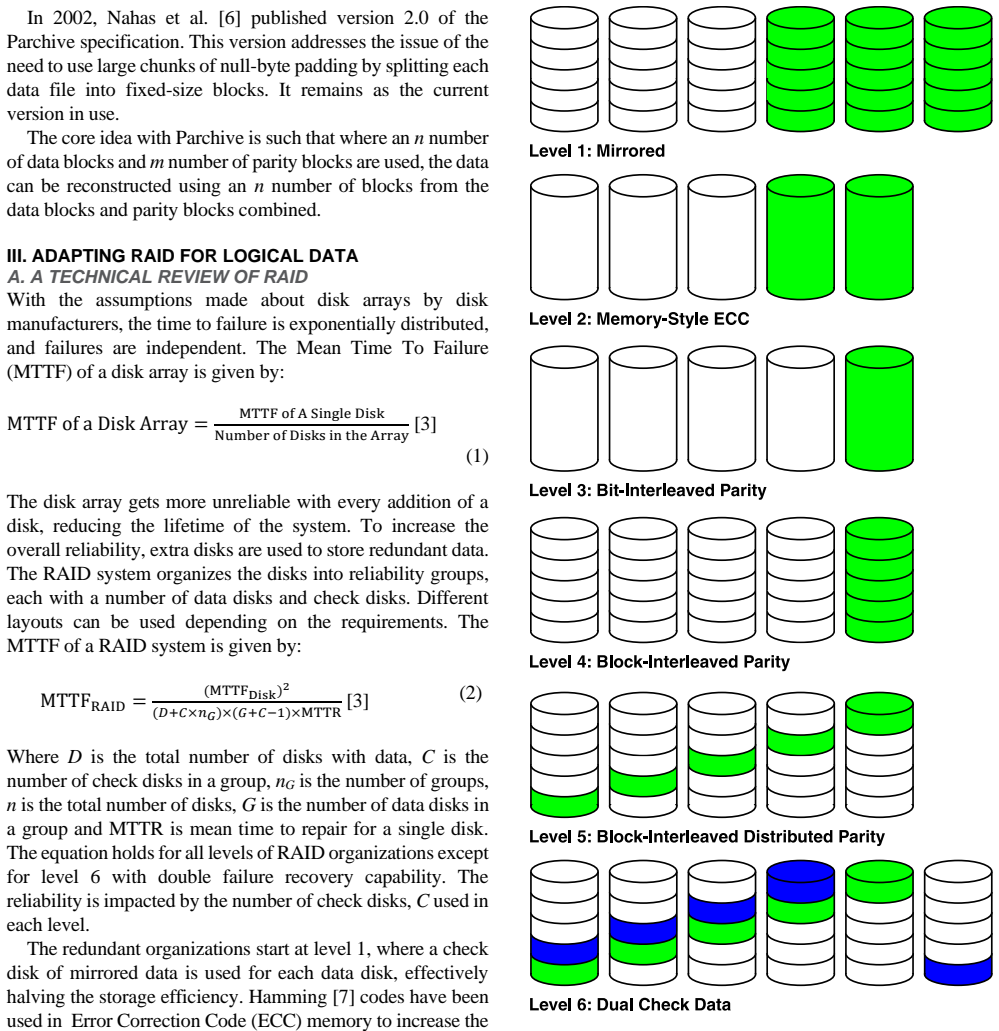
The adapted RAID parity and striping logic applied directly to logical data structures, which generates the redundant information used for both detection and correction.
If this is right
- Large archive files can be protected against arbitrary faults without duplicating the entire file.
- Recovery becomes feasible using only the parity data and ordinary computing resources.
- The approach extends fault tolerance beyond hardware and file-system layers to user-level logical data.
- Multiple use cases can be served by the same file-format specification and recovery procedures.
Where Pith is reading between the lines
- The same logic might be applied to other container formats such as database dumps or virtual-machine images.
- Integration into backup utilities could reduce the total storage needed for reliable long-term archives.
- If the parity calculations prove portable, similar techniques could appear in general-purpose compression or archiving libraries.
Load-bearing premise
That the same parity and striping calculations that work for disk blocks will function correctly on arbitrary logical data without creating new unrecoverable failure patterns.
What would settle it
A test case in which a single injected fault pattern in an archive file defeats the recovery procedure or requires a larger redundant fraction than the reported small overhead.
Figures

read the original abstract
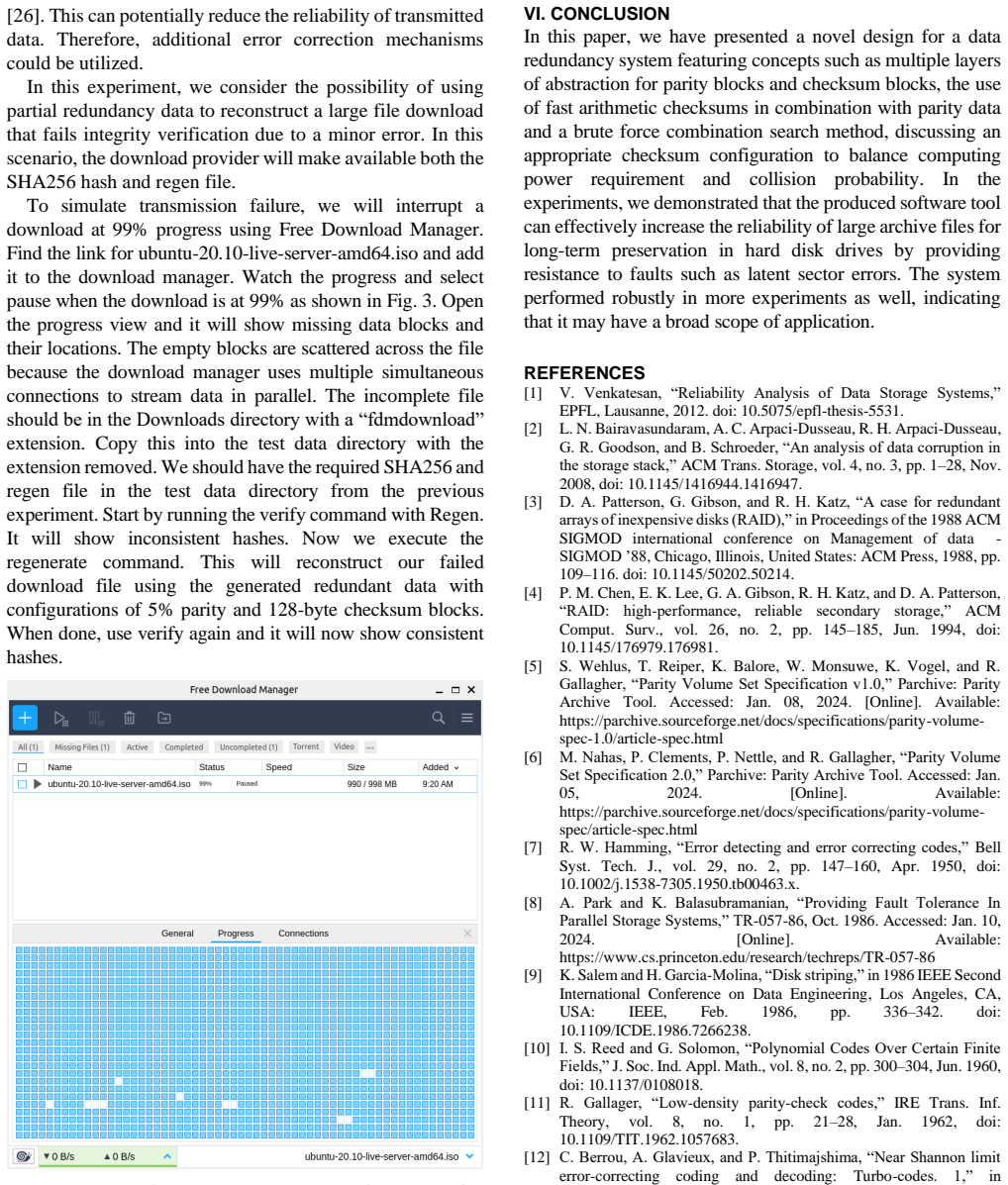
Data redundancy techniques have been tested in several different applications to provide fault tolerance and performance gains. The use of these techniques is mostly seen at the hardware, device driver, or file system level. In practice, the use of data integrity techniques with logical data has largely been limited to verifying the integrity of transferred files using cryptographic hashes. In this paper, we study the RAID scheme used with disk arrays and adapt it for use with logical data. An implementation for such a system is devised in theory and implemented in software, providing the specifications for the procedures and file formats used. Rigorous experimentation is conducted to test the effectiveness of the developed system for multiple use cases. With computer-generated benchmarks and simulated experiments, the system demonstrates robust performance in recovering arbitrary faults in large archive files only using a small fraction of redundant data. This was achieved by leveraging computing power for the process of data recovery.
Editorial analysis
A structured set of objections, weighed in public.
Referee Report
Summary. The paper adapts RAID parity and striping techniques from disk arrays for use with logical data to enable error detection and correction. It provides a theoretical design, software implementation specifications including procedures and file formats, and evaluates the approach via computer-generated benchmarks and simulated fault-injection experiments on large archive files. The central claim is that the system recovers arbitrary faults robustly while using only a small fraction of redundant data, with recovery powered by computation rather than hardware.
Significance. If the performance claims are validated under fault models representative of logical data, the work could extend application-level redundancy beyond cryptographic hashes, offering a practical way to protect archive integrity with modest overhead. The explicit provision of procedure and file-format specifications is a strength that aids reproducibility.
major comments (3)
- [Abstract] Abstract: the claim of demonstrating 'robust performance in recovering arbitrary faults ... only using a small fraction of redundant data' is unsupported by any quantitative metrics, recovery rates, redundancy percentages, or statistical description of the simulated experiments; without these the central performance assertion cannot be assessed.
- [Experimentation section] Experimentation / fault model: RAID parity assumes independent whole-block erasures on separate devices, yet the manuscript's adaptation to logical archive files must demonstrate that the simulated fault injection captures correlated bit/byte corruptions, partial overwrites, and format-specific damage typical of logical data; the direct transfer of RAID logic without such validation risks non-generalizable recovery rates.
- [Design and Implementation] Design / implementation: the claim that RAID logic can be transferred to arbitrary logical data structures without new failure modes requires explicit analysis or tests showing that recovery procedures remain effective for non-block-aligned or format-dependent data; this assumption is load-bearing for the robustness claim.
minor comments (2)
- [Results] Provide a clear definition and table of the exact redundancy fraction (e.g., parity overhead) used across the reported benchmarks.
- [Experimentation] Include at least one baseline comparison (e.g., simple hashing or existing erasure codes) to contextualize the reported recovery performance.
Simulated Author's Rebuttal
We thank the referee for the constructive comments, which highlight areas where the manuscript can be clarified and strengthened. We address each major comment below and indicate the revisions we will make.
read point-by-point responses
-
Referee: [Abstract] Abstract: the claim of demonstrating 'robust performance in recovering arbitrary faults ... only using a small fraction of redundant data' is unsupported by any quantitative metrics, recovery rates, redundancy percentages, or statistical description of the simulated experiments; without these the central performance assertion cannot be assessed.
Authors: We agree that the abstract would be strengthened by including explicit quantitative support drawn from the experimentation section. The full manuscript reports results from computer-generated benchmarks and simulated fault-injection experiments on large archive files; we will revise the abstract to reference key metrics such as observed recovery rates, the specific redundancy fractions employed, and a brief statistical summary of the trials. revision: yes
-
Referee: [Experimentation section] Experimentation / fault model: RAID parity assumes independent whole-block erasures on separate devices, yet the manuscript's adaptation to logical archive files must demonstrate that the simulated fault injection captures correlated bit/byte corruptions, partial overwrites, and format-specific damage typical of logical data; the direct transfer of RAID logic without such validation risks non-generalizable recovery rates.
Authors: The experimentation section describes simulated fault injection on archive files that includes bit- and byte-level corruptions. To address the concern about representativeness for logical data, we will add an explicit subsection detailing the fault model (including how partial overwrites and format-agnostic corruptions are generated) and will include additional validation runs that inject correlated errors to confirm that recovery rates remain consistent with the independent-block assumption. revision: partial
-
Referee: [Design and Implementation] Design / implementation: the claim that RAID logic can be transferred to arbitrary logical data structures without new failure modes requires explicit analysis or tests showing that recovery procedures remain effective for non-block-aligned or format-dependent data; this assumption is load-bearing for the robustness claim.
Authors: The design section specifies block-based procedures and file formats that apply to arbitrary data via explicit padding to block boundaries. We will augment the design section with a short analysis and accompanying test cases demonstrating that the recovery procedures continue to function correctly for non-aligned data and across different archive formats, thereby confirming that no new failure modes are introduced by the logical-data adaptation. revision: yes
Circularity Check
No circularity: claims rest on external simulation results, not self-referential definitions or fits
full rationale
The visible abstract and description contain no equations, fitted parameters, self-citations, or uniqueness theorems. The central claim is that an adapted RAID scheme recovers faults in simulated experiments using small redundancy; this is presented as an empirical outcome of software implementation and benchmark runs rather than a derivation that reduces to its own inputs by construction. No self-definitional steps, no 'prediction' that is statistically forced by a prior fit, and no load-bearing self-citation chain appear. The paper is therefore self-contained against external benchmarks for the purpose of this circularity check.
Axiom & Free-Parameter Ledger
Lean theorems connected to this paper
-
IndisputableMonolith/Cost/FunctionalEquation.leanwashburn_uniqueness_aczel unclear?
unclearRelation between the paper passage and the cited Recognition theorem.
We study the RAID scheme used with disk arrays and adapt it for use with logical data... XOR parity is used... Fletcher-16... generate a set of combinations with the erroneous bit indexes
-
IndisputableMonolith/Foundation/AbsoluteFloorClosure.leanreality_from_one_distinction unclear?
unclearRelation between the paper passage and the cited Recognition theorem.
MTTFRAID formulas, parity-block / checksum-block layout, Pr(recovery) = 1 − Pr(checksum collision) − Pr(parity collision)
What do these tags mean?
- matches
- The paper's claim is directly supported by a theorem in the formal canon.
- supports
- The theorem supports part of the paper's argument, but the paper may add assumptions or extra steps.
- extends
- The paper goes beyond the formal theorem; the theorem is a base layer rather than the whole result.
- uses
- The paper appears to rely on the theorem as machinery.
- contradicts
- The paper's claim conflicts with a theorem or certificate in the canon.
- unclear
- Pith found a possible connection, but the passage is too broad, indirect, or ambiguous to say the theorem truly supports the claim.
Reference graph
Works this paper leans on
-
[1]
Reliability Analysis of Data Storage Systems,
V. Venkatesan, “Reliability Analysis of Data Storage Systems,” EPFL, Lausanne, 2012. doi: 10.5075/epfl-thesis-5531
-
[2]
An analysis of data corruption in the storage stack,
L. N. Bairavasundaram, A. C. Arpaci-Dusseau, R. H. Arpaci-Dusseau, G. R. Goodson, and B. Schroeder, “An analysis of data corruption in the storage stack,” ACM Trans. Storage, vol. 4, no. 3, pp. 1–28, Nov. 2008, doi: 10.1145/1416944.1416947
-
[3]
A case for redundant arrays of inexpensive disks (RAID),
D. A. Patterson, G. Gibson, and R. H. Katz, “A case for redundant arrays of inexpensive disks (RAID),” in Proceedings of the 1988 ACM SIGMOD international conference on Management of data - SIGMOD ’88, Chicago, Illinois, United States: ACM Press, 1988, pp. 109–116. doi: 10.1145/50202.50214
-
[4]
RAID: high -performance, reliable secondary storage,
P. M. Chen, E. K. Lee, G. A. Gibson, R. H. Katz, and D. A. Patterson, “RAID: high -performance, reliable secondary storage,” ACM Comput. Surv. , vol. 26, no. 2, pp. 145 –185, Jun. 1994, doi: 10.1145/176979.176981
-
[5]
Parity Volume Set Specification v1.0,
S. Wehlus, T. Reiper, K. Balore, W. Monsuwe, K. Vogel, and R. Gallagher, “Parity Volume Set Specification v1.0,” Parchive: Parity Archive Tool. Accessed: Jan. 08, 2024. [Online]. Available: https://parchive.sourceforge.net/docs/specifications/parity-volume- spec-1.0/article-spec.html
work page 2024
-
[6]
Parity Volume Set Specification 2.0,
M. Nahas, P. Clements, P. Nettle, and R. Gallagher, “Parity Volume Set Specification 2.0,” Parchive: Parity Archive Tool. Accessed: Jan. 05, 2024. [Online]. Available: https://parchive.sourceforge.net/docs/specifications/parity-volume- spec/article-spec.html
work page 2024
-
[7]
Error detecting and error correcting codes,
R. W. Hamming, “Error detecting and error correcting codes,” Bell Syst. Tech. J. , vol. 29, no. 2, pp. 147 –160, Apr. 1950, doi: 10.1002/j.1538-7305.1950.tb00463.x
-
[8]
Providing Fault Tolerance In Parallel Storage Systems,
A. Park and K. Balasubramanian, “Providing Fault Tolerance In Parallel Storage Systems,” TR-057-86, Oct. 1986. Accessed: Jan. 10,
work page 1986
-
[9]
Available: https://www.cs.princeton.edu/research/techreps/TR-057-86
[Online]. Available: https://www.cs.princeton.edu/research/techreps/TR-057-86
-
[10]
K. Salem and H. Garcia-Molina, “Disk striping,” in 1986 IEEE Second International Conference on Data Engineering , Los Angeles, CA, USA: IEEE, Feb. 1986, pp. 336 –342. doi: 10.1109/ICDE.1986.7266238
-
[11]
Journal of the Society for Industrial and Applied Mathematics8(2), 300–304 (1960)
I. S. Reed and G. Solomon, “Polynomial Codes Over Certain Finite Fields,” J. Soc. Ind. Appl. Math., vol. 8, no. 2, pp. 300–304, Jun. 1960, doi: 10.1137/0108018
-
[12]
Low -density parity -check codes,
R. Gallager, “Low -density parity -check codes,” IRE Trans. Inf. Theory, vol. 8, no. 1, pp. 21 –28, Jan. 1962, doi: 10.1109/TIT.1962.1057683
-
[13]
Near Shannon limit error-correcting coding and decoding: Turbo -codes. 1,
C. Berrou, A. Glavieux, and P. Thitimajshima, “Near Shannon limit error-correcting coding and decoding: Turbo -codes. 1,” in Proceedings of ICC ’93 - IEEE International Conference on Communications, May 1993, pp. 1064 –1070 vol.2. doi: 10.1109/ICC.1993.397441
-
[14]
An Arithmetic Checksum for Serial Transmissions,
J. Fletcher, “An Arithmetic Checksum for Serial Transmissions,” IEEE Trans. Commun. , vol. 30, no. 1, pp. 247 –252, Jan. 1982, doi: 10.1109/TCOM.1982.1095369. 11
-
[15]
The Effectiveness of Checksums for Embedded Control Networks,
T. C. Maxino and P. J. Koopman, “The Effectiveness of Checksums for Embedded Control Networks,” IEEE Trans. Dependable Secure Comput., vol. 6, no. 1, pp. 59 –72, Jan. 2009, doi: 10.1109/TDSC.2007.70216
-
[16]
Cyclic Codes for Error Detection,
W. W. Peterson and D. T. Brown, “Cyclic Codes for Error Detection,” Proc. IRE , vol. 49, no. 1, pp. 228 –235, Jan. 1961, doi: 10.1109/JRPROC.1961.287814
-
[17]
Secure Hash Standard , NIST FIPS 180 -4, Jul. 2015. doi: 10.6028/NIST.FIPS.180-4
-
[18]
Revisiting Fletcher and Adler Checksums,
T. Maxino, “Revisiting Fletcher and Adler Checksums,” Jan. 2006, doi: 10.1184/R1/6625619.v1
-
[19]
Sharuvan, sharuvan/regen: Data redundancy generator for archive files
A. Sharuvan, sharuvan/regen: Data redundancy generator for archive files. (Jan. 28, 2024). Go. Accessed: Feb. 22, 2024. [Online]. Available: https://github.com/sharuvan/regen
work page 2024
-
[20]
Benchmarking as Empirical Standard in Software Engineering Research,
W. Hasselbring, “Benchmarking as Empirical Standard in Software Engineering Research,” in Proceedings of the 25th International Conference on Evaluation and Assessment in Software Engineering , in EASE ’21. New York, NY, USA: Association for Computing Machinery, Jun. 2021, pp. 365–372. doi: 10.1145/3463274.3463361
-
[21]
An Analysis of Latent Sector Errors in Disk Drives
L. N. Bairavasundaram, G. R. Goodson, S. Pasupathy, and J. Schindler, “An Analysis of Latent Sector Errors in Disk Drives”
-
[22]
Latent Sector Faults and Reliability of Disk Arrays,
H. H. Kari, “Latent Sector Faults and Reliability of Disk Arrays,” Helsinki University of Technology, Espoo, 1997
work page 1997
-
[23]
RAIDShield: Characterizing, Monitoring, and Proactively Protecting Against Disk Failures,
A. Ma et al. , “RAIDShield: Characterizing, Monitoring, and Proactively Protecting Against Disk Failures,” ACM Trans. Storage, vol. 11, no. 4, pp. 1–28, Nov. 2015, doi: 10.1145/2820615
-
[24]
Transmission Control Protocol (TCP) , Request for Comments RFC 9293, Aug. 2022. doi: 10.17487/rfc9293
-
[25]
The TFTP Protocol (Revision 2) , Request for Comments RFC 1350, Jul. 1992. doi: 10.17487/rfc1350
-
[26]
Protocols for Transferring Bulk Data Over Internet: Current Solutions and Future Challenges,
K. Khurshid, I. Ullah, Z. Shah, N. Hassan, and T. A. Ahanger, “Protocols for Transferring Bulk Data Over Internet: Current Solutions and Future Challenges,” IEEE Access, vol. 9, pp. 95228 – 95249, 2021, doi: 10.1109/ACCESS.2021.3094656
-
[27]
LEDBAT: The New BitTorrent Congestion Control Protocol,
D. Rossi, C. Testa, S. Valenti, and L. Muscariello, “LEDBAT: The New BitTorrent Congestion Control Protocol,” in 2010 Proceedings of 19th International Conference on Computer Communications and Networks, Aug. 2010, pp. 1–6. doi: 10.1109/ICCCN.2010.5560080
discussion (0)
Sign in with ORCID, Apple, or X to comment. Anyone can read and Pith papers without signing in.