Ageing-aware Energy Management for Residential Multi-Carrier Energy Systems
Pith reviewed 2026-05-22 23:28 UTC · model grok-4.3
The pith
An ageing-aware nonlinear MPC for residential multi-carrier energy systems cuts grid costs by 10 percent and battery degradation by 5 percent versus standard methods in high-solar periods.
A machine-rendered reading of the paper's core claim, the machinery that carries it, and where it could break.
Core claim
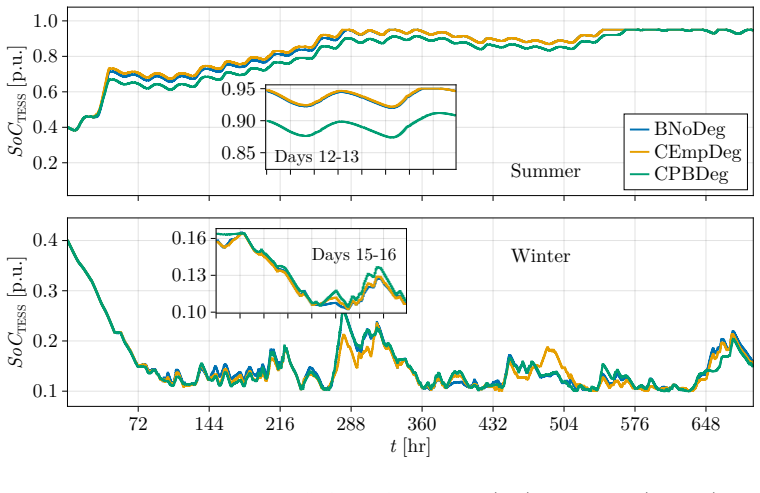
Embedding physics-based battery ageing models into a nonlinear economic model predictive controller for residential multi-carrier energy systems produces explicit trade-offs between grid cost and battery degradation. When applied to aged batteries the controller improves grid cost by 10 percent and degradation by 5 percent over the state of the art in summer periods; switching from NMC to LFP chemistry further yields a 10 percent grid-cost reduction and a 20 percent degradation decrease.
What carries the argument
Nonlinear economic model predictive controller that incorporates physics-based battery ageing models to optimize power dispatch across electricity, heat, and mobility while distinguishing storage chemistries and ageing states.
If this is right
- The controller can be tuned to prioritize either lower grid costs or longer battery life for electric-vehicle or stationary packs.
- Replacing NMC cells with LFP chemistry improves summer performance by 10 percent on grid cost and 20 percent on degradation.
- Gains of 10 percent grid cost and 5 percent degradation hold when the system uses already-aged batteries during high-solar, low-thermal-load seasons.
Where Pith is reading between the lines
- Similar embedding of physics-based models could be tested on other assets such as heat pumps or hydrogen storage to balance multiple degradation mechanisms.
- The framework suggests that residential energy standards may need chemistry-specific ageing data rather than generic empirical curves.
- Coupling the MPC with short-term solar and occupancy forecasts could amplify the reported summer gains.
Load-bearing premise
Physics-based battery ageing models stay accurate and can be solved in real time inside the nonlinear MPC without exceeding the computing limits of residential hardware.
What would settle it
A side-by-side test that records actual battery capacity loss over one year of residential operation and checks whether the MPC's embedded ageing predictions match the measured fade within a few percent.
Figures




read the original abstract
In the context of building electrification, the operation of distributed energy resources integrating multiple energy carriers (electricity, heat, mobility) poses a significant challenge due to the nonlinear device dynamics, uncertainty, and computational issues. As such, energy management systems seek to decide the power dispatch in the best way possible. The objective is to minimize and balance operative costs (energy bills or asset degradation) with user requirements (mobility, heating, etc.). Current energy management uses empirical battery ageing models outside of their specific fitting conditions, resulting in inaccuracies and poor performance. Moreover, the link to thermal systems is also overlooked. This paper presents an ageing-aware nonlinear economic model predictive controller for electrified buildings that incorporates physics-based battery ageing models. The models distinguish between energy storage systems (chemistry, ageing state, etc.) and make explicit the trade-off between grid cost and battery degradation. The proposed algorithm can either cut down on grid costs or extend battery lifetime (electric vehicle or stationary battery packs). Additionally, substituting NMC cells with LFP chemistries optimizes grid performance during the summer, yielding a 10% grid cost reduction and a 20% decrease in degradation. Finally, the grid cost and degradation of the presented MPC when using aged batteries are improved with respect to the state of the art by 10% and 5% respectively, in periods with high solar generation and low thermal loads like summer.
Editorial analysis
A structured set of objections, weighed in public.
Referee Report
Summary. The manuscript proposes an ageing-aware nonlinear economic model predictive controller (MPC) for residential multi-carrier energy systems integrating electricity, heat, and mobility. It embeds physics-based battery ageing models that differentiate by chemistry and state-of-health to explicitly trade off grid costs against degradation. The central claims are that the MPC improves grid cost by 10% and degradation by 5% versus state-of-the-art in summer conditions with aged batteries, and that substituting NMC with LFP cells yields a 10% grid-cost reduction and 20% degradation decrease.
Significance. If the computational and modeling claims hold, the work would advance practical energy management by moving battery ageing inside the optimizer rather than using empirical models post hoc, potentially enabling longer asset lifetimes in electrified buildings. The chemistry-specific treatment is a constructive step beyond generic degradation penalties.
major comments (2)
- [Abstract] Abstract: The headline quantitative claims (10% grid-cost and 5% degradation improvement vs. SOTA; 10%/20% LFP benefit) rest on the unverified premise that physics-based ageing models (chemistry-specific, SoH-dependent, nonlinear) can be embedded inside the nonlinear multi-carrier MPC while preserving real-time solvability on residential hardware. No solver timings, iteration counts, hardware platform, or approximation strategy are supplied to substantiate this precondition.
- [Abstract] Abstract: The manuscript states that the controller “can either cut down on grid costs or extend battery lifetime” but supplies no derivation details, validation of the embedded physics models against experimental ageing data, or evidence that the resulting non-convex OCP converges reliably under the reported operating conditions (high solar, low thermal load).
Simulated Author's Rebuttal
We thank the referee for the detailed review and constructive feedback on the computational and modeling aspects of our work. We address each major comment below, clarifying what is already in the manuscript and what we will revise.
read point-by-point responses
-
Referee: [Abstract] Abstract: The headline quantitative claims (10% grid-cost and 5% degradation improvement vs. SOTA; 10%/20% LFP benefit) rest on the unverified premise that physics-based ageing models (chemistry-specific, SoH-dependent, nonlinear) can be embedded inside the nonlinear multi-carrier MPC while preserving real-time solvability on residential hardware. No solver timings, iteration counts, hardware platform, or approximation strategy are supplied to substantiate this precondition.
Authors: We agree that the abstract would be strengthened by explicit reference to computational performance. The full manuscript (Section 4 and Appendix) details the use of a direct nonlinear solver on standard desktop hardware with no approximations or relaxations applied to the physics-based ageing models. Average solve times remain compatible with typical residential sampling intervals. We will add a concise statement to the abstract summarizing these aspects. revision: yes
-
Referee: [Abstract] Abstract: The manuscript states that the controller “can either cut down on grid costs or extend battery lifetime” but supplies no derivation details, validation of the embedded physics models against experimental ageing data, or evidence that the resulting non-convex OCP converges reliably under the reported operating conditions (high solar, low thermal load).
Authors: Derivation details for the chemistry-specific, SoH-dependent ageing models appear in Section 3, drawn from established electrochemical literature. The manuscript does not contain new laboratory ageing experiments; the models are embedded directly from published parameterizations. Convergence behavior is evidenced by the successful solution of all reported case studies under the stated summer conditions. We will expand the methods section with additional formulation details and initialization procedures used to support reliable convergence. revision: partial
- New experimental validation of the physics-based ageing models against laboratory data, as this lies outside the scope of the current simulation-based study.
Circularity Check
No circularity; claims rest on external SOTA comparisons and model embedding
full rationale
The paper's central results (10% grid-cost and 5% degradation improvements vs SOTA; LFP vs NMC benefits) are presented as outcomes of embedding physics-based ageing models into nonlinear economic MPC and running simulations. No equations, parameter fits, or self-citations are shown that reduce any reported performance metric to an input by construction. The derivation chain is self-contained against external benchmarks and does not invoke uniqueness theorems or ansatzes from prior author work as load-bearing justification.
Axiom & Free-Parameter Ledger
Reference graph
Works this paper leans on
-
[1]
IEA, Net Zero by 2050: A Roadmap for the Global Energy Sector, International Energy Agency (2021) 224
work page 2050
-
[2]
M. Geidl, G. Andersson, Optimal Power Flow of Multiple Energy Car- riers, IEEE Transactions on Power Systems 22 (1) (2007) 145–155. doi:10.1109/TPWRS.2006.888988. URL https://ieeexplore.ieee.org/document/4077107/
-
[3]
G. Andersson, E. Zurich, M. Geidl, Optimal power dispatch and conver- sion in systems with multiple energy carriers PlanGridEV View project BPES-Optimal sizing and control of balancing power in the future EU power system considering transmission constraints View project OPTI- MAL POWER DISPATC, Proceedings 15th Power Systems Computa- tion Conference (PSCC...
-
[4]
W. Vermeer, G. R. C. Mouli, P. Bauer, Real-Time Building Smart Charging System Based on PV Forecast and Li-Ion Battery Degra- dation, Energies 2020, Vol. 13, Page 3415 13 (13) (2020) 3415. doi:10.3390/EN13133415. URL https://www.mdpi.com/1996-1073/13/13/3415/htmhttps: //www.mdpi.com/1996-1073/13/13/3415
-
[5]
W. Vermeer, G. R. Chandra Mouli, P. Bauer, A Comprehensive Re- view on the Characteristics and Modeling of Lithium-Ion Battery Ag- ing, IEEE Transactions on Transportation Electrification 8 (2) (2022) 2205–2232. doi:10.1109/TTE.2021.3138357. URL https://ieeexplore.ieee.org/document/9662298/ 34
-
[6]
G. Ceusters, R. C. Rodr´ ıguez, A. B. Garc´ ıa, R. Franke, G. De- coninck, L. Helsen, A. Now´ e, M. Messagie, L. R. Camargo, Model-predictive control and reinforcement learning in multi- energy system case studies, Applied Energy 303 (2021) 117634. doi:10.1016/j.apenergy.2021.117634. URL https://linkinghub.elsevier.com/retrieve/pii/ S0306261921010011
-
[7]
G. Ceusters, L. R. Camargo, R. Franke, A. Now´ e, M. Messagie, Safe reinforcement learning for multi-energy management systems with known constraint functions, Energy and AI 12 (2023) 100227. doi:10.1016/j.egyai.2022.100227. URL https://doi.org/10.1016/j.egyai.2022.100227https: //linkinghub.elsevier.com/retrieve/pii/S2666546822000738
-
[8]
D. Van Der Meer, G. R. C. Mouli, G. M. E. Mouli, L. R. Elizondo, P. Bauer, Energy Management System with PV Power Forecast to Op- timally Charge EVs at the Workplace, IEEE Transactions on Industrial Informatics 14 (1) (2018) 311–320. doi:10.1109/TII.2016.2634624
-
[9]
Y. Ye, D. Qiu, X. Wu, G. Strbac, J. Ward, Model-Free Real-Time Au- tonomous Control for a Residential Multi-Energy System Using Deep Reinforcement Learning, IEEE Transactions on Smart Grid 11 (4) (2020) 3068–3082. doi:10.1109/TSG.2020.2976771. URL https://ieeexplore.ieee.org/document/9016168/
-
[10]
W. Vermeer, G. R. C. Mouli, P. Bauer, Optimal Sizing and Control of a PV-EV-BES Charging System Including Primary Frequency Control and Component Degradation, IEEE Open Journal of the Industrial Elec- tronics Society 3 (2022) 236–251. doi:10.1109/OJIES.2022.3161091. URL https://ieeexplore.ieee.org/document/9740621/
-
[11]
W. Vermeer, G. R. Chandra Mouli, P. Bauer, A Multi-Objective De- sign Approach for PV-Battery Assisted Fast Charging Stations Based on Real Data, 2022 IEEE Transportation Electrification Conference and Expo, ITEC 2022 (2022) 114–118 doi:10.1109/ITEC53557.2022. 9814016
-
[12]
IEEE Access8, 199523–199538 (2020) https://doi.org/10.1109/ACCESS
A. Esmaeel Nezhad, A. Rahimnejad, P. H. J. Nardelli, S. A. Gads- den, S. Sahoo, F. Ghanavati, A Shrinking Horizon Model Predictive 35 Controller for Daily Scheduling of Home Energy Management Sys- tems, IEEE Access 10 (2022) 29716–29730. doi:10.1109/ACCESS. 2022.3158346. URL https://ieeexplore.ieee.org/document/9732346/
-
[13]
P. Alexeenko, E. Bitar, Achieving reliable coordination of residen- tial plug-in electric vehicle charging: A pilot study, Transportation Research Part D: Transport and Environment 118 (2023) 103658. doi:10.1016/j.trd.2023.103658. URL https://linkinghub.elsevier.com/retrieve/pii/ S136192092300055X
-
[14]
M. A. Xavier, A. K. de Souza, K. Karami, G. L. Plett, M. S. Trimboli, A Computational Framework for Lithium Ion Cell-Level Model Predictive Control Using a Physics-Based Reduced-Order Model, IEEE Control Systems Letters 5 (4) (2021) 1387–1392. doi:10.1109/LCSYS.2020.3038131. URL https://www.ieee.org/publications/rights/index. htmlhttps://ieeexplore.ieee.o...
-
[15]
X. Jin, Aging-Aware optimal charging strategy for lithium- ion batteries: Considering aging status and electro-thermal- aging dynamics, Electrochimica Acta 407 (2022) 139651. doi:10.1016/j.electacta.2021.139651. URL https://linkinghub.elsevier.com/retrieve/pii/ S0013468621019356
-
[16]
Y. Li, Y. Yang, J. Tang, B. Xiong, X. Deng, D. Tang, Design of Degradation-Conscious Optimal Dispatch Strategy for Home Energy Management System With Rooftop PV and Lithium-Ion Batteries, in: 2019 4th International Conference on Intelligent Green Building and Smart Grid (IGBSG), IEEE, 2019, pp. 741–746. doi:10.1109/IGBSG. 2019.8886194. URL https://ieeexpl...
-
[17]
G. L. Plett, Battery Management Systems Volume I Battery Modeling, Artech House Power Engineering and Power Electronics, 2015. URL https://us.artechhouse.com/Battery-Management-Systems-Volume-1-Battery-Modeling-P1752. aspx 36
work page 2015
-
[18]
G. L. Plett, BATTERY MANAGEMENT SYSTEMS Volume II: Equivalent-Circuit Methods, first edit Edition, Artech House Power Engineering and Power Electronics, 2016. URL https://us.artechhouse.com/Battery-Management-Systems-Volume-II-Equivalent-Circuit-Methods-P2192. aspx
work page 2016
-
[19]
Z. Chen, L. Wu, Y. Fu, Z. Chen, L. Wu, Real-Time Price-Based De- mand Response Management for Residential Appliances via Stochastic Optimization and Robust Optimization, IEEE Transactions on Smart Grid 3 (2012). doi:10.1109/TSG.2012.2212729
-
[20]
M. J. Risbeck, Mixed-Integer Model Predictive Control with Applica- tions to Building Energy Systems (2018)
work page 2018
-
[21]
T. Jouini, A. Bensmann, T. Lilge, R. Hanke-Rauschenbach, M. M¨ uller, Predictive Operation of Multi-Energy Systems in Sequential Markets: A Case Study, in: 2024 European Control Conference (ECC), IEEE, 2024, pp. 1509–1515. doi:10.23919/ECC64448.2024.10591115. URL https://ieeexplore.ieee.org/document/10591115/
-
[22]
P. Li, T. Guo, M. Abeysekera, J. Wu, Z. Han, Z. Wang, Y. Yin, F. Zhou, Intraday multi-objective hierarchical coordinated op- eration of a multi-energy system, Energy 228 (2021) 120528. doi:10.1016/j.energy.2021.120528. URL https://linkinghub.elsevier.com/retrieve/pii/ S0360544221007775
-
[23]
D. Mariano-Hern´ andez, L. Hern´ andez-Callejo, A. Zorita-Lamadrid, O. Duque-P´ erez, F. Santos Garc´ ıa, A review of strategies for building en- ergy management system: Model predictive control, demand side man- agement, optimization, and fault detect & diagnosis, Journal of Building Engineering 33 (2021) 101692. doi:10.1016/J.JOBE.2020.101692
-
[24]
S. Yang, H. O. Gao, F. You, Building electrification and carbon emissions: Integrated energy management considering the dynamics of the electricity mix and pricing, Advances in Applied Energy 10 (2023) 100141. doi:10.1016/J.ADAPEN.2023.100141. URL https://www-sciencedirect-com.tudelft.idm.oclc.org/ science/article/pii/S2666792423000203#fig0001 37
-
[25]
M. Mittelviefhaus, G. Georges, K. Boulouchos, Electrifica- tion of multi-energy hubs under limited electricity supply: De- /centralized investment and operation for cost-effective greenhouse gas mitigation, Advances in Applied Energy 5 (2022) 100083. doi:10.1016/J.ADAPEN.2022.100083. URL https://www.sciencedirect.com/science/article/pii/ S2666792422000014
-
[26]
Q. Su, Z. Gao, Z. Zhong, Dynamic energy hub-based planning and operation for optimal integration of variable energy conversion effi- ciency in community-level energy systems, Energy 332 (2025) 137143. doi:10.1016/J.ENERGY.2025.137143. URL https://www.sciencedirect.com/science/article/pii/ S0360544225027859#sec4
-
[27]
J. M. Reniers, G. Mulder, D. A. Howey, Review and Performance Comparison of Mechanical-Chemical Degradation Models for Lithium- Ion Batteries, Journal of The Electrochemical Society 166 (14) (2019) A3189–A3200. doi:10.1149/2.0281914jes. URL https://iopscience.iop.org/article/10.1149/2. 0281914jes
-
[28]
V. Vega–Garita, M. Heydarzadeh, A. H. Dadash, E. Immonen, The need for aging-aware control methods in lithium-ion bat- teries: A review, Journal of Energy Storage 132 (2025) 117653. doi:10.1016/J.EST.2025.117653. URL https://www.sciencedirect.com/science/article/pii/ S2352152X25023667?via%3Dihub
-
[29]
S. E. J. O’Kane, W. Ai, G. Madabattula, D. Alonso-Alvarez, R. Timms, V. Sulzer, J. S. Edge, B. Wu, G. J. Offer, M. Marinescu, Lithium-ion battery degradation: how to model it, Physical Chemistry Chemical Physics 24 (13) (2022) 7909–7922. doi:10.1039/D2CP00417H. URL http://xlink.rsc.org/?DOI=D2CP00417H
-
[30]
X. Jin, A. Vora, V. Hoshing, T. Saha, G. Shaver, R. E. Garc´ ıa, O. Wasynczuk, S. Varigonda, Physically-based reduced-order capacity loss model for graphite anodes in Li-ion battery cells, Journal of Power Sources 342 (2017) 750–761. doi:10.1016/j.jpowsour.2016.12.099. 38 URL https://linkinghub.elsevier.com/retrieve/pii/ S037877531631802X
-
[31]
E. Prada, D. Di Domenico, Y. Creff, J. Bernard, V. Sauvant-Moynot, F. Huet, A Simplified Electrochemical and Thermal Aging Model of LiFePO 4 -Graphite Li-ion Batteries: Power and Capacity Fade Simulations , Journal of The Electrochemical Society 160 (4) (2013) A616–A628. doi:10.1149/2.053304JES/XML. URL https://iopscience.iop.org/article/10.1149/2. 053304...
-
[32]
J. Wang, J. Purewal, P. Liu, J. Hicks-Garner, S. Soukazian, E. Sher- man, A. Sorenson, L. Vu, H. Tataria, M. W. Verbrugge, Degra- dation of lithium ion batteries employing graphite negatives and nickel–cobalt–manganese oxide + spinel manganese oxide positives: Part 1, aging mechanisms and life estimation, Journal of Power Sources 269 (2014) 937–948. doi:1...
-
[34]
J. Alp´ ızar-Castillo, L. M. Ram´ ırez-Elizondo, P. Bauer, Modelling and evaluating different multi-carrier energy system configu- rations for a Dutch house, Applied Energy 364 (2024) 123197. doi:10.1016/j.apenergy.2024.123197. URL https://linkinghub.elsevier.com/retrieve/pii/ S0306261924005804
-
[35]
Y. Li, D. M. Vilathgamuwa, D. E. Quevedo, C. F. Lee, C. Zou, Ensemble Nonlinear Model Predictive Control for Residential Solar Battery En- ergy Management, IEEE Transactions on Control Systems Technology 31 (5) (2023) 2188–2200. doi:10.1109/TCST.2023.3291540. URL https://ieeexplore.ieee.org/document/10186024/ 39
-
[36]
J. Schmalstieg, S. K¨ abitz, M. Ecker, D. U. Sauer, A holistic aging model for Li(NiMnCo)O2 based 18650 lithium-ion batteries, Journal of Power Sources 257 (2014) 325–334. doi:10.1016/j.jpowsour.2014.02.012. URL https://linkinghub.elsevier.com/retrieve/pii/ S0378775314001876
-
[37]
J. Purewal, J. Wang, J. Graetz, S. Soukiazian, H. Tataria, M. W. Ver- brugge, Degradation of lithium ion batteries employing graphite neg- atives and nickel–cobalt–manganese oxide + spinel manganese oxide positives: Part 2, chemical–mechanical degradation model, Journal of Power Sources 272 (2014) 1154–1161. doi:10.1016/J.JPOWSOUR.2014. 07.028
-
[38]
J. M. Reniers, D. A. Howey, Digital twin of a MWh-scale grid battery system for efficiency and degradation analysis, Applied Energy 336 (2023) 120774. doi:10.1016/J.APENERGY.2023.120774. URL https://linkinghub.elsevier.com/retrieve/pii/ S0306261923001381
-
[39]
J. M. Reniers, G. Mulder, D. A. Howey, Unlocking extra value from grid batteries using advanced models, Journal of Power Sources 487 (Decem- ber 2020) (2021) 229355. doi:10.1016/j.jpowsour.2020.229355. URL https://doi.org/10.1016/j.jpowsour.2020.229355https:// linkinghub.elsevier.com/retrieve/pii/S0378775320316438
- [40]
-
[41]
J. M. Reniers, G. Mulder, S. Ober-Bl¨ obaum, D. A. Howey, Improving optimal control of grid-connected lithium-ion batteries through more accurate battery and degradation modelling, Journal of Power Sources 379 (September 2017) (2018) 91–102. doi:10.1016/j.jpowsour.2018. 01.004. URL https://doi.org/10.1016/j.jpowsour.2018.01.004https:// linkinghub.elsevier...
-
[42]
J. Marqusee, W. Becker, S. Ericson, Resilience and economics of microgrids with PV, battery storage, and networked diesel 40 generators, Advances in Applied Energy 3 (2021) 100049. doi:10.1016/J.ADAPEN.2021.100049. URL https://www-sciencedirect-com.tudelft.idm.oclc.org/ science/article/pii/S266679242100041X
-
[43]
W. B. Powell, A unified framework for stochastic optimization, Euro- pean Journal of Operational Research 275 (3) (2019) 795–821. doi: 10.1016/J.EJOR.2018.07.014
-
[44]
W. B. Powell, Sequential Decision Analytics and Modeling Modeling with Python, Now Foundations and Trends, 2022
work page 2022
-
[45]
W. Powell, Reinforcement Learning and Stochastic Optimization: A Unified Framework for Sequential Decisions, Vol. 22, Wiley, 2022. doi:10.1080/14697688.2022.2135456. URL https://www.tandfonline.com/doi/full/10.1080/14697688. 2022.2135456
-
[46]
Y. Cao, S. B. Lee, V. R. Subramanian, V. M. Zavala, Multiscale model predictive control of battery systems for frequency regulation markets using physics-based models, Journal of Process Control 90 (2020) 46–55. doi:10.1016/J.JPROCONT.2020.04.001
-
[47]
H. Movahedi, S. Pannala, J. Siegel, S. J. Harris, D. Howey, A. Ste- fanopoulou, Extra throughput versus days lost in V2G services: Influence of dominant degradation mechanism, Journal of Energy Storage 104 (2024) 114242. doi:10.1016/J.EST.2024.114242. URL https://linkinghub.elsevier.com/retrieve/pii/ S2352152X24038283
-
[48]
L. Gr¨ une, J. Pannek, Nonlinear Model Predictive Control Theory and Algorithms, 2017. doi:10.1007/978-3-319-46024-6 . URL http://www.springer.com/series/61
- [49]
-
[50]
D. Slaifstein, t. Joel Alp´ ızar-Castillo, t. Alvaro Menendez Agudin, t. Laura Ram´ ırez-Elizondo, G. Ram Chandra Mouli, P. Bauer, Aging- aware Battery Operation for Multicarrier Energy Systems, in: 49th An- nual Conference of the IEEE Industrial Electronics Society (IES), Sin- gapore, 2023
work page 2023
-
[51]
URL https://platform.elaad.io/
Home - Elaad NL (2024). URL https://platform.elaad.io/
work page 2024
-
[52]
B. Planden, K. Lukow, P. Henshall, G. Collier, D. Morrey, A com- putationally informed realisation algorithm for lithium-ion batteries implemented with LiiBRA.jl, Journal of Energy Storage 55 (2022) 105637. doi:10.1016/j.est.2022.105637. URL https://linkinghub.elsevier.com/retrieve/pii/ S2352152X22016255
-
[53]
A. Rodr´ ıguez, G. L. Plett, M. S. Trimboli, Comparing four model-order reduction techniques, applied to lithium-ion battery-cell internal electrochemical transfer functions, eTransportation 1 (2019) 100009. doi:10.1016/j.etran.2019.100009. URL https://linkinghub.elsevier.com/retrieve/pii/ S2590116819300098
-
[54]
G. Fan, D. Lu, M. S. Trimboli, G. L. Plett, C. Zhu, X. Zhang, Nondestructive diagnostics and quantification of battery aging under different degradation paths, Journal of Power Sources 557 (2023) 232555. doi:10.1016/j.jpowsour.2022.232555. URL https://linkinghub.elsevier.com/retrieve/pii/ S0378775322015324
-
[55]
URL https://www.thegreenvillage.org/
The Green Village, fieldlab voor duurzame innovatie. URL https://www.thegreenvillage.org/
-
[56]
A. Smets, K. J¨ ager, O. Isabella, R. van Swaaij, M. Zeman, Solar Energy: The physics and engineering of photovoltaic conversion, technologies and systems, UIT Cambridge Ltd, 2016. URL https://ebookcentral-proquest-com.tudelft.idm.oclc. org/lib/delft/detail.action?docID=4781743 42
work page 2016
- [57]
- [58]
-
[59]
Python Battery Mathematical Modelling (PyBaMM)
V. Sulzer, S. G. Marquis, R. Timms, M. Robinson, S. J. Chapman, Python battery mathematical modelling (PyBaMM), Journal of Open Research Software 9 (1) (2021) 1–8. doi:10.5334/JORS.309. URL https://doi.org/10.5334/
-
[61]
J. Bezanson, A. Edelman, S. Karpinski, V. B. Shah, Julia: A Fresh Approach to Numerical Computing, SIAM Review 59 (1) (2017) 65–98. doi:10.1137/141000671
- [62]
-
[63]
J. L. Pulsipher, W. Zhang, T. J. Hongisto, V. M. Zavala, A unify- ing modeling abstraction for infinite-dimensional optimization, Com- puters & Chemical Engineering 156 (2022) 107567. doi:10.1016/j. compchemeng.2021.107567
work page doi:10.1016/j 2022
-
[64]
R. H. Byrd, J. Nocedal, R. A. Waltz, Knitro: An Integrated Package for Nonlinear Optimization, Springer, Boston, MA, 2006, pp. 35–59. doi:10.1007/0-387-30065-1{\_}4 . URL http://link.springer.com/10.1007/0-387-30065-1_4
-
[65]
Reniers, Degradation-aware optimal control of grid-connected lithium-ion batteries, Ph.D
J. Reniers, Degradation-aware optimal control of grid-connected lithium-ion batteries, Ph.D. thesis, University of Oxford (2020). 43
work page 2020
discussion (0)
Sign in with ORCID, Apple, or X to comment. Anyone can read and Pith papers without signing in.