REVIEW 3 minor 23 references
Ordering and refining path-complete Lyapunov functions through composition lifts
T0 review · 0 major / 3 minor · reviewed 2026-05-22 · grok-4.3
Pith's one-line read A conjecture that the composition lift preserves preorder relations on path-complete Lyapunov functions is false, revealing a structural feature for iterative graph refinement.
desk verdict The paper refutes the composition lift conjecture but turns the counterexample into a concrete graph refinement procedure and adapted lift. read the letter →
The pith
A machine-rendered reading of the paper's core claim, the machinery that carries it, and where it could break.
The reading
What carries the argument
The composition lift, an operation that maps algebraic preorder comparisons of multiple Lyapunov functions to combinatorial comparisons on path-complete graphs.
What would settle it
A concrete switched linear system together with two path-complete graphs and associated Lyapunov functions such that applying the composition lift produces a combinatorial relation that contradicts the algebraic preorder between the functions.
Extended reading notes
Core claim
While the composition lift was conjectured to preserve the preorder relations among path-complete Lyapunov functions, making comparison purely combinatorial, this property does not hold in general. The refutation identifies a beneficial structural feature of the lift that supports an iterative refinement process on the underlying graphs and motivates a favourable adaptation of the lift operator.
Load-bearing premise
The preorders introduced to compare multiple Lyapunov functions, when combined with the proposed lifting techniques, correctly capture the stability properties without introducing spurious combinatorial artifacts that would invalidate the refinement procedure.
Editorial extensions
If this is right
- Path-complete graphs can be iteratively refined by exploiting the structural feature uncovered in the composition lift.
- An adapted form of the composition lift becomes available that respects the preorder in a more controlled way.
- Some preorders on Lyapunov functions become algorithmically tractable through the refined lifting procedure.
- The interplay between the choice of Lyapunov template and the switching signal can be explored combinatorially after refinement.
Reading between the lines
- The refinement procedure may reduce the number of decision variables needed when searching for stability certificates in concrete switched systems.
- Similar structural features could appear in other lift operators used for comparing multiple Lyapunov functions.
- The approach suggests a way to generate sequences of successively tighter graphical certificates without restarting the search from scratch.
Editorial analysis
A structured set of objections, weighed in public.
Referee Report
Summary. The manuscript refutes a conjecture on the composition lift for path-complete Lyapunov functions in switched systems by exhibiting a counterexample. It then exploits a structural feature of the composition lift revealed by the refutation to enable iterative refinement of path-complete graphs and to introduce an adapted composition lift.
Significance. If the counterexample is valid and the refinement procedure preserves stability properties without introducing spurious combinatorial artifacts, the work corrects a prior belief in the literature and converts the refutation into a practical tool for improving path-complete certificates. The explicit counterexample and derivation of positive consequences from it constitute a clear strength, as does the focus on combinatorial lifts that avoid parameter-dependent fitting.
minor comments (3)
- The abstract states that the refutation 'points us to a beneficial structural feature' but does not name the feature; a one-sentence description in the abstract would improve readability.
- Notation for the preorders and the various lifts should be collected in a single preliminary section or table to avoid repeated redefinitions when the refinement procedure is introduced.
- Figure captions (if present) should explicitly indicate which lift or preorder is illustrated in each panel to facilitate comparison with the textual claims.
Simulated Author's Rebuttal
We thank the referee for their positive assessment of the manuscript, accurate summary of the contributions, and recommendation for minor revision. The significance of refuting the conjecture while extracting a practical refinement procedure is well noted. No specific major comments were raised in the report.
Circularity Check
No significant circularity; refutation is self-contained via counterexample
full rationale
The paper's core contribution is an explicit counterexample refuting a prior conjecture on the composition lift for path-complete Lyapunov functions, followed by derivation of positive structural consequences for graph refinement. No load-bearing step reduces by construction to fitted parameters, self-definitions, or unverified self-citations; the preorders and lifts are treated as given inputs from prior literature, and the refutation itself is independent and falsifiable. The derivation chain does not invoke uniqueness theorems or ansatzes from the authors' own prior work in a circular manner. This matches the default expectation of non-circularity for a direct mathematical refutation.
Assumptions & free parameters
assumptions (1)
- domain assumption Lyapunov inequalities can be used to certify stability of switched systems via multiple functions organized by path-complete graphs.
Cite this review
Pith. "Pith review of Ordering and refining path-complete Lyapunov functions through composition lifts." pith.science (2026). https://pith.science/paper/2503.18189
@misc{pith2026250318189,
  author       = {Pith},
  title        = {Pith review of: Ordering and refining path-complete Lyapunov functions through composition lifts},
  year         = {2026},
  howpublished = {\url{https://pith.science/paper/2503.18189}},
  note         = {Machine review of arXiv:2503.18189}
}
read the original abstract
A fruitful approach to study stability of switched systems is to look for multiple Lyapunov functions. However, in general, we do not yet understand the interplay between the desired stability certificate, the template of the Lyapunov functions and their mutual relationships to accommodate switching. In this work we elaborate on path-complete Lyapunov functions: a graphical framework that aims to elucidate this interplay. In particular, previously, several preorders were introduced to compare multiple Lyapunov functions. These preorders are initially algorithmically intractable due to the algebraic nature of Lyapunov inequalities, yet, lifting techniques were proposed to turn some preorders purely combinatorial and thereby eventually tractable. In this note we show that a conjecture in this area regarding the so-called composition lift, that was believed to be true, is false. This refutal, however, points us to a beneficial structural feature of the composition lift that we exploit to iteratively refine path-complete graphs, plus, it points us to a favourable adaptation of the composition lift.
Figures


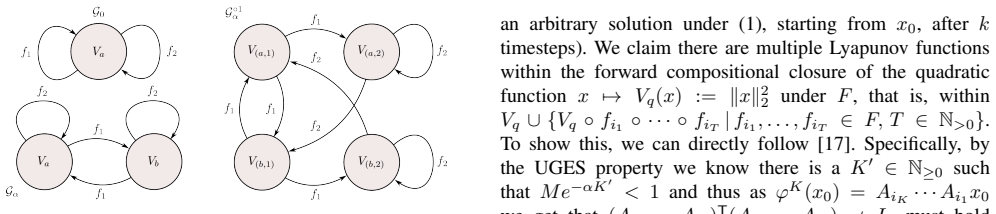
Figures from the paper (3 more)


Lean theorems connected to this paper
-
IndisputableMonolith/Cost/FunctionalEquation.leanwashburn_uniqueness_aczel unclear?
unclearRelation between the paper passage and the cited Recognition theorem.
Conjecture IV.2 (The composition lift [10, Conj. 8.20])... (ii) G ≤V,F eG for any template V closed under forward composition...
-
IndisputableMonolith/Foundation/AlexanderDuality.leanalexander_duality_circle_linking unclear?
unclearRelation between the paper passage and the cited Recognition theorem.
Lemma III.3 (T-composition lifts preserve connectedness)... Assumption III.4 (Non-redundant graphs)
What do these tags mean?
- matches
- The paper's claim is directly supported by a theorem in the formal canon.
- supports
- The theorem supports part of the paper's argument, but the paper may add assumptions or extra steps.
- extends
- The paper goes beyond the formal theorem; the theorem is a base layer rather than the whole result.
- uses
- The paper appears to rely on the theorem as machinery.
- contradicts
- The paper's claim conflicts with a theorem or certificate in the canon.
- unclear
- Pith found a possible connection, but the passage is too broad, indirect, or ambiguous to say the theorem truly supports the claim.
Reference graph
Works this paper leans on
-
[1]
Liberzon, Switching in systems and control
D. Liberzon, Switching in systems and control . Birkh ¨auser, 2003
work page 2003
-
[2]
Tabuada, Verification and control of hybrid systems: a symbolic approach
P. Tabuada, Verification and control of hybrid systems: a symbolic approach. Springer, 2009
work page 2009
- [3]
-
[4]
R. G. Sanfelice, Hybrid Feedback Control . Princeton University Press, 2020
work page 2020
-
[5]
W. Jongeneel and E. Moulay, Topological Obstructions to Stability and Stabilization: History, Recent Advances and Open Problems . Springer Nature, 2023
work page 2023
-
[6]
Jungers, The joint spectral radius: theory and applications
R. Jungers, The joint spectral radius: theory and applications . Springer, 2009
work page 2009
-
[7]
Multiple Lyapunov functions and other analysis tools for switched and hybrid systems,
M. S. Branicky, “Multiple Lyapunov functions and other analysis tools for switched and hybrid systems,” IEEE T. Automat. Contr. , vol. 43, no. 4, pp. 475–482, 1998
work page 1998
-
[8]
Joint spectral radius and path-complete graph Lyapunov functions,
A. A. Ahmadi, R. M. Jungers, P. A. Parrilo, and M. Roozbehani, “Joint spectral radius and path-complete graph Lyapunov functions,” SIAM J. Control Optim. , vol. 52, no. 1, pp. 687–717, 2014
work page 2014
Show all 23 references
-
[9]
A complete characterization of the ordering of path-complete methods,
M. Philippe and R. M. Jungers, “A complete characterization of the ordering of path-complete methods,” in International Conference on Hybrid Systems: Computation and Control , 2019, pp. 138–146
2019
-
[10]
Path-complete and neural Lyapunov functions: Com- putation and performance,
V . Debauche, “Path-complete and neural Lyapunov functions: Com- putation and performance,” Ph.D. dissertation, UCLouvain, 2024. [Online]. Available: https : / / dial . uclouvain . be / pr / boreal/object/boreal:291972
2024
-
[11]
A note on the joint spectral radius,
G.-C. Rota and G. Strang, “A note on the joint spectral radius,” Indag. Math, vol. 22, no. 4, pp. 379–381, 1960
1960
-
[12]
Algebraic unsolvability of problem of absolute sta- bility of desynchronized systems,
V . S. Kozyakin, “Algebraic unsolvability of problem of absolute sta- bility of desynchronized systems,” Automation and Remote Control , vol. 51, no. 6, pp. 754–759, 1990
1990
-
[13]
The Lyapunov exponent and joint spectral radius of pairs of matrices are hard—when not impos- sible—to compute and to approximate,
J. N. Tsitsiklis and V . D. Blondel, “The Lyapunov exponent and joint spectral radius of pairs of matrices are hard—when not impos- sible—to compute and to approximate,” Math. Control Signals Syst., vol. 10, pp. 31–40, 1997
1997
-
[14]
The boundedness of all products of a pair of matrices is undecidable,
V . D. Blondel and J. N. Tsitsiklis, “The boundedness of all products of a pair of matrices is undecidable,” Syst. Control Lett. , vol. 41, no. 2, pp. 135–140, 2000
2000
-
[15]
Approximation of the joint spectral radius using sum of squares,
P. A. Parrilo and A. Jadbabaie, “Approximation of the joint spectral radius using sum of squares,” Linear Algebra Appl., vol. 428, no. 10, pp. 2385–2402, 2008
2008
-
[16]
Characterization of the ordering of path-complete stability certificates with addition- closed templates,
V . Debauche, M. Della Rossa, and R. Jungers, “Characterization of the ordering of path-complete stability certificates with addition- closed templates,” in International Conference on Hybrid Systems: Computation and Control , 2023, pp. 1–10
2023
-
[17]
Stability analysis of discrete- time switched systems through Lyapunov functions with nonminimal state,
P.-A. Bliman and G. Ferrari-Trecate, “Stability analysis of discrete- time switched systems through Lyapunov functions with nonminimal state,” IFAC Proceedings, vol. 36, no. 6, pp. 325–329, 2003
2003
-
[18]
Equivalence of stability concepts for discrete time-varying systems,
A. Bhaya, F. Das, and C. Mota, “Equivalence of stability concepts for discrete time-varying systems,” Int. J. Robust Nonlin. , vol. 4, no. 6, pp. 725–740, 1994
1994
-
[19]
On path-complete Lyapunov functions: Geometry and comparison,
M. Philippe, N. Athanasopoulos, D. Angeli, and R. M. Jungers, “On path-complete Lyapunov functions: Geometry and comparison,” IEEE T. Automat. Contr., vol. 64, no. 5, pp. 1947–1957, 2018
1947
-
[20]
Comparison of path-complete Lyapunov functions via template-dependent lifts,
V . Debauche, M. Della Rossa, and R. M. Jungers, “Comparison of path-complete Lyapunov functions via template-dependent lifts,” Nonlinear Analysis: Hybrid Systems , vol. 46, p. 101 237, 2022
2022
-
[21]
Solving semidefinite- quadratic-linear programs using SDPT3,
R. H. T ¨ut¨unc¨u, K.-C. Toh, and M. J. Todd, “Solving semidefinite- quadratic-linear programs using SDPT3,” Math. Program., vol. 95, pp. 189–217, 2003
2003
-
[22]
On preorders of path-complete Lyapunov functions through lifts,
W. Jongeneel and R. M. Jungers, “On preorders of path-complete Lyapunov functions through lifts,” in Benelux Meeting on Systems and Control, 2025, p. 50
2025
-
[23]
Statistical comparison of path-complete Lyapunov functions: A discrete-event systems perspective,
R. M. Jungers, “Statistical comparison of path-complete Lyapunov functions: A discrete-event systems perspective,” IFAC Proceedings, vol. 58, no. 1, pp. 258–263, 2024
2024
Reviewed May 22, 2026 · model on record in the stance chip above.
Discussion (0). Sign in to comment.