REVIEW 2 major objections 16 references
Decoding Islamophobic Discourse: Using LLMs to Identify Tropes and Semi-Coded Hate Speech
T0 review · 2 major / 0 minor · reviewed 2026-05-22 · grok-4.3
Pith's one-line read LLMs recognize semi-coded Islamophobic slurs that standard systems miss
desk verdict The abstract claims LLMs understand specific OOV slurs but gives no prompts, metrics, samples, or validation, so the main result cannot be assessed. read the letter →
The pith
A machine-rendered reading of the paper's core claim, the machinery that carries it, and where it could break.
The reading
What carries the argument
Large language models applied to out-of-vocabulary slurs, Google Perspective API for toxicity scoring, and BERT topic modeling for discourse extraction
What would settle it
A comparison study where human annotators classify the same posts for hate speech and show low agreement with LLM classifications would challenge the claim that LLMs understand the slurs.
Extended reading notes
Core claim
LLMs understand these Out-Of-Vocabulary slurs; Islamophobic posts receive higher toxicity scores than Antisemitism; topic modeling extracts various topics showing discourse in political, conspiratorial, and far-right movements particularly directed against Muslim immigrants. Further improvements in moderation strategies and algorithmic detection are necessary.
Load-bearing premise
The listed terms function as Islamophobic slurs in the sampled contexts and LLM outputs constitute reliable evidence of understanding without validation against human judgments.
Editorial analysis
A structured set of objections, weighed in public.
Referee Report
Summary. The manuscript claims to perform a large-scale analysis of semi-coded Islamophobic terms such as (muzrat, pislam, mudslime, mohammedan, muzzies) on platforms including 4Chan, Gab, and Telegram. It uses LLMs to demonstrate understanding of these OOV terms, Google Perspective API to show higher toxicity scores than other hate speech categories such as Antisemitism, and BERT topic modeling to extract topics spanning political, conspiratorial, and far-right movements particularly directed against Muslim immigrants. The conclusion states that LLMs understand these slurs but further improvements in moderation are needed.
Significance. The topic of detecting semi-coded hate speech is relevant to computational social science and content moderation. However, because the manuscript supplies no data, methods, sample sizes, prompts, metrics, or results, it is not possible to assess whether any contribution would hold or advance the field.
major comments (2)
- [Abstract] Abstract: The claims that LLMs understand the listed OOV slurs, that Islamophobic posts receive higher toxicity scores, and that topic modeling reveals specific discourse patterns are asserted without any reported prompts, evaluation criteria, quantitative metrics (e.g., accuracy, F1), sample sizes, or statistical results, so the central empirical findings lack visible support.
- [Abstract] Abstract: The premise that the listed terms function as Islamophobic slurs in the sampled contexts is taken as given without any annotation details, contextual examples, or validation against human judgments, which is load-bearing for the analysis of semi-coded hate speech.
Simulated Author's Rebuttal
We thank the referee for the review and the emphasis on empirical transparency. The comments correctly identify that the provided abstract asserts findings without accompanying details. We address each point below. As only the abstract is available, our ability to supply the requested specifics is limited.
read point-by-point responses
-
Referee: [Abstract] Abstract: The claims that LLMs understand the listed OOV slurs, that Islamophobic posts receive higher toxicity scores, and that topic modeling reveals specific discourse patterns are asserted without any reported prompts, evaluation criteria, quantitative metrics (e.g., accuracy, F1), sample sizes, or statistical results, so the central empirical findings lack visible support.
Authors: We agree that the abstract presents the claims without the supporting methodological details, metrics, or sample sizes. Abstracts are by nature concise, but the absence of any reference to evaluation criteria or results does leave the findings without visible support in the provided text. We will revise the abstract to incorporate a high-level statement of the evaluation approach and key quantitative outcomes where space permits. revision: yes
-
Referee: [Abstract] Abstract: The premise that the listed terms function as Islamophobic slurs in the sampled contexts is taken as given without any annotation details, contextual examples, or validation against human judgments, which is load-bearing for the analysis of semi-coded hate speech.
Authors: We agree that the abstract assumes the listed terms are Islamophobic slurs without supplying annotation procedures, examples, or human validation. This premise is indeed central, and its lack of support in the abstract is a valid concern. We will revise the abstract to include a short statement on the basis for identifying these terms as semi-coded hate speech. revision: yes
- Absence of data, methods, sample sizes, prompts, metrics, results, annotation details, contextual examples, and human validation in the manuscript as provided (limited to the abstract).
Circularity Check
No circularity; purely descriptive empirical study with no derivations
full rationale
The paper is a descriptive empirical analysis that applies off-the-shelf LLMs, Google Perspective API, and BERT topic modeling to a corpus of social media posts. No equations, parameter fitting, predictions derived from inputs, self-citations, or uniqueness theorems appear in the provided abstract or description. The central claim that LLMs 'understand' the listed terms is presented as an observation from model outputs rather than a derived result that reduces to the inputs by construction. This is the normal case of a non-circular empirical paper.
Assumptions & free parameters
Cite this review
Pith. "Pith review of Decoding Islamophobic Discourse: Using LLMs to Identify Tropes and Semi-Coded Hate Speech." pith.science (2026). https://pith.science/paper/2503.18273
@misc{pith2026250318273,
  author       = {Pith},
  title        = {Pith review of: Decoding Islamophobic Discourse: Using LLMs to Identify Tropes and Semi-Coded Hate Speech},
  year         = {2026},
  howpublished = {\url{https://pith.science/paper/2503.18273}},
  note         = {Machine review of arXiv:2503.18273}
}
read the original abstract
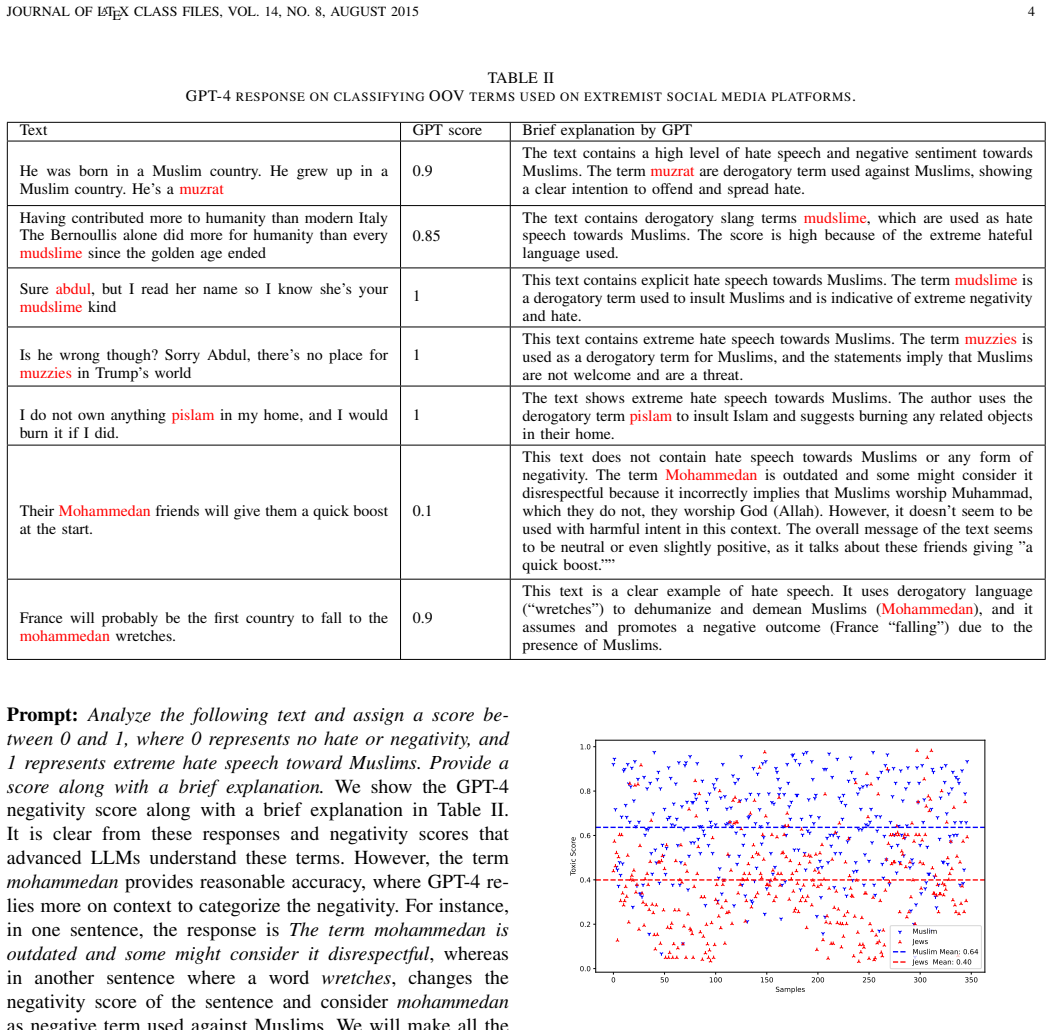
In recent years, Islamophobia has gained significant traction across Western societies, fueled by the rise of digital communication networks. This paper performs a large-scale analysis of specialized, semi-coded Islamophobic terms such as (muzrat, pislam, mudslime, mohammedan, muzzies) floated on extremist social platforms, i.e., 4Chan, Gab, Telegram, etc. Many of these terms appear lexically neutral or ambiguous outside of specific contexts, making them difficult for both human moderators and automated systems to reliably identify as hate speech. First, we use Large Language Models (LLMs) to show their ability to understand these terms. Second, Google Perspective API suggests that Islamophobic posts tend to receive higher toxicity scores than other categories of hate speech like Antisemitism. Finally, we use BERT topic modeling approach to extract different topics and Islamophobic discourse on these social platforms. Our findings indicate that LLMs understand these Out-Of-Vocabulary (OOV) slurs; however, further improvements in moderation strategies and algorithmic detection are necessary to address such discourse effectively. Our topic modeling also indicates that Islamophobic text is found across various political, conspiratorial, and far-right movements and is particularly directed against Muslim immigrants. Taken altogether, we performed one of the first studies on Islamophobic semi-coded terms and shed a global light on Islamophobia.
Figures


Reference graph
Works this paper leans on
-
[1]
The language of islamophobia in internet articles,
H. Mohideen and S. Mohideen, “The language of islamophobia in internet articles,” Intellectual Discourse , vol. 16, no. 1, 2008
work page 2008
-
[2]
Unsafe diffusion: On the generation of unsafe images and hateful memes from text-to-image models,
Y. Qu, X. Shen, X. He, M. Backes, S. Zannettou, and Y. Zhang, “Unsafe diffusion: On the generation of unsafe images and hateful memes from text-to-image models,” in Proceedings of the 2023 ACM SIGSAC conference on computer and communications security , pp. 3403–3417, 2023
work page 2023
-
[3]
How developments in natural language processing help us in understanding human behaviour,
R. Mihalcea, L. Biester, R. L. Boyd, Z. Jin, V . Perez-Rosas, S. Wilson, and J. W. Pennebaker, “How developments in natural language processing help us in understanding human behaviour,” Nature Human Behaviour , vol. 8, no. 10, pp. 1877–1889, 2024
work page 2024
-
[4]
Howard, Freedom of expression and religious hate speech in Europe
E. Howard, Freedom of expression and religious hate speech in Europe. Routledge, 2017
work page 2017
-
[5]
E. Zsisku, A. Zubiaga, and H. Dubossarsky, “Hate speech detection and reclaimed language: Mitigating false positives and compounded discrimination,” in Proceedings of the 16th ACM Web Science Conference, pp. 241–249, 2024
work page 2024
-
[6]
H. Watanabe, M. Bouazizi, and T. Ohtsuki, “Hate speech on twitter: A pragmatic approach to collect hateful and offensive expressions and perform hate speech detection,” IEEE access, vol. 6, pp. 13825– 13835, 2018
work page 2018
-
[7]
P. Burnap and M. L. Williams, “Cyber hate speech on twitter: An application of machine classification and statistical modeling for policy and decision making,” Policy & internet , vol. 7, no. 2, pp. 223–242, 2015. JOURNAL OF LATEX CLASS FILES, VOL. 14, NO. 8, AUGUST 2015 8
work page 2015
-
[8]
Is- lamophobia content detection using natural language processing,
A. Jaleel, M. Anwar, F. Ali, R. Mukhtar, and M. Farooq, “Is- lamophobia content detection using natural language processing,” Journal of Computing & Biomedical Informatics , vol. 4, no. 02, pp. 88–97, 2023
work page 2023
Show all 16 references
-
[9]
Enhancing automated hate speech detection: Addressing islamophobia and freedom of speech in online discussions,
E. Aldreabi and J. Blackburn, “Enhancing automated hate speech detection: Addressing islamophobia and freedom of speech in online discussions,” in Proceedings of the International Conference on Advances in Social Networks Analysis and Mining , pp. 644–651, 2023
2023
-
[10]
‘is this a hate speech?’the difficulty in combating radicalisation in coded communications on social media platforms,
B. Farrand, “‘is this a hate speech?’the difficulty in combating radicalisation in coded communications on social media platforms,” European Journal on Criminal Policy and Research , vol. 29, no. 3, pp. 477–493, 2023
2023
-
[11]
Challenges of hate speech detection in social media: Data scarcity, and leveraging external resources,
G. Kov ´acs, P. Alonso, and R. Saini, “Challenges of hate speech detection in social media: Data scarcity, and leveraging external resources,” SN Computer Science , vol. 2, no. 2, p. 95, 2021
2021
-
[12]
Hate speech detec- tion and racial bias mitigation in social media based on bert model,
M. Mozafari, R. Farahbakhsh, and N. Crespi, “Hate speech detec- tion and racial bias mitigation in social media based on bert model,” PloS one , vol. 15, no. 8, p. e0237861, 2020
2020
-
[13]
Monitoring the evolution of antisemitic hate speech on extremist social media,
R. U. Mustafa and N. Japkowicz, “Monitoring the evolution of antisemitic hate speech on extremist social media,” in 2024 IEEE Digital Platforms and Societal Harms (DPSH) , pp. 1–8, IEEE, 2024
2024
-
[14]
Coded term discovery for online hate speech detection,
D. Kikkisetti, R. Mustafa, W. Melillo, R. Corizzo, Z. Boukouvalas, J. Gill, and N. Japkowicz, “Coded term discovery for online hate speech detection,” in 2024 IEEE 11th International Conference on Data Science and Advanced Analytics (DSAA) , pp. 1–10, IEEE, 2024
2024
-
[15]
Perspective api,
G. Jigsaw, “Perspective api,” 2025. Accessed: March 16, 2025
2025
-
[16]
Undocumented aapi: Profiles of those ineligible for immigration relief,
D. Millet, “Undocumented aapi: Profiles of those ineligible for immigration relief,” 2022. Accessed: March 6, 2025
2022
Reviewed May 22, 2026 · model on record in the stance chip above.
Discussion (0). Sign in to comment.