Localizing entropy production along non-equilibrium trajectories
Pith reviewed 2026-05-22 22:57 UTC · model grok-4.3
The pith
Deep neural networks paired with short-time uncertainty relations localize entropy production in space and time from trajectory data.
A machine-rendered reading of the paper's core claim, the machinery that carries it, and where it could break.
Core claim
By leveraging the flexible representation of deep neural networks within the short-time thermodynamic uncertainty relation based inference scheme, the method accurately reconstructs high-dimensional, potentially time-dependent dissipative force fields and localizes fluctuating entropy production in both space and time along nonequilibrium trajectories.
What carries the argument
The short-time thermodynamic uncertainty relation combined with deep neural network representation of force fields for inference from trajectory data.
If this is right
- Reconstruction of dissipative forces in high dimensions without assuming specific forms.
- Spatiotemporal localization of entropy production along individual trajectories.
- Applicability to time-dependent force fields in complex systems.
- Successful application to physical, chemical, and biological systems of interest.
Where Pith is reading between the lines
- Could enable better analysis of experimental data in active matter or biological systems where models are incomplete.
- Potential to integrate with other machine learning techniques for even more complex dynamics.
- Testable by comparing inferred entropy production maps to exact calculations in simple stochastic models like Brownian particles in periodic potentials.
Load-bearing premise
The short-time thermodynamic uncertainty relation inference scheme stays accurate and stable when paired with deep neural networks for high-dimensional and time-dependent force fields.
What would settle it
Running the method on a simulated trajectory from a known system, such as an overdamped particle in a time-dependent potential, and checking if the localized entropy production matches the exact calculation from the known forces.
Figures



read the original abstract
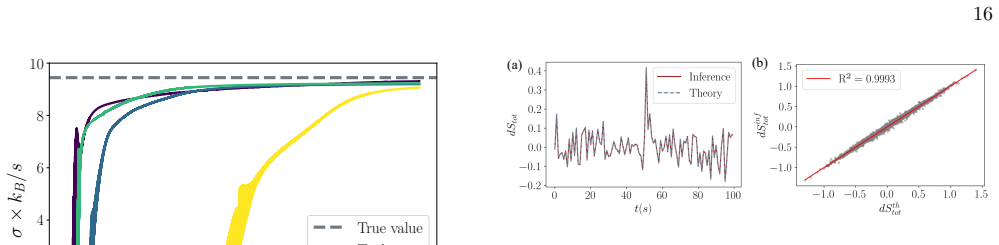
Entropy production is a universal measure of irreversibility and energy dissipation in physical, chemical, and biological systems operating far from equilibrium. However, quantifying and spatiotemporally localising it in complex processes directly from experimental data remains a major open challenge. Here we address this issue through a data-driven approach that combines the recently developed short-time thermodynamic uncertainty relation based inference scheme with machine learning techniques. Our approach leverages the flexible function representation provided by deep neural networks to achieve accurate reconstruction of high-dimensional, potentially time-dependent dissipative force fields as well as the localization of fluctuating entropy production in both space and time along nonequilibrium trajectories. We demonstrate the versatility of the framework through applications to diverse systems of fundamental interest and experimental significance, where it successfully addresses distinct challenges in localising entropy production.
Editorial analysis
A structured set of objections, weighed in public.
Referee Report
Summary. The manuscript proposes a data-driven framework that integrates the short-time thermodynamic uncertainty relation (TUR) inference scheme with deep neural networks. The method aims to reconstruct high-dimensional and potentially time-dependent dissipative force fields from trajectory data and to localize fluctuating entropy production in both space and time along nonequilibrium paths. Versatility is illustrated through applications to diverse physical, chemical, and biological systems.
Significance. If the combined TUR-DNN scheme delivers accurate force-field reconstruction and entropy-production localization without introducing uncontrolled biases, the work would provide a practical tool for quantifying irreversibility directly from experimental trajectories in high-dimensional nonequilibrium systems, an area of broad interest in statistical mechanics.
major comments (1)
- [Abstract (central claim) and Methods (inferred from description)] The central claim requires that the short-time TUR inference scheme remains accurate and stable when the dissipative forces are represented by a DNN approximator, especially for high-dimensional or explicitly time-dependent fields where data coverage is sparse. No error bounds, stability analysis, or verification that the DNN satisfies the implicit regularity conditions of the short-time expansion (e.g., bounded higher derivatives or exact short-time scaling) are supplied; this assumption is load-bearing for both the reconstruction and localization claims.
minor comments (1)
- [Abstract] The abstract would be strengthened by inclusion of at least one quantitative performance metric (e.g., reconstruction error or comparison to ground-truth entropy production) from the demonstrations.
Simulated Author's Rebuttal
We thank the referee for their thoughtful assessment of our manuscript. The major comment correctly identifies that the work does not supply formal error bounds or stability analysis for the combined short-time TUR-DNN approach. We respond to this point below and indicate where a revision is feasible.
read point-by-point responses
-
Referee: The central claim requires that the short-time TUR inference scheme remains accurate and stable when the dissipative forces are represented by a DNN approximator, especially for high-dimensional or explicitly time-dependent fields where data coverage is sparse. No error bounds, stability analysis, or verification that the DNN satisfies the implicit regularity conditions of the short-time expansion (e.g., bounded higher derivatives or exact short-time scaling) are supplied; this assumption is load-bearing for both the reconstruction and localization claims.
Authors: We agree that the manuscript provides no rigorous error bounds, stability analysis, or explicit verification that the DNN approximator satisfies the regularity conditions (such as bounded higher derivatives) implicit in the short-time TUR expansion. The method applies the established short-time TUR inference directly, using the DNN only as a flexible function approximator for the dissipative force field, with performance assessed through numerical demonstrations on several systems. Deriving general theoretical guarantees for arbitrary DNN architectures and sparse high-dimensional data is a substantial undertaking that lies outside the scope of the present work. We will revise the manuscript to add an explicit discussion of the assumptions inherited from the short-time TUR, the empirical nature of the validation, and the potential limitations in regimes of very sparse data coverage. revision: partial
Circularity Check
Minor self-citation not load-bearing; derivation remains independent
full rationale
The abstract presents the localization method as a combination of an external short-time TUR inference scheme with DNN function approximation for force-field reconstruction. No equations or steps are shown that reduce the claimed entropy-production localization to a fitted quantity by construction, nor is there evidence of self-definitional loops or ansatz smuggling. Any self-citation of the TUR scheme is not load-bearing for the central claim, which retains independent content from the ML component. This is the normal case of a self-contained approach against external benchmarks.
Axiom & Free-Parameter Ledger
Lean theorems connected to this paper
-
IndisputableMonolith/Cost/FunctionalEquation.leanwashburn_uniqueness_aczel unclear?
unclearRelation between the paper passage and the cited Recognition theorem.
short-time thermodynamic uncertainty relation based inference scheme ... deep neural networks to achieve accurate reconstruction of high-dimensional, potentially time-dependent dissipative force fields
-
IndisputableMonolith/Foundation/RealityFromDistinction.leanreality_from_one_distinction unclear?
unclearRelation between the paper passage and the cited Recognition theorem.
σ(t) = ∫ F(x,t)·j(x,t) dx with F = j^T D^{-1}/p
What do these tags mean?
- matches
- The paper's claim is directly supported by a theorem in the formal canon.
- supports
- The theorem supports part of the paper's argument, but the paper may add assumptions or extra steps.
- extends
- The paper goes beyond the formal theorem; the theorem is a base layer rather than the whole result.
- uses
- The paper appears to rely on the theorem as machinery.
- contradicts
- The paper's claim conflicts with a theorem or certificate in the canon.
- unclear
- Pith found a possible connection, but the passage is too broad, indirect, or ambiguous to say the theorem truly supports the claim.
Reference graph
Works this paper leans on
-
[1]
= 1 2(k1x′2 1 +k 2x′2 2 ) with a rotated coordinate system such that (x ′ 1, x′ 2)T =R(θ)·(x 1, x2)T ,R= cosθ−sinθ sinθcosθ , (2) the anharmonic gyrator with a bistable potential Udw(x′ 1, x′
-
[2]
=x ′4 1 −2bx ′2 1 + 0.5kx ′2 2 and (3) a quartic potentialU qu(x′ 1, x′
-
[3]
= 0.5(k 1x′2 1 +k 2x′2 2 )2, both hav- ing prominent non-linear dynamics and finally (4) a mul- tidimensional, linear gyrator which exemplifies a high- dimensional system. For examples (1) and (4), since the dynamics is governed by linear Langevin equation, exact analytic solutions are available for the thermodynamic force field. This is, however, not the...
-
[4]
Spatial coarse graining and reduced local entropy production The local entropy production rate in a reduced phase space obtained via a projection operation can be esti- 17 10 3 10 2 10 1 100 t 0.2 0.4 0.6t kB s 1 True Value Theory Theory: t 0 Interpolated Inference Inference t 0 Interpolated FIG. 11. Analytical and inferred time–coarse-grained entropy pro...
-
[5]
Temporal coarse graining and trajectory-level entropy production A closely related notion of coarse-grained entropy pro- duction arises when the same Langevin dynamics (C1) is observed only at discrete times separated by a finite interval ∆t, as discussed in Ref. [70]. Over this interval, the transition probabilityp(x 1|x0) is Gaussian with co- varianceC ...
-
[6]
J. Liphardt, F. Ritort, and C. Bustamante, The nonequi- librium thermodynamics of small systems, Phys. Today 58, 43 (2005)
work page 2005
- [7]
-
[8]
F. S. Gnesotto, F. Mura, J. Gladrow, and C. P. Broed- ersz, Broken detailed balance and non-equilibrium dy- namics in living systems: a review, Reports on Progress in Physics81, 066601 (2018)
work page 2018
-
[9]
´E. Rold´ an and J. M. Parrondo, Estimating dissipation from single stationary trajectories, Physical review let- ters105, 150607 (2010)
work page 2010
- [10]
-
[11]
T. Harada and S.-i. Sasa, Equality connecting energy dis- sipation with a violation of the fluctuation-response re- lation, Physical review letters95, 130602 (2005)
work page 2005
-
[12]
A. Frishman and P. Ronceray, Learning force fields from stochastic trajectories, Physical Review X10, 021009 (2020)
work page 2020
-
[13]
F. S. Gnesotto, G. Gradziuk, P. Ronceray, and C. P. Broedersz, Learning the non-equilibrium dynamics of brownian movies, Nature communications11, 5378 (2020)
work page 2020
-
[14]
S. K. Manikandan, D. Gupta, and S. Krishnamurthy, In- ferring entropy production from short experiments, Phys- ical Review Letters124, 120603 (2020)
work page 2020
-
[15]
S. K. Manikandan, T. Ghosh, T. Mandal, A. Biswas, B. Sinha, and D. Mitra, Estimate of entropy production rate can spatiotemporally resolve the active nature of cell flickering, Phys. Rev. Res.6, 023310 (2024)
work page 2024
-
[16]
N. M. Boffi and E. Vanden-Eijnden, Deep learning proba- bility flows and entropy production rates in active matter, Proceedings of the National Academy of Sciences121, e2318106121 (2024)
work page 2024
-
[17]
´E. Rold´ an, J. Barral, P. Martin, J. M. Parrondo, and F. J¨ ulicher, Quantifying entropy production in active fluctuations of the hair-cell bundle from time irreversibil- ity and uncertainty relations, New Journal of Physics23, 083013 (2021)
work page 2021
-
[18]
I. Di Terlizzi, M. Gironella, D. Herr´ aez-Aguilar, T. Betz, F. Monroy, M. Baiesi, and F. Ritort, Variance sum rule for entropy production, Science383, 971 (2024)
work page 2024
-
[19]
J. Deg¨ unther, J. van der Meer, and U. Seifert, Fluctuat- ing entropy production on the coarse-grained level: In- ference and localization of irreversibility, Phys. Rev. Res. 6, 023175 (2024)
work page 2024
-
[20]
J. Deg¨ unther, J. van der Meer, and U. Seifert, General theory for localizing the where and when of entropy pro- duction meets single-molecule experiments, Proceedings of the National Academy of Sciences121, e2405371121 (2024)
work page 2024
- [21]
-
[22]
U. Seifert, Stochastic thermodynamics: principles and perspectives, The European Physical Journal B64, 423 (2008)
work page 2008
-
[23]
U. Seifert, From stochastic thermodynamics to thermo- dynamic inference, Annual Review of Condensed Matter Physics10, 171 (2019)
work page 2019
-
[24]
Ciliberto, Experiments in stochastic thermodynamics: Short history and perspectives, Phys
S. Ciliberto, Experiments in stochastic thermodynamics: Short history and perspectives, Phys. Rev. X7, 021051 (2017)
work page 2017
-
[25]
J. Li, J. M. Horowitz, T. R. Gingrich, and N. Fakhri, Quantifying dissipation using fluctuating currents, Na- ture Communications10, 1666 (2019)
work page 2019
- [26]
-
[27]
S. K. Manikandan, S. Ghosh, A. Kundu, B. Das, 19 V. Agrawal, D. Mitra, A. Banerjee, and S. Krishna- murthy, Quantitative analysis of non-equilibrium sys- tems from short-time experimental data, Communica- tions Physics4, 258 (2021)
work page 2021
-
[28]
D.-K. Kim, Y. Bae, S. Lee, and H. Jeong, Learning en- tropy production via neural networks, Phys. Rev. Lett. 125, 140604 (2020)
work page 2020
- [29]
- [30]
-
[31]
U. Seifert, Entropy production along a stochastic trajec- tory and an integral fluctuation theorem, Physical Re- view Letters95, 040602 (2005)
work page 2005
-
[32]
U. Seifert, Entropy production along a stochastic tra- jectory and an integral fluctuation theorem, Phys. Rev. Lett.95, 040602 (2005)
work page 2005
-
[33]
K. Sekimoto, Kinetic characterization of heat bath and the energetics of thermal ratchet models, Journal of the physical society of Japan66, 1234 (1997)
work page 1997
-
[34]
K. Sekimoto, Langevin equation and thermodynamics, Progress of Theoretical Physics Supplement130, 17 (1998)
work page 1998
-
[35]
Seifert, Stochastic thermodynamics, fluctuation the- orems and molecular machines, Rep
U. Seifert, Stochastic thermodynamics, fluctuation the- orems and molecular machines, Rep. Prog. Phys.75, 126001 (2012)
work page 2012
-
[36]
C. Maes and K. Netoˇ cn` y, Time-reversal and entropy, Journal of statistical physics110, 269 (2003)
work page 2003
-
[37]
P. Gaspard, Time-reversed dynamical entropy and irre- versibility in markovian random processes, Journal of sta- tistical physics117, 599 (2004)
work page 2004
-
[38]
D. Andrieux, P. Gaspard, S. Ciliberto, N. Garnier, S. Joubaud, and A. Petrosyan, Thermodynamic time asymmetry in non-equilibrium fluctuations, Journal of Statistical Mechanics: Theory and Experiment2008, P01002 (2008)
work page 2008
-
[39]
D. Andrieux, P. Gaspard, S. Ciliberto, N. Garnier, S. Joubaud, and A. Petrosyan, Entropy production and time asymmetry in nonequilibrium fluctuations, Phys. Rev. Lett.98, 150601 (2007)
work page 2007
-
[40]
Di Terlizzi, Force-free kinetic inference of entropy pro- duction, Phys
I. Di Terlizzi, Force-free kinetic inference of entropy pro- duction, Phys. Rev. Lett.135, 237101 (2025)
work page 2025
-
[41]
A. C. Barato and U. Seifert, Thermodynamic uncertainty relation for biomolecular processes, Physical Review Let- ters114, 158101 (2015)
work page 2015
-
[42]
T. R. Gingrich, G. M. Rotskoff, and J. M. Horowitz, Inferring dissipation from current fluctuations, Journal of Physics A: Mathematical and Theoretical50, 184004 (2017)
work page 2017
-
[43]
T. R. Gingrich, J. M. Horowitz, N. Perunov, and J. L. England, Dissipation bounds all steady-state current fluctuations, Phys. Rev. Lett.116, 120601 (2016)
work page 2016
- [44]
- [45]
-
[46]
B. Das, S. K. Manikandan, and A. Banerjee, Inferring entropy production in anharmonic brownian gyrators, Physical Review Research4, 043080 (2022)
work page 2022
-
[47]
N. M. Boffi and E. Vanden-Eijnden, Probability flow so- lution of the fokker–planck equation, Machine Learning: Science and Technology4, 035012 (2023)
work page 2023
- [48]
-
[49]
R. E. Spinney and I. J. Ford, Entropy production in full phase space for continuous stochastic dynamics, Phys. Rev. E85, 051113 (2012)
work page 2012
- [50]
-
[51]
S. K. Manikandan and S. Krishnamurthy, Exact results for the finite time thermodynamic uncertainty relation, J. Phys. A: Math. Theor.51, 11LT01 (2018)
work page 2018
-
[52]
G. Rotskoff and E. Vanden-Eijnden, inAdvances in Neu- ral Information Processing Systems 31, edited by S. Ben- gio, H. Wallach, H. Larochelle, K. Grauman, N. Cesa- Bianchi, and R. Garnett (Curran Associates, Red Hook, NY, 2018) pp. 7146–7155
work page 2018
-
[53]
L. Chizat and F. Bach, inAdvances in Neural Informa- tion Processing Systems 31, edited by S. Bengio, H. Wal- lach, H. Larochelle, K. Grauman, N. Cesa-Bianchi, and R. Garnett (Curran Associates, Red Hook, NY, 2018) pp. 3036–3046
work page 2018
-
[54]
S. Mei, A. Montanari, and P.-M. Nguyen, A mean field view of the landscape of two-layer neural networks, Pro- ceedings of the National Academy of Sciences115, E7665 (2018)
work page 2018
-
[55]
J. Sirignano and K. Spiliopoulos, Mean field analysis of neural networks: A law of large numbers, SIAM Journal on Applied Mathematics80, 725 (2020)
work page 2020
-
[56]
A. R. Barron, Universal approximation bounds for super- positions of a sigmoidal function, IEEE Transactions on Information theory39, 930 (1993)
work page 1993
-
[57]
G. Cybenko, Approximation by superpositions of a sig- moidal function, Mathematics of control, signals and sys- tems2, 303 (1989). [53]https://github.com/sreekmnoneq/Inference-short
work page 1989
-
[58]
B. Yuet al., The deep ritz method: a deep learning- based numerical algorithm for solving variational prob- lems, Communications in Mathematics and Statistics6, 1 (2018)
work page 2018
-
[59]
J. Yan, H. Touchette, and G. M. Rotskoff, Learning nonequilibrium control forces to characterize dynamical phase transitions, Physical Review E105, 024115 (2022)
work page 2022
-
[60]
R. Filliger and P. Reimann, Brownian gyrator: A mini- mal heat engine on the nanoscale, Physical Review Let- ters99, 230602 (2007)
work page 2007
- [61]
-
[62]
H. Chang, C.-L. Lee, P.-Y. Lai, and Y.-F. Chen, Au- tonomous brownian gyrators: A study on gyrating char- acteristics, Physical Review E103, 022128 (2021)
work page 2021
-
[63]
S. K. Manikandan, B. Das, A. Kundu, R. Dey, A. Baner- jee, and S. Krishnamurthy, Nonmonotonic skewness of currents in nonequilibrium steady states, Phys. Rev. Res. 4, 043067 (2022)
work page 2022
-
[64]
B. Delaunay, Sur la sph` ere vide, Izvestia Akademii 20 Nauk SSSR, Otdelenie Matematicheskikh i Estestven- nykh Nauk7, 793 (1934)
work page 1934
-
[65]
S. Community, SciPy: Python-based ecosystem of open- source software for mathematics, science, and engineer- ing,https://scipy.org/
-
[66]
P. Virtanenet al., SciPy 1.0: Fundamental algorithms for scientific computing in python, Nature Methods17, 261 (2020)
work page 2020
-
[67]
B. Nadrowski, P. Martin, and F. J¨ ulicher, Active hair- bundle motility harnesses noise to operate near an opti- mum of mechanosensitivity, Proceedings of the National Academy of Sciences101, 12195 (2004)
work page 2004
- [68]
-
[69]
P. Singh and K. Proesmans, Inferring entropy production from time-dependent moments, Communications Physics 7, 231 (2024)
work page 2024
-
[70]
A. B´ erut, A. Arakelyan, A. Petrosyan, S. Ciliberto, R. Dillenschneider, and E. Lutz, Experimental verifica- tion of landauer’s principle linking information and ther- modynamics, Nature483, 187 (2012)
work page 2012
-
[71]
Y. Jun, M. c. v. Gavrilov, and J. Bechhoefer, High- precision test of landauer’s principle in a feedback trap, Physical Review Letters113, 190601 (2014)
work page 2014
-
[72]
M. c. v. Gavrilov and J. Bechhoefer, Erasure without work in an asymmetric double-well potential, Phys. Rev. Lett.117, 200601 (2016)
work page 2016
-
[73]
G. Nicoletti and D. M. Busiello, Tuning transduction from hidden observables to optimize information harvest- ing, Phys. Rev. Lett.133, 158401 (2024)
work page 2024
-
[74]
J. B. Weiss, Fluctuation properties of steady-state langevin systems, Phys. Rev. E76, 061128 (2007)
work page 2007
-
[75]
L. Dabelow, S. Bo, and R. Eichhorn, Irreversibility in active matter systems: Fluctuation theorem and mutual information, Physical Review X9, 021009 (2019)
work page 2019
-
[76]
D. S. Seara, B. B. Machta, and M. P. Murrell, Irreversibil- ity in dynamical phases and transitions, Nature Commu- nications12, 392 (2021)
work page 2021
-
[77]
F. Mori, K. S. Olsen, and S. Krishnamurthy, Entropy pro- duction of resetting processes, Phys. Rev. Res.5, 023103 (2023)
work page 2023
-
[78]
B. Das, S. K. Manikandan, S. Paul, A. Kundu, S. Krish- namurthy, and A. Banerjee, Irreversibility of mesoscopic processes with hydrodynamic interactions, Phys. Rev. E 112, L023401 (2025)
work page 2025
-
[79]
J. Stigler, F. Ziegler, A. Gieseke, J. C. M. Gebhardt, and M. Rief, The complex folding network of single calmod- ulin molecules, Science334, 512 (2011)
work page 2011
-
[80]
C. Bechinger, R. Di Leonardo, H. L¨ owen, C. Reichhardt, G. Volpe, and G. Volpe, Active particles in complex and crowded environments, Reviews of Modern Physics88, 045006 (2016)
work page 2016
discussion (0)
Sign in with ORCID, Apple, or X to comment. Anyone can read and Pith papers without signing in.