Data-Driven Contact-Aware Control Method for Real-Time Deformable Tool Manipulation: A Case Study in the Environmental Swabbing
Pith reviewed 2026-05-22 22:33 UTC · model grok-4.3
The pith
A state-adaptive Koopman LQR framework allows robots to manipulate deformable tools like swabs in real time by linearizing their dynamics and adapting to contact changes.
A machine-rendered reading of the paper's core claim, the machinery that carries it, and where it could break.
Core claim
The SA-KLQR framework linearizes nonlinear dynamics of a deformable tool using the Koopman operator and adapts to state-dependent variations in deformation and contact forces, allowing accurate estimation and regulation of contact angle, pressure, and surface coverage in real-time environmental swabbing without an explicit physics model of the interaction.
What carries the argument
The State-Adaptive Koopman LQR (SA-KLQR) framework, which combines Koopman-based linearization with a state-adaptive layer to manage changes in tool deformation and contact forces during manipulation.
If this is right
- Accurate contact angle estimation and regulation is achieved during dynamic interactions with the surface.
- Robust trajectory tracking and reliable force regulation is demonstrated in the swab sampling experiments.
- Tool pivoting and deformation is mitigated through monitoring of force distribution on the contact pad.
- Compliance with food safety standards is supported by controlled surface coverage in the task.
Where Pith is reading between the lines
- The approach could extend to other contact tasks involving deformable tools such as wiping or polishing surfaces if the adaptation generalizes across different materials.
- By avoiding explicit physics models, the method might lower the barrier for deploying robots in varied real-world settings where tool properties are hard to model.
- Integration with additional sensors like cameras could further enhance the estimation of surface coverage beyond tactile data alone.
Load-bearing premise
The Koopman operator and state-adaptive layer can capture the essential variations in the tool's nonlinear dynamics and contact behavior from data without needing a detailed physical description of how the tool deforms against different surfaces.
What would settle it
A test where the controller is applied to a swab tool on a surface with different friction or stiffness than the training data, resulting in loss of stable contact angle or excessive force variation, would show the limits of the linearization.
Figures




read the original abstract
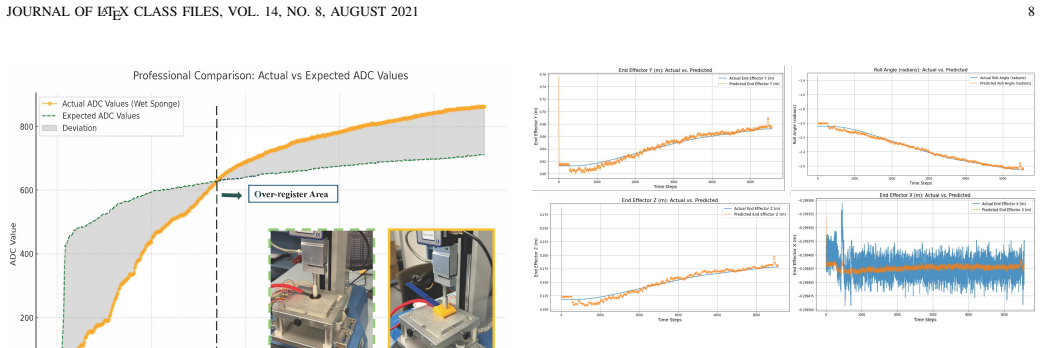
Deformable Object Manipulation (DOM) remains a critical challenge in robotics due to the complexities of developing suitable model-based control strategies. Deformable Tool Manipulation (DTM) further complicates this task by introducing additional uncertainties between the robot and its environment. While humans effortlessly manipulate deformable tools using touch and experience, robotic systems struggle to maintain stability and precision. To address these challenges, we present a novel State-Adaptive Koopman LQR (SA-KLQR) control framework for real-time deformable tool manipulation, demonstrated through a case study in environmental swab sampling for food safety. This method leverages Koopman operator-based control to linearize nonlinear dynamics while adapting to state-dependent variations in tool deformation and contact forces. A tactile-based feedback system dynamically estimates and regulates the swab tool's angle, contact pressure, and surface coverage, ensuring compliance with food safety standards. Additionally, a sensor-embedded contact pad monitors force distribution to mitigate tool pivoting and deformation, improving stability during dynamic interactions. Experimental results validate the SA-KLQR approach, demonstrating accurate contact angle estimation, robust trajectory tracking, and reliable force regulation. The proposed framework enhances precision, adaptability, and real-time control in deformable tool manipulation, bridging the gap between data-driven learning and optimal control in robotic interaction tasks.
Editorial analysis
A structured set of objections, weighed in public.
Referee Report
Summary. The manuscript presents a State-Adaptive Koopman LQR (SA-KLQR) framework for real-time deformable tool manipulation, using a case study in environmental swab sampling. It employs a Koopman operator to linearize nonlinear dynamics of the deformable tool, augments this with a state-adaptive layer to handle variations in deformation and contact forces, incorporates tactile feedback to estimate and regulate contact angle, pressure, and surface coverage, and uses a sensor-embedded pad to monitor force distribution and mitigate pivoting. The abstract claims that experiments validate accurate angle estimation, trajectory tracking, and force regulation.
Significance. If the central claims hold with quantitative support, the work would demonstrate a data-driven, model-free approach to contact-aware control of deformable tools that combines Koopman linearization with state adaptation and LQR, offering a practical bridge between learning-based methods and optimal control for hybrid contact-deformation tasks in robotics applications such as food safety.
major comments (2)
- [Abstract] Abstract: the claim that 'experimental results validate ... accurate contact angle estimation, robust trajectory tracking, and reliable force regulation' supplies no quantitative metrics (e.g., RMSE, mean error, success rate), error bars, baseline comparisons, or description of Koopman model identification and cross-validation procedure, rendering the performance assertions impossible to evaluate.
- [Abstract] Abstract / Methods (Koopman and adaptation sections): the central claim requires that the learned Koopman operator plus state-adaptive layer produces a reliable linear representation of hybrid contact/deformation dynamics; however, no evidence is supplied that the operator was tested for prediction accuracy on unseen contact transitions or that the adaptation mechanism was derived beyond heuristic tuning, leaving the handling of discontinuous modes unverified.
minor comments (1)
- [Abstract] The abstract would be strengthened by including at least one concrete performance number (e.g., angle estimation error) to support the validation statement.
Simulated Author's Rebuttal
We thank the referee for the constructive feedback on our manuscript. We address each major comment below and have revised the manuscript to strengthen the presentation of quantitative results and model validation details.
read point-by-point responses
-
Referee: [Abstract] Abstract: the claim that 'experimental results validate ... accurate contact angle estimation, robust trajectory tracking, and reliable force regulation' supplies no quantitative metrics (e.g., RMSE, mean error, success rate), error bars, baseline comparisons, or description of Koopman model identification and cross-validation procedure, rendering the performance assertions impossible to evaluate.
Authors: We agree that the abstract would be improved by including quantitative metrics to support the performance claims. The experimental results section of the manuscript reports specific metrics including angle estimation errors, trajectory tracking RMSE, and force regulation accuracy across multiple trials. We have revised the abstract to incorporate these key quantitative results along with a concise description of the Koopman operator identification via dynamic mode decomposition and the associated cross-validation procedure. revision: yes
-
Referee: [Abstract] Abstract / Methods (Koopman and adaptation sections): the central claim requires that the learned Koopman operator plus state-adaptive layer produces a reliable linear representation of hybrid contact/deformation dynamics; however, no evidence is supplied that the operator was tested for prediction accuracy on unseen contact transitions or that the adaptation mechanism was derived beyond heuristic tuning, leaving the handling of discontinuous modes unverified.
Authors: The case study experiments include varied contact scenarios that encompass transitions between free motion and surface contact, with the overall closed-loop performance providing indirect validation of the linear representation. We acknowledge the value of explicit prediction tests on held-out transition data. We have added details in the methods section on the state-adaptive layer derivation from collected trajectory data and included prediction accuracy metrics on unseen segments to better verify handling of discontinuous modes. revision: partial
Circularity Check
No circularity: derivation relies on external data-driven validation without self-referential reductions
full rationale
The abstract and description present the SA-KLQR framework as a data-driven approach that learns a Koopman operator from experimental data on swab-tool interactions and validates it through real-time control experiments measuring angle estimation, trajectory tracking, and force regulation. No equations, fitted parameters renamed as predictions, self-citations as load-bearing uniqueness theorems, or ansatzes smuggled via prior work are visible in the provided text. The method is described as leveraging Koopman linearization with state adaptation, but the performance claims are tied to empirical results on the target task rather than reducing by construction to the training inputs themselves. This leaves the derivation self-contained against external benchmarks.
Axiom & Free-Parameter Ledger
Reference graph
Works this paper leans on
-
[1]
Challenges and outlook in robotic manipulation of deformable objects,
J. Zhu, A. Cherubini, C. Dune, D. Navarro-Alarcon, F. Alambeigi, D. Berenson, F. Ficuciello, K. Harada, J. Kober, X. Li, J. Pan, W. Yuan, and M. Gienger, “Challenges and outlook in robotic manipulation of deformable objects,” IEEE Robotics & Automation Magazine , vol. 29, no. 3, pp. 67–77, 2022
work page 2022
-
[2]
Modeling, learning, perception, and control methods for deformable object manipulation,
H. Yin, A. Varava, and D. Kragic, “Modeling, learning, perception, and control methods for deformable object manipulation,” Science Robotics, vol. 6, no. 54, p. eabd8803, 2021
work page 2021
-
[3]
Quasi-static modeling and controlling for planar pushing of deformable objects,
L. Han, Y . Liu, and H. Wang, “Quasi-static modeling and controlling for planar pushing of deformable objects,” IEEE Transactions on Robotics , pp. 1–20, 2025
work page 2025
-
[4]
Flexible simulation of deformable models using discontinuous galerkin fem,
P. Kaufmann, S. Martin, M. Botsch, and M. Gross, “Flexible simulation of deformable models using discontinuous galerkin fem,” Graphical Models, vol. 71, no. 4, pp. 153–167, 2009
work page 2009
-
[5]
A.-M. Cretu, P. Payeur, and E. M. Petriu, “Neural network mapping and clustering of elastic behavior from tactile and range imaging for virtualized reality applications,” IEEE Transactions on Instrumentation and Measurement, vol. 57, no. 9, pp. 1918–1928, 2008
work page 1918
-
[6]
M. Yu, H. Zhong, and X. Li, “Shape control of deformable linear objects with offline and online learning of local linear deformation models,” in 2022 International Conference on Robotics and Automation (ICRA) . IEEE, 2022, pp. 1337–1343
work page 2022
-
[7]
S. Zhaole, J. Zhu, and R. B. Fisher, “Dexdlo: Learning goal-conditioned dexterous policy for dynamic manipulation of deformable linear objects,” in 2024 IEEE International Conference on Robotics and Automation (ICRA). IEEE, 2024, pp. 16 009–16 015
work page 2024
-
[8]
Learning deformable object manipulation from expert demonstrations,
G. Salhotra, I.-C. A. Liu, M. Dominguez-Kuhne, and G. S. Sukhatme, “Learning deformable object manipulation from expert demonstrations,” IEEE Robotics and Automation Letters , vol. 7, no. 4, pp. 8775–8782, 2022
work page 2022
-
[9]
C. Zeng, S. Li, Z. Chen, C. Yang, F. Sun, and J. Zhang, “Multifingered robot hand compliant manipulation based on vision-based demonstration and adaptive force control,” IEEE Transactions on Neural Networks and Learning Systems , vol. 34, no. 9, pp. 5452–5463, 2023
work page 2023
-
[10]
Y . Wang, L. Yang, P. Zhou, J. Qi, L. Lu, J. Zhu, and J. Pan, “Efficient planar fabric repositioning: Deformation-aware rrt* for non-prehensile fabric manipulation,” IEEE Robotics and Automation Letters , 2024
work page 2024
-
[11]
A soft, sensorized gripper for delicate harvesting of small fruits,
F. Visentin, F. Castellini, and R. Muradore, “A soft, sensorized gripper for delicate harvesting of small fruits,” Computers and Electronics in Agriculture, vol. 213, p. 108202, 2023
work page 2023
-
[12]
Z. Li, F. Miao, Z. Yang, P. Chai, and S. Yang, “Factors affecting human hand grasp type in tomato fruit-picking: A statistical investigation for ergonomic development of harvesting robot,” Computers and electronics in agriculture, vol. 157, pp. 90–97, 2019
work page 2019
-
[13]
F. Liu, Z. Li, Y . Han, J. Lu, F. Richter, and M. C. Yip, “Real-to-sim registration of deformable soft tissue with position-based dynamics for surgical robot autonomy,” in 2021 IEEE International Conference on Robotics and Automation (ICRA) . IEEE, 2021, pp. 12 328–12 334
work page 2021
-
[14]
F. Liu, E. Su, J. Lu, M. Li, and M. C. Yip, “Robotic manipulation of deformable rope-like objects using differentiable compliant position- based dynamics,” IEEE Robotics and Automation Letters , vol. 8, no. 7, pp. 3964–3971, 2023
work page 2023
-
[15]
Re- form: A robot learning sandbox for deformable linear object ma- nipulation,
R. Laezza, R. Gieselmann, F. T. Pokorny, and Y . Karayiannidis, “Re- form: A robot learning sandbox for deformable linear object ma- nipulation,” in 2021 IEEE International Conference on Robotics and Automation (ICRA) . IEEE, 2021, pp. 4717–4723
work page 2021
-
[16]
Robots under covid-19 pandemic: A comprehensive survey,
Y . Shen, D. Guo, F. Long, L. A. Mateos, H. Ding, Z. Xiu, R. B. Hellman, A. King, S. Chen, C. Zhang et al. , “Robots under covid-19 pandemic: A comprehensive survey,” Ieee Access , vol. 9, pp. 1590–1615, 2020
work page 2020
-
[17]
S. Mahmoudi, A. Davar, P. Sohrabipour, R. B. Bist, Y . Tao, and D. Wang, “Leveraging imitation learning in agricultural robotics: a comprehensive survey and comparative analysis,” Frontiers in Robotics and AI , vol. 11, p. 1441312, 2024
work page 2024
-
[18]
A survey on deep reinforcement learning algorithms for robotic manipulation,
D. Han, B. Mulyana, V . Stankovic, and S. Cheng, “A survey on deep reinforcement learning algorithms for robotic manipulation,” Sensors, vol. 23, no. 7, p. 3762, 2023
work page 2023
-
[19]
Imitation learning: Progress, taxonomies and challenges,
B. Zheng, S. Verma, J. Zhou, I. W. Tsang, and F. Chen, “Imitation learning: Progress, taxonomies and challenges,” IEEE Transactions on Neural Networks and Learning Systems , vol. 35, no. 5, pp. 6322–6337, 2024
work page 2024
-
[20]
Contact force control on soft membrane for an ear surgical device,
W. Liang, J. Ma, and K. K. Tan, “Contact force control on soft membrane for an ear surgical device,” IEEE Transactions on Industrial Electronics , vol. 65, no. 12, pp. 9593–9603, 2018. JOURNAL OF LATEX CLASS FILES, VOL. 14, NO. 8, AUGUST 2021 12
work page 2018
-
[21]
Interaction con- trol for tool manipulation on deformable objects using tactile feedback,
H. Zhang, Z. Lu, W. Liang, H. Yu, Y . Mao, and Y . Wu, “Interaction con- trol for tool manipulation on deformable objects using tactile feedback,” IEEE Robotics and Automation Letters , vol. 8, no. 5, pp. 2700–2707, 2023
work page 2023
-
[22]
Task-oriented adaptive position/force control for robotic systems under hybrid constraints,
S. Ding, J. Peng, J. Xin, H. Zhang, and Y . Wang, “Task-oriented adaptive position/force control for robotic systems under hybrid constraints,” IEEE Transactions on Industrial Electronics , 2024
work page 2024
-
[23]
Spherical wrist with hybrid motion-impedance control for enhanced robotic manipula- tions,
K. Bai, W. Chen, K.-M. Lee, Z. Que, and R. Huang, “Spherical wrist with hybrid motion-impedance control for enhanced robotic manipula- tions,” IEEE Transactions on Robotics , vol. 38, no. 2, pp. 1174–1185, 2021
work page 2021
-
[24]
Model predictive interaction control for robotic manipulation tasks,
T. Gold, A. V ¨olz, and K. Graichen, “Model predictive interaction control for robotic manipulation tasks,” IEEE Transactions on Robotics , vol. 39, no. 1, pp. 76–89, 2022
work page 2022
-
[25]
F. Gu, Y . Zhou, Z. Wang, S. Jiang, and B. He, “A survey on robotic manipulation of deformable objects: Recent advances, open challenges and new frontiers,” arXiv preprint arXiv:2312.10419 , 2023
-
[26]
A kalman– koopman lqr control approach to robotic systems,
D. Zhao, X. Yang, Y . Li, L. Xu, J. She, and S. Yan, “A kalman– koopman lqr control approach to robotic systems,” IEEE Transactions on Industrial Electronics , 2024
work page 2024
-
[27]
R. Wen, K. Yuan, Q. Wang, S. Heng, and Z. Li, “Force-guided high- precision grasping control of fragile and deformable objects using semg- based force prediction,” IEEE Robotics and Automation Letters , vol. 5, no. 2, pp. 2762–2769, 2020
work page 2020
-
[28]
A sliding-mode control al- gorithm to enhance in-hand motion capabilities,
R. Kumar, J. Mukherjee, and S. Mukherjee, “A sliding-mode control al- gorithm to enhance in-hand motion capabilities,” Journal of Mechanisms and Robotics , vol. 13, no. 3, p. 031013, 2021
work page 2021
-
[29]
G. Xia, Z. Jiang, B. Yao, and Y . Dai, “Viscoelastic modeling based force control framework for enhancing operation safety of soft tissue for orthopedic surgical robots,” Computers in Biology and Medicine , vol. 183, p. 109291, 2024
work page 2024
-
[30]
Modern koopman theory for dynamical systems
S. L. Brunton, M. Budi ˇsi´c, E. Kaiser, and J. N. Kutz, “Modern koopman theory for dynamical systems,” arXiv preprint arXiv:2102.12086 , 2021
-
[31]
Extending data-driven koopman analysis to actuated systems,
M. O. Williams, M. S. Hemati, S. T. Dawson, I. G. Kevrekidis, and C. W. Rowley, “Extending data-driven koopman analysis to actuated systems,” IF AC-PapersOnLine, vol. 49, no. 18, pp. 704–709, 2016
work page 2016
-
[32]
Generalizing koopman theory to allow for inputs and control,
J. L. Proctor, S. L. Brunton, and J. N. Kutz, “Generalizing koopman theory to allow for inputs and control,” SIAM Journal on Applied Dynamical Systems , vol. 17, no. 1, pp. 909–930, 2018
work page 2018
-
[33]
S. L. Brunton, B. W. Brunton, J. L. Proctor, and J. N. Kutz, “Koop- man invariant subspaces and finite linear representations of nonlinear dynamical systems for control,” PloS one , vol. 11, no. 2, p. e0150171, 2016
work page 2016
-
[34]
Koopman operators in robot learning,
L. Shi, M. Haseli, G. Mamakoukas, D. Bruder, I. Abraham, T. Murphey, J. Cortes, and K. Karydis, “Koopman operators in robot learning,” arXiv preprint arXiv:2408.04200, 2024
-
[35]
Data-driven control of soft robots using koopman operator theory,
D. Bruder, X. Fu, R. B. Gillespie, C. D. Remy, and R. Vasudevan, “Data-driven control of soft robots using koopman operator theory,” IEEE Transactions on Robotics , vol. 37, no. 3, pp. 948–961, 2020
work page 2020
-
[36]
Active learning of dynamics for data-driven control using koopman operators,
I. Abraham and T. D. Murphey, “Active learning of dynamics for data-driven control using koopman operators,” IEEE Transactions on Robotics, vol. 35, no. 5, pp. 1071–1083, 2019
work page 2019
-
[37]
Derivative-based koopman operators for real-time control of robotic systems,
G. Mamakoukas, M. L. Castano, X. Tan, and T. D. Murphey, “Derivative-based koopman operators for real-time control of robotic systems,” IEEE Transactions on Robotics, vol. 37, no. 6, pp. 2173–2192, 2021
work page 2021
-
[38]
Koopman-operator-based robust data-driven control for wheeled mobile robots,
C. Ren, H. Jiang, C. Li, W. Sun, and S. Ma, “Koopman-operator-based robust data-driven control for wheeled mobile robots,” IEEE/ASME Transactions on Mechatronics , vol. 28, no. 1, pp. 461–472, 2022
work page 2022
-
[39]
Resolution enhancement method used for force sensing resistor array,
K. Flores De Jesus, M. H. Cheng, L. Jiang, and E. G. Bakhoum, “Resolution enhancement method used for force sensing resistor array,” Journal of Sensors , vol. 2015, no. 1, p. 647427, 2015
work page 2015
-
[40]
R. Isma ¨ıl, F. Aviat, V . Michel, I. Le Bayon, P. Gay-Perret, M. Kutnik, and M. F ´ed´erighi, “Methods for recovering microorganisms from solid surfaces used in the food industry: a review of the literature,” Inter- national journal of environmental research and public health , vol. 10, no. 11, pp. 6169–6183, 2013
work page 2013
-
[41]
Nonlinear system identifi- cation of soft robot dynamics using koopman operator theory,
D. Bruder, C. D. Remy, and R. Vasudevan, “Nonlinear system identifi- cation of soft robot dynamics using koopman operator theory,” in 2019 International Conference on Robotics and Automation (ICRA) . IEEE, 2019, pp. 6244–6250
work page 2019
-
[42]
Linear identification of nonlinear systems: A lifting technique based on the koopman operator,
A. Mauroy and J. Goncalves, “Linear identification of nonlinear systems: A lifting technique based on the koopman operator,” in 2016 IEEE 55th Conference on Decision and Control (CDC) . IEEE, 2016, pp. 6500– 6505
work page 2016
-
[43]
A data–driven approximation of the koopman operator: Extending dynamic mode decomposition,
M. O. Williams, I. G. Kevrekidis, and C. W. Rowley, “A data–driven approximation of the koopman operator: Extending dynamic mode decomposition,” Journal of Nonlinear Science , vol. 25, pp. 1307–1346, 2015
work page 2015
-
[44]
Deep koopman operator with control for nonlinear systems,
H. Shi and M. Q.-H. Meng, “Deep koopman operator with control for nonlinear systems,” IEEE Robotics and Automation Letters , vol. 7, no. 3, pp. 7700–7707, 2022
work page 2022
-
[45]
M. Athans and P. L. Falb, Optimal control: an introduction to the theory and its applications . Courier Corporation, 2007
work page 2007
-
[46]
Fuzzy entropy: a brief survey,
S. Al-Sharhan, F. Karray, W. Gueaieb, and O. Basir, “Fuzzy entropy: a brief survey,” in 10th IEEE international conference on fuzzy sys- tems.(Cat. No. 01CH37297) , vol. 3. IEEE, 2001, pp. 1135–1139
work page 2001
-
[47]
Q. Cao and C. Shen, “A distributionally robust control strategy for frequency safety based on koopman operator described system model,” arXiv preprint arXiv:2411.04467 , 2024
-
[48]
Discovering governing equations from data by sparse identification of nonlinear dynamical systems,
S. L. Brunton, J. L. Proctor, and J. N. Kutz, “Discovering governing equations from data by sparse identification of nonlinear dynamical systems,” Proceedings of the national academy of sciences , vol. 113, no. 15, pp. 3932–3937, 2016
work page 2016
-
[49]
Optimum settings for automatic con- trollers,
J. G. Ziegler and N. B. Nichols, “Optimum settings for automatic con- trollers,” Transactions of the American society of mechanical engineers , vol. 64, no. 8, pp. 759–765, 1942
work page 1942
discussion (0)
Sign in with ORCID, Apple, or X to comment. Anyone can read and Pith papers without signing in.