Modeling hot, anisotropic ion beams in the solar wind motivated by the Parker Solar Probe observations near perihelia
Pith reviewed 2026-05-22 22:00 UTC · model grok-4.3
The pith
Nonlinear hybrid models of hot anisotropic ion beams reproduce the core and hammerhead velocity distributions observed by Parker Solar Probe near perihelion.
A machine-rendered reading of the paper's core claim, the machinery that carries it, and where it could break.
Core claim
Hybrid simulations initialized with PSP-derived hot-beam parameters show rapid growth of ion-cyclotron and magnetosonic instabilities that produce the observed left- and right-hand wave spectra; in the nonlinear stage the ion velocity distributions develop the anisotropic core and hammerhead features seen in the data, indicating that kinetic instabilities mediate energy transfer from waves to particle thermal motion.
What carries the argument
Nonlinear hybrid simulations that evolve the full ion velocity distribution functions under the combined action of ion-cyclotron and magnetosonic instabilities seeded by the initial anisotropy and beam drift.
If this is right
- Wave-particle interactions convert magnetic fluctuation energy into anisotropic ion thermal energy on short timescales.
- Both proton and alpha-particle populations undergo similar instability-driven reshaping.
- The resulting perpendicular heating maintains T_perp/T_parallel greater than one in the core population.
- The modeled wave polarization spectra match the right-hand and left-hand signatures recorded by FIELDS.
Where Pith is reading between the lines
- If the modeled evolution holds, the same instabilities should operate at larger heliocentric distances once the beams remain sufficiently anisotropic.
- Comparison of simulated versus observed wave amplitudes could yield an independent estimate of local heating rates.
- Adding electron kinetics or Coulomb collisions would test how robust the hammerhead formation remains under more complete physics.
Load-bearing premise
The starting velocity distributions are taken directly from the PSP measurements without prior evolutionary history or uncertainties in core-beam separation.
What would settle it
A set of PSP intervals showing persistent hammerhead distributions accompanied by no detectable ion-scale wave power at the predicted growth rates would falsify the claimed causal link.
Figures




read the original abstract
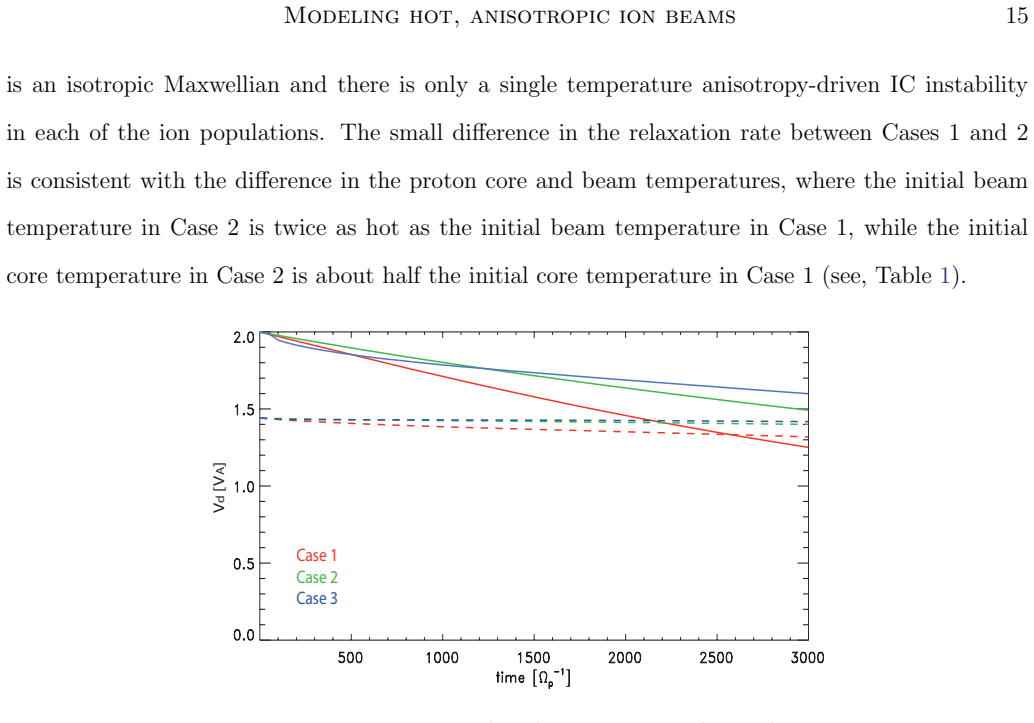
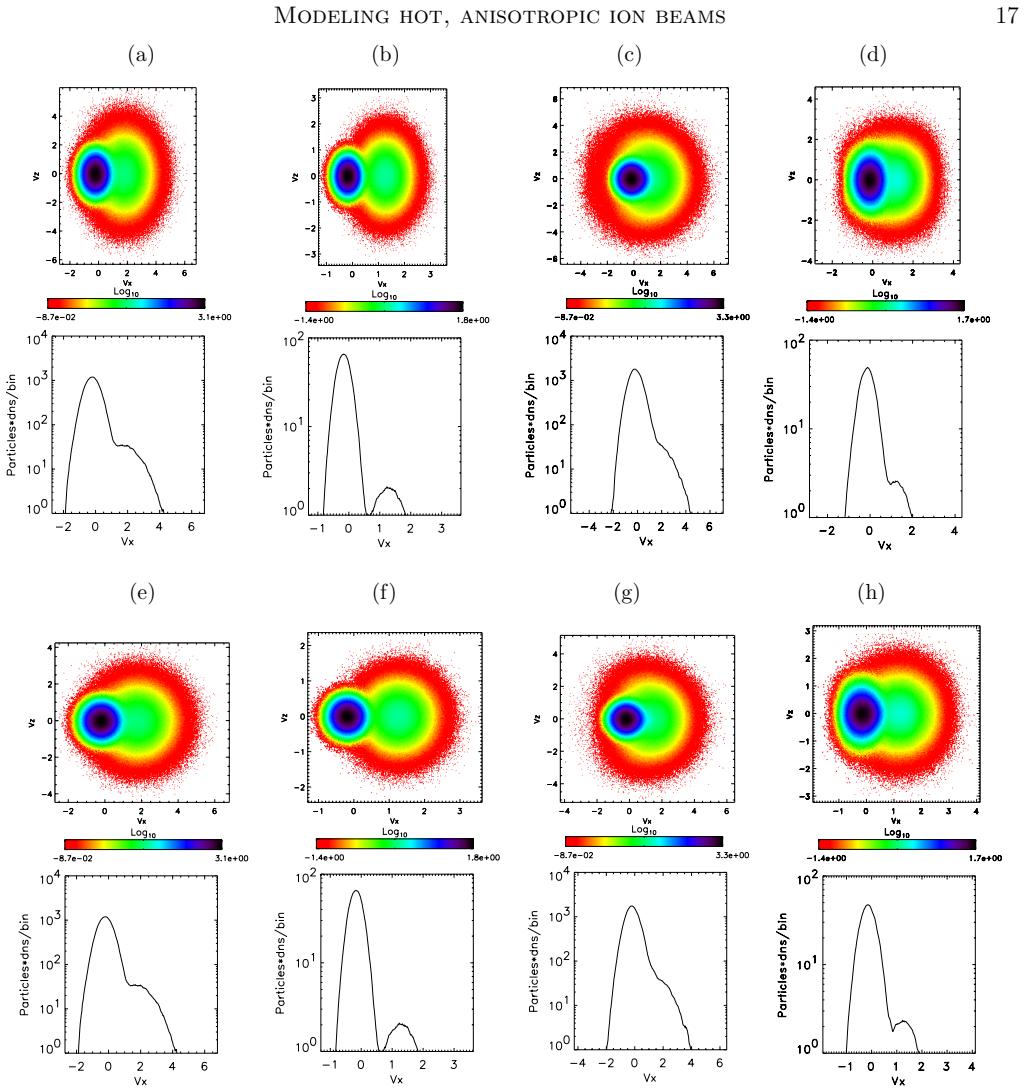
Recent observations of the solar wind ions by the SPAN-I instruments on board the Parker Solar Probe (PSP) spacecraft at solar perihelia (Encounters) 4 and closer find ample evidence of complex anisotropic non-Maxwellian velocity distributions that consist of core, beam, and `hammerhead' (i.e., anisotropic beam) populations. The proton core populations are anisotropic, with T_perp/T||>1, and the beams have super-Alfvenic speed relative to the core (we provide an example from Encounter 17). The alpha-particle population show similar features as the protons. These unstable VDFs are associated with enhanced, right-hand (RH) and left-hand (LH) polarized ion-scale kinetic wave activity, detected by the FIELDS instrument. Motivated by PSP observations, we employ nonlinear hybrid models to investigate the evolution of the anisotropic hot-beam VDFs and model the growth and the nonlinear stage of ion kinetic instabilities in several linearly unstable cases. The models are initialized with ion VDFs motivated by the observational parameters. We find rapidly growing (in terms of proton gyroperiods) combined ion-cyclotron (IC) and magnetosonic (MS) instabilities, which produce LH and RH ion-scale wave spectra, respectively. The modeled ion VDFs in the nonlinear stage of the evolution are qualitatively in agreement with PSP observations of the anisotropic core and `hammerhead' velocity distributions, quantifying the effect of the ion kinetic instabilities on wind plasma heating close to the Sun. We conclude that the wave-particle interactions play an important role in the energy transfer between the magnetic energy (waves) and random particle motion leading to anisotropic solar wind plasma heating.
Editorial analysis
A structured set of objections, weighed in public.
Referee Report
Summary. The paper claims that nonlinear hybrid simulations of the solar wind, initialized with anisotropic hot-beam ion VDFs drawn from PSP SPAN-I observations (e.g., Encounter 17 parameters for core-beam density ratio, super-Alfvénic beam speed, and T_perp/T_parallel ratios), exhibit rapid growth of combined ion-cyclotron (LH) and magnetosonic (RH) instabilities. The nonlinear stage produces ion VDFs that are qualitatively similar to the observed anisotropic core plus hammerhead distributions, thereby quantifying the contribution of wave-particle interactions to anisotropic heating near the Sun.
Significance. If the qualitative agreement can be placed on a quantitative footing, the work would provide a useful bridge between PSP observations of unstable VDFs and the kinetic processes that regulate inner-heliosphere heating. The hybrid approach is a standard tool for ion-scale dynamics, and the initialization from independent measurements avoids direct fitting of the final state. However, the current reliance on visual comparison alone limits the strength of the heating-quantification claim.
major comments (2)
- [Abstract] Abstract: the central claim that the nonlinear-stage VDFs are 'qualitatively in agreement' with PSP observations and thereby 'quantify' the effect of instabilities on heating rests entirely on visual inspection. No quantitative metrics (e.g., Wasserstein distance between VDFs, relative errors in core anisotropy or beam speed, or resolution-convergence tests) are reported, which is load-bearing for the assertion that the simulations demonstrate a causal pathway to the observed features.
- [Model initialization paragraph] Model initialization paragraph: while the initial core-beam parameters are taken from PSP data without post-hoc fitting of the saturated state, the manuscript does not describe control runs initialized with stable or sub-critical anisotropy ratios. Such runs would strengthen the demonstration that the hammerhead morphology emerges specifically from the instability evolution rather than being inherited from the chosen initial conditions.
Simulated Author's Rebuttal
We thank the referee for the constructive comments that highlight opportunities to strengthen the quantitative support for our claims. We address each major comment below and will incorporate revisions to improve the manuscript.
read point-by-point responses
-
Referee: [Abstract] Abstract: the central claim that the nonlinear-stage VDFs are 'qualitatively in agreement' with PSP observations and thereby 'quantify' the effect of instabilities on heating rests entirely on visual inspection. No quantitative metrics (e.g., Wasserstein distance between VDFs, relative errors in core anisotropy or beam speed, or resolution-convergence tests) are reported, which is load-bearing for the assertion that the simulations demonstrate a causal pathway to the observed features.
Authors: We agree that the current reliance on visual comparison alone limits the strength of the heating-quantification claim. In the revised manuscript we will add quantitative metrics, including Wasserstein distances between the simulated nonlinear-stage VDFs and the PSP observations, relative errors on core anisotropy, beam speed, and density ratio, plus resolution-convergence tests for the primary runs. These additions will place the qualitative agreement on a firmer footing while preserving the paper's focus on the instability-driven evolution. revision: yes
-
Referee: [Model initialization paragraph] Model initialization paragraph: while the initial core-beam parameters are taken from PSP data without post-hoc fitting of the saturated state, the manuscript does not describe control runs initialized with stable or sub-critical anisotropy ratios. Such runs would strengthen the demonstration that the hammerhead morphology emerges specifically from the instability evolution rather than being inherited from the chosen initial conditions.
Authors: We acknowledge that explicit control runs would strengthen the demonstration of causality. In the revised manuscript we will include additional hybrid simulations initialized with stable (sub-critical) anisotropy ratios drawn from the same observational parameter space. These runs will show that the hammerhead features do not develop in the absence of the instability, confirming that the morphology arises from the nonlinear wave-particle interactions rather than from the initial conditions alone. revision: yes
Circularity Check
No significant circularity: forward hybrid evolution from independent observational initial conditions
full rationale
The paper initializes nonlinear hybrid simulations using ion VDF parameters taken directly from PSP observations and evolves them under the standard hybrid plasma equations. The reported qualitative agreement in the nonlinear stage arises from the dynamical action of the model (IC and MS instabilities, wave-particle interactions) rather than any redefinition, fitting of final states, or self-citation chain that reduces the result to the inputs. The central claim therefore remains a genuine prediction from the physics, not a tautology.
Axiom & Free-Parameter Ledger
free parameters (1)
- initial core-beam density ratio, beam speed, and T_perp/T_parallel ratios
axioms (1)
- domain assumption Hybrid approximation (kinetic ions, fluid electrons) captures the dominant ion-scale instabilities
Reference graph
Works this paper leans on
-
[1]
Alexandrova, O., Jagarlamudi, V. K., Hellinger, P., et al. 2021, PhRvE, 103, 063202, doi: 10.1103/PhysRevE.103.063202
-
[2]
Araneda, J. A., Marsch, E., & Vi˜ nAs, A. F. 2007, Journal of Geophysical Research (Space Physics), 112, A04104, doi: 10.1029/2006JA011999
-
[3]
Bale, S. D., Kasper, J. C., Howes, G. G., et al. 2009, PhRvL, 103, 211101, doi: 10.1103/PhysRevLett.103.211101
-
[4]
Bale, S. D., Goetz, K., Harvey, P. R., et al. 2016, SSRv, 204, 49, doi: 10.1007/s11214-016-0244-5
-
[5]
McComas, D. J., et al. 2022, ApJL, 926, L1, doi: 10.3847/2041-8213/ac4a5c
-
[6]
Boardsen, S. A., Hospodarsky, G. B., Kletzing, C. A., et al. 2016, Journal of Geophysical Research (Space Physics), 121, 2902, doi: 10.1002/2015JA021844
-
[7]
Bourouaine, S., & Chandran, B. D. G. 2013, The Astrophysical Journal, 774, 96, doi: 10.1088/0004-637X/774/2/96
-
[8]
Bourouaine, S., Verscharen, D., Chandran, B. D. G., Maruca, B. A., & Kasper, J. C. 2013, ApJL, 777, L3, doi: 10.1088/2041-8205/777/1/L3
-
[9]
A., Mallet, A., Huang, J., et al
Bowen, T. A., Mallet, A., Huang, J., et al. 2020, ApJS, 246, 66, doi: 10.3847/1538-4365/ab6c65
-
[10]
Bowen, T. A., Vasko, I. Y., Bale, S. D., et al. 2024a, ApJL, 972, L8, doi: 10.3847/2041-8213/ad6b2e —. 2024b, ApJL, 972, L8, doi: 10.3847/2041-8213/ad6b2e
-
[11]
Bowen, T. A., Bale, S. D., Chandran, B. D. G., et al. 2024c, Nature Astronomy, 8, 482, doi: 10.1038/s41550-023-02186-4
-
[12]
Chen, C. H. K., Leung, L., Boldyrev, S., Maruca, B. A., & Bale, S. D. 2014, Geophys. Res. Lett., 41, 8081, doi: 10.1002/2014GL062009
-
[13]
Chen, C. H. K., Matteini, L., Schekochihin, A. A., et al. 2016, ApJL, 825, L26, doi: 10.3847/2041-8205/825/2/L26
-
[14]
Fox, N. J., Velli, M. C., Bale, S. D., et al. 2016, SSRv, 204, 7, doi: 10.1007/s11214-015-0211-6
-
[15]
Gary, S. P., Yin, L., & Winske, D. 2006, Journal of Geophysical Research (Space Physics), 111, A06105, doi: 10.1029/2005JA011552
-
[16]
P., Yin, L., Winske, D., & Ofman, L
Gary, S. P., Yin, L., Winske, D., & Ofman, L. 2001, J. Geophys. Res., 106, 10715, doi: 10.1029/2000JA000406
-
[17]
P., Yin, L., Winske, D., et al
Gary, S. P., Yin, L., Winske, D., et al. 2003, Journal of Geophysical Research (Space Physics), 108, 1068, doi: 10.1029/2002JA009654
-
[18]
P., Yin, L., Winske, D., & Reisenfeld, D
Gary, S. P., Yin, L., Winske, D., & Reisenfeld, D. B. 2000, Geophys. Res. Lett., 27, 1355, doi: 10.1029/2000GL000019
-
[19]
2006, Journal of Geophysical Research (Space Physics), 111, A01107, doi: 10.1029/2005JA011318
Hellinger, P., & Tr´ avn´ ıˇ cek, P. 2006, Journal of Geophysical Research (Space Physics), 111, A01107, doi: 10.1029/2005JA011318
-
[20]
Kasper, J. C., Lazarus, A. J., & Gary, S. P. 2008, Physical Review Letters, 101, 261103, doi: 10.1103/PhysRevLett.101.261103 Modeling hot, anisotropic ion beams 29
-
[21]
C., Abiad, R., Austin, G., et al
Kasper, J. C., Abiad, R., Austin, G., et al. 2016, SSRv, 204, 131, doi: 10.1007/s11214-015-0206-3
-
[22]
Kasper, J. C., Klein, K. G., Lichko, E., et al. 2021, PhRvL, 127, 255101, doi: 10.1103/PhysRevLett.127.255101
-
[23]
Vech, D., & Kasper, J. C. 2018, PhRvL, 120, 205102, doi: 10.1103/PhysRevLett.120.205102
-
[24]
Klein, K. G., & Howes, G. G. 2015, Phys. Plasma, 22, 032903, doi: 10.1063/1.4914933
-
[25]
Valentini, F. 2020, J. Phys. (Paris), 86, 905860402, doi: 10.1017/S0022377820000689
-
[26]
Stevens, M. L. 2017, J. Geophys. Res., 122, 9815, doi: 10.1002/2017JA024486
-
[27]
Klein, K. G., Verniero, J. L., Alterman, B., et al. 2021, ApJ, 909, 7, doi: 10.3847/1538-4357/abd7a0
-
[28]
Livi, R., Larson, D. E., Kasper, J. C., et al. 2021, Earth and Space Science Open Archive, 20, doi: 10.1002/essoar.10508651.1
-
[29]
Livi, R., Larson, D. E., Kasper, J. C., et al. 2022, ApJ, 938, 138, doi: 10.3847/1538-4357/ac93f5
-
[30]
2021, A&A, 656, A36, doi: 10.1051/0004-6361/202141095
Louarn, P., Fedorov, A., Prech, L., et al. 2021, A&A, 656, A36, doi: 10.1051/0004-6361/202141095
-
[31]
Maneva, Y. G., Ofman, L., & Vi˜ nas, A. 2015, A&A, 578, A85, doi: 10.1051/0004-6361/201424401
-
[32]
Maneva, Y. G., Vi˜ nAs, A. F., & Ofman, L. 2013, Journal of Geophysical Research (Space Physics), 118, 2842, doi: 10.1002/jgra.50363
-
[33]
Markovskii, S. A., & Vasquez, B. J. 2024, ApJ, 966, 1, doi: 10.3847/1538-4357/ad3727
-
[34]
Markovskii, S. A., Vasquez, B. J., & Chandran, B. D. G. 2020, ApJ, 889, 7, doi: 10.3847/1538-4357/ab5af3
-
[35]
Marsch, E. 2006, Living Reviews in Solar Physics, 3, 1, doi: 10.12942/lrsp-2006-1 —. 2012, SSRv, 172, 23, doi: 10.1007/s11214-010-9734-z
-
[37]
Muehlhaeuser, K. H., & Neubauer, F. M. 1982b, J. Geophys. Res., 87, 35, doi: 10.1029/JA087iA01p00035 Martinovi´ c, M. M., & Klein, K. G. 2023, ApJ, 952, 14, doi: 10.3847/1538-4357/acdb79 Martinovi´ c, M. M., Klein, K. G., De Marco, R., et al. 2024, arXiv e-prints, arXiv:2412.04885, doi: 10.48550/arXiv.2412.04885 Martinovi´ c, M. M., Klein, K. G.,ˇDurovcov...
-
[38]
Maruca, B. A., Kasper, J. C., & Gary, S. P. 2012, ApJ, 748, 137, doi: 10.1088/0004-637X/748/2/137
-
[39]
McManus, M. D., Verniero, J., Bale, S. D., et al. 2022, ApJ, 933, 43, doi: 10.3847/1538-4357/ac6ba3
-
[40]
McManus, M. D., Klein, K. G., Bale, S. D., et al. 2024, ApJ, 961, 142, doi: 10.3847/1538-4357/ad05ba
-
[41]
Mostafavi, P., Allen, R. C., McManus, M. D., et al. 2022, The Astrophysical Journal Letters, 926, L38, doi: 10.3847/2041-8213/ac51e1
-
[42]
Mostafavi, P., Allen, R. C., Jagarlamudi, V. K., et al. 2024, A&A, 682, A152, doi: 10.1051/0004-6361/202347134 M¨ uller, D., St. Cyr, O. C., Zouganelis, I., et al. 2020, A&A, 642, A1, doi: 10.1051/0004-6361/202038467
-
[43]
Neugebauer, M. 1976, J. Geophys. Res., 81, 78, doi: 10.1029/JA081i001p00078
-
[44]
Ofman, L. 2010a, J. Geophys. Res., 115, 4108, doi: 10.1029/2009JA015094 —. 2010b, Journal of Geophysical Research (Space Physics), 115, A04108, doi: 10.1029/2009JA015094 —. 2019, SoPh, 294, 51, doi: 10.1007/s11207-019-1440-8
-
[45]
Ofman, L., Boardsen, S. A., Jian, L. K., Verniero, J. L., & Larson, D. 2022, ApJ, 926, 185, doi: 10.3847/1538-4357/ac402c
-
[46]
Ofman, L., & Vi˜ nas, A. F. 2007, J. Geophys. Res., 112, 6104, doi: 10.1029/2006JA012187
-
[47]
Ofman, L., Vi˜ nas, A. F., & Maneva, Y. 2014, Journal of Geophysical Research (Space Physics), 119, 4223, doi: 10.1002/2013JA019590
-
[48]
Ofman, L., Vi˜ nas, A. F., & Moya, P. S. 2011, Annales Geophysicae, 29, 1071, doi: 10.5194/angeo-29-1071-2011
-
[49]
Ofman, L., Vi˜ nas, A. F., & Roberts, D. A. 2017, Journal of Geophysical Research (Space Physics), 122, 5839, doi: 10.1002/2016JA023705
-
[50]
Ofman, L., Boardsen, S. A., Jian, L. K., et al. 2023, ApJ, 954, 109, doi: 10.3847/1538-4357/acea7e
-
[51]
Ozak, N., Ofman, L., & Vi˜ nas, A. F. 2015, ApJ, 799, 77, doi: 10.1088/0004-637X/799/1/77
-
[52]
2024, ApJ, 977, 27, doi: 10.3847/1538-4357/ad79fa
Peng, J., He, J., Duan, D., & Verscharen, D. 2024, ApJ, 977, 27, doi: 10.3847/1538-4357/ad79fa
-
[53]
Pezzini, L., Zhukov, A. N., Bacchini, F., et al. 2024, ApJ, 975, 37, doi: 10.3847/1538-4357/ad7465
-
[54]
1998, ApJ, 500, 978, doi: 10.1086/305770
Quataert, E. 1998, ApJ, 500, 978, doi: 10.1086/305770
-
[55]
E., Matteini, L., Squire, J., et al
Raouafi, N. E., Matteini, L., Squire, J., et al. 2023, SSRv, 219, 8, doi: 10.1007/s11214-023-00952-4
-
[56]
Sadykov, V., Ofman, L., Boardsen, S. A., & Yogesh. 2025, New Astronomy, in prep
work page 2025
-
[57]
Shaaban, S. M., Lazar, M., L´ opez, R. A., Yoon, P. H., & Poedts, S. 2024, A&A, 692, L6, doi: 10.1051/0004-6361/202452205
-
[58]
Shankarappa, N., Klein, K. G., & Martinovi´ c, M. M. 2023, ApJ, 946, 85, doi: 10.3847/1538-4357/acb542 Modeling hot, anisotropic ion beams 31
-
[59]
Shankarappa, N., Klein, K. G., Martinovi´ c, M. M., & Bowen, T. A. 2024, ApJ, 973, 20, doi: 10.3847/1538-4357/ad5f2a
-
[60]
2024, ApJL, 971, L41, doi: 10.3847/2041-8213/ad68fb
Shi, C., Zhao, J., Liu, S., et al. 2024, ApJL, 971, L41, doi: 10.3847/2041-8213/ad68fb
-
[61]
Squire, J., Meyrand, R., & Kunz, M. W. 2023, ApJL, 957, L30, doi: 10.3847/2041-8213/ad0779
-
[62]
Squire, J., Meyrand, R., Kunz, M. W., et al. 2022, Nature Astronomy, 6, 715, doi: 10.1038/s41550-022-01624-z
-
[63]
Vech, D., Klein, K. G., & Kasper, J. C. 2017, The Astrophysical Journal Letters, 850, L11, doi: 10.3847/2041-8213/aa9887
-
[64]
Vech, D., Mallet, A., Klein, K. G., & Kasper, J. C. 2018, ApJL, 855, L27, doi: 10.3847/2041-8213/aab351
-
[65]
Vech, D., Martinovi´ c, M. M., Klein, K. G., et al. 2021, A&A, 650, A10, doi: 10.1051/0004-6361/202039296
-
[66]
Verniero, J. L., Larson, D. E., Livi, R., et al. 2020, ApJS, 248, 5, doi: 10.3847/1538-4365/ab86af
-
[67]
Verniero, J. L., Chandran, B. D. G., Larson, D. E., et al. 2022, ApJ, 924, 112, doi: 10.3847/1538-4357/ac36d5
-
[68]
Verscharen, D., Bourouaine, S., & Chandran, B. D. G. 2013, ApJ, 773, 163, doi: 10.1088/0004-637X/773/2/163
-
[69]
Verscharen, D., Klein, K. G., & Maruca, B. A. 2019, Living Reviews in Solar Physics, 16, 5, doi: 10.1007/s41116-019-0021-0
-
[70]
2011, Journal of Plasma Physics, 77, 693, doi: 10.1017/S0022377811000080
Verscharen, D., & Marsch, E. 2011, Journal of Plasma Physics, 77, 693, doi: 10.1017/S0022377811000080
-
[71]
2012, PhRvE, 86, 027401, doi: 10.1103/PhysRevE.86.027401
Verscharen, D., Marsch, E., Motschmann, U., & M¨ uller, J. 2012, PhRvE, 86, 027401, doi: 10.1103/PhysRevE.86.027401
-
[72]
Walters, J., Klein, K. G., Lichko, E., et al. 2023, ApJ, 955, 97, doi: 10.3847/1538-4357/acf1fa
- [73]
-
[74]
1993, Computer Space Plasma Physics: Simulation Techniques and
Winske, D., & Omidi, N. 1993, Computer Space Plasma Physics: Simulation Techniques and
work page 1993
-
[75]
Woodham, L. D., Horbury, T. S., Matteini, L., et al. 2021, A&A, 650, L1, doi: 10.1051/0004-6361/202039415
-
[76]
2004, Journal of Geophysical Research (Space Physics), 109, A08103, doi: 10.1029/2004JA010501
Xie, H., Ofman, L., & Vi˜ nAs, A. 2004, Journal of Geophysical Research (Space Physics), 109, A08103, doi: 10.1029/2004JA010501
-
[77]
Xiong, Q. Y., Parashar, T. N., Huang, S. Y., et al. 2024, ApJ, 968, 93, doi: 10.3847/1538-4357/ad4643
-
[78]
Yoon, P. H. 2017, Reviews of Modern Plasma Physics, 1, 4, doi: 10.1007/s41614-017-0006-1
-
[79]
H., Lazar, M., Salem, C., et al
Yoon, P. H., Lazar, M., Salem, C., et al. 2024, ApJ, 969, 77, doi: 10.3847/1538-4357/ad47f1
discussion (0)
Sign in with ORCID, Apple, or X to comment. Anyone can read and Pith papers without signing in.